ENERGY (POWER GENERATION)
Presented by
NAME ENROLLMENT
NO.
PRIYA PORE 09119103916
PRIYANKA
CHAUHAN
09219103916
PRIYANKA GOGNA 09319103916
PRIYANKA MITTAL 09419103916
PRIYANKA
SHUKLA
09519103916
PUJA PANDEY 09619103916
HISTORICAL GROWTH
▪ In 1897, the first hydroelectric station heralded the
beginning of power generation in India.
▪ Post-Independence, the share of hydropower
significantly decreased from an all-time high
contribution of 50.6% in 1962-63 to 25.5% in 1996-
97, paving the way to its successor, ‘coal’.
▪ The power sector is currently dominated by coal,
which is complemented by natural gas, nuclear,
hydro and renewable energy (RE) at a ratio of
61:9:2:15:13.
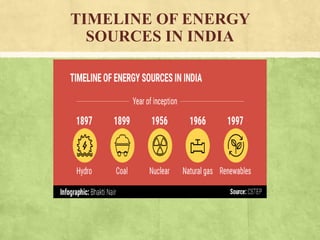
TIMELINE OF ENERGY
SOURCES IN INDIA
▪ A 40 megawatt (MW) nuclear reactor was developed by the research
reactor agreement signed in 1956.
▪ Apsara
▪ Post 1990, RE sources such as solar, wind and biomass took precedence
over other sources.Today over 13% of the electricity is generated from RE.
▪ As of 2015, RE accounted for 34.35GW of installed capacity with the shares
of wind, solar and biomass at 8.6%, 1.3% and 1.6%, respectively.
TIMELINE OF ENERGY
SOURCES IN INDIA
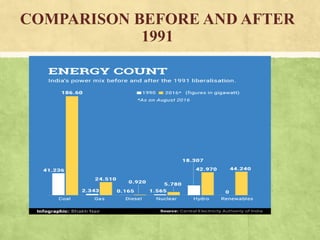
COMPARISON BEFORE AND AFTER
1991
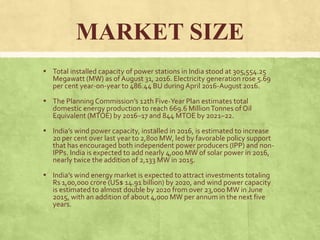
MARKET SIZE
▪ Total installed capacity of power stations in India stood at 305,554.25
Megawatt (MW) as ofAugust 31, 2016. Electricity generation rose 5.69
per cent year-on-year to 486.44 BU during April 2016-August 2016.
▪ The Planning Commission’s 12th Five-Year Plan estimates total
domestic energy production to reach 669.6 MillionTonnes of Oil
Equivalent (MTOE) by 2016–17 and 844 MTOE by 2021–22.
▪ India’s wind power capacity, installed in 2016, is estimated to increase
20 per cent over last year to 2,800 MW, led by favorable policy support
that has encouraged both independent power producers (IPP) and non-
IPPs. India is expected to add nearly 4,000 MW of solar power in 2016,
nearly twice the addition of 2,133 MW in 2015.
▪ India’s wind energy market is expected to attract investments totaling
Rs 1,00,000 crore (US$ 14.91 billion) by 2020, and wind power capacity
is estimated to almost double by 2020 from over 23,000 MW in June
2015, with an addition of about 4,000 MW per annum in the next five
years.
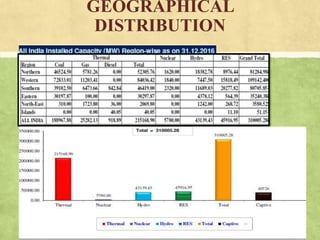
GEOGRAPHICAL
DISTRIBUTION
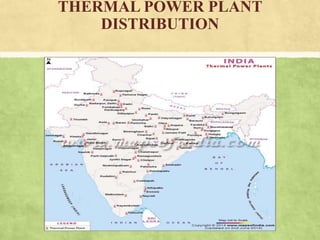
THERMAL POWER PLANT
DISTRIBUTION
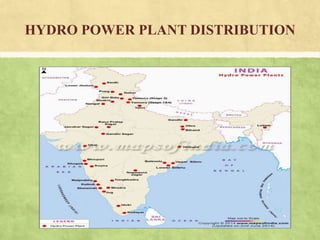
HYDRO POWER PLANT DISTRIBUTION
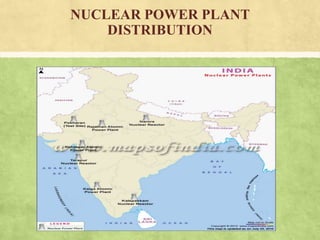
NUCLEAR POWER PLANT
DISTRIBUTION
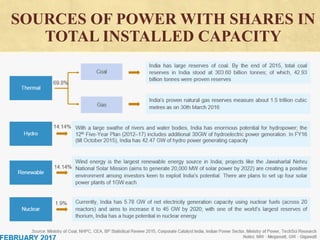
SOURCES OF POWER WITH SHARES IN
TOTAL INSTALLED CAPACITY
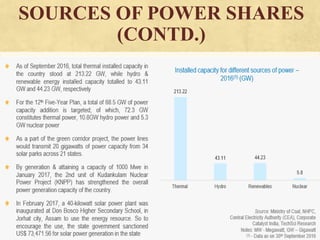
SOURCES OF POWER SHARES
(CONTD.)
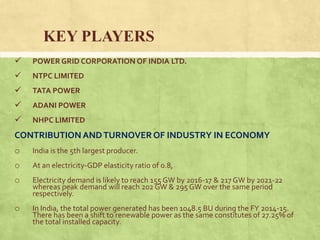
KEY PLAYERS
 POWER GRID CORPORATION OF INDIA LTD.
 NTPC LIMITED
 TATA POWER
 ADANI POWER
 NHPC LIMITED
CONTRIBUTION ANDTURNOVER OF INDUSTRY IN ECONOMY
o India is the 5th largest producer.
o At an electricity-GDP elasticity ratio of 0.8,
o Electricity demand is likely to reach 155 GW by 2016-17 & 217 GW by 2021-22
whereas peak demand will reach 202 GW & 295 GW over the same period
respectively.
o In India, the total power generated has been 1048.5 BU during the FY 2014-15.
There has been a shift to renewable power as the same constitutes of 27.25% of
the total installed capacity.
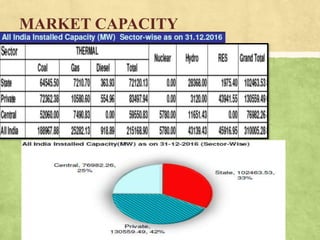
MARKET CAPACITY
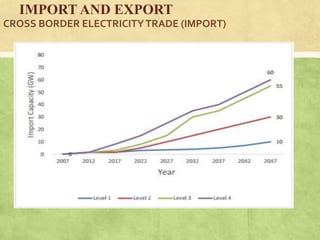
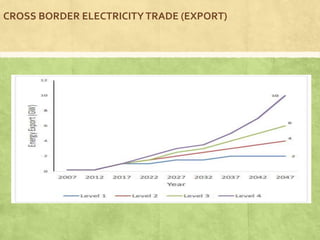
IMPORT AND EXPORT
CROSS BORDER ELECTRICITYTRADE (IMPORT)
CROSS BORDER ELECTRICITYTRADE (EXPORT)
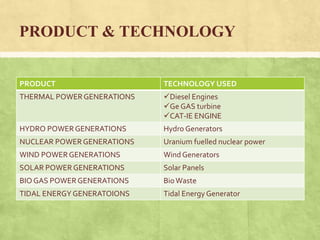
PRODUCT & TECHNOLOGY
PRODUCT TECHNOLOGY USED
THERMAL POWERGENERATIONS Diesel Engines
Ge GAS turbine
CAT-IE ENGINE
HYDRO POWERGENERATIONS Hydro Generators
NUCLEAR POWERGENERATIONS Uranium fuelled nuclear power
WIND POWERGENERATIONS Wind Generators
SOLAR POWER GENERATIONS Solar Panels
BIO GAS POWERGENERATIONS BioWaste
TIDAL ENERGYGENERATOIONS Tidal Energy Generator
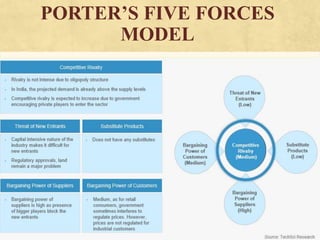
PORTER’S FIVE FORCES
MODEL
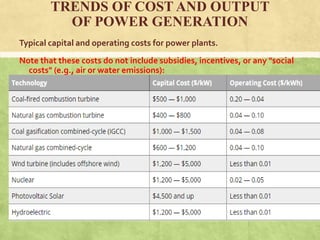
TRENDS OF COST AND OUTPUT
OF POWER GENERATION
Typical capital and operating costs for power plants.
Note that these costs do not include subsidies, incentives, or any "social
costs" (e.g., air or water emissions):
▪ Operating costs for power plants include fuel, labour and maintenance costs.The fixed costs of
power generation are essentially capital costs and land. The capital cost of building central station
generators vary from region to region, largely as a function of labour costs and "regulatory costs," which
include things like obtaining siting permits, environmental approvals, and so on.
Irrespective of technology, all generators share the following characteristics
which influence the plant's operations:
▪ Ramp rate
This variable influences how quickly the plant can increase or decrease power output, in [MW/h] or in [%
of capacity per unit time]
▪ Ramp time
The amount of time it takes from the moment a generator is turned on to the moment it can start
providing energy to the grid at its lower operating limit (see below), in [h]
▪ Capacity
The maximum output of a plant, in [MW]
▪ Lower Operating Limit (LOL)
The minimum amount of power a plant can generate once it is turned on, in [MW]
▪ Minimum RunTime
The shortest amount of time a plant can operate once it is turned on, in [h].
▪ No-Load Cost
The cost of turning the plant on, but keeping it "spinning," ready to increase power output, in [Rs/MWh].
Another way of looking at the no-load cost is the fixed cost of operation; i.e., the cost incurred by the
generator that is independent of the amount of energy generated.
▪ Start-up and Shut-down Costs
These are the costs involved in turning the plant on and off, in [Rs/MWh].
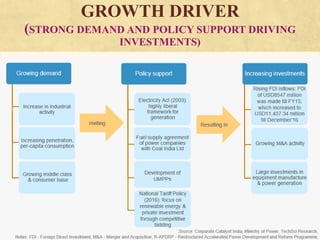
GROWTH DRIVER
(STRONG DEMAND AND POLICY SUPPORT DRIVING
INVESTMENTS)
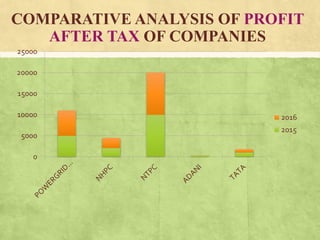
COMPARATIVE ANALYSIS OF PROFIT
AFTER TAX OF COMPANIES
0
5000
10000
15000
20000
25000
2016
2015
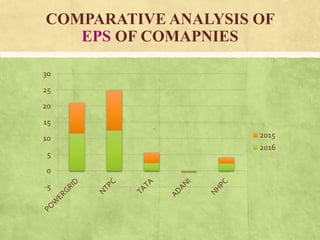
COMPARATIVE ANALYSIS OF
EPS OF COMAPNIES
-5
0
5
10
15
20
25
30
2015
2016
PROTECTION OF ENVIRONMENT
A. Special Purpose Vehicle (SPV) for Afforestation
 A Special PurposeVehicle is being set up jointly by NTPC and other Central Power Sector
Undertakings as a Registered Society to take up afforestation and environmental measures in
order to reduce the carbon dioxide in the atmosphere.The objectives of the Society shall be to:
 Undertake fruitful channelising of investments by members to increase the national forest cover.
 Identify suitable lands for afforestation for power projects of NTPC and other members through
Ministry of Environment and Forests (MOEF) which will coordinate with the State Forest
Departments/District Rural DevelopmentAuthority etc.
 Facilitate quick procurement of forest clearance for the forestland proposed to be acquired by
NTPC and other members for the future projects to be set up.
 Interact with MOEF to score off the necessary compensatory afforestation required for projects of
NTPC and other members, which needs diversion of forestland.
 It is noteworthy that NTPC has already planted over 1.45 crore trees, which is one of the biggest
afforestation efforts in the country. In fact the ambient temperature around the Ramagundam
Station of NTPC has come down by 30 Celsius due to the afforestation done by NTPC as revealed
in a study by the National Remote Sensing Agency (NRSA), Hyderabad.
PROTECTION OF ENVIRONMENT (CONTD.)
B. Fly Ash Utilisation Action Plan
▪ All the coal based power stations put together generate around 90
million tonnes of fly-ash per annum.
▪ The Fly Ash Mission ofTIFAC has made several useful
recommendations for utilisation of fly-ash.
▪ Armed with the findings of the national laboratories that flyash is
superior in strength and durability as compared to conventional
products, the Ministry of Power is taking steps to make the use of
flyash products.
PROTECTION OF ENVIRONMENT
(CONTD.)
C. Clean Development Mechanism (CDM)
▪ To address increasing concerns related to the
environment and to improve environmental
performance, the services ofTata Energy Research
Institute (TERI) have been engaged for providing
consultancy services to the Ministry of Power on CDM.
▪ The terms of reference include project formulation,
base line surveys for each project, negotiations with the
CDM parties, identification of the counterpart CDM
parties from the developed countries, cost of CO2
monitoring and verification of CO2 emission reduction
and supervision of project implementation.
NEW INNOVATIVE DESIGNS AND ENGINEERING
1. By GE
• GE introduced state-of-the-art wind energy technology
• GE’s offering for the Indian market is the 1.7-103 turbine model
• The 1.7-103 turbine, engineered at GE’s John F.WelchTechnology
Centre in Bangalore.
• It uses GE’s evolutionary technology platform and is based on the
success of the 22,000 GE wind turbines installed globally.
NEW INNOVATIONS (CONTD.)
• Works on enhanced control system.
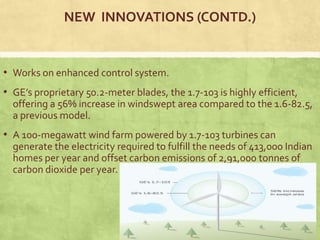
• GE’s proprietary 50.2-meter blades, the 1.7-103 is highly efficient,
offering a 56% increase in windswept area compared to the 1.6-82.5,
a previous model.
• A 100-megawatt wind farm powered by 1.7-103 turbines can
generate the electricity required to fulfill the needs of 413,000 Indian
homes per year and offset carbon emissions of 2,91,000 tonnes of
carbon dioxide per year.
(CONTD.)
2. Micro Hybrid Power plant
• Concept of Micro hybrid Power Plant developed by young engineer in
of Punjab.
• MHPP of 250 kilowatt has been set up through a combination of solar
power, bio-gas and bio-mass technologies to produce electricity.
• Each plant can be set up on a 2.5 acre plot of land with an investment
of approximately Rs. 3 crore and provide employment to about 20
persons, while the per unit cost of power generation would average
around Rs. 4.29.
• Department of Science andTechnology of the Union government had
agreed to provide up to 80 per cent of the funds required to set up
pilot plants.
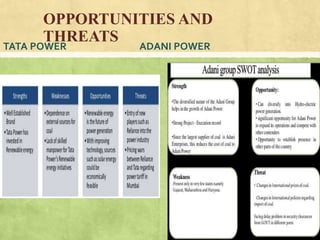
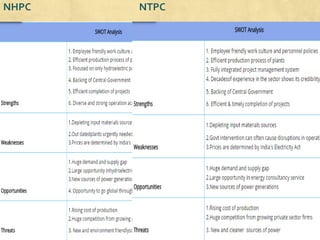
OPPORTUNITIES AND
THREATS
TATA POWER ADANI POWER
NHPC NTPC
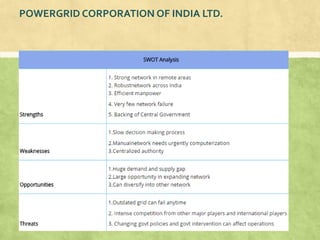
POWERGRID CORPORATION OF INDIA LTD.
GROWTH POTENTIAL
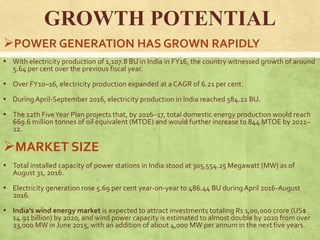
POWER GENERATION HAS GROWN RAPIDLY
▪ With electricity production of 1,107.8 BU in India in FY16, the country witnessed growth of around
5.64 per cent over the previous fiscal year.
▪ Over FY10–16, electricity production expanded at a CAGR of 6.21 per cent.
▪ DuringApril-September 2016, electricity production in India reached 584.22 BU.
▪ The 12th FiveYear Plan projects that, by 2016–17, total domestic energy production would reach
669.6 million tonnes of oil equivalent (MTOE) and would further increase to 844 MTOE by 2021–
22.
MARKET SIZE
▪ Total installed capacity of power stations in India stood at 305,554.25 Megawatt (MW) as of
August 31, 2016.
▪ Electricity generation rose 5.69 per cent year-on-year to 486.44 BU duringApril 2016-August
2016.
▪ India’s wind energy market is expected to attract investments totaling Rs 1,00,000 crore (US$
14.91 billion) by 2020, and wind power capacity is estimated to almost double by 2020 from over
23,000 MW in June 2015, with an addition of about 4,000 MW per annum in the next five years.
GROWTH POTENTIAL
(CONTD.)
ROAD AHEAD
▪ The Indian power sector has an investment potential of Rs 15 trillion
(US$ 223.67 billion) in the next 4–5 years, thereby providing immense
opportunities in power generation, distribution, transmission, and
equipment, according to Union Minister Mr Piyush Goyal.
▪ The government’s immediate goal is to generate two trillion units
(kilowatt hours) of energy by 2019.This means doubling the current
production capacity to provide 24x7 electricity for residential,
industrial, commercial and agriculture use.
▪ The Government of India is taking a number of steps and initiatives like
10-year tax exemption for solar energy projects, etc., in order to achieve
India's ambitious renewable energy targets of adding 175GW of
renewable energy, including addition of 100 GW of solar power, by the
year 2022.
▪ The government has also sought to restart the stalled hydro power
projects and increase the wind energy production target to 60 GW by
2022 from the current 20GW.
CAREER OPPORTUNITIES
A. PUBLIC SECTOR
There are many governmental organizations such as NationalThermal Power Corporation, DamodarValley
Corporation, Power Finance Corporation, PowerGrid Corporation of India Limited, various state level
power generation companies and power suppliers that are providing ample job opportunities to MBA-
power graduates.
B. PRIVATE SECTOR
At present, private sector accounts for 19 percent in the total installed capacity of nation and it is set to increase
about 5 times in next 6 to 7 years. Moreover, in addition to power generation, now private players are
extending financial and technical assistance to government in erecting power plants and other facilities,
financing the ultra mega power projects, involved in power trading, evolving clean energy development
mechanism, supplying the power and managing the energy resources etc.Thus, it goes without saying
that huge job potential exists in rapidly growing private sector for MBA-power graduates.
 An MBA-power graduate can make his/her career in any of the following fields-
1. Power Resource Management
2. Power Generation,Transmission and Distribution
3. Carbon Financing Market
4. PowerTrading
5. Power Project Planning and Financing
6. Clean Energy Development Mechanism
7. Power Sector Laws and Regulations
8. Economics of Power Demand and Supply and Policy Aspects
9. Power Planning
THANK YOU

Power energy generation report

  • 1.
    ENERGY (POWER GENERATION) Presentedby NAME ENROLLMENT NO. PRIYA PORE 09119103916 PRIYANKA CHAUHAN 09219103916 PRIYANKA GOGNA 09319103916 PRIYANKA MITTAL 09419103916 PRIYANKA SHUKLA 09519103916 PUJA PANDEY 09619103916
  • 2.
    HISTORICAL GROWTH ▪ In1897, the first hydroelectric station heralded the beginning of power generation in India. ▪ Post-Independence, the share of hydropower significantly decreased from an all-time high contribution of 50.6% in 1962-63 to 25.5% in 1996- 97, paving the way to its successor, ‘coal’. ▪ The power sector is currently dominated by coal, which is complemented by natural gas, nuclear, hydro and renewable energy (RE) at a ratio of 61:9:2:15:13.
  • 3.
    TIMELINE OF ENERGY SOURCESIN INDIA ▪ A 40 megawatt (MW) nuclear reactor was developed by the research reactor agreement signed in 1956. ▪ Apsara ▪ Post 1990, RE sources such as solar, wind and biomass took precedence over other sources.Today over 13% of the electricity is generated from RE. ▪ As of 2015, RE accounted for 34.35GW of installed capacity with the shares of wind, solar and biomass at 8.6%, 1.3% and 1.6%, respectively.
  • 4.
  • 5.
  • 6.
    MARKET SIZE ▪ Totalinstalled capacity of power stations in India stood at 305,554.25 Megawatt (MW) as ofAugust 31, 2016. Electricity generation rose 5.69 per cent year-on-year to 486.44 BU during April 2016-August 2016. ▪ The Planning Commission’s 12th Five-Year Plan estimates total domestic energy production to reach 669.6 MillionTonnes of Oil Equivalent (MTOE) by 2016–17 and 844 MTOE by 2021–22. ▪ India’s wind power capacity, installed in 2016, is estimated to increase 20 per cent over last year to 2,800 MW, led by favorable policy support that has encouraged both independent power producers (IPP) and non- IPPs. India is expected to add nearly 4,000 MW of solar power in 2016, nearly twice the addition of 2,133 MW in 2015. ▪ India’s wind energy market is expected to attract investments totaling Rs 1,00,000 crore (US$ 14.91 billion) by 2020, and wind power capacity is estimated to almost double by 2020 from over 23,000 MW in June 2015, with an addition of about 4,000 MW per annum in the next five years.
  • 7.
  • 8.
  • 9.
    HYDRO POWER PLANTDISTRIBUTION
  • 10.
  • 11.
    SOURCES OF POWERWITH SHARES IN TOTAL INSTALLED CAPACITY
  • 12.
    SOURCES OF POWERSHARES (CONTD.)
  • 13.
    KEY PLAYERS  POWERGRID CORPORATION OF INDIA LTD.  NTPC LIMITED  TATA POWER  ADANI POWER  NHPC LIMITED CONTRIBUTION ANDTURNOVER OF INDUSTRY IN ECONOMY o India is the 5th largest producer. o At an electricity-GDP elasticity ratio of 0.8, o Electricity demand is likely to reach 155 GW by 2016-17 & 217 GW by 2021-22 whereas peak demand will reach 202 GW & 295 GW over the same period respectively. o In India, the total power generated has been 1048.5 BU during the FY 2014-15. There has been a shift to renewable power as the same constitutes of 27.25% of the total installed capacity.
  • 14.
  • 15.
    IMPORT AND EXPORT CROSSBORDER ELECTRICITYTRADE (IMPORT)
  • 16.
  • 17.
    PRODUCT & TECHNOLOGY PRODUCTTECHNOLOGY USED THERMAL POWERGENERATIONS Diesel Engines Ge GAS turbine CAT-IE ENGINE HYDRO POWERGENERATIONS Hydro Generators NUCLEAR POWERGENERATIONS Uranium fuelled nuclear power WIND POWERGENERATIONS Wind Generators SOLAR POWER GENERATIONS Solar Panels BIO GAS POWERGENERATIONS BioWaste TIDAL ENERGYGENERATOIONS Tidal Energy Generator
  • 18.
  • 19.
    TRENDS OF COSTAND OUTPUT OF POWER GENERATION Typical capital and operating costs for power plants. Note that these costs do not include subsidies, incentives, or any "social costs" (e.g., air or water emissions):
  • 20.
    ▪ Operating costsfor power plants include fuel, labour and maintenance costs.The fixed costs of power generation are essentially capital costs and land. The capital cost of building central station generators vary from region to region, largely as a function of labour costs and "regulatory costs," which include things like obtaining siting permits, environmental approvals, and so on. Irrespective of technology, all generators share the following characteristics which influence the plant's operations: ▪ Ramp rate This variable influences how quickly the plant can increase or decrease power output, in [MW/h] or in [% of capacity per unit time] ▪ Ramp time The amount of time it takes from the moment a generator is turned on to the moment it can start providing energy to the grid at its lower operating limit (see below), in [h] ▪ Capacity The maximum output of a plant, in [MW] ▪ Lower Operating Limit (LOL) The minimum amount of power a plant can generate once it is turned on, in [MW] ▪ Minimum RunTime The shortest amount of time a plant can operate once it is turned on, in [h]. ▪ No-Load Cost The cost of turning the plant on, but keeping it "spinning," ready to increase power output, in [Rs/MWh]. Another way of looking at the no-load cost is the fixed cost of operation; i.e., the cost incurred by the generator that is independent of the amount of energy generated. ▪ Start-up and Shut-down Costs These are the costs involved in turning the plant on and off, in [Rs/MWh].
  • 21.
    GROWTH DRIVER (STRONG DEMANDAND POLICY SUPPORT DRIVING INVESTMENTS)
  • 22.
    COMPARATIVE ANALYSIS OFPROFIT AFTER TAX OF COMPANIES 0 5000 10000 15000 20000 25000 2016 2015
  • 23.
    COMPARATIVE ANALYSIS OF EPSOF COMAPNIES -5 0 5 10 15 20 25 30 2015 2016
  • 24.
    PROTECTION OF ENVIRONMENT A.Special Purpose Vehicle (SPV) for Afforestation  A Special PurposeVehicle is being set up jointly by NTPC and other Central Power Sector Undertakings as a Registered Society to take up afforestation and environmental measures in order to reduce the carbon dioxide in the atmosphere.The objectives of the Society shall be to:  Undertake fruitful channelising of investments by members to increase the national forest cover.  Identify suitable lands for afforestation for power projects of NTPC and other members through Ministry of Environment and Forests (MOEF) which will coordinate with the State Forest Departments/District Rural DevelopmentAuthority etc.  Facilitate quick procurement of forest clearance for the forestland proposed to be acquired by NTPC and other members for the future projects to be set up.  Interact with MOEF to score off the necessary compensatory afforestation required for projects of NTPC and other members, which needs diversion of forestland.  It is noteworthy that NTPC has already planted over 1.45 crore trees, which is one of the biggest afforestation efforts in the country. In fact the ambient temperature around the Ramagundam Station of NTPC has come down by 30 Celsius due to the afforestation done by NTPC as revealed in a study by the National Remote Sensing Agency (NRSA), Hyderabad.
  • 25.
    PROTECTION OF ENVIRONMENT(CONTD.) B. Fly Ash Utilisation Action Plan ▪ All the coal based power stations put together generate around 90 million tonnes of fly-ash per annum. ▪ The Fly Ash Mission ofTIFAC has made several useful recommendations for utilisation of fly-ash. ▪ Armed with the findings of the national laboratories that flyash is superior in strength and durability as compared to conventional products, the Ministry of Power is taking steps to make the use of flyash products.
  • 26.
    PROTECTION OF ENVIRONMENT (CONTD.) C.Clean Development Mechanism (CDM) ▪ To address increasing concerns related to the environment and to improve environmental performance, the services ofTata Energy Research Institute (TERI) have been engaged for providing consultancy services to the Ministry of Power on CDM. ▪ The terms of reference include project formulation, base line surveys for each project, negotiations with the CDM parties, identification of the counterpart CDM parties from the developed countries, cost of CO2 monitoring and verification of CO2 emission reduction and supervision of project implementation.
  • 27.
    NEW INNOVATIVE DESIGNSAND ENGINEERING 1. By GE • GE introduced state-of-the-art wind energy technology • GE’s offering for the Indian market is the 1.7-103 turbine model • The 1.7-103 turbine, engineered at GE’s John F.WelchTechnology Centre in Bangalore. • It uses GE’s evolutionary technology platform and is based on the success of the 22,000 GE wind turbines installed globally.
  • 28.
    NEW INNOVATIONS (CONTD.) •Works on enhanced control system. • GE’s proprietary 50.2-meter blades, the 1.7-103 is highly efficient, offering a 56% increase in windswept area compared to the 1.6-82.5, a previous model. • A 100-megawatt wind farm powered by 1.7-103 turbines can generate the electricity required to fulfill the needs of 413,000 Indian homes per year and offset carbon emissions of 2,91,000 tonnes of carbon dioxide per year.
  • 29.
    (CONTD.) 2. Micro HybridPower plant • Concept of Micro hybrid Power Plant developed by young engineer in of Punjab. • MHPP of 250 kilowatt has been set up through a combination of solar power, bio-gas and bio-mass technologies to produce electricity. • Each plant can be set up on a 2.5 acre plot of land with an investment of approximately Rs. 3 crore and provide employment to about 20 persons, while the per unit cost of power generation would average around Rs. 4.29. • Department of Science andTechnology of the Union government had agreed to provide up to 80 per cent of the funds required to set up pilot plants.
  • 30.
  • 31.
  • 32.
  • 33.
    GROWTH POTENTIAL POWER GENERATIONHAS GROWN RAPIDLY ▪ With electricity production of 1,107.8 BU in India in FY16, the country witnessed growth of around 5.64 per cent over the previous fiscal year. ▪ Over FY10–16, electricity production expanded at a CAGR of 6.21 per cent. ▪ DuringApril-September 2016, electricity production in India reached 584.22 BU. ▪ The 12th FiveYear Plan projects that, by 2016–17, total domestic energy production would reach 669.6 million tonnes of oil equivalent (MTOE) and would further increase to 844 MTOE by 2021– 22. MARKET SIZE ▪ Total installed capacity of power stations in India stood at 305,554.25 Megawatt (MW) as of August 31, 2016. ▪ Electricity generation rose 5.69 per cent year-on-year to 486.44 BU duringApril 2016-August 2016. ▪ India’s wind energy market is expected to attract investments totaling Rs 1,00,000 crore (US$ 14.91 billion) by 2020, and wind power capacity is estimated to almost double by 2020 from over 23,000 MW in June 2015, with an addition of about 4,000 MW per annum in the next five years.
  • 34.
    GROWTH POTENTIAL (CONTD.) ROAD AHEAD ▪The Indian power sector has an investment potential of Rs 15 trillion (US$ 223.67 billion) in the next 4–5 years, thereby providing immense opportunities in power generation, distribution, transmission, and equipment, according to Union Minister Mr Piyush Goyal. ▪ The government’s immediate goal is to generate two trillion units (kilowatt hours) of energy by 2019.This means doubling the current production capacity to provide 24x7 electricity for residential, industrial, commercial and agriculture use. ▪ The Government of India is taking a number of steps and initiatives like 10-year tax exemption for solar energy projects, etc., in order to achieve India's ambitious renewable energy targets of adding 175GW of renewable energy, including addition of 100 GW of solar power, by the year 2022. ▪ The government has also sought to restart the stalled hydro power projects and increase the wind energy production target to 60 GW by 2022 from the current 20GW.
  • 35.
    CAREER OPPORTUNITIES A. PUBLICSECTOR There are many governmental organizations such as NationalThermal Power Corporation, DamodarValley Corporation, Power Finance Corporation, PowerGrid Corporation of India Limited, various state level power generation companies and power suppliers that are providing ample job opportunities to MBA- power graduates. B. PRIVATE SECTOR At present, private sector accounts for 19 percent in the total installed capacity of nation and it is set to increase about 5 times in next 6 to 7 years. Moreover, in addition to power generation, now private players are extending financial and technical assistance to government in erecting power plants and other facilities, financing the ultra mega power projects, involved in power trading, evolving clean energy development mechanism, supplying the power and managing the energy resources etc.Thus, it goes without saying that huge job potential exists in rapidly growing private sector for MBA-power graduates.  An MBA-power graduate can make his/her career in any of the following fields- 1. Power Resource Management 2. Power Generation,Transmission and Distribution 3. Carbon Financing Market 4. PowerTrading 5. Power Project Planning and Financing 6. Clean Energy Development Mechanism 7. Power Sector Laws and Regulations 8. Economics of Power Demand and Supply and Policy Aspects 9. Power Planning
  • 36.

Editor's Notes

  • #23 Higher net profit after tax indicates that company is efficient in their operations & generates higher revenues as compared to other firms operating in the same sector. NTPC has higher net profit after tax which is the indication of the efficiency of their operation.