Company Profile
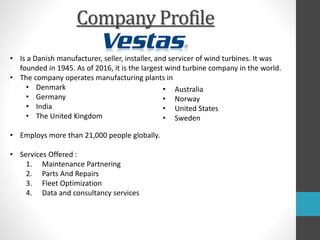
• Is a Danish manufacturer, seller, installer, and servicer of wind turbines. It was
founded in 1945. As of 2016, it is the largest wind turbine company in the world.
• The company operates manufacturing plants in
• Denmark
• Germany
• India
• The United Kingdom
• Employs more than 21,000 people globally.
• Services Offered :
1. Maintenance Partnering
2. Parts And Repairs
3. Fleet Optimization
4. Data and consultancy services
• Australia
• Norway
• United States
• Sweden
Vision And Mission
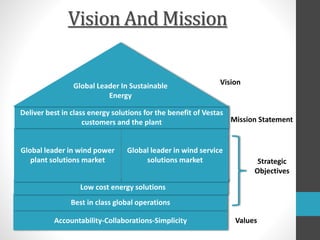
Accountability-Collaborations-Simplicity
Best in class global operations
Low cost energy solutions
Global leader in wind power
plant solutions market
Global leader in wind service
solutions market
Deliver best in class energy solutions for the benefit of Vestas
customers and the plant
Global Leader In Sustainable
Energy
Values
Strategic
Objectives
Mission Statement
Vision
Porter’s Five Forces Model
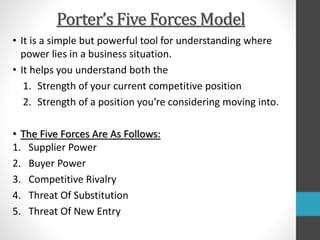
• It is a simple but powerful tool for understanding where
power lies in a business situation.
• It helps you understand both the
1. Strength of your current competitive position
2. Strength of a position you're considering moving into.
• The Five Forces Are As Follows:
1. Supplier Power
2. Buyer Power
3. Competitive Rivalry
4. Threat Of Substitution
5. Threat Of New Entry
Nature Of Strategy
• Five Forces Model is a competitive strategy.
• A competitive strategy is a long-term action plan that is devised
to help a company gain a competitive advantage over its rival.
• It is aimed at creating defensive position in an industry and
generating a superior ROI (Return on Investment).
• Such type of strategies play a very important role when industry
is very competitive and consumers are provided with almost
similar products.
• Why Five Forces Model Is Considered As Competitive Strategy ?
It is because the model takes into consideration the entire
ecosystem of the specified industry and the factors that
influence key managerial decisions , vision and mission of the
company.
Analysis Of Strategy
1. Threat Of Entry:
• Barriers in the wind turbine industry are highly affected by the
expensive start up costs related to setting up production facilities,
and investing in R&D. The costs for a utility scale wind turbine range
from about $1.3 million to $2.2 million per MW and most of the
commercial-scale turbines installed today are 2 MW in size and cost
roughly $3-$4 million.
• Big companies like Vestas can acquire technology through licensing
from other foreign companies that are not present in untapped
market.
• A large demand means potential profit for established companies. To
draw a conclusion , China’s population growth has made the wind
industry explode in terms of new entrants.
• At end of 2015 , about 60 wind energy companies were located in the
China market out of the entire Asian market.
• Since, the U.S Market is mostly dominated by companies like GE ,
Siemens and Gamesa , it will be easier for Vestas to continue with
expansion plans in the Asian market as they already have huge share
in it because of China and India.
• The Power Of Suppliers:
• In the wind turbine industry it is crucial to have a security in
supply of components, since both profits and the reputation of
the company are at stake. The best established companies are
those who can control their suppliers either by buying them
(vertical integration) or by making long term commitments.
• Long‐term commitments are about mutual trust, and the loyalty
between supplier and buyer regarding that each part will comply
with the contract is important. Long‐term commitments also
include that the supplier is able to deliver wanted components
and execute projects in time.
• Having suppliers in house , does not only ensure cost reduction ,
better quality control and accuracy on delivery , it also makes
sure that other companies do not copy the special technology
and design.
• Having analyzed the supplier power , this leaves Vestas
characterized as a company that has to focus on vertical
integration for suppliers and it has already implemented it.
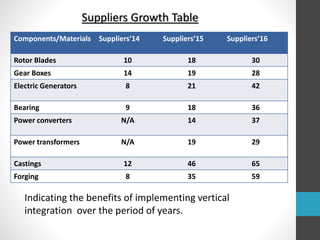
Components/Materials Suppliers’14 Suppliers’15 Suppliers’16
Rotor Blades 10 18 30
Gear Boxes 14 19 28
Electric Generators 8 21 42
Bearing 9 18 36
Power converters N/A 14 37
Power transformers N/A 19 29
Castings 12 46 65
Forging 8 35 59
Suppliers Growth Table
Indicating the benefits of implementing vertical
integration over the period of years.
3. The Power Of Buyers:
• Being able to fulfill specific requests and conditions has been
crucial for the amount of orders that Vestas get, and it is a
competitive advantage for Vestas when they are competing in the
market for new orders.
• Remarkably enough ,Vestas has not lowered their prices (Home or
Farm Scale Wind Turbines under 100 kilowatts cost roughly
$3,000 to $8,000 per kilowatt of capacity), by considering the
aggressive competition. Their strategy has been to convince the
customers that the products they deliver of the best quality and
thereby is also worth the money.
• It is not only the products that must be perfect but the
communication and dialogue with the customers is a key factor
for Vestas for providing the best service and having the happiest
customers.
4. The Threat Of Substitutes:
• The substitutes for wind power are fuel and technologies, which
can be exploited to generate electricity. The dominant fuel and
technology types for generating electricity are the following:
• Coal
• Gas
• Nuclear
• Hydro energy
• Bio fuel
• Solar energy
• Wind energy is considered to be the cheapest alternative
available when gas is not taken into consideration.
• Another issue, is one that affects the entire energy sector; the oil
price. Since the price on oil is correlated with energy, price
dumping by OPEC will generate costs of which wind power no
longer will be competitive. This was the case when oil prices
plunged in the summer of 2008, which lead to a decrease of 91%
in green energy investment in the U.S. for the first quarter in
2009.
5. Threat Of Competitive Rivalry
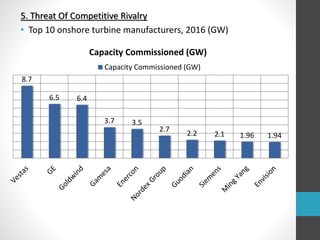
• Top 10 onshore turbine manufacturers, 2016 (GW)
8.7
6.5 6.4
3.7 3.5
2.7
2.2 2.1 1.96 1.94
Capacity Commissioned (GW)
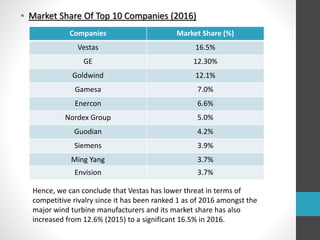
• Market Share Of Top 10 Companies (2016)
Companies Market Share (%)
Vestas 16.5%
GE 12.30%
Goldwind 12.1%
Gamesa 7.0%
Enercon 6.6%
Nordex Group 5.0%
Guodian 4.2%
Siemens 3.9%
Ming Yang 3.7%
Envision 3.7%
Hence, we can conclude that Vestas has lower threat in terms of
competitive rivalry since it has been ranked 1 as of 2016 amongst the
major wind turbine manufacturers and its market share has also
increased from 12.6% (2015) to a significant 16.5% in 2016.
Outcome Of Strategy
• The threat of entrants is fairly low in the U.S. and will decline in Asian
market as the demand will be met.
• Since most of Vestas’ components and parts are produced in‐house the
power of suppliers is reduced.
• Vestas has to apply CRM and good service in order to retain and keep
customers for further sales and profit generation.
• The threat of substitutes is twofold. This places wind energy in a unique
position since no other renewable energy has the exact same traits.
• Other fossil fuels can have a great effect on the attractiveness of wind
power, because if oil prices fall, it will make Vestas products unattractive
however , usage of oil and other fuels would to lead to increased
emission , Vestas still has scope to tap that opportunity and trade on
steady price level.
• Vestas is leading amongst the top 10 companies like GE , Goldwind and
Siemens in terms of manufacturing of wind turbines.
Present Scenario
• To build on Vestas’ momentum in APC and align with the
updated corporate strategy, the company plans to re-organize
the current SBU APC into two new SBUs for the month of April
1, 2017. The two SBUs will be called SBU CHI, covering China
and Mongolia, and SBU ASP covering all other Asia-Pacific
countries, including India.
• With the introduction of two SBUs, each dedicated to a more
specific regional area of responsibility, the company is investing
more resources in the region and trying to create a more agile
and customer centric organization.
• The aim is to achieve a deeper market understanding and
ultimately increase the market share.
• Vestas Awarded Mammoth 1 GW Wind Turbine Order In
Norway.
1. Fosen Vind DA, a joint venture company owned
by Statkraft, awarded Vestas its largest ever wind
turbine order this past week, for 1 GW of wind
turbines.
2. Vestas will supply 278 wind turbines in total
3. Going to be installed across six different wind parks
being developed in Norway, making it Europe’s
largest onshore wind project to date.
4. Total investment in the wind farms amounts to
approximately €1.1 billion, and will result in about 3.4
TWh of electricity generated annually.
THANK YOU
Project By:
Isha Desai
Shweta Chavan
Rucha Walimbe
Kompal Kaur

Vestas - Five Forces Analysis

  • 2.
    Company Profile • Isa Danish manufacturer, seller, installer, and servicer of wind turbines. It was founded in 1945. As of 2016, it is the largest wind turbine company in the world. • The company operates manufacturing plants in • Denmark • Germany • India • The United Kingdom • Employs more than 21,000 people globally. • Services Offered : 1. Maintenance Partnering 2. Parts And Repairs 3. Fleet Optimization 4. Data and consultancy services • Australia • Norway • United States • Sweden
  • 3.
    Vision And Mission Accountability-Collaborations-Simplicity Bestin class global operations Low cost energy solutions Global leader in wind power plant solutions market Global leader in wind service solutions market Deliver best in class energy solutions for the benefit of Vestas customers and the plant Global Leader In Sustainable Energy Values Strategic Objectives Mission Statement Vision
  • 4.
    Porter’s Five ForcesModel • It is a simple but powerful tool for understanding where power lies in a business situation. • It helps you understand both the 1. Strength of your current competitive position 2. Strength of a position you're considering moving into. • The Five Forces Are As Follows: 1. Supplier Power 2. Buyer Power 3. Competitive Rivalry 4. Threat Of Substitution 5. Threat Of New Entry
  • 5.
    Nature Of Strategy •Five Forces Model is a competitive strategy. • A competitive strategy is a long-term action plan that is devised to help a company gain a competitive advantage over its rival. • It is aimed at creating defensive position in an industry and generating a superior ROI (Return on Investment). • Such type of strategies play a very important role when industry is very competitive and consumers are provided with almost similar products. • Why Five Forces Model Is Considered As Competitive Strategy ? It is because the model takes into consideration the entire ecosystem of the specified industry and the factors that influence key managerial decisions , vision and mission of the company.
  • 6.
    Analysis Of Strategy 1.Threat Of Entry: • Barriers in the wind turbine industry are highly affected by the expensive start up costs related to setting up production facilities, and investing in R&D. The costs for a utility scale wind turbine range from about $1.3 million to $2.2 million per MW and most of the commercial-scale turbines installed today are 2 MW in size and cost roughly $3-$4 million. • Big companies like Vestas can acquire technology through licensing from other foreign companies that are not present in untapped market. • A large demand means potential profit for established companies. To draw a conclusion , China’s population growth has made the wind industry explode in terms of new entrants. • At end of 2015 , about 60 wind energy companies were located in the China market out of the entire Asian market. • Since, the U.S Market is mostly dominated by companies like GE , Siemens and Gamesa , it will be easier for Vestas to continue with expansion plans in the Asian market as they already have huge share in it because of China and India.
  • 7.
    • The PowerOf Suppliers: • In the wind turbine industry it is crucial to have a security in supply of components, since both profits and the reputation of the company are at stake. The best established companies are those who can control their suppliers either by buying them (vertical integration) or by making long term commitments. • Long‐term commitments are about mutual trust, and the loyalty between supplier and buyer regarding that each part will comply with the contract is important. Long‐term commitments also include that the supplier is able to deliver wanted components and execute projects in time. • Having suppliers in house , does not only ensure cost reduction , better quality control and accuracy on delivery , it also makes sure that other companies do not copy the special technology and design. • Having analyzed the supplier power , this leaves Vestas characterized as a company that has to focus on vertical integration for suppliers and it has already implemented it.
  • 8.
    Components/Materials Suppliers’14 Suppliers’15Suppliers’16 Rotor Blades 10 18 30 Gear Boxes 14 19 28 Electric Generators 8 21 42 Bearing 9 18 36 Power converters N/A 14 37 Power transformers N/A 19 29 Castings 12 46 65 Forging 8 35 59 Suppliers Growth Table Indicating the benefits of implementing vertical integration over the period of years.
  • 9.
    3. The PowerOf Buyers: • Being able to fulfill specific requests and conditions has been crucial for the amount of orders that Vestas get, and it is a competitive advantage for Vestas when they are competing in the market for new orders. • Remarkably enough ,Vestas has not lowered their prices (Home or Farm Scale Wind Turbines under 100 kilowatts cost roughly $3,000 to $8,000 per kilowatt of capacity), by considering the aggressive competition. Their strategy has been to convince the customers that the products they deliver of the best quality and thereby is also worth the money. • It is not only the products that must be perfect but the communication and dialogue with the customers is a key factor for Vestas for providing the best service and having the happiest customers.
  • 10.
    4. The ThreatOf Substitutes: • The substitutes for wind power are fuel and technologies, which can be exploited to generate electricity. The dominant fuel and technology types for generating electricity are the following: • Coal • Gas • Nuclear • Hydro energy • Bio fuel • Solar energy • Wind energy is considered to be the cheapest alternative available when gas is not taken into consideration. • Another issue, is one that affects the entire energy sector; the oil price. Since the price on oil is correlated with energy, price dumping by OPEC will generate costs of which wind power no longer will be competitive. This was the case when oil prices plunged in the summer of 2008, which lead to a decrease of 91% in green energy investment in the U.S. for the first quarter in 2009.
  • 11.
    5. Threat OfCompetitive Rivalry • Top 10 onshore turbine manufacturers, 2016 (GW) 8.7 6.5 6.4 3.7 3.5 2.7 2.2 2.1 1.96 1.94 Capacity Commissioned (GW) Capacity Commissioned (GW)
  • 12.
    • Market ShareOf Top 10 Companies (2016) Companies Market Share (%) Vestas 16.5% GE 12.30% Goldwind 12.1% Gamesa 7.0% Enercon 6.6% Nordex Group 5.0% Guodian 4.2% Siemens 3.9% Ming Yang 3.7% Envision 3.7% Hence, we can conclude that Vestas has lower threat in terms of competitive rivalry since it has been ranked 1 as of 2016 amongst the major wind turbine manufacturers and its market share has also increased from 12.6% (2015) to a significant 16.5% in 2016.
  • 13.
    Outcome Of Strategy •The threat of entrants is fairly low in the U.S. and will decline in Asian market as the demand will be met. • Since most of Vestas’ components and parts are produced in‐house the power of suppliers is reduced. • Vestas has to apply CRM and good service in order to retain and keep customers for further sales and profit generation. • The threat of substitutes is twofold. This places wind energy in a unique position since no other renewable energy has the exact same traits. • Other fossil fuels can have a great effect on the attractiveness of wind power, because if oil prices fall, it will make Vestas products unattractive however , usage of oil and other fuels would to lead to increased emission , Vestas still has scope to tap that opportunity and trade on steady price level. • Vestas is leading amongst the top 10 companies like GE , Goldwind and Siemens in terms of manufacturing of wind turbines.
  • 14.
    Present Scenario • Tobuild on Vestas’ momentum in APC and align with the updated corporate strategy, the company plans to re-organize the current SBU APC into two new SBUs for the month of April 1, 2017. The two SBUs will be called SBU CHI, covering China and Mongolia, and SBU ASP covering all other Asia-Pacific countries, including India. • With the introduction of two SBUs, each dedicated to a more specific regional area of responsibility, the company is investing more resources in the region and trying to create a more agile and customer centric organization. • The aim is to achieve a deeper market understanding and ultimately increase the market share.
  • 15.
    • Vestas AwardedMammoth 1 GW Wind Turbine Order In Norway. 1. Fosen Vind DA, a joint venture company owned by Statkraft, awarded Vestas its largest ever wind turbine order this past week, for 1 GW of wind turbines. 2. Vestas will supply 278 wind turbines in total 3. Going to be installed across six different wind parks being developed in Norway, making it Europe’s largest onshore wind project to date. 4. Total investment in the wind farms amounts to approximately €1.1 billion, and will result in about 3.4 TWh of electricity generated annually.
  • 16.
    THANK YOU Project By: IshaDesai Shweta Chavan Rucha Walimbe Kompal Kaur