WimbA Classroom, 02/09/10Dr Bex Lewis
Wimba Classroom: The SessionUnderstand the basic functionality offered by Classroom (hand-raise, emoticons, chat)Have experienced time as both a participant and a tutor in the Classroom (including breakout rooms and polling)Uploaded a PowerPoint presentation to the eBoard, experienced ‘app-sharing’Tweaking ‘settings’, including providing a URL to allow external participants to enter the conversationArchiving a session, and accessing that archiveClassroom Etiquette
Do you have?USB headset with integrated microphone?Module on the Learning Network in which you can practice?
The Big Picture: Why E-tools?The tangible benefits identified through the case studies are wide-ranging but can be summarised under the following broad headings:Cost Savings/Resource EfficiencyRecruitment and RetentionSkills and EmploymentStudent AchievementInclusionWidening Participation and Social EqualityOther Benefitshttp://www.jiscinfonet.ac.uk/case-studies/tangible/tb-briefing-paper.pdf
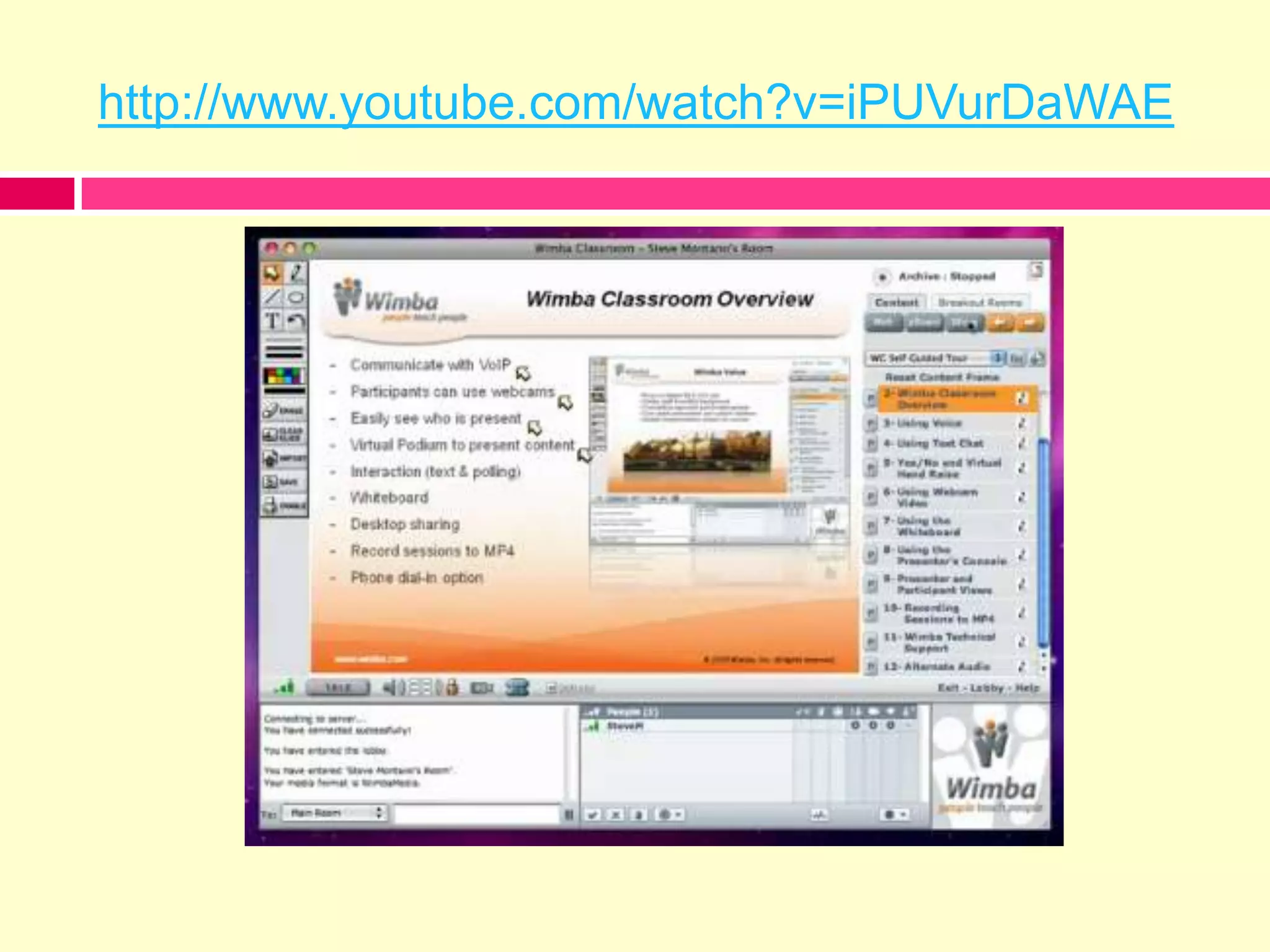
http://www.youtube.com/watch?v=iPUVurDaWAE
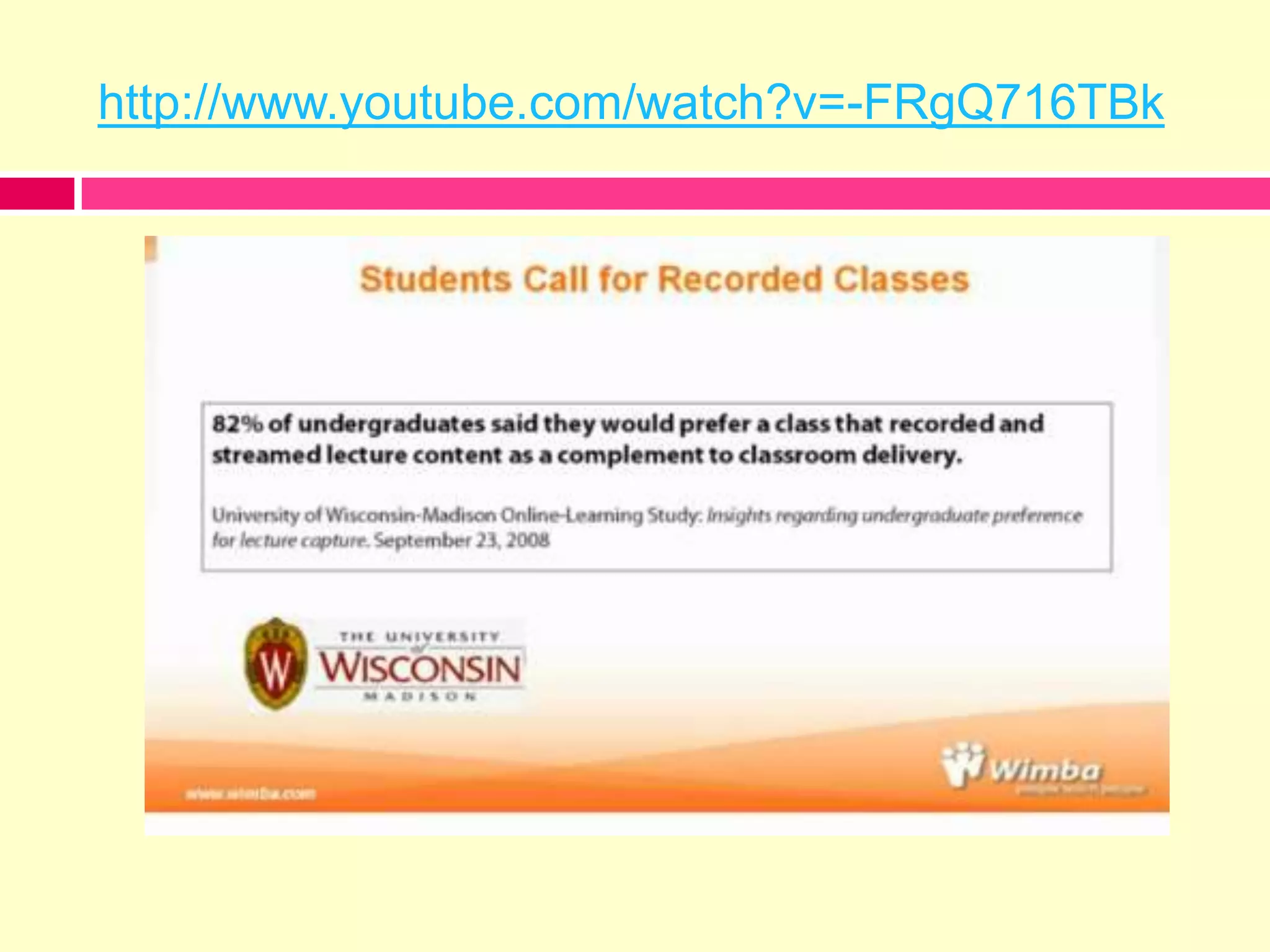
http://www.youtube.com/watch?v=-FRgQ716TBk
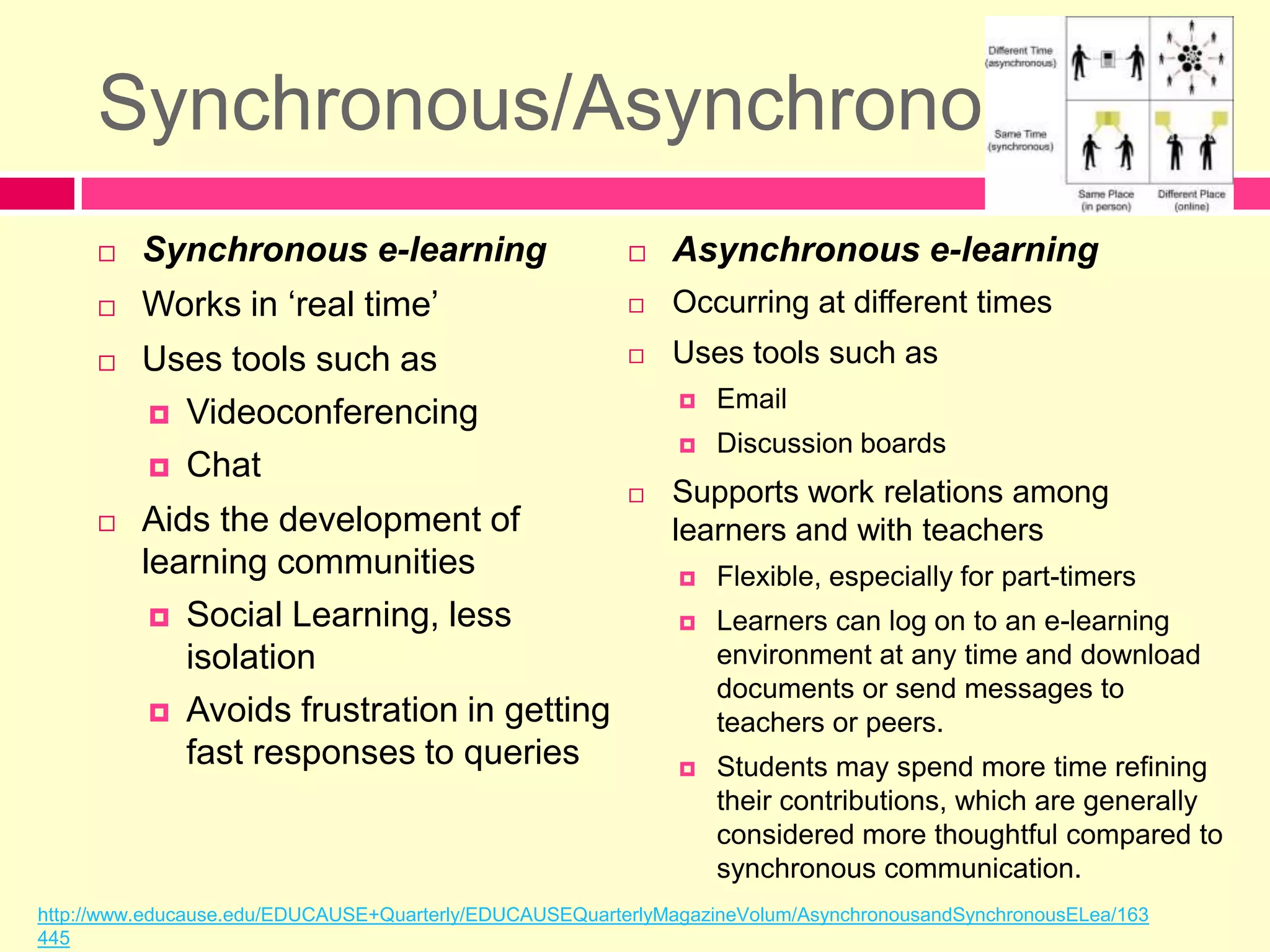
Synchronous/AsynchronousSynchronous e-learningWorks in ‘real time’Uses tools such asVideoconferencing ChatAids the development of learning communitiesSocial Learning, less isolationAvoids frustration in getting fast responses to queriesAsynchronous e-learningOccurring at different timesUses tools such asEmailDiscussion boardsSupports work relations among learners and with teachersFlexible, especially for part-timersLearners can log on to an e-learning environment at any time and download documents or send messages to teachers or peers.Students may spend more time refining their contributions, which are generally considered more thoughtful compared to synchronous communication.http://www.educause.edu/EDUCAUSE+Quarterly/EDUCAUSEQuarterlyMagazineVolum/AsynchronousandSynchronousELea/163445Image: http://www.kollewin.com/EX/09-15-11/synchronous-vs-asynchronous-collaboration-by-Ramius.gif
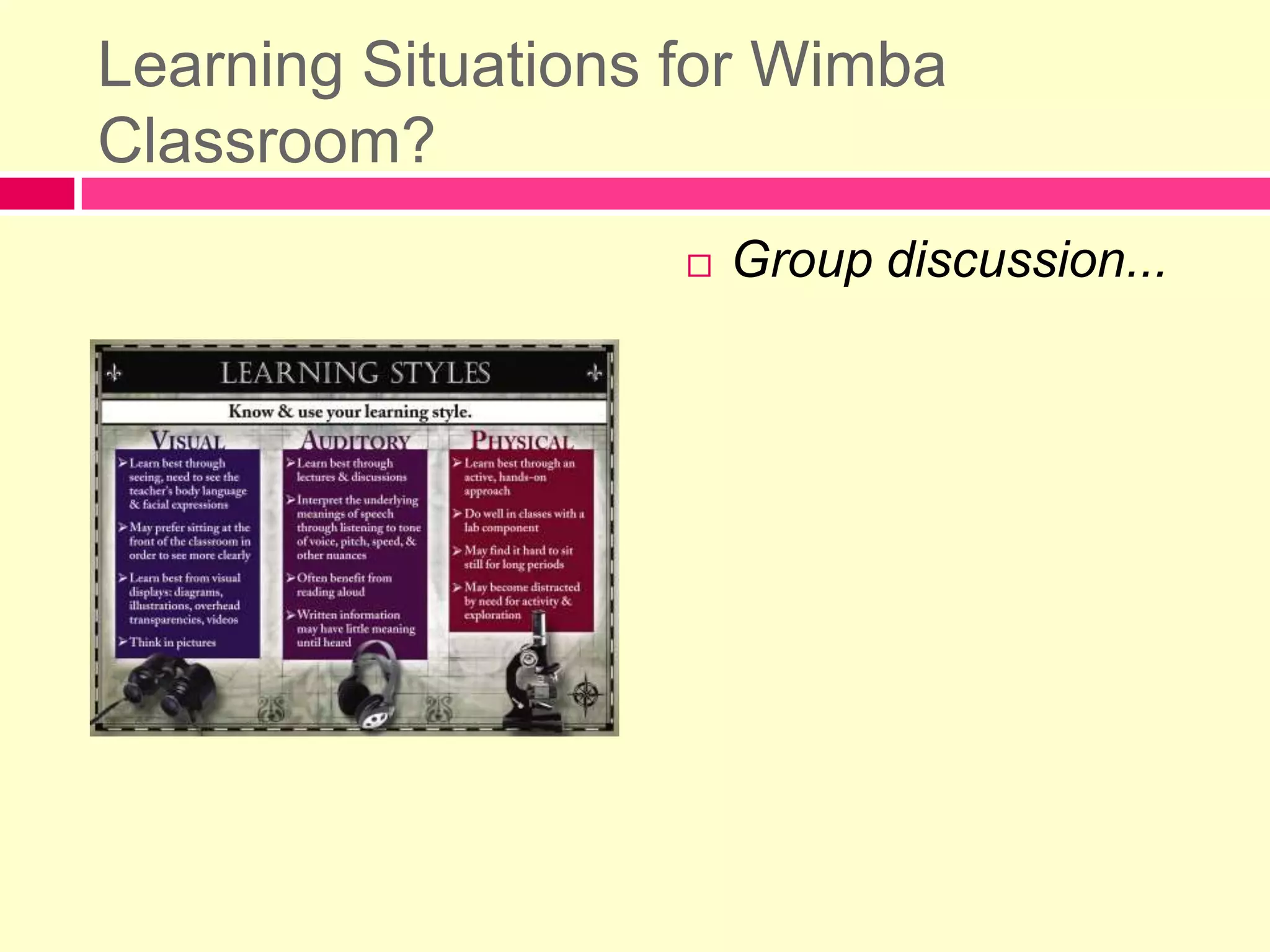
Learning Situations for Wimba Classroom?Group discussion...
Wimba Setup Wizard Should only need running once per computer.
 Recommend: running the day before a session if possible
Run again if experiencing technical difficulties or have installed new software/ hardware on machine.* Most audio problems on campus seem to be caused by a conflict between sound cards/jack headsets. The Media Services counter sells USB headsets for £7.20 which seem to solve any issues we’ve had!
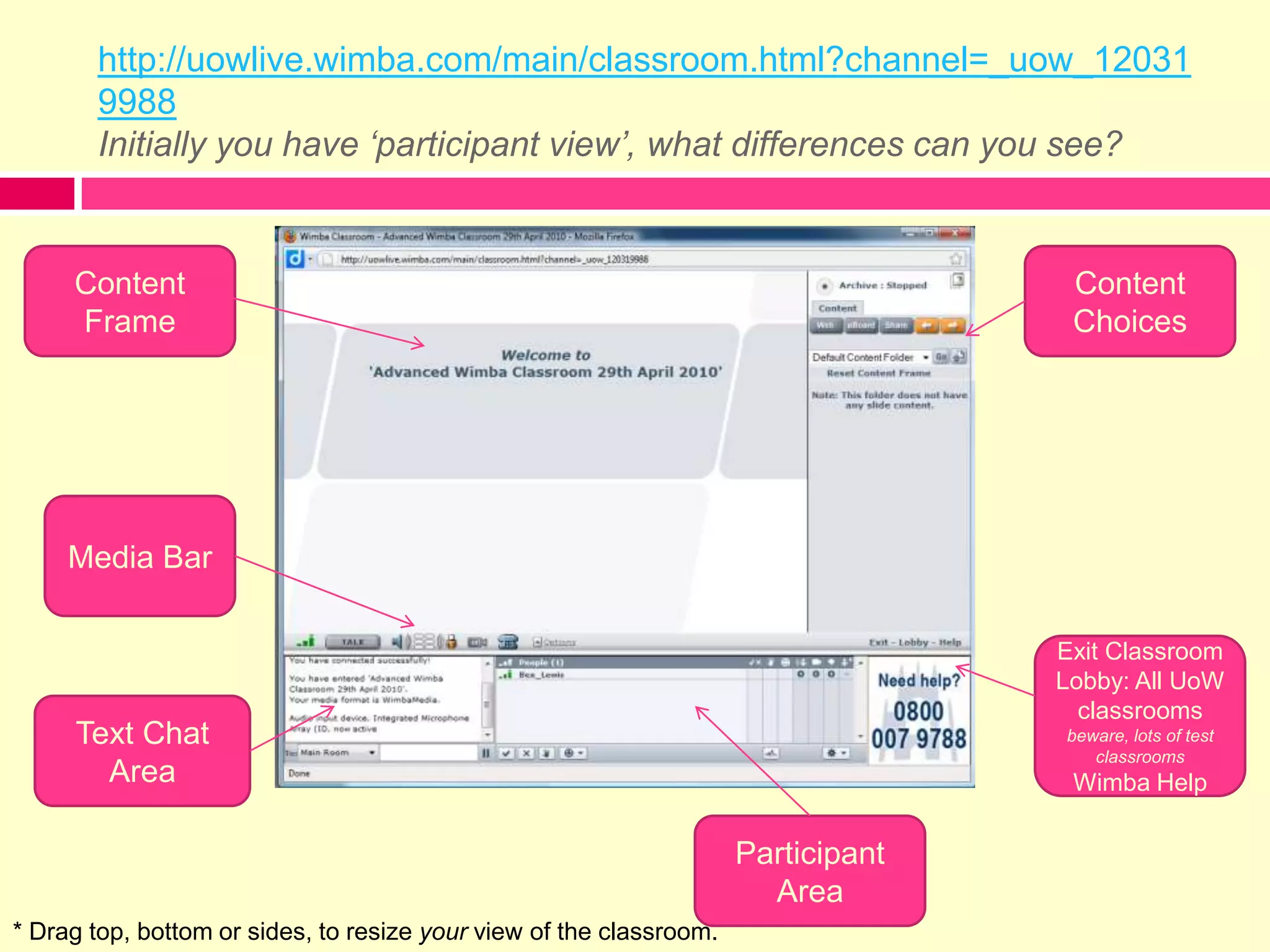
http://uowlive.wimba.com/main/classroom.html?channel=_uow_120319988Initially you have ‘participant view’, what differences can you see?Content FrameContent ChoicesMedia BarExit ClassroomLobby: All UoW classrooms beware, lots of test classroomsWimba HelpText Chat AreaParticipant Area* Drag top, bottom or sides, to resize your view of the classroom.
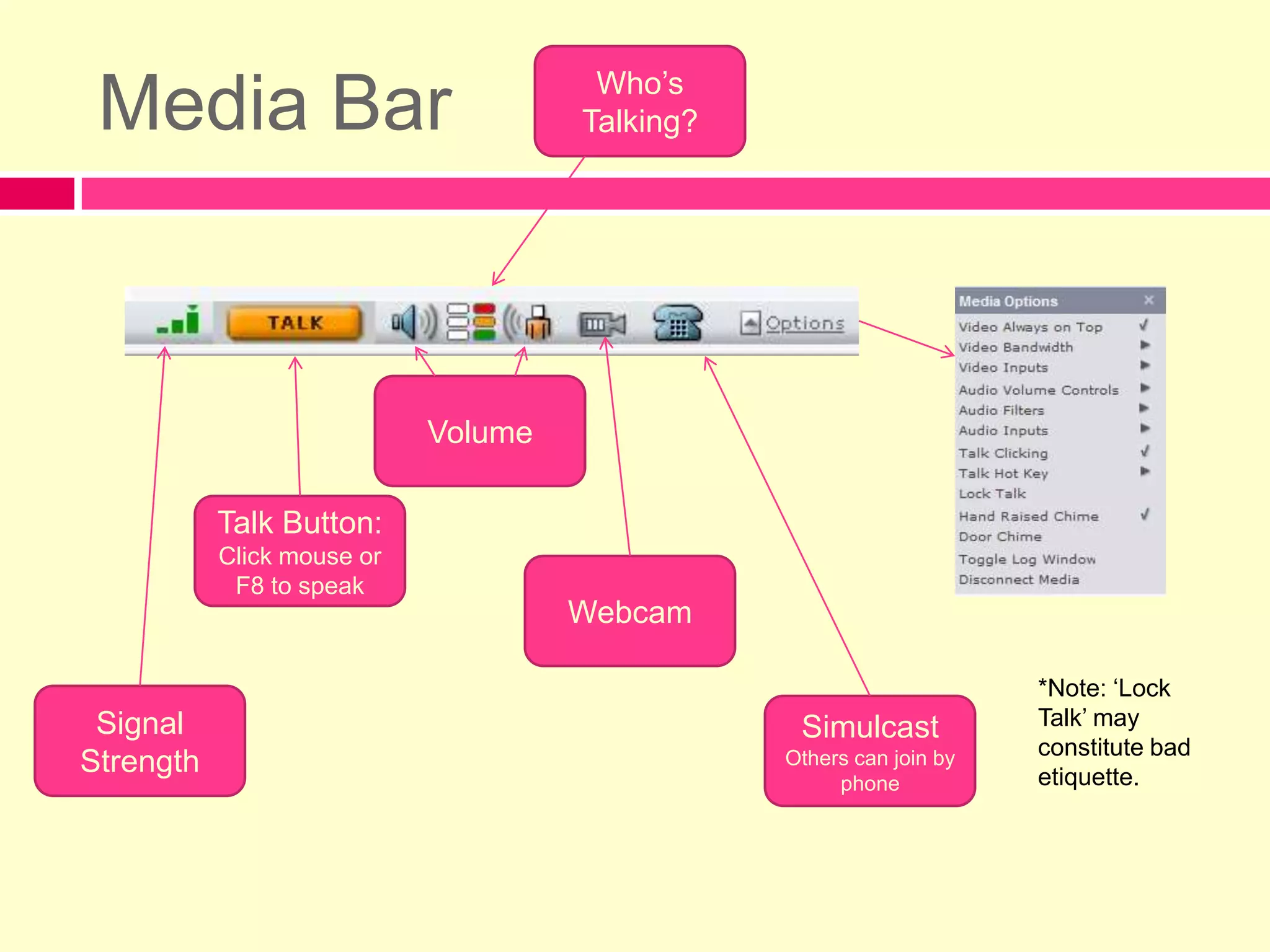
Media BarWho’s Talking?VolumeTalk Button: Click mouse or F8 to speakWebcam*Note: ‘Lock Talk’ may constitute bad etiquette.Signal StrengthSimulcastOthers can join by phone
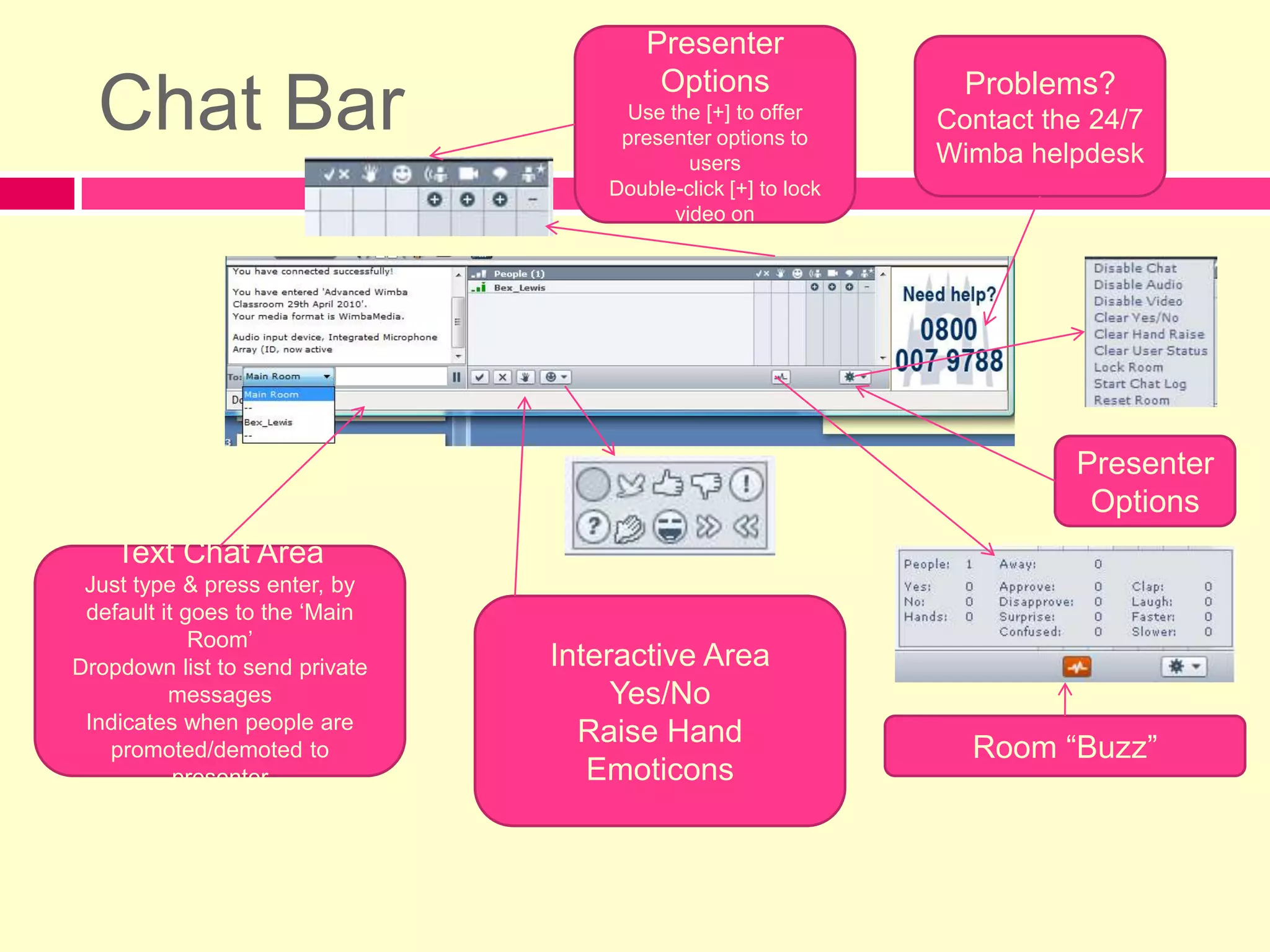
Chat BarPresenter OptionsUse the [+] to offer presenter options to usersDouble-click [+] to lock video onProblems?Contact the 24/7 Wimba helpdeskPresenter OptionsText Chat AreaJust type & press enter, by default it goes to the ‘Main Room’Dropdown list to send private messagesIndicates when people are promoted/demoted to presenterInteractive AreaYes/NoRaise HandEmoticonsRoom “Buzz”
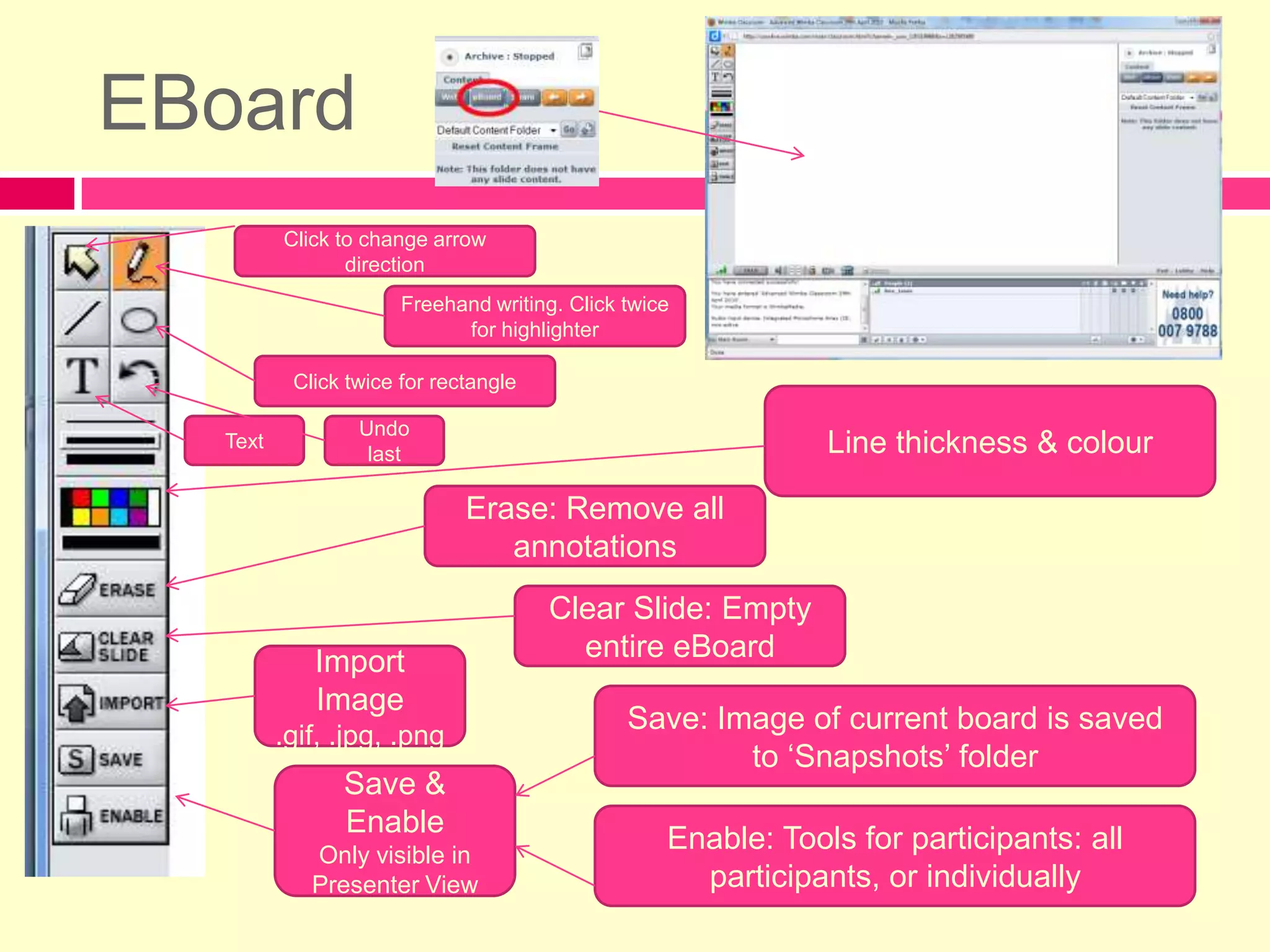
EBoardClick to change arrow directionFreehand writing. Click twice for highlighterClick twice for rectangleLine thickness & colourTextUndo lastErase: Remove all annotationsClear Slide: Empty entire eBoardImport Image.gif, .jpg, .pngSave: Image of current board is saved to ‘Snapshots’ folderSave & EnableOnly visible in Presenter ViewEnable: Tools for participants: all participants, or individually
Adding Wimba Classroom to a ModuleTurn Editing OnCreate & Return to CourseChoose a name that is meaningful to you & the students, can be the same in both.Select Activity
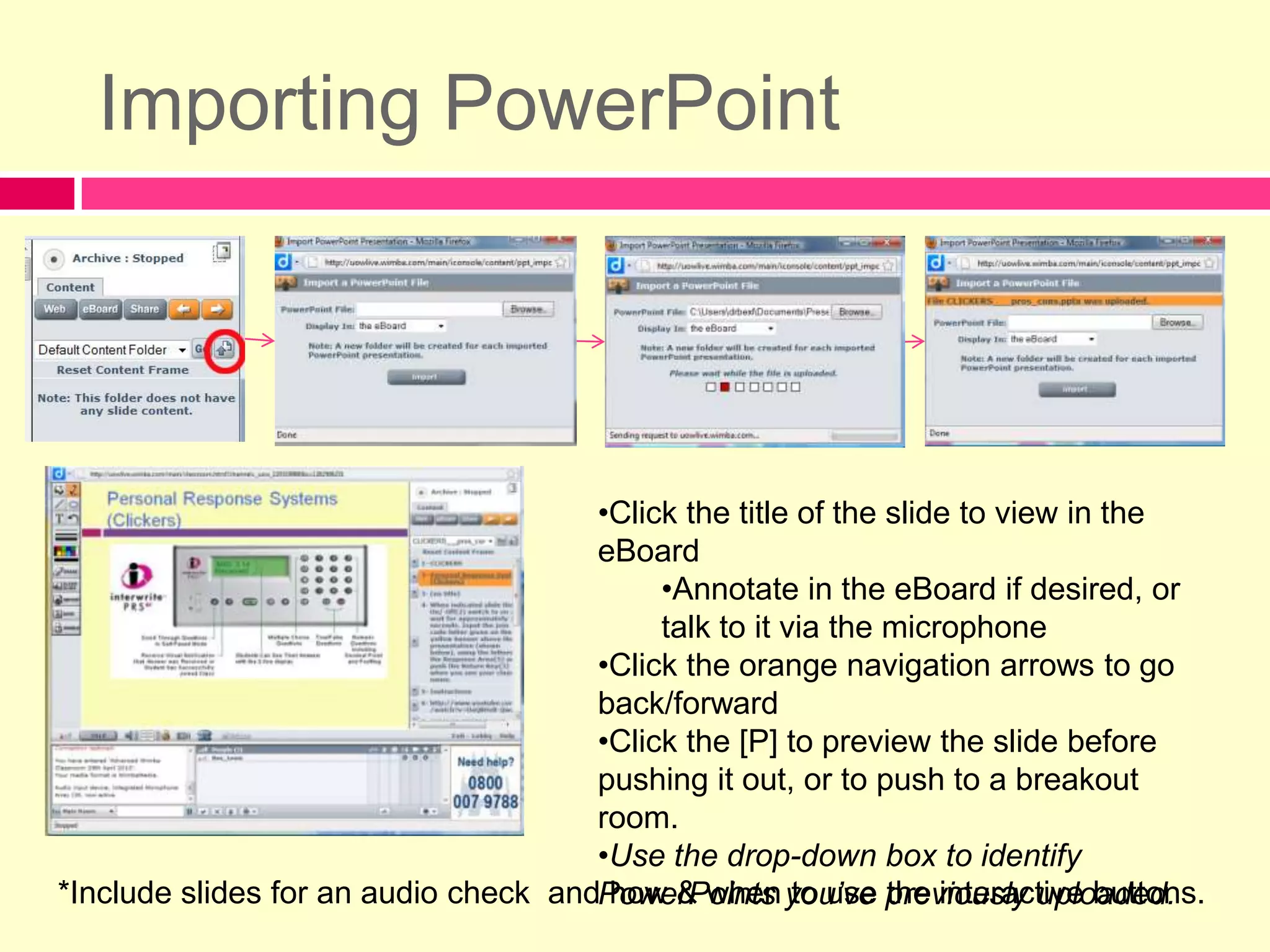
Importing PowerPointClick the title of the slide to view in the eBoard
Annotate in the eBoard if desired, or talk to it via the microphone
Click the orange navigation arrows to go back/forward
Click the [P] to preview the slide before pushing it out, or to push to a breakout room.
Use the drop-down box to identify PowerPoints you’ve previously uploaded.*Include slides for an audio check  and how & when to use the interactive buttons.
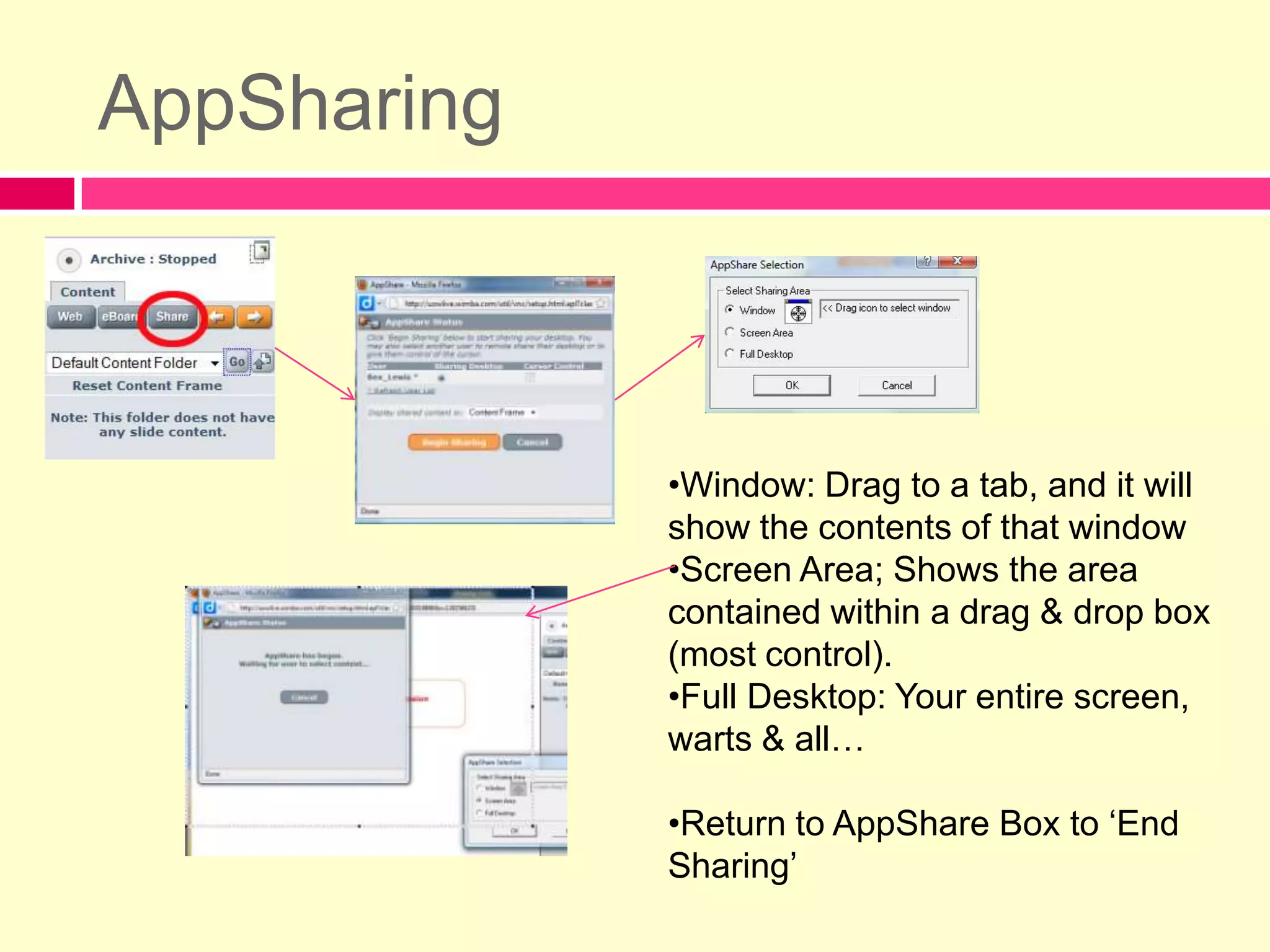
AppSharingWindow: Drag to a tab, and it will show the contents of that window
Screen Area; Shows the area contained within a drag & drop box (most control).
Full Desktop: Your entire screen, warts & all…
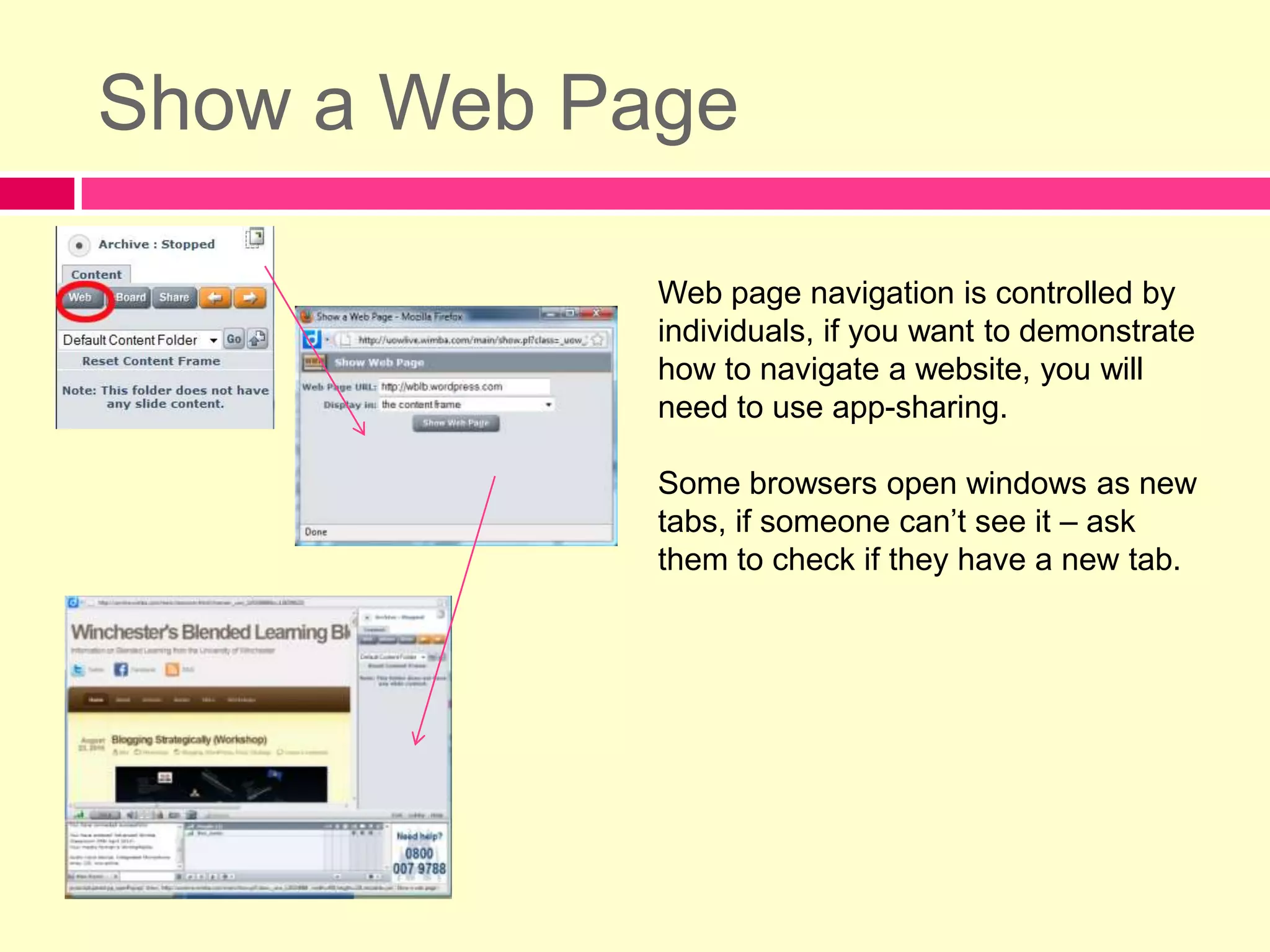
Return to AppShare Box to ‘End Sharing’ Show a Web PageWeb page navigation is controlled by individuals, if you want to demonstrate how to navigate a website, you will need to use app-sharing. Some browsers open windows as new tabs, if someone can’t see it – ask them to check if they have a new tab.
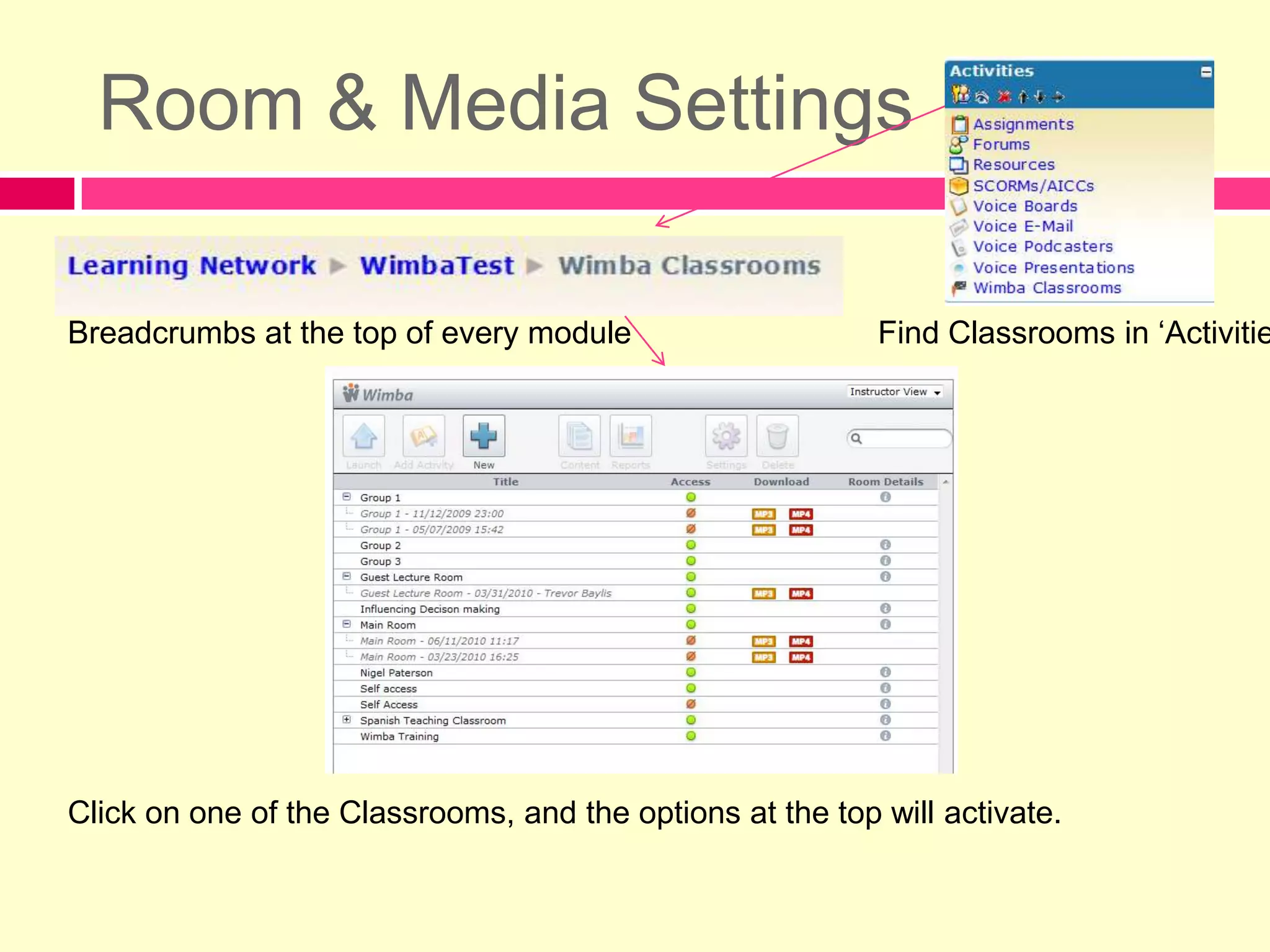
Room & Media SettingsBreadcrumbs at the top of every moduleFind Classrooms in ‘Activities’Click on one of the Classrooms, and the options at the top will activate.
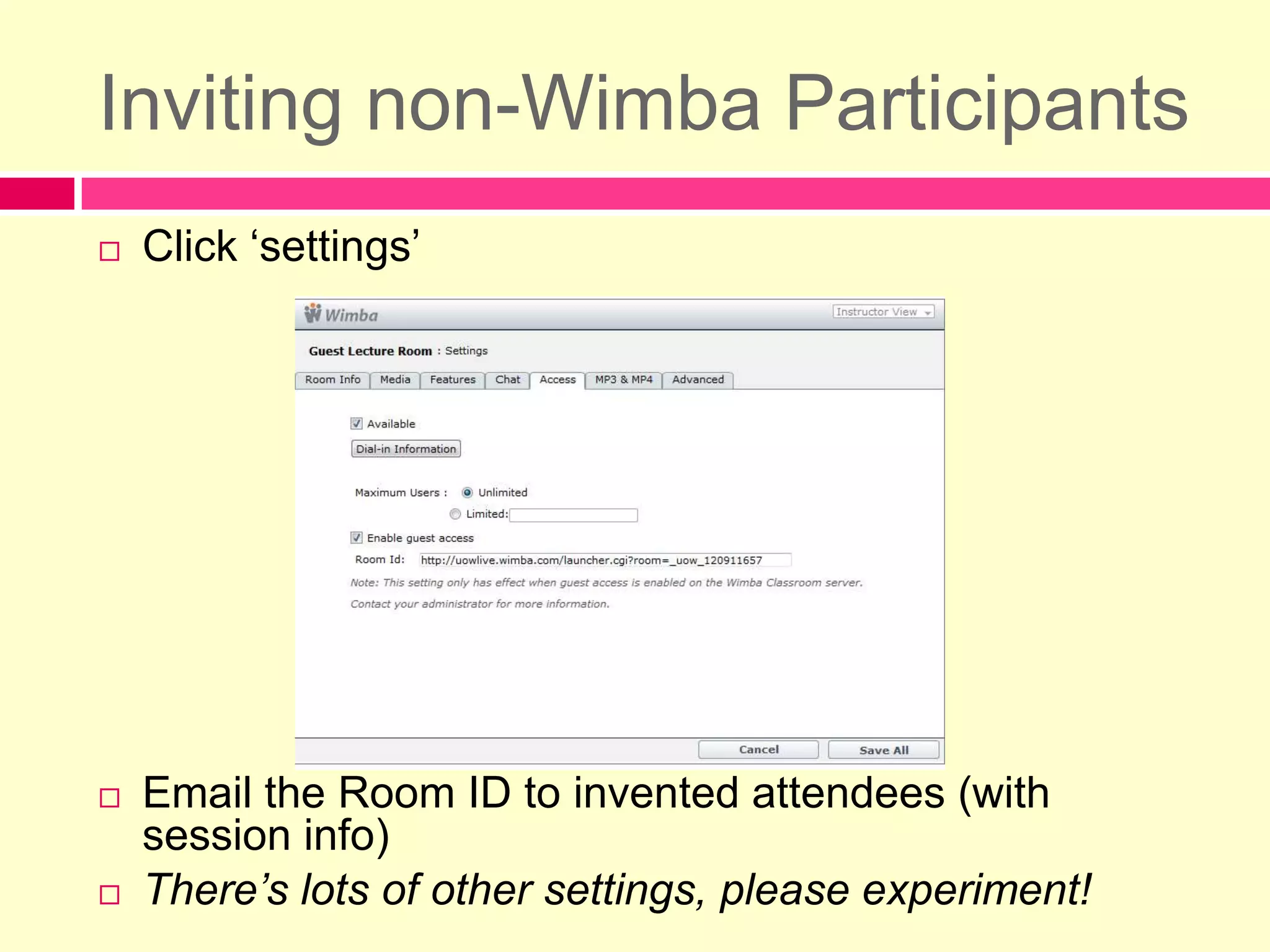
Inviting non-Wimba ParticipantsClick ‘settings’Email the Room ID to invented attendees (with session info)There’s lots of other settings, please experiment!

Wimba classroom

  • 1.
  • 2.
    Wimba Classroom: TheSessionUnderstand the basic functionality offered by Classroom (hand-raise, emoticons, chat)Have experienced time as both a participant and a tutor in the Classroom (including breakout rooms and polling)Uploaded a PowerPoint presentation to the eBoard, experienced ‘app-sharing’Tweaking ‘settings’, including providing a URL to allow external participants to enter the conversationArchiving a session, and accessing that archiveClassroom Etiquette
  • 3.
    Do you have?USBheadset with integrated microphone?Module on the Learning Network in which you can practice?
  • 4.
    The Big Picture:Why E-tools?The tangible benefits identified through the case studies are wide-ranging but can be summarised under the following broad headings:Cost Savings/Resource EfficiencyRecruitment and RetentionSkills and EmploymentStudent AchievementInclusionWidening Participation and Social EqualityOther Benefitshttp://www.jiscinfonet.ac.uk/case-studies/tangible/tb-briefing-paper.pdf
  • 5.
  • 6.
  • 7.
    Synchronous/AsynchronousSynchronous e-learningWorks in‘real time’Uses tools such asVideoconferencing ChatAids the development of learning communitiesSocial Learning, less isolationAvoids frustration in getting fast responses to queriesAsynchronous e-learningOccurring at different timesUses tools such asEmailDiscussion boardsSupports work relations among learners and with teachersFlexible, especially for part-timersLearners can log on to an e-learning environment at any time and download documents or send messages to teachers or peers.Students may spend more time refining their contributions, which are generally considered more thoughtful compared to synchronous communication.http://www.educause.edu/EDUCAUSE+Quarterly/EDUCAUSEQuarterlyMagazineVolum/AsynchronousandSynchronousELea/163445Image: http://www.kollewin.com/EX/09-15-11/synchronous-vs-asynchronous-collaboration-by-Ramius.gif
  • 8.
    Learning Situations forWimba Classroom?Group discussion...
  • 9.
    Wimba Setup WizardShould only need running once per computer.
  • 10.
    Recommend: runningthe day before a session if possible
  • 11.
    Run again ifexperiencing technical difficulties or have installed new software/ hardware on machine.* Most audio problems on campus seem to be caused by a conflict between sound cards/jack headsets. The Media Services counter sells USB headsets for £7.20 which seem to solve any issues we’ve had!
  • 12.
    http://uowlive.wimba.com/main/classroom.html?channel=_uow_120319988Initially you have‘participant view’, what differences can you see?Content FrameContent ChoicesMedia BarExit ClassroomLobby: All UoW classrooms beware, lots of test classroomsWimba HelpText Chat AreaParticipant Area* Drag top, bottom or sides, to resize your view of the classroom.
  • 13.
    Media BarWho’s Talking?VolumeTalkButton: Click mouse or F8 to speakWebcam*Note: ‘Lock Talk’ may constitute bad etiquette.Signal StrengthSimulcastOthers can join by phone
  • 14.
    Chat BarPresenter OptionsUsethe [+] to offer presenter options to usersDouble-click [+] to lock video onProblems?Contact the 24/7 Wimba helpdeskPresenter OptionsText Chat AreaJust type & press enter, by default it goes to the ‘Main Room’Dropdown list to send private messagesIndicates when people are promoted/demoted to presenterInteractive AreaYes/NoRaise HandEmoticonsRoom “Buzz”
  • 15.
    EBoardClick to changearrow directionFreehand writing. Click twice for highlighterClick twice for rectangleLine thickness & colourTextUndo lastErase: Remove all annotationsClear Slide: Empty entire eBoardImport Image.gif, .jpg, .pngSave: Image of current board is saved to ‘Snapshots’ folderSave & EnableOnly visible in Presenter ViewEnable: Tools for participants: all participants, or individually
  • 16.
    Adding Wimba Classroomto a ModuleTurn Editing OnCreate & Return to CourseChoose a name that is meaningful to you & the students, can be the same in both.Select Activity
  • 17.
    Importing PowerPointClick thetitle of the slide to view in the eBoard
  • 18.
    Annotate in theeBoard if desired, or talk to it via the microphone
  • 19.
    Click the orangenavigation arrows to go back/forward
  • 20.
    Click the [P]to preview the slide before pushing it out, or to push to a breakout room.
  • 21.
    Use the drop-downbox to identify PowerPoints you’ve previously uploaded.*Include slides for an audio check and how & when to use the interactive buttons.
  • 22.
    AppSharingWindow: Drag toa tab, and it will show the contents of that window
  • 23.
    Screen Area; Showsthe area contained within a drag & drop box (most control).
  • 24.
    Full Desktop: Yourentire screen, warts & all…
  • 25.
    Return to AppShareBox to ‘End Sharing’ Show a Web PageWeb page navigation is controlled by individuals, if you want to demonstrate how to navigate a website, you will need to use app-sharing. Some browsers open windows as new tabs, if someone can’t see it – ask them to check if they have a new tab.
  • 26.
    Room & MediaSettingsBreadcrumbs at the top of every moduleFind Classrooms in ‘Activities’Click on one of the Classrooms, and the options at the top will activate.
  • 27.
    Inviting non-Wimba ParticipantsClick‘settings’Email the Room ID to invented attendees (with session info)There’s lots of other settings, please experiment!
  • 28.
    Breakout RoomsWhen ‘BreakoutRooms are enabled, next to content ‘Breakout Rooms’ will appearSelect ‘Manual’ to drag & drop participants into Breakout rooms. Press & hold CTRL to select multiple names.Select ‘Automatic’ to randomly assign participants to rooms. Select the number of rooms to use. Click move to distribute participants. To return everyone to the main room, select ‘Automatic’, ‘to main room’. Click ‘move’
  • 29.
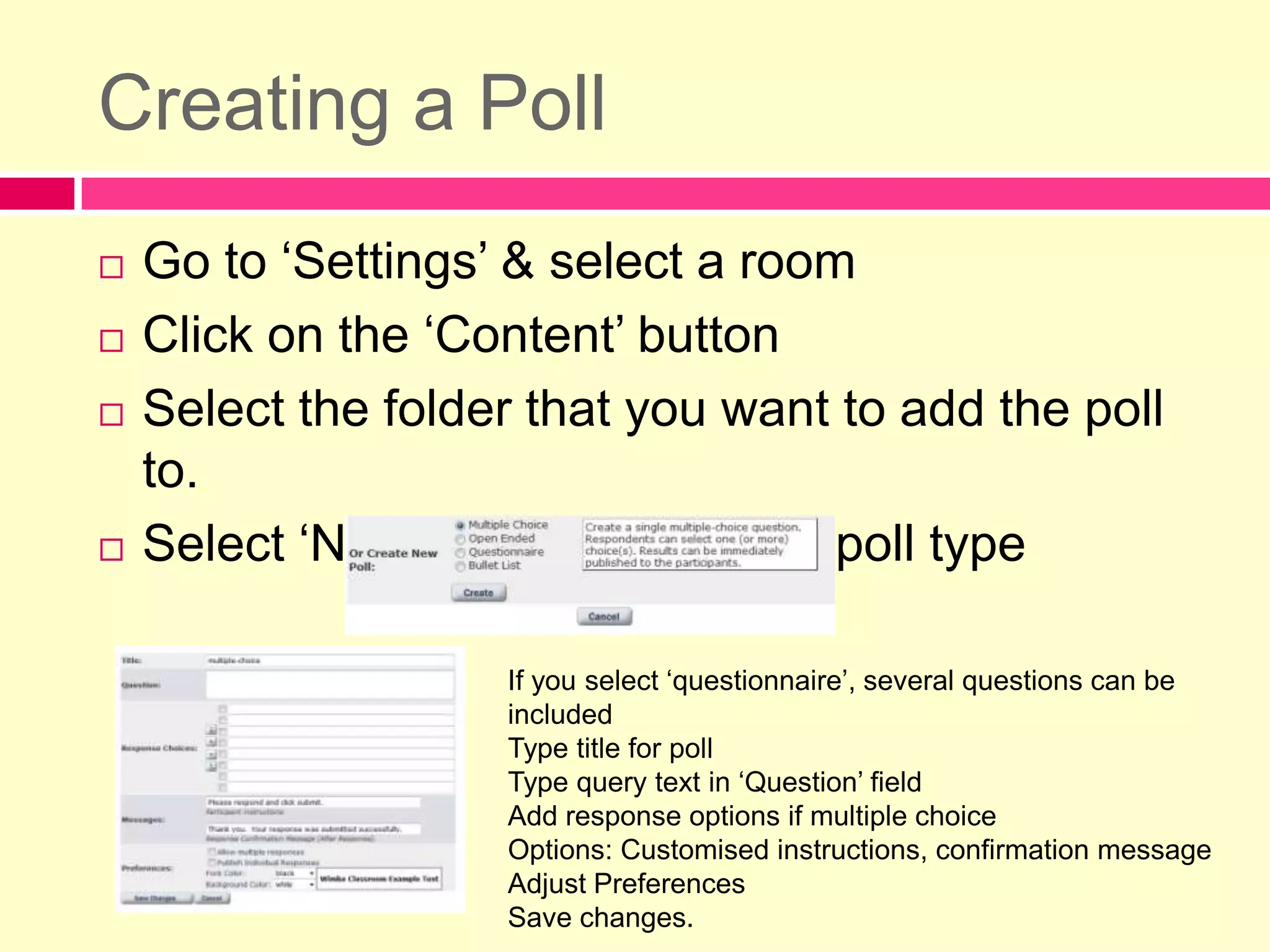
    Creating a PollGoto ‘Settings’ & select a roomClick on the ‘Content’ buttonSelect the folder that you want to add the poll to.Select ‘New Content’, select a poll typeIf you select ‘questionnaire’, several questions can be includedType title for pollType query text in ‘Question’ fieldAdd response options if multiple choiceOptions: Customised instructions, confirmation messageAdjust PreferencesSave changes.
  • 30.
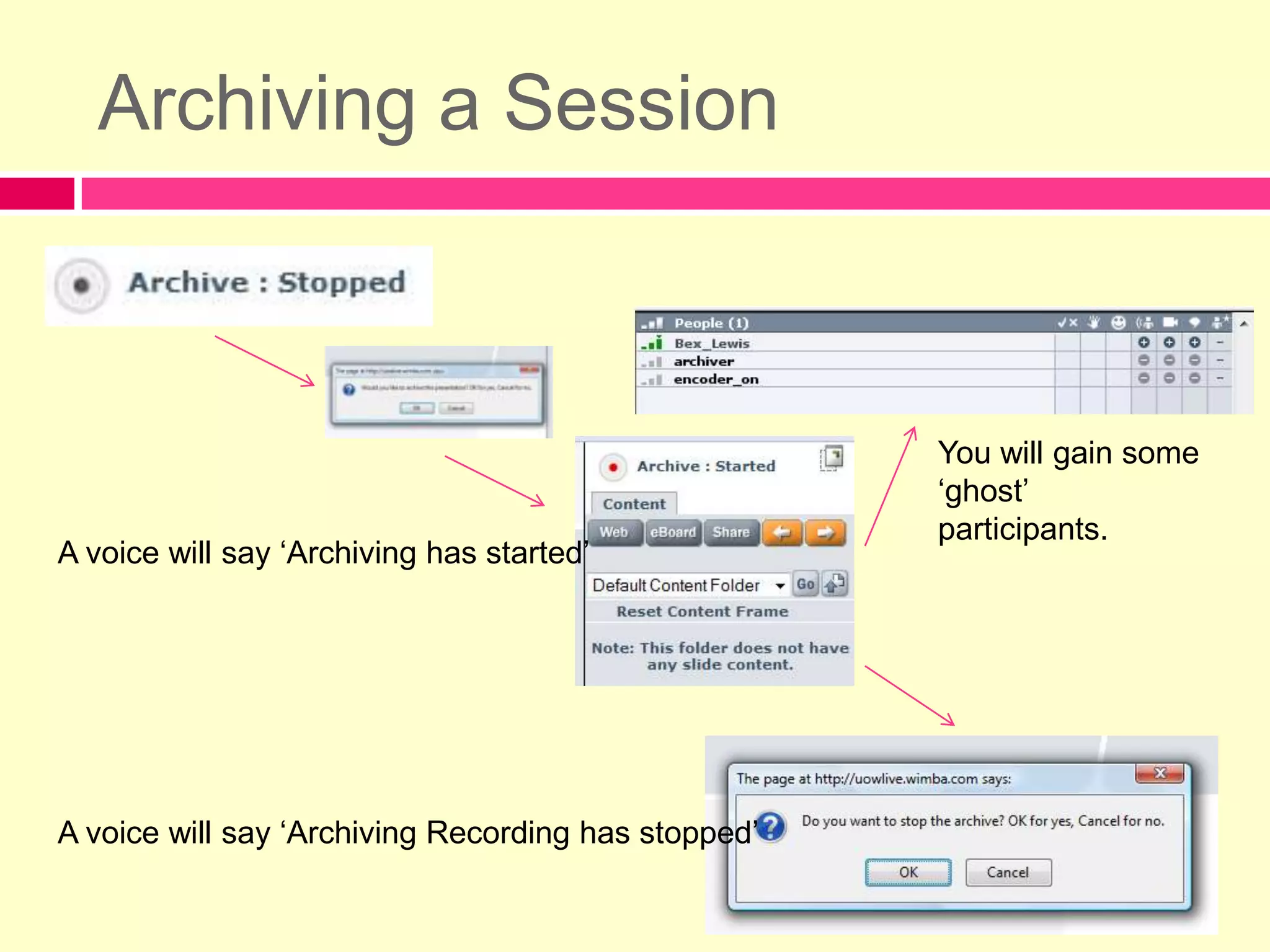
    Archiving a SessionYouwill gain some ‘ghost’ participants.A voice will say ‘Archiving has started’A voice will say ‘Archiving Recording has stopped’
  • 31.
    Access the ArchiveClickto savehttp://uowlive.wimba.com/main/classroom.html?channel=_uow_120911657_2010_0331_1543_37&x=1282588597http://bit.ly/wimbaarchive
  • 32.
    Some Points ofEtiquette“Can everyone hear me?”Don’t ask this question (just) audibly, as if they can’t hear you, they won’t hear you ask! Use the chat area/slides at the beginning of the session. Set up ‘rules of engagement’, as you would in a regular classroom, at the beginning of the session. Especially consider how to ensure only one person talks at a time.Before AppSharing, ensure that you have removed/ minimised any private information from your screen.Sharing, whether Apps or Video, both use up a lot of bandwidth. Use judiciously to allow the widest possible audience to participate.
  • 33.
    Final Thoughts: Possibilitiesfor Wimba Classroom?Group discussion...
  • 34.
    Thank you foryour timeQUESTIONS?
  • 35.
    Further InformationLearning Network:http://bit.ly/bllearnnetTwitter: http://twitter.com/blwinchFacebook: http://bit.ly/blfacebookBlog: http://wblb.wordpress.com/Email: bex.lewis@winchester.ac.uk

Editor's Notes

  • #3 Wimba Classroom offers a virtual classroom environment, including audio, video, application sharing, content display and archiving facilities.By the end of the session participants will know about:· Understand the basic functionality offered by Classroom (hand-raise, emoticons, chat)· Have experienced time as both a participant and a tutor in the Classroom (if enter a BL module, should be a participant by default, if one of your own modules, tutor by default)· Uploaded a PowerPoint presentation to the eBoard, experienced ‘app-sharing’· Tweaking ‘settings’, including providing a URL to allow external participants to enter the conversation· Archiving a session, and accessing that archiveThis session will also provide space for a discussion of classroom etiquette, and potential uses for the software for both academic and professional services staff within the University of Winchester.
  • #5 More & more students are mobile-enabled & love to listen to material on the move – so podcasts, etc. = great idea!
  • #6 4:38
  • #7 3:13
  • #8 Synchronous e-learning, commonly supported by media such as videoconferencing and chat, has the potential to support e-learners in the development of learning communities. Learners and teachers experience synchronous e-learning as more social and avoid frustration by asking and answering questions in real time.Synchronous sessions help e-learners feel like participants rather than isolates:Isolation can be overcome by more continued contact, particularly synchronously, and by becoming aware of themselves as members of a community rather than as isolated individuals communicating with the computer.Asynchronous e-learning, commonly facilitated by media such as e-mail and discussion boards, supports work relations among learners and with teachers, even when participants cannot be online at the same time. It is thus a key component of flexible e-learning. In fact, many people take online courses because of their asynchronous nature, combining education with work, family, and other commitments. Asynchronous e-learning makes it possible for learners to log on to an e-learning environment at any time and download documents or send messages to teachers or peers. Students may spend more time refining their contributions, which are generally considered more thoughtful compared to synchronous communication.
  • #13 P33 – copy participant interaction icons.
  • #14 “Having participants collectively draw an image on the eBoard builds community & collaboration skills. Text shouldn’t appear on the board for everyone else to see until you press enter?!
  • #16 Wimba over-rides any transitions, etc. in PPT and uploads them as static slides – you will need to use the eBoard to annotate material (and can then take screenshots of the same). BREAKOUT rooms – to address in this workshop?!
  • #17 See p30 of instructions for best practice for app sharing – copy!
  • #18 Have participants run a quick search on a given topic. Open a search engine in the Content Frame, set a time limit, and then ask participants to type the search term. After the search time has elapsed, push out an open-ended polling question. The polling question will force participants to end their searches and give them a place to report their findings.
  • #19 Lanuch: Access room as a presenterAdd an Activity: Link to any room from a Topic/Week, or social activities blockNew: Build a new Wimba ClassroomContent: Upload files, create links to webpages, specify the target area for files & web pages, create advanced polls (we’ll have a quick look at those), reorder, rename & delete contentFILES SUPPORTED ARE: PDF, PPT, PPTX, SWF, WMV, JPG, GIF, PNGReports: Review polling results (haven’t done polling yet), View tracking dataSettings: Adjust media settings, specify room settingsDelete: Delete selected room/archive permanently Search Box: Search for a specific room/archive by its titleRoom Details: View the room information
  • #20 This access tab also determines whether archives are open to view or not – determined by if ‘Available’ is ticked. Room Info – add a description that e.g. “We will meet in this room each Tuesday from 7-9pm GMT”. Make presentation tools available to all students if they are working alone, or both students & instructors are presenting content. Archive access, any archives created will automatically be available to students. Media – Can change the access speed, it defaults to most users have a university style network, it might require a change to ‘medium’ if people are on slow broadband (and ‘slow’ if any on dial-up!)Features: Can enable breakout rooms (show you those next)Chat: Private chat cannot be enabled or disabled, but can disable public chats. MP3 & MP4: Which format do you want the archive to record in? (after breakouts)Advanced… well…
  • #21 Use a breakout room to hold 1-on-1 conferences with participants. The audio broadcast in the breakout room isn’t heard in other rooms – can also be used for group work.
  • #22 Intersperse poll questions with other content to help keep participants engaged and to provide presenters with valuable feedback about the learning process.Avoid colour combos of red-blue, green-yellow, green-white & green-grey = poor contrast.
  • #23 P71, getting ready to deliver a live session, p72, checklistArchives can be used to record live sessions, and are also a great way to record frequently repeated information. Consider creating an archive for a new employee or new student orientation. REMEMBER: Lock talk, and that any breakout room activity isn’t included in the archives.
  • #25 P50, best practice in using Classroom