●

Civil Liberties
Chapter 5

Rebecca Mendelsohn, Will Kumi, and Conrad
Black.

●
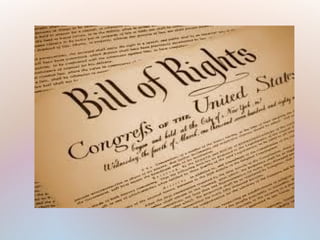
Bill of Rights
●

●

●

When the Bill of Rights , which contains many of
the most important protections of individual
liberties, was written, its drafters were not think
about issues such as abortion, gay rights, physician
assisted suicide , or any other personal liberties .
Civil Liberties- The personal guarantees and
freedoms that the federal government cannot
abridge by law, constitution or judicial
interpretation.
Civil Rights- The government protected rights of
individuals against arbitrary or discriminatory
treatment.
The First Constitutional Amendments: The
Bill of Rights






1787 – Most state constitutions explicitly protected
a variety of personal liberties.
Speech, religion, freedom from unreasonable
search and seizure, trial by jury
New Constitution shifted power to the national
government

Would the national government uphold
these liberties?
The First Constitutional Amendments: The
Bill of Rights
●

●
●
●

●

●
●

●

Bill of Rights addition defeated unanimously at the federal convention

Federalists argued that a bill of rights was unnecessary.
Already included by states
Federalists believed it was foolhardy to list things that the
national government had no power to do.
Some Federalists supported the idea such as Thomas
Jefferson
James Madison did not support until politics intervened
He sought House seat in a district that was largely AntiFederalist in nature.
Made good on his promise and became prime author of the
Bill of Rights
The First Constitutional Amendments: The
Bill of Rights
●

Bill of Rights
●
1789 Congress sent proposed Bill of Rights to the states for
ratification, which occurred in 1791
●
The first ten amendments to the Constitution contain
numerous specific guarantees:
●
●
●

Free speech, press and religion
9th and 10th amendments highlighted Anti-Federalist fears
Ninth Amendment
●

●

“The enumeration in the Constitution, of certain rights, shall not be
construed to deny or disparage others retained by the people.”

Tenth Amendment
●

Reiterates that powers not delegated to the national government are
reserved to the states or to the people.
The Incorporation Doctrine: The Bill of Rights Made
Applicable to the States




Bill of Rights intended to limit powers of the
national government
Barron v. Baltimore (1833)




Court ruled that the national Bill of Rights limited only
the actions of the U.S. government and not those of the
states.
But decision suggested the possibility that some or all
of the protections might be interpreted to prevent state
infringement of those rights.
The Incorporation Doctrine: The Bill of Rights Made
Applicable to the States
●
●

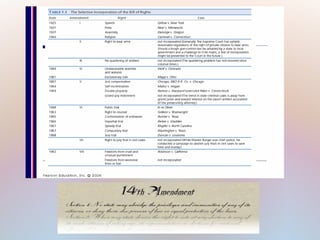
14th Amendment
Due process clause
●

●

Over the years this clause has been construed to
guarantee to individuals a variety of rights.
●
Economic liberty to criminal procedural rights and
protection from arbitrary governmental action
Substantive due process
●
Judicial interpretation of the Fifth and Fourteenth
Amendments’ due process clause that protects citizens
from arbitrary or unjust laws
The Incorporation Doctrine: The Bill of Rights Made
Applicable to the States
●

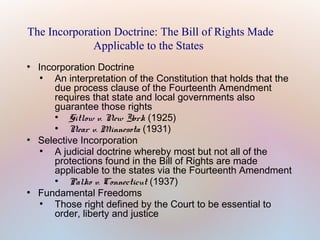
●

●

Incorporation Doctrine
●
An interpretation of the Constitution that holds that the
due process clause of the Fourteenth Amendment
requires that state and local governments also
guarantee those rights
●
Gitlow v. New York (1925)
●
Near v. Minnesota (1931)
Selective Incorporation
●
A judicial doctrine whereby most but not all of the
protections found in the Bill of Rights are made
applicable to the states via the Fourteenth Amendment
●
Palko v. Connecticut (1937)
Fundamental Freedoms
●
Those right defined by the Court to be essential to
order, liberty and justice
First Amendment Guarantees: Freedom of
Religion
●

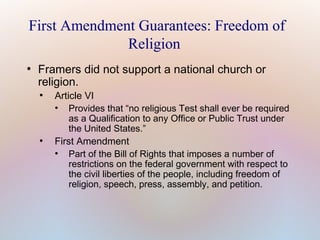
Framers did not support a national church or
religion.
●

●

Article VI
●
Provides that “no religious Test shall ever be required
as a Qualification to any Office or Public Trust under
the United States.”
First Amendment
●
Part of the Bill of Rights that imposes a number of
restrictions on the federal government with respect to
the civil liberties of the people, including freedom of
religion, speech, press, assembly, and petition.
First Amendment Guarantees: Freedom of
Religion
●

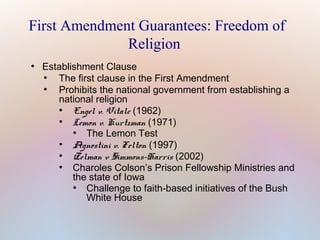
Establishment Clause
●
The first clause in the First Amendment
●
Prohibits the national government from establishing a
national religion
●
Engel v. Vitale (1962)
●
Lemon v. Kurtzman (1971)
●
The Lemon Test
●
Agnostini v. Felton (1997)
●
Zelman v Simmons-Harris (2002)
●
Charoles Colson’s Prison Fellowship Ministries and
the state of Iowa
●
Challenge to faith-based initiatives of the Bush
White House
The Free Exercise Clause
●
●

●

The second clause of the First Amendment
Prohibits the U.S. government from interfering
with a citizen’s right to practice his or her religion
Gonzales v. O Centro Espirita Beneficient Uniao Do
Vegetal
First Amendment Guarantees: Freedom of Speech, Press,
and Assembly
●

●

Democracy depends on a free exchange of
ideas.
Volatile area of constitutional interpretation
●

Alien and Sedition Acts
●

Prior restraint: Constitutional doctrine that prevents
the government from prohibiting speech or
publication before the fact; generally held to be in
violation of the First Amendment
First Amendment Guarantees: Freedom of Speech and
Press


Slavery, the Civil War, and Rights Curtailments

Lincoln suspended the free press provision of the First
Amendment as well as the writ of habeas corpus.




Ordered the arrest of the editors of two New York papers who
were critical of him
Newspaper editor jailed by a military court without having any
charges brought against him





Appealed to the Supreme Court: Ex parte McCardle (1869)
Congress enacted legislation prohibiting the Court from issuing a
judgment in any cases involving convictions for publishing
statements critical of the U.S.
Article II gives Congress power to determine the jurisdiction of the
Court.
First Amendment Guarantees: Freedom of Speech and
Press
●

WWI
●
●

Anti-governmental speech
Clear and Present Danger Test
●

●

●

●

●

Test articulated by the Supreme Court in Schenck v. U.S. (1919) to draw
the line between protected and unprotected speech
The Court looks to see “whether the words used” could “create a clear
and present danger that they will bring about substantive evils” that
Congress seeks “to prevent.”
Anti-war leaflets okay during peace, but not permissible during war – too
dangerous
But what constituted a danger?

Direct Incitement Test
●

A test articulated by the Supreme Court in Brandenburg v. Ohio (1969) that
holds that advocacy of illegal action is protected by the First
Amendment unless imminent lawless action is intended and likely to
occur
First Amendment Guarantees: Freedom of Speech and
Press
●

Protected Speech and Publications
●

Prior Restraint
●
Court has made it clear that it will not tolerate prior
restraint of speech
●
New York Times Co. v. Sullivan (1971)
●
●

●

Pentagon Papers case
Supreme Court ruled that the U.S. government could not
block the publication of secret Department of Defense
documents illegally furnished to the Times by anti-war
activists.

Nebraska Press Association v. Stuart (1976)
●

Court ruled in favor of press’s right to cover trial.
First Amendment Guarantees: Freedom of Speech and
Press
●

Symbolic Speech

 Symbols, signs, and other methods of expression
generally also considered to be protected by the First
Amendment
 Stromberg v. California (1931)
 Upheld flying of red flag (symbol of opposition to
U.S. government)
 Tinker v. Des Moines Independent Community District School
(1969)
 Court upheld wearing of black armbands as protest
against Viet Nam War

 Gregory Johnson and flag burning
Hate Speech, Unpopular Speech, Speech Zones
●
●

●

R.A.V. v. City of St Paul (1992)
Two-thirds of colleges and universities have banned a variety
of forms of speech or conduct that creates or fosters an
intimidating, hostile or offensive environment on campus.
Some have created free speech zones.
 These restrict the time, place or manner of speech
 Implication that speech can be limited on other parts of
campus
 ACLU a critic a such policies; filed number of suits, but none
has reached the Supreme Court
Unprotected Speech and Publications
●

●

●

Libel
●
False written statements or written statements tending
to call someone’s reputation into disrepute
Slander
●
Untrue spoken statements that defame the character of
a person
New York Times Co. v. Sullivan (1964)
●
The Supreme Court concluded that “actual malice”
must be provided to support a finding of libel against a
public figure.
●
Concept of malice can be difficult and confusing
●
“knowledge of falsity,” “reckless disregard for the
truth”
●
Malice standards make it difficult for public officials
or persons to win libel cases.
Unprotected Speech and Publications
●

●

Fighting Words
 Chaplinsky v. New Hampshire (1942)
Obscenity
 Roth v. U.S. (1957)
 Congress concerned with obscenity on the Internet
 Communications Decency Act (1996)
 Prohibited transmission of obscene materials over the
Internet to anyone under age 18
 Reno v. ACLU (1997)
 Law too vague; violated First Amendment
 Child Online Protection Act (1998)
 Ashcroft v. Free Speech Coalition (2002)
 Court has continued to strike down as unconstitutional
Congress’s latest efforts to limit cyberporn and has blocked
enforcement of COPA
Freedoms of Assembly and Petition
●

DeJonge v. Oregon (1937)

 Incorporated the First Amendment’s freedom of
assembly clause

●

Among the most controversial, especially in
times of war
The Second Amendment: The Right to
Keep and Bear Arms
●

Colonial times


Distrust of standing armies evident




●

1934 – Congress passed the National Firearms Act




●
●

Required all white men to keep and bear arms
Local militias
2nd Amendment passed to make sure that Congress could not pass
laws to disarm state militias – appeased Anti-Federalists

Response to organize crime
U. S. v. M r (1939) upheld the constitutionality of the act
ille
This was the last time the Supreme Court directly addressed the
Second Amendment.

Brady Bill
Ban on Assault Weapons (Clinton; ten year time limit)


Not renewed by Bush or the Republican-controlled congress prior to the
2004 elections when it expired
The Rights of Criminal Defendants
●

Due process rights
●

●

Procedural guarantees provided by the Fourth,
Fifth, Sixth and Eighth Amendments for those
accused of crimes
Warren Court made several provisions of the
Bill of Rights dealing with the liberties of criminal
defendants (those charged but not yet tried)
applicable to the states through the Fourteenth
Amendment.
Fourth Amendment
●

“The right of the people to be secure in their persons,
houses, papers, and effects, against unreasonable
searches and seizures, shall not be violated, and no
Warrants shall issue, but upon probable cause,
supported by Oath or affirmation, and particularly
describing the place to be searched, and the persons or
things to be seized.”
Fourth Amendment
●

●

●

●

●

Over the years, the Court has interpreted the Fourth Amendment to allow the
police to search:
●
The person arrested
●
Things in plain view of the accused person
●
Places or things that the arrested person could also touch or reach or are
otherwise in the arrestee’s immediate control.
Court has ruled that police must knock and announce their presence before
entering a home or apartment to execute a search
2001 ruling on thermal imaging drug evidence (without a warrant) was violation of
Fourth Amendment – binoculars or helicopters okay – why? Just plain eyesight
used – not a new technology
2006, the Court ruled that the police could not conduct a warrantless search of a
home if one of the occupants objected
Drug testing difficult search and seizure issue
●
Chandler v. Miller (1997)
●
Public employees enjoy more protection in the area of drug testing than do
employees of private enterprises
●
But what about drug testing of pregnant women?
●
2001, the Supreme Court said no. This is unconstitutional.
Fifth Amendment: Self-incrimination and Double
Jeopardy
●

Imposes a number of restrictions on the federal government with respect
to the rights of persons suspected of committing a crime.
●

●

“No person shall be…compelled in any criminal case to be a witness against
himself.”

Miranda v. Arizona (1966)
●

●

●

●

●

Miranda rights

Provides for indictment by a grand jury and protection against selfincrimination
Prevents the national government from denying a person life, liberty, or
property without the due process of law
It also prevents the national government from taking property without fair
compensation
Double jeopardy clause
●

Protects individuals from being tried twice for the same offense
Fourth and Fifth Amendments and the
Exclusionary Rule
●

●

●

●

Judicially created rule that prohibits policy from using illegally
seized evidence at trial.
Weeks v. U.S. (1914)
●
The Court reasoned that allowing police and prosecutors to
use a tainted search would only encourage that activity.
Mapp v. Ohio (1961)
●
Warren Court ruled that “all evidence obtained by searches
and seizures in violation of the Constitution, is inadmissible in
a state court.”
The Court, despite its conservative reputation, has continued
to uphold the exclusionary rule.
Sixth Amendment and the Right to Counsel
●

Sets out the basic requirements of
procedural due process for federal courts to
follow in criminal trials

 These include speedy and public trials, impartial
juries, trials in the state where the crime was
committed, notice of the charges, the right to
confront and obtain favorable witnesses, and
the right to counsel
-Gideon v.
Wainwright (1936)
The Sixth Amendment and Jury Trials
●

●

●

●

Provides that a person accused of a crime shall
enjoy the right to a speedy and public trial by an
impartial jury
It also provides defendants the right to confront
witnesses against them.
Supreme Court has held that jury trials must be
available if a prison sentence of six or more
months is possible
Impartiality of jury
●

●

Batson v. Kentucky (1986)

Right to confront witnesses
●

Maryland v. Craig (1990)
The Eighth Amendment and Cruel and
Unusual Punishment
●

●

●

●
●

●

Part of the Bill of Rights that states: “Excessive bail shall
not be required, nor excessive fines imposed, nor cruel and
unusual punishments inflicted.”
Furman v. Georgia (1972)
●
Court ended capital punishment
●
Found it was imposed in an arbitrary manner
Gregg v. Georgia (1976)
●
Reaction to rewriting of state laws on death penalty
●
Death penalty statute found to be constitutional
McClesky cases (1987 and 1991)
House v. Bell (2006)
●
DNA evidence
Court also ruled in 2006 that death-row inmates could
challenge the drugs and procedures involved in lethal
injections
Right to Privacy
●
●

●

●

●

The right to be left alone
A judicially created doctrine encompassing an individual’s decision to use
birth control or to secure an abortion
Birth Control
 Griswold v. Connecticut (1965)
Abortion
 Roe v. Wade (1973)
 Court found a woman’s right to an abortion was protected by the
right to privacy that could be implied from specific guarantees found
in the Bill of Rights applied to the states through the Fourteenth
Amendment
 Webster v. Reproductive Health Services (1989)
 Planned Parenthood of S.E. Pennsylvania v. Casey (1992)
 Stenberg v. Carhart (2000)
 Partial Birth Abortion Ban Act (2003)
Homosexuality
 Lawrence v. Texas (2003)
 State sodomy laws found unconstitutional
The Right to Die
●

●

1990 Court ruled in a 5-4 decision that
parents could not withdraw a feeding tube
from their comatose daughter after her
doctors testified that she could live for many
more years if the tube remained in place.
Rehnquist rejected any attempts to expand
the right to privacy in to this area.
The Right to Die
●

●

Court did note that individuals could terminate medical treatment if they
were able to express, or had done so in writing via a living will, their
desire to have medical treatment terminated in the event they became
incompetent
1997 Court ruled unanimously that terminally ill persons do NOT have a
constitutional right to physician assisted suicide
●
Oregon voters approved a right to die law in 2001.
●
Attorney General Ashcroft issued legal opinion that this was not
acceptable.
●
●

●

State and national conflict
Federal judge ruled that Ashcroft, then Attorney General, had
overstepped his authority

Gonzales v. Oregon (2005)
●

Court once again disagreed and upheld Oregon’s law by a 6-3 vote.

Ch 5 presentation

  • 1.
    ● Civil Liberties Chapter 5 RebeccaMendelsohn, Will Kumi, and Conrad Black. ●
  • 2.
    Bill of Rights ● ● ● Whenthe Bill of Rights , which contains many of the most important protections of individual liberties, was written, its drafters were not think about issues such as abortion, gay rights, physician assisted suicide , or any other personal liberties . Civil Liberties- The personal guarantees and freedoms that the federal government cannot abridge by law, constitution or judicial interpretation. Civil Rights- The government protected rights of individuals against arbitrary or discriminatory treatment.
  • 4.
    The First ConstitutionalAmendments: The Bill of Rights    1787 – Most state constitutions explicitly protected a variety of personal liberties. Speech, religion, freedom from unreasonable search and seizure, trial by jury New Constitution shifted power to the national government  Would the national government uphold these liberties?
  • 5.
    The First ConstitutionalAmendments: The Bill of Rights ● ● ● ● ● ● ● ● Bill of Rights addition defeated unanimously at the federal convention Federalists argued that a bill of rights was unnecessary. Already included by states Federalists believed it was foolhardy to list things that the national government had no power to do. Some Federalists supported the idea such as Thomas Jefferson James Madison did not support until politics intervened He sought House seat in a district that was largely AntiFederalist in nature. Made good on his promise and became prime author of the Bill of Rights
  • 6.
    The First ConstitutionalAmendments: The Bill of Rights ● Bill of Rights ● 1789 Congress sent proposed Bill of Rights to the states for ratification, which occurred in 1791 ● The first ten amendments to the Constitution contain numerous specific guarantees: ● ● ● Free speech, press and religion 9th and 10th amendments highlighted Anti-Federalist fears Ninth Amendment ● ● “The enumeration in the Constitution, of certain rights, shall not be construed to deny or disparage others retained by the people.” Tenth Amendment ● Reiterates that powers not delegated to the national government are reserved to the states or to the people.
  • 7.
    The Incorporation Doctrine:The Bill of Rights Made Applicable to the States   Bill of Rights intended to limit powers of the national government Barron v. Baltimore (1833)   Court ruled that the national Bill of Rights limited only the actions of the U.S. government and not those of the states. But decision suggested the possibility that some or all of the protections might be interpreted to prevent state infringement of those rights.
  • 8.
    The Incorporation Doctrine:The Bill of Rights Made Applicable to the States ● ● 14th Amendment Due process clause ● ● Over the years this clause has been construed to guarantee to individuals a variety of rights. ● Economic liberty to criminal procedural rights and protection from arbitrary governmental action Substantive due process ● Judicial interpretation of the Fifth and Fourteenth Amendments’ due process clause that protects citizens from arbitrary or unjust laws
  • 9.
    The Incorporation Doctrine:The Bill of Rights Made Applicable to the States ● ● ● Incorporation Doctrine ● An interpretation of the Constitution that holds that the due process clause of the Fourteenth Amendment requires that state and local governments also guarantee those rights ● Gitlow v. New York (1925) ● Near v. Minnesota (1931) Selective Incorporation ● A judicial doctrine whereby most but not all of the protections found in the Bill of Rights are made applicable to the states via the Fourteenth Amendment ● Palko v. Connecticut (1937) Fundamental Freedoms ● Those right defined by the Court to be essential to order, liberty and justice
  • 11.
    First Amendment Guarantees:Freedom of Religion ● Framers did not support a national church or religion. ● ● Article VI ● Provides that “no religious Test shall ever be required as a Qualification to any Office or Public Trust under the United States.” First Amendment ● Part of the Bill of Rights that imposes a number of restrictions on the federal government with respect to the civil liberties of the people, including freedom of religion, speech, press, assembly, and petition.
  • 12.
    First Amendment Guarantees:Freedom of Religion ● Establishment Clause ● The first clause in the First Amendment ● Prohibits the national government from establishing a national religion ● Engel v. Vitale (1962) ● Lemon v. Kurtzman (1971) ● The Lemon Test ● Agnostini v. Felton (1997) ● Zelman v Simmons-Harris (2002) ● Charoles Colson’s Prison Fellowship Ministries and the state of Iowa ● Challenge to faith-based initiatives of the Bush White House
  • 13.
    The Free ExerciseClause ● ● ● The second clause of the First Amendment Prohibits the U.S. government from interfering with a citizen’s right to practice his or her religion Gonzales v. O Centro Espirita Beneficient Uniao Do Vegetal
  • 14.
    First Amendment Guarantees:Freedom of Speech, Press, and Assembly ● ● Democracy depends on a free exchange of ideas. Volatile area of constitutional interpretation ● Alien and Sedition Acts ● Prior restraint: Constitutional doctrine that prevents the government from prohibiting speech or publication before the fact; generally held to be in violation of the First Amendment
  • 15.
    First Amendment Guarantees:Freedom of Speech and Press  Slavery, the Civil War, and Rights Curtailments  Lincoln suspended the free press provision of the First Amendment as well as the writ of habeas corpus.   Ordered the arrest of the editors of two New York papers who were critical of him Newspaper editor jailed by a military court without having any charges brought against him    Appealed to the Supreme Court: Ex parte McCardle (1869) Congress enacted legislation prohibiting the Court from issuing a judgment in any cases involving convictions for publishing statements critical of the U.S. Article II gives Congress power to determine the jurisdiction of the Court.
  • 16.
    First Amendment Guarantees:Freedom of Speech and Press ● WWI ● ● Anti-governmental speech Clear and Present Danger Test ● ● ● ● ● Test articulated by the Supreme Court in Schenck v. U.S. (1919) to draw the line between protected and unprotected speech The Court looks to see “whether the words used” could “create a clear and present danger that they will bring about substantive evils” that Congress seeks “to prevent.” Anti-war leaflets okay during peace, but not permissible during war – too dangerous But what constituted a danger? Direct Incitement Test ● A test articulated by the Supreme Court in Brandenburg v. Ohio (1969) that holds that advocacy of illegal action is protected by the First Amendment unless imminent lawless action is intended and likely to occur
  • 17.
    First Amendment Guarantees:Freedom of Speech and Press ● Protected Speech and Publications ● Prior Restraint ● Court has made it clear that it will not tolerate prior restraint of speech ● New York Times Co. v. Sullivan (1971) ● ● ● Pentagon Papers case Supreme Court ruled that the U.S. government could not block the publication of secret Department of Defense documents illegally furnished to the Times by anti-war activists. Nebraska Press Association v. Stuart (1976) ● Court ruled in favor of press’s right to cover trial.
  • 18.
    First Amendment Guarantees:Freedom of Speech and Press ● Symbolic Speech  Symbols, signs, and other methods of expression generally also considered to be protected by the First Amendment  Stromberg v. California (1931)  Upheld flying of red flag (symbol of opposition to U.S. government)  Tinker v. Des Moines Independent Community District School (1969)  Court upheld wearing of black armbands as protest against Viet Nam War  Gregory Johnson and flag burning
  • 19.
    Hate Speech, UnpopularSpeech, Speech Zones ● ● ● R.A.V. v. City of St Paul (1992) Two-thirds of colleges and universities have banned a variety of forms of speech or conduct that creates or fosters an intimidating, hostile or offensive environment on campus. Some have created free speech zones.  These restrict the time, place or manner of speech  Implication that speech can be limited on other parts of campus  ACLU a critic a such policies; filed number of suits, but none has reached the Supreme Court
  • 20.
    Unprotected Speech andPublications ● ● ● Libel ● False written statements or written statements tending to call someone’s reputation into disrepute Slander ● Untrue spoken statements that defame the character of a person New York Times Co. v. Sullivan (1964) ● The Supreme Court concluded that “actual malice” must be provided to support a finding of libel against a public figure. ● Concept of malice can be difficult and confusing ● “knowledge of falsity,” “reckless disregard for the truth” ● Malice standards make it difficult for public officials or persons to win libel cases.
  • 21.
    Unprotected Speech andPublications ● ● Fighting Words  Chaplinsky v. New Hampshire (1942) Obscenity  Roth v. U.S. (1957)  Congress concerned with obscenity on the Internet  Communications Decency Act (1996)  Prohibited transmission of obscene materials over the Internet to anyone under age 18  Reno v. ACLU (1997)  Law too vague; violated First Amendment  Child Online Protection Act (1998)  Ashcroft v. Free Speech Coalition (2002)  Court has continued to strike down as unconstitutional Congress’s latest efforts to limit cyberporn and has blocked enforcement of COPA
  • 22.
    Freedoms of Assemblyand Petition ● DeJonge v. Oregon (1937)  Incorporated the First Amendment’s freedom of assembly clause ● Among the most controversial, especially in times of war
  • 23.
    The Second Amendment:The Right to Keep and Bear Arms ● Colonial times  Distrust of standing armies evident    ● 1934 – Congress passed the National Firearms Act    ● ● Required all white men to keep and bear arms Local militias 2nd Amendment passed to make sure that Congress could not pass laws to disarm state militias – appeased Anti-Federalists Response to organize crime U. S. v. M r (1939) upheld the constitutionality of the act ille This was the last time the Supreme Court directly addressed the Second Amendment. Brady Bill Ban on Assault Weapons (Clinton; ten year time limit)  Not renewed by Bush or the Republican-controlled congress prior to the 2004 elections when it expired
  • 24.
    The Rights ofCriminal Defendants ● Due process rights ● ● Procedural guarantees provided by the Fourth, Fifth, Sixth and Eighth Amendments for those accused of crimes Warren Court made several provisions of the Bill of Rights dealing with the liberties of criminal defendants (those charged but not yet tried) applicable to the states through the Fourteenth Amendment.
  • 25.
    Fourth Amendment ● “The rightof the people to be secure in their persons, houses, papers, and effects, against unreasonable searches and seizures, shall not be violated, and no Warrants shall issue, but upon probable cause, supported by Oath or affirmation, and particularly describing the place to be searched, and the persons or things to be seized.”
  • 26.
    Fourth Amendment ● ● ● ● ● Over theyears, the Court has interpreted the Fourth Amendment to allow the police to search: ● The person arrested ● Things in plain view of the accused person ● Places or things that the arrested person could also touch or reach or are otherwise in the arrestee’s immediate control. Court has ruled that police must knock and announce their presence before entering a home or apartment to execute a search 2001 ruling on thermal imaging drug evidence (without a warrant) was violation of Fourth Amendment – binoculars or helicopters okay – why? Just plain eyesight used – not a new technology 2006, the Court ruled that the police could not conduct a warrantless search of a home if one of the occupants objected Drug testing difficult search and seizure issue ● Chandler v. Miller (1997) ● Public employees enjoy more protection in the area of drug testing than do employees of private enterprises ● But what about drug testing of pregnant women? ● 2001, the Supreme Court said no. This is unconstitutional.
  • 27.
    Fifth Amendment: Self-incriminationand Double Jeopardy ● Imposes a number of restrictions on the federal government with respect to the rights of persons suspected of committing a crime. ● ● “No person shall be…compelled in any criminal case to be a witness against himself.” Miranda v. Arizona (1966) ● ● ● ● ● Miranda rights Provides for indictment by a grand jury and protection against selfincrimination Prevents the national government from denying a person life, liberty, or property without the due process of law It also prevents the national government from taking property without fair compensation Double jeopardy clause ● Protects individuals from being tried twice for the same offense
  • 28.
    Fourth and FifthAmendments and the Exclusionary Rule ● ● ● ● Judicially created rule that prohibits policy from using illegally seized evidence at trial. Weeks v. U.S. (1914) ● The Court reasoned that allowing police and prosecutors to use a tainted search would only encourage that activity. Mapp v. Ohio (1961) ● Warren Court ruled that “all evidence obtained by searches and seizures in violation of the Constitution, is inadmissible in a state court.” The Court, despite its conservative reputation, has continued to uphold the exclusionary rule.
  • 29.
    Sixth Amendment andthe Right to Counsel ● Sets out the basic requirements of procedural due process for federal courts to follow in criminal trials  These include speedy and public trials, impartial juries, trials in the state where the crime was committed, notice of the charges, the right to confront and obtain favorable witnesses, and the right to counsel -Gideon v. Wainwright (1936)
  • 30.
    The Sixth Amendmentand Jury Trials ● ● ● ● Provides that a person accused of a crime shall enjoy the right to a speedy and public trial by an impartial jury It also provides defendants the right to confront witnesses against them. Supreme Court has held that jury trials must be available if a prison sentence of six or more months is possible Impartiality of jury ● ● Batson v. Kentucky (1986) Right to confront witnesses ● Maryland v. Craig (1990)
  • 31.
    The Eighth Amendmentand Cruel and Unusual Punishment ● ● ● ● ● ● Part of the Bill of Rights that states: “Excessive bail shall not be required, nor excessive fines imposed, nor cruel and unusual punishments inflicted.” Furman v. Georgia (1972) ● Court ended capital punishment ● Found it was imposed in an arbitrary manner Gregg v. Georgia (1976) ● Reaction to rewriting of state laws on death penalty ● Death penalty statute found to be constitutional McClesky cases (1987 and 1991) House v. Bell (2006) ● DNA evidence Court also ruled in 2006 that death-row inmates could challenge the drugs and procedures involved in lethal injections
  • 32.
    Right to Privacy ● ● ● ● ● Theright to be left alone A judicially created doctrine encompassing an individual’s decision to use birth control or to secure an abortion Birth Control  Griswold v. Connecticut (1965) Abortion  Roe v. Wade (1973)  Court found a woman’s right to an abortion was protected by the right to privacy that could be implied from specific guarantees found in the Bill of Rights applied to the states through the Fourteenth Amendment  Webster v. Reproductive Health Services (1989)  Planned Parenthood of S.E. Pennsylvania v. Casey (1992)  Stenberg v. Carhart (2000)  Partial Birth Abortion Ban Act (2003) Homosexuality  Lawrence v. Texas (2003)  State sodomy laws found unconstitutional
  • 33.
    The Right toDie ● ● 1990 Court ruled in a 5-4 decision that parents could not withdraw a feeding tube from their comatose daughter after her doctors testified that she could live for many more years if the tube remained in place. Rehnquist rejected any attempts to expand the right to privacy in to this area.
  • 34.
    The Right toDie ● ● Court did note that individuals could terminate medical treatment if they were able to express, or had done so in writing via a living will, their desire to have medical treatment terminated in the event they became incompetent 1997 Court ruled unanimously that terminally ill persons do NOT have a constitutional right to physician assisted suicide ● Oregon voters approved a right to die law in 2001. ● Attorney General Ashcroft issued legal opinion that this was not acceptable. ● ● ● State and national conflict Federal judge ruled that Ashcroft, then Attorney General, had overstepped his authority Gonzales v. Oregon (2005) ● Court once again disagreed and upheld Oregon’s law by a 6-3 vote.