Life and works prepared by Dipti
Vaghela
 The second of five children born to John Wordsworth
and Ann Cookson, William Wordsworth was born on 7
April 1770 in what is now named Wordsworth
House in Cockermouth, Cumberland.
 Wordsworth was taught to read by his mother and
attended, first, a tiny school of low quality in
Cockermouth, then a school in Penrith for the children
of upper-class families, where he was taught by Ann
Birkett
 After the death of Wordsworth's mother, in 1778, his
father sent him to Hawkshead Grammar
School in Lancashire. He received his B.A degree in
1791
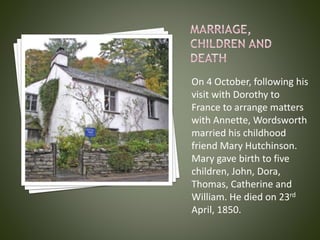
On 4 October, following his
visit with Dorothy to
France to arrange matters
with Annette, Wordsworth
married his childhood
friend Mary Hutchinson.
Mary gave birth to five
children, John, Dora,
Thomas, Catherine and
William. He died on 23rd
April, 1850.
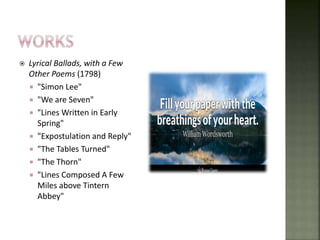
 Lyrical Ballads, with a Few
Other Poems (1798)
 "Simon Lee"
 "We are Seven"
 "Lines Written in Early
Spring"
 "Expostulation and Reply"
 "The Tables Turned"
 "The Thorn"
 "Lines Composed A Few
Miles above Tintern
Abbey"
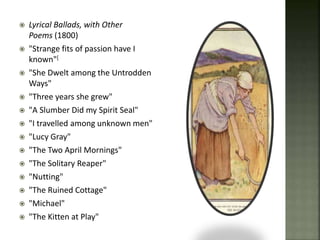
 Lyrical Ballads, with Other
Poems (1800)
 "Strange fits of passion have I
known"[
 "She Dwelt among the Untrodden
Ways"
 "Three years she grew"
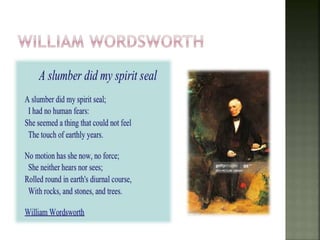
 "A Slumber Did my Spirit Seal"
 "I travelled among unknown men"
 "Lucy Gray"
 "The Two April Mornings"
 "The Solitary Reaper"
 "Nutting"
 "The Ruined Cottage"
 "Michael"
 "The Kitten at Play"
 Poems, in Two Volumes (1807)
 "Resolution and
Independence"
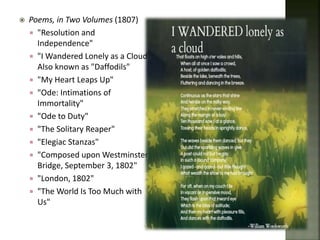
 "I Wandered Lonely as a Cloud"
Also known as "Daffodils"
 "My Heart Leaps Up"
 "Ode: Intimations of
Immortality"
 "Ode to Duty"
 "The Solitary Reaper"
 "Elegiac Stanzas"
 "Composed upon Westminster
Bridge, September 3, 1802"
 "London, 1802"
 "The World Is Too Much with
Us"
 "French Revolution" (1810)
 Guide to the Lakes (1810)
 "To the Cuckoo"
 The Excursion (1814)
 Laodamia (1815, 1845)
 The White Doe of
Rylstone (1815)
 Peter Bell (1819)
 Ecclesiastical
Sonnets (1822)
 The Prelude (1850)
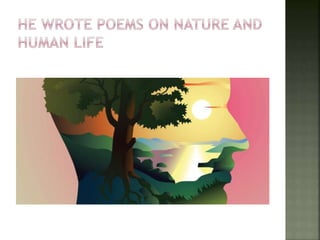
 William Wordsworth was the central figure in the
English Romantic revolution in poetry. His contribution
to it was threefold. First, he formulated in his poems
and his essays a new attitude toward nature. This was
more than a matter of introducing nature imagery into
his verse; it amounted to a fresh view of the organic
relation between man and the natural world, and it
culminated in metaphors of a wedding between
nature and the human mind, and beyond that, in the
sweeping metaphor of nature as emblematic of the
mind of God, a mind that “feeds upon infinity” and
“broods over the dark abyss.” Second, Wordsworth
probed deeply into his own sensibility as he traced, in
his finest poem, The Prelude, the “growth of a poet’s
mind.” The Prelude was in fact the first long
autobiographical poem. Writing it in a drawn-out
process of self-exploration.
 Wordsworth worked his way toward a modern
psychological understanding of his own nature,
and thus more broadly of human nature. Third,
Wordsworth placed poetry at the centre of human
experience; in impassioned rhetoric he
pronounced poetry to be nothing less than “the
first and last of all knowledge—it is as immortal as
the heart of man,” and he then went on to create
some of the greatest English poetry of his century.
It is probably safe to say that by the late 20th
century he stood in critical estimation where
Coleridge and Arnold had originally placed him,
next to John Milton—who stands, of course, next
to William Shakespeare.
 https://en.wikipedia.org/wiki/William_Word
sworth
 History of English literature by William J.
Long
 https://www.britannica.com/biography/Willi
am-Wordsworth/Late-work
William Wordsworth

William Wordsworth

  • 1.
    Life and worksprepared by Dipti Vaghela
  • 3.
     The secondof five children born to John Wordsworth and Ann Cookson, William Wordsworth was born on 7 April 1770 in what is now named Wordsworth House in Cockermouth, Cumberland.  Wordsworth was taught to read by his mother and attended, first, a tiny school of low quality in Cockermouth, then a school in Penrith for the children of upper-class families, where he was taught by Ann Birkett  After the death of Wordsworth's mother, in 1778, his father sent him to Hawkshead Grammar School in Lancashire. He received his B.A degree in 1791
  • 4.
    On 4 October,following his visit with Dorothy to France to arrange matters with Annette, Wordsworth married his childhood friend Mary Hutchinson. Mary gave birth to five children, John, Dora, Thomas, Catherine and William. He died on 23rd April, 1850.
  • 5.
     Lyrical Ballads,with a Few Other Poems (1798)  "Simon Lee"  "We are Seven"  "Lines Written in Early Spring"  "Expostulation and Reply"  "The Tables Turned"  "The Thorn"  "Lines Composed A Few Miles above Tintern Abbey"
  • 6.
     Lyrical Ballads,with Other Poems (1800)  "Strange fits of passion have I known"[  "She Dwelt among the Untrodden Ways"  "Three years she grew"  "A Slumber Did my Spirit Seal"  "I travelled among unknown men"  "Lucy Gray"  "The Two April Mornings"  "The Solitary Reaper"  "Nutting"  "The Ruined Cottage"  "Michael"  "The Kitten at Play"
  • 7.
     Poems, inTwo Volumes (1807)  "Resolution and Independence"  "I Wandered Lonely as a Cloud" Also known as "Daffodils"  "My Heart Leaps Up"  "Ode: Intimations of Immortality"  "Ode to Duty"  "The Solitary Reaper"  "Elegiac Stanzas"  "Composed upon Westminster Bridge, September 3, 1802"  "London, 1802"  "The World Is Too Much with Us"
  • 8.
     "French Revolution"(1810)  Guide to the Lakes (1810)  "To the Cuckoo"  The Excursion (1814)  Laodamia (1815, 1845)  The White Doe of Rylstone (1815)  Peter Bell (1819)  Ecclesiastical Sonnets (1822)  The Prelude (1850)
  • 10.
     William Wordsworthwas the central figure in the English Romantic revolution in poetry. His contribution to it was threefold. First, he formulated in his poems and his essays a new attitude toward nature. This was more than a matter of introducing nature imagery into his verse; it amounted to a fresh view of the organic relation between man and the natural world, and it culminated in metaphors of a wedding between nature and the human mind, and beyond that, in the sweeping metaphor of nature as emblematic of the mind of God, a mind that “feeds upon infinity” and “broods over the dark abyss.” Second, Wordsworth probed deeply into his own sensibility as he traced, in his finest poem, The Prelude, the “growth of a poet’s mind.” The Prelude was in fact the first long autobiographical poem. Writing it in a drawn-out process of self-exploration.
  • 11.
     Wordsworth workedhis way toward a modern psychological understanding of his own nature, and thus more broadly of human nature. Third, Wordsworth placed poetry at the centre of human experience; in impassioned rhetoric he pronounced poetry to be nothing less than “the first and last of all knowledge—it is as immortal as the heart of man,” and he then went on to create some of the greatest English poetry of his century. It is probably safe to say that by the late 20th century he stood in critical estimation where Coleridge and Arnold had originally placed him, next to John Milton—who stands, of course, next to William Shakespeare.
  • 12.
     https://en.wikipedia.org/wiki/William_Word sworth  Historyof English literature by William J. Long  https://www.britannica.com/biography/Willi am-Wordsworth/Late-work