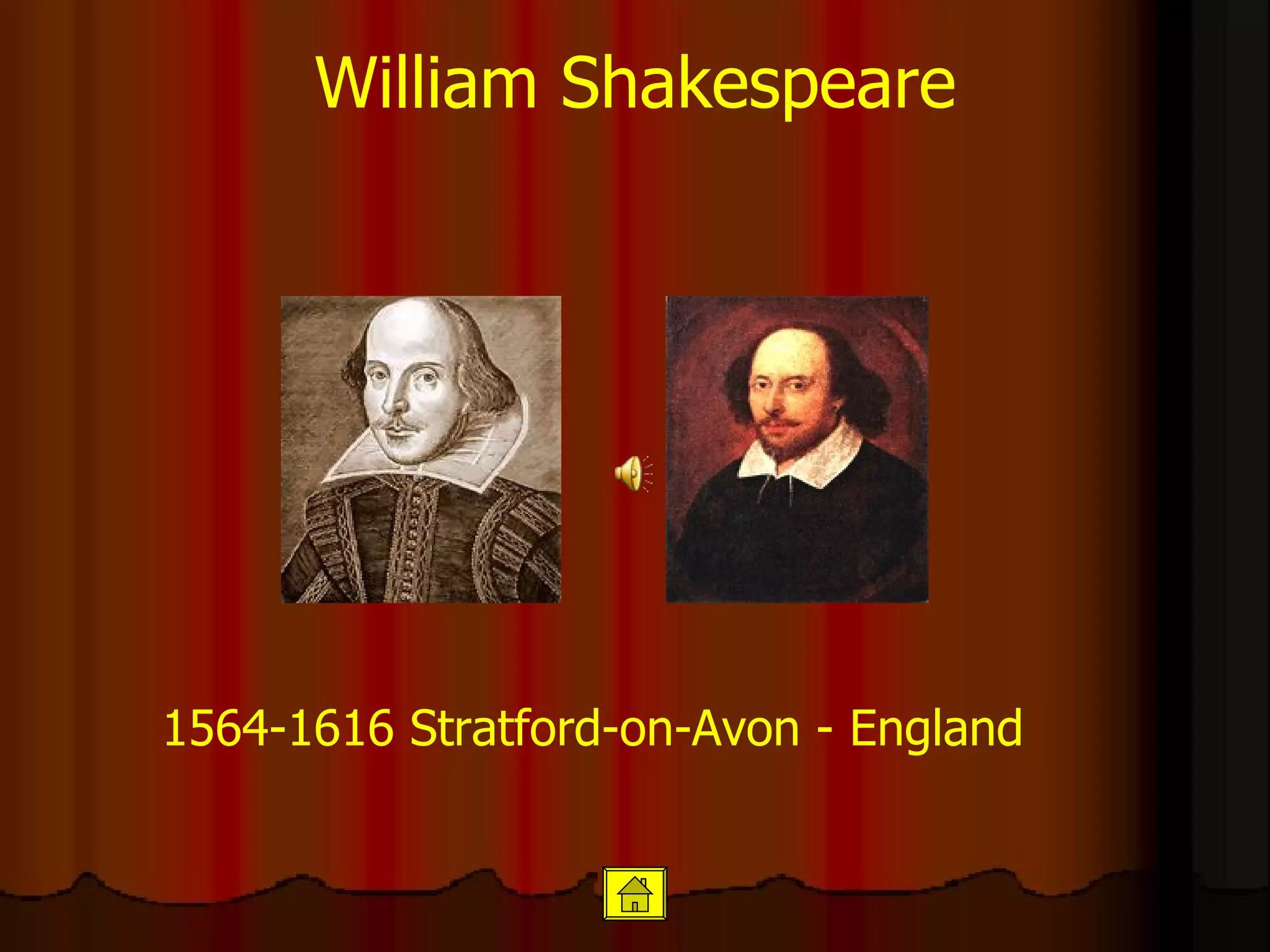
William Shakespeare 1564-1616 Stratford-on-Avon - England
Overview Who was he? Why is he so famous? Life Works Tragedy Comedy History Poetry Chronology Elements of drama Dramatic technique Poetic technique Elizabethan   theatre Sonnet  XVIII Macbeth Hamlet   Julius   Caesar Romeo and  Juliet Much   ado   about   nothing The Merchant of  Venice Links
Who was he? Widely regarded as the greatest writer in English Literature Poet and dramatist Wrote 37 plays:  comedies ,  histories ,  tragedies Composed about 154  sonnets  and a few  poems Started out as an actor
Life Born around April 23, 1564; 3rd of 8 children Family lived in  Stratford-on-Avon , a market town about 100 miles NW of London  Father (John) a shopkeeper. A man of considerable standing in Stratford. Served as Justice of the Peace and High Bailiff (mayor) Attended grammar school, where he studied Latin, grammar and literature, Rhetoric (the use of language). No further formal education known Marriage to Anne Hathaway,  8 years older than he,  3 children: Susanna (1583), Judith and Hamnet (twins, 1585)
Later life 1594 -  became shareholder in a company of actors called Lord Chamberlain’s Men  1599 -  Lord Chamberlain’s Co. Built Globe Theater where most of S. Play’s were performed 1599 - Actor for Lord Chamberlain’s Men and  principal playwright for them 1603 – James I became king of England; acting company renamed King’s Men 1610 – Shakespeare retired to Stratford-on-Avon  April 2 1616 – died at the age of 52
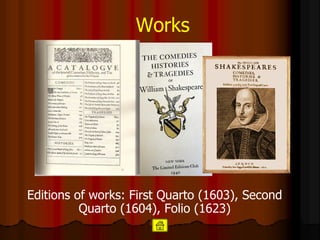
Works Editions of works: First Quarto (1603), Second Quarto (1604), Folio (1623)
Comedy A Midsummer Night's Dream All's Well That Ends Well As You Like It Cymbeline Loves Labours Lost Measure for Measure Much Ado About   Nothing Pericles, Prince of Tyre The Comedy of Errors The Merchant of Venice The Merry Wives of Windsor The Taming of the Shrew The Tempest Troilus and Cressida Twelfth Night Two Gentlemen of Verona Winter's Tale
Tragedy  Antony and Cleopatra Coriolanus Hamlet Julius Caesar King Lear   Macbeth Othello Romeo and Juliet Timon of Athens Titus Andronicus
History   Henry IV, part 1 Henry IV, part 2 Henry V Henry VI, part 1 Henry VI, part 2   Henry VI, part 3 Henry VIII King John Richard II Richard III
Poetry A Lover's Complaint Sonnets  (about 154) The Passionate Pilgrim The Phoenix and the turtle The Rape of Lucrece Venus and Adonis
Why is he still so famous?   His plays portray recognizable people in situations we experience in our lives:  love, marriage, death, mourning, guilt, the need to make difficult choices, separation, reunion and reconciliation   They do so with great  humanity, tolerance, and wisdom  They are constantly  fres h and can be adapted to the place and time they are performed  Their  language  is  wonderfully expressive  and  powerful   They help us to understand what it is to be   human , and to cope with the problems of being so
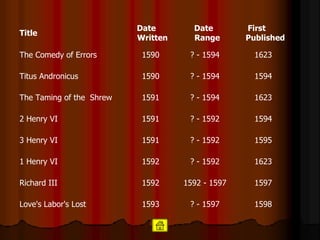
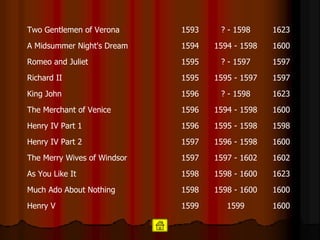
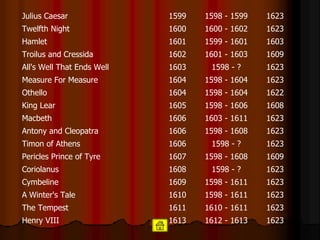
Chronology The problem with any timeline of Shakespeare's works is that most dates are subject to interpretation. While it is easy to say that  The Comedy of Errors  is an early work and  The Tempest  is quite later, exact dates are not - and may not ever be -proved.
1598 ? - 1597 1593 Love's Labor's Lost 1597 1592 - 1597 1592 Richard III 1623 ? - 1592 1592 1 Henry VI 1595 ? - 1592 1591 3 Henry VI 1594 ? - 1592 1591 2 Henry VI 1623 ? - 1594 1591 The Taming of the  Shrew 1594 ? - 1594 1590 Titus Andronicus 1623 ? - 1594 1590 The Comedy of Errors First Published Date Range Date Written Title
1600 1599 1599 Henry V 1600 1598 - 1600 1598 Much Ado About Nothing 1623 1598 - 1600 1598 As You Like It 1602 1597 - 1602 1597 The Merry Wives of Windsor 1600 1596 - 1598 1597 Henry IV Part 2 1598 1595 - 1598 1596 Henry IV Part 1 1600 1594 - 1598 1596 The Merchant of Venice 1623 ? - 1598 1596 King John 1597 1595 - 1597 1595 Richard II 1597 ? - 1597 1595 Romeo and Juliet 1600 1594 - 1598 1594 A Midsummer Night's Dream 1623 ? - 1598 1593 Two Gentlemen of Verona
1623 1612 - 1613 1613 Henry VIII 1623 1610 - 1611 1611 The Tempest 1623 1598 - 1611 1610 A Winter's Tale 1623 1598 - 1611 1609 Cymbeline 1623 1598 - ? 1608 Coriolanus 1609 1598 - 1608 1607 Pericles Prince of Tyre 1623 1598 - ? 1606 Timon of Athens 1623 1598 - 1608 1606 Antony and Cleopatra 1623 1603 - 1611 1606 Macbeth 1608 1598 - 1606 1605 King Lear 1622 1598 - 1604 1604 Othello 1623 1598 - 1604 1604 Measure For Measure 1623 1598 - ? 1603 All's Well That Ends Well 1609 1601 - 1603 1602 Troilus and Cressida 1603 1599 - 1601 1601 Hamlet 1623 1600 - 1602 1600 Twelfth Night 1623 1598 - 1599 1599 Julius Caesar
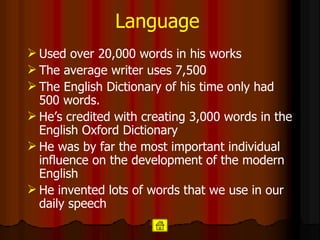
Language Used over 20,000 words in his works  The average writer uses 7,500  The English Dictionary of his time only had 500 words. He’s credited with creating 3,000 words in the English Oxford Dictionary He was by far the most important individual influence on the development of the modern English  He invented lots of words that we use in our daily speech
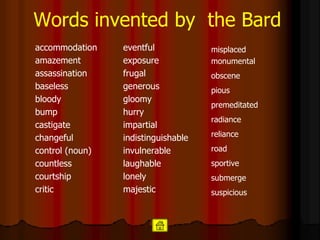
Words invented by  the Bard accommodation  amazement  assassination  baseless  bloody  bump  castigate  changeful  control (noun)  countless  courtship  critic  eventful  exposure  frugal  generous  gloomy  hurry  impartial  indistinguishable  invulnerable  laughable  lonely  majestic  misplaced  monumental  obscene  pious  premeditated  radiance reliance  road  sportive  submerge  suspicious
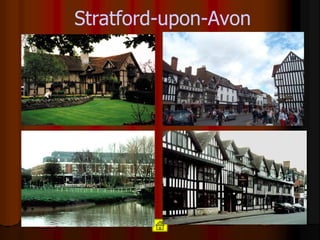
Stratford-upon-Avon
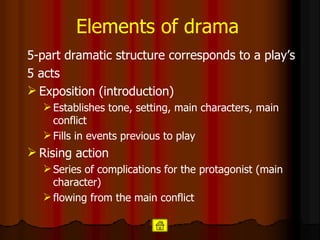
Elements of drama   5-part dramatic structure corresponds to a play’s 5 acts  Exposition (introduction)  Establishes tone, setting, main characters, main conflict  Fills in events previous to play  Rising action  Series of complications for the protagonist (main character) flowing from the main conflict
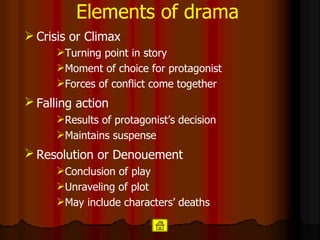
Crisis or Climax  Turning point in story  Moment of choice for protagonist  Forces of conflict come together  Falling action   Results of protagonist’s decision  Maintains suspense  Resolution or Denouement   Conclusion of play  Unraveling of plot  May include characters’ deaths Elements of drama
Dramatic technique Pun: play on words   involving  Word with more than one meaning  Words with similar sounds  Soliloquy  Speech of moderate to long length  Spoken by one actor alone on stage (or not heard by other actors)   Aside  Direct address by actor to audience  Not supposed to be overheard by other characters
Poetic technique Blank verse: unrhymed iambic pentameter  Iambic pentameter   5 units of rhythm per line  primary rhythm is iambic ( U / ) “ Shal Ì compàre Thée to a sùmmer’s dày”
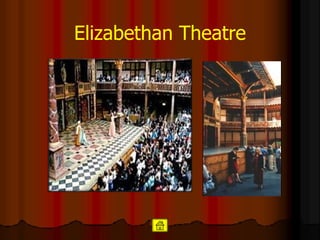
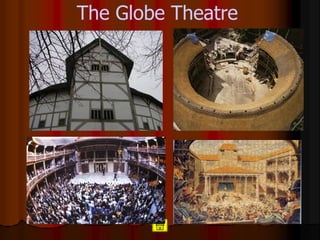
Typical 16th century theatre Building :  3 stories Levels 1 & 2,  Backstage: dressing and storage areas Level 3, Upper Stage: could represent balcony, walls of a castle, bridge of a ship  Resembled courtyard of an inn The Globe  Theatre
Elizabethan Theatre
The Globe Theatre
Proscenium stage  A large platform without a curtain or a stage setting  2 ornate pillars supported canopy Stage roof (underpart of canopy)  called “the heavens”  elaborately painted to depict the sun, moon, stars, planets
Trap doors: entrances and exits of ghosts; area under stage called Hell  2 large doors at back: actors made entrances and exits in full view of audience  Inner stage: a recess with balcony area above  Floor: ash mixed with hazelnut shells from snacks audience ate during performance  Effect on performance: plays held in afternoon  No roof  No artificial lighting  No scenery
Acting companies   Developed from the medieval trade guilds  Were composed of Only boys and men  Young boys performed female roles
Audience   2000-3000 people from all walks of life Well-to-do spectators sat in covered galleries around stage  Most stood in yard around platform stage – “groundlings”
The sonnets Containing some of the greatest lyric poems in English literature,  Shakespeare’s Sonnets  are not just the easy love sentiments of "Shall I compare thee to a summer's day." Many of the poems are bleak cries of emotional torment and spiritual exhaustion. They tell a story of the struggle of love and forgiveness against anguish and despair. It is this tragic portrait of human love that makes the sonnets immortal.
Sonnet 18 Shall I compare thee to a summer's day?  Thou art more lovely and more temperate: Rough winds do shake the darling buds of May,  And summer's lease hath all too short a date: Sometime too hot the eye of heaven shines,  And often is his gold complexion dimm'd;  And every fair from fair sometime declines,  By chance, or nature's changing course un-trimm'd; But thy eternal summer shall not fade,  Nor lose possession of that fair thou ow'st,  Nor shall death brag thou wander'st in his shade, When in eternal lines to time thou grow'st;  So long as men can breathe, or eyes can see,  So long lives this, and this gives life to thee
Paraphrase   of   Sonnet 18 Shall I compare you to a summer's day? You are more lovely and more moderate: Harsh winds disturb the delicate buds of May, and summer doesn't last long enough. Sometimes the sun is too hot, and its golden face is often dimmed by clouds. All beautiful things eventually become less beautiful, either by the experiences of life or by the passing of time. But your eternal beauty won't fade, nor lose any of its quality. And you will never die, as you will live on in my enduring poetry. As long as there are people still alive to read poems this sonnet will live, and you will live in it.
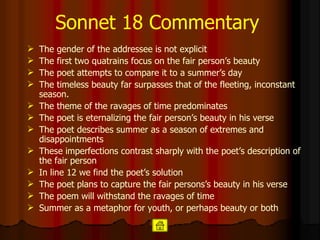
Sonnet 18 Commentary The gender of the addressee is not explicit   The first two quatrains focus on the fair person’s beauty   The poet attempts to compare it to a summer’s day The timeless beauty far surpasses that of the fleeting, inconstant season. The theme of the ravages of time predominates The poet is eternalizing the fair person’s beauty in his verse   The poet describes summer as a season of extremes and disappointments   These imperfections contrast sharply with the poet’s description of the fair person   In line 12 we find the poet’s solution  The poet plans to capture the fair persons’s beauty in his verse   The poem will withstand the ravages of time   Summer as a metaphor for youth, or perhaps beauty  or both
Figures of speeech Rhyming scheme:  ABAB CDCD EFEF GG.  Anaphora (the repetition of opening words) in lines 6-7, 10-11, and 13-14.   Metaphor: summer for youth or beauty or both Initial Rethorical question Comparison Personification Imagery
Sonnet   73 That time of year thou mayst in me behold When yellow leaves, or none, or few, do hang Upon those boughs which shake against the cold, Bare ruined choirs, where late the sweet birds sang. In me thou seest the twilight of such day As after sunset fadeth in the west, Which by and by black night doth take away, Death's second self, that seals up all in rest. In me thou see'st the glowing of such fire That on the ashes of his youth doth lie, As the death-bed whereon it must expire Consumed with that which it was nourish'd by. This thou perceivest, which makes thy love more strong, To love that well which thou must leave ere long.
Paraphrase   of Sonnet 73 In me you can see that time of year When a few yellow leaves or none at all hang On the branches, shaking against the cold, Bare ruins of church choirs where lately the sweet birds sang. In me you can see only the dim light that remains After the sun sets in the west, Which is soon extinguished by black night The image of death that envelops all in rest. In me you can see the glowing embers That lie upon the ashes remaining from the flame of my youth, As on a death bed where it (youth) must finally die Consumed by that which once fed it. This you sense, and it makes your love more determined To love more deeply that which you must give up before long.
Sonnet  130 My mistress' eyes are nothing like the sun, Coral is far more red, than her lips red, If snow be white, why then her breasts are dun: If hairs be wires, black wires grow on her head: I have seen roses damasked, red and white, But no such roses see I in her cheeks, And in some perfumes is there more delight, Than in the breath that from my mistress reeks. I love to hear her speak, yet well I know, That music hath a far more pleasing sound: I grant I never saw a goddess go, My mistress when she walks treads on the ground. And yet by heaven I think my love as rare, As any she belied with false compare.
Paraphrase of Sonnet 130 My mistress's eyes are not at all like the sun; Coral is much more red than her lips; If snow is white, then her breasts are certainly not white as snow; If hairs can be compared to wires, hers are black and not golden I have seen roses colored a combination of red and white  But I do not see such colors in her cheeks; And some perfumes give more delight Than the breath of my mistress. I love to hear her speak, but I know That music has a more pleasing sound than her voice; I also never saw a goddess walk; But I know that my mistress walks only on the ground. And yet I think my love as rare .As any woman who has had poetic untruths told about her
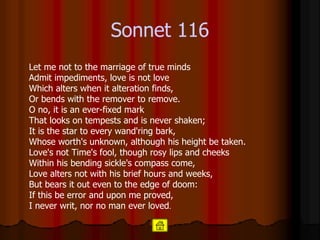
Sonnet  116 Let me not to the marriage of true minds Admit impediments, love is not love Which alters when it alteration finds, Or bends with the remover to remove. O no, it is an ever-fixed mark That looks on tempests and is never shaken; It is the star to every wand'ring bark, Whose worth's unknown, although his height be taken. Love's not Time's fool, though rosy lips and cheeks Within his bending sickle's compass come, Love alters not with his brief hours and weeks, But bears it out even to the edge of doom: If this be error and upon me proved, I never writ, nor no man ever loved .
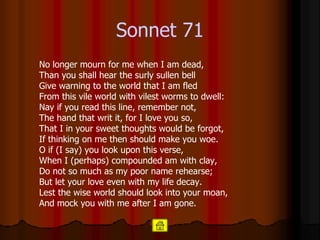
Sonnet  71 No longer mourn for me when I am dead, Than you shall hear the surly sullen bell Give warning to the world that I am fled From this vile world with vilest worms to dwell: Nay if you read this line, remember not, The hand that writ it, for I love you so, That I in your sweet thoughts would be forgot, If thinking on me then should make you woe. O if (I say) you look upon this verse, When I (perhaps) compounded am with clay, Do not so much as my poor name rehearse; But let your love even with my life decay. Lest the wise world should look into your moan, And mock you with me after I am gone.
Links Shakespeare  Resource   centre Mr  W. Shakespeare and the Internet No  sweat  Shakespeare Absolute  Shakespeare Shakespeare’ s  Movies Works in  Italian Shakespeare in  Modern   English Study   Guides Online  Guides One more guide

William Shakespeare Mt

  • 1.
    William Shakespeare 1564-1616Stratford-on-Avon - England
  • 2.
    Overview Who washe? Why is he so famous? Life Works Tragedy Comedy History Poetry Chronology Elements of drama Dramatic technique Poetic technique Elizabethan theatre Sonnet XVIII Macbeth Hamlet Julius Caesar Romeo and Juliet Much ado about nothing The Merchant of Venice Links
  • 3.
    Who was he?Widely regarded as the greatest writer in English Literature Poet and dramatist Wrote 37 plays: comedies , histories , tragedies Composed about 154 sonnets and a few poems Started out as an actor
  • 4.
    Life Born aroundApril 23, 1564; 3rd of 8 children Family lived in Stratford-on-Avon , a market town about 100 miles NW of London Father (John) a shopkeeper. A man of considerable standing in Stratford. Served as Justice of the Peace and High Bailiff (mayor) Attended grammar school, where he studied Latin, grammar and literature, Rhetoric (the use of language). No further formal education known Marriage to Anne Hathaway, 8 years older than he, 3 children: Susanna (1583), Judith and Hamnet (twins, 1585)
  • 5.
    Later life 1594- became shareholder in a company of actors called Lord Chamberlain’s Men 1599 - Lord Chamberlain’s Co. Built Globe Theater where most of S. Play’s were performed 1599 - Actor for Lord Chamberlain’s Men and principal playwright for them 1603 – James I became king of England; acting company renamed King’s Men 1610 – Shakespeare retired to Stratford-on-Avon April 2 1616 – died at the age of 52
  • 6.
    Works Editions ofworks: First Quarto (1603), Second Quarto (1604), Folio (1623)
  • 7.
    Comedy A MidsummerNight's Dream All's Well That Ends Well As You Like It Cymbeline Loves Labours Lost Measure for Measure Much Ado About Nothing Pericles, Prince of Tyre The Comedy of Errors The Merchant of Venice The Merry Wives of Windsor The Taming of the Shrew The Tempest Troilus and Cressida Twelfth Night Two Gentlemen of Verona Winter's Tale
  • 8.
    Tragedy Antonyand Cleopatra Coriolanus Hamlet Julius Caesar King Lear Macbeth Othello Romeo and Juliet Timon of Athens Titus Andronicus
  • 9.
    History Henry IV, part 1 Henry IV, part 2 Henry V Henry VI, part 1 Henry VI, part 2 Henry VI, part 3 Henry VIII King John Richard II Richard III
  • 10.
    Poetry A Lover'sComplaint Sonnets (about 154) The Passionate Pilgrim The Phoenix and the turtle The Rape of Lucrece Venus and Adonis
  • 11.
    Why is hestill so famous? His plays portray recognizable people in situations we experience in our lives: love, marriage, death, mourning, guilt, the need to make difficult choices, separation, reunion and reconciliation They do so with great humanity, tolerance, and wisdom They are constantly fres h and can be adapted to the place and time they are performed Their language is wonderfully expressive and powerful They help us to understand what it is to be human , and to cope with the problems of being so
  • 12.
    Chronology The problemwith any timeline of Shakespeare's works is that most dates are subject to interpretation. While it is easy to say that The Comedy of Errors is an early work and The Tempest is quite later, exact dates are not - and may not ever be -proved.
  • 13.
    1598 ? -1597 1593 Love's Labor's Lost 1597 1592 - 1597 1592 Richard III 1623 ? - 1592 1592 1 Henry VI 1595 ? - 1592 1591 3 Henry VI 1594 ? - 1592 1591 2 Henry VI 1623 ? - 1594 1591 The Taming of the Shrew 1594 ? - 1594 1590 Titus Andronicus 1623 ? - 1594 1590 The Comedy of Errors First Published Date Range Date Written Title
  • 14.
    1600 1599 1599Henry V 1600 1598 - 1600 1598 Much Ado About Nothing 1623 1598 - 1600 1598 As You Like It 1602 1597 - 1602 1597 The Merry Wives of Windsor 1600 1596 - 1598 1597 Henry IV Part 2 1598 1595 - 1598 1596 Henry IV Part 1 1600 1594 - 1598 1596 The Merchant of Venice 1623 ? - 1598 1596 King John 1597 1595 - 1597 1595 Richard II 1597 ? - 1597 1595 Romeo and Juliet 1600 1594 - 1598 1594 A Midsummer Night's Dream 1623 ? - 1598 1593 Two Gentlemen of Verona
  • 15.
    1623 1612 -1613 1613 Henry VIII 1623 1610 - 1611 1611 The Tempest 1623 1598 - 1611 1610 A Winter's Tale 1623 1598 - 1611 1609 Cymbeline 1623 1598 - ? 1608 Coriolanus 1609 1598 - 1608 1607 Pericles Prince of Tyre 1623 1598 - ? 1606 Timon of Athens 1623 1598 - 1608 1606 Antony and Cleopatra 1623 1603 - 1611 1606 Macbeth 1608 1598 - 1606 1605 King Lear 1622 1598 - 1604 1604 Othello 1623 1598 - 1604 1604 Measure For Measure 1623 1598 - ? 1603 All's Well That Ends Well 1609 1601 - 1603 1602 Troilus and Cressida 1603 1599 - 1601 1601 Hamlet 1623 1600 - 1602 1600 Twelfth Night 1623 1598 - 1599 1599 Julius Caesar
  • 16.
    Language Used over20,000 words in his works The average writer uses 7,500 The English Dictionary of his time only had 500 words. He’s credited with creating 3,000 words in the English Oxford Dictionary He was by far the most important individual influence on the development of the modern English He invented lots of words that we use in our daily speech
  • 17.
    Words invented by the Bard accommodation amazement assassination baseless bloody bump castigate changeful control (noun) countless courtship critic eventful exposure frugal generous gloomy hurry impartial indistinguishable invulnerable laughable lonely majestic misplaced monumental obscene pious premeditated radiance reliance road sportive submerge suspicious
  • 18.
  • 19.
    Elements of drama 5-part dramatic structure corresponds to a play’s 5 acts Exposition (introduction) Establishes tone, setting, main characters, main conflict Fills in events previous to play Rising action Series of complications for the protagonist (main character) flowing from the main conflict
  • 20.
    Crisis or Climax Turning point in story Moment of choice for protagonist Forces of conflict come together Falling action Results of protagonist’s decision Maintains suspense Resolution or Denouement Conclusion of play Unraveling of plot May include characters’ deaths Elements of drama
  • 21.
    Dramatic technique Pun:play on words involving Word with more than one meaning Words with similar sounds Soliloquy Speech of moderate to long length Spoken by one actor alone on stage (or not heard by other actors) Aside Direct address by actor to audience Not supposed to be overheard by other characters
  • 22.
    Poetic technique Blankverse: unrhymed iambic pentameter Iambic pentameter 5 units of rhythm per line primary rhythm is iambic ( U / ) “ Shal Ì compàre Thée to a sùmmer’s dày”
  • 23.
    Typical 16th centurytheatre Building : 3 stories Levels 1 & 2, Backstage: dressing and storage areas Level 3, Upper Stage: could represent balcony, walls of a castle, bridge of a ship Resembled courtyard of an inn The Globe Theatre
  • 24.
  • 25.
  • 26.
    Proscenium stage A large platform without a curtain or a stage setting 2 ornate pillars supported canopy Stage roof (underpart of canopy) called “the heavens” elaborately painted to depict the sun, moon, stars, planets
  • 27.
    Trap doors: entrancesand exits of ghosts; area under stage called Hell 2 large doors at back: actors made entrances and exits in full view of audience Inner stage: a recess with balcony area above Floor: ash mixed with hazelnut shells from snacks audience ate during performance Effect on performance: plays held in afternoon No roof No artificial lighting No scenery
  • 28.
    Acting companies Developed from the medieval trade guilds Were composed of Only boys and men Young boys performed female roles
  • 29.
    Audience 2000-3000 people from all walks of life Well-to-do spectators sat in covered galleries around stage Most stood in yard around platform stage – “groundlings”
  • 30.
    The sonnets Containingsome of the greatest lyric poems in English literature, Shakespeare’s Sonnets are not just the easy love sentiments of "Shall I compare thee to a summer's day." Many of the poems are bleak cries of emotional torment and spiritual exhaustion. They tell a story of the struggle of love and forgiveness against anguish and despair. It is this tragic portrait of human love that makes the sonnets immortal.
  • 31.
    Sonnet 18 ShallI compare thee to a summer's day? Thou art more lovely and more temperate: Rough winds do shake the darling buds of May, And summer's lease hath all too short a date: Sometime too hot the eye of heaven shines, And often is his gold complexion dimm'd; And every fair from fair sometime declines, By chance, or nature's changing course un-trimm'd; But thy eternal summer shall not fade, Nor lose possession of that fair thou ow'st, Nor shall death brag thou wander'st in his shade, When in eternal lines to time thou grow'st; So long as men can breathe, or eyes can see, So long lives this, and this gives life to thee
  • 32.
    Paraphrase of Sonnet 18 Shall I compare you to a summer's day? You are more lovely and more moderate: Harsh winds disturb the delicate buds of May, and summer doesn't last long enough. Sometimes the sun is too hot, and its golden face is often dimmed by clouds. All beautiful things eventually become less beautiful, either by the experiences of life or by the passing of time. But your eternal beauty won't fade, nor lose any of its quality. And you will never die, as you will live on in my enduring poetry. As long as there are people still alive to read poems this sonnet will live, and you will live in it.
  • 33.
    Sonnet 18 CommentaryThe gender of the addressee is not explicit The first two quatrains focus on the fair person’s beauty The poet attempts to compare it to a summer’s day The timeless beauty far surpasses that of the fleeting, inconstant season. The theme of the ravages of time predominates The poet is eternalizing the fair person’s beauty in his verse The poet describes summer as a season of extremes and disappointments These imperfections contrast sharply with the poet’s description of the fair person In line 12 we find the poet’s solution The poet plans to capture the fair persons’s beauty in his verse The poem will withstand the ravages of time Summer as a metaphor for youth, or perhaps beauty or both
  • 34.
    Figures of speeechRhyming scheme: ABAB CDCD EFEF GG. Anaphora (the repetition of opening words) in lines 6-7, 10-11, and 13-14. Metaphor: summer for youth or beauty or both Initial Rethorical question Comparison Personification Imagery
  • 35.
    Sonnet 73 That time of year thou mayst in me behold When yellow leaves, or none, or few, do hang Upon those boughs which shake against the cold, Bare ruined choirs, where late the sweet birds sang. In me thou seest the twilight of such day As after sunset fadeth in the west, Which by and by black night doth take away, Death's second self, that seals up all in rest. In me thou see'st the glowing of such fire That on the ashes of his youth doth lie, As the death-bed whereon it must expire Consumed with that which it was nourish'd by. This thou perceivest, which makes thy love more strong, To love that well which thou must leave ere long.
  • 36.
    Paraphrase of Sonnet 73 In me you can see that time of year When a few yellow leaves or none at all hang On the branches, shaking against the cold, Bare ruins of church choirs where lately the sweet birds sang. In me you can see only the dim light that remains After the sun sets in the west, Which is soon extinguished by black night The image of death that envelops all in rest. In me you can see the glowing embers That lie upon the ashes remaining from the flame of my youth, As on a death bed where it (youth) must finally die Consumed by that which once fed it. This you sense, and it makes your love more determined To love more deeply that which you must give up before long.
  • 37.
    Sonnet 130My mistress' eyes are nothing like the sun, Coral is far more red, than her lips red, If snow be white, why then her breasts are dun: If hairs be wires, black wires grow on her head: I have seen roses damasked, red and white, But no such roses see I in her cheeks, And in some perfumes is there more delight, Than in the breath that from my mistress reeks. I love to hear her speak, yet well I know, That music hath a far more pleasing sound: I grant I never saw a goddess go, My mistress when she walks treads on the ground. And yet by heaven I think my love as rare, As any she belied with false compare.
  • 38.
    Paraphrase of Sonnet130 My mistress's eyes are not at all like the sun; Coral is much more red than her lips; If snow is white, then her breasts are certainly not white as snow; If hairs can be compared to wires, hers are black and not golden I have seen roses colored a combination of red and white But I do not see such colors in her cheeks; And some perfumes give more delight Than the breath of my mistress. I love to hear her speak, but I know That music has a more pleasing sound than her voice; I also never saw a goddess walk; But I know that my mistress walks only on the ground. And yet I think my love as rare .As any woman who has had poetic untruths told about her
  • 39.
    Sonnet 116Let me not to the marriage of true minds Admit impediments, love is not love Which alters when it alteration finds, Or bends with the remover to remove. O no, it is an ever-fixed mark That looks on tempests and is never shaken; It is the star to every wand'ring bark, Whose worth's unknown, although his height be taken. Love's not Time's fool, though rosy lips and cheeks Within his bending sickle's compass come, Love alters not with his brief hours and weeks, But bears it out even to the edge of doom: If this be error and upon me proved, I never writ, nor no man ever loved .
  • 40.
    Sonnet 71No longer mourn for me when I am dead, Than you shall hear the surly sullen bell Give warning to the world that I am fled From this vile world with vilest worms to dwell: Nay if you read this line, remember not, The hand that writ it, for I love you so, That I in your sweet thoughts would be forgot, If thinking on me then should make you woe. O if (I say) you look upon this verse, When I (perhaps) compounded am with clay, Do not so much as my poor name rehearse; But let your love even with my life decay. Lest the wise world should look into your moan, And mock you with me after I am gone.
  • 41.
    Links Shakespeare Resource centre Mr W. Shakespeare and the Internet No sweat Shakespeare Absolute Shakespeare Shakespeare’ s Movies Works in Italian Shakespeare in Modern English Study Guides Online Guides One more guide