BORN : Baptised 26 April 1564 (birth date unknown)
       Stratford-upon-Avon, Warwickshire, England.

DIED : 23 April 1616 (aged 52)
       Stratford-upon-Avon, Warwickshire, England.

OCCUPATION : Playwright, poet, actor

PARENTS : John Shakespeare (father)
         Mary Shakespeare (mother)

SPOUSE : Anne Hathaway

CHILDREN : Susanna Hall
          Hamnet Shakespeare
          Judith Quiney
William Shakespeare was the son of John Shakespeare, an alderman and a
successful glover originally from Snitterfield, Mary Arden, the daughter of an
affluent landowning farmer. He was born in Stratford-upon-Avon and baptised
there on 26 April 1564. His actual birth date remains unknown, but is
traditionally observed on 23 April, St George’s Day. This date, which can be traced
back to an 18th-century scholar's mistake, has proved appealing to biographers,
since Shakespeare died 23 April 1616. He was the third child of eight and the eldest
surviving son. Although no attendance records for the period survive, most
biographers agree that Shakespeare was probably educated at the King’s new
school at Stratford, a free school chartered in 1553,about a quarter-mile from his
home .
Shakespeare was a respected poet and playwright in his own day, but his
reputation did not rise to its present heights until the 19th century. The Romantics,
in particular, acclaimed Shakespeare's genius, and the Victorians worshipped
Shakespeare with a reverence that George Bernard Shaw called “bardolatry”.
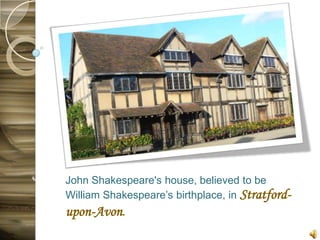
John Shakespeare's house, believed to be
William Shakespeare’s birthplace, in Stratford-
upon-Avon.
Greene's attack is the earliest surviving mention of Shakespeare’s career in the
theatre. Biographers suggest that his career may have begun any time from the
mid-1580s to just before Greene's remarks. From 1594, Shakespeare's plays were
performed by only the Lord Chamberlain's men, a company owned by a group of
players, including Shakespeare, that soon became the leading playing company in
London.
Some of Shakespeare's plays were published in quarto editions from 1594. By
1598, his name had become a selling point and began to appear on the title
pages. Shakespeare continued to act in his own and other plays after his success
as a playwright. The First Folio of 1623, however, lists Shakespeare as one of
"the Principal Actors in all these Plays", some of which were first staged after
Volpone, although we cannot know for certain which roles he played.


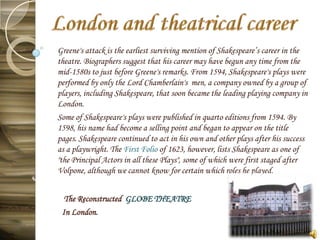
  The Reconstructed GLOBE THEATRE
 In London.
Most playwrights of the period typically collaborated with others at some point,
and critics agree that Shakespeare did the same, mostly early and late in his career.
Some attributions, such as Titus Andronicus and the early history plays, remain
controversial, while The Two Noble Kinsmen and the lost Cardenio have well-
attested contemporary documentation.
The first recorded works of Shakespeare are Richard III and the three parts of
Henry VI, written in the early 1590s during a vogue for historical drama.
Shakespeare's plays are difficult to date, however, and studies of the texts suggest
that Titus Andronicus, The Comedy of Errors, The Taming of the Shrew and The
Two Gentlemen Of Verona may also belong to Shakespeare’s earliest period.


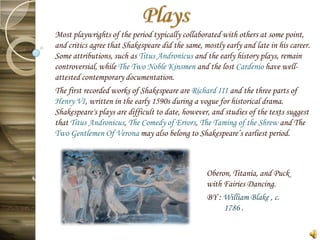
                                                  Oberon, Titania, and Puck
                                                  with Fairies Dancing.
                                                  BY : William Blake , c.
                                                       1786 .
Among Shakespeare’s greatest contribution
to the English Language
must be the introduction of new vocabulary
and phrases which have enriched the
language making it more colorful and
expressive. Some estimates at the number of
words coined by Shakespeare number in
several thousands
Shakespeare's writings greatly influenced the entire English language. Prior to
and during Shakespeare's time, the grammar and rules of English were not
fixed. But once Shakespeare's plays became popular in the late seventeenth
and eighteenth century, they helped contribute to the standardization of the
English language, with many Shakespearean words and phrases becoming
embedded in the English language, particularly through projects such as
Samuel Johnson’s A Dictionary of English Language which quoted
Shakespeare more than any other writer. He expanded the scope of English
literature by introducing new words and phrases, experimenting with blank
verse, and also introducing new poetic and grammatical structures.
COMEDIES                      HISTORIES         LOST PLAYS
All’s Well that Ends Well     King John         Love’s Labour Won
The Two Gentlemen Of Verona
As You Like It
                              Richard II        The History Of Cardenio
The Comedy Of Errors          Henry IV Part 1
Love’s Labour’s Lost          Henry IV Part 2
Measure for Measure
                              Henry V
The Merchant Of Venice
The Merry Wives Of Windsor    Henry VI Part 1
A Midsummer Night’s dream     Henry VI Part 2
Much Ado About Nothing        Henry VI Part 3
Pericles, Prince of Tyre
The Taming Of The Shrew
                              Richard III
The Tempest                   Henry VIII
Twelfth Night
The Two Noble Kinsmen
The Winter’s Tale
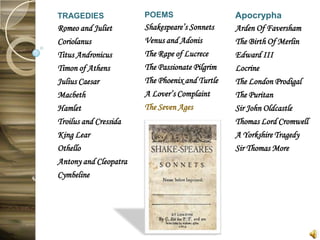
TRAGEDIES              POEMS                    Apocrypha
Romeo and Juliet       Shakespeare’s Sonnets    Arden Of Faversham
Coriolanus             Venus and Adonis         The Birth Of Merlin
Titus Andronicus       The Rape of Lucrece      Edward III
Timon of Athens        The Passionate Pilgrim   Locrine
Julius Caesar          The Phoenix and Turtle   The London Prodigal
Macbeth                A Lover’s Complaint      The Puritan
Hamlet                 The Seven Ages           Sir John Oldcastle
Troilus and Cressida                            Thomas Lord Cromwell
King Lear                                       A Yorkshire Tragedy
Othello                                         Sir Thomas More
Antony and Cleopatra
Cymbeline
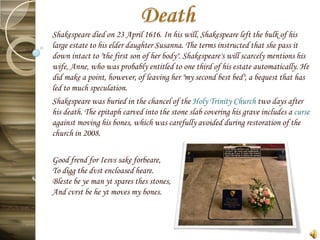
Shakespeare died on 23 April 1616. In his will, Shakespeare left the bulk of his
large estate to his elder daughter Susanna. The terms instructed that she pass it
down intact to "the first son of her body". Shakespeare's will scarcely mentions his
wife, Anne, who was probably entitled to one third of his estate automatically. He
did make a point, however, of leaving her "my second best bed", a bequest that has
led to much speculation.
Shakespeare was buried in the chancel of the Holy Trinity Church two days after
his death. The epitaph carved into the stone slab covering his grave includes a curse
against moving his bones, which was carefully avoided during restoration of the
church in 2008.

Good frend for Iesvs sake forbeare,
To digg the dvst encloased heare.
Bleste be ye man yt spares thes stones,
And cvrst be he yt moves my bones.
William shakespeare

William shakespeare

  • 2.
    BORN : Baptised26 April 1564 (birth date unknown) Stratford-upon-Avon, Warwickshire, England. DIED : 23 April 1616 (aged 52) Stratford-upon-Avon, Warwickshire, England. OCCUPATION : Playwright, poet, actor PARENTS : John Shakespeare (father) Mary Shakespeare (mother) SPOUSE : Anne Hathaway CHILDREN : Susanna Hall Hamnet Shakespeare Judith Quiney
  • 3.
    William Shakespeare wasthe son of John Shakespeare, an alderman and a successful glover originally from Snitterfield, Mary Arden, the daughter of an affluent landowning farmer. He was born in Stratford-upon-Avon and baptised there on 26 April 1564. His actual birth date remains unknown, but is traditionally observed on 23 April, St George’s Day. This date, which can be traced back to an 18th-century scholar's mistake, has proved appealing to biographers, since Shakespeare died 23 April 1616. He was the third child of eight and the eldest surviving son. Although no attendance records for the period survive, most biographers agree that Shakespeare was probably educated at the King’s new school at Stratford, a free school chartered in 1553,about a quarter-mile from his home . Shakespeare was a respected poet and playwright in his own day, but his reputation did not rise to its present heights until the 19th century. The Romantics, in particular, acclaimed Shakespeare's genius, and the Victorians worshipped Shakespeare with a reverence that George Bernard Shaw called “bardolatry”.
  • 4.
    John Shakespeare's house,believed to be William Shakespeare’s birthplace, in Stratford- upon-Avon.
  • 5.
    Greene's attack isthe earliest surviving mention of Shakespeare’s career in the theatre. Biographers suggest that his career may have begun any time from the mid-1580s to just before Greene's remarks. From 1594, Shakespeare's plays were performed by only the Lord Chamberlain's men, a company owned by a group of players, including Shakespeare, that soon became the leading playing company in London. Some of Shakespeare's plays were published in quarto editions from 1594. By 1598, his name had become a selling point and began to appear on the title pages. Shakespeare continued to act in his own and other plays after his success as a playwright. The First Folio of 1623, however, lists Shakespeare as one of "the Principal Actors in all these Plays", some of which were first staged after Volpone, although we cannot know for certain which roles he played. The Reconstructed GLOBE THEATRE In London.
  • 6.
    Most playwrights ofthe period typically collaborated with others at some point, and critics agree that Shakespeare did the same, mostly early and late in his career. Some attributions, such as Titus Andronicus and the early history plays, remain controversial, while The Two Noble Kinsmen and the lost Cardenio have well- attested contemporary documentation. The first recorded works of Shakespeare are Richard III and the three parts of Henry VI, written in the early 1590s during a vogue for historical drama. Shakespeare's plays are difficult to date, however, and studies of the texts suggest that Titus Andronicus, The Comedy of Errors, The Taming of the Shrew and The Two Gentlemen Of Verona may also belong to Shakespeare’s earliest period. Oberon, Titania, and Puck with Fairies Dancing. BY : William Blake , c. 1786 .
  • 7.
    Among Shakespeare’s greatestcontribution to the English Language must be the introduction of new vocabulary and phrases which have enriched the language making it more colorful and expressive. Some estimates at the number of words coined by Shakespeare number in several thousands Shakespeare's writings greatly influenced the entire English language. Prior to and during Shakespeare's time, the grammar and rules of English were not fixed. But once Shakespeare's plays became popular in the late seventeenth and eighteenth century, they helped contribute to the standardization of the English language, with many Shakespearean words and phrases becoming embedded in the English language, particularly through projects such as Samuel Johnson’s A Dictionary of English Language which quoted Shakespeare more than any other writer. He expanded the scope of English literature by introducing new words and phrases, experimenting with blank verse, and also introducing new poetic and grammatical structures.
  • 8.
    COMEDIES HISTORIES LOST PLAYS All’s Well that Ends Well King John Love’s Labour Won The Two Gentlemen Of Verona As You Like It Richard II The History Of Cardenio The Comedy Of Errors Henry IV Part 1 Love’s Labour’s Lost Henry IV Part 2 Measure for Measure Henry V The Merchant Of Venice The Merry Wives Of Windsor Henry VI Part 1 A Midsummer Night’s dream Henry VI Part 2 Much Ado About Nothing Henry VI Part 3 Pericles, Prince of Tyre The Taming Of The Shrew Richard III The Tempest Henry VIII Twelfth Night The Two Noble Kinsmen The Winter’s Tale
  • 9.
    TRAGEDIES POEMS Apocrypha Romeo and Juliet Shakespeare’s Sonnets Arden Of Faversham Coriolanus Venus and Adonis The Birth Of Merlin Titus Andronicus The Rape of Lucrece Edward III Timon of Athens The Passionate Pilgrim Locrine Julius Caesar The Phoenix and Turtle The London Prodigal Macbeth A Lover’s Complaint The Puritan Hamlet The Seven Ages Sir John Oldcastle Troilus and Cressida Thomas Lord Cromwell King Lear A Yorkshire Tragedy Othello Sir Thomas More Antony and Cleopatra Cymbeline
  • 10.
    Shakespeare died on23 April 1616. In his will, Shakespeare left the bulk of his large estate to his elder daughter Susanna. The terms instructed that she pass it down intact to "the first son of her body". Shakespeare's will scarcely mentions his wife, Anne, who was probably entitled to one third of his estate automatically. He did make a point, however, of leaving her "my second best bed", a bequest that has led to much speculation. Shakespeare was buried in the chancel of the Holy Trinity Church two days after his death. The epitaph carved into the stone slab covering his grave includes a curse against moving his bones, which was carefully avoided during restoration of the church in 2008. Good frend for Iesvs sake forbeare, To digg the dvst encloased heare. Bleste be ye man yt spares thes stones, And cvrst be he yt moves my bones.