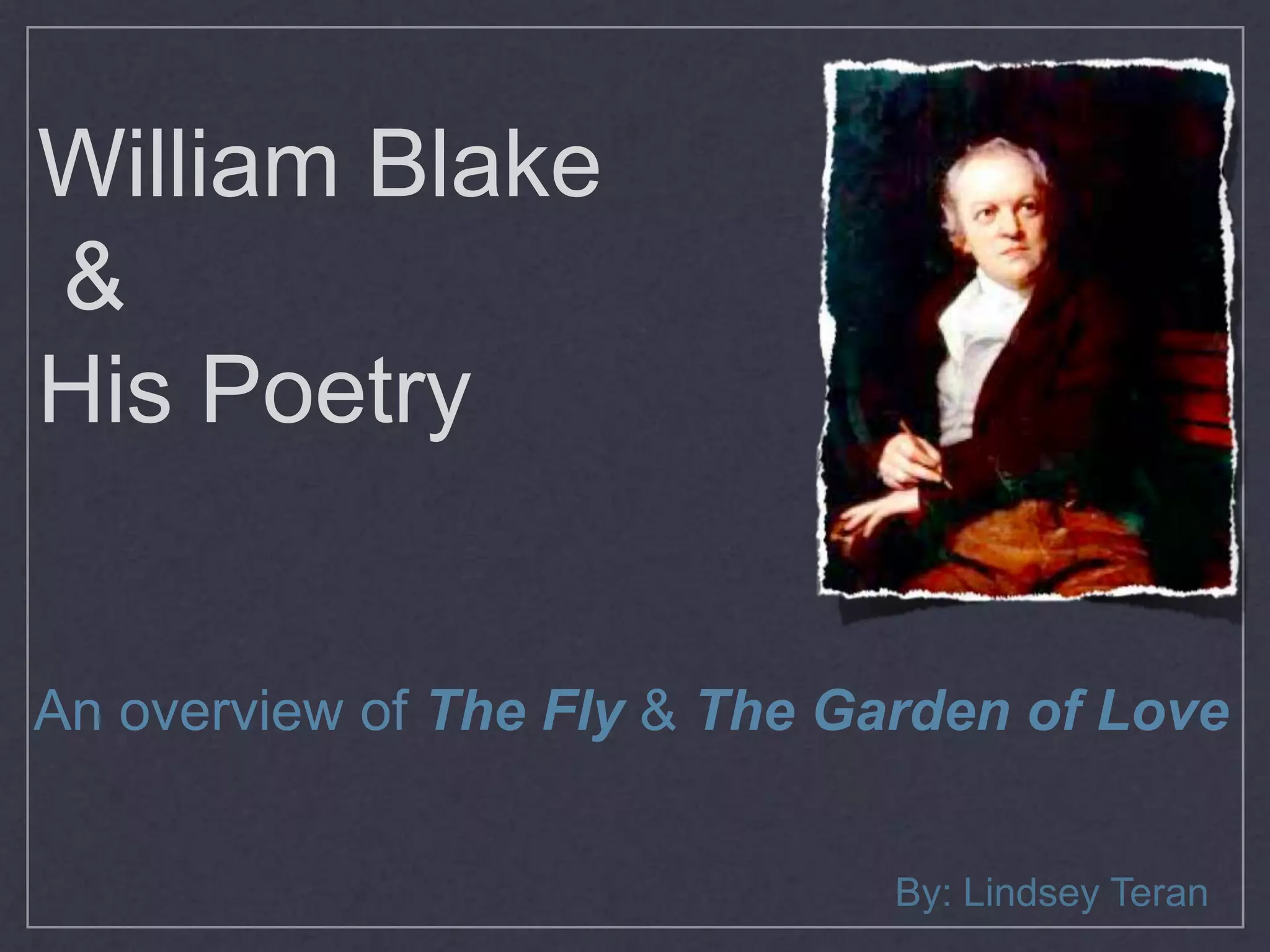
William Blake
&
His Poetry
An overview of The Fly & The Garden of Love
By: Lindsey Teran
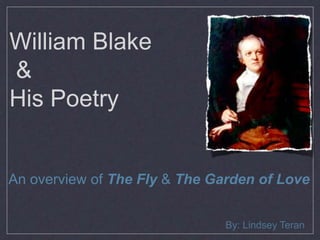
William Blake
Date & Location of Birth: November 28, 1757 in London, England
Date & Location of Death: August 12, 1827 in London, England
Genre: Visionary, poetry
Literary Movement: Romanticism
Spouse: Catherine Boucher
William Blake was born to James and Catherine Blake, from an early age Blake
would say that he had visions of unseen things. He did not attend a regular public
school and instead stayed at home to learn. By the age of 10 William wanted to
become a painter so his parents sent him to a drawing school; it was only 2 years
later at the age of 12, that he began writing poetry. In 1782 William and Catherine
Boucher married, the couple did not have any children. William Blake was a firm
believer that poetry no matter what could be understood by people no matter what.
However, he would not give himself away in order to become popular.
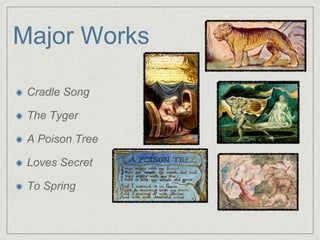
Major Works
Cradle Song
The Tyger
A Poison Tree
Loves Secret
To Spring
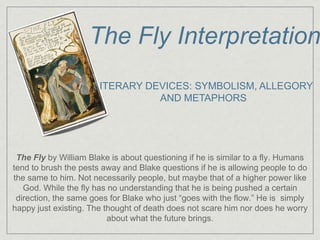
The Fly Interpretation
The Fly by William Blake is about questioning if he is similar to a fly. Humans
tend to brush the pests away and Blake questions if he is allowing people to do
the same to him. Not necessarily people, but maybe that of a higher power like
God. While the fly has no understanding that he is being pushed a certain
direction, the same goes for Blake who just “goes with the flow.” He is simply
happy just existing. The thought of death does not scare him nor does he worry
about what the future brings.
LITERARY DEVICES: SYMBOLISM, ALLEGORY
AND METAPHORS
The Garden of Love
Interpretation
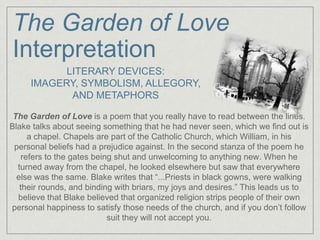
The Garden of Love is a poem that you really have to read between the lines.
Blake talks about seeing something that he had never seen, which we find out is
a chapel. Chapels are part of the Catholic Church, which William, in his
personal beliefs had a prejudice against. In the second stanza of the poem he
refers to the gates being shut and unwelcoming to anything new. When he
turned away from the chapel, he looked elsewhere but saw that everywhere
else was the same. Blake writes that “...Priests in black gowns, were walking
their rounds, and binding with briars, my joys and desires.” This leads us to
believe that Blake believed that organized religion strips people of their own
personal happiness to satisfy those needs of the church, and if you don’t follow
suit they will not accept you.
LITERARY DEVICES:
IMAGERY, SYMBOLISM, ALLEGORY,
AND METAPHORS
Compare & Contrast
Both The Fly and The Garden of Love deal with William Blake’s
personal beliefs. While The Fly deals more with the finding of oneself
and the assurance of being happy in life. The Garden of Love gives the
audience a confirmation that William Blake has specific beliefs and that
no matter how other people treat him he will not sacrifice himself for
popularity among the people. Both of the pieces have similar literary
devices, such as metaphors and allegories. Blake does an excellent
job of making the reader feel as if they are there with him and both
poems had that effect throughout the pieces.
Works Cited
"William Blake." Poets.org. Academy of American Poets, n.d. Web. 21 Mar. 2014.
http://www.poets.org/poet.php/prmPID/116.
"Best Famous William Blake Poems." Poetry Soup. Poetry Soup, n.d. Web. 21 Mar. 2014.
<http%3A%2F%2Fwww.poetrysoup.com%2Ffamous%2Fpoems%2Fbest%2Fwilliam_blake>.
"William Blake : The Fly." William Blake : The Fly. Portable Poetry, n.d. Web. 21 Mar. 2014.
http://www.portablepoetry.com/poems/william_blake/the_fly.html.
Blake, William. "The Garden of Love." Poetry Foundation. Poetry Foundation, n.d. Web. 21 Mar. 2014.
http://www.poetryfoundation.org/poem/175220.
"Google Images." Google Images. N.p., n.d. Web. 19 Mar. 2014. <http://www.google.com/imghp>.

William Blake and His Poetry

  • 1.
    William Blake & His Poetry Anoverview of The Fly & The Garden of Love By: Lindsey Teran
  • 2.
    William Blake Date &Location of Birth: November 28, 1757 in London, England Date & Location of Death: August 12, 1827 in London, England Genre: Visionary, poetry Literary Movement: Romanticism Spouse: Catherine Boucher William Blake was born to James and Catherine Blake, from an early age Blake would say that he had visions of unseen things. He did not attend a regular public school and instead stayed at home to learn. By the age of 10 William wanted to become a painter so his parents sent him to a drawing school; it was only 2 years later at the age of 12, that he began writing poetry. In 1782 William and Catherine Boucher married, the couple did not have any children. William Blake was a firm believer that poetry no matter what could be understood by people no matter what. However, he would not give himself away in order to become popular.
  • 3.
    Major Works Cradle Song TheTyger A Poison Tree Loves Secret To Spring
  • 4.
    The Fly Interpretation TheFly by William Blake is about questioning if he is similar to a fly. Humans tend to brush the pests away and Blake questions if he is allowing people to do the same to him. Not necessarily people, but maybe that of a higher power like God. While the fly has no understanding that he is being pushed a certain direction, the same goes for Blake who just “goes with the flow.” He is simply happy just existing. The thought of death does not scare him nor does he worry about what the future brings. LITERARY DEVICES: SYMBOLISM, ALLEGORY AND METAPHORS
  • 5.
    The Garden ofLove Interpretation The Garden of Love is a poem that you really have to read between the lines. Blake talks about seeing something that he had never seen, which we find out is a chapel. Chapels are part of the Catholic Church, which William, in his personal beliefs had a prejudice against. In the second stanza of the poem he refers to the gates being shut and unwelcoming to anything new. When he turned away from the chapel, he looked elsewhere but saw that everywhere else was the same. Blake writes that “...Priests in black gowns, were walking their rounds, and binding with briars, my joys and desires.” This leads us to believe that Blake believed that organized religion strips people of their own personal happiness to satisfy those needs of the church, and if you don’t follow suit they will not accept you. LITERARY DEVICES: IMAGERY, SYMBOLISM, ALLEGORY, AND METAPHORS
  • 6.
    Compare & Contrast BothThe Fly and The Garden of Love deal with William Blake’s personal beliefs. While The Fly deals more with the finding of oneself and the assurance of being happy in life. The Garden of Love gives the audience a confirmation that William Blake has specific beliefs and that no matter how other people treat him he will not sacrifice himself for popularity among the people. Both of the pieces have similar literary devices, such as metaphors and allegories. Blake does an excellent job of making the reader feel as if they are there with him and both poems had that effect throughout the pieces.
  • 7.
    Works Cited "William Blake."Poets.org. Academy of American Poets, n.d. Web. 21 Mar. 2014. http://www.poets.org/poet.php/prmPID/116. "Best Famous William Blake Poems." Poetry Soup. Poetry Soup, n.d. Web. 21 Mar. 2014. <http%3A%2F%2Fwww.poetrysoup.com%2Ffamous%2Fpoems%2Fbest%2Fwilliam_blake>. "William Blake : The Fly." William Blake : The Fly. Portable Poetry, n.d. Web. 21 Mar. 2014. http://www.portablepoetry.com/poems/william_blake/the_fly.html. Blake, William. "The Garden of Love." Poetry Foundation. Poetry Foundation, n.d. Web. 21 Mar. 2014. http://www.poetryfoundation.org/poem/175220. "Google Images." Google Images. N.p., n.d. Web. 19 Mar. 2014. <http://www.google.com/imghp>.