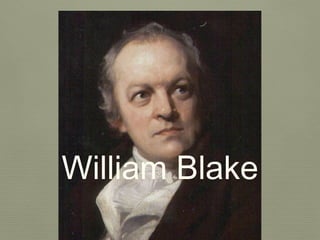
William Blake
History
•William was born on November 28th, 1757, in
Soho, United Kingdom.
•He died on August 12, 1827, in London, United
Kingdom.
•He lived during the Romanticism Period.
Influences
•Throughout his life, William claimed to have
visions of angels, and other holy figures.
•When he was ten, he was enrolled in Henry Par’s
drawing school. Here, he was taught how to sketch
people by observing Greek and Roman sculpture.
•He also bought prints of Raphael, Michelangelo,
Giulio Romano, Albrecht Durer, and Maerten
Heemskerck.
Influences
•At age fourteen, he became an apprentice for
James Basire.
•At Basire’s shop he learned how to engrave.
•He was also influenced by Jacob Bryant, who was
an antiquarian and mythographer.
Works
•“Poetical Sketches” in 1783
•“An Island and the Moon” 1784-1785
•“All Religions are One” and “There is No Natural
Religion” in 1788
•“Songs of Innocence” and “The Book of Thel”
and “Tiriel” in 1789-1790
•“The Marriage of Heaven and Hell” in 1790
Works
• Composes and engraves six original designs for Mary
Wollstonecraft’s “Original Stories from Real Life” in
1791.
• “Visions from the Daughters of Albion,” “America a
Prophecy,” and “For Children,” in 1793
• “Europe: A Prophecy,” “Songs of Experience,” “The
Book of Urizen,” in 1794.
• “For the Sexes: The Gates of Paradise” in 1820
The Garden of Love
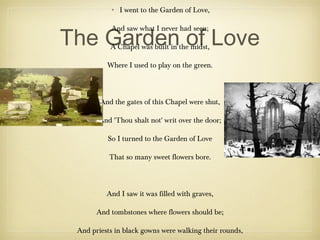
• I went to the Garden of Love,
And saw what I never had seen;
A Chapel was built in the midst,
Where I used to play on the green.
And the gates of this Chapel were shut,
And 'Thou shalt not' writ over the door;
So I turned to the Garden of Love
That so many sweet flowers bore.
And I saw it was filled with graves,
And tombstones where flowers should be;
And priests in black gowns were walking their rounds,
Analysis
•This poem describes a man who has found that his
once happy childhood is dominated by a church,
which is the Chapel. His once happy childhood
memories are gone, and replaced by death and grief,
represented by the tombstones. It seems that he is
despairing over the fact that he cannot love who he
chooses, and he cannot be happy with the eyes of the
church upon him. The rhyme scheme is ABCB
DEFE for the first two stanzas, and the last stanza
does not rhyme.
The Divine Image
For Mercy, Pity, Peace, and Love
Is God, our Father dear,
And Mercy, Pity, Peace, and Love
Is man, His child and care.
For Mercy has a human heart,
Pity a human face,
And Love, the human form divine,
And Peace, the human dress.
Then every man, of every clime,
That prays in his distress,
Prays to the human form divine,
Love, Mercy, Pity, Peace.
Analysis
•Mercy, Pity, Peace and Love are the “virtues of
delight,” and everyone prays to them in times of
need. The prayers are not just to God, but to the
divine form of humans. Therefore, everyone must
respect the four virtues regardless of religion or
culture. The rhyme scheme is ABCB-ABAC-
ABCB-ABAC-ABCB, and is composed of five
quatrains.
Works cited
• Crosby, Mark. "Chronology." William Blake Archive. Morris Eaves, Robert N. Essick, Joseph Viscomi, 1996-2014. Web. 24
Mar. 2014. <http://www.blakearchive.org/blake/chronology.html>.
• Vultee, Denise. "Biography." About Blake. Morris Eaves, Robert N. Essick, Joseph Viscomi, 2005-2011. Web. 24 Mar. 2014. <
http://www.blakearchive.org/exist/blake/archive/biography.xq?b=biography&targ_div=d1>.
• "The Divine Image." Poetry Lovers' Page. Poetryloverspage.com, 1995-2013. Web. 24 Mar. 2014. <
http://www.poetryloverspage.com/poets/blake/divine_image.html>.
• "The Garden of Love." Poetry Lovers' Page. Poetryloverspage.com, 1995-2013. Web. 24 Mar. 2014.
<http://www.poetryloverspage.com/poets/blake/garden_of_love.html>.

William Blake PowerPoint

  • 1.
  • 2.
    History •William was bornon November 28th, 1757, in Soho, United Kingdom. •He died on August 12, 1827, in London, United Kingdom. •He lived during the Romanticism Period.
  • 3.
    Influences •Throughout his life,William claimed to have visions of angels, and other holy figures. •When he was ten, he was enrolled in Henry Par’s drawing school. Here, he was taught how to sketch people by observing Greek and Roman sculpture. •He also bought prints of Raphael, Michelangelo, Giulio Romano, Albrecht Durer, and Maerten Heemskerck.
  • 4.
    Influences •At age fourteen,he became an apprentice for James Basire. •At Basire’s shop he learned how to engrave. •He was also influenced by Jacob Bryant, who was an antiquarian and mythographer.
  • 5.
    Works •“Poetical Sketches” in1783 •“An Island and the Moon” 1784-1785 •“All Religions are One” and “There is No Natural Religion” in 1788 •“Songs of Innocence” and “The Book of Thel” and “Tiriel” in 1789-1790 •“The Marriage of Heaven and Hell” in 1790
  • 6.
    Works • Composes andengraves six original designs for Mary Wollstonecraft’s “Original Stories from Real Life” in 1791. • “Visions from the Daughters of Albion,” “America a Prophecy,” and “For Children,” in 1793 • “Europe: A Prophecy,” “Songs of Experience,” “The Book of Urizen,” in 1794. • “For the Sexes: The Gates of Paradise” in 1820
  • 7.
    The Garden ofLove • I went to the Garden of Love, And saw what I never had seen; A Chapel was built in the midst, Where I used to play on the green. And the gates of this Chapel were shut, And 'Thou shalt not' writ over the door; So I turned to the Garden of Love That so many sweet flowers bore. And I saw it was filled with graves, And tombstones where flowers should be; And priests in black gowns were walking their rounds,
  • 8.
    Analysis •This poem describesa man who has found that his once happy childhood is dominated by a church, which is the Chapel. His once happy childhood memories are gone, and replaced by death and grief, represented by the tombstones. It seems that he is despairing over the fact that he cannot love who he chooses, and he cannot be happy with the eyes of the church upon him. The rhyme scheme is ABCB DEFE for the first two stanzas, and the last stanza does not rhyme.
  • 9.
    The Divine Image ForMercy, Pity, Peace, and Love Is God, our Father dear, And Mercy, Pity, Peace, and Love Is man, His child and care. For Mercy has a human heart, Pity a human face, And Love, the human form divine, And Peace, the human dress. Then every man, of every clime, That prays in his distress, Prays to the human form divine, Love, Mercy, Pity, Peace.
  • 10.
    Analysis •Mercy, Pity, Peaceand Love are the “virtues of delight,” and everyone prays to them in times of need. The prayers are not just to God, but to the divine form of humans. Therefore, everyone must respect the four virtues regardless of religion or culture. The rhyme scheme is ABCB-ABAC- ABCB-ABAC-ABCB, and is composed of five quatrains.
  • 11.
    Works cited • Crosby,Mark. "Chronology." William Blake Archive. Morris Eaves, Robert N. Essick, Joseph Viscomi, 1996-2014. Web. 24 Mar. 2014. <http://www.blakearchive.org/blake/chronology.html>. • Vultee, Denise. "Biography." About Blake. Morris Eaves, Robert N. Essick, Joseph Viscomi, 2005-2011. Web. 24 Mar. 2014. < http://www.blakearchive.org/exist/blake/archive/biography.xq?b=biography&targ_div=d1>. • "The Divine Image." Poetry Lovers' Page. Poetryloverspage.com, 1995-2013. Web. 24 Mar. 2014. < http://www.poetryloverspage.com/poets/blake/divine_image.html>. • "The Garden of Love." Poetry Lovers' Page. Poetryloverspage.com, 1995-2013. Web. 24 Mar. 2014. <http://www.poetryloverspage.com/poets/blake/garden_of_love.html>.