ALFONSO SINTJAGO
GAPSA REPORT
GAPSA President
GAPSA
The graduate and professional student governance on the Twin Cities campus of
the University of Minnesota rests with the Graduate and Professional Student
Assembly (GAPSA). All currently registered graduate and professional students at
the University of Minnesota are members of GAPSA. It was established in 1990 as a
non-profit (IRS 501 (c)(3)) confederation of independent college councils
representing all graduate and professional students at the University of Minnesota to
the Board of Regents, the President of the University, the University Senate, the
University at large and wider community. GAPSA serves as a resource for member
councils, as the primary contact point for administrative units, as a graduate and
professional student policy-making and policy-influencing body, and as a center of
intercollegiate and intra-collegiate interaction among students.
Internal Changes
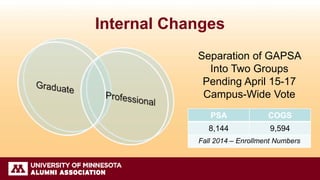
Separation of GAPSA
Into Two Groups
Pending April 15-17
Campus-Wide Vote
PSA COGS
8,144 9,594
Fall 2014 – Enrollment Numbers
Programming Goals
• Cirque de Stress and Mental Health Awareness
• Concert Series, TEDxUMN, and Edutainment
• Greater Grad. and Prof. Attendance at “Support the U”
• Appreciation Week and Welcome Week
• Advising and Mentoring Award
• Mary McEvoy Public Engagement & Leadership Award
• Emphasize Council’s Programing & Pass-Through
Advocacy Goals
• Joint Efforts Via the MSLC Platform.
• Approved Resolutions
– Tuition Freeze For Out of State Students
– Removing Race from Crime Alerts
– Support for The Immigration Innovation Act of 2015
– Improve Recruitment of Underrepresented Grad. Students
– Reducing Parking Costs on Evening and Weekends
• Also:
– Improve Childcare Services for Grad and Prof. Students*
– Promoting FASTR and Open Knowledge*
– Platform 2014-2015
International Student Alumni
• Increase In the Number of Grad. And Prof. International Students
(2,500+ at UMN). Many Work As TAs and RAs.
• Establishment of the Council of International Graduate Students
(CIGS) (2014) – Supporting A Sense of Community.
• What Connections Does the UMAA Currently Have With
International Student Alumni? How Can We Establish a Better
Connection With International Student Alumni?
• Questions: What Do They Do Now? How Was Their Study-Abroad
Experience in the US? How Many Currently Live In The United
States?
An International Student
& Alumni Challenge
After graduating, international students under an F1 Visa can apply for OPT. If an
employer would like to continue employing them past the year of OPT the student
receives after graduating, the company must sponsor the student. Students then
compete for only 85k H1B visa spots available. These same spots are available to
any international citizen hoping to work in the United States. With over 800k
international students in the US alone, 85k is a very small number. Due to the lack
of certainty that the visa will be made available despite the company’s interest in
hiring a student, an employee may reconsider hiring that student, to the detriment of
the student and the investment made by the university in support of that student.
Should international students who completed their studies in the United States be
subject to the same H1B quota as other foreign workers? This quota has already
been removed for certain types of employment.
Benefits of Removing the Quota
GAPSA Resolution (Approved Jan. 21, 2014)
http://z.umn.edu/H1BQuota Highlights How:
• Many International Students come here in search of opportunities and
would like to contribute to the United States.
• International Students invest in The United States, and the University
also invests in these students.
• Advanced Degrees provide economic gains and positive returns on
investment, while also generating more jobs.
• Diversity enriches society, and promotes an exchange of ideas. How
The United States has historically benefited from immigration
Support for the Immigration
Innovation Act of 2015
• The Bill Removes The H1B Cap for Advanced Degrees.
• The Bill Benefits All Graduates Not Only STEM Majors.
• The Bill Changes Student Visas Into Dual Intent Visas.
• The Bill Allows Spouses of H1B Recipients to Work.
The Passage of This Bill Could Improve The Experience of International
Students in the United States, While At The Same Time Benefit The US
Economy. It Primarily Removes The Apprehension An Employer May Have
If They Plan To Sponsor An International Student.
Relationship With The UMAA
International students represent close to 10% of the
student population. Many became very successful in the
United States, but others left and had very successful
careers elsewhere, sometimes because they were unable
to find a sponsor in the United States. We are interested
in their stories, and improving the relationship with
international student alumni, most of whom had a very
positive experience while at the UMN.
Why is Being in the UMAA Board Important?
Thank you for including two students in the UMAA Board.
There are many benefits to the graduate and professional
student body by having a member in this body. From
Alumni-Student events to legislative advocacy, and a
shared concern for the future of the UMN, being a part of
this body helps us in being more connected and improves
GAPSA’s advocacy as student government.
Thanks!

GAPSA - UMN Alumni Association Update - Jan 2015

  • 1.
  • 2.
    GAPSA The graduate andprofessional student governance on the Twin Cities campus of the University of Minnesota rests with the Graduate and Professional Student Assembly (GAPSA). All currently registered graduate and professional students at the University of Minnesota are members of GAPSA. It was established in 1990 as a non-profit (IRS 501 (c)(3)) confederation of independent college councils representing all graduate and professional students at the University of Minnesota to the Board of Regents, the President of the University, the University Senate, the University at large and wider community. GAPSA serves as a resource for member councils, as the primary contact point for administrative units, as a graduate and professional student policy-making and policy-influencing body, and as a center of intercollegiate and intra-collegiate interaction among students.
  • 3.
    Internal Changes Separation ofGAPSA Into Two Groups Pending April 15-17 Campus-Wide Vote PSA COGS 8,144 9,594 Fall 2014 – Enrollment Numbers
  • 4.
    Programming Goals • Cirquede Stress and Mental Health Awareness • Concert Series, TEDxUMN, and Edutainment • Greater Grad. and Prof. Attendance at “Support the U” • Appreciation Week and Welcome Week • Advising and Mentoring Award • Mary McEvoy Public Engagement & Leadership Award • Emphasize Council’s Programing & Pass-Through
  • 5.
    Advocacy Goals • JointEfforts Via the MSLC Platform. • Approved Resolutions – Tuition Freeze For Out of State Students – Removing Race from Crime Alerts – Support for The Immigration Innovation Act of 2015 – Improve Recruitment of Underrepresented Grad. Students – Reducing Parking Costs on Evening and Weekends • Also: – Improve Childcare Services for Grad and Prof. Students* – Promoting FASTR and Open Knowledge* – Platform 2014-2015
  • 6.
    International Student Alumni •Increase In the Number of Grad. And Prof. International Students (2,500+ at UMN). Many Work As TAs and RAs. • Establishment of the Council of International Graduate Students (CIGS) (2014) – Supporting A Sense of Community. • What Connections Does the UMAA Currently Have With International Student Alumni? How Can We Establish a Better Connection With International Student Alumni? • Questions: What Do They Do Now? How Was Their Study-Abroad Experience in the US? How Many Currently Live In The United States?
  • 7.
    An International Student &Alumni Challenge After graduating, international students under an F1 Visa can apply for OPT. If an employer would like to continue employing them past the year of OPT the student receives after graduating, the company must sponsor the student. Students then compete for only 85k H1B visa spots available. These same spots are available to any international citizen hoping to work in the United States. With over 800k international students in the US alone, 85k is a very small number. Due to the lack of certainty that the visa will be made available despite the company’s interest in hiring a student, an employee may reconsider hiring that student, to the detriment of the student and the investment made by the university in support of that student. Should international students who completed their studies in the United States be subject to the same H1B quota as other foreign workers? This quota has already been removed for certain types of employment.
  • 8.
    Benefits of Removingthe Quota GAPSA Resolution (Approved Jan. 21, 2014) http://z.umn.edu/H1BQuota Highlights How: • Many International Students come here in search of opportunities and would like to contribute to the United States. • International Students invest in The United States, and the University also invests in these students. • Advanced Degrees provide economic gains and positive returns on investment, while also generating more jobs. • Diversity enriches society, and promotes an exchange of ideas. How The United States has historically benefited from immigration
  • 9.
    Support for theImmigration Innovation Act of 2015 • The Bill Removes The H1B Cap for Advanced Degrees. • The Bill Benefits All Graduates Not Only STEM Majors. • The Bill Changes Student Visas Into Dual Intent Visas. • The Bill Allows Spouses of H1B Recipients to Work. The Passage of This Bill Could Improve The Experience of International Students in the United States, While At The Same Time Benefit The US Economy. It Primarily Removes The Apprehension An Employer May Have If They Plan To Sponsor An International Student.
  • 10.
    Relationship With TheUMAA International students represent close to 10% of the student population. Many became very successful in the United States, but others left and had very successful careers elsewhere, sometimes because they were unable to find a sponsor in the United States. We are interested in their stories, and improving the relationship with international student alumni, most of whom had a very positive experience while at the UMN.
  • 11.
    Why is Beingin the UMAA Board Important? Thank you for including two students in the UMAA Board. There are many benefits to the graduate and professional student body by having a member in this body. From Alumni-Student events to legislative advocacy, and a shared concern for the future of the UMN, being a part of this body helps us in being more connected and improves GAPSA’s advocacy as student government. Thanks!