Warm-up
nagaRAJU
Which do you think is the number one requirement for being
a good teacher?
1. is able to maintain discipline and order
2. works hard to remain up-to-date in his or her subject
3. admits when he or she made a mistake
4. is interested in the personal lives and issues of students
5. makes the students work hard and sets high standards
6. Is friendly with and helpful to colleagues
7. makes learning interesting using creative materials and methods
8. helps the students become independent
Discussion
nagaRAJU
How can I get my students talk in my
English class?
How can I increase the time students
spend using English?
Icebreaker
nagaRAJU
Two volunteers to unmute and interact
Get up?
Breakfast?
College?
Lunch?
Evening?
Go out?
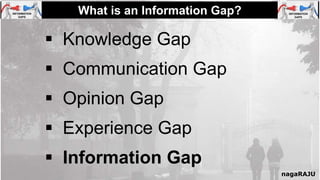
What is an Information Gap?
nagaRAJU
 Knowledge Gap
 Communication Gap
 Opinion Gap
 Experience Gap
 Information Gap
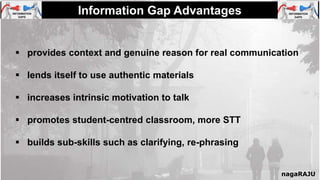
Information Gap Advantages
nagaRAJU
 provides context and genuine reason for real communication
 lends itself to use authentic materials
 increases intrinsic motivation to talk
 promotes student-centred classroom, more STT
 builds sub-skills such as clarifying, re-phrasing
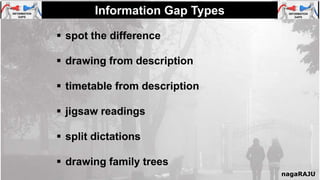
Information Gap Types
nagaRAJU
 spot the difference
 drawing from description
 timetable from description
 jigsaw readings
 split dictations
 drawing family trees
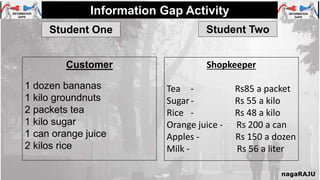
Information Gap Activity
nagaRAJU
Student One Student Two
Customer
1 dozen bananas
1 kilo groundnuts
2 packets tea
1 kilo sugar
1 can orange juice
2 kilos rice
Shopkeeper
Tea - Rs85 a packet
Sugar- Rs 55 a kilo
Rice - Rs 48 a kilo
Orange juice - Rs 200 a can
Apples - Rs 150 a dozen
Milk - Rs 56 a liter
Information Gap Activity
nagaRAJU
Student One Student Two
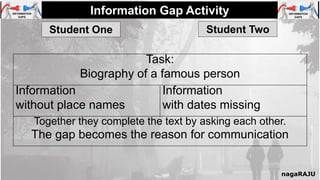
Task:
Biography of a famous person
Information
without place names
Information
with dates missing
Together they complete the text by asking each other.
The gap becomes the reason for communication
Information Gap Activity
nagaRAJU
Student One Student Two
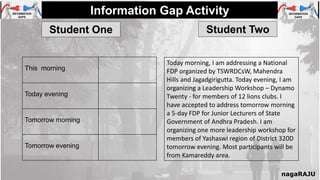
This morning
Today evening
Tomorrow morning
Tomorrow evening
Today morning, I am addressing a National
FDP organized by TSWRDCsW, Mahendra
Hills and Jagadgirigutta. Today evening, I am
organizing a Leadership Workshop – Dynamo
Twenty - for members of 12 lions clubs. I
have accepted to address tomorrow morning
a 5-day FDP for Junior Lecturers of State
Government of Andhra Pradesh. I am
organizing one more leadership workshop for
members of Yashaswi region of District 320D
tomorrow evening. Most participants will be
from Kamareddy area.
Information Gap Activity
nagaRAJU
Student One Student Two
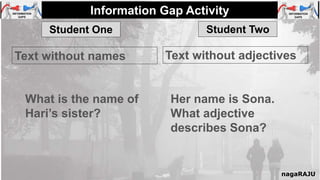
Her name is Sona.
What adjective
describes Sona?
What is the name of
Hari’s sister?
Text without adjectivesText without names
Information Gap Activity
nagaRAJU
Student One Student Two
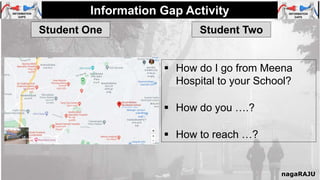
 How do I go from Meena
Hospital to your School?
 How do you ….?
 How to reach …?
Information Gap Activity
nagaRAJU
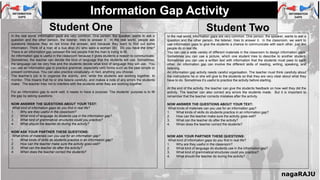
In the real world, information gaps are very common. One person, the speaker, wants to ask a
question and the other person, the listener, tries to answer it. In the real world, people ask
questions because they do not know the answer, and because they want to find out some
information. Think of a man at a bus stop (A) who asks a woman (B): Do you have the time?
There is an information gap between the two people that the man is trying to fill.
An information gap is useful in the classroom because it gives students a reason to communicate.
Sometimes, the teacher can decide the kind of language that the students will use. Sometimes,
the language can be very free and the students decide what kind of language they will use. You
can use an information gap to practice grammar, especially verb forms such as the past simple or
present continuous. You can also practice vocabulary--in fact, anything you choose.
The teacher’s job is to organize the activity, and, while the students are working together, to
monitor. This means that he or she listens carefully, and makes a note of any errors the students
make. The teacher tries not to interfere with the students while they are working together.
For an information gap to work well, it needs to have a purpose. The students’ purpose is to fill
the gap by asking questions.
NOW ANSWER THE QUESTIONS ABOUT YOUR TEXT:
What kind of information gaps do you find in real life?
1. Why are they useful in the classroom?
2. What kind of language do students use in the information gap?
3. What kind of grammatical structures could you practice?
4. What should the teacher do during the activity?
NOW ASK YOUR PARTNER THESE QUESTIONS:
What kinds of materials can you use for an information gap?
1. What kinds of skills do students practice in an information gap?
2. How can the teacher make sure the activity goes well?
3. What can the teacher do after the activity?
4. When does the teacher correct the students?
In the real world, information gaps are very common. One person, the speaker, wants to ask a
question and the other person, the listener, tries to answer it. In the classroom, we want to
use information gaps to give the students a chance to communicate with each other, just like
people do in real life.
You can use a wide variety of different materials in the classroom to design information gaps.
Sometimes you can use a picture, which one student tries to describe to another student.
Sometimes you can use a written text with information that the students must pass to each
other. An information gap can involve the different skills of reading, writing, speaking, and
listening.
An information gap activity needs careful organisation. The teacher must think carefully about
the instructions he or she will give to the students so that they are very clear about what they
have to do. Sometimes it’s useful to practice the activity before starting.
At the end of the activity, the teacher can give the students feedback on how well they did the
activity. The teacher can also correct any errors the students made. But it is important to
remember that the teacher corrects mistakes after the activity.
NOW ANSWER THE QUESTIONS ABOUT YOUR TEXT:
What kinds of materials can you use for an information gap?
1. What kinds of skills do students practice in an information gap?
2. How can the teacher make sure the activity goes well?
3. What can the teacher do after the activity?
4. When does the teacher correct the students?
NOW ASK YOUR PARTNER THESE QUESTIONS:
What kind of information gaps do you find in real life?
1. Why are they useful in the classroom?
2. What kind of language do students use in the information gap?
3. What kind of grammatical structures could you practice?
4. What should the teacher do during the activity?
Student TwoStudent One
Information Gap Activity
nagaRAJU
Student TwoStudent One
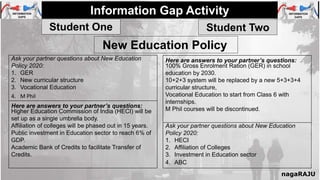
New Education Policy
Ask your partner questions about New Education
Policy 2020:
1. GER
2. New curricular structure
3. Vocational Education
4. M Phil
Here are answers to your partner’s questions:
Higher Education Commission of India (HECI) will be
set up as a single umbrella body.
Affiliation of colleges will be phased out in 15 years.
Public investment in Education sector to reach 6% of
GDP.
Academic Bank of Credits to facilitate Transfer of
Credits.
Here are answers to your partner’s questions:
100% Gross Enrolment Ration (GER) in school
education by 2030.
10+2+3 system will be replaced by a new 5+3+3+4
curricular structure,
Vocational Education to start from Class 6 with
internships.
M Phil courses will be discontinued.
Ask your partner questions about New Education
Policy 2020:
1. HECI
2. Affiliation of Colleges
3. Investment in Education sector
4. ABC
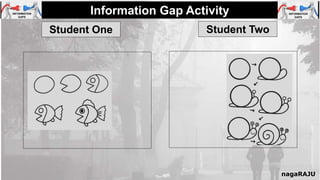
Information Gap Activity
nagaRAJU
Student One Student Two
Information Gap Quiz
nagaRAJU
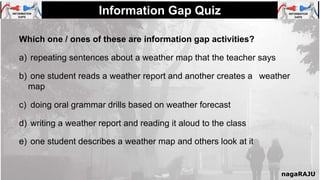
Which one / ones of these are information gap activities?
a) repeating sentences about a weather map that the teacher says
b) one student reads a weather report and another creates a weather
map
c) doing oral grammar drills based on weather forecast
d) writing a weather report and reading it aloud to the class
e) one student describes a weather map and others look at it

Information Gaps for Teaching English

  • 2.
    Warm-up nagaRAJU Which do youthink is the number one requirement for being a good teacher? 1. is able to maintain discipline and order 2. works hard to remain up-to-date in his or her subject 3. admits when he or she made a mistake 4. is interested in the personal lives and issues of students 5. makes the students work hard and sets high standards 6. Is friendly with and helpful to colleagues 7. makes learning interesting using creative materials and methods 8. helps the students become independent
  • 3.
    Discussion nagaRAJU How can Iget my students talk in my English class? How can I increase the time students spend using English?
  • 4.
    Icebreaker nagaRAJU Two volunteers tounmute and interact Get up? Breakfast? College? Lunch? Evening? Go out?
  • 5.
    What is anInformation Gap? nagaRAJU  Knowledge Gap  Communication Gap  Opinion Gap  Experience Gap  Information Gap
  • 6.
    Information Gap Advantages nagaRAJU provides context and genuine reason for real communication  lends itself to use authentic materials  increases intrinsic motivation to talk  promotes student-centred classroom, more STT  builds sub-skills such as clarifying, re-phrasing
  • 7.
    Information Gap Types nagaRAJU spot the difference  drawing from description  timetable from description  jigsaw readings  split dictations  drawing family trees
  • 8.
    Information Gap Activity nagaRAJU StudentOne Student Two Customer 1 dozen bananas 1 kilo groundnuts 2 packets tea 1 kilo sugar 1 can orange juice 2 kilos rice Shopkeeper Tea - Rs85 a packet Sugar- Rs 55 a kilo Rice - Rs 48 a kilo Orange juice - Rs 200 a can Apples - Rs 150 a dozen Milk - Rs 56 a liter
  • 9.
    Information Gap Activity nagaRAJU StudentOne Student Two Task: Biography of a famous person Information without place names Information with dates missing Together they complete the text by asking each other. The gap becomes the reason for communication
  • 10.
    Information Gap Activity nagaRAJU StudentOne Student Two This morning Today evening Tomorrow morning Tomorrow evening Today morning, I am addressing a National FDP organized by TSWRDCsW, Mahendra Hills and Jagadgirigutta. Today evening, I am organizing a Leadership Workshop – Dynamo Twenty - for members of 12 lions clubs. I have accepted to address tomorrow morning a 5-day FDP for Junior Lecturers of State Government of Andhra Pradesh. I am organizing one more leadership workshop for members of Yashaswi region of District 320D tomorrow evening. Most participants will be from Kamareddy area.
  • 11.
    Information Gap Activity nagaRAJU StudentOne Student Two Her name is Sona. What adjective describes Sona? What is the name of Hari’s sister? Text without adjectivesText without names
  • 12.
    Information Gap Activity nagaRAJU StudentOne Student Two  How do I go from Meena Hospital to your School?  How do you ….?  How to reach …?
  • 13.
    Information Gap Activity nagaRAJU Inthe real world, information gaps are very common. One person, the speaker, wants to ask a question and the other person, the listener, tries to answer it. In the real world, people ask questions because they do not know the answer, and because they want to find out some information. Think of a man at a bus stop (A) who asks a woman (B): Do you have the time? There is an information gap between the two people that the man is trying to fill. An information gap is useful in the classroom because it gives students a reason to communicate. Sometimes, the teacher can decide the kind of language that the students will use. Sometimes, the language can be very free and the students decide what kind of language they will use. You can use an information gap to practice grammar, especially verb forms such as the past simple or present continuous. You can also practice vocabulary--in fact, anything you choose. The teacher’s job is to organize the activity, and, while the students are working together, to monitor. This means that he or she listens carefully, and makes a note of any errors the students make. The teacher tries not to interfere with the students while they are working together. For an information gap to work well, it needs to have a purpose. The students’ purpose is to fill the gap by asking questions. NOW ANSWER THE QUESTIONS ABOUT YOUR TEXT: What kind of information gaps do you find in real life? 1. Why are they useful in the classroom? 2. What kind of language do students use in the information gap? 3. What kind of grammatical structures could you practice? 4. What should the teacher do during the activity? NOW ASK YOUR PARTNER THESE QUESTIONS: What kinds of materials can you use for an information gap? 1. What kinds of skills do students practice in an information gap? 2. How can the teacher make sure the activity goes well? 3. What can the teacher do after the activity? 4. When does the teacher correct the students? In the real world, information gaps are very common. One person, the speaker, wants to ask a question and the other person, the listener, tries to answer it. In the classroom, we want to use information gaps to give the students a chance to communicate with each other, just like people do in real life. You can use a wide variety of different materials in the classroom to design information gaps. Sometimes you can use a picture, which one student tries to describe to another student. Sometimes you can use a written text with information that the students must pass to each other. An information gap can involve the different skills of reading, writing, speaking, and listening. An information gap activity needs careful organisation. The teacher must think carefully about the instructions he or she will give to the students so that they are very clear about what they have to do. Sometimes it’s useful to practice the activity before starting. At the end of the activity, the teacher can give the students feedback on how well they did the activity. The teacher can also correct any errors the students made. But it is important to remember that the teacher corrects mistakes after the activity. NOW ANSWER THE QUESTIONS ABOUT YOUR TEXT: What kinds of materials can you use for an information gap? 1. What kinds of skills do students practice in an information gap? 2. How can the teacher make sure the activity goes well? 3. What can the teacher do after the activity? 4. When does the teacher correct the students? NOW ASK YOUR PARTNER THESE QUESTIONS: What kind of information gaps do you find in real life? 1. Why are they useful in the classroom? 2. What kind of language do students use in the information gap? 3. What kind of grammatical structures could you practice? 4. What should the teacher do during the activity? Student TwoStudent One
  • 14.
    Information Gap Activity nagaRAJU StudentTwoStudent One New Education Policy Ask your partner questions about New Education Policy 2020: 1. GER 2. New curricular structure 3. Vocational Education 4. M Phil Here are answers to your partner’s questions: Higher Education Commission of India (HECI) will be set up as a single umbrella body. Affiliation of colleges will be phased out in 15 years. Public investment in Education sector to reach 6% of GDP. Academic Bank of Credits to facilitate Transfer of Credits. Here are answers to your partner’s questions: 100% Gross Enrolment Ration (GER) in school education by 2030. 10+2+3 system will be replaced by a new 5+3+3+4 curricular structure, Vocational Education to start from Class 6 with internships. M Phil courses will be discontinued. Ask your partner questions about New Education Policy 2020: 1. HECI 2. Affiliation of Colleges 3. Investment in Education sector 4. ABC
  • 15.
  • 16.
    Information Gap Quiz nagaRAJU Whichone / ones of these are information gap activities? a) repeating sentences about a weather map that the teacher says b) one student reads a weather report and another creates a weather map c) doing oral grammar drills based on weather forecast d) writing a weather report and reading it aloud to the class e) one student describes a weather map and others look at it

Editor's Notes

  • #4 IG: an activity where learners are missing the information they need to complete a task and need to talk to each other to find it A task which requires B to find out the information that A has, a task which closes the gap, will provide a reason for communication.
  • #6 IG: an activity where learners are missing the information they need to complete a task and need to talk to each other to find it A task which requires B to find out the information that A has, a task which closes the gap, will provide a reason for communication.