Linux: kernel vs user space
BPF and FUSE as examples
Hervé Nicol - GFI
@hervenicol
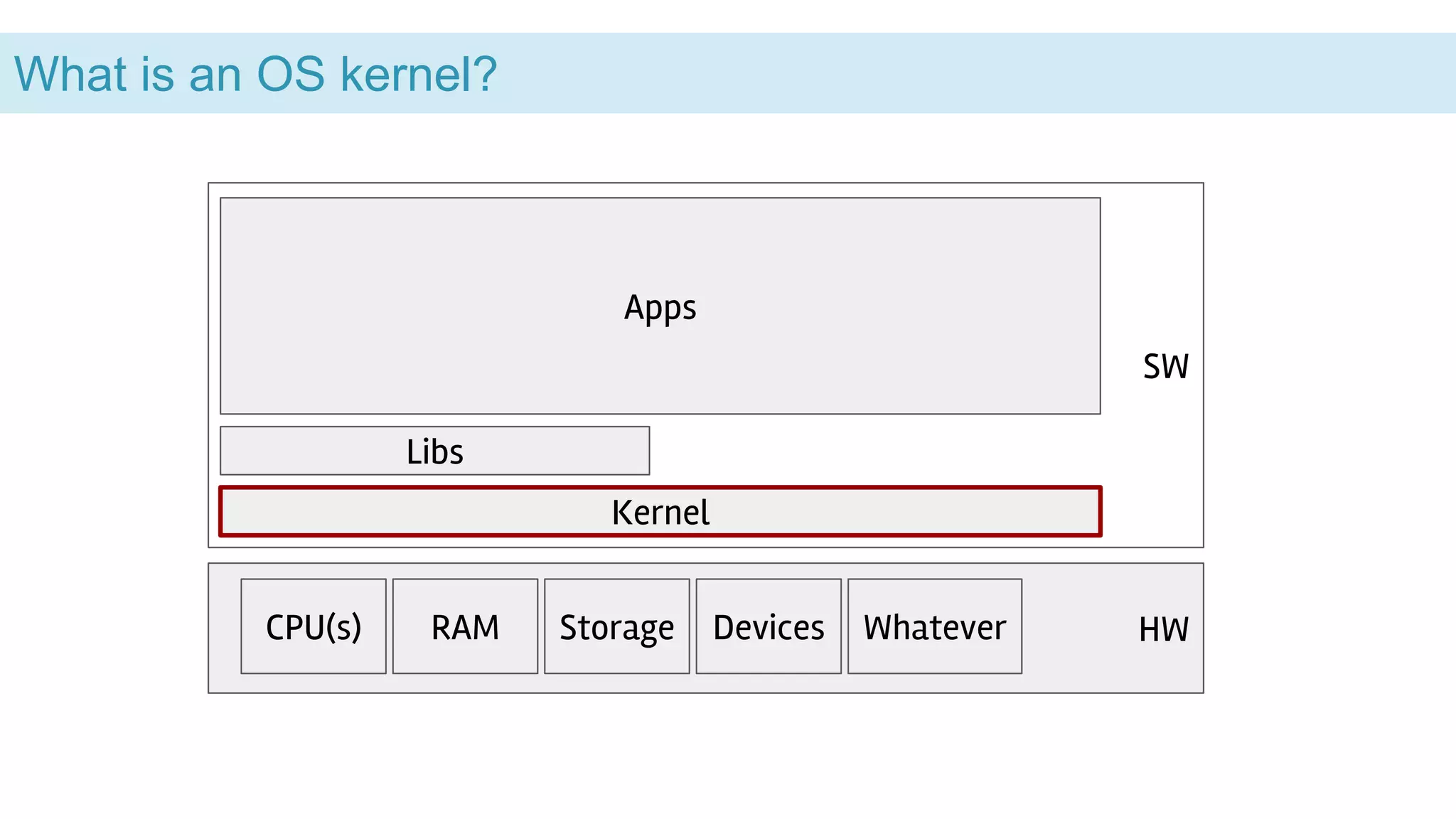
What is an OS kernel?
HWCPU(s) RAM Storage Devices Whatever
Kernel
Libs
Apps
2
SW
Linux syscalls
http://man7.org/linux/man-pages/man2/syscalls.2.html
“The system call is the fundamental interface between an application
and the Linux kernel.”
● 123 in kernel 1.0
● 400+ in kernel 4.11
What can I do with syscalls?
● You don’t need to know it to code or use linux
● You may use it for perf analysis and debug (strace, perf, trace, sysdig)
○ See http://www.brendangregg.com/linuxperf.html
● You can filter them with seccomp (ie in containers)
○ Docker filters: https://docs.docker.com/engine/security/seccomp/
○ https://blog.yadutaf.fr/2014/05/29/introduction-to-seccomp-bpf-linux-s
yscall-filter/
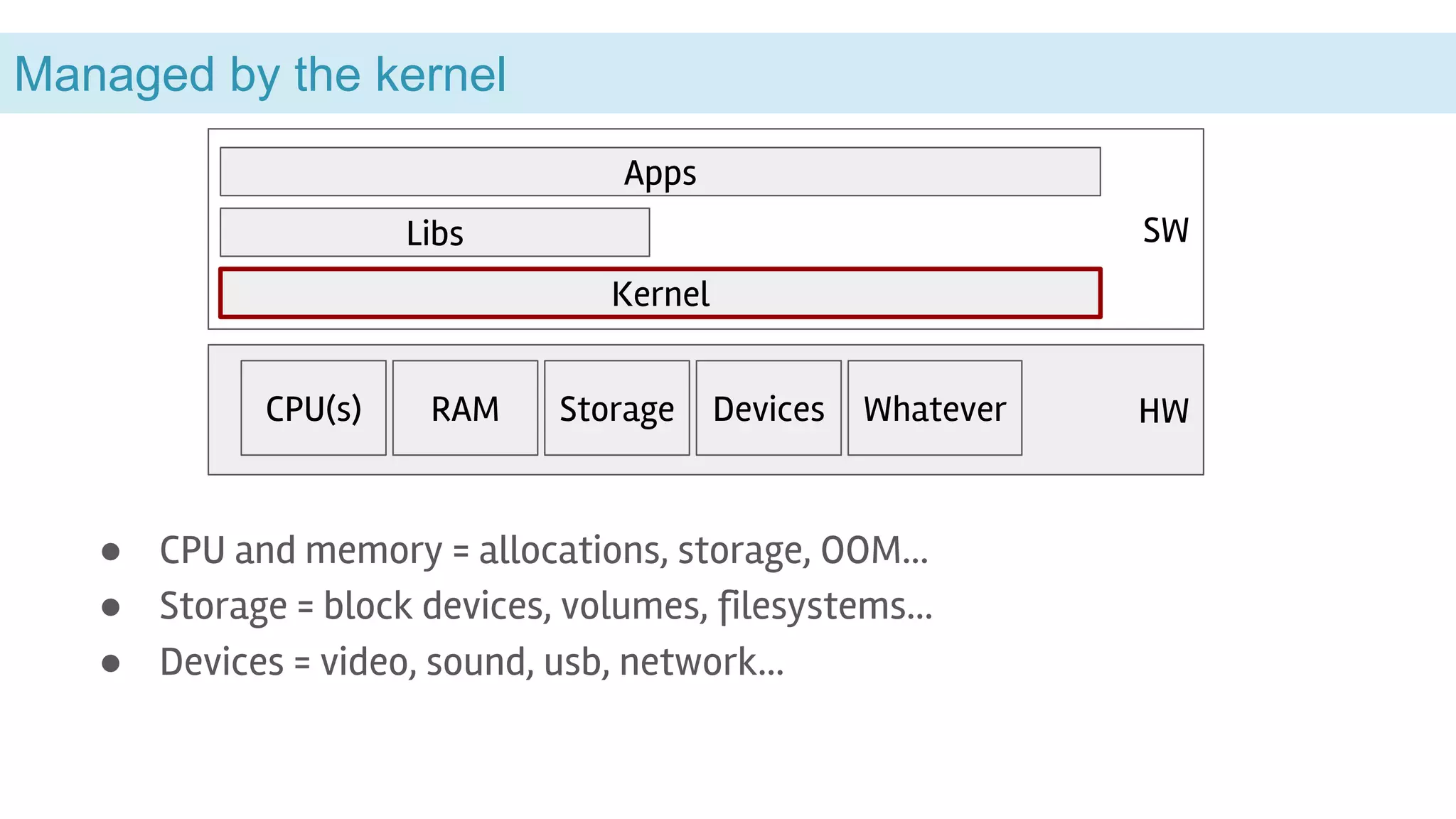
Managed by the kernel
● CPU and memory = allocations, storage, OOM…
● Storage = block devices, volumes, filesystems…
● Devices = video, sound, usb, network…
HWCPU(s) RAM Storage Devices Whatever
Kernel
Libs
Apps
SW
Introducing FUSE
● File System in Userspace
https://en.wikipedia.org/wiki/Filesystem_in_Userspace
○ Sshfs
○ Ntfs
○ gmailfs
Prototype use case
When eBPF meets FUSE - Improving performance of user file systems
https://events.linuxfoundation.org/wp-content/uploads/2017/11/When-eBPF-Meets-FUSE-Improving-Performance-of-User-File-Sys
tems-Ashish-Bijlani-Georgia-Tech.pdf
Other interesting projects
● Gvisor - https://github.com/google/gvisor
“Userland kernel”
● Cilium - https://cilium.io/
“Bringing the BPF Revolution to Kubernetes Networking and Security”
● Brendan Gregg’s blog - http://www.brendangregg.com/ebpf.html
Linux Performance at Netflix

Linux kernel vs user space - Hervé Nicol (GFI)

  • 1.
    Linux: kernel vsuser space BPF and FUSE as examples Hervé Nicol - GFI @hervenicol
  • 2.
    What is anOS kernel? HWCPU(s) RAM Storage Devices Whatever Kernel Libs Apps 2 SW
  • 3.
    Linux syscalls http://man7.org/linux/man-pages/man2/syscalls.2.html “The systemcall is the fundamental interface between an application and the Linux kernel.” ● 123 in kernel 1.0 ● 400+ in kernel 4.11
  • 4.
    What can Ido with syscalls? ● You don’t need to know it to code or use linux ● You may use it for perf analysis and debug (strace, perf, trace, sysdig) ○ See http://www.brendangregg.com/linuxperf.html ● You can filter them with seccomp (ie in containers) ○ Docker filters: https://docs.docker.com/engine/security/seccomp/ ○ https://blog.yadutaf.fr/2014/05/29/introduction-to-seccomp-bpf-linux-s yscall-filter/
  • 5.
    Managed by thekernel ● CPU and memory = allocations, storage, OOM… ● Storage = block devices, volumes, filesystems… ● Devices = video, sound, usb, network… HWCPU(s) RAM Storage Devices Whatever Kernel Libs Apps SW
  • 6.
    Introducing FUSE ● FileSystem in Userspace https://en.wikipedia.org/wiki/Filesystem_in_Userspace ○ Sshfs ○ Ntfs ○ gmailfs
  • 7.
    Prototype use case WheneBPF meets FUSE - Improving performance of user file systems https://events.linuxfoundation.org/wp-content/uploads/2017/11/When-eBPF-Meets-FUSE-Improving-Performance-of-User-File-Sys tems-Ashish-Bijlani-Georgia-Tech.pdf
  • 8.
    Other interesting projects ●Gvisor - https://github.com/google/gvisor “Userland kernel” ● Cilium - https://cilium.io/ “Bringing the BPF Revolution to Kubernetes Networking and Security” ● Brendan Gregg’s blog - http://www.brendangregg.com/ebpf.html Linux Performance at Netflix