“WHY LIBRARIES VIRTUALIZE”
    Understanding cloud computing adoption and impact


                   Erik Mitchell
               Assistant Professor
              University of Maryland
                  erik@umd.edu
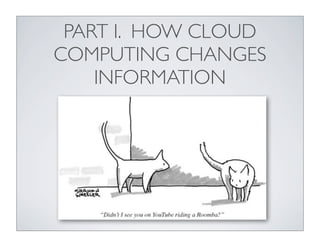
PART I. HOW CLOUD
COMPUTING CHANGES
    INFORMATION
“For me the most powerful aspect of cloud
computing is that it enables libraries to stop
dealing with technical issues that have nothing to
do with their day-to-day missions and services”
               -- Roy Tennant (Getting Started with
               cloud Computing)
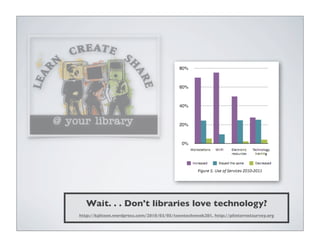
Wait. . . Don't libraries love technology?
http://kplteen.wordpress.com/2010/03/05/teentechweek201, http://plinternetsurvey.org
“Libraries to their benefit and detriment fetishized the book”
                           --John Blyberg LITA Keynote 2011
Though a radically different kind of setting for a
home, the third place is remarkably similar to a
good home in the psychological comfort and
support that it extends…They are the heart of a
community’s social vitality, the grassroots of
democracy . . .”

                                    -- Ray Oldenburg


                    http://www.clir.org/pubs/reports/pub129/pub129.pdf
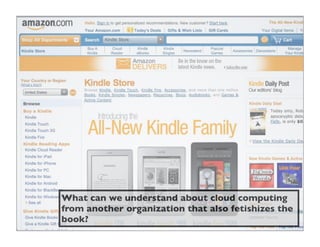
What can we understand about cloud computing
from another organization that also fetishizes the
book?
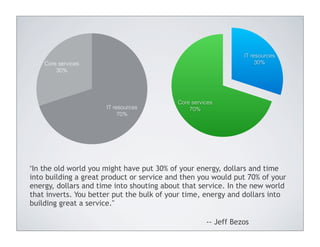
IT resources
    Core services                                                    30%
        30%


                                           Core services
                      IT resources             70%
                           70%


"In the old world you might have put 30% of your energy, dollars and time
into building a great product or service and then you would put 70% of your
energy, dollars and time into shouting about that service. In the new world
that inverts. You better put the bulk of your time, energy and dollars into
building great a service."

                                                     -- Jeff Bezos
The book is such a great technology because it disappears when you use it

-- jeff bezos (Charlie Rose interview )
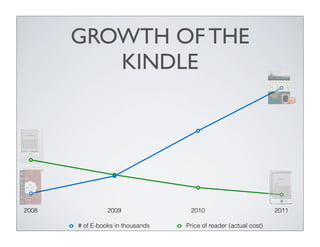
GROWTH OF THE
          KINDLE


2008             2009               2010                           2011

       # of E-books in thousands   Price of reader (actual cost)
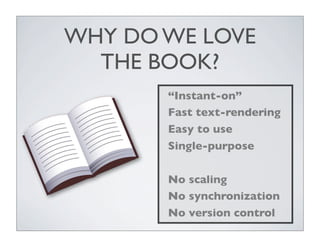
WHY DO WE LOVE
  THE BOOK?
       “Instant-on”
       Fast text-rendering
       Easy to use
       Single-purpose

       No scaling
       No synchronization
       No version control
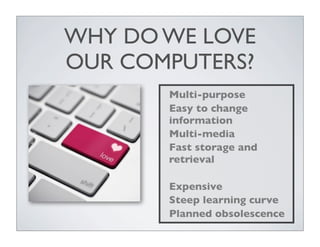
WHY DO WE LOVE
OUR COMPUTERS?
       Multi-purpose
       Easy to change
       information
       Multi-media
       Fast storage and
       retrieval

       Expensive
       Steep learning curve
       Planned obsolescence
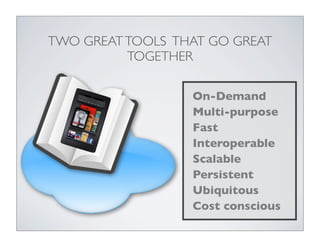
TWO GREAT TOOLS THAT GO GREAT
          TOGETHER

                  On-Demand
                  Multi-purpose
                  Fast
                  Interoperable
                  Scalable
                  Persistent
                  Ubiquitous
                  Cost conscious
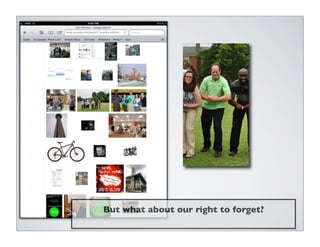
But what about our right to forget?
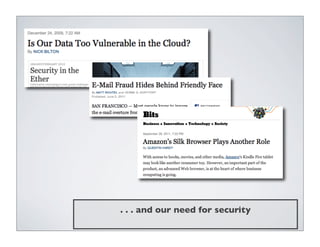
. . . and our need for security
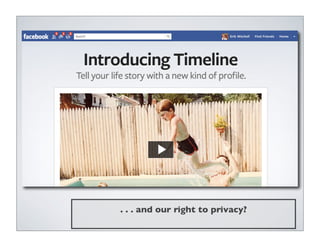
. . . and our right to privacy?
PART II. DEFINE THE CLOUD
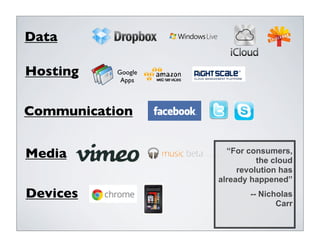
Data

Hosting    Google
            Apps


Communication


Media                 “For consumers,
                              the cloud
                         revolution has
                    already happened”
Devices                     -- Nicholas
                                   Carr
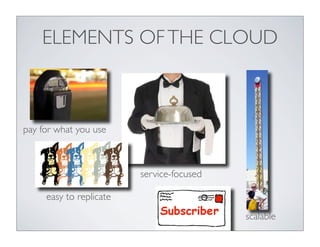
ELEMENTS OF THE CLOUD


pay for what you use


                         service-focused

     easy to replicate
                                           scalable
RELATED CONCEPTS
Cloud computing “is a phrase that is being used today to
describe the act of storing, accessing, and sharing data,
applications, and computing power in cyberspace” - Pew
Internet Trust

A Web service “is a software system designed to support
interoperable machine-to-machine interaction over a
network” - w3c.org

Application programming interface (API) “is a specification
for allowing programs to exchange data”
CLOUD COMPUTING TYPES

Software as a Service “applications designed to be
utilized by end-users without IT administrative overhead (e.g.
Google Docs)”

Platform as a Service “an IT environment configured to
serve a distinct but customized purpose (e.g. web-hosting)”

Infrastructure as a Service “an IT environment that
supports a wide range of tools but comes with little pre-
configured resources (e.g. Server and disk space)”

                         NIST definition of cloud computing
CLOUD COMPUTING PLACES

Private cloud An implementation of technology run for a
single organization (e.g Internal virtualization)

Public cloud “an IT environment configured to support a
number of customers (e.g. Amazon EC2)”

Community cloud “an IT environment restricted to a
specific community (e.g. Governmental, Education)”


                     NIST definition of cloud computing
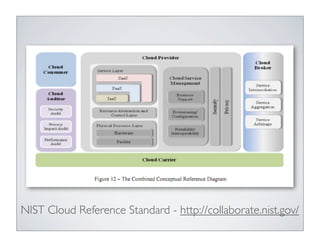
NIST Cloud Reference Standard - http://collaborate.nist.gov/
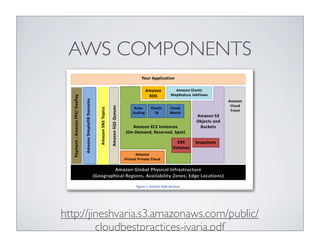
AWS COMPONENTS


http://jineshvaria.s3.amazonaws.com/public/
         cloudbestpractices-jvaria.pdf
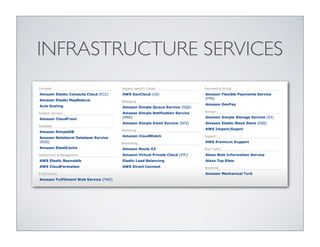
INFRASTRUCTURE SERVICES
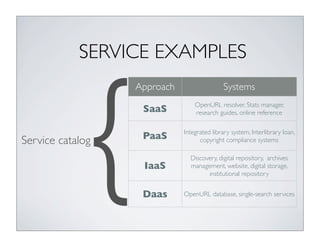
SERVICE EXAMPLES


              {
                  Approach                  Systems
                                 OpenURL resolver, Stats manager,
                   SaaS          research guides, online reference

                             Integrated library system, Interlibrary loan,
Service catalog    PaaS            copyright compliance systems

                               Discovery, digital repository, archives
                   IaaS        management, website, digital storage,
                                     institutional repository


                   Daas      OpenURL database, single-search services
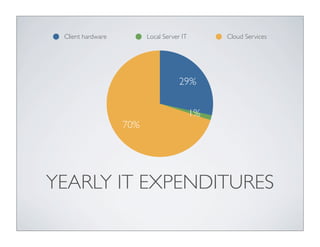
Client hardware         Local Server IT        Cloud Services


                                     29%


                                           1%
                   70%


YEARLY IT EXPENDITURES
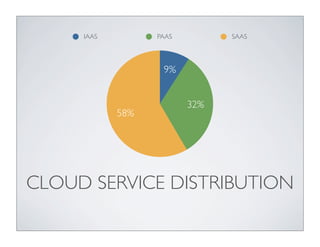
IAAS         PAAS         SAAS


                   9%


                         32%
            58%


CLOUD SERVICE DISTRIBUTION
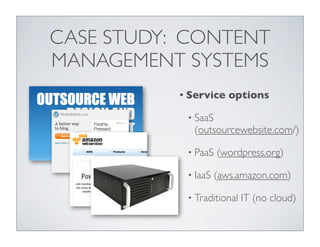
CASE STUDY: CONTENT
MANAGEMENT SYSTEMS
           • Service    options

            • SaaS
             (outsourcewebsite.com/)

            • PaaS   (wordpress.org)

            • IaaS   (aws.amazon.com)

            • Traditional   IT (no cloud)
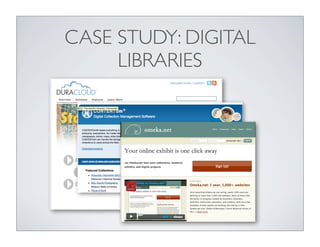
CASE STUDY: DIGITAL
     LIBRARIES
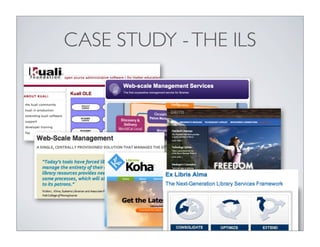
CASE STUDY - THE ILS
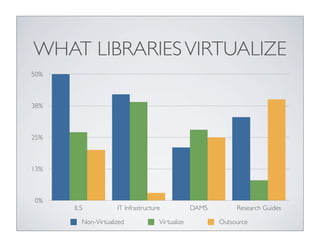
WHAT LIBRARIES VIRTUALIZE
50%


38%


25%


13%


0%
      ILS           IT Infrastructure            DAMS        Research Guides

        Non-Virtualized             Virtualize          Outsource
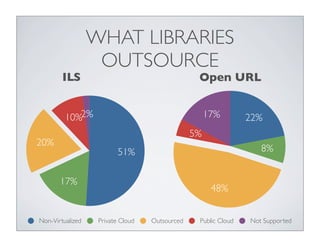
WHAT LIBRARIES
                   OUTSOURCE
        ILS                                      Open URL


         10%2%                                       17%        22%
                                                5%
20%
                          51%                                      8%


       17%
                                                      48%


Non-Virtualized    Private Cloud   Outsourced    Public Cloud   Not Supported
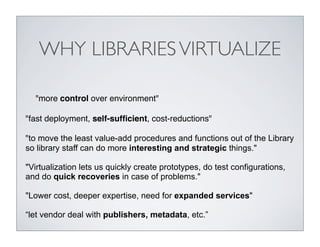
WHY LIBRARIES VIRTUALIZE

  "more control over environment"

"fast deployment, self-sufficient, cost-reductions"

"to move the least value-add procedures and functions out of the Library
so library staff can do more interesting and strategic things."

"Virtualization lets us quickly create prototypes, do test configurations,
and do quick recoveries in case of problems."

"Lower cost, deeper expertise, need for expanded services"

“let vendor deal with publishers, metadata, etc.”
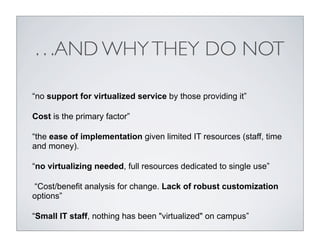
. . .AND WHY THEY DO NOT

“no support for virtualized service by those providing it”

Cost is the primary factor”

“the ease of implementation given limited IT resources (staff, time
and money).

“no virtualizing needed, full resources dedicated to single use”

“Cost/benefit analysis for change. Lack of robust customization
options”

“Small IT staff, nothing has been "virtualized" on campus”
PART III. HOW CLOUD
COMPUTING CAN HELP
        LIBRARIES
1. LIBRARIES ARE FORWARD-THINKING, SERVICE-
           ORIENTED INSTITUTIONS


Within five years, all library collections, systems, and services will be
driven into the cloud. . .
                                   -- Taiga provocative statements 2011
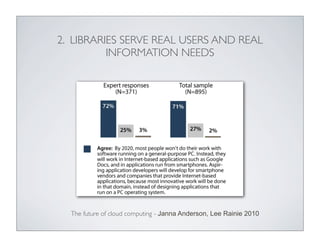
2. LIBRARIES SERVE REAL USERS AND REAL
          INFORMATION NEEDS


  The future of cloud computing - Janna Anderson, Lee Rainie 2010
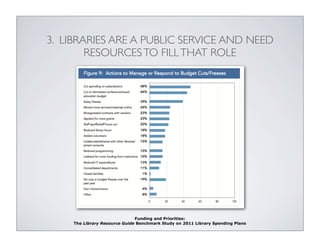
3. LIBRARIES ARE A PUBLIC SERVICE AND NEED
        RESOURCES TO FILL THAT ROLE


                               Funding and Priorities:
     The Library Resource Guide Benchmark Study on 2011 Library Spending Plans
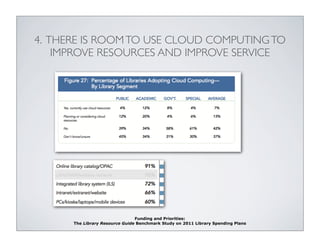
4. THERE IS ROOM TO USE CLOUD COMPUTING TO
    IMPROVE RESOURCES AND IMPROVE SERVICE


                                Funding and Priorities:
      The Library Resource Guide Benchmark Study on 2011 Library Spending Plans
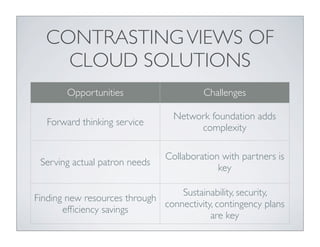
CONTRASTING VIEWS OF
    CLOUD SOLUTIONS
        Opportunities                    Challenges

                                 Network foundation adds
   Forward thinking service
                                      complexity

                               Collaboration with partners is
 Serving actual patron needs
                                            key

                                  Sustainability, security,
Finding new resources through
                              connectivity, contingency plans
       efficiency savings
                                          are key
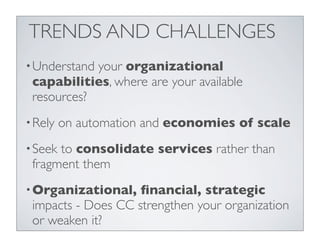
TRENDS AND CHALLENGES
• Understandyour organizational
 capabilities, where are your available
 resources?
• Rely   on automation and economies of scale
• Seekto consolidate services rather than
 fragment them
• Organizational,   financial, strategic
 impacts - Does CC strengthen your organization
 or weaken it?
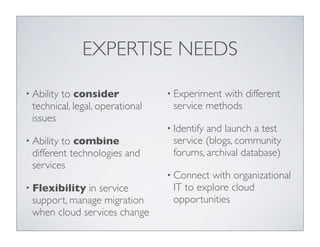
EXPERTISE NEEDS

        to consider
• Ability                        • Experiment with different
 technical, legal, operational    service methods
 issues
                                 • Identify
                                          and launch a test
• Abilityto combine               service (blogs, community
 different technologies and       forums, archival database)
 services
                                 • Connect with organizational
• Flexibilityin service           IT to explore cloud
 support, manage migration        opportunities
 when cloud services change
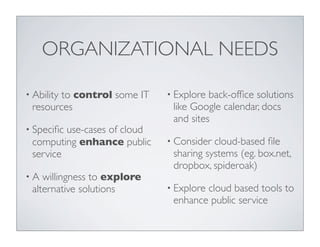
ORGANIZATIONAL NEEDS

       to control some IT
• Ability                     • Explore back-office solutions
 resources                     like Google calendar, docs
                               and sites
• Specificuse-cases of cloud
 computing enhance public     • Consider cloud-based file
 service                       sharing systems (eg. box.net,
                               dropbox, spideroak)
•A  willingness to explore
 alternative solutions        • Explore
                                      cloud based tools to
                               enhance public service
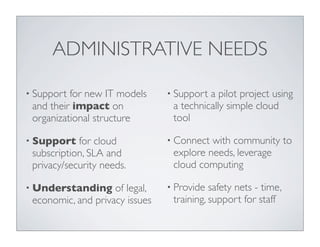
ADMINISTRATIVE NEEDS

• Support for new IT models     • Support a pilot project using
 and their impact on             a technically simple cloud
 organizational structure        tool

• Support   for cloud           • Connect with community to
 subscription, SLA and           explore needs, leverage
 privacy/security needs.         cloud computing

• Understanding     of legal,   • Provide  safety nets - time,
 economic, and privacy issues    training, support for staff
THANK YOU!
The Tower and the Cloud - http://www.educause.edu/
thetowerandthecloud
Amazon EC2 tutorials for libraries - http://erikmitchell.info
Library funding priorities - http://libraryresource.onlineinc.com/
Downloads/ResearchReports
ECAR Studies - http://www.educause.edu/Resources/
Future of cloud computing - http://www.pewinternet.org/Reports/
2010/The-future-of-cloud-computing.aspx, http://www.pewinternet.org/
Press-Releases/2008/Cloud-computing-takes-hold-as-69-of-all-
internet-users-have-either-stored-data-online-or.aspx


               http://erikmitchell.info

Why Libraries Virtualize

  • 1.
    “WHY LIBRARIES VIRTUALIZE” Understanding cloud computing adoption and impact Erik Mitchell Assistant Professor University of Maryland erik@umd.edu
  • 2.
    PART I. HOWCLOUD COMPUTING CHANGES INFORMATION
  • 3.
    “For me themost powerful aspect of cloud computing is that it enables libraries to stop dealing with technical issues that have nothing to do with their day-to-day missions and services” -- Roy Tennant (Getting Started with cloud Computing)
  • 4.
    Wait. . .Don't libraries love technology? http://kplteen.wordpress.com/2010/03/05/teentechweek201, http://plinternetsurvey.org
  • 5.
    “Libraries to theirbenefit and detriment fetishized the book” --John Blyberg LITA Keynote 2011
  • 6.
    Though a radicallydifferent kind of setting for a home, the third place is remarkably similar to a good home in the psychological comfort and support that it extends…They are the heart of a community’s social vitality, the grassroots of democracy . . .” -- Ray Oldenburg http://www.clir.org/pubs/reports/pub129/pub129.pdf
  • 7.
    What can weunderstand about cloud computing from another organization that also fetishizes the book?
  • 8.
    IT resources Core services 30% 30% Core services IT resources 70% 70% "In the old world you might have put 30% of your energy, dollars and time into building a great product or service and then you would put 70% of your energy, dollars and time into shouting about that service. In the new world that inverts. You better put the bulk of your time, energy and dollars into building great a service." -- Jeff Bezos
  • 9.
    The book issuch a great technology because it disappears when you use it -- jeff bezos (Charlie Rose interview )
  • 10.
    GROWTH OF THE KINDLE 2008 2009 2010 2011 # of E-books in thousands Price of reader (actual cost)
  • 11.
    WHY DO WELOVE THE BOOK? “Instant-on” Fast text-rendering Easy to use Single-purpose No scaling No synchronization No version control
  • 12.
    WHY DO WELOVE OUR COMPUTERS? Multi-purpose Easy to change information Multi-media Fast storage and retrieval Expensive Steep learning curve Planned obsolescence
  • 13.
    TWO GREAT TOOLSTHAT GO GREAT TOGETHER On-Demand Multi-purpose Fast Interoperable Scalable Persistent Ubiquitous Cost conscious
  • 14.
    But what aboutour right to forget?
  • 15.
    . . .and our need for security
  • 16.
    . . .and our right to privacy?
  • 17.
    PART II. DEFINETHE CLOUD
  • 18.
    Data Hosting Google Apps Communication Media “For consumers, the cloud revolution has already happened” Devices -- Nicholas Carr
  • 20.
    ELEMENTS OF THECLOUD pay for what you use service-focused easy to replicate scalable
  • 21.
    RELATED CONCEPTS Cloud computing“is a phrase that is being used today to describe the act of storing, accessing, and sharing data, applications, and computing power in cyberspace” - Pew Internet Trust A Web service “is a software system designed to support interoperable machine-to-machine interaction over a network” - w3c.org Application programming interface (API) “is a specification for allowing programs to exchange data”
  • 22.
    CLOUD COMPUTING TYPES Softwareas a Service “applications designed to be utilized by end-users without IT administrative overhead (e.g. Google Docs)” Platform as a Service “an IT environment configured to serve a distinct but customized purpose (e.g. web-hosting)” Infrastructure as a Service “an IT environment that supports a wide range of tools but comes with little pre- configured resources (e.g. Server and disk space)” NIST definition of cloud computing
  • 23.
    CLOUD COMPUTING PLACES Privatecloud An implementation of technology run for a single organization (e.g Internal virtualization) Public cloud “an IT environment configured to support a number of customers (e.g. Amazon EC2)” Community cloud “an IT environment restricted to a specific community (e.g. Governmental, Education)” NIST definition of cloud computing
  • 24.
    NIST Cloud ReferenceStandard - http://collaborate.nist.gov/
  • 25.
  • 26.
  • 27.
    SERVICE EXAMPLES { Approach Systems OpenURL resolver, Stats manager, SaaS research guides, online reference Integrated library system, Interlibrary loan, Service catalog PaaS copyright compliance systems Discovery, digital repository, archives IaaS management, website, digital storage, institutional repository Daas OpenURL database, single-search services
  • 28.
    Client hardware Local Server IT Cloud Services 29% 1% 70% YEARLY IT EXPENDITURES
  • 29.
    IAAS PAAS SAAS 9% 32% 58% CLOUD SERVICE DISTRIBUTION
  • 30.
    CASE STUDY: CONTENT MANAGEMENTSYSTEMS • Service options • SaaS (outsourcewebsite.com/) • PaaS (wordpress.org) • IaaS (aws.amazon.com) • Traditional IT (no cloud)
  • 31.
  • 32.
    CASE STUDY -THE ILS
  • 33.
    WHAT LIBRARIES VIRTUALIZE 50% 38% 25% 13% 0% ILS IT Infrastructure DAMS Research Guides Non-Virtualized Virtualize Outsource
  • 34.
    WHAT LIBRARIES OUTSOURCE ILS Open URL 10%2% 17% 22% 5% 20% 51% 8% 17% 48% Non-Virtualized Private Cloud Outsourced Public Cloud Not Supported
  • 35.
    WHY LIBRARIES VIRTUALIZE "more control over environment" "fast deployment, self-sufficient, cost-reductions" "to move the least value-add procedures and functions out of the Library so library staff can do more interesting and strategic things." "Virtualization lets us quickly create prototypes, do test configurations, and do quick recoveries in case of problems." "Lower cost, deeper expertise, need for expanded services" “let vendor deal with publishers, metadata, etc.”
  • 36.
    . . .ANDWHY THEY DO NOT “no support for virtualized service by those providing it” Cost is the primary factor” “the ease of implementation given limited IT resources (staff, time and money). “no virtualizing needed, full resources dedicated to single use” “Cost/benefit analysis for change. Lack of robust customization options” “Small IT staff, nothing has been "virtualized" on campus”
  • 37.
    PART III. HOWCLOUD COMPUTING CAN HELP LIBRARIES
  • 38.
    1. LIBRARIES AREFORWARD-THINKING, SERVICE- ORIENTED INSTITUTIONS Within five years, all library collections, systems, and services will be driven into the cloud. . . -- Taiga provocative statements 2011
  • 39.
    2. LIBRARIES SERVEREAL USERS AND REAL INFORMATION NEEDS The future of cloud computing - Janna Anderson, Lee Rainie 2010
  • 40.
    3. LIBRARIES AREA PUBLIC SERVICE AND NEED RESOURCES TO FILL THAT ROLE Funding and Priorities: The Library Resource Guide Benchmark Study on 2011 Library Spending Plans
  • 41.
    4. THERE ISROOM TO USE CLOUD COMPUTING TO IMPROVE RESOURCES AND IMPROVE SERVICE Funding and Priorities: The Library Resource Guide Benchmark Study on 2011 Library Spending Plans
  • 42.
    CONTRASTING VIEWS OF CLOUD SOLUTIONS Opportunities Challenges Network foundation adds Forward thinking service complexity Collaboration with partners is Serving actual patron needs key Sustainability, security, Finding new resources through connectivity, contingency plans efficiency savings are key
  • 43.
    TRENDS AND CHALLENGES •Understandyour organizational capabilities, where are your available resources? • Rely on automation and economies of scale • Seekto consolidate services rather than fragment them • Organizational, financial, strategic impacts - Does CC strengthen your organization or weaken it?
  • 44.
    EXPERTISE NEEDS to consider • Ability • Experiment with different technical, legal, operational service methods issues • Identify and launch a test • Abilityto combine service (blogs, community different technologies and forums, archival database) services • Connect with organizational • Flexibilityin service IT to explore cloud support, manage migration opportunities when cloud services change
  • 45.
    ORGANIZATIONAL NEEDS to control some IT • Ability • Explore back-office solutions resources like Google calendar, docs and sites • Specificuse-cases of cloud computing enhance public • Consider cloud-based file service sharing systems (eg. box.net, dropbox, spideroak) •A willingness to explore alternative solutions • Explore cloud based tools to enhance public service
  • 46.
    ADMINISTRATIVE NEEDS • Supportfor new IT models • Support a pilot project using and their impact on a technically simple cloud organizational structure tool • Support for cloud • Connect with community to subscription, SLA and explore needs, leverage privacy/security needs. cloud computing • Understanding of legal, • Provide safety nets - time, economic, and privacy issues training, support for staff
  • 47.
    THANK YOU! The Towerand the Cloud - http://www.educause.edu/ thetowerandthecloud Amazon EC2 tutorials for libraries - http://erikmitchell.info Library funding priorities - http://libraryresource.onlineinc.com/ Downloads/ResearchReports ECAR Studies - http://www.educause.edu/Resources/ Future of cloud computing - http://www.pewinternet.org/Reports/ 2010/The-future-of-cloud-computing.aspx, http://www.pewinternet.org/ Press-Releases/2008/Cloud-computing-takes-hold-as-69-of-all- internet-users-have-either-stored-data-online-or.aspx http://erikmitchell.info