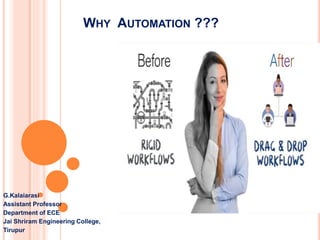
WHY AUTOMATION ???
G.Kalaiarasi
Assistant Professor
Department of ECE
Jai Shriram Engineering College,
Tirupur
AUTOMATION
 Use of control system and information technologies to
reduce the need for human work in the production of
goods and services
 Automation may….
Wibe-out certain jobs
Reduce contents of certain jobs
Combining several jobs to one
WHY AUTOMATION ?
 To improve productivity
 Shortage of skilled labours
 To reduce labour fatigue and health issues
 Increase safety Requirements
 To handle job in hazardous
EVOLUTION OF AUTOMATION..
FIXED AUTOMATION
 Equipments are used to automate the process in orderly
manner
Features:
 High initial investment
 High production rates
 Relatively inflexible in accommodating product variety
FIXED AUTOMATION
PROGRAMMABLE AUTOMATION
 Capability change the sequence of operations through re-
programming to accommodate different product of
configuration
Features:
 Suitable for batch production
 Low production rate than fixed automation
 Flexible to deal with variations and changes in product
configuration
PROGRAMMABLE AUTOMATION
FLEXIBLE AUTOMATION
 Extension of Programmable Automation. It is
capable of producing a variety of parts with virtually
time lost for changeovers from one part style to
next
Features:
 High Investment
 Continuous production with variable design
 Medium production rate
FLEXIBLE AUTOMATION
ATTRIBUTES AND ADVANTAGES OF
AUTOMATION
Automation When to consider Advantages Disadvantages
Fixed High demand volume
Long Product Life cycle
1.Maximum
Efficiency
2.Low unit cost
1.Inflexibility
2.Large initial
investment
Programmable Batch production, Products
with different options
1.Low unit cost for
large batches
2.Flexibility to deal
with changes in
product
1.New product
requires long
setup time
2.High unit cost
related to fixed
automation
Flexible Low production rates,
Varying demand
1.Flexiblilty to deal
with design
variations
2.Customized
products
1.Large initial
investment
2.High unit cost
related to fixed or
programmable
automation
AUTOMATION TOOLS
 ANN-Artificial Neural Networks
 DCS- Distributed Control system
 HMI- Human Machine Interface
 SCADA- Supervisory Control and Data Acquisition
 PLC- Programmable Logic Controller
 PAC-Programmable Automation Controller
 Instrumentation
 Motion Control
 Robotics
BEFORE AND AFTER AUTOMATION
PLC AUTOMATION
APPLICATIONS
HOME AUTOMATION
 Simplification of complex tasks
 Centralized control of home
systems via smart phone
 Enhanced convenience and
comport
 Access and use home systems
from anywhere
 Monitor security of home even
you where miles away
 Save time and money
INDUSTRY AUTOMATION
 More efficient production
 Avoids boring and repetitive
jobs
 Improve safety and remove
risk of human error
 Can give consumer greater
choice of goods
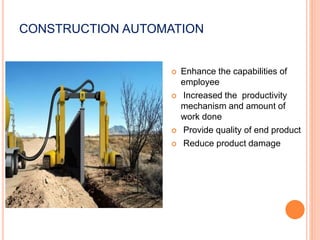
CONSTRUCTION AUTOMATION
 Enhance the capabilities of
employee
 Increased the productivity
mechanism and amount of
work done
 Provide quality of end product
 Reduce product damage
AUTOMATION IN MEDICAL
 High definition 3D vision
 Greater precision
 Motion scaling
 Resistance to radiation and
infection
 Scale motion
 Can use diverse sensors in
control
 Stable and untiring
AUTOMATION IN DEFENSE
 Protect a country from
incoming enemy Missiles,
Aircrafts, Choppers, Nuke
Missiles etc…
 Highly useful in protection to
armies residing in camps of
enemy territories from
airstrikes.
 Used even in NAVY
AUTOMATION IN AGRICULTURE
 Production of high quality food
and raw materials
 Rational use of natural resources
and preservation of environment
 The sensor should able to
measure the grain flow,
irrigation, Soil moisture with
sufficient accuracy
 Pest management
 Crop water management
AUTOMATION IN TRANSMISSION AND
DISTRIBUTION
 Remotely monitor the
distributed system
 Provides decision support
tools to improve the system
performance
 Improves tracking ,
monitoring and reporting.
Why automation

Why automation

  • 1.
    WHY AUTOMATION ??? G.Kalaiarasi AssistantProfessor Department of ECE Jai Shriram Engineering College, Tirupur
  • 2.
    AUTOMATION  Use ofcontrol system and information technologies to reduce the need for human work in the production of goods and services  Automation may…. Wibe-out certain jobs Reduce contents of certain jobs Combining several jobs to one
  • 3.
    WHY AUTOMATION ? To improve productivity  Shortage of skilled labours  To reduce labour fatigue and health issues  Increase safety Requirements  To handle job in hazardous
  • 4.
  • 5.
    FIXED AUTOMATION  Equipmentsare used to automate the process in orderly manner Features:  High initial investment  High production rates  Relatively inflexible in accommodating product variety
  • 6.
  • 7.
    PROGRAMMABLE AUTOMATION  Capabilitychange the sequence of operations through re- programming to accommodate different product of configuration Features:  Suitable for batch production  Low production rate than fixed automation  Flexible to deal with variations and changes in product configuration
  • 8.
  • 9.
    FLEXIBLE AUTOMATION  Extensionof Programmable Automation. It is capable of producing a variety of parts with virtually time lost for changeovers from one part style to next Features:  High Investment  Continuous production with variable design  Medium production rate
  • 10.
  • 11.
    ATTRIBUTES AND ADVANTAGESOF AUTOMATION Automation When to consider Advantages Disadvantages Fixed High demand volume Long Product Life cycle 1.Maximum Efficiency 2.Low unit cost 1.Inflexibility 2.Large initial investment Programmable Batch production, Products with different options 1.Low unit cost for large batches 2.Flexibility to deal with changes in product 1.New product requires long setup time 2.High unit cost related to fixed automation Flexible Low production rates, Varying demand 1.Flexiblilty to deal with design variations 2.Customized products 1.Large initial investment 2.High unit cost related to fixed or programmable automation
  • 12.
    AUTOMATION TOOLS  ANN-ArtificialNeural Networks  DCS- Distributed Control system  HMI- Human Machine Interface  SCADA- Supervisory Control and Data Acquisition  PLC- Programmable Logic Controller  PAC-Programmable Automation Controller  Instrumentation  Motion Control  Robotics
  • 13.
    BEFORE AND AFTERAUTOMATION
  • 14.
  • 15.
    APPLICATIONS HOME AUTOMATION  Simplificationof complex tasks  Centralized control of home systems via smart phone  Enhanced convenience and comport  Access and use home systems from anywhere  Monitor security of home even you where miles away  Save time and money
  • 16.
    INDUSTRY AUTOMATION  Moreefficient production  Avoids boring and repetitive jobs  Improve safety and remove risk of human error  Can give consumer greater choice of goods
  • 17.
    CONSTRUCTION AUTOMATION  Enhancethe capabilities of employee  Increased the productivity mechanism and amount of work done  Provide quality of end product  Reduce product damage
  • 18.
    AUTOMATION IN MEDICAL High definition 3D vision  Greater precision  Motion scaling  Resistance to radiation and infection  Scale motion  Can use diverse sensors in control  Stable and untiring
  • 19.
    AUTOMATION IN DEFENSE Protect a country from incoming enemy Missiles, Aircrafts, Choppers, Nuke Missiles etc…  Highly useful in protection to armies residing in camps of enemy territories from airstrikes.  Used even in NAVY
  • 20.
    AUTOMATION IN AGRICULTURE Production of high quality food and raw materials  Rational use of natural resources and preservation of environment  The sensor should able to measure the grain flow, irrigation, Soil moisture with sufficient accuracy  Pest management  Crop water management
  • 21.
    AUTOMATION IN TRANSMISSIONAND DISTRIBUTION  Remotely monitor the distributed system  Provides decision support tools to improve the system performance  Improves tracking , monitoring and reporting.