APPLIC ATION NOTE


                                                                               FT-NIR Spectroscopy

Whole Tablet Measurements
Using the Frontier Tablet
Autosampler System


        Introduction
        Recent advances in NIR technology have changed the ways in which both the
        pharmaceutical industry and the regulators view the current approaches to tablet
        testing in manufacturing.
        In 2001, among the FDA’s top 10 reasons for product recall were problems with
        sub-potency and tablet dissolution. In addition, recent cases of cGMP violations have
        highlighted issues in tablet manufacturing. One area where the industry is seeking
        to improve its processes is in the blending area. After tablet pressing, measurement
        of uniformity of content usually involves taking a sample (typically 10 tablets) from
        the batch and performing individual assays by HPLC. The standard deviation of assay
        is intended to provide an idea of the uniformity of the blend. This measurement is
        required before batch release and can cause serious bottlenecks, especially if out-of-
        specification results are generated. The HPLC technique used is slow, requires skilled
        analysts, provides little or no information on the matrix and destroys the sample.
        Analysts are actively seeking faster, non-destructive methods which can provide
        more information on the sample and are capable of being used by less experienced
        operators.
        NIR now offers the possibility of performing non-destructive, whole tablet testing
        at much higher speeds and also provides more sample matrix information. It is also
        readily automated thus providing the potential for more and/or faster tablet testing
        using less specialized operators. More efficient, more informative measurement
        in this area is a key factor in delivering more process understanding; an objective
        pursued by industry and regulators alike.
        This note describes an example showing the application of NIR tablet transmission
        measurements to determine the active content of whole tablets.
Method
The aim of the study was to present whole, coated tablets
to the analyser to determine active level, then to perform a
series of analyses on a batch of tablets to provide information
on the uniformity of the batch. Using the system described
below, the samples are presented horizontally to the
spectrometer and a masked beam illuminates each sample
with a spot diameter of 6 mm. The power of the beam at
the sample position is relatively low (ca 200 mW) in order to
avoid unwanted heating problems in the tablet, which could
interfere with results.
The tablets to be tested were 350 mg in weight, ca 12 mm
in length and ca. 5-mm thick. Using the NIR transmission
approach, it is important to present the sample to the
instrument in such a way as to minimize stray radiation from
the instrument passing around the side of the sample and
going onto the detector. To overcome this potential problem,
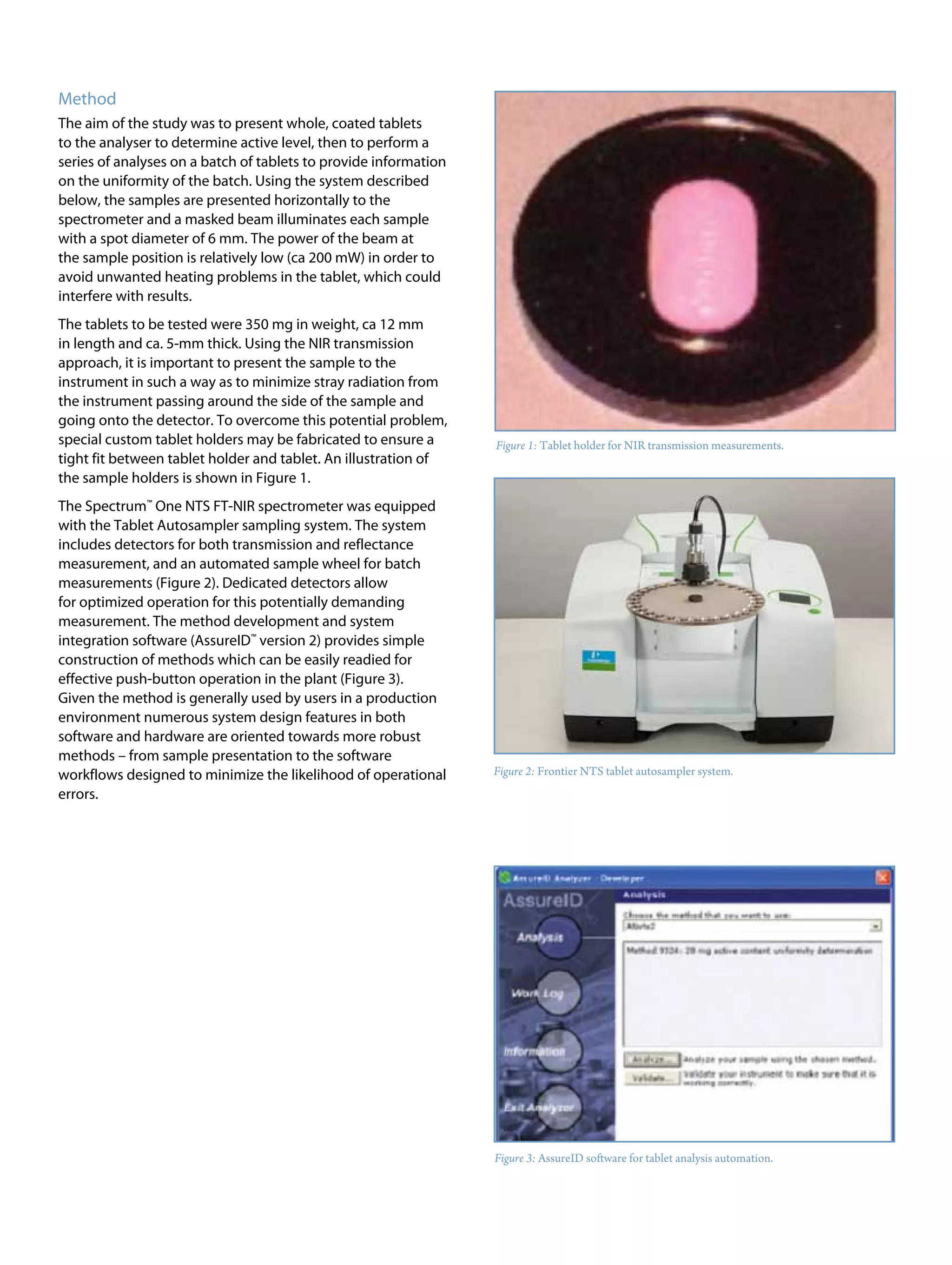
special custom tablet holders may be fabricated to ensure a       Figure 1: Tablet holder for NIR transmission measurements.
tight fit between tablet holder and tablet. An illustration of
the sample holders is shown in Figure 1.
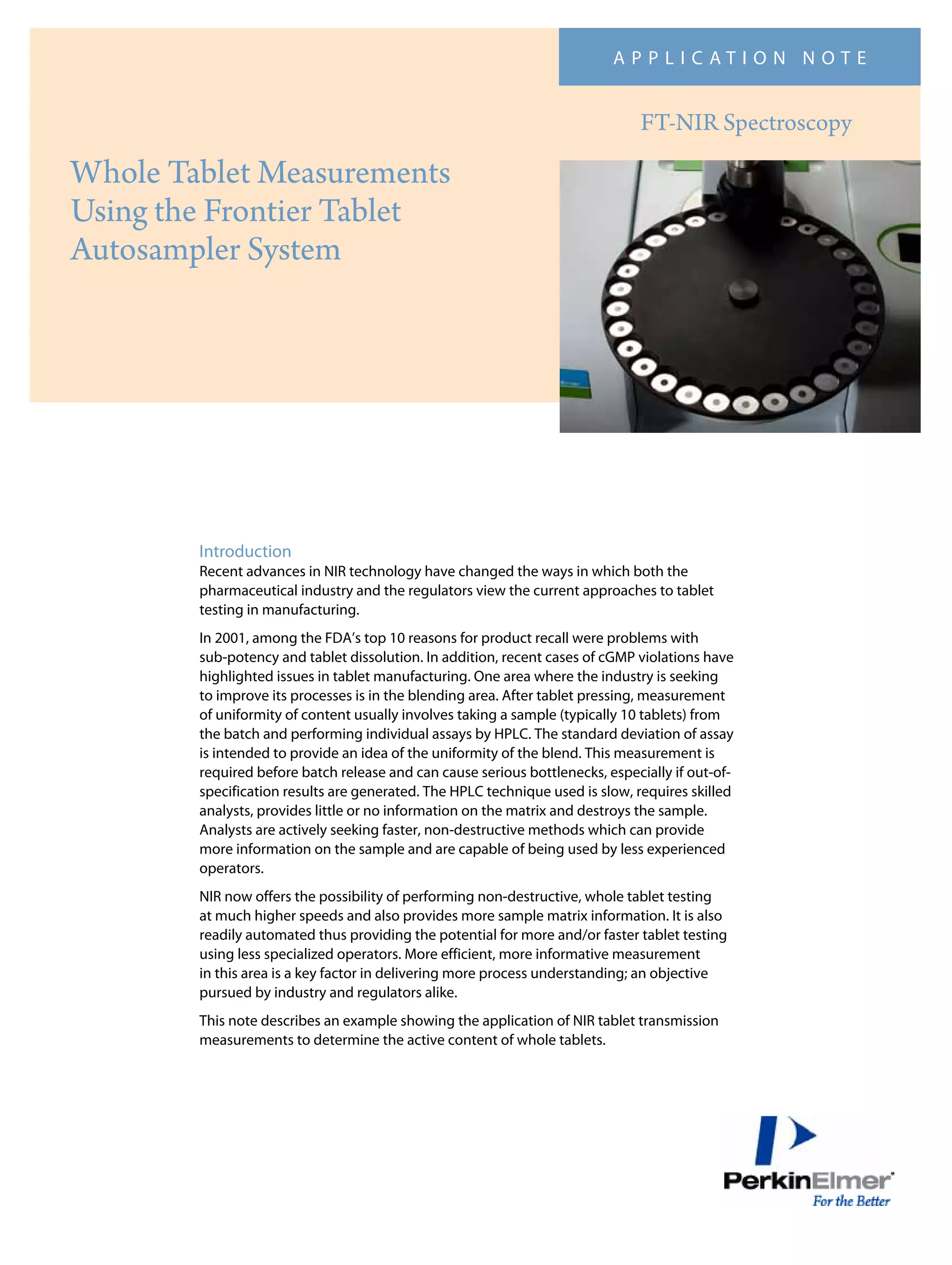
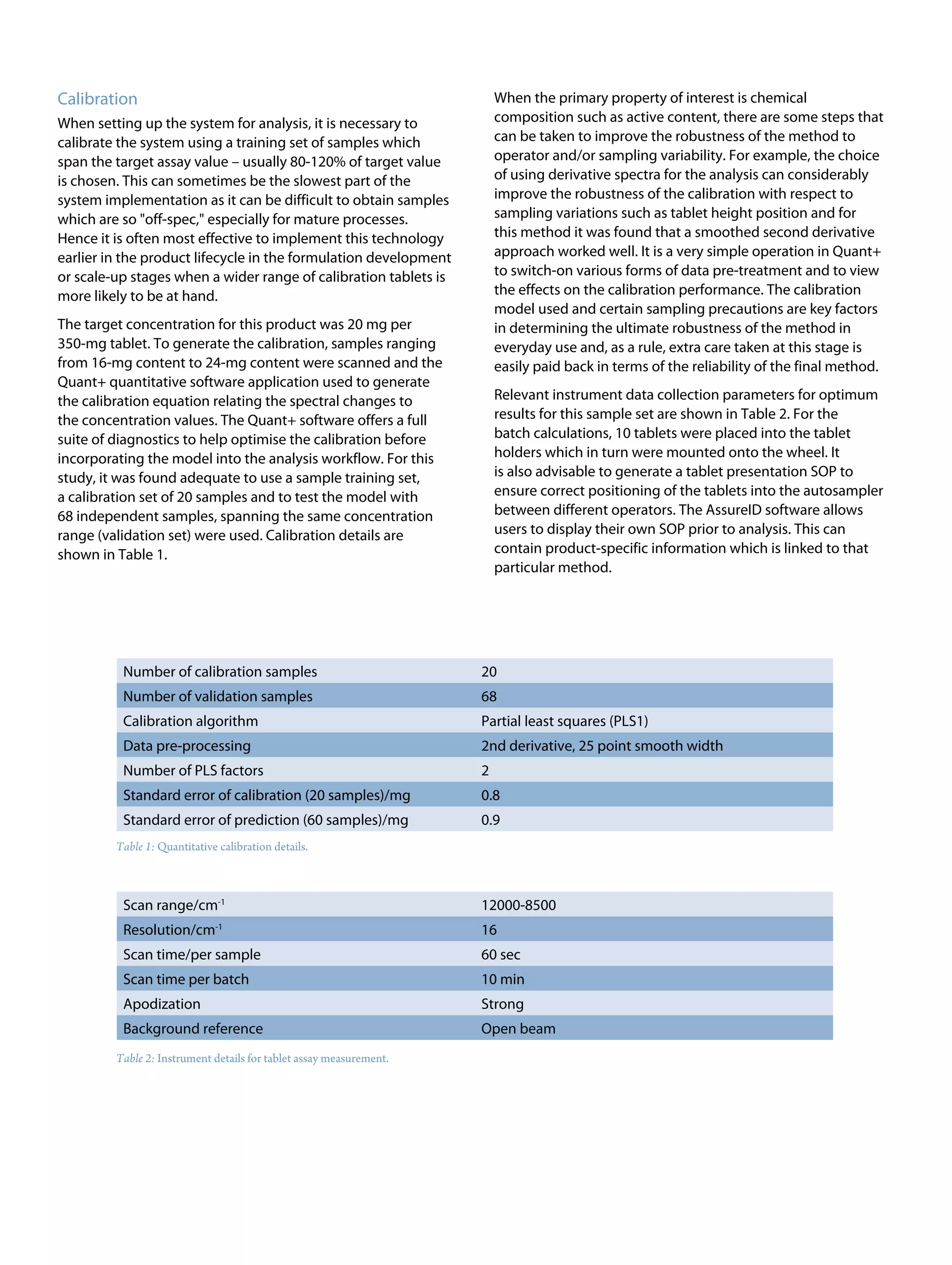
The Spectrum™ One NTS FT-NIR spectrometer was equipped
with the Tablet Autosampler sampling system. The system
includes detectors for both transmission and reflectance
measurement, and an automated sample wheel for batch
measurements (Figure 2). Dedicated detectors allow
for optimized operation for this potentially demanding
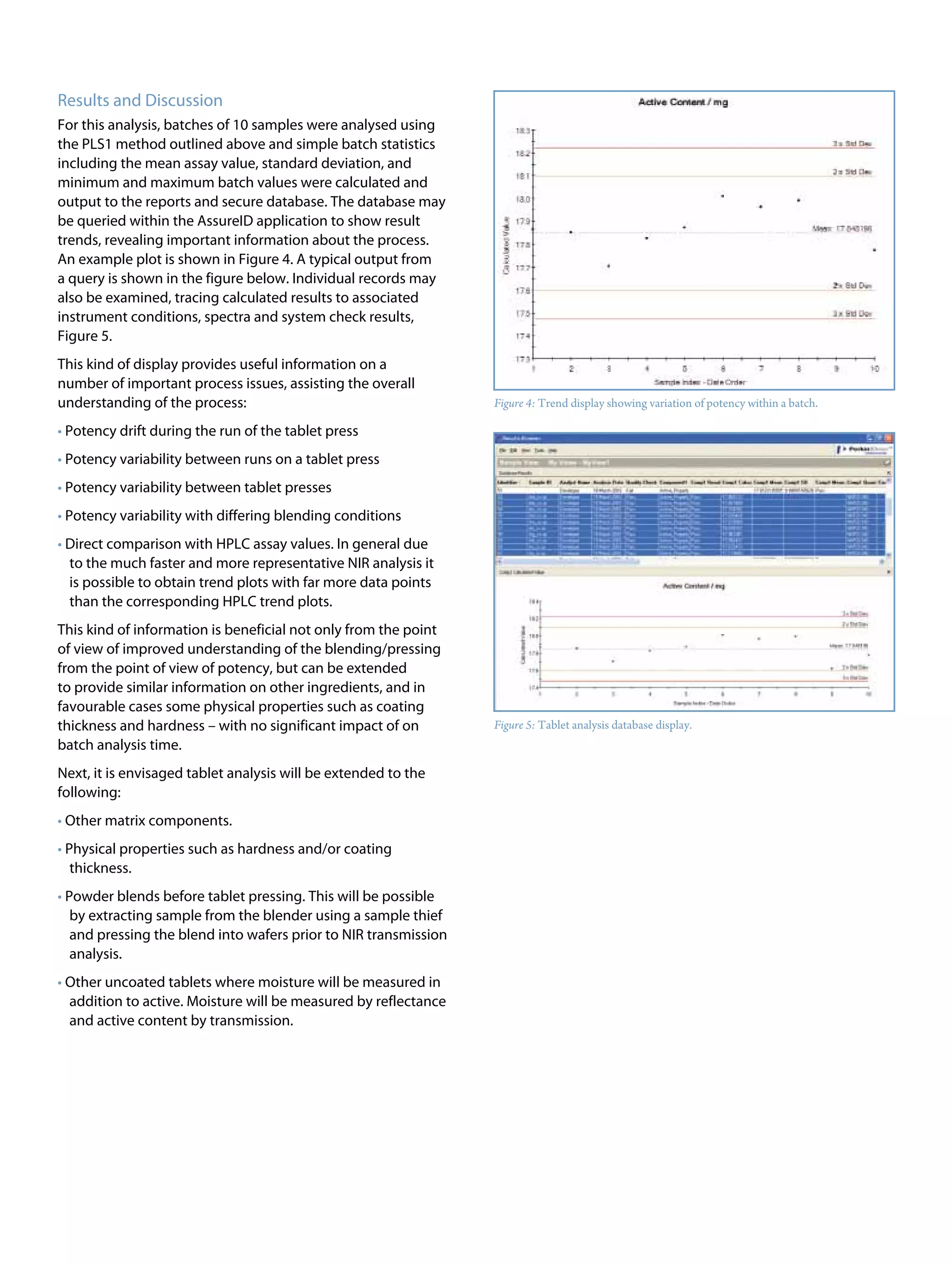
measurement. The method development and system
integration software (AssureID™ version 2) provides simple
construction of methods which can be easily readied for
effective push-button operation in the plant (Figure 3).
Given the method is generally used by users in a production
environment numerous system design features in both
software and hardware are oriented towards more robust
methods – from sample presentation to the software
workflows designed to minimize the likelihood of operational      Figure 2: Frontier NTS tablet autosampler system.
errors.


                                                                  Figure 3: AssureID software for tablet analysis automation.
Calibration                                                              When the primary property of interest is chemical
When setting up the system for analysis, it is necessary to              composition such as active content, there are some steps that
calibrate the system using a training set of samples which               can be taken to improve the robustness of the method to
span the target assay value – usually 80-120% of target value            operator and/or sampling variability. For example, the choice
is chosen. This can sometimes be the slowest part of the                 of using derivative spectra for the analysis can considerably
system implementation as it can be difficult to obtain samples           improve the robustness of the calibration with respect to
which are so "off-spec," especially for mature processes.                sampling variations such as tablet height position and for
Hence it is often most effective to implement this technology            this method it was found that a smoothed second derivative
earlier in the product lifecycle in the formulation development          approach worked well. It is a very simple operation in Quant+
or scale-up stages when a wider range of calibration tablets is          to switch-on various forms of data pre-treatment and to view
more likely to be at hand.                                               the effects on the calibration performance. The calibration
                                                                         model used and certain sampling precautions are key factors
The target concentration for this product was 20 mg per                  in determining the ultimate robustness of the method in
350-mg tablet. To generate the calibration, samples ranging              everyday use and, as a rule, extra care taken at this stage is
from 16-mg content to 24-mg content were scanned and the                 easily paid back in terms of the reliability of the final method.
Quant+ quantitative software application used to generate
the calibration equation relating the spectral changes to                Relevant instrument data collection parameters for optimum
the concentration values. The Quant+ software offers a full              results for this sample set are shown in Table 2. For the
suite of diagnostics to help optimise the calibration before             batch calculations, 10 tablets were placed into the tablet
incorporating the model into the analysis workflow. For this             holders which in turn were mounted onto the wheel. It
study, it was found adequate to use a sample training set,               is also advisable to generate a tablet presentation SOP to
a calibration set of 20 samples and to test the model with               ensure correct positioning of the tablets into the autosampler
68 independent samples, spanning the same concentration                  between different operators. The AssureID software allows
range (validation set) were used. Calibration details are                users to display their own SOP prior to analysis. This can
shown in Table 1.                                                        contain product-specific information which is linked to that
                                                                         particular method.


          Number of calibration samples                              20
          Number of validation samples                               68
          Calibration algorithm                                      Partial least squares (PLS1)
          Data pre-processing                                        2nd derivative, 25 point smooth width
          Number of PLS factors                                      2
          Standard error of calibration (20 samples)/mg              0.8
          Standard error of prediction (60 samples)/mg               0.9
         Table 1: Quantitative calibration details.


          Scan range/cm-1                                            12000-8500
          Resolution/cm       -1
                                                                     16
          Scan time/per sample                                       60 sec
          Scan time per batch                                        10 min
          Apodization                                                Strong
          Background reference                                       Open beam
         Table 2: Instrument details for tablet assay measurement.
Results and Discussion
For this analysis, batches of 10 samples were analysed using
the PLS1 method outlined above and simple batch statistics
including the mean assay value, standard deviation, and
minimum and maximum batch values were calculated and
output to the reports and secure database. The database may
be queried within the AssureID application to show result
trends, revealing important information about the process.
An example plot is shown in Figure 4. A typical output from
a query is shown in the figure below. Individual records may
also be examined, tracing calculated results to associated
instrument conditions, spectra and system check results,
Figure 5.
This kind of display provides useful information on a
number of important process issues, assisting the overall
understanding of the process:                                     Figure 4: Trend display showing variation of potency within a batch.

• Potency drift during the run of the tablet press
• Potency variability between runs on a tablet press
• Potency variability between tablet presses
• Potency variability with differing blending conditions
• Direct comparison with HPLC assay values. In general due
  to the much faster and more representative NIR analysis it
  is possible to obtain trend plots with far more data points
  than the corresponding HPLC trend plots.
This kind of information is beneficial not only from the point
of view of improved understanding of the blending/pressing
from the point of view of potency, but can be extended
to provide similar information on other ingredients, and in
favourable cases some physical properties such as coating
thickness and hardness – with no significant impact of on         Figure 5: Tablet analysis database display.
batch analysis time.
Next, it is envisaged tablet analysis will be extended to the
following:
• Other matrix components.
• Physical properties such as hardness and/or coating
   thickness.
• Powder blends before tablet pressing. This will be possible
   by extracting sample from the blender using a sample thief
   and pressing the blend into wafers prior to NIR transmission
   analysis.
• Other uncoated tablets where moisture will be measured in
  addition to active. Moisture will be measured by reflectance
  and active content by transmission.
As the technique becomes more accepted by the industry,
it is expected that more "calibration-free" approaches
will be adopted in tablet analysis. Such methods skip the
step of developing a model relating the spectral changes
to properties of interest for a pre-analysed training set of
samples and applying the model to predict properties for
the samples. In this case changes in the spectra are related
directly to some variability in the process. For example,
the standard deviation of an isolated active peak height
may be related directly to uniformity of a batch thereby
eliminating the need to calibrate using samples which are
already beyond the bounds of normal process variability. This
approach may be easier for some products, where the active
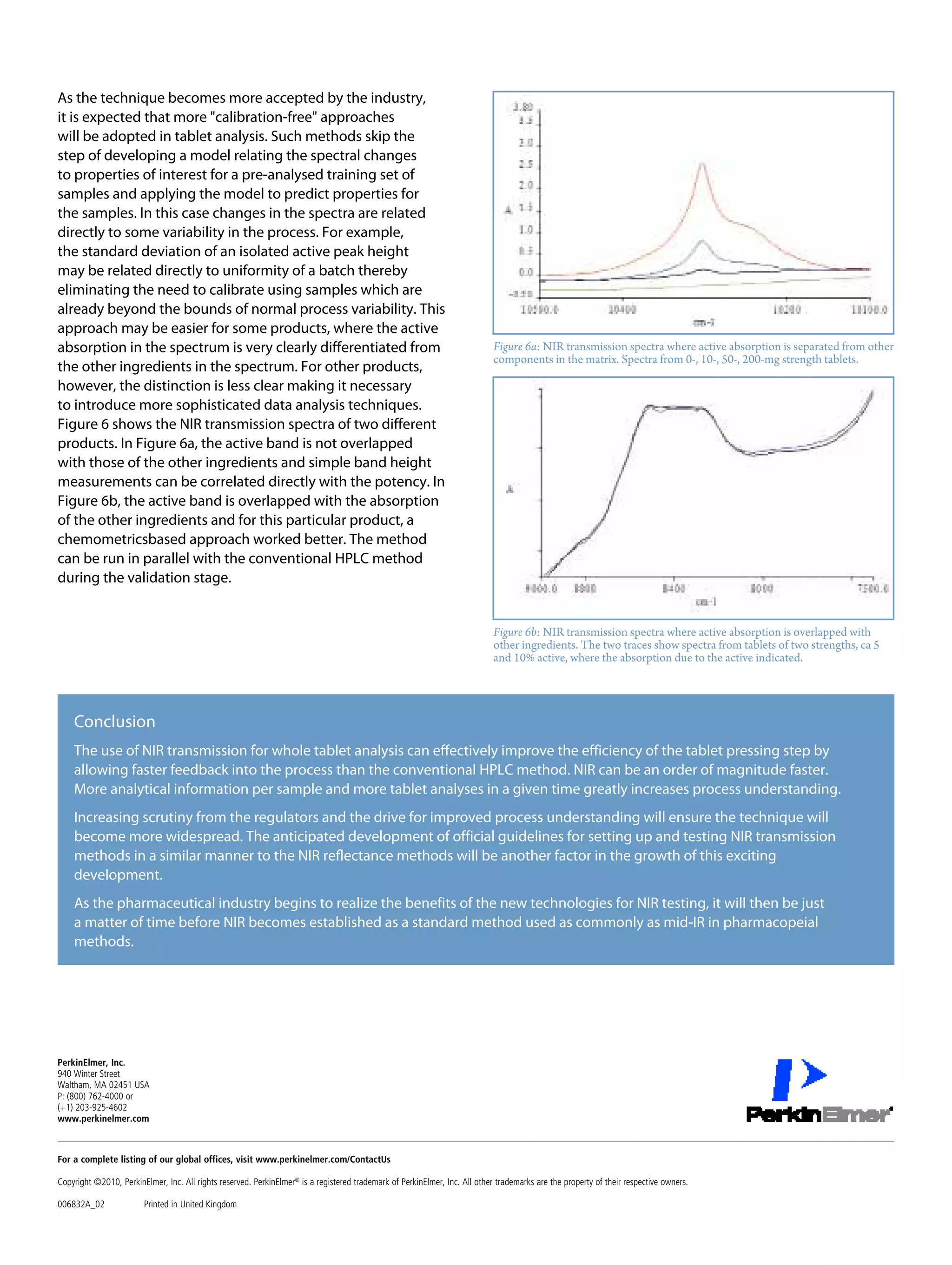
absorption in the spectrum is very clearly differentiated from                                                               Figure 6a: NIR transmission spectra where active absorption is separated from other
                                                                                                                             components in the matrix. Spectra from 0-, 10-, 50-, 200-mg strength tablets.
the other ingredients in the spectrum. For other products,
however, the distinction is less clear making it necessary
to introduce more sophisticated data analysis techniques.
Figure 6 shows the NIR transmission spectra of two different
products. In Figure 6a, the active band is not overlapped
with those of the other ingredients and simple band height
measurements can be correlated directly with the potency. In
Figure 6b, the active band is overlapped with the absorption
of the other ingredients and for this particular product, a
chemometricsbased approach worked better. The method
can be run in parallel with the conventional HPLC method
during the validation stage.


                                                                                                                             Figure 6b: NIR transmission spectra where active absorption is overlapped with
                                                                                                                             other ingredients. The two traces show spectra from tablets of two strengths, ca 5
                                                                                                                             and 10% active, where the absorption due to the active indicated.


    Conclusion
    The use of NIR transmission for whole tablet analysis can effectively improve the efficiency of the tablet pressing step by
    allowing faster feedback into the process than the conventional HPLC method. NIR can be an order of magnitude faster.
    More analytical information per sample and more tablet analyses in a given time greatly increases process understanding.
    Increasing scrutiny from the regulators and the drive for improved process understanding will ensure the technique will
    become more widespread. The anticipated development of official guidelines for setting up and testing NIR transmission
    methods in a similar manner to the NIR reflectance methods will be another factor in the growth of this exciting
    development.
    As the pharmaceutical industry begins to realize the benefits of the new technologies for NIR testing, it will then be just
    a matter of time before NIR becomes established as a standard method used as commonly as mid-IR in pharmacopeial
    methods.


PerkinElmer, Inc.
940 Winter Street
Waltham, MA 02451 USA
P: (800) 762-4000 or
(+1) 203-925-4602
www.perkinelmer.com


For a complete listing of our global offices, visit www.perkinelmer.com/ContactUs

Copyright ©2010, PerkinElmer, Inc. All rights reserved. PerkinElmer® is a registered trademark of PerkinElmer, Inc. All other trademarks are the property of their respective owners.

006832A_02              Printed in United Kingdom

PerkinElmer: Whole Tablet Measurements Using the Frontier Tablet Autosampler System

  • 1.
    APPLIC ATION NOTE FT-NIR Spectroscopy Whole Tablet Measurements Using the Frontier Tablet Autosampler System Introduction Recent advances in NIR technology have changed the ways in which both the pharmaceutical industry and the regulators view the current approaches to tablet testing in manufacturing. In 2001, among the FDA’s top 10 reasons for product recall were problems with sub-potency and tablet dissolution. In addition, recent cases of cGMP violations have highlighted issues in tablet manufacturing. One area where the industry is seeking to improve its processes is in the blending area. After tablet pressing, measurement of uniformity of content usually involves taking a sample (typically 10 tablets) from the batch and performing individual assays by HPLC. The standard deviation of assay is intended to provide an idea of the uniformity of the blend. This measurement is required before batch release and can cause serious bottlenecks, especially if out-of- specification results are generated. The HPLC technique used is slow, requires skilled analysts, provides little or no information on the matrix and destroys the sample. Analysts are actively seeking faster, non-destructive methods which can provide more information on the sample and are capable of being used by less experienced operators. NIR now offers the possibility of performing non-destructive, whole tablet testing at much higher speeds and also provides more sample matrix information. It is also readily automated thus providing the potential for more and/or faster tablet testing using less specialized operators. More efficient, more informative measurement in this area is a key factor in delivering more process understanding; an objective pursued by industry and regulators alike. This note describes an example showing the application of NIR tablet transmission measurements to determine the active content of whole tablets.
  • 2.
    Method The aim ofthe study was to present whole, coated tablets to the analyser to determine active level, then to perform a series of analyses on a batch of tablets to provide information on the uniformity of the batch. Using the system described below, the samples are presented horizontally to the spectrometer and a masked beam illuminates each sample with a spot diameter of 6 mm. The power of the beam at the sample position is relatively low (ca 200 mW) in order to avoid unwanted heating problems in the tablet, which could interfere with results. The tablets to be tested were 350 mg in weight, ca 12 mm in length and ca. 5-mm thick. Using the NIR transmission approach, it is important to present the sample to the instrument in such a way as to minimize stray radiation from the instrument passing around the side of the sample and going onto the detector. To overcome this potential problem, special custom tablet holders may be fabricated to ensure a Figure 1: Tablet holder for NIR transmission measurements. tight fit between tablet holder and tablet. An illustration of the sample holders is shown in Figure 1. The Spectrum™ One NTS FT-NIR spectrometer was equipped with the Tablet Autosampler sampling system. The system includes detectors for both transmission and reflectance measurement, and an automated sample wheel for batch measurements (Figure 2). Dedicated detectors allow for optimized operation for this potentially demanding measurement. The method development and system integration software (AssureID™ version 2) provides simple construction of methods which can be easily readied for effective push-button operation in the plant (Figure 3). Given the method is generally used by users in a production environment numerous system design features in both software and hardware are oriented towards more robust methods – from sample presentation to the software workflows designed to minimize the likelihood of operational Figure 2: Frontier NTS tablet autosampler system. errors. Figure 3: AssureID software for tablet analysis automation.
  • 3.
    Calibration When the primary property of interest is chemical When setting up the system for analysis, it is necessary to composition such as active content, there are some steps that calibrate the system using a training set of samples which can be taken to improve the robustness of the method to span the target assay value – usually 80-120% of target value operator and/or sampling variability. For example, the choice is chosen. This can sometimes be the slowest part of the of using derivative spectra for the analysis can considerably system implementation as it can be difficult to obtain samples improve the robustness of the calibration with respect to which are so "off-spec," especially for mature processes. sampling variations such as tablet height position and for Hence it is often most effective to implement this technology this method it was found that a smoothed second derivative earlier in the product lifecycle in the formulation development approach worked well. It is a very simple operation in Quant+ or scale-up stages when a wider range of calibration tablets is to switch-on various forms of data pre-treatment and to view more likely to be at hand. the effects on the calibration performance. The calibration model used and certain sampling precautions are key factors The target concentration for this product was 20 mg per in determining the ultimate robustness of the method in 350-mg tablet. To generate the calibration, samples ranging everyday use and, as a rule, extra care taken at this stage is from 16-mg content to 24-mg content were scanned and the easily paid back in terms of the reliability of the final method. Quant+ quantitative software application used to generate the calibration equation relating the spectral changes to Relevant instrument data collection parameters for optimum the concentration values. The Quant+ software offers a full results for this sample set are shown in Table 2. For the suite of diagnostics to help optimise the calibration before batch calculations, 10 tablets were placed into the tablet incorporating the model into the analysis workflow. For this holders which in turn were mounted onto the wheel. It study, it was found adequate to use a sample training set, is also advisable to generate a tablet presentation SOP to a calibration set of 20 samples and to test the model with ensure correct positioning of the tablets into the autosampler 68 independent samples, spanning the same concentration between different operators. The AssureID software allows range (validation set) were used. Calibration details are users to display their own SOP prior to analysis. This can shown in Table 1. contain product-specific information which is linked to that particular method. Number of calibration samples 20 Number of validation samples 68 Calibration algorithm Partial least squares (PLS1) Data pre-processing 2nd derivative, 25 point smooth width Number of PLS factors 2 Standard error of calibration (20 samples)/mg 0.8 Standard error of prediction (60 samples)/mg 0.9 Table 1: Quantitative calibration details. Scan range/cm-1 12000-8500 Resolution/cm -1 16 Scan time/per sample 60 sec Scan time per batch 10 min Apodization Strong Background reference Open beam Table 2: Instrument details for tablet assay measurement.
  • 4.
    Results and Discussion Forthis analysis, batches of 10 samples were analysed using the PLS1 method outlined above and simple batch statistics including the mean assay value, standard deviation, and minimum and maximum batch values were calculated and output to the reports and secure database. The database may be queried within the AssureID application to show result trends, revealing important information about the process. An example plot is shown in Figure 4. A typical output from a query is shown in the figure below. Individual records may also be examined, tracing calculated results to associated instrument conditions, spectra and system check results, Figure 5. This kind of display provides useful information on a number of important process issues, assisting the overall understanding of the process: Figure 4: Trend display showing variation of potency within a batch. • Potency drift during the run of the tablet press • Potency variability between runs on a tablet press • Potency variability between tablet presses • Potency variability with differing blending conditions • Direct comparison with HPLC assay values. In general due to the much faster and more representative NIR analysis it is possible to obtain trend plots with far more data points than the corresponding HPLC trend plots. This kind of information is beneficial not only from the point of view of improved understanding of the blending/pressing from the point of view of potency, but can be extended to provide similar information on other ingredients, and in favourable cases some physical properties such as coating thickness and hardness – with no significant impact of on Figure 5: Tablet analysis database display. batch analysis time. Next, it is envisaged tablet analysis will be extended to the following: • Other matrix components. • Physical properties such as hardness and/or coating thickness. • Powder blends before tablet pressing. This will be possible by extracting sample from the blender using a sample thief and pressing the blend into wafers prior to NIR transmission analysis. • Other uncoated tablets where moisture will be measured in addition to active. Moisture will be measured by reflectance and active content by transmission.
  • 5.
    As the techniquebecomes more accepted by the industry, it is expected that more "calibration-free" approaches will be adopted in tablet analysis. Such methods skip the step of developing a model relating the spectral changes to properties of interest for a pre-analysed training set of samples and applying the model to predict properties for the samples. In this case changes in the spectra are related directly to some variability in the process. For example, the standard deviation of an isolated active peak height may be related directly to uniformity of a batch thereby eliminating the need to calibrate using samples which are already beyond the bounds of normal process variability. This approach may be easier for some products, where the active absorption in the spectrum is very clearly differentiated from Figure 6a: NIR transmission spectra where active absorption is separated from other components in the matrix. Spectra from 0-, 10-, 50-, 200-mg strength tablets. the other ingredients in the spectrum. For other products, however, the distinction is less clear making it necessary to introduce more sophisticated data analysis techniques. Figure 6 shows the NIR transmission spectra of two different products. In Figure 6a, the active band is not overlapped with those of the other ingredients and simple band height measurements can be correlated directly with the potency. In Figure 6b, the active band is overlapped with the absorption of the other ingredients and for this particular product, a chemometricsbased approach worked better. The method can be run in parallel with the conventional HPLC method during the validation stage. Figure 6b: NIR transmission spectra where active absorption is overlapped with other ingredients. The two traces show spectra from tablets of two strengths, ca 5 and 10% active, where the absorption due to the active indicated. Conclusion The use of NIR transmission for whole tablet analysis can effectively improve the efficiency of the tablet pressing step by allowing faster feedback into the process than the conventional HPLC method. NIR can be an order of magnitude faster. More analytical information per sample and more tablet analyses in a given time greatly increases process understanding. Increasing scrutiny from the regulators and the drive for improved process understanding will ensure the technique will become more widespread. The anticipated development of official guidelines for setting up and testing NIR transmission methods in a similar manner to the NIR reflectance methods will be another factor in the growth of this exciting development. As the pharmaceutical industry begins to realize the benefits of the new technologies for NIR testing, it will then be just a matter of time before NIR becomes established as a standard method used as commonly as mid-IR in pharmacopeial methods. PerkinElmer, Inc. 940 Winter Street Waltham, MA 02451 USA P: (800) 762-4000 or (+1) 203-925-4602 www.perkinelmer.com For a complete listing of our global offices, visit www.perkinelmer.com/ContactUs Copyright ©2010, PerkinElmer, Inc. All rights reserved. PerkinElmer® is a registered trademark of PerkinElmer, Inc. All other trademarks are the property of their respective owners. 006832A_02 Printed in United Kingdom