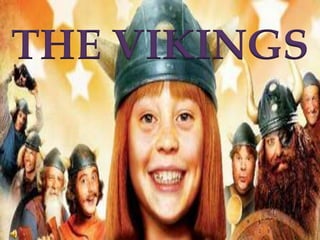
THE VIKINGS
Vikings came from three countries of Scandinavia:
Denmark, Norway, Sweden. The word Viking
comes from a language called Old Norses and means
a pirate raid.
 The Viking age in European history was about AD
700 to 1100. During this period many Vikings left
Scandinavia and travelled to other countries, such as
Britain and Ireland. Some went to fight and steal
treasure. Others settled in new lands as farmers,
craftsmen or traders.
Viking houses where built of wood, stone or blocks of
grass depending on the local materials.
 Most houses had just one room for a family to share.
Rich people which have farmhouses have a small
entrance hall, a large main room, a kitchen, a
bedroom and a store room. In a Viking town, houses
were crowded close together along narrow streets.
Men wore tunics and trousers.
Women wore long dresses, with a kind of long
apron.
Clothes were made from wool, linen and animal
 skins.
People dressed mostly to keep warm!
Most Viking men were all-round handymen, but some
had special skills. There were boat-builders, for example
and potters, leather-workers and smiths. Most Viking
men knew how to handle a boat. And most could fight if
they had, to protect the family.
Women baked bread. They looked after the children,
made the family's clothes and cooked the two meals a
day most families ate. On the farm, women milked the
cows and made cheese  .
   They worshipped many gods. The old stories
    they told about gods, giants and monsters are
    known as Norse myths. In one story, Thor, the
    god of thunder, tries to prove his strength to
    the Giant King
•.The Vikings built fast ships for raiding and war.
•.These ships were 'dragon-ships' or 'longships'.
• .The Vikings also had passenger and cargo ships
called knorrs.
•.They built small boats for fishing or short trips.
•.Viking longships could sail in shallow water.
• .So they could travel up rivers as well as across the
sea.
• .The Vikings could jump out and start fighting, and
then make a quick getaway if they were chased.
   Some Viking ships brought families to Britain looking
    for land to farm.
    The parts of Britain where most Vikings settled were
    northern Scotland and eastern England, the
     Orkney and Shetland isles and the Hebrides islands off
    the west coast.
    In Ireland, Vikings founded the city of Dublin.
   Viking areas in east and northern England became
    known as theb Danelaw. Viking settlements brought
    new words into the English language.
   BY Teresa Aznar
   6th primary
   2.011 – 2.012
   Beatriz Domeque Yus
   School Antonio Machado
Teresa aznar

Teresa aznar

  • 1.
  • 2.
    Vikings came fromthree countries of Scandinavia: Denmark, Norway, Sweden. The word Viking comes from a language called Old Norses and means a pirate raid. The Viking age in European history was about AD 700 to 1100. During this period many Vikings left Scandinavia and travelled to other countries, such as Britain and Ireland. Some went to fight and steal treasure. Others settled in new lands as farmers, craftsmen or traders.
  • 3.
    Viking houses wherebuilt of wood, stone or blocks of grass depending on the local materials. Most houses had just one room for a family to share. Rich people which have farmhouses have a small entrance hall, a large main room, a kitchen, a bedroom and a store room. In a Viking town, houses were crowded close together along narrow streets.
  • 4.
    Men wore tunicsand trousers. Women wore long dresses, with a kind of long apron. Clothes were made from wool, linen and animal skins. People dressed mostly to keep warm!
  • 5.
    Most Viking menwere all-round handymen, but some had special skills. There were boat-builders, for example and potters, leather-workers and smiths. Most Viking men knew how to handle a boat. And most could fight if they had, to protect the family. Women baked bread. They looked after the children, made the family's clothes and cooked the two meals a day most families ate. On the farm, women milked the cows and made cheese .
  • 6.
    They worshipped many gods. The old stories they told about gods, giants and monsters are known as Norse myths. In one story, Thor, the god of thunder, tries to prove his strength to the Giant King
  • 7.
    •.The Vikings builtfast ships for raiding and war. •.These ships were 'dragon-ships' or 'longships'. • .The Vikings also had passenger and cargo ships called knorrs. •.They built small boats for fishing or short trips. •.Viking longships could sail in shallow water. • .So they could travel up rivers as well as across the sea. • .The Vikings could jump out and start fighting, and then make a quick getaway if they were chased.
  • 8.
    Some Viking ships brought families to Britain looking for land to farm.  The parts of Britain where most Vikings settled were northern Scotland and eastern England, the Orkney and Shetland isles and the Hebrides islands off the west coast.  In Ireland, Vikings founded the city of Dublin.  Viking areas in east and northern England became known as theb Danelaw. Viking settlements brought new words into the English language.
  • 9.
    BY Teresa Aznar  6th primary  2.011 – 2.012  Beatriz Domeque Yus  School Antonio Machado