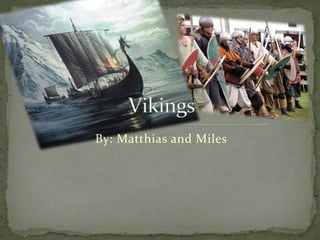
By: Matthias and Miles
Map of Viking
Civilization

This map shows where
the Vikings started off
and where there
civilizations expanded
to. In the 8th century
they started off in
Scandinavia but then
in the 9th century they
had moved to parts of
Iceland, England, and
Ireland. Over time
they had much of
Europe and even some
of North America. The
Vikings were a
dominate group.
 The Vikings were a
  Scandinavian group who
  explored and raided most of
  Europe
 The Vikings were around
  from the 8th century to the 11th
  century. This was known as
  the Viking age
 They were mostly known for
  their big long ships and their
  trading. The Vikings brought
  their valuable goods with
  them and traded them to
  other civilizations
1.   Chieftain: The Chieftain owned all of the land they had
         raided. Every summer he and his army would raid other
         countries
    2.   Chieftains Wife: She stayed home and looked after farm
    3.   The Eldest Son: He inherited all of the money and land
    4.   The Freemen: Would stay at home and maintain the
         land, and complete tasks such as melting iron and
         making weapons
    5.   The Tradesmen: Would go to Villages to trade their goods
    6.   The Slaves: Would do all of the dirty work
     Chieftain and his
     family                   The Freemen
                                                 The Viking
The Tradesmen
                                                 Chieftain
                                    The Slaves
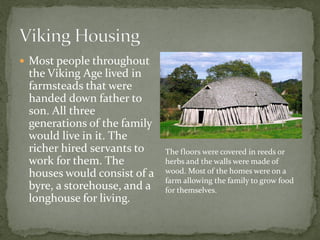
 Most people throughout
 the Viking Age lived in
 farmsteads that were
 handed down father to
 son. All three
 generations of the family
 would live in it. The
 richer hired servants to    The floors were covered in reeds or
 work for them. The          herbs and the walls were made of
 houses would consist of a   wood. Most of the homes were on a
                             farm allowing the family to grow food
 byre, a storehouse, and a   for themselves.
 longhouse for living.
Wearing jewellery in the Viking
age was a sign of wealth that
showed that you were rich enough
to wear expensive jewellery. Also in
a normal house it would usually be
just one room but well off families
would be able to have two rooms.
Also only the rich could afford
furniture such as tables and chairs.
Most Vikings slept on hay or on a
rug or bench but only the rich
could afford beds, some rich
people would also have tapestry on     Viking wore their jewellery to
the walls to decorate but rugs had     show off their wealth
not been made yet instead the rich
would spread rushes on the floor.
Also if a Viking was more well of
they could have more clothing that
was made out of fine materials.
Vikings enjoyed eating many
types of seafood such as fish,
seaweed, shellfish, seals, and
whales. Sometimes the slaves
pickled the fish in salt water
to give it more taste. With all
the vegetables they grew on
their farms they ate as well.
They also ate some wild
animals. They drank milk,
beer and other drinks with
                                  Here are some foods that the Vikings ate
their meals. Also on holidays     such as fish, vegetables, and bread
they had big feasts with a
variety.
 Most of the Viking men
  were all around workers
  doing work such as boat
  building, or making tools.
  They also knew how to
  fight, so they could protect
  their family or the
  chieftain.
 Most of the Viking women
  took care of the everyday
  household tasks. They
  would wash clothes, take
  care of the children. They     The Viking women also made
  also looked after the farms    pottery in there spare time at
  while the men were out.        home
 Girls usually get married around the
    ages of 12-15 year of age
   When they got married they were
    expected to take over and run the
    household
   The decision of the marriage was
    mostly between the two families.
    The girls didn’t get that much of a
    say in it
   If the other partner wasn’t taking
    much part in the marriage or if he
    was treating her poorly she had the
    right to divorce him
                                              That is a Viking engagement
   She had to call over some witness’s
    to make it final                          ring. The Viking men would
   The children were kept with the           propose to someone with it
    mother if they were little, but if they
    were bigger they would be split
   The Wives brought sewing supplies
    as well as a loom and a bed
 Women were always the
 care givers when a woman
 was delivering a baby.
 When a woman was
 delivering a baby they
 would take a position by
 kneeling on the ground
 with helpers behind the
 woman helping her up.
 Then they would hold her
 elbows and deliver the
 baby through the back. To
 calm a woman they would       A Viking Childbirth Practice
 sing songs to help her calm
 down.
 If the child survived birth then
  hardly any children got an education
  so they most likely wouldn’t go to
  school.
 Children did not have toys like they
  have now but they did act out like
  their parents so for example they
  would ride sticks and pretend to be
  in a battle.
 When a child would become old
  enough they would start to help
  around the house, in cleaning the
  house and working on the crops.
 They would have to learn these skills
  when they have their own house.
  Skills in fighting were learned using
  pretend toy weapons.
                                          Viking children would preform
                                          household tasks when they got older
Our life                       Viking Life
                                Some Viking children didn’t
 Many more children
                                 survive birth or had a hard
  survive birth and live a       time living healthy
  healthy live because of
  good healthcare               In the Viking age children
                                 didn’t have as many toys to
 Today we have many toys        play with so they had to use
  to play with                   their imagination
 Today we have much more       When a Viking child turned a
  freedom but we still have      certain age they had to
  to help around the house       perform many tasks around
                                 the household and had little
 We have the opportunity to     time for play
  really be a kid
                                The Vikings had a much
                                 different life then we had
                                 growing up
 In the Viking age there were
  no public schools, all
  education was done at home.
  The Adults or parents
  educated the children
 When Viking children
  reached the age of around 10
  they were taught how to run a
  household so they could take
  over the family farm
 Girls learned how to spin and
  weave while boys went fishing
  with their fathers
                                  Viking children were always
                                  busy around the household,
                                  but they still had a bit of time
 The Vikings believed in many
  different types of gods and
  goddesses who all had many
  different personalities almost
  like humans. The main gods or
  chief gods were Odin, Thor and
  Frey. The Vikings would worship
  the gods and ask different gods
  for different things for example,
  they would pray for good
  weather for crops. Later when
  Vikings went to other countries
  most people were Christian so
  some Vikings became Christian
  but most Vikings stayed loyal to    Thor was one of the most
  the gods and didn’t become          common gods among the
  Christians.                         Viking society
Thor
Thor is one of the most
commonly known gods
among Viking Heritage.
He is the son of Odin and
Fjorgyn. Thor is the god of
thunder, sky, and law. Thor
wore a belt carrying a
hammer. Thor killed
anything that moved. Thor
was a very powerful god.      Thor, the god of Thunder
 The Vikings like most people
  back in their time made most of
  their clothes out of wool.
 The Vikings would bring sheep
  around with them to create
  clothes; the women would weave
  the wool and create clothes.
 They would also use fruits and
  vegetables to dye the clothes
  different colors. Men would
  typically wear a wool shirt and a
  skirt or kilt. The women would
  wear a long linen dress and
  would wear an apron around the
  house. In the cold both men and
  women wore wool hats and            They wore wool sweaters with
  cloaks.                             helmets on. They would
                                      sometimes wear a skirt or kilt
 Music in Viking times evolved
  over the ages. Every generation
  slightly changed music in Viking
  times. In the 17th century music
  started to be written down and
  kept. Then once songs had been
  written there was lots of singing
  and dancing with the music. The
  Vikings sang when they were sad
  and when they were happy. They
  also danced sang songs and
  played instruments when there
  was a celebration of some kind.
  Viking art was not very
  important; they instead
  decorated ordinary objects such
  as cones and buckets. They also     Swan bone flutes were
  made some out of metal and
  leather and wood to makes stuff     used to play music
  such as belts and jewellery to
  sell.
 Thursebolt was a popular
 festival among Viking
 heritage honouring Thor
 who protected
 Midgaurd. At Festivals
 Vikings drank ale and
 mead from wooden cups.
 Some funerals in the
 Viking age lasted as long   Popular food at a Viking festivals
 as a week
 The Vikings were a
 ruthless group of
 invaders who took over
 and explored parts of the
 world mainly Europe.
 We admire the Vikings
 for their willingness to
 explore and invade new
 places. Overall many of
 the skills the Vikings      A Viking battle
 possessed helped them
 during the Viking age.
The Vikings: http://en.wikipedia.org/wiki/Viking
Social Structure of the Vikings:
http://valdis_sca.tripod.com/rsocial_structure.html
Food of the Vikings:
http://library.thinkquest.org/C005446/Food/English/viking.html
Housing in Viking Age:
http://www.vikingsonline.org.uk/resources/articles/housing.htm
Vikings at Home:
http://www.bbc.co.uk/schools/primaryhistory/vikings/vikings_at_ho
me/
Clothes: http://www.viking.no/e/life/eclothes.htm
Women: http://www.viking.no/e/life/ewomen.htm
Viking Gods: http://www.rosala-viking-centre.com/gods.htm
Vikings:
http://cd7.e2bn.net/e2bn/leas/c99/schools/cd7/website/Vikings.htm
Medical care: http://www.vikinganswerlady.com/medicine.shtml
 Margeson, Susan.
  Eyewitness Books—
  Viking. Stoddart
  publishing co. Toronto
  Canada, 1994
 Morley, Jacqueline. First
  Facts about the Vikings.
  Peter Bedrick Books.
  New York, New York,
  1996.
 Viking Chieftain:                     Viking Man:
    http://forum.nationstates.net/vi       http://www.celticattic.com/cont
    ewtopic.php?t=106463&f=23&vie          act_us/norwegian_connection/c
    w=unread                               lothing.htm
   Food: http://www.lore-and-            Viking ring:
    saga.co.uk/html/viking_burials.        http://www.wedbands.com/viki
    html                                   ngcol.htm
   Thor:                                 Viking Flute:
    http://seshdotcom.wordpress.co         http://homepage.eircom.net/~br
    m/2008/04/01/telling-thor-is-          onzeagehorns/stoneage.html
    he-the-greatest-of-norse-gods/        Viking Village:
   Viking Children:                       http://liverpool.fluxtime.com/hi
    http://caroljonas.com/page3.ht         story2.html
    m                                     Viking Battle:
   Viking Ship:                           http://www.flickr.com/photos/
    http://www.vikingsgab.com/200          mararie/2844902161/sizes/m/in/
    9/08/30/vikings-ship/                  photostream/

Matthias_Miles_Socials

  • 1.
  • 2.
    Map of Viking Civilization Thismap shows where the Vikings started off and where there civilizations expanded to. In the 8th century they started off in Scandinavia but then in the 9th century they had moved to parts of Iceland, England, and Ireland. Over time they had much of Europe and even some of North America. The Vikings were a dominate group.
  • 3.
     The Vikingswere a Scandinavian group who explored and raided most of Europe  The Vikings were around from the 8th century to the 11th century. This was known as the Viking age  They were mostly known for their big long ships and their trading. The Vikings brought their valuable goods with them and traded them to other civilizations
  • 4.
    1. Chieftain: The Chieftain owned all of the land they had raided. Every summer he and his army would raid other countries 2. Chieftains Wife: She stayed home and looked after farm 3. The Eldest Son: He inherited all of the money and land 4. The Freemen: Would stay at home and maintain the land, and complete tasks such as melting iron and making weapons 5. The Tradesmen: Would go to Villages to trade their goods 6. The Slaves: Would do all of the dirty work Chieftain and his family The Freemen The Viking The Tradesmen Chieftain The Slaves
  • 5.
     Most peoplethroughout the Viking Age lived in farmsteads that were handed down father to son. All three generations of the family would live in it. The richer hired servants to The floors were covered in reeds or work for them. The herbs and the walls were made of houses would consist of a wood. Most of the homes were on a farm allowing the family to grow food byre, a storehouse, and a for themselves. longhouse for living.
  • 6.
    Wearing jewellery inthe Viking age was a sign of wealth that showed that you were rich enough to wear expensive jewellery. Also in a normal house it would usually be just one room but well off families would be able to have two rooms. Also only the rich could afford furniture such as tables and chairs. Most Vikings slept on hay or on a rug or bench but only the rich could afford beds, some rich people would also have tapestry on Viking wore their jewellery to the walls to decorate but rugs had show off their wealth not been made yet instead the rich would spread rushes on the floor. Also if a Viking was more well of they could have more clothing that was made out of fine materials.
  • 7.
    Vikings enjoyed eatingmany types of seafood such as fish, seaweed, shellfish, seals, and whales. Sometimes the slaves pickled the fish in salt water to give it more taste. With all the vegetables they grew on their farms they ate as well. They also ate some wild animals. They drank milk, beer and other drinks with Here are some foods that the Vikings ate their meals. Also on holidays such as fish, vegetables, and bread they had big feasts with a variety.
  • 8.
     Most ofthe Viking men were all around workers doing work such as boat building, or making tools. They also knew how to fight, so they could protect their family or the chieftain.  Most of the Viking women took care of the everyday household tasks. They would wash clothes, take care of the children. They The Viking women also made also looked after the farms pottery in there spare time at while the men were out. home
  • 9.
     Girls usuallyget married around the ages of 12-15 year of age  When they got married they were expected to take over and run the household  The decision of the marriage was mostly between the two families. The girls didn’t get that much of a say in it  If the other partner wasn’t taking much part in the marriage or if he was treating her poorly she had the right to divorce him That is a Viking engagement  She had to call over some witness’s to make it final ring. The Viking men would  The children were kept with the propose to someone with it mother if they were little, but if they were bigger they would be split  The Wives brought sewing supplies as well as a loom and a bed
  • 10.
     Women werealways the care givers when a woman was delivering a baby. When a woman was delivering a baby they would take a position by kneeling on the ground with helpers behind the woman helping her up. Then they would hold her elbows and deliver the baby through the back. To calm a woman they would A Viking Childbirth Practice sing songs to help her calm down.
  • 11.
     If thechild survived birth then hardly any children got an education so they most likely wouldn’t go to school.  Children did not have toys like they have now but they did act out like their parents so for example they would ride sticks and pretend to be in a battle.  When a child would become old enough they would start to help around the house, in cleaning the house and working on the crops.  They would have to learn these skills when they have their own house. Skills in fighting were learned using pretend toy weapons. Viking children would preform household tasks when they got older
  • 12.
    Our life Viking Life  Some Viking children didn’t  Many more children survive birth or had a hard survive birth and live a time living healthy healthy live because of good healthcare  In the Viking age children didn’t have as many toys to  Today we have many toys play with so they had to use to play with their imagination  Today we have much more  When a Viking child turned a freedom but we still have certain age they had to to help around the house perform many tasks around the household and had little  We have the opportunity to time for play really be a kid  The Vikings had a much different life then we had growing up
  • 13.
     In theViking age there were no public schools, all education was done at home. The Adults or parents educated the children  When Viking children reached the age of around 10 they were taught how to run a household so they could take over the family farm  Girls learned how to spin and weave while boys went fishing with their fathers Viking children were always busy around the household, but they still had a bit of time
  • 14.
     The Vikingsbelieved in many different types of gods and goddesses who all had many different personalities almost like humans. The main gods or chief gods were Odin, Thor and Frey. The Vikings would worship the gods and ask different gods for different things for example, they would pray for good weather for crops. Later when Vikings went to other countries most people were Christian so some Vikings became Christian but most Vikings stayed loyal to Thor was one of the most the gods and didn’t become common gods among the Christians. Viking society
  • 15.
    Thor Thor is oneof the most commonly known gods among Viking Heritage. He is the son of Odin and Fjorgyn. Thor is the god of thunder, sky, and law. Thor wore a belt carrying a hammer. Thor killed anything that moved. Thor was a very powerful god. Thor, the god of Thunder
  • 16.
     The Vikingslike most people back in their time made most of their clothes out of wool.  The Vikings would bring sheep around with them to create clothes; the women would weave the wool and create clothes.  They would also use fruits and vegetables to dye the clothes different colors. Men would typically wear a wool shirt and a skirt or kilt. The women would wear a long linen dress and would wear an apron around the house. In the cold both men and women wore wool hats and They wore wool sweaters with cloaks. helmets on. They would sometimes wear a skirt or kilt
  • 17.
     Music inViking times evolved over the ages. Every generation slightly changed music in Viking times. In the 17th century music started to be written down and kept. Then once songs had been written there was lots of singing and dancing with the music. The Vikings sang when they were sad and when they were happy. They also danced sang songs and played instruments when there was a celebration of some kind. Viking art was not very important; they instead decorated ordinary objects such as cones and buckets. They also Swan bone flutes were made some out of metal and leather and wood to makes stuff used to play music such as belts and jewellery to sell.
  • 18.
     Thursebolt wasa popular festival among Viking heritage honouring Thor who protected Midgaurd. At Festivals Vikings drank ale and mead from wooden cups. Some funerals in the Viking age lasted as long Popular food at a Viking festivals as a week
  • 19.
     The Vikingswere a ruthless group of invaders who took over and explored parts of the world mainly Europe. We admire the Vikings for their willingness to explore and invade new places. Overall many of the skills the Vikings A Viking battle possessed helped them during the Viking age.
  • 20.
    The Vikings: http://en.wikipedia.org/wiki/Viking SocialStructure of the Vikings: http://valdis_sca.tripod.com/rsocial_structure.html Food of the Vikings: http://library.thinkquest.org/C005446/Food/English/viking.html Housing in Viking Age: http://www.vikingsonline.org.uk/resources/articles/housing.htm Vikings at Home: http://www.bbc.co.uk/schools/primaryhistory/vikings/vikings_at_ho me/ Clothes: http://www.viking.no/e/life/eclothes.htm Women: http://www.viking.no/e/life/ewomen.htm Viking Gods: http://www.rosala-viking-centre.com/gods.htm Vikings: http://cd7.e2bn.net/e2bn/leas/c99/schools/cd7/website/Vikings.htm Medical care: http://www.vikinganswerlady.com/medicine.shtml
  • 21.
     Margeson, Susan. Eyewitness Books— Viking. Stoddart publishing co. Toronto Canada, 1994  Morley, Jacqueline. First Facts about the Vikings. Peter Bedrick Books. New York, New York, 1996.
  • 22.
     Viking Chieftain:  Viking Man: http://forum.nationstates.net/vi http://www.celticattic.com/cont ewtopic.php?t=106463&f=23&vie act_us/norwegian_connection/c w=unread lothing.htm  Food: http://www.lore-and-  Viking ring: saga.co.uk/html/viking_burials. http://www.wedbands.com/viki html ngcol.htm  Thor:  Viking Flute: http://seshdotcom.wordpress.co http://homepage.eircom.net/~br m/2008/04/01/telling-thor-is- onzeagehorns/stoneage.html he-the-greatest-of-norse-gods/  Viking Village:  Viking Children: http://liverpool.fluxtime.com/hi http://caroljonas.com/page3.ht story2.html m  Viking Battle:  Viking Ship: http://www.flickr.com/photos/ http://www.vikingsgab.com/200 mararie/2844902161/sizes/m/in/ 9/08/30/vikings-ship/ photostream/