The Vikings
7 класс
 The Viking age in European history was
about AD 700 to 1100. During this period
many Vikings left Scandinavia and travelled
to other countries, such as Britain and
Ireland. Some went to fight and steal
treasure. Others settled in new lands as
farmers, craftsmen ortraders.
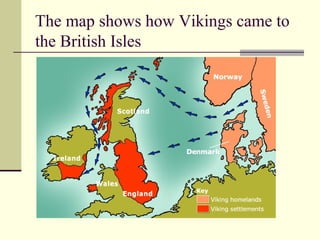
The map shows how Vikings came to
the British Isles
The remains of a Viking farm at
Ribblehead in Yorkshire, England.
A Viking ship, pictured in an Anglo-
Saxon history book.
Viking buildings at Jarlshof in the
Shetland Isles, north of Scotland.
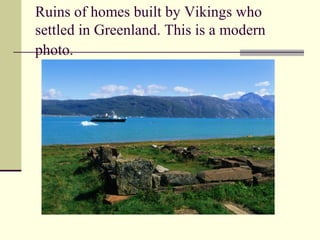
Ruins of homes built by Vikings who
settled in Greenland. This is a modern
photo.
Viking ships
 The Vikings built fast ships for raiding and
war. These ships were 'dragon-ships' or
'longships'. The Vikings also had slower
passenger and cargo ships called knorrs.
They built small boats for fishing or short
trips.
A real Viking longship. The ‘Gokstad’ ship was built between AD 850
and AD 900. It was excavated by archaeologists, and is now in a
museum in Oslo, Norway.
The Oseberg longship in the
Vikingskiphuset, Oslo.
Figureheads on ships were meant to scare enemies.
It shows what the 'dragon-head' on a Viking
fighting-ship probably looked like.
Viking sailors could tell which way the
wind was blowing by looking at a weather-
vane
A raid on England
 In 793, 'Northmen' (as the Anglo-Saxon Chronicle calls them)
attacked theChristian monastery at Lindisfarne in Northumbria,
in north-east England. Northumbria was an English kingdom,
and its monasteries were famous for books, art and treasures.
On a January day, the longships arrived and the Vikings
attacked. They burned buildings, stole treasures, murdered
monks, and terrified everyone. Some Christian Church leaders
said the Vikings were sent by God, to punish people in England
for doing wrong.
This is a modern re-enactment of a Viking
battle. Notice the men's helmets and round
shields.
A Viking sword. Only a rich Viking could afford a fine sword. Sword-
making was a great skill, and a good sword was kept as a family
treasure.
Lindisfarne today. The Viking raid on the Christian
monastery at Lindisfarne in AD 793 shocked and
frightened people in England.
This is what a Viking might have looked like. Most men
had beards. In this picture, the man wears an iron helmet
with a nose-protector.
These are fragments of Viking cloth and weaving tools.
The tools include needles and shears. The textiles still have
traces of coloured dyes.
Viking women spent a lot of time weaving
wool, to make clothes and blankets.
A leather boot. Can you see how it was
fastened? This boot was found at
Coppergate (York).
A stone, for grinding grain to make
flour.
A wood-turner working a pole-lathe, a machine for shaping
wood. This is a model at the Jorvik Viking Centre (York).
Animals shared Viking homes with Viking families. This woman is looking
after her geese.
These are playing pieces made form bone, antler and ivory. They are
shown alongside a fragment of a board for the game hnefatafl.
Jorvik's last king
 Throughout the Viking Age, there were many battles
between the Vikings and the English. In the 9th
century, the English king Alfred the Great stopped the
Vikings taking over all of England. In the 10th century
the Englishreconquered much of the land held by
Vikings. In 954, they drove out Eric Bloodaxe, the last
Viking king of Jorvik. After Eric was killed in battle,
the Vikings in England agreed to be ruled by
England's king.
Eric Bloodaxe was the last Viking King of Jorvik. This is one of his
silver pennies, with a sword and his name Eric Rex ('King Eric' in
Latin) on one side.

The vikings

  • 1.
  • 2.
     The Vikingage in European history was about AD 700 to 1100. During this period many Vikings left Scandinavia and travelled to other countries, such as Britain and Ireland. Some went to fight and steal treasure. Others settled in new lands as farmers, craftsmen ortraders.
  • 3.
    The map showshow Vikings came to the British Isles
  • 4.
    The remains ofa Viking farm at Ribblehead in Yorkshire, England.
  • 5.
    A Viking ship,pictured in an Anglo- Saxon history book.
  • 6.
    Viking buildings atJarlshof in the Shetland Isles, north of Scotland.
  • 7.
    Ruins of homesbuilt by Vikings who settled in Greenland. This is a modern photo.
  • 8.
    Viking ships  TheVikings built fast ships for raiding and war. These ships were 'dragon-ships' or 'longships'. The Vikings also had slower passenger and cargo ships called knorrs. They built small boats for fishing or short trips.
  • 9.
    A real Vikinglongship. The ‘Gokstad’ ship was built between AD 850 and AD 900. It was excavated by archaeologists, and is now in a museum in Oslo, Norway.
  • 10.
    The Oseberg longshipin the Vikingskiphuset, Oslo.
  • 11.
    Figureheads on shipswere meant to scare enemies. It shows what the 'dragon-head' on a Viking fighting-ship probably looked like.
  • 12.
    Viking sailors couldtell which way the wind was blowing by looking at a weather- vane
  • 13.
    A raid onEngland  In 793, 'Northmen' (as the Anglo-Saxon Chronicle calls them) attacked theChristian monastery at Lindisfarne in Northumbria, in north-east England. Northumbria was an English kingdom, and its monasteries were famous for books, art and treasures. On a January day, the longships arrived and the Vikings attacked. They burned buildings, stole treasures, murdered monks, and terrified everyone. Some Christian Church leaders said the Vikings were sent by God, to punish people in England for doing wrong.
  • 14.
    This is amodern re-enactment of a Viking battle. Notice the men's helmets and round shields.
  • 15.
    A Viking sword.Only a rich Viking could afford a fine sword. Sword- making was a great skill, and a good sword was kept as a family treasure.
  • 16.
    Lindisfarne today. TheViking raid on the Christian monastery at Lindisfarne in AD 793 shocked and frightened people in England.
  • 17.
    This is whata Viking might have looked like. Most men had beards. In this picture, the man wears an iron helmet with a nose-protector.
  • 18.
    These are fragmentsof Viking cloth and weaving tools. The tools include needles and shears. The textiles still have traces of coloured dyes.
  • 19.
    Viking women spenta lot of time weaving wool, to make clothes and blankets.
  • 20.
    A leather boot.Can you see how it was fastened? This boot was found at Coppergate (York).
  • 21.
    A stone, forgrinding grain to make flour.
  • 22.
    A wood-turner workinga pole-lathe, a machine for shaping wood. This is a model at the Jorvik Viking Centre (York).
  • 23.
    Animals shared Vikinghomes with Viking families. This woman is looking after her geese.
  • 24.
    These are playingpieces made form bone, antler and ivory. They are shown alongside a fragment of a board for the game hnefatafl.
  • 25.
    Jorvik's last king Throughout the Viking Age, there were many battles between the Vikings and the English. In the 9th century, the English king Alfred the Great stopped the Vikings taking over all of England. In the 10th century the Englishreconquered much of the land held by Vikings. In 954, they drove out Eric Bloodaxe, the last Viking king of Jorvik. After Eric was killed in battle, the Vikings in England agreed to be ruled by England's king.
  • 26.
    Eric Bloodaxe wasthe last Viking King of Jorvik. This is one of his silver pennies, with a sword and his name Eric Rex ('King Eric' in Latin) on one side.