DEPARTMENT OF ENTOMOLOGY
ALLAHABAD SCHOOL OF AGRICULTURE
SAM HIGGINBOTTOM INSTITUTE OF AGRICULTURE TECHNOLOGY &
SCIENCES
[Formerly-Allahabad Agricultural Institute]
(Deemed-to-be-University)
ALLAHABAD- 211007, U.P., INDIA
SUBMMITED BY,
RAKESH
SUBMITTED TO,
DEPARTMENT OF PLANT PROTECTION
 Ginger is a plant with leafy stems and yellowish green
flowers.
 The ginger spice comes from the roots of the plant.
 Ginger is native to warmer parts of Asia, such as China,
Japan, and India, but now is grown in parts of South
American and Africa.
 It is also now grown in the Middle East to use as medicine
and with food.
 Ginger is commonly used to treat various types of "stomach
problems," including motion sickness, morning sickness,
colic, upset stomach, gas, diarrhea, irritable bowel
syndrome(IBS), nausea, nausea caused by cancer treatment.
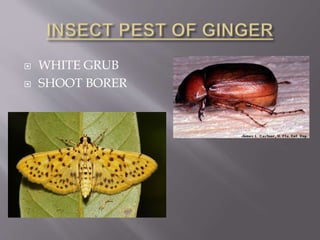
 WHITE GRUB
 SHOOT BORER
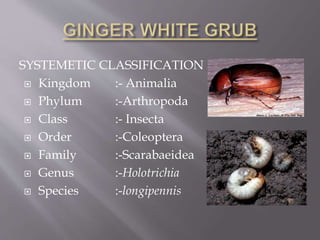
SYSTEMETIC CLASSIFICATION
 Kingdom :- Animalia
 Phylum :-Arthropoda
 Class :- Insecta
 Order :-Coleoptera
 Family :-Scarabaeidea
 Genus :-Holotrichia
 Species :-longipennis
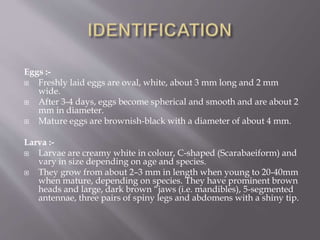
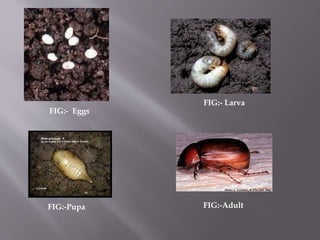
Eggs :-
 Freshly laid eggs are oval, white, about 3 mm long and 2 mm
wide.
 After 3-4 days, eggs become spherical and smooth and are about 2
mm in diameter.
 Mature eggs are brownish-black with a diameter of about 4 mm.
Larva :-
 Larvae are creamy white in colour, C-shaped (Scarabaeiform) and
vary in size depending on age and species.
 They grow from about 2–3 mm in length when young to 20-40mm
when mature, depending on species. They have prominent brown
heads and large, dark brown “jaws (i.e. mandibles), 5-segmented
antennae, three pairs of spiny legs and abdomens with a shiny tip.
Pupae :-
 Pupae are white to yellowish in the early stages, and gradually
become brown.
 They pupate in the soil and range from 1.5 to 3cm in length and
are typically about 1.5 cm wide.
Adults :-
 Adults differ considerably in size, shape and colour depending on
species.
 Antennae are 10-segmented. Adults are broad, robust looking
beetles with thick elytra (wing cases) and pronotum (plate-like
covering of front segment of the thorax ).
 In some species these structures are brightly coloured, even
metallic green, and/or patterned, in other species they are plain
brown to black.
FIG:-Pupa FIG:-Adult
FIG:- Larva
FIG:- Eggs
HOST PLANT:-
 White grubs feed on the roots of corn, ginger, timothy, Kentucky
bluegrass, sorghum, soybean, strawberry, potato, barley, oat,
wheat, rye, bean, turnip, and to a lesser degree, other cultivated
crops.
DISTRIBUTION:-
 More than 200 species of white grubs are found throughout
North America.
 Populations of most grub species tend to be highest in older
plantings of sod, or in soils high in decomposing organic
matter.
NATURE AND DAMAGE:-
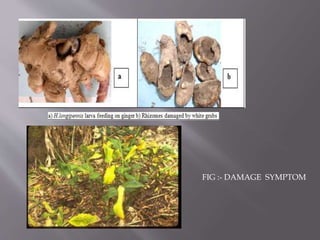
 Root grubs occasionally feed on tender rhizomes, roots and base of
pseudostems causing yellowing and wilting of shoots.
 The grubs make large holes in rhizomes and reduce market value of produce
Damage by white grubs is usually most severe when corn is planted following
sod.
 In this case, root feeding can be so severe that plants may grow no taller than
30 to 60 cm (1 or 2 feet).
 If the root system is badly damaged, injured plants will eventually die and
can be easily pulled from the ground.
 Even light infestations usually result in increased lodging and reduce yield
FIG :- DAMAGE SYMPTOM
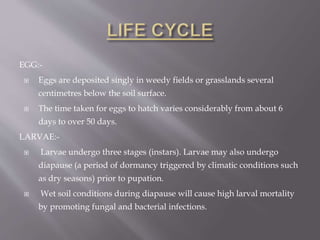
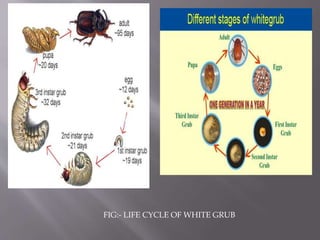
EGG:-
 Eggs are deposited singly in weedy fields or grasslands several
centimetres below the soil surface.
 The time taken for eggs to hatch varies considerably from about 6
days to over 50 days.
LARVAE:-
 Larvae undergo three stages (instars). Larvae may also undergo
diapause (a period of dormancy triggered by climatic conditions such
as dry seasons) prior to pupation.
 Wet soil conditions during diapause will cause high larval mortality
by promoting fungal and bacterial infections.
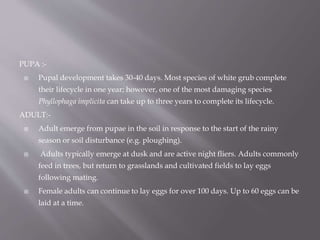
PUPA :-
 Pupal development takes 30-40 days. Most species of white grub complete
their lifecycle in one year; however, one of the most damaging species
Phyllophaga implicita can take up to three years to complete its lifecycle.
ADULT:-
 Adult emerge from pupae in the soil in response to the start of the rainy
season or soil disturbance (e.g. ploughing).
 Adults typically emerge at dusk and are active night fliers. Adults commonly
feed in trees, but return to grasslands and cultivated fields to lay eggs
following mating.
 Female adults can continue to lay eggs for over 100 days. Up to 60 eggs can be
laid at a time.
FIG:- LIFE CYCLE OF WHITE GRUB
CULTURAL CONTROL:-
 Crop rotation is an effective control method of grubs if maize is
rotated with resistant or less susceptible crops deep-rooted
legumes such as alfalfa, cowpea, and pigeon peas.
 Ensuring proper drainage in the field since grubs prefer moist soil,
especially with decaying organic matter - female beetles prefer to
lay eggs on moist-decaying organic matter.
 Reducing or pruning trees that attract adults bordering the crop.
 Heavy application of nitrogen fertilizer which can kill first instar
larvae.
BIOLOGICAL CONTROL:-
 Spores of the pathogens Bacillus popilliae, B. lentimorbus and
Metarhizium anisopliae can be used to inoculate the soil.
 Parasitic wasps including Tiphia species, Myzinum species and
Pelecinus polyturator, as well as the parasitic fly Pyrgota undata have
been used as biological control agents.
 Nematodes such as species of Steinernema can also be effective
against white grubs.
CHEMICAL CONTROL:-
 Chemical control is rarely necessary for white grubs. Chemical
treatment on grubs must be done when they are young as older
larvae are more robust and larvae move to a greater depth as they
develop. If insecticides must be applied then the following
treatments have shown to have some control of white grubs:
 Aldicarb granules – a systemic insecticide;
 Carbofuran granules – a systemic insecticide;
 Chlorpyriphos – a contact insecticide;
 Ethoprophos granules – a contact insecticide;
 Fipronil – a contact insecticide;
 Imidachloprid – a systemic insecticide with reasonable soil
mobility;
 Isofenphos– a systemic insecticide with reasonable soil mobility
 Application of contact insecticides to the foliage of the trees where
adult beetles swarm.
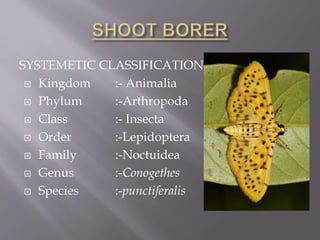
SYSTEMETIC CLASSIFICATION
 Kingdom :- Animalia
 Phylum :-Arthropoda
 Class :- Insecta
 Order :-Lepidoptera
 Family :-Noctuidea
 Genus :-Conogethes
 Species :-punctiferalis
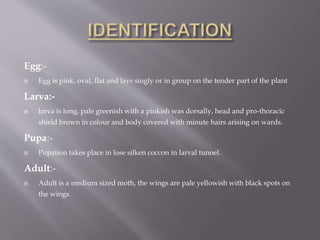
Egg:-
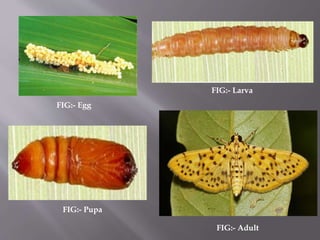
 Egg is pink, oval, flat and lays singly or in group on the tender part of the plant
Larva:-
 larva is long, pale greenish with a pinkish was dorsally, head and pro-thoracic
shield brown in colour and body covered with minute hairs arising on wards.
Pupa:-
 Pupation takes place in lose silken coccon in larval tunnel.
Adult:-
 Adult is a medium sized moth, the wings are pale yellowish with black spots on
the wings.
FIG:- Egg
FIG:- Larva
FIG:- Pupa
FIG:- Adult
HOST PLANT:-
 The shoot borer highly polyphagous pest.It is feed also crop
ginger, termric, cocoa, custard apple, cotton, hollyhocks etc.
DISTRIBUTION:-
 It is various country found in austrelia, china, india, japan,
srilanka, asia, africa, etc.
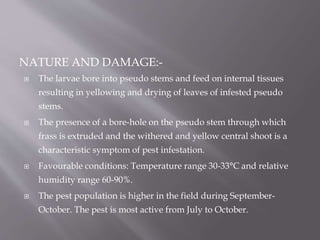
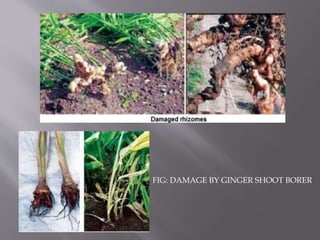
NATURE AND DAMAGE:-
 The larvae bore into pseudo stems and feed on internal tissues
resulting in yellowing and drying of leaves of infested pseudo
stems.
 The presence of a bore-hole on the pseudo stem through which
frass is extruded and the withered and yellow central shoot is a
characteristic symptom of pest infestation.
 Favourable conditions: Temperature range 30-33°C and relative
humidity range 60-90%.
 The pest population is higher in the field during September-
October. The pest is most active from July to October.
FIG: DAMAGE BY GINGER SHOOT BORER
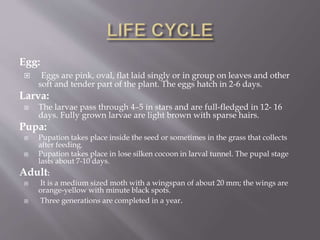
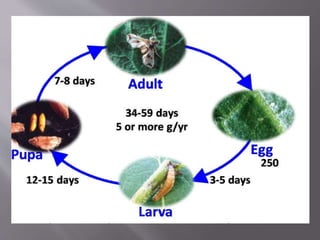
Egg:
 Eggs are pink, oval, flat laid singly or in group on leaves and other
soft and tender part of the plant. The eggs hatch in 2-6 days.
Larva:
 The larvae pass through 4–5 in stars and are full-fledged in 12- 16
days. Fully grown larvae are light brown with sparse hairs.
Pupa:
 Pupation takes place inside the seed or sometimes in the grass that collects
after feeding.
 Pupation takes place in lose silken cocoon in larval tunnel. The pupal stage
lasts about 7-10 days.
Adult:
 It is a medium sized moth with a wingspan of about 20 mm; the wings are
orange-yellow with minute black spots.
 Three generations are completed in a year.
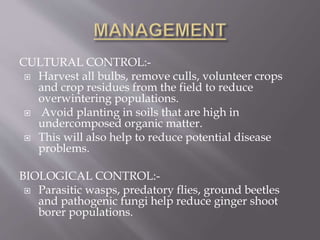
CULTURAL CONTROL:-
 Harvest all bulbs, remove culls, volunteer crops
and crop residues from the field to reduce
overwintering populations.
 Avoid planting in soils that are high in
undercomposed organic matter.
 This will also help to reduce potential disease
problems.
BIOLOGICAL CONTROL:-
 Parasitic wasps, predatory flies, ground beetles
and pathogenic fungi help reduce ginger shoot
borer populations.
CHEMICAL:-
 Spraying malathion 0.1% at 30 day intervals during July to
October is effective in controlling the pest infestation.
 The spraying has to be initiated when the first symptom of pest
attack is seen on the inner most leaves on the pseudostem.
 CAB International (2007). Crop Protection Compendium.
Wallingford, UK. CAB International.
 Flanders K.L., Heinrichs E.A., Foster J.E. and Rice M.E.
(2010). Maize pests of North America. In: EB Radcliffe, WD
Hutchinson and RE Cancelado (Eds) Radcliff’s IPM.
 Hill, D.S. (2008). Pests of crops in warmer climates and their
control. Springer Science and Business Media BV.
 Ortega, A. (1987). Insect pests of Maize: A Guide for Field
Identification. Mexico, D.F.: CIMMYT.
Insect pest of gingeR

Insect pest of gingeR

  • 1.
    DEPARTMENT OF ENTOMOLOGY ALLAHABADSCHOOL OF AGRICULTURE SAM HIGGINBOTTOM INSTITUTE OF AGRICULTURE TECHNOLOGY & SCIENCES [Formerly-Allahabad Agricultural Institute] (Deemed-to-be-University) ALLAHABAD- 211007, U.P., INDIA SUBMMITED BY, RAKESH SUBMITTED TO, DEPARTMENT OF PLANT PROTECTION
  • 2.
     Ginger isa plant with leafy stems and yellowish green flowers.  The ginger spice comes from the roots of the plant.  Ginger is native to warmer parts of Asia, such as China, Japan, and India, but now is grown in parts of South American and Africa.  It is also now grown in the Middle East to use as medicine and with food.  Ginger is commonly used to treat various types of "stomach problems," including motion sickness, morning sickness, colic, upset stomach, gas, diarrhea, irritable bowel syndrome(IBS), nausea, nausea caused by cancer treatment.
  • 3.
     WHITE GRUB SHOOT BORER
  • 4.
    SYSTEMETIC CLASSIFICATION  Kingdom:- Animalia  Phylum :-Arthropoda  Class :- Insecta  Order :-Coleoptera  Family :-Scarabaeidea  Genus :-Holotrichia  Species :-longipennis
  • 5.
    Eggs :-  Freshlylaid eggs are oval, white, about 3 mm long and 2 mm wide.  After 3-4 days, eggs become spherical and smooth and are about 2 mm in diameter.  Mature eggs are brownish-black with a diameter of about 4 mm. Larva :-  Larvae are creamy white in colour, C-shaped (Scarabaeiform) and vary in size depending on age and species.  They grow from about 2–3 mm in length when young to 20-40mm when mature, depending on species. They have prominent brown heads and large, dark brown “jaws (i.e. mandibles), 5-segmented antennae, three pairs of spiny legs and abdomens with a shiny tip.
  • 6.
    Pupae :-  Pupaeare white to yellowish in the early stages, and gradually become brown.  They pupate in the soil and range from 1.5 to 3cm in length and are typically about 1.5 cm wide. Adults :-  Adults differ considerably in size, shape and colour depending on species.  Antennae are 10-segmented. Adults are broad, robust looking beetles with thick elytra (wing cases) and pronotum (plate-like covering of front segment of the thorax ).  In some species these structures are brightly coloured, even metallic green, and/or patterned, in other species they are plain brown to black.
  • 7.
  • 8.
    HOST PLANT:-  Whitegrubs feed on the roots of corn, ginger, timothy, Kentucky bluegrass, sorghum, soybean, strawberry, potato, barley, oat, wheat, rye, bean, turnip, and to a lesser degree, other cultivated crops. DISTRIBUTION:-  More than 200 species of white grubs are found throughout North America.  Populations of most grub species tend to be highest in older plantings of sod, or in soils high in decomposing organic matter.
  • 9.
    NATURE AND DAMAGE:- Root grubs occasionally feed on tender rhizomes, roots and base of pseudostems causing yellowing and wilting of shoots.  The grubs make large holes in rhizomes and reduce market value of produce Damage by white grubs is usually most severe when corn is planted following sod.  In this case, root feeding can be so severe that plants may grow no taller than 30 to 60 cm (1 or 2 feet).  If the root system is badly damaged, injured plants will eventually die and can be easily pulled from the ground.  Even light infestations usually result in increased lodging and reduce yield
  • 10.
  • 11.
    EGG:-  Eggs aredeposited singly in weedy fields or grasslands several centimetres below the soil surface.  The time taken for eggs to hatch varies considerably from about 6 days to over 50 days. LARVAE:-  Larvae undergo three stages (instars). Larvae may also undergo diapause (a period of dormancy triggered by climatic conditions such as dry seasons) prior to pupation.  Wet soil conditions during diapause will cause high larval mortality by promoting fungal and bacterial infections.
  • 12.
    PUPA :-  Pupaldevelopment takes 30-40 days. Most species of white grub complete their lifecycle in one year; however, one of the most damaging species Phyllophaga implicita can take up to three years to complete its lifecycle. ADULT:-  Adult emerge from pupae in the soil in response to the start of the rainy season or soil disturbance (e.g. ploughing).  Adults typically emerge at dusk and are active night fliers. Adults commonly feed in trees, but return to grasslands and cultivated fields to lay eggs following mating.  Female adults can continue to lay eggs for over 100 days. Up to 60 eggs can be laid at a time.
  • 13.
    FIG:- LIFE CYCLEOF WHITE GRUB
  • 14.
    CULTURAL CONTROL:-  Croprotation is an effective control method of grubs if maize is rotated with resistant or less susceptible crops deep-rooted legumes such as alfalfa, cowpea, and pigeon peas.  Ensuring proper drainage in the field since grubs prefer moist soil, especially with decaying organic matter - female beetles prefer to lay eggs on moist-decaying organic matter.  Reducing or pruning trees that attract adults bordering the crop.  Heavy application of nitrogen fertilizer which can kill first instar larvae.
  • 15.
    BIOLOGICAL CONTROL:-  Sporesof the pathogens Bacillus popilliae, B. lentimorbus and Metarhizium anisopliae can be used to inoculate the soil.  Parasitic wasps including Tiphia species, Myzinum species and Pelecinus polyturator, as well as the parasitic fly Pyrgota undata have been used as biological control agents.  Nematodes such as species of Steinernema can also be effective against white grubs.
  • 16.
    CHEMICAL CONTROL:-  Chemicalcontrol is rarely necessary for white grubs. Chemical treatment on grubs must be done when they are young as older larvae are more robust and larvae move to a greater depth as they develop. If insecticides must be applied then the following treatments have shown to have some control of white grubs:  Aldicarb granules – a systemic insecticide;  Carbofuran granules – a systemic insecticide;  Chlorpyriphos – a contact insecticide;  Ethoprophos granules – a contact insecticide;  Fipronil – a contact insecticide;  Imidachloprid – a systemic insecticide with reasonable soil mobility;  Isofenphos– a systemic insecticide with reasonable soil mobility  Application of contact insecticides to the foliage of the trees where adult beetles swarm.
  • 17.
    SYSTEMETIC CLASSIFICATION  Kingdom:- Animalia  Phylum :-Arthropoda  Class :- Insecta  Order :-Lepidoptera  Family :-Noctuidea  Genus :-Conogethes  Species :-punctiferalis
  • 18.
    Egg:-  Egg ispink, oval, flat and lays singly or in group on the tender part of the plant Larva:-  larva is long, pale greenish with a pinkish was dorsally, head and pro-thoracic shield brown in colour and body covered with minute hairs arising on wards. Pupa:-  Pupation takes place in lose silken coccon in larval tunnel. Adult:-  Adult is a medium sized moth, the wings are pale yellowish with black spots on the wings.
  • 19.
  • 20.
    HOST PLANT:-  Theshoot borer highly polyphagous pest.It is feed also crop ginger, termric, cocoa, custard apple, cotton, hollyhocks etc. DISTRIBUTION:-  It is various country found in austrelia, china, india, japan, srilanka, asia, africa, etc.
  • 21.
    NATURE AND DAMAGE:- The larvae bore into pseudo stems and feed on internal tissues resulting in yellowing and drying of leaves of infested pseudo stems.  The presence of a bore-hole on the pseudo stem through which frass is extruded and the withered and yellow central shoot is a characteristic symptom of pest infestation.  Favourable conditions: Temperature range 30-33°C and relative humidity range 60-90%.  The pest population is higher in the field during September- October. The pest is most active from July to October.
  • 22.
    FIG: DAMAGE BYGINGER SHOOT BORER
  • 23.
    Egg:  Eggs arepink, oval, flat laid singly or in group on leaves and other soft and tender part of the plant. The eggs hatch in 2-6 days. Larva:  The larvae pass through 4–5 in stars and are full-fledged in 12- 16 days. Fully grown larvae are light brown with sparse hairs. Pupa:  Pupation takes place inside the seed or sometimes in the grass that collects after feeding.  Pupation takes place in lose silken cocoon in larval tunnel. The pupal stage lasts about 7-10 days. Adult:  It is a medium sized moth with a wingspan of about 20 mm; the wings are orange-yellow with minute black spots.  Three generations are completed in a year.
  • 25.
    CULTURAL CONTROL:-  Harvestall bulbs, remove culls, volunteer crops and crop residues from the field to reduce overwintering populations.  Avoid planting in soils that are high in undercomposed organic matter.  This will also help to reduce potential disease problems. BIOLOGICAL CONTROL:-  Parasitic wasps, predatory flies, ground beetles and pathogenic fungi help reduce ginger shoot borer populations.
  • 26.
    CHEMICAL:-  Spraying malathion0.1% at 30 day intervals during July to October is effective in controlling the pest infestation.  The spraying has to be initiated when the first symptom of pest attack is seen on the inner most leaves on the pseudostem.
  • 27.
     CAB International(2007). Crop Protection Compendium. Wallingford, UK. CAB International.  Flanders K.L., Heinrichs E.A., Foster J.E. and Rice M.E. (2010). Maize pests of North America. In: EB Radcliffe, WD Hutchinson and RE Cancelado (Eds) Radcliff’s IPM.  Hill, D.S. (2008). Pests of crops in warmer climates and their control. Springer Science and Business Media BV.  Ortega, A. (1987). Insect pests of Maize: A Guide for Field Identification. Mexico, D.F.: CIMMYT.