THE WHITE TOWER
BY:THODORIS MANIATIS
AKIS VAIRAMIS,GIANNIS KARPATHIS
& LYBERIS DIONISOPOULOS
THE WHITE TOWER
• The White Tower of Thessaloniki (Greek:
Λευκός Πύργος Lefkos Pyrgos), is a monument
and museum on the waterfront of the city of
Thessaloniki, capital of the region of
Macedonia in northern Greece and a symbol
of Greek sovereignty over Macedonia.
PHYSICAL ATTRIBUTES
• The White Tower takes the form of a
cylindrical drum 23 m (75 ft) in diameter with
a height of 27 m (89 ft) above ground level, on
top of which is a turret 12 m (39 ft) in
diameter and 6 m (20 ft) high. Some of the
embrasures in the outer wall of the tower are
reached by a spiral ramp; others are accessed
from a central room on each of the six floors.
HISTORY
• The tower, which once guarded the eastern end of the city's sea walls, was
for many years attributed to Venice, to which the Byzantines ceded
Thessaloniki in 1423. It is now known definitely that the tower was
constructed by the Ottomans some time after the army of Sultan Murad II
captured Thessaloniki in 1430.
• Until 1912, an inscription in Ottoman Turkish verse above the door dated
the structure to AH 942 (1535–1536). The present tower likely replaced an
older Byzantine tower mentioned by the 12th century archbishop
Eustathis during the sack of 1185.
• The Tower is now a buff colour but has retained the name White Tower. It
now stands on Thessaloniki's waterfront boulevard, Nikis (Victory) Street.
It houses a museum dedicated to the history of Thessaloniki and is one of
the city's leading tourist attractions. The Tower is under the administration
of the Ephorate of Byzantine Antiquities of the Greek Ministry of Culture.
THE WHITE TOWER MUSEUM
• Today, the White Tower houses an exhibition
dedicated to the city of Thessaloniki and its
history throughout various periods, organized by
the city's Museum of Byzantine Culture.
• For the first few months of 2002 it housed
‘Byzantine Hours’, an exhibition devoted to
ordinary life in Byzantine times.
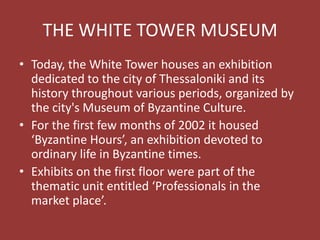
• Exhibits on the first floor were part of the
thematic unit entitled ‘Professionals in the
market place’.
SOME PICTURES 1
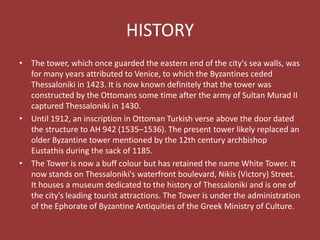
• View from outside First floor gallery
SOME PICTURES 2
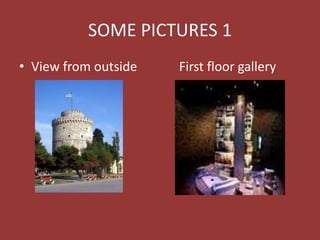
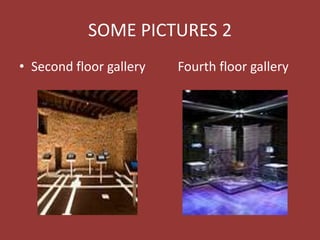
• Second floor gallery Fourth floor gallery
THE END!
THANKS FOR
PAYING ATTENTION

White tower limperis akis_thodoris_giannis

  • 1.
    THE WHITE TOWER BY:THODORISMANIATIS AKIS VAIRAMIS,GIANNIS KARPATHIS & LYBERIS DIONISOPOULOS
  • 2.
    THE WHITE TOWER •The White Tower of Thessaloniki (Greek: Λευκός Πύργος Lefkos Pyrgos), is a monument and museum on the waterfront of the city of Thessaloniki, capital of the region of Macedonia in northern Greece and a symbol of Greek sovereignty over Macedonia.
  • 3.
    PHYSICAL ATTRIBUTES • TheWhite Tower takes the form of a cylindrical drum 23 m (75 ft) in diameter with a height of 27 m (89 ft) above ground level, on top of which is a turret 12 m (39 ft) in diameter and 6 m (20 ft) high. Some of the embrasures in the outer wall of the tower are reached by a spiral ramp; others are accessed from a central room on each of the six floors.
  • 4.
    HISTORY • The tower,which once guarded the eastern end of the city's sea walls, was for many years attributed to Venice, to which the Byzantines ceded Thessaloniki in 1423. It is now known definitely that the tower was constructed by the Ottomans some time after the army of Sultan Murad II captured Thessaloniki in 1430. • Until 1912, an inscription in Ottoman Turkish verse above the door dated the structure to AH 942 (1535–1536). The present tower likely replaced an older Byzantine tower mentioned by the 12th century archbishop Eustathis during the sack of 1185. • The Tower is now a buff colour but has retained the name White Tower. It now stands on Thessaloniki's waterfront boulevard, Nikis (Victory) Street. It houses a museum dedicated to the history of Thessaloniki and is one of the city's leading tourist attractions. The Tower is under the administration of the Ephorate of Byzantine Antiquities of the Greek Ministry of Culture.
  • 5.
    THE WHITE TOWERMUSEUM • Today, the White Tower houses an exhibition dedicated to the city of Thessaloniki and its history throughout various periods, organized by the city's Museum of Byzantine Culture. • For the first few months of 2002 it housed ‘Byzantine Hours’, an exhibition devoted to ordinary life in Byzantine times. • Exhibits on the first floor were part of the thematic unit entitled ‘Professionals in the market place’.
  • 6.
    SOME PICTURES 1 •View from outside First floor gallery
  • 7.
    SOME PICTURES 2 •Second floor gallery Fourth floor gallery
  • 8.