MYKONOS
By:THEO MANIATIS
AKIS VAIRAMIS
KOSTAS LEONIS
GENERALLY
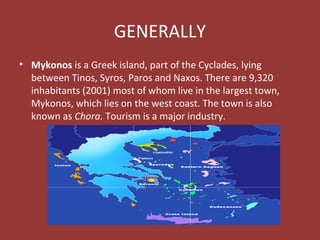
• Mykonos is a Greek island, part of the Cyclades, lying
between Tinos, Syros, Paros and Naxos. There are 9,320
inhabitants (2001) most of whom live in the largest town,
Mykonos, which lies on the west coast. The town is also
known as Chora. Tourism is a major industry.
HISTORY
• Mykonos early human inhabitants were Carians,
followed by Ancient Egyptians, Phoenicians, Cretans
and Ionians.
• In ancient times, Mykonos, due to its proximity to the
then highly populated island of Delos became very
important as a supply island and possibly as a getaway
location for Delian citizens.
• Mythology
• In Greek mythology Mykonos was the location of the
battle between Zeus and the Titans, and the island was
named in honor of Mykons, son of Anios who was a
son of Apollo and nymph named Rio.
LANDMARKS(1)
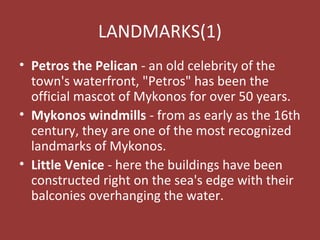
• Petros the Pelican - an old celebrity of the
town's waterfront, "Petros" has been the
official mascot of Mykonos for over 50 years.
• Mykonos windmills - from as early as the 16th
century, they are one of the most recognized
landmarks of Mykonos.
• Little Venice - here the buildings have been
constructed right on the sea's edge with their
balconies overhanging the water.
LANDMARKS(2)
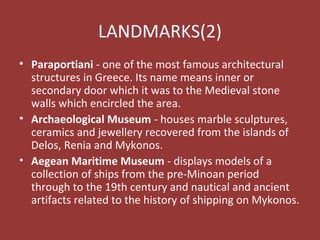
• Paraportiani - one of the most famous architectural
structures in Greece. Its name means inner or
secondary door which it was to the Medieval stone
walls which encircled the area.
• Archaeological Museum - houses marble sculptures,
ceramics and jewellery recovered from the islands of
Delos, Renia and Mykonos.
• Aegean Maritime Museum - displays models of a
collection of ships from the pre-Minoan period
through to the 19th century and nautical and ancient
artifacts related to the history of shipping on Mykonos.
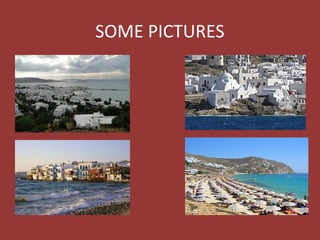
SOME PICTURES
THANK YOU FOR YOUR
ATTENTION

Mykonos

  • 1.
  • 2.
    GENERALLY • Mykonos isa Greek island, part of the Cyclades, lying between Tinos, Syros, Paros and Naxos. There are 9,320 inhabitants (2001) most of whom live in the largest town, Mykonos, which lies on the west coast. The town is also known as Chora. Tourism is a major industry.
  • 3.
    HISTORY • Mykonos earlyhuman inhabitants were Carians, followed by Ancient Egyptians, Phoenicians, Cretans and Ionians. • In ancient times, Mykonos, due to its proximity to the then highly populated island of Delos became very important as a supply island and possibly as a getaway location for Delian citizens. • Mythology • In Greek mythology Mykonos was the location of the battle between Zeus and the Titans, and the island was named in honor of Mykons, son of Anios who was a son of Apollo and nymph named Rio.
  • 4.
    LANDMARKS(1) • Petros thePelican - an old celebrity of the town's waterfront, "Petros" has been the official mascot of Mykonos for over 50 years. • Mykonos windmills - from as early as the 16th century, they are one of the most recognized landmarks of Mykonos. • Little Venice - here the buildings have been constructed right on the sea's edge with their balconies overhanging the water.
  • 5.
    LANDMARKS(2) • Paraportiani -one of the most famous architectural structures in Greece. Its name means inner or secondary door which it was to the Medieval stone walls which encircled the area. • Archaeological Museum - houses marble sculptures, ceramics and jewellery recovered from the islands of Delos, Renia and Mykonos. • Aegean Maritime Museum - displays models of a collection of ships from the pre-Minoan period through to the 19th century and nautical and ancient artifacts related to the history of shipping on Mykonos.
  • 6.
  • 7.
    THANK YOU FORYOUR ATTENTION