By Florin-Gabriel Cabaua
Muzaffer Can Sahin
Lorenzo Finizio
Juvelina Meminaj
Heraklion-the largest city of Crete
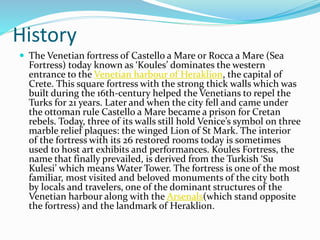
 Heraklion is the administrative capital of the island
of Crete. It is the fourth largest city in Greece.
According to the results of the 2011 census, the
population of the city proper was 140,730 inhabitants,
the municipality's was 173,993 while the Heraklion
urban area has a population of 225,574 and it extends
over an area of 684.3 km2 (264.2 sq mi).
History
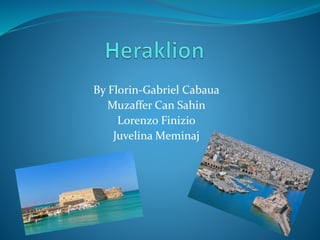
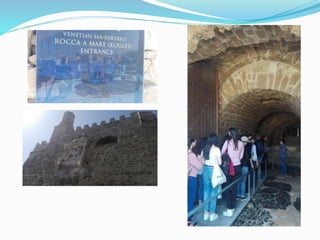
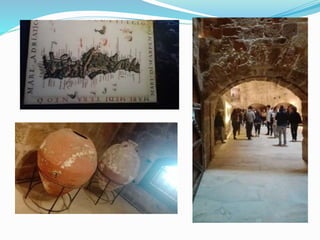
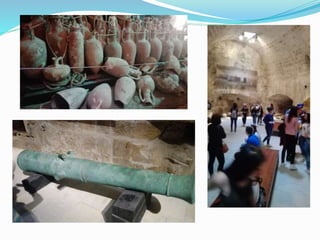
 The Venetian fortress of Castello a Mare or Rocca a Mare (Sea
Fortress) today known as ‘Koules’ dominates the western
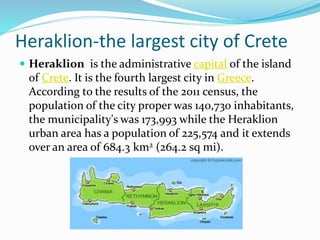
entrance to the Venetian harbour of Heraklion, the capital of
Crete. This square fortress with the strong thick walls which was
built during the 16th-century helped the Venetians to repel the
Turks for 21 years. Later and when the city fell and came under
the ottoman rule Castello a Mare became a prison for Cretan
rebels. Today, three of its walls still hold Venice’s symbol on three
marble relief plaques: the winged Lion of St Mark. The interior
of the fortress with its 26 restored rooms today is sometimes
used to host art exhibits and performances. Koules Fortress, the
name that finally prevailed, is derived from the Turkish ‘Su
Kulesi’ which means Water Tower. The fortress is one of the most
familiar, most visited and beloved monuments of the city both
by locals and travelers, one of the dominant structures of the
Venetian harbour along with the Arsenals(which stand opposite
the fortress) and the landmark of Heraklion.
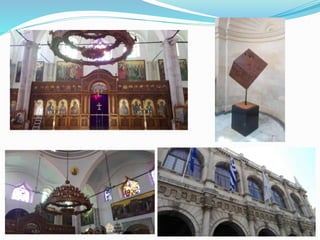
Saint Titus Cathedral
 Walking up the short hill, and passing the shops and tourist
offices, we reach St. Titus' Cathedral, an impressive sight. Saint
Titus, a fellow traveller of Saint Paul, preached the gospel in
Crete during Roman rule and was martyred in Gortyn, where a
7th Century basilica stands in his memory. His church in
Heraklion was built during the second Byzantine period, when it
first served as the city's cathedral. During Venetian rule, it
housed the seat of the Catholic archbishop and was renovated in
1466, only to be ruined in a fire in 1544. During the Turkish
Occupation it served as a mosque and called Vizier Tzami, when
a minaret was added, now gone. The present-day structure is the
result of further renovations after its almost entire destruction by
a strong earthquake in 1856, and later work which followed in
1922. The skull of St Titus was transferred here from Venice in
1956 and has since been kept in the church. If the cathedral is
open when you visit, it is well worth going in.
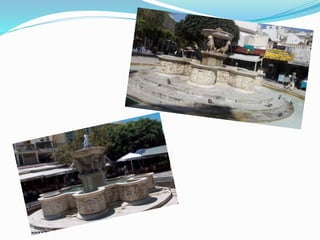
Lion Square or Liondaria
 This is the heart of Heraklion where tourists and locals
share the small space around the fountain, exchanging
glances and perhaps a few words. Business and pleasure
combine here, and it is the place to meet for whatever
purpose or no purpose. To give some background, it might
also be called the Morosini Fountain or,Liondaria in
Greek or, more properly, Plateia Eleftheriou Venizelou,
after Venizelos, Crete's greatest man of state. The
decorated fountain is composed of eight cisterns and
decorated with stone relief, depicting figures of Greek
mythology, Nymphs, Tritons, sea monsters and dolphins,
while the main basin is supported by four sitting lions
balancing a circular bowl on their heads.
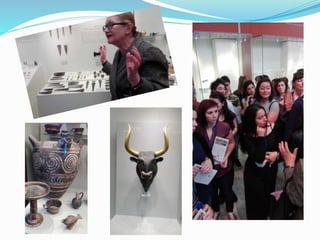
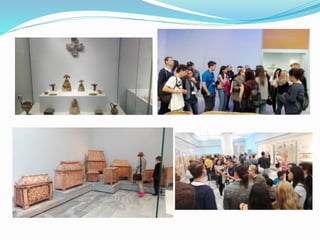
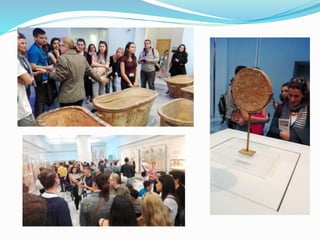
Archaeological Museum
 The world famous Heraklion Archaeological Museum
was built between 1937 and 1940 on a site that had
been occupied during the Venetian Period by an
imposing Catholic monastery of St. Francis, which was
destroyed by the earthquake of 1856. The Museum
houses archaeological finds from all over Crete. Pride
of place goes to the treasures of the earliest European
civilization, the Minoan, which can here be admired in
all its historical continuity.
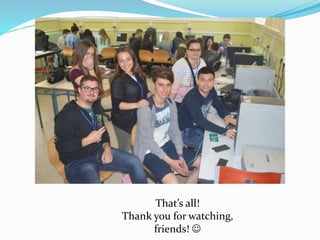
That’s all!
Thank you for watching,
friends! 

Heraklion as a multicultural town

  • 1.
    By Florin-Gabriel Cabaua MuzafferCan Sahin Lorenzo Finizio Juvelina Meminaj
  • 2.
    Heraklion-the largest cityof Crete  Heraklion is the administrative capital of the island of Crete. It is the fourth largest city in Greece. According to the results of the 2011 census, the population of the city proper was 140,730 inhabitants, the municipality's was 173,993 while the Heraklion urban area has a population of 225,574 and it extends over an area of 684.3 km2 (264.2 sq mi).
  • 3.
    History  The Venetianfortress of Castello a Mare or Rocca a Mare (Sea Fortress) today known as ‘Koules’ dominates the western entrance to the Venetian harbour of Heraklion, the capital of Crete. This square fortress with the strong thick walls which was built during the 16th-century helped the Venetians to repel the Turks for 21 years. Later and when the city fell and came under the ottoman rule Castello a Mare became a prison for Cretan rebels. Today, three of its walls still hold Venice’s symbol on three marble relief plaques: the winged Lion of St Mark. The interior of the fortress with its 26 restored rooms today is sometimes used to host art exhibits and performances. Koules Fortress, the name that finally prevailed, is derived from the Turkish ‘Su Kulesi’ which means Water Tower. The fortress is one of the most familiar, most visited and beloved monuments of the city both by locals and travelers, one of the dominant structures of the Venetian harbour along with the Arsenals(which stand opposite the fortress) and the landmark of Heraklion.
  • 8.
    Saint Titus Cathedral Walking up the short hill, and passing the shops and tourist offices, we reach St. Titus' Cathedral, an impressive sight. Saint Titus, a fellow traveller of Saint Paul, preached the gospel in Crete during Roman rule and was martyred in Gortyn, where a 7th Century basilica stands in his memory. His church in Heraklion was built during the second Byzantine period, when it first served as the city's cathedral. During Venetian rule, it housed the seat of the Catholic archbishop and was renovated in 1466, only to be ruined in a fire in 1544. During the Turkish Occupation it served as a mosque and called Vizier Tzami, when a minaret was added, now gone. The present-day structure is the result of further renovations after its almost entire destruction by a strong earthquake in 1856, and later work which followed in 1922. The skull of St Titus was transferred here from Venice in 1956 and has since been kept in the church. If the cathedral is open when you visit, it is well worth going in.
  • 10.
    Lion Square orLiondaria  This is the heart of Heraklion where tourists and locals share the small space around the fountain, exchanging glances and perhaps a few words. Business and pleasure combine here, and it is the place to meet for whatever purpose or no purpose. To give some background, it might also be called the Morosini Fountain or,Liondaria in Greek or, more properly, Plateia Eleftheriou Venizelou, after Venizelos, Crete's greatest man of state. The decorated fountain is composed of eight cisterns and decorated with stone relief, depicting figures of Greek mythology, Nymphs, Tritons, sea monsters and dolphins, while the main basin is supported by four sitting lions balancing a circular bowl on their heads.
  • 12.
    Archaeological Museum  Theworld famous Heraklion Archaeological Museum was built between 1937 and 1940 on a site that had been occupied during the Venetian Period by an imposing Catholic monastery of St. Francis, which was destroyed by the earthquake of 1856. The Museum houses archaeological finds from all over Crete. Pride of place goes to the treasures of the earliest European civilization, the Minoan, which can here be admired in all its historical continuity.
  • 16.
    That’s all! Thank youfor watching, friends! 