PEIRAMATIKO SCHOOL OF THE UNIVERSITY OF
THESSALONIKI
Icarus
Georgia Kelessi Elpida Kelessi
B1
2012-2013
• In Greek mythology, Icarus is the 
son of the master 
craftsman Daedalus. The main 
story told about Icarus is his 
attempt to escape from Crete by 
means of wings that his father 
constructed from feathers and 
wax. But he ignored instructions 
not to fly too close to the sun, 
and the melting wax caused him 
to fall into the sea where he 
drowned.  
A few words about Icarus
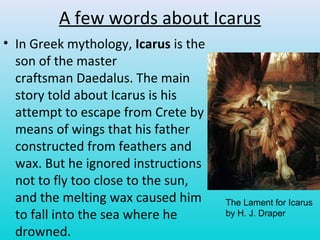
The Lament for Icarus
by H. J. Draper
The story
Daedalus was shut up in a tower to 
prevent his knowledge of his 
Labyrinth from spreading to the 
public. He could not leave Crete 
by sea, as the king kept strict 
watch on all vessels, permitting 
none to sail without being 
carefully searched. Since Minos 
controlled the land and sea 
routes, Daedalus set to work to 
fabricate wings for himself and his 
young son Icarus. 
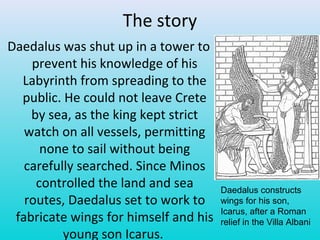
Daedalus constructs
wings for his son,
Icarus, after a Roman
relief in the Villa Albani
The story
When the work was done, the artist,
waving his wings, found himself
buoyed upward and hung
suspended, poising himself on the
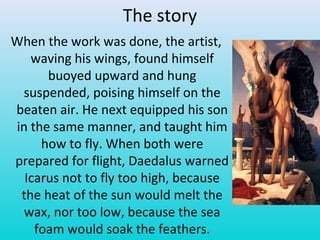
beaten air. He next equipped his son
in the same manner, and taught him
how to fly. When both were
prepared for flight, Daedalus warned
Icarus not to fly too high, because
the heat of the sun would melt the
wax, nor too low, because the sea
foam would soak the feathers.
The story
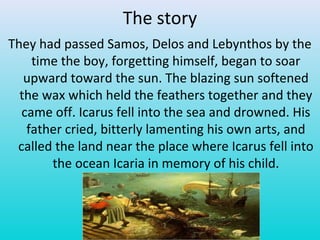
They had passed Samos, Delos and Lebynthos by the
time the boy, forgetting himself, began to soar
upward toward the sun. The blazing sun softened
the wax which held the feathers together and they
came off. Icarus fell into the sea and drowned. His
father cried, bitterly lamenting his own arts, and
called the land near the place where Icarus fell into
the ocean Icaria in memory of his child.
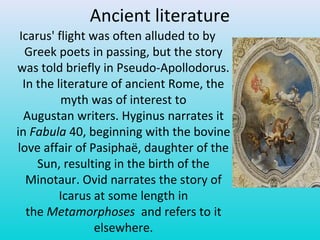
Ancient literature
Icarus' flight was often alluded to by
Greek poets in passing, but the story
was told briefly in Pseudo-Apollodorus.
In the literature of ancient Rome, the
myth was of interest to
Augustan writers. Hyginus narrates it
in Fabula 40, beginning with the bovine
love affair of Pasiphaë, daughter of the
Sun, resulting in the birth of the
Minotaur. Ovid narrates the story of
Icarus at some length in
the Metamorphoses and refers to it
elsewhere.
Classical tradition
Ovid's treatment of the Icarus myth and its
connection with that of Phaëton influenced
the mythological tradition in English
literatureas received and interpreted by
major writers such as Chaucer, Marlowe,S
hakespeare, Milton, and Joyce. In
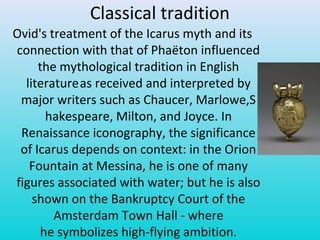
Renaissance iconography, the significance
of Icarus depends on context: in the Orion
Fountain at Messina, he is one of many
figures associated with water; but he is also
shown on the Bankruptcy Court of the
Amsterdam Town Hall - where
he symbolizes high-flying ambition.
Interpretation
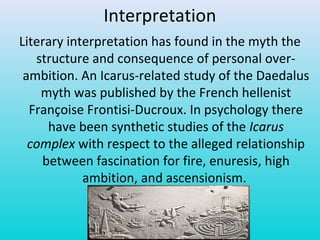
Literary interpretation has found in the myth the
structure and consequence of personal over-
ambition. An Icarus-related study of the Daedalus
myth was published by the French hellenist
Françoise Frontisi-Ducroux. In psychology there
have been synthetic studies of the Icarus
complex with respect to the alleged relationship
between fascination for fire, enuresis, high
ambition, and ascensionism.
Interpretation
In the psychiatric mind features of
disease were perceived in the shape of
the pendulous emotional ecstatic-
high and depressive-low of bi-polar
disorder. Henry Murray having
proposed the term Icarus complex,
apparently found symptoms
particularly in mania where a person is
fond of heights, fascinated by both fire
and water, narcissistic and observed
with fantastical or far-fetched-
imaginary cognition
Thank You For Your
Attention!

Icarus elpida and georgia