About Our National Flag
IntroductionEvery free nation of the world has its own flag. It is a symbol of a free country.
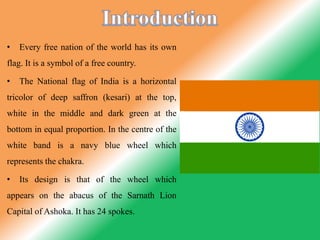
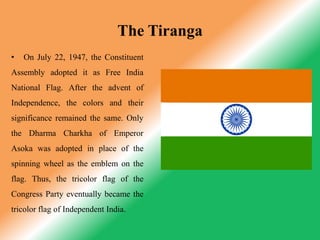
The National flag of India is a horizontal tricolor of deep saffron (kesari) at the top, white in the middle and dark green at the bottom in equal proportion. In the centre of the white band is a navy blue wheel which represents the chakra.
Its design is that of the wheel which appears on the abacus of the Sarnath Lion Capital of Ashoka. It has 24 spokes.Evolution of Our National Flag
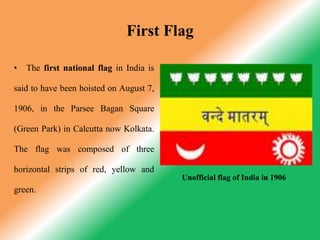
First FlagThe first national flag in India is said to have been hoisted on August 7, 1906, in the Parsee Bagan Square (Green Park) in Calcutta now Kolkata. The flag was composed of three horizontal strips of red, yellow and green.Unofficial flag of India in 1906
Second FlagThe second flag was hoisted in Paris by Madame Cama and her band of exiled revolutionaries in 1907 (according to some in l90’S). This was very similar to the first flag except that the top strip had only one lotus but seven stars denoting the Saptarishi. This flag was also exhibited at a socialist conference in Berlin.The Berlin committee flag, first raised by Bhikaiji Cama in 1907.
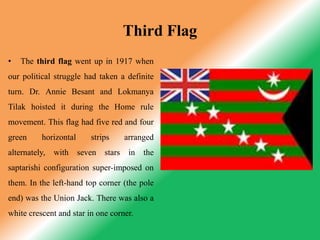
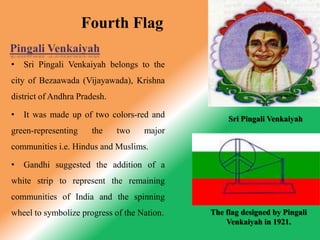
Third FlagThe third flag went up in 1917 when our political struggle had taken a definite turn. Dr. Annie Besant and Lokmanya Tilak hoisted it during the Home rule movement. This flag had five red and four green horizontal strips arranged alternately, with seven stars in the saptarishi configuration super-imposed on them. In the left-hand top corner (the pole end) was the Union Jack. There was also a white crescent and star in one corner.Fourth FlagPingali VenkaiyahSri Pingali Venkaiyah belongs to the city of Bezaawada (Vijayawada), Krishna district of Andhra Pradesh.
It was made up of two colors-red and green-representing the two major communities i.e. Hindus and Muslims.
Gandhi suggested the addition of a white strip to represent the remaining communities of India and the spinning wheel to symbolize progress of the Nation.Sri Pingali VenkaiyahThe flag designed by Pingali Venkaiyah in 1921.
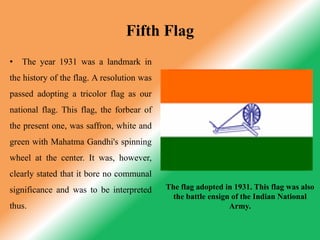
Fifth FlagThe year 1931 was a landmark in the history of the flag. A resolution was passed adopting a tricolor flag as our national flag. This flag, the forbear of the present one, was saffron, white and green with Mahatma Gandhi's spinning wheel at the center. It was, however, clearly stated that it bore no communal significance and was to be interpreted thus.The flag adopted in 1931. This flag was also the battle ensign of the Indian National Army.
Now The Present Flag
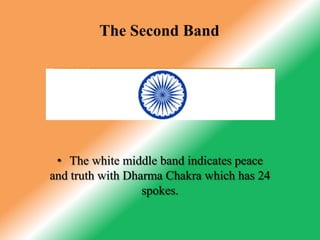
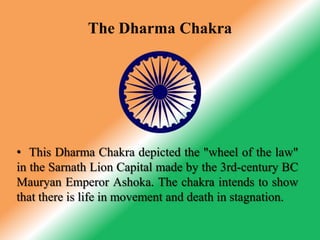
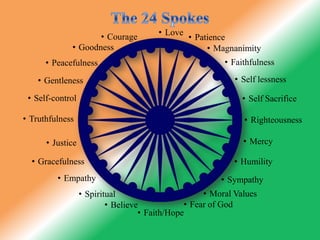
The TirangaOn July 22, 1947, the Constituent Assembly adopted it as Free India National Flag. After the advent of Independence, the colors and their significance remained the same. Only the Dharma Charkha of Emperor Asoka was adopted in place of the spinning wheel as the emblem on the flag. Thus, the tricolor flag of the Congress Party eventually became the tricolor flag of Independent India.The First BandIn the national flag of India the top band is of Saffron color, indicating the strength and courage of the country.The Second BandThe white middle band indicates peace and truth with Dharma Chakra which has 24 spokes.The Third BandThe last band is green in color shows the fertility, growth and auspiciousness of the land.The Dharma ChakraThis Dharma Chakra depicted the "wheel of the law" in the Sarnath Lion Capital made by the 3rd-century BC Mauryan Emperor Ashoka. The chakra intends to show that there is life in movement and death in stagnation.The 24 SpokesLove
Courage
Patience
Goodness
Magnanimity
Faithfulness

About our flag

  • 1.
  • 2.
    IntroductionEvery free nationof the world has its own flag. It is a symbol of a free country.
  • 3.
    The National flagof India is a horizontal tricolor of deep saffron (kesari) at the top, white in the middle and dark green at the bottom in equal proportion. In the centre of the white band is a navy blue wheel which represents the chakra.
  • 4.
    Its design isthat of the wheel which appears on the abacus of the Sarnath Lion Capital of Ashoka. It has 24 spokes.Evolution of Our National Flag
  • 5.
    First FlagThe firstnational flag in India is said to have been hoisted on August 7, 1906, in the Parsee Bagan Square (Green Park) in Calcutta now Kolkata. The flag was composed of three horizontal strips of red, yellow and green.Unofficial flag of India in 1906
  • 6.
    Second FlagThe secondflag was hoisted in Paris by Madame Cama and her band of exiled revolutionaries in 1907 (according to some in l90’S). This was very similar to the first flag except that the top strip had only one lotus but seven stars denoting the Saptarishi. This flag was also exhibited at a socialist conference in Berlin.The Berlin committee flag, first raised by Bhikaiji Cama in 1907.
  • 7.
    Third FlagThe thirdflag went up in 1917 when our political struggle had taken a definite turn. Dr. Annie Besant and Lokmanya Tilak hoisted it during the Home rule movement. This flag had five red and four green horizontal strips arranged alternately, with seven stars in the saptarishi configuration super-imposed on them. In the left-hand top corner (the pole end) was the Union Jack. There was also a white crescent and star in one corner.Fourth FlagPingali VenkaiyahSri Pingali Venkaiyah belongs to the city of Bezaawada (Vijayawada), Krishna district of Andhra Pradesh.
  • 8.
    It was madeup of two colors-red and green-representing the two major communities i.e. Hindus and Muslims.
  • 9.
    Gandhi suggested theaddition of a white strip to represent the remaining communities of India and the spinning wheel to symbolize progress of the Nation.Sri Pingali VenkaiyahThe flag designed by Pingali Venkaiyah in 1921.
  • 10.
    Fifth FlagThe year1931 was a landmark in the history of the flag. A resolution was passed adopting a tricolor flag as our national flag. This flag, the forbear of the present one, was saffron, white and green with Mahatma Gandhi's spinning wheel at the center. It was, however, clearly stated that it bore no communal significance and was to be interpreted thus.The flag adopted in 1931. This flag was also the battle ensign of the Indian National Army.
  • 11.
  • 12.
    The TirangaOn July22, 1947, the Constituent Assembly adopted it as Free India National Flag. After the advent of Independence, the colors and their significance remained the same. Only the Dharma Charkha of Emperor Asoka was adopted in place of the spinning wheel as the emblem on the flag. Thus, the tricolor flag of the Congress Party eventually became the tricolor flag of Independent India.The First BandIn the national flag of India the top band is of Saffron color, indicating the strength and courage of the country.The Second BandThe white middle band indicates peace and truth with Dharma Chakra which has 24 spokes.The Third BandThe last band is green in color shows the fertility, growth and auspiciousness of the land.The Dharma ChakraThis Dharma Chakra depicted the "wheel of the law" in the Sarnath Lion Capital made by the 3rd-century BC Mauryan Emperor Ashoka. The chakra intends to show that there is life in movement and death in stagnation.The 24 SpokesLove
  • 13.
  • 14.
  • 15.
  • 16.
  • 17.