White Board to White Coats
Sir Michael Brady FRS FREng FMedSci
Professor of Oncological Imaging
Department of Oncology
University of Oxford
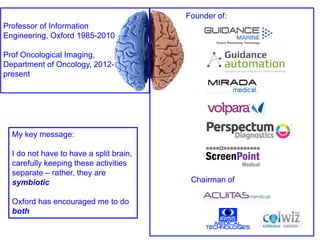
Professor of Information
Engineering, Oxford 1985-2010
Prof Oncological Imaging,
Department of Oncology, 2012-
present
Founder of:
Chairman of
My key message:
I do not have to have a split brain,
carefully keeping these activities
separate – rather, they are
symbiotic
Oxford has encouraged me to do
both
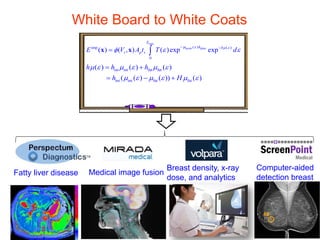
White Board to White Coats
max
lucite plate( )imp ( )
0
( ) ( , ) ( )exp exp
E
h h
t p sE V A t T d
µ ε µ ε
φ ε ε
− −
= ∫x x
int int fat fat
int int fat fat
( ) ( ) ( )
( ( ) ( )) ( )
h h h
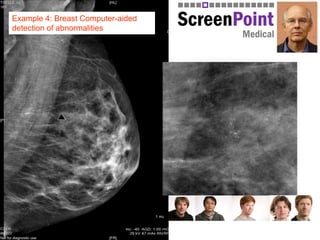
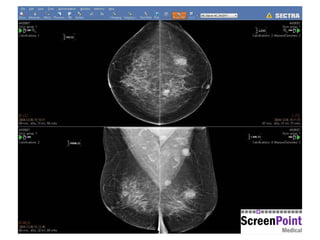
h H
µ ε µ ε µ ε
µ ε µ ε µ ε
= +
= − +
Medical image fusionFatty liver disease
Breast density, x-ray
dose, and analytics
Computer-aided
detection breast
What is the underlying
problem?
• A wonderful target for pharma / biotech
• HEP C drugs have made Gilead - revenues for 2014 increased 122% to $24.89Bn
from $11.20Bn
• NASH market is 6X HEP C ($$), 20X incidence in West
• Imaging needed as endpoints in drug trials – Perspectum’s initial target market
36%
%% 24%
Now : 170 million
2030: 357 million
• 25-35% of Western populations have fatty liver disease (UK: 15-20 Million)
• 1/4 will develop steatohepatitis (UK 4-5 Million) Of these a substantial
fraction will develop cirrhosis and/or liver cancer
• Dame Sally Davies: liver disease is THE main priority1
Example 1: Liver disease pandemic
2000
2030
1. Davies, S.C. “Annual Report of the Chief Medical Officer, Volume One, 2011, On the State of the Public’s Health” London: Department of Health (November 2012)
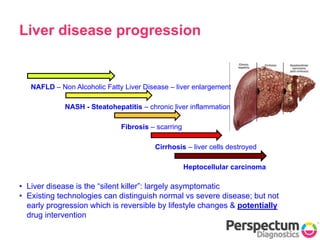
Liver disease progression
NAFLD – Non Alcoholic Fatty Liver Disease – liver enlargement
NASH - Steatohepatitis – chronic liver inflammation
Fibrosis – scarring
Cirrhosis – liver cells destroyed
Heptocellular carcinoma
• Liver disease is the “silent killer”: largely asymptomatic
• Existing technologies can distinguish normal vs severe disease; but not
early progression which is reversible by lifestyle changes & potentially
drug intervention
What is the underlying
problem?
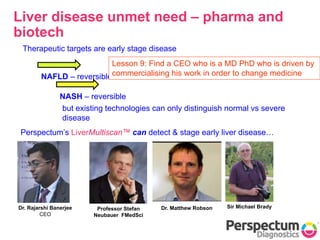
Liver disease unmet need – pharma and
biotech
NAFLD – reversible
NASH – reversible
Therapeutic targets are early stage disease
but existing technologies can only distinguish normal vs severe
disease
Perspectum’s LiverMultiscan™ can detect & stage early liver disease…
Dr. Rajarshi Banerjee
CEO
Sir Michael BradyDr. Matthew RobsonProfessor Stefan
Neubauer FMedSci
Lesson 9: Find a CEO who is a MD PhD who is driven by
commercialising his work in order to change medicine
Liver biopsy is the “gold standard”
Biopsy with a 20cm needle
 is painful, costly ($1K – rising to $4K in
cases of complications)
 … and samples 0.02% of the 1.5Kg
liver, that is 1/5000th of the liver
normal
cT1 = 733ms
mild disease
cT1 = 869ms
severe disease very severe disease
cT1 = 955ms
We have developed a patented MRI method enables
analysis of the whole liver avoidance of many
biopsies, and more accurate assessment of most kinds
of liver disease
cT1 s
cT1 = 1355ms
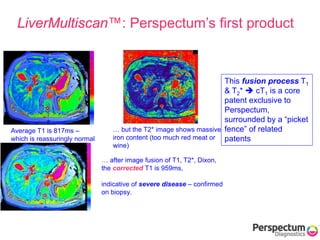
Average T1 is 817ms –
which is reassuringly normal
… but the T2* image shows massive
iron content (too much red meat or
wine)
LiverMultiscan™: Perspectum’s first product
… after image fusion of T1, T2*, Dixon,
the corrected T1 is 959ms,
indicative of severe disease – confirmed
on biopsy.
This fusion process T1
& T2*  cT1 is a core
patent exclusive to
Perspectum,
surrounded by a “picket
fence” of related
patents
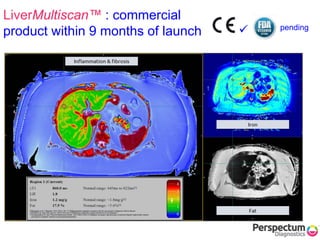
LiverMultiscan™ : commercial
product within 9 months of launch
Inflammation & fibrosis
(T1)
Fat
Iron (T2*)
 pending
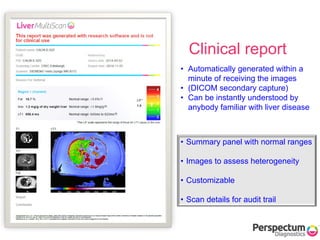
• Summary panel with normal ranges
• Images to assess heterogeneity
• Customizable
• Scan details for audit trail
Clinical report
• Automatically generated within a
minute of receiving the images
• (DICOM secondary capture)
• Can be instantly understood by
anybody familiar with liver disease
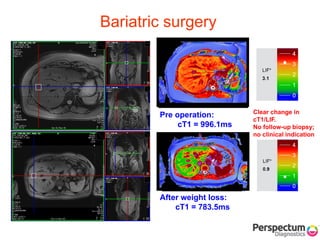
After weight loss:
cT1 = 783.5ms
Pre operation:
cT1 = 996.1ms
Clear change in
cT1/LIF.
No follow-up biopsy;
no clinical indication
Bariatric surgery
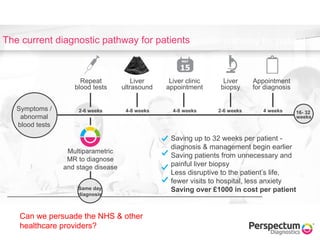
Changing the diagnostic pathway for patients
Repeat
blood tests
Liver
ultrasound
Liver clinic
appointment
Liver
biopsy
Appointment
for diagnosis
2-6 weeks 4-8 weeks 4-8 weeks 2-6 weeks 4 weeksSymptoms /
abnormal
blood tests
Saving up to 32 weeks per patient -
diagnosis & management begin earlier
Saving patients from unnecessary and
painful liver biopsy
Less disruptive to the patient’s life,
fewer visits to hospital, less anxiety
Saving over £1000 in cost per patient
16- 32
weeks
Multiparametric
MR to diagnose
and stage disease
Same day
diagnosis
The current diagnostic pathway for patients
Can we persuade the NHS & other
healthcare providers?
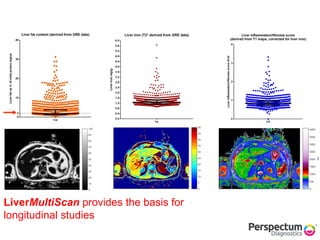
LiverMultiScan provides the basis for
longitudinal studies
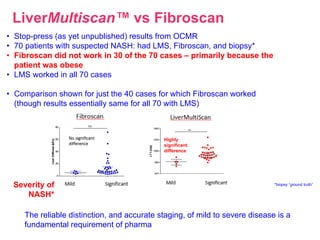
LiverMultiscan™ vs Fibroscan
Highly
significant
difference
Severity of
NASH*
The reliable distinction, and accurate staging, of mild to severe disease is a
fundamental requirement of pharma
*biopsy “ground truth”
• Stop-press (as yet unpublished) results from OCMR
• 70 patients with suspected NASH: had LMS, Fibroscan, and biopsy*
• Fibroscan did not work in 30 of the 70 cases – primarily because the
patient was obese
• LMS worked in all 70 cases
• Comparison shown for just the 40 cases for which Fibroscan worked
(though results essentially same for all 70 with LMS)
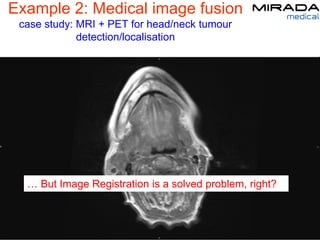
Example 2: Medical image fusion
case study: MRI + PET for head/neck tumour
detection/localisation
… But Image Registration is a solved problem, right?
Deformable image registration
academic & reality
• Generally works reliably for the brain, but not much else
• Promising results published at conferences, but rarely
translated to routine clinical practice
• Many practical cases are poorly served in clinical
practice:
– Whole body registration
– Upper body
– Large-scale deformations, e.g. lung
– Breath-hold, e.g. liver
– Substantial differences in image configuration (e.g. breast)
– …
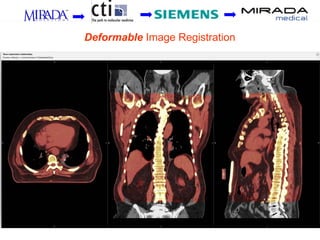
Deformable Image Registration
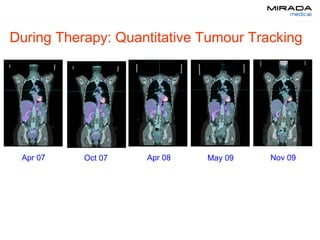
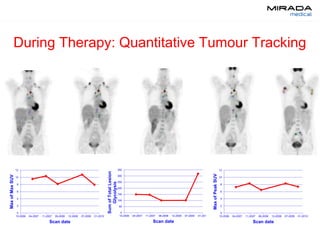
During Therapy: Quantitative Tumour Tracking
Apr 07 Oct 07 Apr 08 May 09 Nov 09
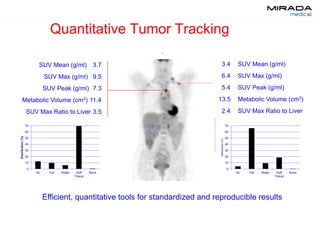
Quantitative Tumor Tracking
0
10
20
30
40
50
60
70
Air Fat Water Soft
Tissue
Bone
Distribution(%)
0
10
20
30
40
50
60
70
Air Fat Water Soft
Tissue
Bone
Distribution(%)
Efficient, quantitative tools for standardized and reproducible results
3.4 SUV Mean (g/ml)
6.4 SUV Max (g/ml)
5.4 SUV Peak (g/ml)
13.5 Metabolic Volume (cm3)
2.4 SUV Max Ratio to Liver
3.7SUV Mean (g/ml)
9.5SUV Max (g/ml)
7.3SUV Peak (g/ml)
11.4Metabolic Volume (cm3)
3.5SUV Max Ratio to Liver
During Therapy: Quantitative Tumour Tracking
0
2
4
6
8
10
12
10-2006 04-2007 11-2007 06-2008 12-2008 07-2009 01-2010
MaxofMaxSUV
Scan date
0
50
100
150
200
250
300
350
10-2006 04-2007 11-2007 06-2008 12-2008 07-2009 01-2010
SumofTotalLesion
Glycolysis
Scan date
0
2
4
6
8
10
12
10-2006 04-2007 11-2007 06-2008 12-2008 07-2009 01-2010MaxofPeakSUV
Scan date
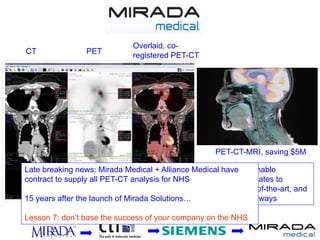
CT PET
Overlaid, co-
registered PET-CT
PET-CT-MRI, saving $5M
Mirada’s deformable
registration equates to
research state-of-the-art, and
works almost always
Late breaking news: Mirada Medical + Alliance Medical have
contract to supply all PET-CT analysis for NHS
15 years after the launch of Mirada Solutions…
Lesson 7: don’t base the success of your company on the NHS
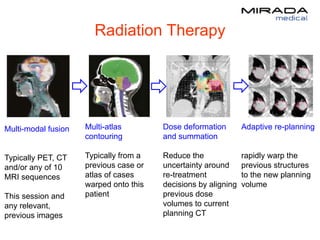
Radiation Therapy
Multi-modal fusion
Typically PET, CT
and/or any of 10
MRI sequences
This session and
any relevant,
previous images
Multi-atlas
contouring
Typically from a
previous case or
atlas of cases
warped onto this
patient
Dose deformation
and summation
Reduce the
uncertainty around
re-treatment
decisions by aligning
previous dose
volumes to current
planning CT
Adaptive re-planning
rapidly warp the
previous structures
to the new planning
volume
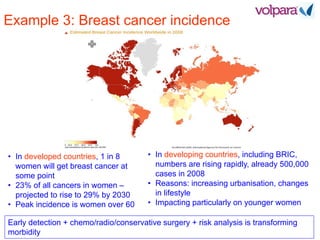
Example 3: Breast cancer incidence
• In developed countries, 1 in 8
women will get breast cancer at
some point
• 23% of all cancers in women –
projected to rise to 29% by 2030
• Peak incidence is women over 60
• In developing countries, including BRIC,
numbers are rising rapidly, already 500,000
cases in 2008
• Reasons: increasing urbanisation, changes
in lifestyle
• Impacting particularly on younger women
Early detection + chemo/radio/conservative surgery + risk analysis is transforming
morbidity
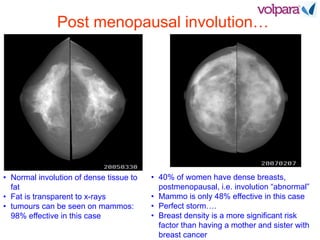
Post menopausal involution…
• Normal involution of dense tissue to
fat
• Fat is transparent to x-rays
• tumours can be seen on mammos:
98% effective in this case
• 40% of women have dense breasts,
postmenopausal, i.e. involution “abnormal”
• Mammo is only 48% effective in this case
• Perfect storm….
• Breast density is a more significant risk
factor than having a mother and sister with
breast cancer
74M annually worldwide
Compare to previous mammograms
Computer-aided detection
Personalised Screening: Stratification
[5] Berg, W.A. Detection of breast cancer with addition of annual screening ultrasound or a single screening MRI to mammography in women
with elevated breast cancer risk. JAMA 2012, 307: 1394 – 1404.
European Union FP7 Project ASSURE, led by Nico Karssemeijer, with Matakina leading WP1 on density
Mammogram
Low density
Await next screening round
(2-3 years)
High density➔ stratification
Additional imaging
Breast MRI Breast Tomosynthesis Breast Ultrasound Molecular Breast Imaging
+
Mammography is 98% effective in fatty
breasts; but only 48% dense breasts
Lesson 10: work to replace ill-
informed debate with sound
science
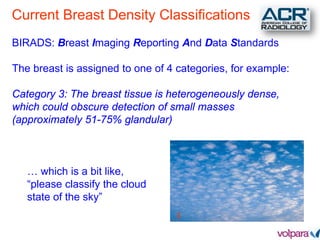
Current Breast Density Classifications
BIRADS: Breast Imaging Reporting And Data Standards
The breast is assigned to one of 4 categories, for example:
Category 3: The breast tissue is heterogeneously dense,
which could obscure detection of small masses
(approximately 51-75% glandular)
… which is a bit like,
“please classify the cloud
state of the sky”
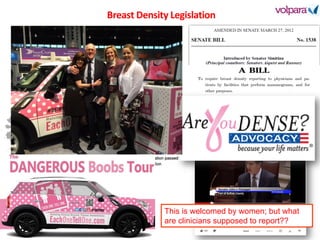
Breast Density Legislation
This is welcomed by women; but what
are clinicians supposed to report??
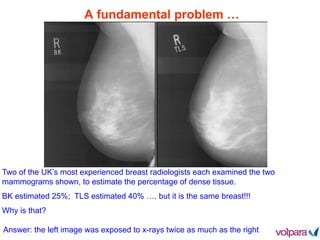
A fundamental problem …
Two of the UK’s most experienced breast radiologists each examined the two
mammograms shown, to estimate the percentage of dense tissue.
BK estimated 25%; TLS estimated 40% …. but it is the same breast!!!
Why is that?
Answer: the left image was exposed to x-rays twice as much as the right
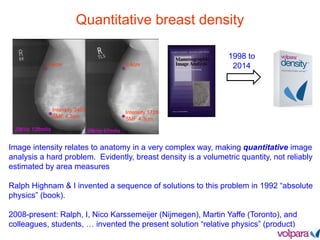
Quantitative breast density
Intensity 3401
SMF 4.3cm
0.4cm
Intensity 1728
SMF 4.3cm
0.4cm
29kVp 128mAs 28kVp 67mAs
1998 to
2014
Image intensity relates to anatomy in a very complex way, making quantitative image
analysis a hard problem. Evidently, breast density is a volumetric quantity, not reliably
estimated by area measures
Ralph Highnam & I invented a sequence of solutions to this problem in 1992 “absolute
physics” (book).
2008-present: Ralph, I, Nico Karssemeijer (Nijmegen), Martin Yaffe (Toronto), and
colleagues, students, … invented the present solution “relative physics” (product)
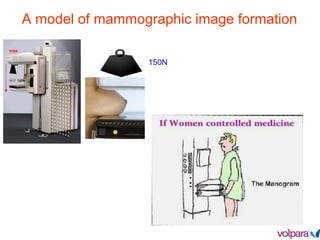
A model of mammographic image formation
tube
150N
( ), = tube voltage
= exposure time
= pixel size
t
s
p
V
t
A
φ x
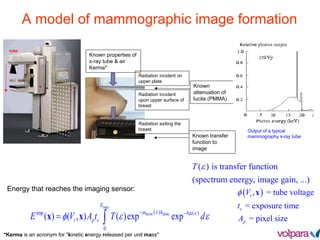
A model of mammographic image formation
max
lucite plate( )imp ( )
0
( ) ( , ) ( )exp exp
E
h h
t p sE V A t T d
µ ε µ ε
φ ε ε
− −
= ∫x x
Energy that reaches the imaging sensor:
( ) is transfer function
(spectrum energy, image gain, ...)
T ε
tube
Radiation incident on
upper plate
Radiation incident
upon upper surface of
breast
Radiation exiting the
breast
Known
attenuation of
lucite (PMMA)
Known transfer
function to
image
Known properties of
x-ray tube & air
Kerma*
Output of a typical
mammography x-ray tube
*Kerma is an acronym for "kinetic energy released per unit mass"
Volumetric breast density
At this pixel, 5.8cm of fat; 0.2cm of
dense tissue
At this one, 3.6cm fat, 2.4cm of
dense tissue
Volume of Fibroglandular = sum over all pixels in the breast region of
amount of dense tissue,
and has unit of cubic centimetres (cm3)
Volumetric Breast Density = 100.0 * (Volume of Fibroglandular divided
by Volume of the Breast)
Lesson 11: medicine needs
numbers not pretty pictures
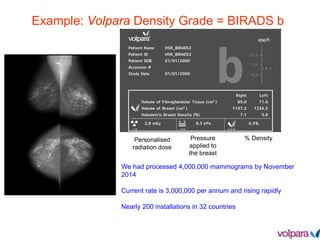
Example: Volpara Density Grade = BIRADS b
We had processed 4,000,000 mammograms by November
2014
Current rate is 3,000,000 per annum and rising rapidly
Nearly 200 installations in 32 countries
% DensityPressure
applied to
the breast
Personalised
radiation dose
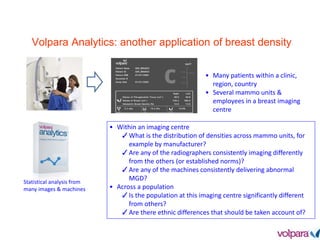
Volpara Analytics: another application of breast density
• Many patients within a clinic,
region, country
• Several mammo units &
employees in a breast imaging
centre
Statistical analysis from
many images & machines
• Within an imaging centre
✓What is the distribution of densities across mammo units, for
example by manufacturer?
✓Are any of the radiographers consistently imaging differently
from the others (or established norms)?
✓Are any of the machines consistently delivering abnormal
MGD?
• Across a population
✓Is the population at this imaging centre significantly different
from others?
✓Are there ethnic differences that should be taken account of?
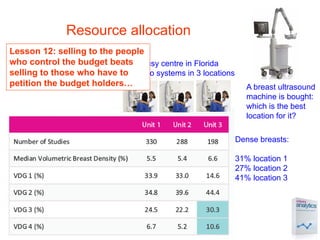
A busy centre in Florida
3 mammo systems in 3 locations
A breast ultrasound
machine is bought:
which is the best
location for it?
Dense breasts:
31% location 1
27% location 2
41% location 3
Resource allocation
Lesson 12: selling to the people
who control the budget beats
selling to those who have to
petition the budget holders…
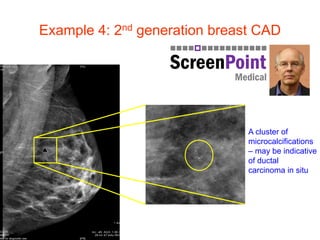
Example 4: 2nd generation breast CAD
A cluster of
microcalcifications
– may be indicative
of ductal
carcinoma in situ
Example 4: Breast Computer-aided
detection of abnormalities
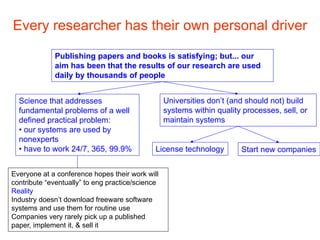
Every researcher has their own personal driver
Publishing papers and books is satisfying; but... our
aim has been that the results of our research are used
daily by thousands of people
Science that addresses
fundamental problems of a well
defined practical problem:
• our systems are used by
nonexperts
• have to work 24/7, 365, 99.9%
Universities don’t (and should not) build
systems within quality processes, sell, or
maintain systems
License technology Start new companies
Everyone at a conference hopes their work will
contribute “eventually” to eng practice/science
Reality
Industry doesn’t download freeware software
systems and use them for routine use
Companies very rarely pick up a published
paper, implement it, & sell it
Why start companies?
1. Frustration of dealing with large companies, particularly in medical
image analysis, and particularly in the UK
– 99% of Mirada’s sales are in the USA, as are Matakina’s
2. I can’t help it (Guidance, Mirada Solutions, Mirada Medical,
Matakina, ...)
3. Secure the kids’ futures yet live with academic poverty
4. The dream of a swimming pool in Provence …
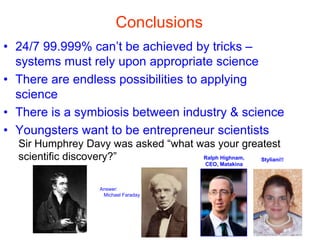
Conclusions
• 24/7 99.999% can’t be achieved by tricks –
systems must rely upon appropriate science
• There are endless possibilities to applying
science
• There is a symbiosis between industry & science
• Youngsters want to be entrepreneur scientists
Answer:
Michael Faraday
Sir Humphrey Davy was asked “what was your greatest
scientific discovery?” Ralph Highnam,
CEO, Matakina
Styliani!!
42
This is a presentation at the ABCDCAD project
workshop, on June 24, 2015, which is
supported by the Cyprus Research Promotion
Foundation's Grant ΤΠΕ/ΟΡΙΖΟ/311(ΒΙΕ)/29
and is co-funded by the Republic of Cyprus
and the European Regional Development
Fund.

White Board to White Coats

  • 1.
    White Board toWhite Coats Sir Michael Brady FRS FREng FMedSci Professor of Oncological Imaging Department of Oncology University of Oxford
  • 2.
    Professor of Information Engineering,Oxford 1985-2010 Prof Oncological Imaging, Department of Oncology, 2012- present Founder of: Chairman of My key message: I do not have to have a split brain, carefully keeping these activities separate – rather, they are symbiotic Oxford has encouraged me to do both
  • 3.
    White Board toWhite Coats max lucite plate( )imp ( ) 0 ( ) ( , ) ( )exp exp E h h t p sE V A t T d µ ε µ ε φ ε ε − − = ∫x x int int fat fat int int fat fat ( ) ( ) ( ) ( ( ) ( )) ( ) h h h h H µ ε µ ε µ ε µ ε µ ε µ ε = + = − + Medical image fusionFatty liver disease Breast density, x-ray dose, and analytics Computer-aided detection breast
  • 4.
    What is theunderlying problem? • A wonderful target for pharma / biotech • HEP C drugs have made Gilead - revenues for 2014 increased 122% to $24.89Bn from $11.20Bn • NASH market is 6X HEP C ($$), 20X incidence in West • Imaging needed as endpoints in drug trials – Perspectum’s initial target market 36% %% 24% Now : 170 million 2030: 357 million • 25-35% of Western populations have fatty liver disease (UK: 15-20 Million) • 1/4 will develop steatohepatitis (UK 4-5 Million) Of these a substantial fraction will develop cirrhosis and/or liver cancer • Dame Sally Davies: liver disease is THE main priority1 Example 1: Liver disease pandemic 2000 2030 1. Davies, S.C. “Annual Report of the Chief Medical Officer, Volume One, 2011, On the State of the Public’s Health” London: Department of Health (November 2012)
  • 5.
    Liver disease progression NAFLD– Non Alcoholic Fatty Liver Disease – liver enlargement NASH - Steatohepatitis – chronic liver inflammation Fibrosis – scarring Cirrhosis – liver cells destroyed Heptocellular carcinoma • Liver disease is the “silent killer”: largely asymptomatic • Existing technologies can distinguish normal vs severe disease; but not early progression which is reversible by lifestyle changes & potentially drug intervention
  • 6.
    What is theunderlying problem? Liver disease unmet need – pharma and biotech NAFLD – reversible NASH – reversible Therapeutic targets are early stage disease but existing technologies can only distinguish normal vs severe disease Perspectum’s LiverMultiscan™ can detect & stage early liver disease… Dr. Rajarshi Banerjee CEO Sir Michael BradyDr. Matthew RobsonProfessor Stefan Neubauer FMedSci Lesson 9: Find a CEO who is a MD PhD who is driven by commercialising his work in order to change medicine
  • 7.
    Liver biopsy isthe “gold standard” Biopsy with a 20cm needle  is painful, costly ($1K – rising to $4K in cases of complications)  … and samples 0.02% of the 1.5Kg liver, that is 1/5000th of the liver normal cT1 = 733ms mild disease cT1 = 869ms severe disease very severe disease cT1 = 955ms We have developed a patented MRI method enables analysis of the whole liver avoidance of many biopsies, and more accurate assessment of most kinds of liver disease cT1 s cT1 = 1355ms
  • 8.
    Average T1 is817ms – which is reassuringly normal … but the T2* image shows massive iron content (too much red meat or wine) LiverMultiscan™: Perspectum’s first product … after image fusion of T1, T2*, Dixon, the corrected T1 is 959ms, indicative of severe disease – confirmed on biopsy. This fusion process T1 & T2*  cT1 is a core patent exclusive to Perspectum, surrounded by a “picket fence” of related patents
  • 9.
    LiverMultiscan™ : commercial productwithin 9 months of launch Inflammation & fibrosis (T1) Fat Iron (T2*)  pending
  • 10.
    • Summary panelwith normal ranges • Images to assess heterogeneity • Customizable • Scan details for audit trail Clinical report • Automatically generated within a minute of receiving the images • (DICOM secondary capture) • Can be instantly understood by anybody familiar with liver disease
  • 11.
    After weight loss: cT1= 783.5ms Pre operation: cT1 = 996.1ms Clear change in cT1/LIF. No follow-up biopsy; no clinical indication Bariatric surgery
  • 12.
    Changing the diagnosticpathway for patients Repeat blood tests Liver ultrasound Liver clinic appointment Liver biopsy Appointment for diagnosis 2-6 weeks 4-8 weeks 4-8 weeks 2-6 weeks 4 weeksSymptoms / abnormal blood tests Saving up to 32 weeks per patient - diagnosis & management begin earlier Saving patients from unnecessary and painful liver biopsy Less disruptive to the patient’s life, fewer visits to hospital, less anxiety Saving over £1000 in cost per patient 16- 32 weeks Multiparametric MR to diagnose and stage disease Same day diagnosis The current diagnostic pathway for patients Can we persuade the NHS & other healthcare providers?
  • 13.
    LiverMultiScan provides thebasis for longitudinal studies
  • 14.
    LiverMultiscan™ vs Fibroscan Highly significant difference Severityof NASH* The reliable distinction, and accurate staging, of mild to severe disease is a fundamental requirement of pharma *biopsy “ground truth” • Stop-press (as yet unpublished) results from OCMR • 70 patients with suspected NASH: had LMS, Fibroscan, and biopsy* • Fibroscan did not work in 30 of the 70 cases – primarily because the patient was obese • LMS worked in all 70 cases • Comparison shown for just the 40 cases for which Fibroscan worked (though results essentially same for all 70 with LMS)
  • 15.
    Example 2: Medicalimage fusion case study: MRI + PET for head/neck tumour detection/localisation … But Image Registration is a solved problem, right?
  • 16.
    Deformable image registration academic& reality • Generally works reliably for the brain, but not much else • Promising results published at conferences, but rarely translated to routine clinical practice • Many practical cases are poorly served in clinical practice: – Whole body registration – Upper body – Large-scale deformations, e.g. lung – Breath-hold, e.g. liver – Substantial differences in image configuration (e.g. breast) – …
  • 17.
  • 18.
    During Therapy: QuantitativeTumour Tracking Apr 07 Oct 07 Apr 08 May 09 Nov 09
  • 19.
    Quantitative Tumor Tracking 0 10 20 30 40 50 60 70 AirFat Water Soft Tissue Bone Distribution(%) 0 10 20 30 40 50 60 70 Air Fat Water Soft Tissue Bone Distribution(%) Efficient, quantitative tools for standardized and reproducible results 3.4 SUV Mean (g/ml) 6.4 SUV Max (g/ml) 5.4 SUV Peak (g/ml) 13.5 Metabolic Volume (cm3) 2.4 SUV Max Ratio to Liver 3.7SUV Mean (g/ml) 9.5SUV Max (g/ml) 7.3SUV Peak (g/ml) 11.4Metabolic Volume (cm3) 3.5SUV Max Ratio to Liver
  • 20.
    During Therapy: QuantitativeTumour Tracking 0 2 4 6 8 10 12 10-2006 04-2007 11-2007 06-2008 12-2008 07-2009 01-2010 MaxofMaxSUV Scan date 0 50 100 150 200 250 300 350 10-2006 04-2007 11-2007 06-2008 12-2008 07-2009 01-2010 SumofTotalLesion Glycolysis Scan date 0 2 4 6 8 10 12 10-2006 04-2007 11-2007 06-2008 12-2008 07-2009 01-2010MaxofPeakSUV Scan date
  • 21.
    CT PET Overlaid, co- registeredPET-CT PET-CT-MRI, saving $5M Mirada’s deformable registration equates to research state-of-the-art, and works almost always Late breaking news: Mirada Medical + Alliance Medical have contract to supply all PET-CT analysis for NHS 15 years after the launch of Mirada Solutions… Lesson 7: don’t base the success of your company on the NHS
  • 22.
    Radiation Therapy Multi-modal fusion TypicallyPET, CT and/or any of 10 MRI sequences This session and any relevant, previous images Multi-atlas contouring Typically from a previous case or atlas of cases warped onto this patient Dose deformation and summation Reduce the uncertainty around re-treatment decisions by aligning previous dose volumes to current planning CT Adaptive re-planning rapidly warp the previous structures to the new planning volume
  • 23.
    Example 3: Breastcancer incidence • In developed countries, 1 in 8 women will get breast cancer at some point • 23% of all cancers in women – projected to rise to 29% by 2030 • Peak incidence is women over 60 • In developing countries, including BRIC, numbers are rising rapidly, already 500,000 cases in 2008 • Reasons: increasing urbanisation, changes in lifestyle • Impacting particularly on younger women Early detection + chemo/radio/conservative surgery + risk analysis is transforming morbidity
  • 24.
    Post menopausal involution… •Normal involution of dense tissue to fat • Fat is transparent to x-rays • tumours can be seen on mammos: 98% effective in this case • 40% of women have dense breasts, postmenopausal, i.e. involution “abnormal” • Mammo is only 48% effective in this case • Perfect storm…. • Breast density is a more significant risk factor than having a mother and sister with breast cancer
  • 25.
    74M annually worldwide Compareto previous mammograms Computer-aided detection Personalised Screening: Stratification [5] Berg, W.A. Detection of breast cancer with addition of annual screening ultrasound or a single screening MRI to mammography in women with elevated breast cancer risk. JAMA 2012, 307: 1394 – 1404. European Union FP7 Project ASSURE, led by Nico Karssemeijer, with Matakina leading WP1 on density Mammogram Low density Await next screening round (2-3 years) High density➔ stratification Additional imaging Breast MRI Breast Tomosynthesis Breast Ultrasound Molecular Breast Imaging + Mammography is 98% effective in fatty breasts; but only 48% dense breasts Lesson 10: work to replace ill- informed debate with sound science
  • 26.
    Current Breast DensityClassifications BIRADS: Breast Imaging Reporting And Data Standards The breast is assigned to one of 4 categories, for example: Category 3: The breast tissue is heterogeneously dense, which could obscure detection of small masses (approximately 51-75% glandular) … which is a bit like, “please classify the cloud state of the sky”
  • 27.
    Breast Density Legislation Thisis welcomed by women; but what are clinicians supposed to report??
  • 28.
    A fundamental problem… Two of the UK’s most experienced breast radiologists each examined the two mammograms shown, to estimate the percentage of dense tissue. BK estimated 25%; TLS estimated 40% …. but it is the same breast!!! Why is that? Answer: the left image was exposed to x-rays twice as much as the right
  • 29.
    Quantitative breast density Intensity3401 SMF 4.3cm 0.4cm Intensity 1728 SMF 4.3cm 0.4cm 29kVp 128mAs 28kVp 67mAs 1998 to 2014 Image intensity relates to anatomy in a very complex way, making quantitative image analysis a hard problem. Evidently, breast density is a volumetric quantity, not reliably estimated by area measures Ralph Highnam & I invented a sequence of solutions to this problem in 1992 “absolute physics” (book). 2008-present: Ralph, I, Nico Karssemeijer (Nijmegen), Martin Yaffe (Toronto), and colleagues, students, … invented the present solution “relative physics” (product)
  • 30.
    A model ofmammographic image formation tube 150N
  • 31.
    ( ), =tube voltage = exposure time = pixel size t s p V t A φ x A model of mammographic image formation max lucite plate( )imp ( ) 0 ( ) ( , ) ( )exp exp E h h t p sE V A t T d µ ε µ ε φ ε ε − − = ∫x x Energy that reaches the imaging sensor: ( ) is transfer function (spectrum energy, image gain, ...) T ε tube Radiation incident on upper plate Radiation incident upon upper surface of breast Radiation exiting the breast Known attenuation of lucite (PMMA) Known transfer function to image Known properties of x-ray tube & air Kerma* Output of a typical mammography x-ray tube *Kerma is an acronym for "kinetic energy released per unit mass"
  • 32.
    Volumetric breast density Atthis pixel, 5.8cm of fat; 0.2cm of dense tissue At this one, 3.6cm fat, 2.4cm of dense tissue Volume of Fibroglandular = sum over all pixels in the breast region of amount of dense tissue, and has unit of cubic centimetres (cm3) Volumetric Breast Density = 100.0 * (Volume of Fibroglandular divided by Volume of the Breast) Lesson 11: medicine needs numbers not pretty pictures
  • 33.
    Example: Volpara DensityGrade = BIRADS b We had processed 4,000,000 mammograms by November 2014 Current rate is 3,000,000 per annum and rising rapidly Nearly 200 installations in 32 countries % DensityPressure applied to the breast Personalised radiation dose
  • 34.
    Volpara Analytics: anotherapplication of breast density • Many patients within a clinic, region, country • Several mammo units & employees in a breast imaging centre Statistical analysis from many images & machines • Within an imaging centre ✓What is the distribution of densities across mammo units, for example by manufacturer? ✓Are any of the radiographers consistently imaging differently from the others (or established norms)? ✓Are any of the machines consistently delivering abnormal MGD? • Across a population ✓Is the population at this imaging centre significantly different from others? ✓Are there ethnic differences that should be taken account of?
  • 35.
    A busy centrein Florida 3 mammo systems in 3 locations A breast ultrasound machine is bought: which is the best location for it? Dense breasts: 31% location 1 27% location 2 41% location 3 Resource allocation Lesson 12: selling to the people who control the budget beats selling to those who have to petition the budget holders…
  • 36.
    Example 4: 2ndgeneration breast CAD A cluster of microcalcifications – may be indicative of ductal carcinoma in situ
  • 37.
    Example 4: BreastComputer-aided detection of abnormalities
  • 39.
    Every researcher hastheir own personal driver Publishing papers and books is satisfying; but... our aim has been that the results of our research are used daily by thousands of people Science that addresses fundamental problems of a well defined practical problem: • our systems are used by nonexperts • have to work 24/7, 365, 99.9% Universities don’t (and should not) build systems within quality processes, sell, or maintain systems License technology Start new companies Everyone at a conference hopes their work will contribute “eventually” to eng practice/science Reality Industry doesn’t download freeware software systems and use them for routine use Companies very rarely pick up a published paper, implement it, & sell it
  • 40.
    Why start companies? 1.Frustration of dealing with large companies, particularly in medical image analysis, and particularly in the UK – 99% of Mirada’s sales are in the USA, as are Matakina’s 2. I can’t help it (Guidance, Mirada Solutions, Mirada Medical, Matakina, ...) 3. Secure the kids’ futures yet live with academic poverty 4. The dream of a swimming pool in Provence …
  • 41.
    Conclusions • 24/7 99.999%can’t be achieved by tricks – systems must rely upon appropriate science • There are endless possibilities to applying science • There is a symbiosis between industry & science • Youngsters want to be entrepreneur scientists Answer: Michael Faraday Sir Humphrey Davy was asked “what was your greatest scientific discovery?” Ralph Highnam, CEO, Matakina Styliani!!
  • 42.
    42 This is apresentation at the ABCDCAD project workshop, on June 24, 2015, which is supported by the Cyprus Research Promotion Foundation's Grant ΤΠΕ/ΟΡΙΖΟ/311(ΒΙΕ)/29 and is co-funded by the Republic of Cyprus and the European Regional Development Fund.