Jillian Whetstone
      ESL 501
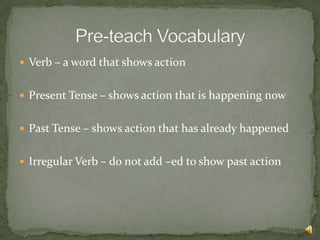
 Verb – a word that shows action


 Present Tense – shows action that is happening now


 Past Tense – shows action that has already happened


 Irregular Verb – do not add –ed to show past action
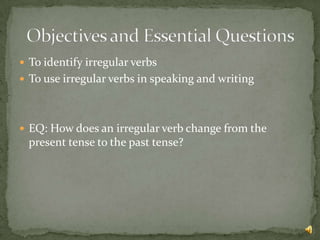
 To identify irregular verbs
 To use irregular verbs in speaking and writing


 EQ: How does an irregular verb change from the
  present tense to the past tense?
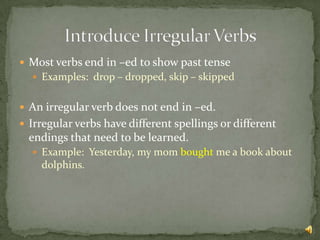
 Most verbs end in –ed to show past tense
   Examples: drop – dropped, skip – skipped


 An irregular verb does not end in –ed.
 Irregular verbs have different spellings or different
  endings that need to be learned.
   Example: Yesterday, my mom bought me a book about
    dolphins.
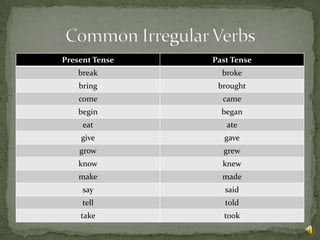
Present Tense   Past Tense
    break         broke
    bring        brought
    come          came
    begin         began
     eat           ate
    give           gave
    grow          grew
    know          knew
    make          made
     say           said
     tell          told
    take           took
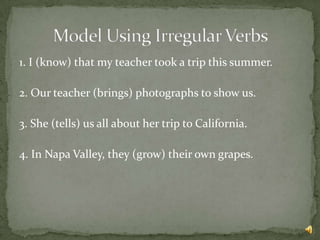
1. I (know) that my teacher took a trip this summer.

2. Our teacher (brings) photographs to show us.

3. She (tells) us all about her trip to California.

4. In Napa Valley, they (grow) their own grapes.
5. We (take) a day to tour the Redwood Forest.

6. We (leave) in time to get to the airport.

7. We (drive) to the Jelly Belly factory to take a tour.

8. My family and I (make) a plan to go again next year.
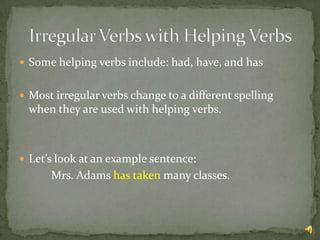
 Some helping verbs include: had, have, and has


 Most irregular verbs change to a different spelling
 when they are used with helping verbs.


 Let’s look at an example sentence:
      Mrs. Adams has taken many classes.
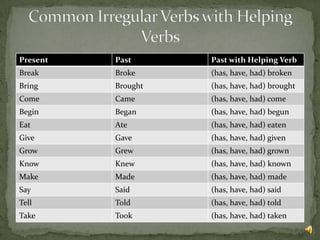
Present   Past      Past with Helping Verb
Break     Broke     (has, have, had) broken
Bring     Brought   (has, have, had) brought
Come      Came      (has, have, had) come
Begin     Began     (has, have, had) begun
Eat       Ate       (has, have, had) eaten
Give      Gave      (has, have, had) given
Grow      Grew      (has, have, had) grown
Know      Knew      (has, have, had) known
Make      Made      (has, have, had) made
Say       Said      (has, have, had) said
Tell      Told      (has, have, had) told
Take      Took      (has, have, had) taken
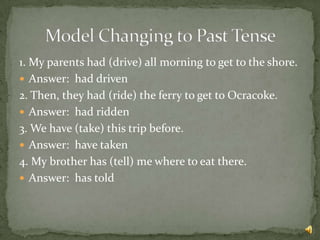
1. My parents had (drive) all morning to get to the shore.
 Answer: had driven
2. Then, they had (ride) the ferry to get to Ocracoke.
 Answer: had ridden
3. We have (take) this trip before.
 Answer: have taken
4. My brother has (tell) me where to eat there.
 Answer: has told
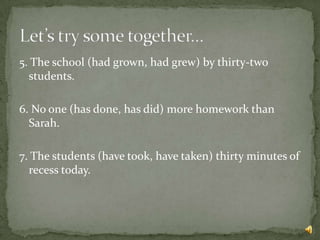
5. The school (had grown, had grew) by thirty-two
  students.

6. No one (has done, has did) more homework than
  Sarah.

7. The students (have took, have taken) thirty minutes of
  recess today.
Thumbs Up/Thumbs Down Activity
Excerpt From: A
Father’s Garden by
Ana Maria Alvarado


                   One day, David was sad when he came home from
               school. His mother gave him a snack to eat. She asked
               if something was wrong.
                   David told her that he didn’t go see his father
               because he didn’t have time. He was going to play
               basketball with his friends. They wanted to practice
               and get ready for Saturday’s game with the kids from
               another street. After practice, David was going to
               come right home because he had a lot of homework to
               do tonight.
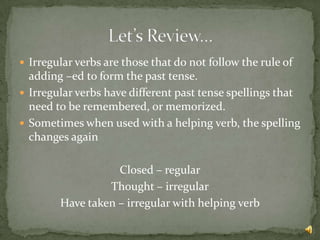
 Irregular verbs are those that do not follow the rule of
  adding –ed to form the past tense.
 Irregular verbs have different past tense spellings that
  need to be remembered, or memorized.
 Sometimes when used with a helping verb, the spelling
  changes again

                   Closed – regular
                 Thought – irregular
        Have taken – irregular with helping verb
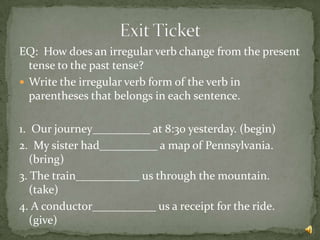
EQ: How does an irregular verb change from the present
  tense to the past tense?
 Write the irregular verb form of the verb in
  parentheses that belongs in each sentence.

1. Our journey__________ at 8:30 yesterday. (begin)
2. My sister had__________ a map of Pennsylvania.
   (bring)
3. The train___________ us through the mountain.
   (take)
4. A conductor___________ us a receipt for the ride.
   (give)
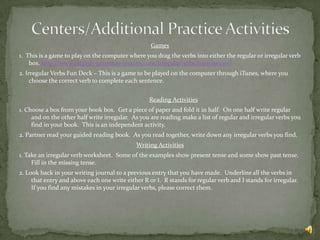
Games
1. This is a game to play on the computer where you drag the verbs into either the regular or irregular verb
    box. http://www.english-grammar-lessons.com/irregularverbs/exercise1.swf
2. Irregular Verbs Fun Deck – This is a game to be played on the computer through iTunes, where you
     choose the correct verb to complete each sentence.


                                                  Reading Activities
1. Choose a box from your book box. Get a piece of paper and fold it in half. On one half write regular
     and on the other half write irregular. As you are reading make a list of regular and irregular verbs you
     find in your book. This is an independent activity.
2. Partner read your guided reading book. As you read together, write down any irregular verbs you find.
                                             Writing Activities
1. Take an irregular verb worksheet. Some of the examples show present tense and some show past tense.
     Fill in the missing tense.
2. Look back in your writing journal to a previous entry that you have made. Underline all the verbs in
     that entry and above each one write either R or I. R stands for regular verb and I stands for irregular.
     If you find any mistakes in your irregular verbs, please correct them.
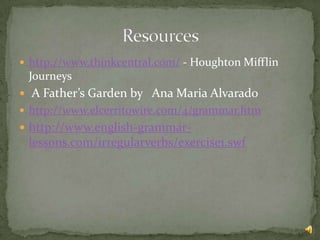
 http://www.thinkcentral.com/ - Houghton Mifflin
 Journeys
 A Father’s Garden by Ana Maria Alvarado
 http://www.elcerritowire.com/4/grammar.htm
 http://www.english-grammar-
 lessons.com/irregularverbs/exercise1.swf

Whetstone u09a1.irregular verbs

  • 1.
  • 2.
     Verb –a word that shows action  Present Tense – shows action that is happening now  Past Tense – shows action that has already happened  Irregular Verb – do not add –ed to show past action
  • 3.
     To identifyirregular verbs  To use irregular verbs in speaking and writing  EQ: How does an irregular verb change from the present tense to the past tense?
  • 4.
     Most verbsend in –ed to show past tense  Examples: drop – dropped, skip – skipped  An irregular verb does not end in –ed.  Irregular verbs have different spellings or different endings that need to be learned.  Example: Yesterday, my mom bought me a book about dolphins.
  • 5.
    Present Tense Past Tense break broke bring brought come came begin began eat ate give gave grow grew know knew make made say said tell told take took
  • 6.
    1. I (know)that my teacher took a trip this summer. 2. Our teacher (brings) photographs to show us. 3. She (tells) us all about her trip to California. 4. In Napa Valley, they (grow) their own grapes.
  • 7.
    5. We (take)a day to tour the Redwood Forest. 6. We (leave) in time to get to the airport. 7. We (drive) to the Jelly Belly factory to take a tour. 8. My family and I (make) a plan to go again next year.
  • 8.
     Some helpingverbs include: had, have, and has  Most irregular verbs change to a different spelling when they are used with helping verbs.  Let’s look at an example sentence: Mrs. Adams has taken many classes.
  • 9.
    Present Past Past with Helping Verb Break Broke (has, have, had) broken Bring Brought (has, have, had) brought Come Came (has, have, had) come Begin Began (has, have, had) begun Eat Ate (has, have, had) eaten Give Gave (has, have, had) given Grow Grew (has, have, had) grown Know Knew (has, have, had) known Make Made (has, have, had) made Say Said (has, have, had) said Tell Told (has, have, had) told Take Took (has, have, had) taken
  • 10.
    1. My parentshad (drive) all morning to get to the shore.  Answer: had driven 2. Then, they had (ride) the ferry to get to Ocracoke.  Answer: had ridden 3. We have (take) this trip before.  Answer: have taken 4. My brother has (tell) me where to eat there.  Answer: has told
  • 11.
    5. The school(had grown, had grew) by thirty-two students. 6. No one (has done, has did) more homework than Sarah. 7. The students (have took, have taken) thirty minutes of recess today.
  • 12.
    Thumbs Up/Thumbs DownActivity Excerpt From: A Father’s Garden by Ana Maria Alvarado One day, David was sad when he came home from school. His mother gave him a snack to eat. She asked if something was wrong. David told her that he didn’t go see his father because he didn’t have time. He was going to play basketball with his friends. They wanted to practice and get ready for Saturday’s game with the kids from another street. After practice, David was going to come right home because he had a lot of homework to do tonight.
  • 13.
     Irregular verbsare those that do not follow the rule of adding –ed to form the past tense.  Irregular verbs have different past tense spellings that need to be remembered, or memorized.  Sometimes when used with a helping verb, the spelling changes again Closed – regular Thought – irregular Have taken – irregular with helping verb
  • 14.
    EQ: How doesan irregular verb change from the present tense to the past tense?  Write the irregular verb form of the verb in parentheses that belongs in each sentence. 1. Our journey__________ at 8:30 yesterday. (begin) 2. My sister had__________ a map of Pennsylvania. (bring) 3. The train___________ us through the mountain. (take) 4. A conductor___________ us a receipt for the ride. (give)
  • 15.
    Games 1. This isa game to play on the computer where you drag the verbs into either the regular or irregular verb box. http://www.english-grammar-lessons.com/irregularverbs/exercise1.swf 2. Irregular Verbs Fun Deck – This is a game to be played on the computer through iTunes, where you choose the correct verb to complete each sentence. Reading Activities 1. Choose a box from your book box. Get a piece of paper and fold it in half. On one half write regular and on the other half write irregular. As you are reading make a list of regular and irregular verbs you find in your book. This is an independent activity. 2. Partner read your guided reading book. As you read together, write down any irregular verbs you find. Writing Activities 1. Take an irregular verb worksheet. Some of the examples show present tense and some show past tense. Fill in the missing tense. 2. Look back in your writing journal to a previous entry that you have made. Underline all the verbs in that entry and above each one write either R or I. R stands for regular verb and I stands for irregular. If you find any mistakes in your irregular verbs, please correct them.
  • 16.
     http://www.thinkcentral.com/ -Houghton Mifflin Journeys  A Father’s Garden by Ana Maria Alvarado  http://www.elcerritowire.com/4/grammar.htm  http://www.english-grammar- lessons.com/irregularverbs/exercise1.swf