Complete Stellar WS for chapter
              5-8
   Our intensive preparation for SA2
Grammar: Connectors
                  (pg 9)
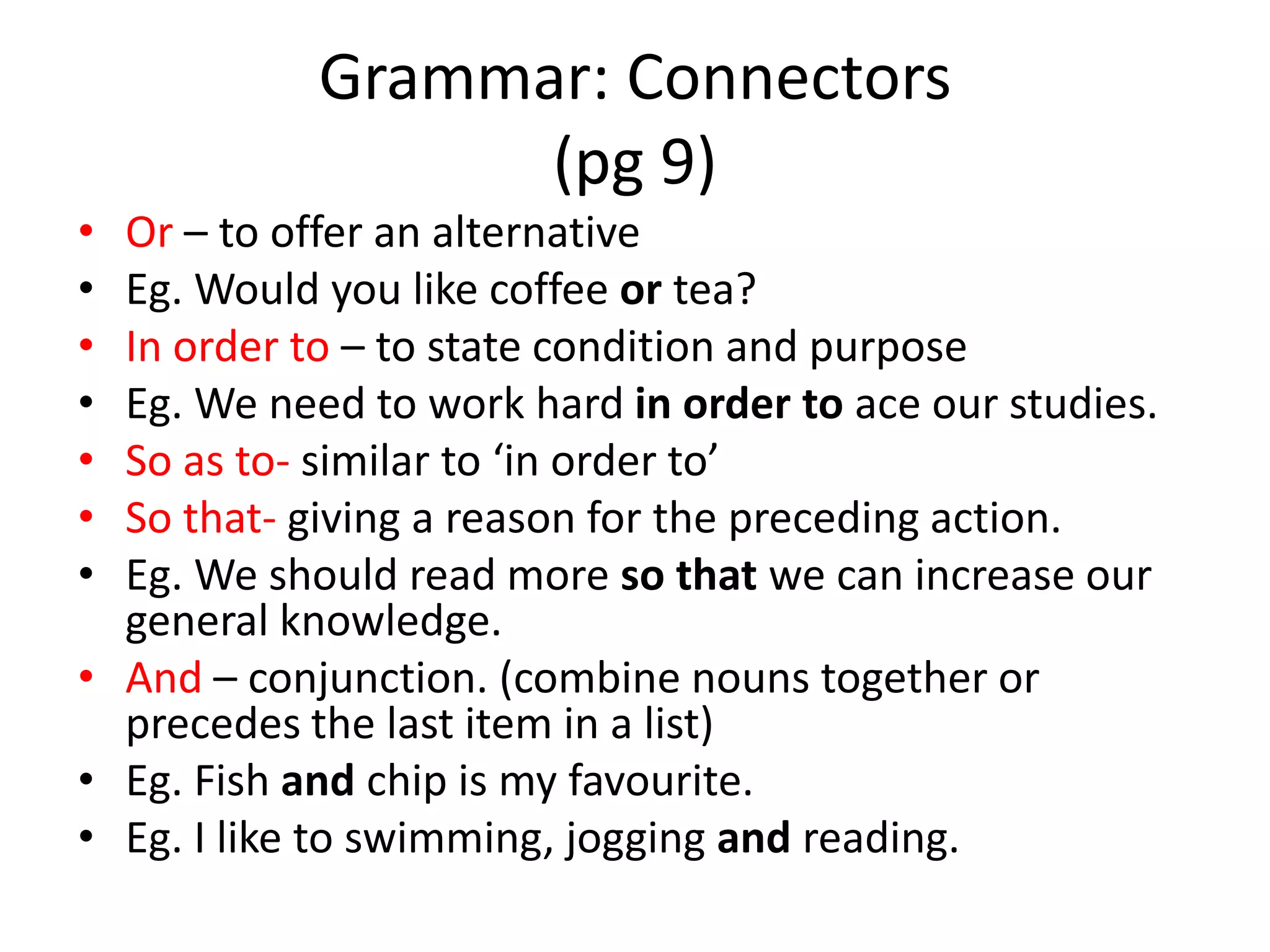
• Or – to offer an alternative
• Eg. Would you like coffee or tea?
• In order to – to state condition and purpose
• Eg. We need to work hard in order to ace our studies.
• So as to- similar to ‘in order to’
• So that- giving a reason for the preceding action.
• Eg. We should read more so that we can increase our
  general knowledge.
• And – conjunction. (combine nouns together or
  precedes the last item in a list)
• Eg. Fish and chip is my favourite.
• Eg. I like to swimming, jogging and reading.
Grammar: Connectors
                 (pg 9)
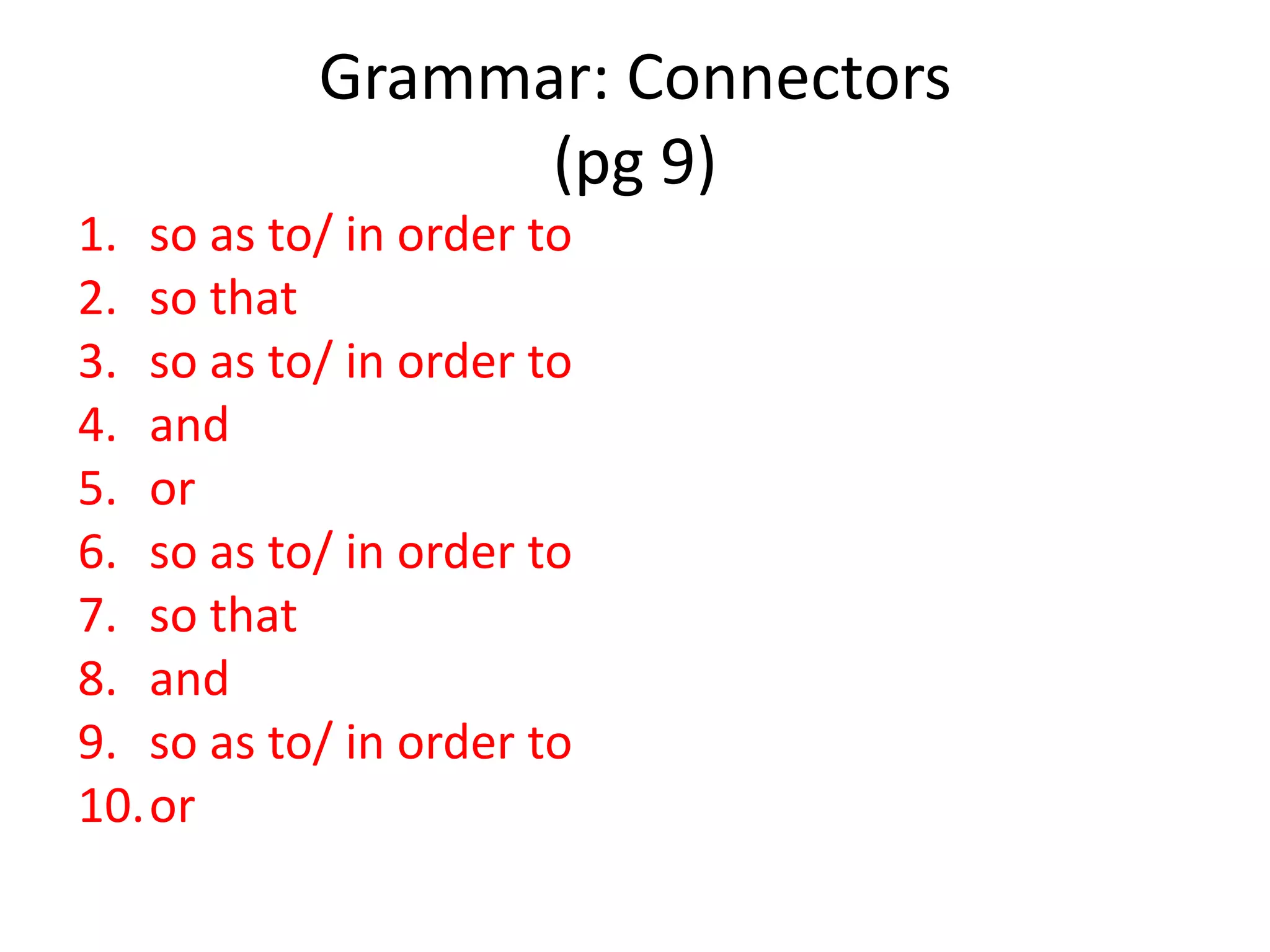
1. so as to/ in order to
2. so that
3. so as to/ in order to
4. and
5. or
6. so as to/ in order to
7. so that
8. and
9. so as to/ in order to
10.or
Adjectives

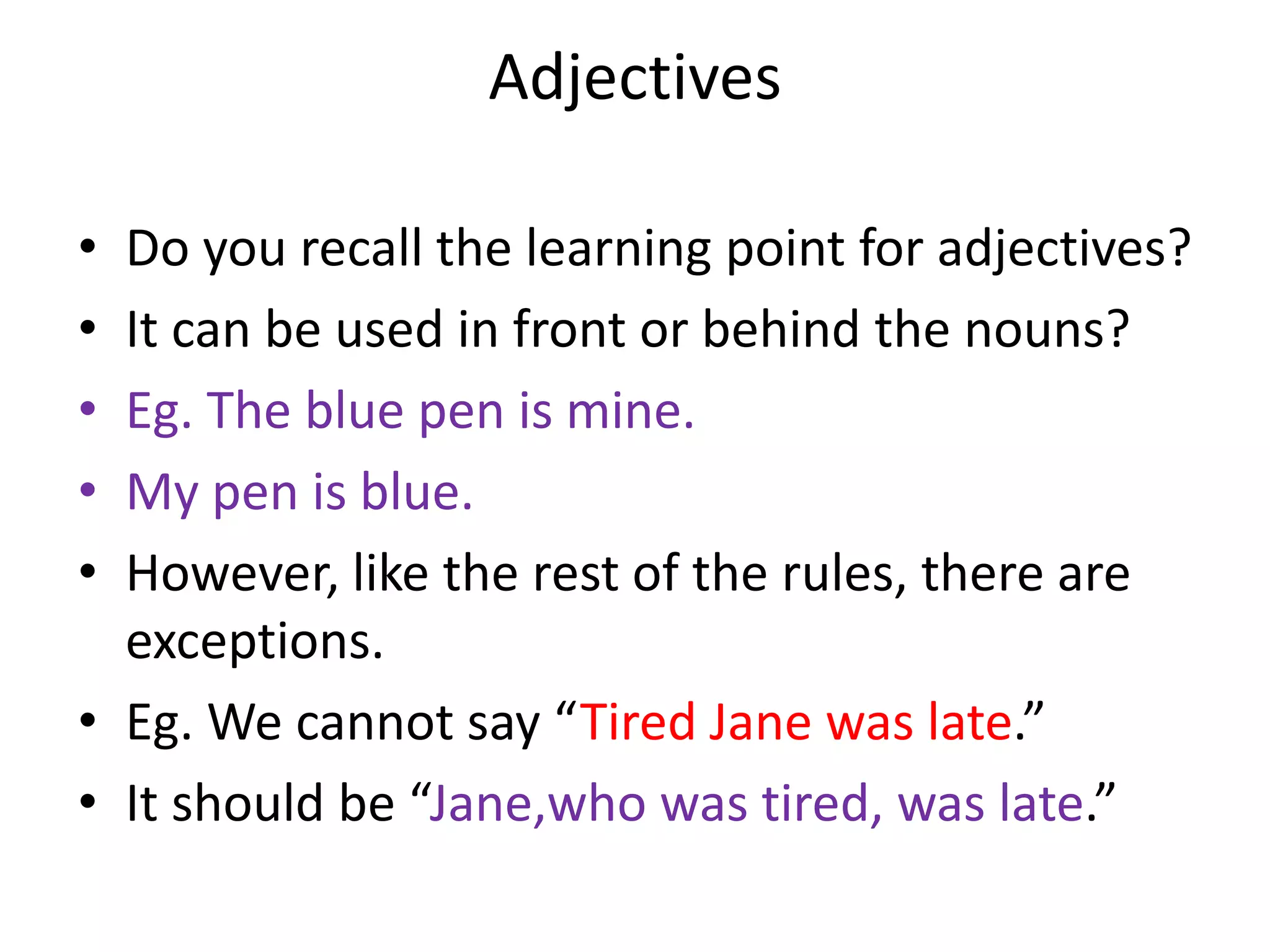
• Do you recall the learning point for adjectives?
• It can be used in front or behind the nouns?
• Eg. The blue pen is mine.
• My pen is blue.
• However, like the rest of the rules, there are
  exceptions.
• Eg. We cannot say “Tired Jane was late.”
• It should be “Jane,who was tired, was late.”
Adjectives
                      (pg 16)
• Additional learning point – some adjectives are best
  used at the back of the noun which you are describing.
1. The pupils are/ were ready for the trip to Sungei
   Buloh.
2. They are/were afraid of the ants getting into their
   lunch.
3. His food is/are safe from the bears.
4. Madam Lee is/was glad to have taken the long
   journey to see her grandchildren.
5. The tourist is/was sorry to have missed the last train
   for the day.
Adverbs- nowhere / somewhere
               (pg 17)
• Nowhere-not in or to any place
• Somewhere- in, at or to a place that you do not know
  or do not mention by name

Answers:
1. Somewhere
2. Nowhere
3. Somewhere
4. Nowhere
5. Somewhere
6. nowhere
Sentence construction- different tenses
                      (pg 18)
• Do you know your tenses well?
July 21
Present: I eat so much today. (Given)
Simple past:
I ate so much that day
July 24
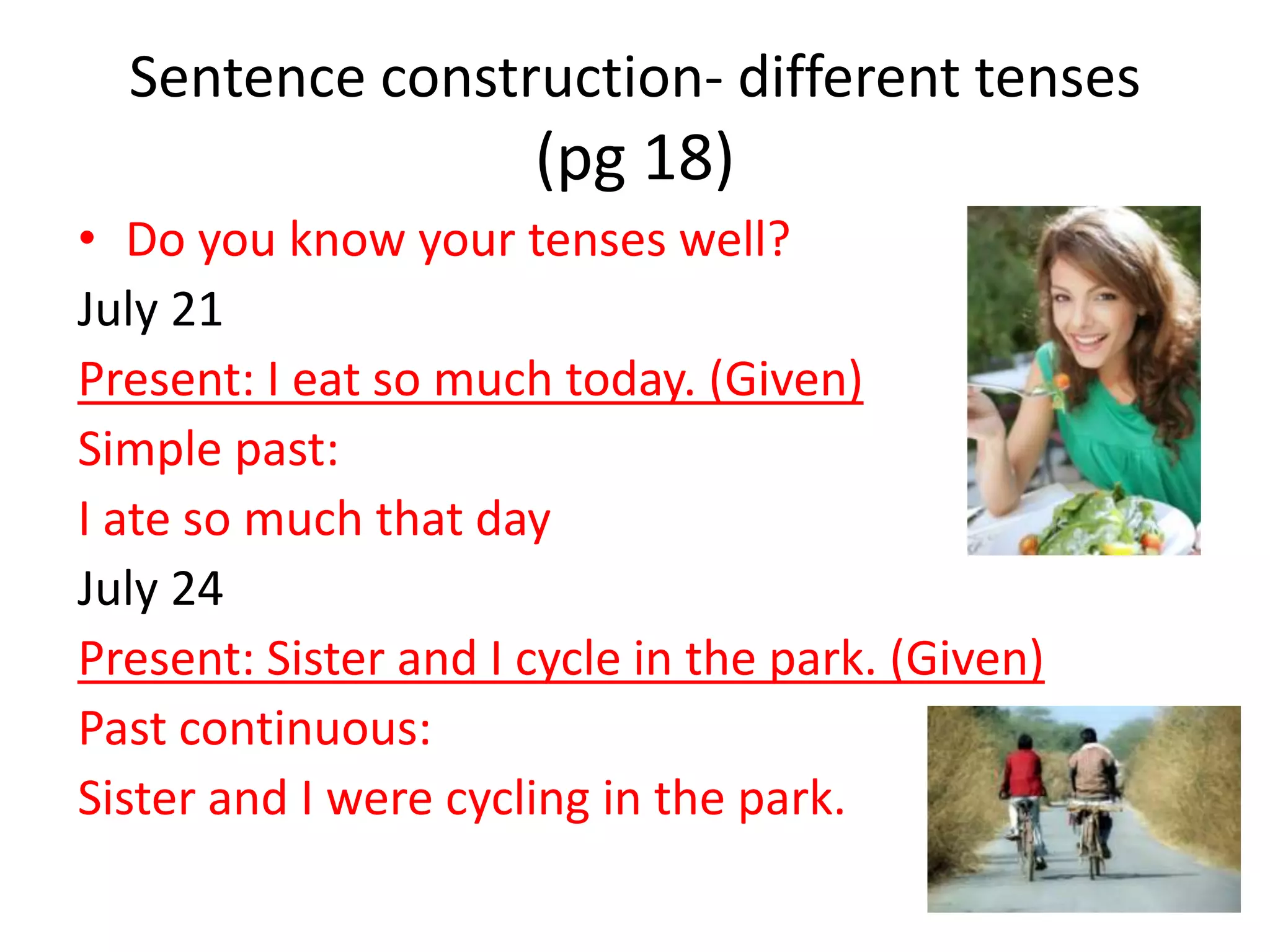
Present: Sister and I cycle in the park. (Given)
Past continuous:
Sister and I were cycling in the park.
Sentence construction- different tenses
                      (pg 19)
• Do you know your tenses well?
July 25
future: Peter is going to catch a movie tomorrow.
(Given)
Past continuous:
Peter was going to catch a movie the day after/ the
following day.
July 26
future: I am going to the library to revise my work .
Past continuous:
I was going to the library to revise my work.
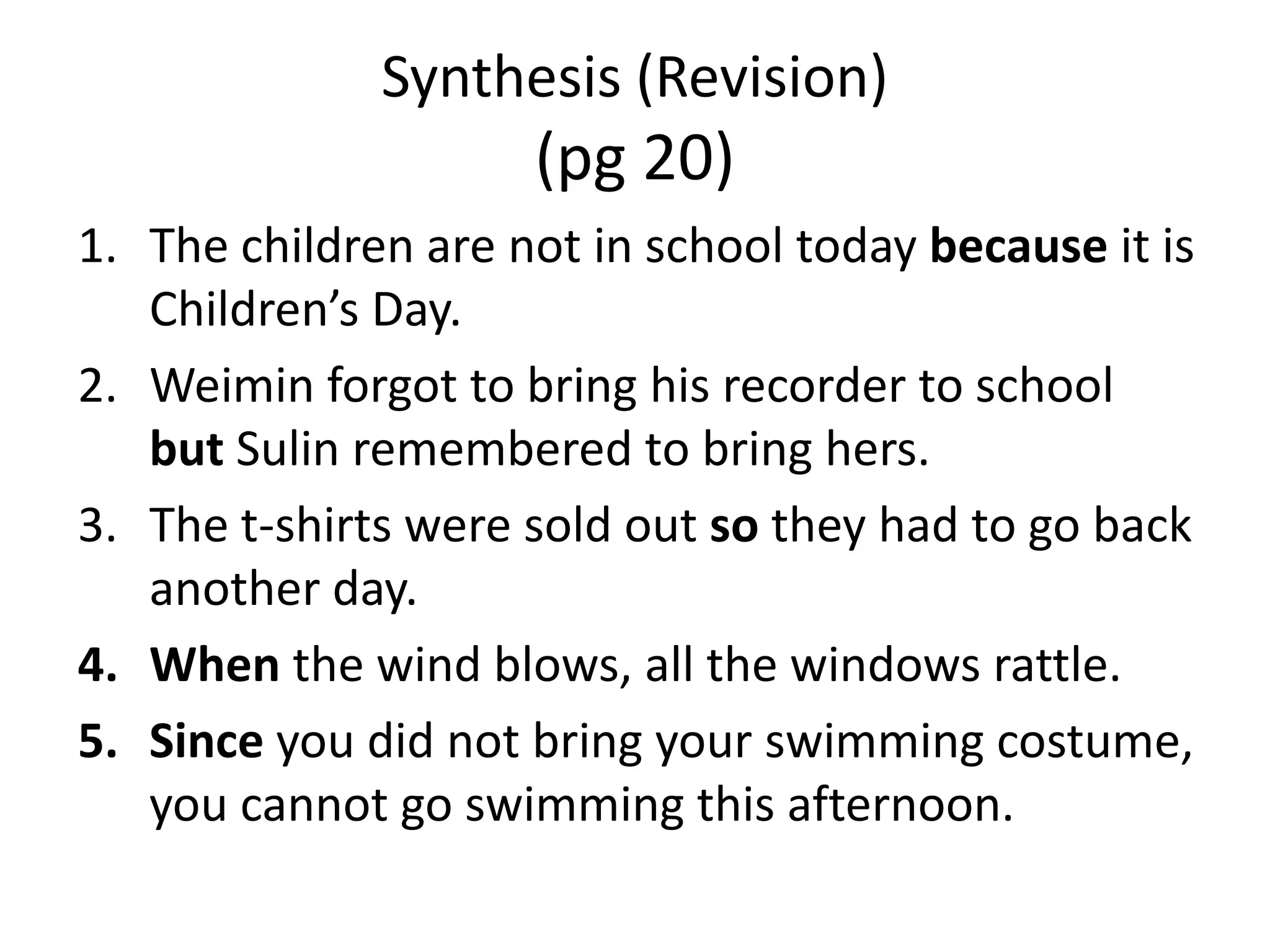
Synthesis (Revision)
                     (pg 20)
1. The children are not in school today because it is
   Children’s Day.
2. Weimin forgot to bring his recorder to school
   but Sulin remembered to bring hers.
3. The t-shirts were sold out so they had to go back
   another day.
4. When the wind blows, all the windows rattle.
5. Since you did not bring your swimming costume,
   you cannot go swimming this afternoon.
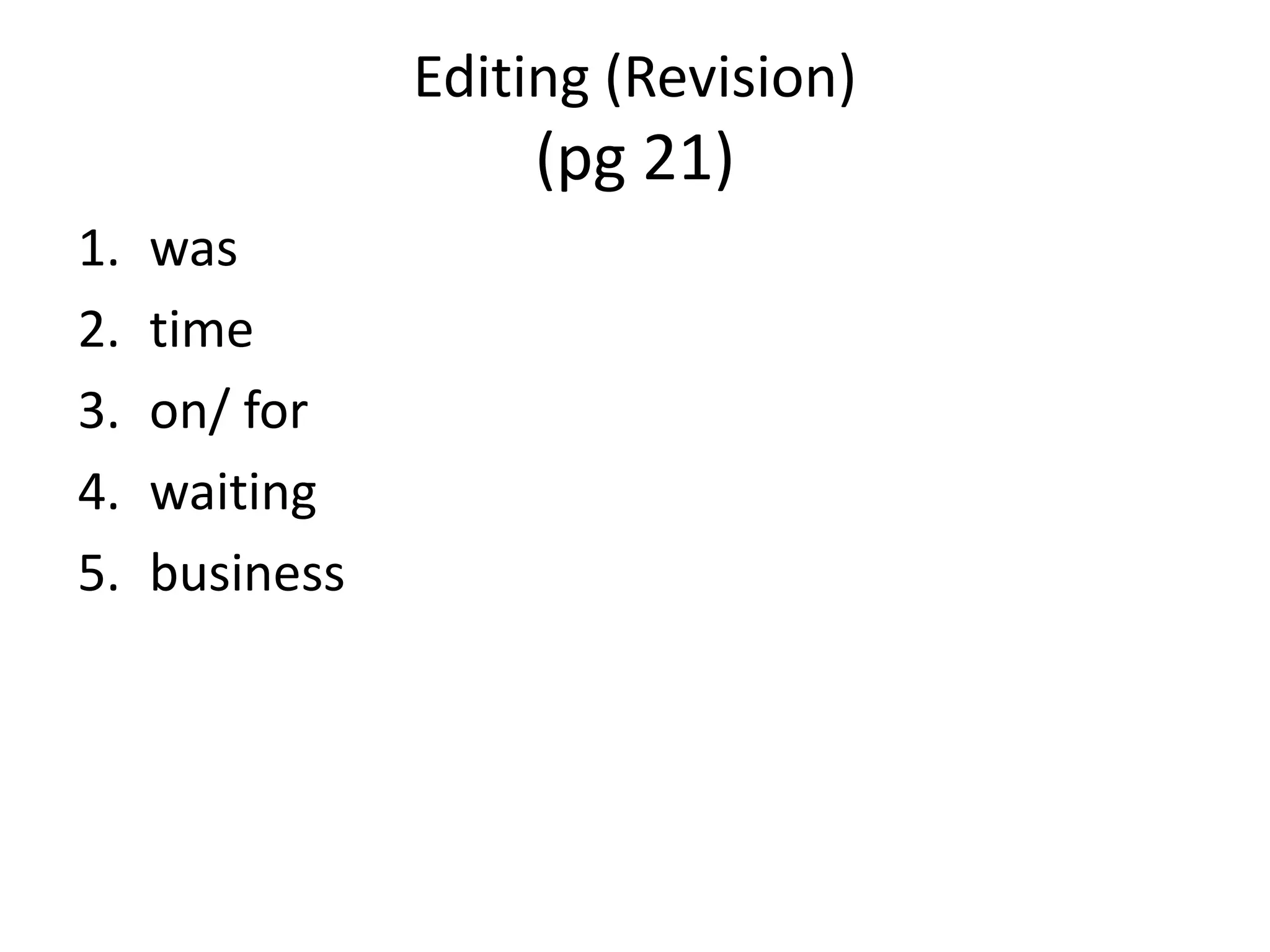
Editing (Revision)
                    (pg 21)
1.   was
2.   time
3.   on/ for
4.   waiting
5.   business
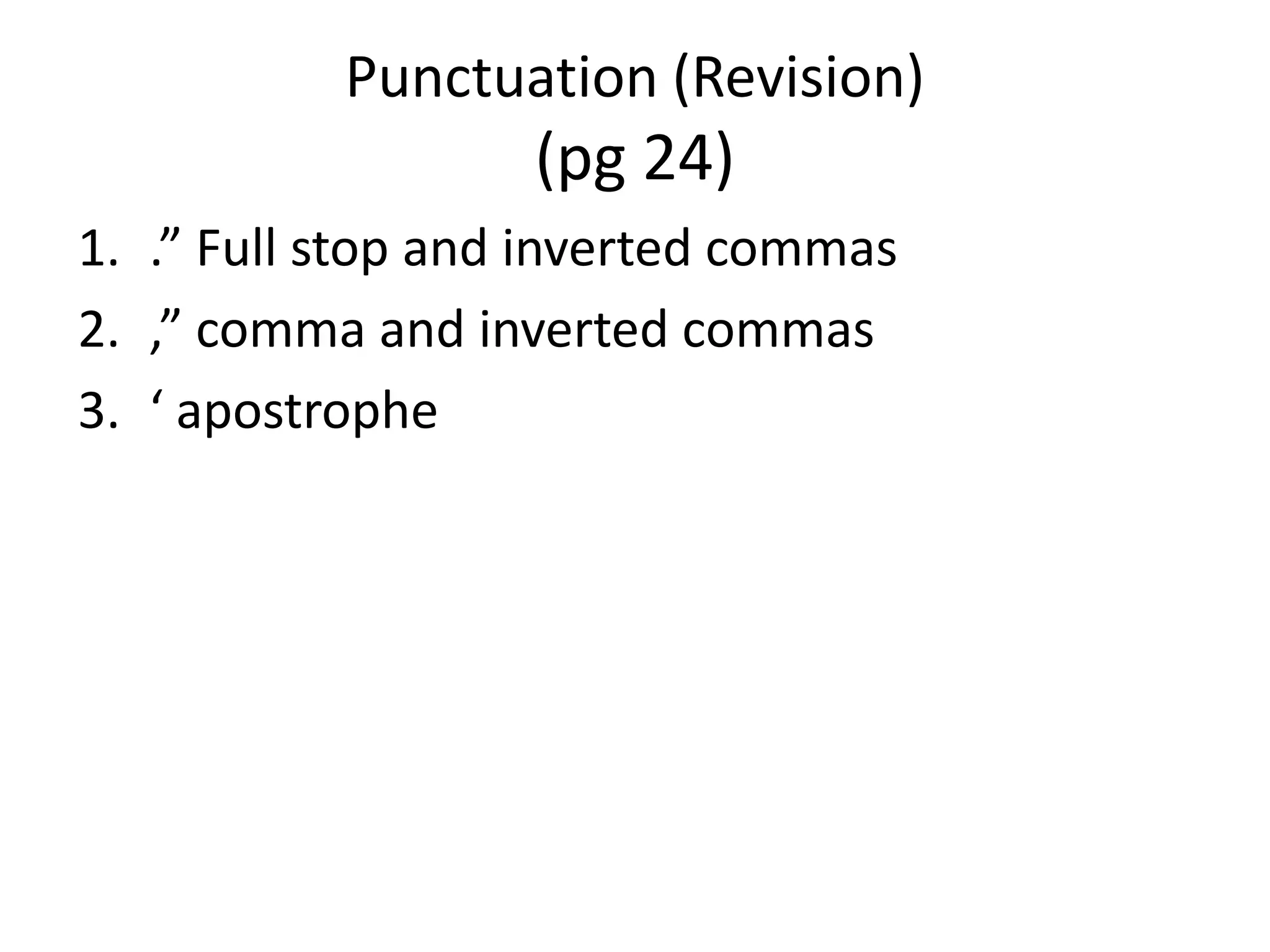
Punctuation (Revision)
                   (pg 24)
1. .” Full stop and inverted commas
2. ,” comma and inverted commas
3. ‘ apostrophe
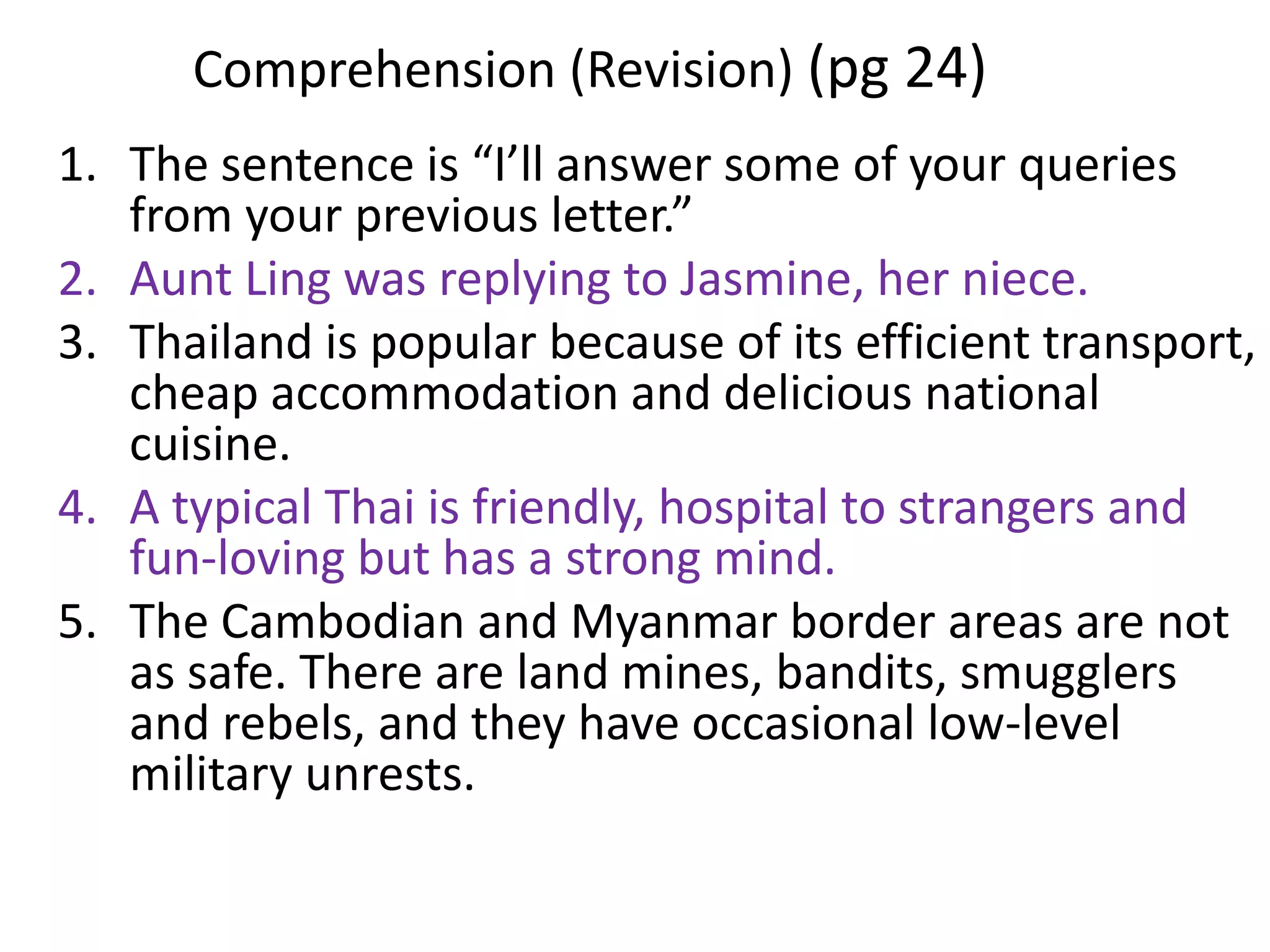
Comprehension (Revision) (pg 24)
1. The sentence is “I’ll answer some of your queries
   from your previous letter.”
2. Aunt Ling was replying to Jasmine, her niece.
3. Thailand is popular because of its efficient transport,
   cheap accommodation and delicious national
   cuisine.
4. A typical Thai is friendly, hospital to strangers and
   fun-loving but has a strong mind.
5. The Cambodian and Myanmar border areas are not
   as safe. There are land mines, bandits, smugglers
   and rebels, and they have occasional low-level
   military unrests.
Tenses and their uses
     An introduction
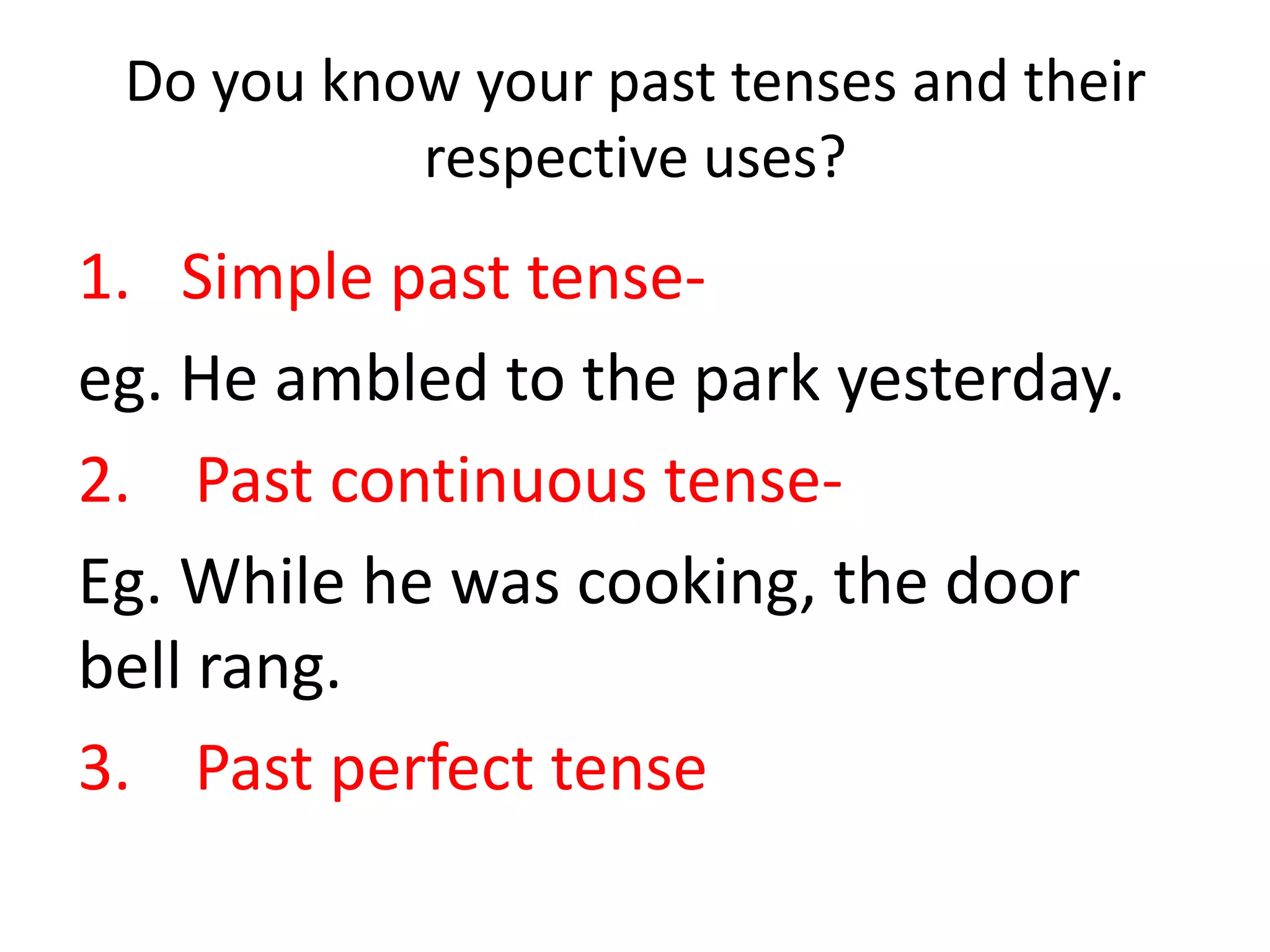
Do you know your past tenses and their
           respective uses?
1. Simple past tense-
eg. He ambled to the park yesterday.
2. Past continuous tense-
Eg. While he was cooking, the door
bell rang.
3. Past perfect tense
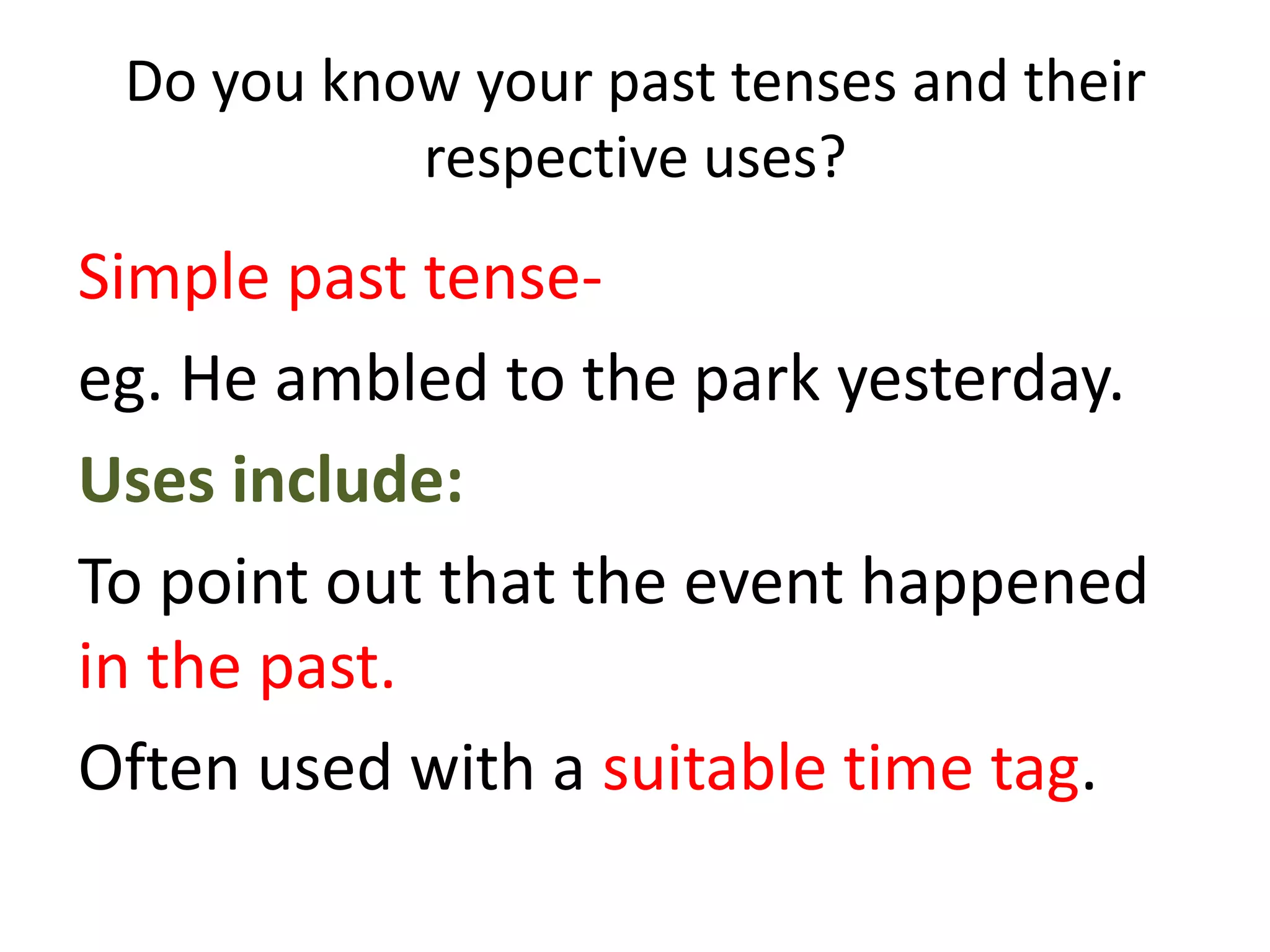
Do you know your past tenses and their
           respective uses?
Simple past tense-
eg. He ambled to the park yesterday.
Uses include:
To point out that the event happened
in the past.
Often used with a suitable time tag.
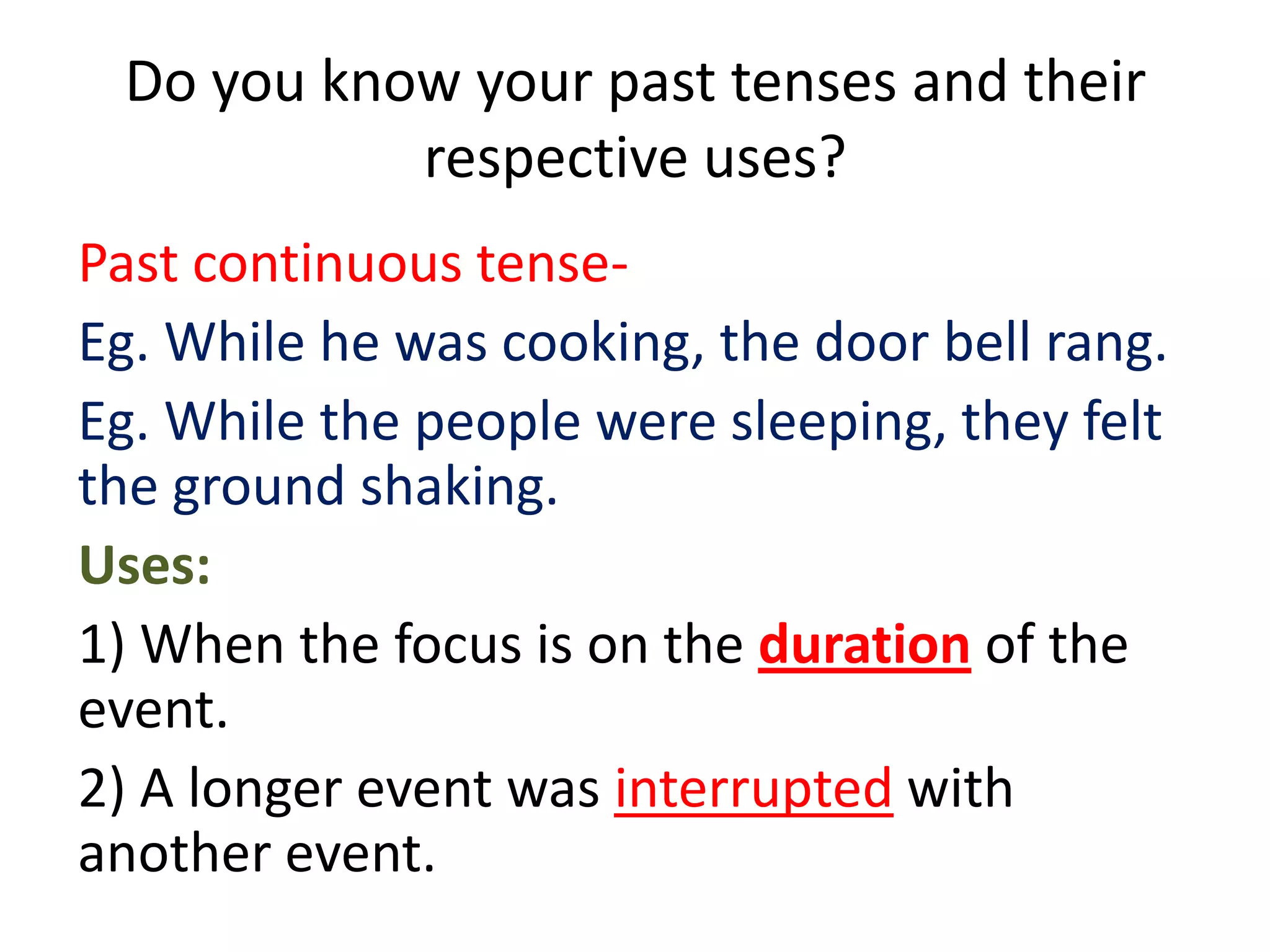
Do you know your past tenses and their
           respective uses?
Past continuous tense-
Eg. While he was cooking, the door bell rang.
Eg. While the people were sleeping, they felt
the ground shaking.
Uses:
1) When the focus is on the duration of the
event.
2) A longer event was interrupted with
another event.
Do you know your past tenses and their
            respective uses?
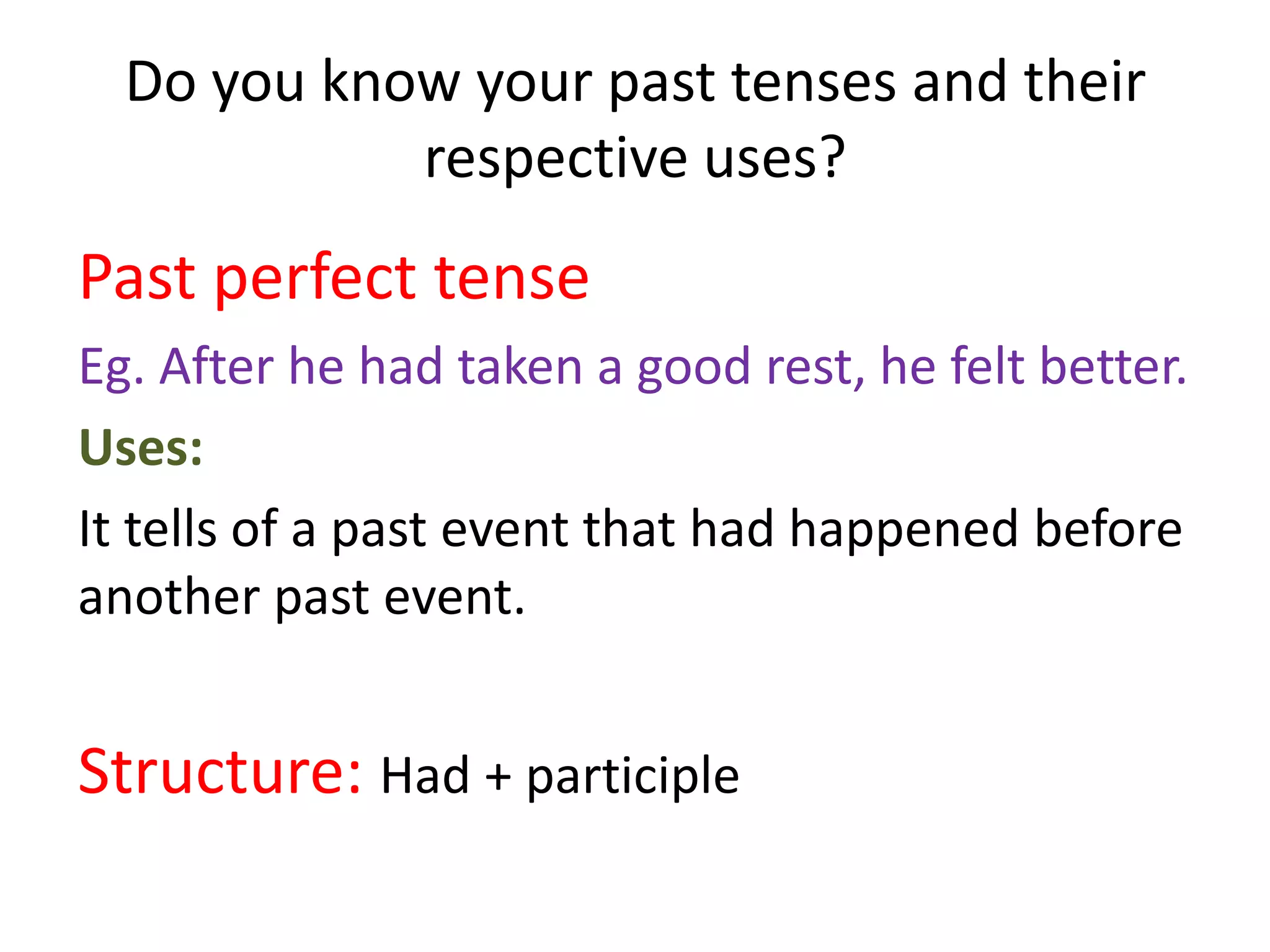
Past perfect tense
Eg. After he had taken a good rest, he felt better.
Uses:
It tells of a past event that had happened before
another past event.


Structure: Had + participle
Do you know your present tenses and their
              respective uses?
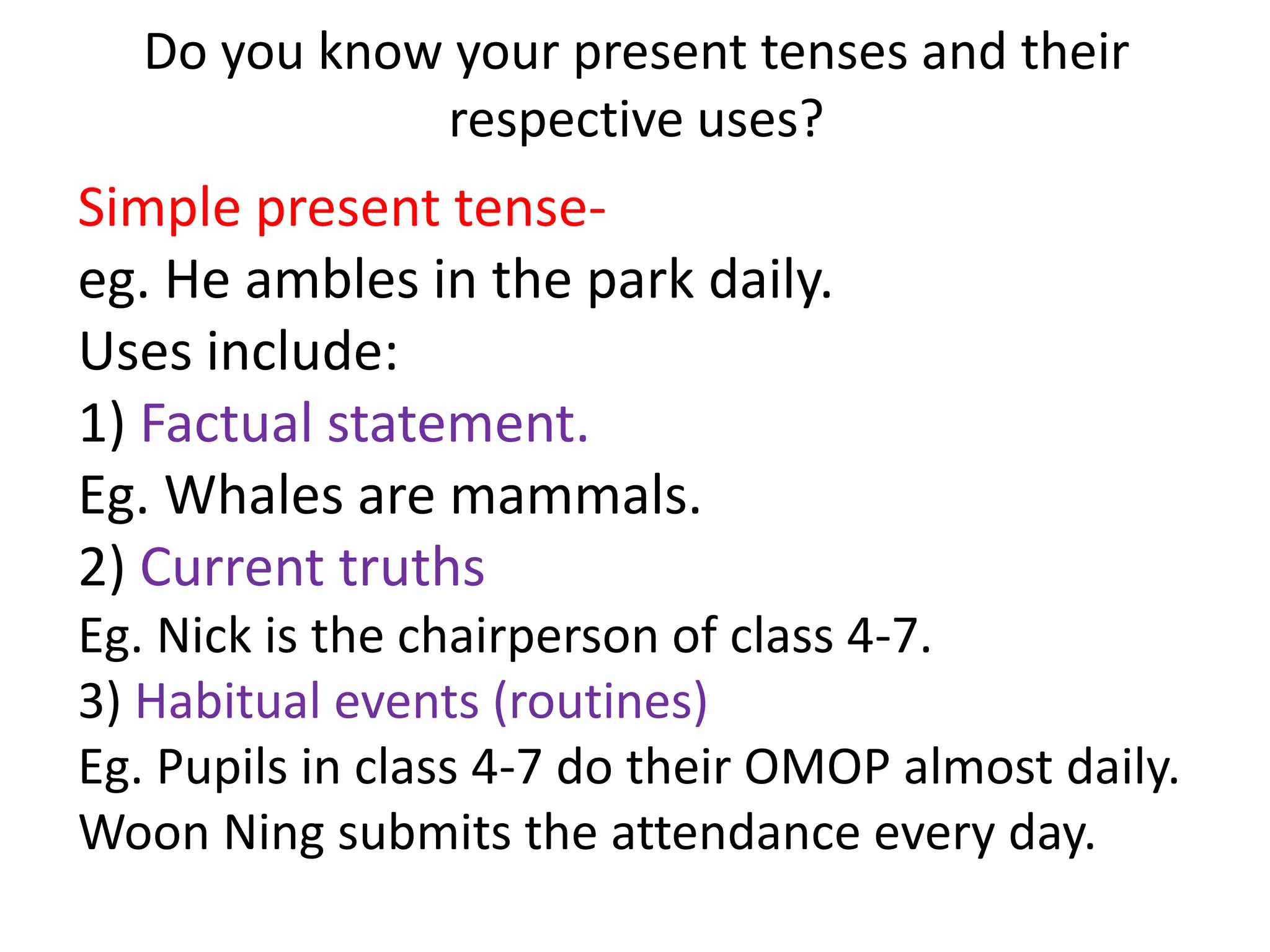
Simple present tense-
eg. He ambles in the park daily.
Uses include:
1) Factual statement.
Eg. Whales are mammals.
2) Current truths
Eg. Nick is the chairperson of class 4-7.
3) Habitual events (routines)
Eg. Pupils in class 4-7 do their OMOP almost daily.
Woon Ning submits the attendance every day.
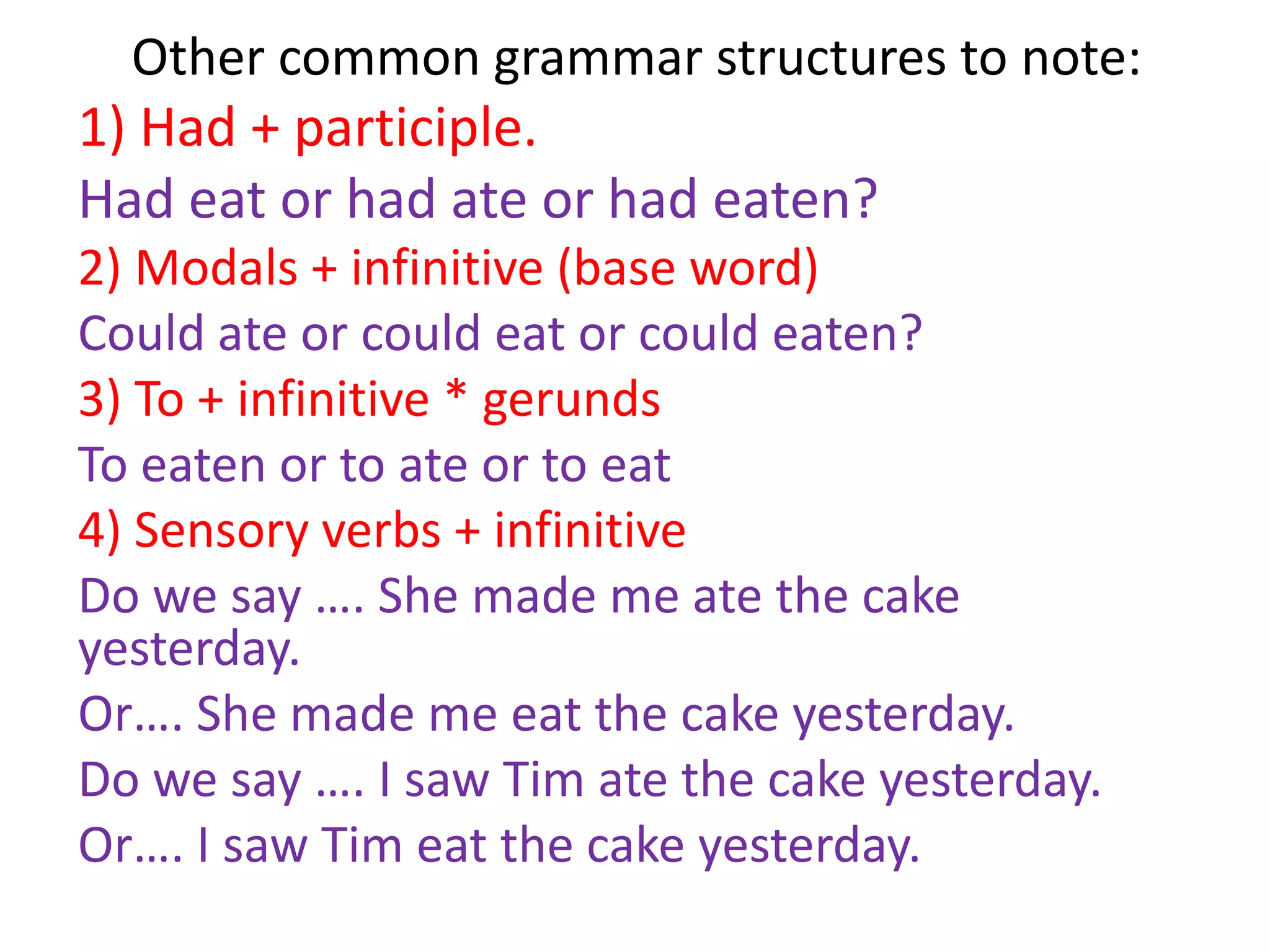
Other common grammar structures to note:
1) Had + participle.
Had eat or had ate or had eaten?
2) Modals + infinitive (base word)
Could ate or could eat or could eaten?
3) To + infinitive * gerunds
To eaten or to ate or to eat
4) Sensory verbs + infinitive
Do we say …. She made me ate the cake
yesterday.
Or…. She made me eat the cake yesterday.
Do we say …. I saw Tim ate the cake yesterday.
Or…. I saw Tim eat the cake yesterday.

Self marking for stellar ws 5-8

  • 1.
    Complete Stellar WSfor chapter 5-8 Our intensive preparation for SA2
  • 2.
    Grammar: Connectors (pg 9) • Or – to offer an alternative • Eg. Would you like coffee or tea? • In order to – to state condition and purpose • Eg. We need to work hard in order to ace our studies. • So as to- similar to ‘in order to’ • So that- giving a reason for the preceding action. • Eg. We should read more so that we can increase our general knowledge. • And – conjunction. (combine nouns together or precedes the last item in a list) • Eg. Fish and chip is my favourite. • Eg. I like to swimming, jogging and reading.
  • 3.
    Grammar: Connectors (pg 9) 1. so as to/ in order to 2. so that 3. so as to/ in order to 4. and 5. or 6. so as to/ in order to 7. so that 8. and 9. so as to/ in order to 10.or
  • 4.
    Adjectives • Do yourecall the learning point for adjectives? • It can be used in front or behind the nouns? • Eg. The blue pen is mine. • My pen is blue. • However, like the rest of the rules, there are exceptions. • Eg. We cannot say “Tired Jane was late.” • It should be “Jane,who was tired, was late.”
  • 5.
    Adjectives (pg 16) • Additional learning point – some adjectives are best used at the back of the noun which you are describing. 1. The pupils are/ were ready for the trip to Sungei Buloh. 2. They are/were afraid of the ants getting into their lunch. 3. His food is/are safe from the bears. 4. Madam Lee is/was glad to have taken the long journey to see her grandchildren. 5. The tourist is/was sorry to have missed the last train for the day.
  • 6.
    Adverbs- nowhere /somewhere (pg 17) • Nowhere-not in or to any place • Somewhere- in, at or to a place that you do not know or do not mention by name Answers: 1. Somewhere 2. Nowhere 3. Somewhere 4. Nowhere 5. Somewhere 6. nowhere
  • 7.
    Sentence construction- differenttenses (pg 18) • Do you know your tenses well? July 21 Present: I eat so much today. (Given) Simple past: I ate so much that day July 24 Present: Sister and I cycle in the park. (Given) Past continuous: Sister and I were cycling in the park.
  • 8.
    Sentence construction- differenttenses (pg 19) • Do you know your tenses well? July 25 future: Peter is going to catch a movie tomorrow. (Given) Past continuous: Peter was going to catch a movie the day after/ the following day. July 26 future: I am going to the library to revise my work . Past continuous: I was going to the library to revise my work.
  • 9.
    Synthesis (Revision) (pg 20) 1. The children are not in school today because it is Children’s Day. 2. Weimin forgot to bring his recorder to school but Sulin remembered to bring hers. 3. The t-shirts were sold out so they had to go back another day. 4. When the wind blows, all the windows rattle. 5. Since you did not bring your swimming costume, you cannot go swimming this afternoon.
  • 10.
    Editing (Revision) (pg 21) 1. was 2. time 3. on/ for 4. waiting 5. business
  • 11.
    Punctuation (Revision) (pg 24) 1. .” Full stop and inverted commas 2. ,” comma and inverted commas 3. ‘ apostrophe
  • 12.
    Comprehension (Revision) (pg24) 1. The sentence is “I’ll answer some of your queries from your previous letter.” 2. Aunt Ling was replying to Jasmine, her niece. 3. Thailand is popular because of its efficient transport, cheap accommodation and delicious national cuisine. 4. A typical Thai is friendly, hospital to strangers and fun-loving but has a strong mind. 5. The Cambodian and Myanmar border areas are not as safe. There are land mines, bandits, smugglers and rebels, and they have occasional low-level military unrests.
  • 13.
    Tenses and theiruses An introduction
  • 14.
    Do you knowyour past tenses and their respective uses? 1. Simple past tense- eg. He ambled to the park yesterday. 2. Past continuous tense- Eg. While he was cooking, the door bell rang. 3. Past perfect tense
  • 15.
    Do you knowyour past tenses and their respective uses? Simple past tense- eg. He ambled to the park yesterday. Uses include: To point out that the event happened in the past. Often used with a suitable time tag.
  • 16.
    Do you knowyour past tenses and their respective uses? Past continuous tense- Eg. While he was cooking, the door bell rang. Eg. While the people were sleeping, they felt the ground shaking. Uses: 1) When the focus is on the duration of the event. 2) A longer event was interrupted with another event.
  • 17.
    Do you knowyour past tenses and their respective uses? Past perfect tense Eg. After he had taken a good rest, he felt better. Uses: It tells of a past event that had happened before another past event. Structure: Had + participle
  • 18.
    Do you knowyour present tenses and their respective uses? Simple present tense- eg. He ambles in the park daily. Uses include: 1) Factual statement. Eg. Whales are mammals. 2) Current truths Eg. Nick is the chairperson of class 4-7. 3) Habitual events (routines) Eg. Pupils in class 4-7 do their OMOP almost daily. Woon Ning submits the attendance every day.
  • 19.
    Other common grammarstructures to note: 1) Had + participle. Had eat or had ate or had eaten? 2) Modals + infinitive (base word) Could ate or could eat or could eaten? 3) To + infinitive * gerunds To eaten or to ate or to eat 4) Sensory verbs + infinitive Do we say …. She made me ate the cake yesterday. Or…. She made me eat the cake yesterday. Do we say …. I saw Tim ate the cake yesterday. Or…. I saw Tim eat the cake yesterday.