Using publication metrics responsibly
Who is this session for?
Anyone assessing research quality when hiring, promoting, reviewing grant or papers
AND, therefore
Anyone being reviewed
Why now?
DORA – The San Francisco Declaration on Research Assessment has been signed by SGUL
REF2021 – Discussion, education, resources and policy on this topic supports ‘Environment’
What?
Today – 25 mins slides (available on SGUL website) and discussion – lead Jodi Lindsay
Disclosure – Jodi is SGUL Academic Lead for REF2021 at SGUL and Chair of the Publishing Committee for
Microbiology Society
(and therefore will mention REF and might be softer on society publishers and harder on commercial publishers…)
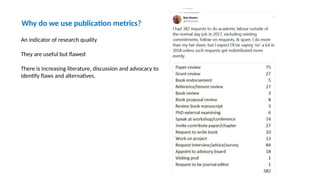
Why do we use publication metrics?
An indicator of research quality
They are useful but flawed
There is increasing literature, discussion and advocacy to
identify flaws and alternatives.
Critical analysis and advocacy around publication metrics
DORA – The San Francisco Declaration on Research Assessment https://sfdora.org/
We should develop better ways to assess research quality and be clear about what we are using
Leiden manifesto - http://www.leidenmanifesto.org/
We should not cede decision-making to the numbers.
‘…quantitative information must not be allowed to morph from an instrument into the goal’
Nature (2015) 520:429-31
The Metric Tide – https://responsiblemetrics.org/the-metric-tide/
There are powerful forces whipping up the use of metrics; metrics are open to misunderstanding and create
perverse incentives
Research Funders – very keen for academics to be more discerning consumers of metrics. (e.g. REF, Plan S)
Consensus of all – Metrics should support, not supplant, expert judgement
Journal impact factors (JIF) are being used inappropriately
What do publication metrics aim to measure?
Three key types -
1. Journal quality e.g. journal impact factor (JIF)
2. Individual article quality e.g. Citation count
3. Individual researcher quality e.g. h-index
Who provides publication metrics and why?
Web of Science/Clarivate - https://wok.mimas.ac.uk/ Subscription model, supplies journal impact factors (JIF),
citation counts, h-index, etc.
Scopus/Elsevier – similar to WoS (SGUL does not have a subscription)
Dimensions - new
Google Scholar - (FREE, larger database from trawling the web, “easy to use”, limited researcher control,
supplies citation counts, h-index)
Altmetric (measures twitter, downloads, blogs, media, etc)
Other tools –
ORCID – identifies which papers belong to which researchers; required by funders, FREE https://orcid.org/
CRIS – SGULs system for deposition to meet open access requirements of funders https://cris.sgul.ac.uk/login.html
ResearchGate – networking site
Most are subscription services, charging libraries/companies a fee (similar to journals)
Questions for you - As researchers, are metric providers delivering the services we need?
- Are they open and transparent about how their metrics are calculated?
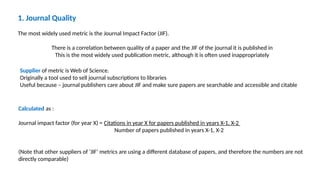
1. Journal Quality
The most widely used metric is the Journal Impact Factor (JIF).
There is a correlation between quality of a paper and the JIF of the journal it is published in
This is the most widely used publication metric, although it is often used inappropriately
Supplier of metric is Web of Science.
Originally a tool used to sell journal subscriptions to libraries
Useful because – journal publishers care about JIF and make sure papers are searchable and accessible and citable
Calculated as :
Journal impact factor (for year X) = Citations in year X for papers published in years X-1, X-2
Number of papers published in years X-1, X-2
(Note that other suppliers of ‘JIF’ metrics are using a different database of papers, and therefore the numbers are not
directly comparable)
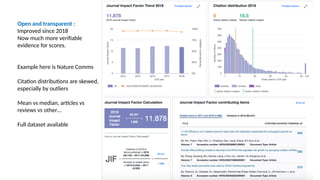
Open and transparent :
Improved since 2018
Now much more verifiable
evidence for scores.
Example here is Nature Comms
Citation distributions are skewed,
especially by outliers
Mean vs median, articles vs
reviews vs other…
Full dataset available
Issues with JIF –
The ‘quality’ of the the journal is not the ‘quality’ of any individual paper published in that journal.
Articles in journals with high JIF can have low citation counts (eg. Nature Comms example, >140 papers cited zero times)
Researchers waste a lot of time and energy trying to publish in journals with the highest JIF
Editorial boards – can be cliquey or powerful
Biases – very field dependent – smaller fields have smaller JIFs
Journal publishers can ‘game’ JIF – e.g. delay the publication date of papers, publish small numbers of selected papers
and/or use ‘cascade journals’, etc. Publishers charge APC and subscription fees.
Result - REF2021 says – JIF should not to be used to assess quality of papers
DORA and Leiden manifestos – strongly recommend that we do not rely on JIF to assess quality of papers
Alternative metrics for measuring journal quality (not the quality of papers)
SNIP – adjustment for field of publication (Scopus, CWTS)
3 year JIF, 5 year JIF, immediacy index, cited half-life, etc. ‘basket of metrics’
Questions for you - Why do we need journal metrics?
- Do we judge a paper differently because of the journal it is published in, and why?
- What are the dangers around choosing to publish in a journal because of its JIF?
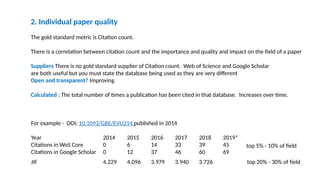
2. Individual paper quality
The gold standard metric is Citation count.
There is a correlation between citation count and the importance and quality and impact on the field of a paper
Suppliers There is no gold standard supplier of Citation count. Web of Science and Google Scholar
are both useful but you must state the database being used as they are very different
Open and transparent? Improving
Calculated : The total number of times a publication has been cited in that database. Increases over time.
For example - DOI: 10.1093/GBE/EVU214 published in 2014
Year 2014 2015 2016 2017 2018 2019*
Citations in WoS Core 0 6 14 33 39 45
Citations in Google Scholar 0 12 37 46 60 69
JIF 4.229 4.096 3.979 3.940 3.726 top 20% - 30% of field
top 5% - 10% of field
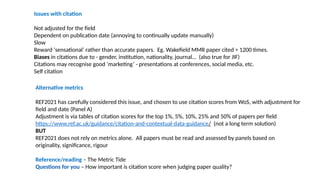
Issues with citation
Not adjusted for the field
Dependent on publication date (annoying to continually update manually)
Slow
Reward ‘sensational’ rather than accurate papers. Eg. Wakefield MMR paper cited > 1200 times.
Biases in citations due to - gender, institution, nationality, journal… (also true for JIF)
Citations may recognise good ‘marketing’ - presentations at conferences, social media, etc.
Self citation
Alternative metrics
REF2021 has carefully considered this issue, and chosen to use citation scores from WoS, with adjustment for
field and date (Panel A)
Adjustment is via tables of citation scores for the top 1%, 5%, 10%, 25% and 50% of papers per field
https://www.ref.ac.uk/guidance/citation-and-contextual-data-guidance/ (not a long term solution)
BUT
REF2021 does not rely on metrics alone. All papers must be read and assessed by panels based on
originality, significance, rigour
Reference/reading – The Metric Tide
Questions for you – How important is citation score when judging paper quality?
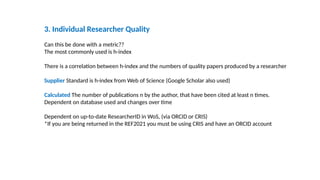
3. Individual Researcher Quality
Can this be done with a metric??
The most commonly used is h-index
There is a correlation between h-index and the numbers of quality papers produced by a researcher
Supplier Standard is h-index from Web of Science (Google Scholar also used)
Calculated The number of publications n by the author, that have been cited at least n times.
Dependent on database used and changes over time
Dependent on up-to-date ResearcherID in WoS, (via ORCID or CRIS)
*If you are being returned in the REF2021 you must be using CRIS and have an ORCID account
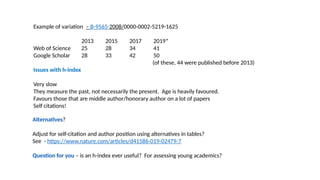
Example of variation – B-9565-2008/0000-0002-5219-1625
2013 2015 2017 2019*
Web of Science 25 28 34 41
Google Scholar 28 33 42 50
(of these, 44 were published before 2013)
Issues with h-index
Very slow
They measure the past, not necessarily the present. Age is heavily favoured.
Favours those that are middle author/honorary author on a lot of papers
Self citations!
Alternatives?
Adjust for self-citation and author position using alternatives in tables?
See - https://www.nature.com/articles/d41586-019-02479-7
Question for you – is an h-index ever useful? For assessing young academics?
Additional resources available -
The UK Forum for Responsible Research Metrics.
https://
www.universitiesuk.ac.uk/policy-and-analysis/research-policy/open-science/Pages/forum-for-responsible-research-
metrics.aspx
How to choose a journal to submit your papers to –
https://thinkchecksubmit.org/
St George’s Library Blog - https://stglibrary.wordpress.com/
https://
www.sgul.ac.uk/about/our-professional-services/information-services/library/researchers/publication-metrics
CRIS Help - https://cris.sgul.ac.uk/information.html
Reviewers of your research may search your publications for metrics indicators – make sure they are accurate.
ORCID & CRIS are essential; Consider ResearcherID (WoS), Google Scholar
Alternatives to metrics – what is good practice?
(no easy answers yet)
See https://sfdora.org/good-practices/
Research funder’s have policies on publication metrics.
e.g. Wellcome Trust ask for your top papers with 50 words of text on their significance and your contribution.
See DORA for links to - CRUK, European Commission, UKRI, Wellcome
University policies –
e.g. UCL “reject the use of certain quantitative indicators, in particular those that apply at the level of journal...”
https://www.ucl.ac.uk/human-resources/sites/human-resources/files/ucl-130418.pdf
Questions for you – if applying for funding or a position/promotion, can you demonstrate quality without
relying on metrics or journal titles?
- if you are reviewing for a funder or university, how do you ensure you are using metrics
responsibly?
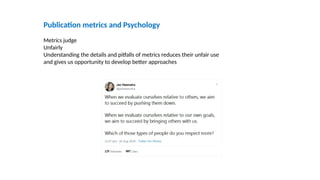
Publication metrics and Psychology
Metrics judge
Unfairly
Understanding the details and pitfalls of metrics reduces their unfair use
and gives us opportunity to develop better approaches
Summary
For reviewers –
Publication metrics are one tool that can be used to judge quality of a journal, paper or individual.
But they are not the only way to judge quality.
Biases should be considered, especially when there is good evidence some metrics are biased
Only use metrics that are supported by reliable data. A basket of publication metrics is better than one
If you don’t know how a metric works, or its limitations, don’t use it.
Similarly, don’t assume one journal is ‘better’ than another if you don’t know why.
We should be clear about how quality is judged, e.g. in job adverts, promotion criteria
For Reviewees -
It pays to keep your publication metrics up-to-date and to know which metrics might be used to your best advantage
Think of alternative ways to demonstrate the quality of your work
We should all be thinking about ways to assess research and publication quality responsibly
Next steps
- Today - start the Discussion
- What metrics do we want to use at SGUL and when?
- Reviewers - Do we need a policy at SGUL when hiring and promoting, awarding grants?
How would we ensure everyone knows and adheres to the policy?
- Reviewees - What metrics and metric strategies are useful on CVs? Grant applications to external funders?
- What resources would be useful? Do we need more training? What do we need from the Library?
Providers - As researchers, are metric providers delivering the services we need?
Are they open and transparent about how their metrics are calculated?
JIF - Why do we need journal metrics?
Do we judge a paper differently because of the journal it is published in, and why?
What are the dangers around choosing to publish in a journal because of its JIF?
Citations - How important is citation score when judging paper quality?
h-index - Is an h-index ever useful? For assessing young academics?
Alternatives- if applying for funding or a position/promotion, can you demonstrate quality without relying on metrics or journal titles?
- if you are reviewing for a funder or university, how do you ensure you are using metrics responsibly?

Using-publication-metrics-responsibly-17-Oct-2019.pptx

  • 1.
    Using publication metricsresponsibly Who is this session for? Anyone assessing research quality when hiring, promoting, reviewing grant or papers AND, therefore Anyone being reviewed Why now? DORA – The San Francisco Declaration on Research Assessment has been signed by SGUL REF2021 – Discussion, education, resources and policy on this topic supports ‘Environment’ What? Today – 25 mins slides (available on SGUL website) and discussion – lead Jodi Lindsay Disclosure – Jodi is SGUL Academic Lead for REF2021 at SGUL and Chair of the Publishing Committee for Microbiology Society (and therefore will mention REF and might be softer on society publishers and harder on commercial publishers…)
  • 2.
    Why do weuse publication metrics? An indicator of research quality They are useful but flawed There is increasing literature, discussion and advocacy to identify flaws and alternatives.
  • 3.
    Critical analysis andadvocacy around publication metrics DORA – The San Francisco Declaration on Research Assessment https://sfdora.org/ We should develop better ways to assess research quality and be clear about what we are using Leiden manifesto - http://www.leidenmanifesto.org/ We should not cede decision-making to the numbers. ‘…quantitative information must not be allowed to morph from an instrument into the goal’ Nature (2015) 520:429-31 The Metric Tide – https://responsiblemetrics.org/the-metric-tide/ There are powerful forces whipping up the use of metrics; metrics are open to misunderstanding and create perverse incentives Research Funders – very keen for academics to be more discerning consumers of metrics. (e.g. REF, Plan S) Consensus of all – Metrics should support, not supplant, expert judgement Journal impact factors (JIF) are being used inappropriately
  • 4.
    What do publicationmetrics aim to measure? Three key types - 1. Journal quality e.g. journal impact factor (JIF) 2. Individual article quality e.g. Citation count 3. Individual researcher quality e.g. h-index
  • 5.
    Who provides publicationmetrics and why? Web of Science/Clarivate - https://wok.mimas.ac.uk/ Subscription model, supplies journal impact factors (JIF), citation counts, h-index, etc. Scopus/Elsevier – similar to WoS (SGUL does not have a subscription) Dimensions - new Google Scholar - (FREE, larger database from trawling the web, “easy to use”, limited researcher control, supplies citation counts, h-index) Altmetric (measures twitter, downloads, blogs, media, etc) Other tools – ORCID – identifies which papers belong to which researchers; required by funders, FREE https://orcid.org/ CRIS – SGULs system for deposition to meet open access requirements of funders https://cris.sgul.ac.uk/login.html ResearchGate – networking site Most are subscription services, charging libraries/companies a fee (similar to journals) Questions for you - As researchers, are metric providers delivering the services we need? - Are they open and transparent about how their metrics are calculated?
  • 6.
    1. Journal Quality Themost widely used metric is the Journal Impact Factor (JIF). There is a correlation between quality of a paper and the JIF of the journal it is published in This is the most widely used publication metric, although it is often used inappropriately Supplier of metric is Web of Science. Originally a tool used to sell journal subscriptions to libraries Useful because – journal publishers care about JIF and make sure papers are searchable and accessible and citable Calculated as : Journal impact factor (for year X) = Citations in year X for papers published in years X-1, X-2 Number of papers published in years X-1, X-2 (Note that other suppliers of ‘JIF’ metrics are using a different database of papers, and therefore the numbers are not directly comparable)
  • 7.
    Open and transparent: Improved since 2018 Now much more verifiable evidence for scores. Example here is Nature Comms Citation distributions are skewed, especially by outliers Mean vs median, articles vs reviews vs other… Full dataset available
  • 8.
    Issues with JIF– The ‘quality’ of the the journal is not the ‘quality’ of any individual paper published in that journal. Articles in journals with high JIF can have low citation counts (eg. Nature Comms example, >140 papers cited zero times) Researchers waste a lot of time and energy trying to publish in journals with the highest JIF Editorial boards – can be cliquey or powerful Biases – very field dependent – smaller fields have smaller JIFs Journal publishers can ‘game’ JIF – e.g. delay the publication date of papers, publish small numbers of selected papers and/or use ‘cascade journals’, etc. Publishers charge APC and subscription fees. Result - REF2021 says – JIF should not to be used to assess quality of papers DORA and Leiden manifestos – strongly recommend that we do not rely on JIF to assess quality of papers Alternative metrics for measuring journal quality (not the quality of papers) SNIP – adjustment for field of publication (Scopus, CWTS) 3 year JIF, 5 year JIF, immediacy index, cited half-life, etc. ‘basket of metrics’ Questions for you - Why do we need journal metrics? - Do we judge a paper differently because of the journal it is published in, and why? - What are the dangers around choosing to publish in a journal because of its JIF?
  • 9.
    2. Individual paperquality The gold standard metric is Citation count. There is a correlation between citation count and the importance and quality and impact on the field of a paper Suppliers There is no gold standard supplier of Citation count. Web of Science and Google Scholar are both useful but you must state the database being used as they are very different Open and transparent? Improving Calculated : The total number of times a publication has been cited in that database. Increases over time. For example - DOI: 10.1093/GBE/EVU214 published in 2014 Year 2014 2015 2016 2017 2018 2019* Citations in WoS Core 0 6 14 33 39 45 Citations in Google Scholar 0 12 37 46 60 69 JIF 4.229 4.096 3.979 3.940 3.726 top 20% - 30% of field top 5% - 10% of field
  • 10.
    Issues with citation Notadjusted for the field Dependent on publication date (annoying to continually update manually) Slow Reward ‘sensational’ rather than accurate papers. Eg. Wakefield MMR paper cited > 1200 times. Biases in citations due to - gender, institution, nationality, journal… (also true for JIF) Citations may recognise good ‘marketing’ - presentations at conferences, social media, etc. Self citation Alternative metrics REF2021 has carefully considered this issue, and chosen to use citation scores from WoS, with adjustment for field and date (Panel A) Adjustment is via tables of citation scores for the top 1%, 5%, 10%, 25% and 50% of papers per field https://www.ref.ac.uk/guidance/citation-and-contextual-data-guidance/ (not a long term solution) BUT REF2021 does not rely on metrics alone. All papers must be read and assessed by panels based on originality, significance, rigour Reference/reading – The Metric Tide Questions for you – How important is citation score when judging paper quality?
  • 11.
    3. Individual ResearcherQuality Can this be done with a metric?? The most commonly used is h-index There is a correlation between h-index and the numbers of quality papers produced by a researcher Supplier Standard is h-index from Web of Science (Google Scholar also used) Calculated The number of publications n by the author, that have been cited at least n times. Dependent on database used and changes over time Dependent on up-to-date ResearcherID in WoS, (via ORCID or CRIS) *If you are being returned in the REF2021 you must be using CRIS and have an ORCID account
  • 12.
    Example of variation– B-9565-2008/0000-0002-5219-1625 2013 2015 2017 2019* Web of Science 25 28 34 41 Google Scholar 28 33 42 50 (of these, 44 were published before 2013) Issues with h-index Very slow They measure the past, not necessarily the present. Age is heavily favoured. Favours those that are middle author/honorary author on a lot of papers Self citations! Alternatives? Adjust for self-citation and author position using alternatives in tables? See - https://www.nature.com/articles/d41586-019-02479-7 Question for you – is an h-index ever useful? For assessing young academics?
  • 13.
    Additional resources available- The UK Forum for Responsible Research Metrics. https:// www.universitiesuk.ac.uk/policy-and-analysis/research-policy/open-science/Pages/forum-for-responsible-research- metrics.aspx How to choose a journal to submit your papers to – https://thinkchecksubmit.org/ St George’s Library Blog - https://stglibrary.wordpress.com/ https:// www.sgul.ac.uk/about/our-professional-services/information-services/library/researchers/publication-metrics CRIS Help - https://cris.sgul.ac.uk/information.html Reviewers of your research may search your publications for metrics indicators – make sure they are accurate. ORCID & CRIS are essential; Consider ResearcherID (WoS), Google Scholar
  • 14.
    Alternatives to metrics– what is good practice? (no easy answers yet) See https://sfdora.org/good-practices/ Research funder’s have policies on publication metrics. e.g. Wellcome Trust ask for your top papers with 50 words of text on their significance and your contribution. See DORA for links to - CRUK, European Commission, UKRI, Wellcome University policies – e.g. UCL “reject the use of certain quantitative indicators, in particular those that apply at the level of journal...” https://www.ucl.ac.uk/human-resources/sites/human-resources/files/ucl-130418.pdf Questions for you – if applying for funding or a position/promotion, can you demonstrate quality without relying on metrics or journal titles? - if you are reviewing for a funder or university, how do you ensure you are using metrics responsibly?
  • 15.
    Publication metrics andPsychology Metrics judge Unfairly Understanding the details and pitfalls of metrics reduces their unfair use and gives us opportunity to develop better approaches
  • 16.
    Summary For reviewers – Publicationmetrics are one tool that can be used to judge quality of a journal, paper or individual. But they are not the only way to judge quality. Biases should be considered, especially when there is good evidence some metrics are biased Only use metrics that are supported by reliable data. A basket of publication metrics is better than one If you don’t know how a metric works, or its limitations, don’t use it. Similarly, don’t assume one journal is ‘better’ than another if you don’t know why. We should be clear about how quality is judged, e.g. in job adverts, promotion criteria For Reviewees - It pays to keep your publication metrics up-to-date and to know which metrics might be used to your best advantage Think of alternative ways to demonstrate the quality of your work We should all be thinking about ways to assess research and publication quality responsibly
  • 17.
    Next steps - Today- start the Discussion - What metrics do we want to use at SGUL and when? - Reviewers - Do we need a policy at SGUL when hiring and promoting, awarding grants? How would we ensure everyone knows and adheres to the policy? - Reviewees - What metrics and metric strategies are useful on CVs? Grant applications to external funders? - What resources would be useful? Do we need more training? What do we need from the Library? Providers - As researchers, are metric providers delivering the services we need? Are they open and transparent about how their metrics are calculated? JIF - Why do we need journal metrics? Do we judge a paper differently because of the journal it is published in, and why? What are the dangers around choosing to publish in a journal because of its JIF? Citations - How important is citation score when judging paper quality? h-index - Is an h-index ever useful? For assessing young academics? Alternatives- if applying for funding or a position/promotion, can you demonstrate quality without relying on metrics or journal titles? - if you are reviewing for a funder or university, how do you ensure you are using metrics responsibly?