Only Humans Need Apply:
Winners and Losers in the Age of Smart Machines
Thomas H. Davenport
Babson College/MIT/Deloitte/International Institute for Analytics
MIT Initiative on the Digital Economy
May 19, 2016
1 | 2016 © Thomas H. Davenport All Rights Reserved
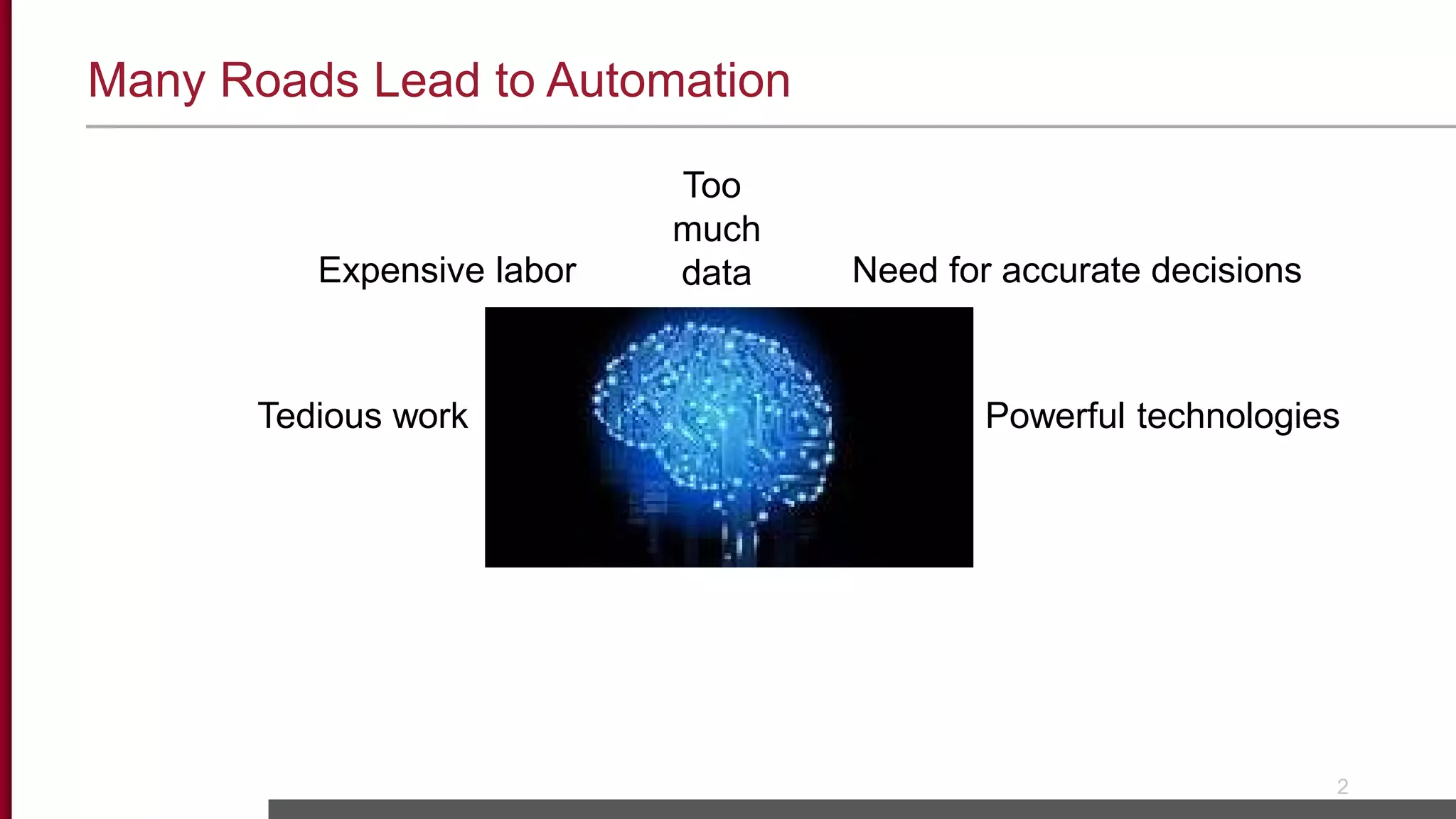
Many Roads Lead to Automation
2
Tedious work
Expensive labor
Too
much
data Need for accurate decisions
Powerful technologies
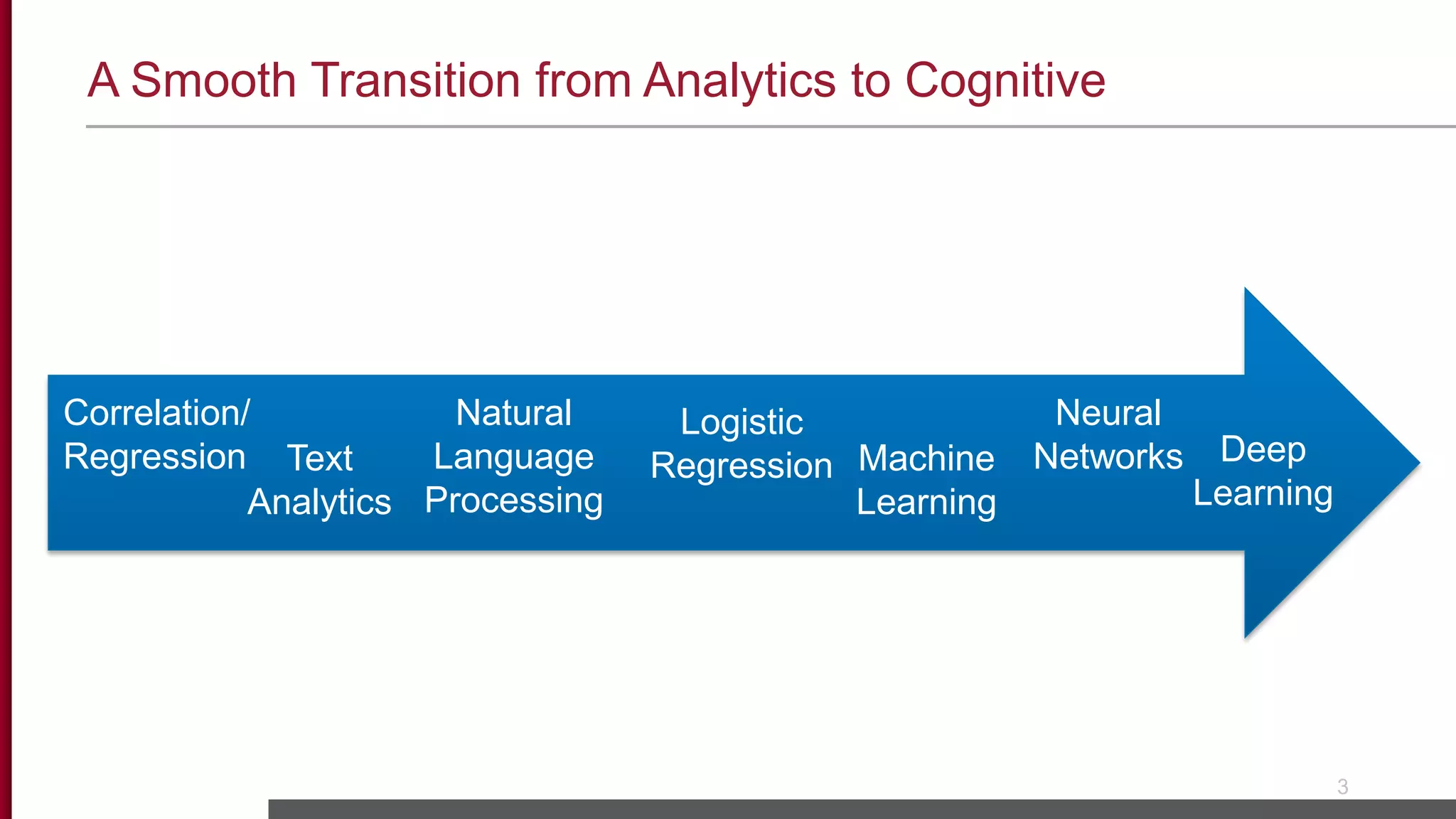
A Smooth Transition from Analytics to Cognitive
3
Correlation/
Regression Text
Analytics
Natural
Language
Processing
Logistic
Regression Machine
Learning
Deep
Learning
Neural
Networks
Is Knowledge Work Next to Go?
4
18th-19th C. 20th C. 21st C.
Mechanical
Systems
Transactional
Computers
Cognitive/
Analytical
Computers
Manual
Labor Jobs
Admin/
Service Jobs
Knowledge
Work Jobs
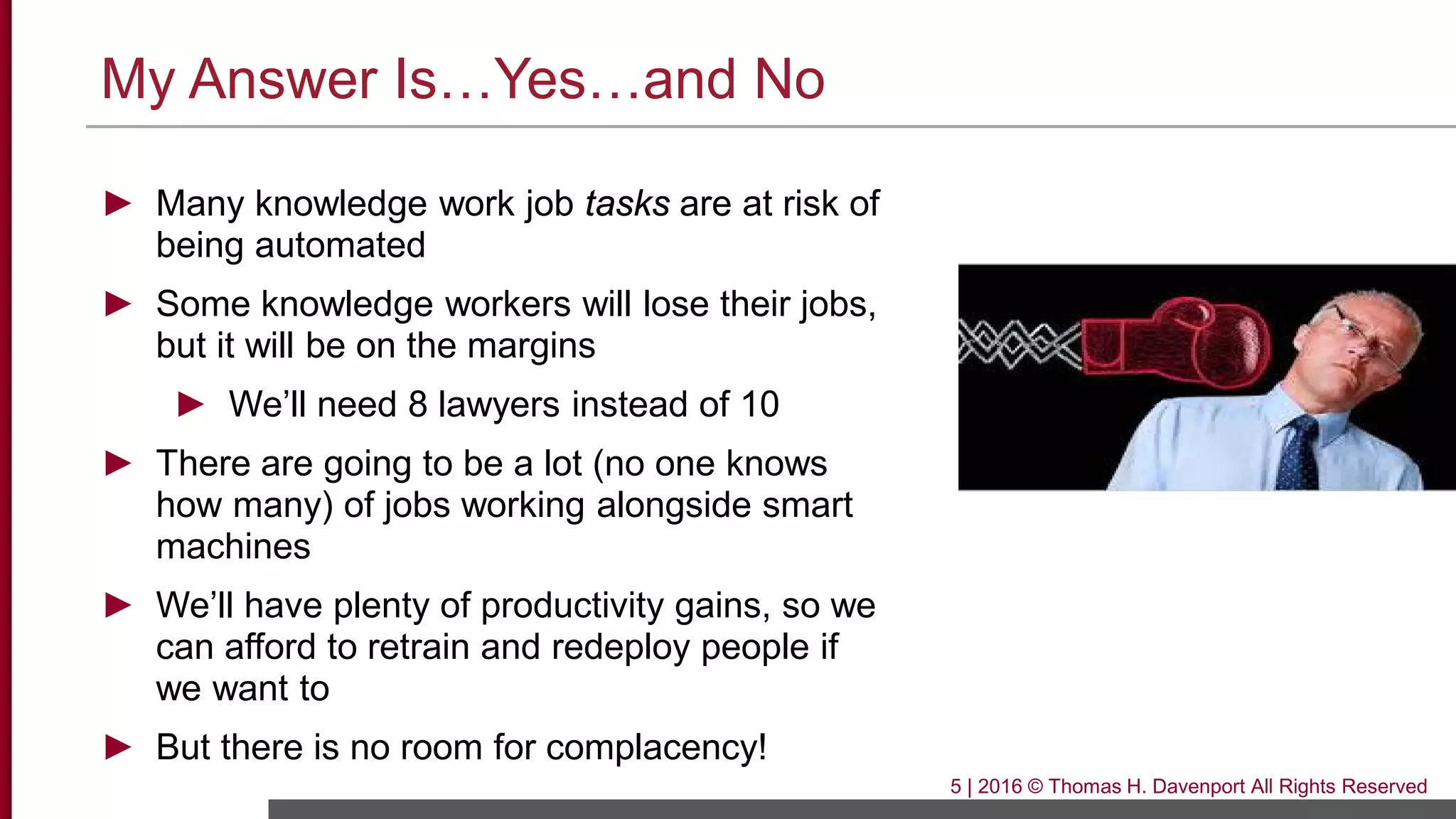
My Answer Is…Yes…and No
► Many knowledge work job tasks are at risk of
being automated
► Some knowledge workers will lose their jobs,
but it will be on the margins
► We’ll need 8 lawyers instead of 10
► There are going to be a lot (no one knows
how many) of jobs working alongside smart
machines
► We’ll have plenty of productivity gains, so we
can afford to retrain and redeploy people if
we want to
► But there is no room for complacency!
5 | 2016 © Thomas H. Davenport All Rights Reserved
Ten Knowledge Work Jobs w/ Automatable Tasks
1. Teacher/Professor—online content, adaptive learning
2. Lawyer—e-discovery, predictive coding, etc.
3. Accountant—automated audits and tax
4. Radiologist—automated cancer detection
5. Reporter—automated story-writing
6. Marketer—programmatic buying, focus groups,
personalized e-mails, etc.
7. Financial advisor—”robo-advisors”
8. Architect—automated drafting, design
9. Financial asset manager—index funds, trading
10.Pharmaceutical scientist—cognitive creation of new drugs
6 | 2016 © Thomas H. Davenport All Rights Reserved
Automation or Augmentation?
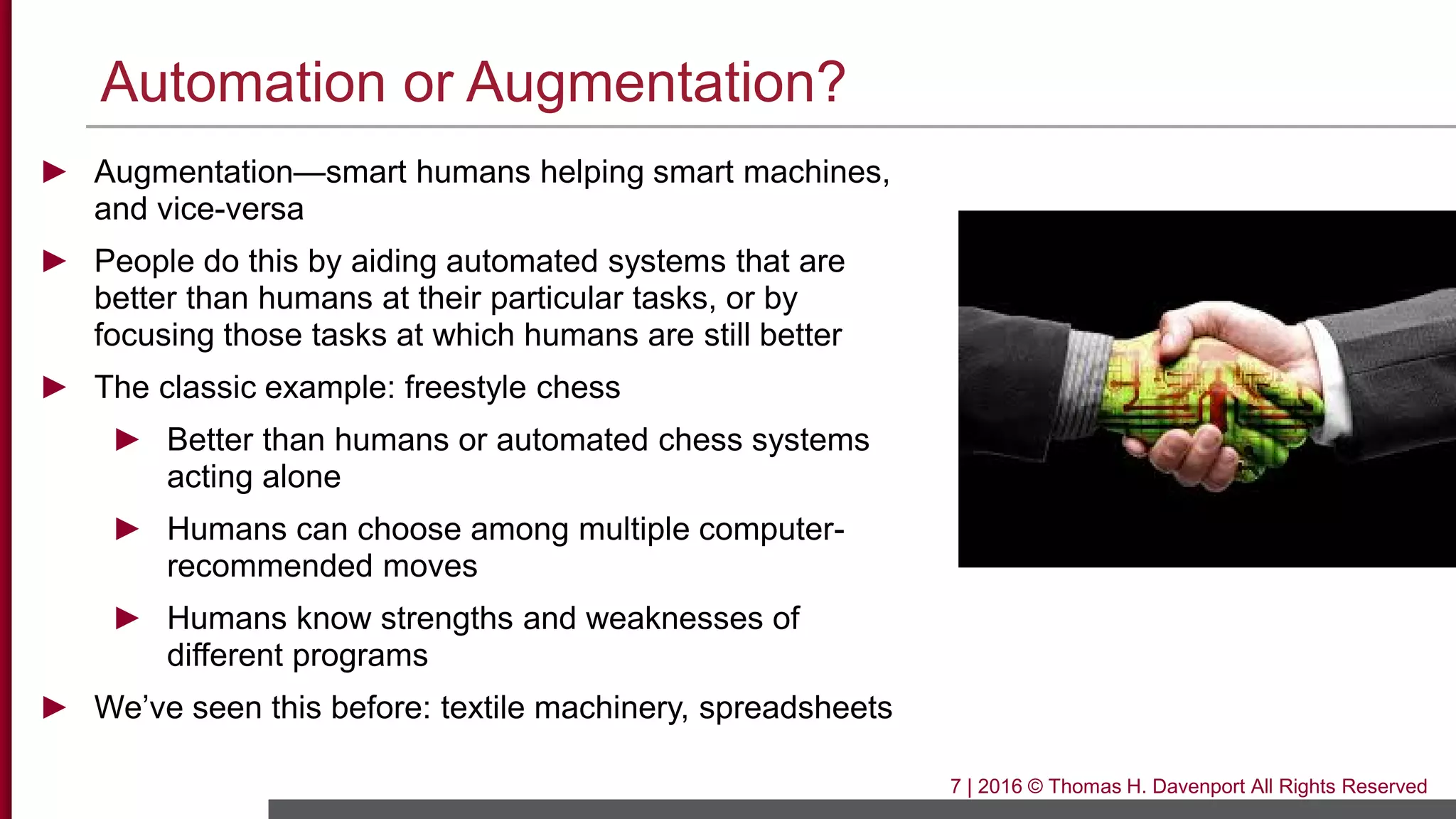
► Augmentation—smart humans helping smart machines,
and vice-versa
► People do this by aiding automated systems that are
better than humans at their particular tasks, or by
focusing those tasks at which humans are still better
► The classic example: freestyle chess
► Better than humans or automated chess systems
acting alone
► Humans can choose among multiple computer-
recommended moves
► Humans know strengths and weaknesses of
different programs
► We’ve seen this before: textile machinery, spreadsheets
7 | 2016 © Thomas H. Davenport All Rights Reserved
Five Ways of Augmented Stepping
8 | 2016 © Thomas H. Davenport. All Rights Reserved
► Step in—humans master the details of the
system, know its strengths and weaknesses,
and when it needs to be modified
► Step up—humans take a big-picture view
of computer-driven tasks and decide
whether to automate new domains
► Step aside—humans focus on areas they
do better than computers, at least for now
► Step narrowly—humans focus on knowledge
domains that are too narrow to be worth
automating
► Step forward—humans build the automated
systems
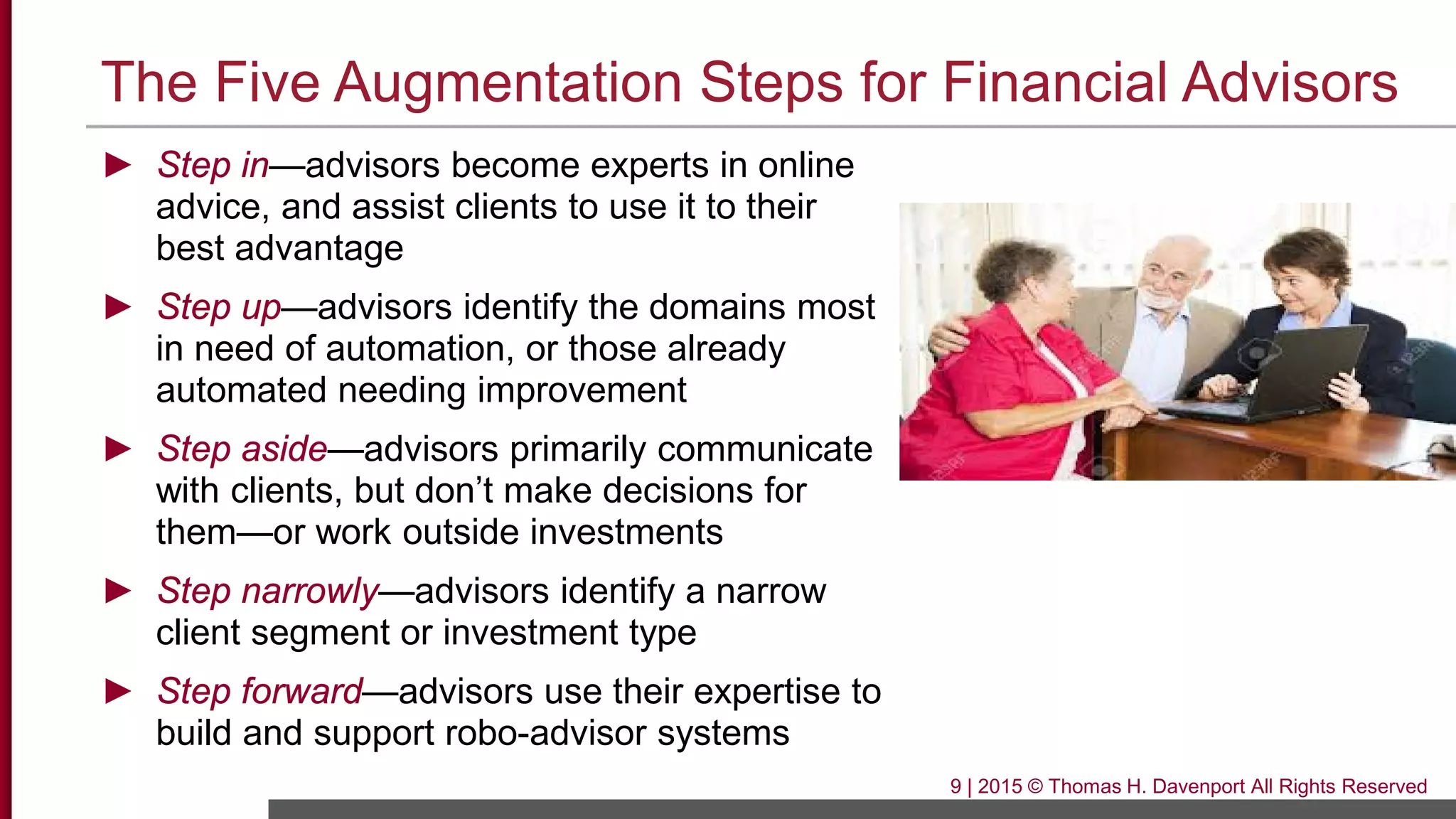
The Five Augmentation Steps for Financial Advisors
► Step in—advisors become experts in online
advice, and assist clients to use it to their
best advantage
► Step up—advisors identify the domains most
in need of automation, or those already
automated needing improvement
► Step aside—advisors primarily communicate
with clients, but don’t make decisions for
them—or work outside investments
► Step narrowly—advisors identify a narrow
client segment or investment type
► Step forward—advisors use their expertise to
build and support robo-advisor systems
9 | 2015 © Thomas H. Davenport All Rights Reserved
Implications for Organizations
10
► Take an augmentation perspective from
the beginning
► Pick the right cognitive technology for
your problem
► Get good at work design for smart
humans and smart machines
► Give your people the options and the
time to transition to them
► Put someone in charge of thinking about
this

Where is my next jobs in the age of Big Data and Automation

  • 1.
    Only Humans NeedApply: Winners and Losers in the Age of Smart Machines Thomas H. Davenport Babson College/MIT/Deloitte/International Institute for Analytics MIT Initiative on the Digital Economy May 19, 2016 1 | 2016 © Thomas H. Davenport All Rights Reserved
  • 2.
    Many Roads Leadto Automation 2 Tedious work Expensive labor Too much data Need for accurate decisions Powerful technologies
  • 3.
    A Smooth Transitionfrom Analytics to Cognitive 3 Correlation/ Regression Text Analytics Natural Language Processing Logistic Regression Machine Learning Deep Learning Neural Networks
  • 4.
    Is Knowledge WorkNext to Go? 4 18th-19th C. 20th C. 21st C. Mechanical Systems Transactional Computers Cognitive/ Analytical Computers Manual Labor Jobs Admin/ Service Jobs Knowledge Work Jobs
  • 5.
    My Answer Is…Yes…andNo ► Many knowledge work job tasks are at risk of being automated ► Some knowledge workers will lose their jobs, but it will be on the margins ► We’ll need 8 lawyers instead of 10 ► There are going to be a lot (no one knows how many) of jobs working alongside smart machines ► We’ll have plenty of productivity gains, so we can afford to retrain and redeploy people if we want to ► But there is no room for complacency! 5 | 2016 © Thomas H. Davenport All Rights Reserved
  • 6.
    Ten Knowledge WorkJobs w/ Automatable Tasks 1. Teacher/Professor—online content, adaptive learning 2. Lawyer—e-discovery, predictive coding, etc. 3. Accountant—automated audits and tax 4. Radiologist—automated cancer detection 5. Reporter—automated story-writing 6. Marketer—programmatic buying, focus groups, personalized e-mails, etc. 7. Financial advisor—”robo-advisors” 8. Architect—automated drafting, design 9. Financial asset manager—index funds, trading 10.Pharmaceutical scientist—cognitive creation of new drugs 6 | 2016 © Thomas H. Davenport All Rights Reserved
  • 7.
    Automation or Augmentation? ►Augmentation—smart humans helping smart machines, and vice-versa ► People do this by aiding automated systems that are better than humans at their particular tasks, or by focusing those tasks at which humans are still better ► The classic example: freestyle chess ► Better than humans or automated chess systems acting alone ► Humans can choose among multiple computer- recommended moves ► Humans know strengths and weaknesses of different programs ► We’ve seen this before: textile machinery, spreadsheets 7 | 2016 © Thomas H. Davenport All Rights Reserved
  • 8.
    Five Ways ofAugmented Stepping 8 | 2016 © Thomas H. Davenport. All Rights Reserved ► Step in—humans master the details of the system, know its strengths and weaknesses, and when it needs to be modified ► Step up—humans take a big-picture view of computer-driven tasks and decide whether to automate new domains ► Step aside—humans focus on areas they do better than computers, at least for now ► Step narrowly—humans focus on knowledge domains that are too narrow to be worth automating ► Step forward—humans build the automated systems
  • 9.
    The Five AugmentationSteps for Financial Advisors ► Step in—advisors become experts in online advice, and assist clients to use it to their best advantage ► Step up—advisors identify the domains most in need of automation, or those already automated needing improvement ► Step aside—advisors primarily communicate with clients, but don’t make decisions for them—or work outside investments ► Step narrowly—advisors identify a narrow client segment or investment type ► Step forward—advisors use their expertise to build and support robo-advisor systems 9 | 2015 © Thomas H. Davenport All Rights Reserved
  • 10.
    Implications for Organizations 10 ►Take an augmentation perspective from the beginning ► Pick the right cognitive technology for your problem ► Get good at work design for smart humans and smart machines ► Give your people the options and the time to transition to them ► Put someone in charge of thinking about this