Accounting, Reporting, Auditing, and
Analysis in a Digital Environment:
an introduction
Charles Hoffman, CPA
(choffm@uw.edu)
About Me
• Graduate of Pacific Lutheran University with a degree in business administration and a
concentration in accounting.
• Masters of Business Administration (MBA) from Pacific Lutheran University.
• Started his public accounting career as an auditor with the international firm then called
Price Waterhouse, served various roles in industry and public accounting for over 35 years.
• Credited as being the Father of XBRL.
• In 1997, recipient of the AICPA Innovative User of Technology Award.
• In 2006, received the AICPA Special Recognition Award for his pioneering role in developing
XBRL.
• In 2007, recipient of the Pacific Lutheran University Distinguished Alumni Award, his alma
mater.
• In 2012, named one of the “125 people of impact in accounting” by the Journal of
Accountancy.
• Authored numerous publications including XBRL for Dummies, a number of Journal of
Accountancy articles, writes a blog relating to XBRL, and contributed to a number of XBRL
related technical specification and best practices documents.
World is Changing
• “I skate to where the puck is going to be, not
where it has been.”
– Wayne Gretzky, legendary Canadian hockey star.
The Real Reason to be Afraid of
Artificial Intelligence
• https://www.youtube.com/watch?v=TRzBk_KuIaM
• Healthy skepticism
• Lead
• Snake oil
• Ignorance
• Intellectual laziness
• Standards
Thinking about this Change
• Techno-optimists overstating the impact of
change is not helpful. Nor is it helpful to
unilaterally disregard all notions that change will
occur; pessimism will not cause change to
disappear. In all likelihood actual change will be in
between the optimistic and pessimistic
predictions.
• Consciously understanding the dynamics that are
at work is critical to having an informed position.
These changes deserve to be evaluated with a
healthy skepticism.
Statement by a Student
• “Thus, as a current accounting student, it is
vital to learn more than the basic data entry
and accounting knowledge. As the robotic
finance trend gradually becomes a norm in all
accounting and finance industries, we must be
keen on learning more technological and
acquiring advanced analytical skills to stay
relevant and on top of the game.”
Global Standard Shipping Container
- agreeing to agree to achieve some objective
Fourth Industrial Revolution
-common to each is very significant productivity gains
• First industrial revolution resulted from the perfection of the steam
engine.
• Second industrial revolution resulted from the harnessing of oil and
electricity to create mass production, the assembly line, and the
invention of important technologies such as the telephone, the light bulb,
the phonograph, and the internal combustion engine.
• Third industrial revolution resulted from the change from analog
electronic and mechanical devices to more effective and efficient digital
devices. This era sees the invention of the personal computer, the
internet, and significant advances in information and communications
technology.
• Fourth industrial revolution includes advances in artificial intelligence;
internetworked physical devices (internet of things ); cyber-physical
systems (which are mechanisms controlled or monitored by computer-
based algorithms); nanotechnology (which is the manipulation of matter
on an atomic, molecular, and supramolecular scale); and biotechnology
(which is the use of organisms and living systems to create products).
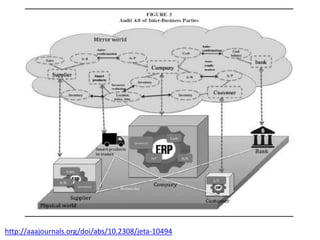
http://aaajournals.org/doi/abs/10.2308/jeta-10494
Think about it This Way
• Think of a paper map as contrast to a
navigation system of a car that exists today
• Think of taking a picture with a film camera,
having to get the film developed, getting one
picture; compare that to a taking a digital
photo on your smartphone
• Think of making a movie using cellulose film
as contrast to digital video, the differences in
workflow of the movie making process
Change in Mindset
Necessary
The Map is Not the Territory
• The territory is changing. A paradigm shift has occurred. But
accountants and auditors are using the same map, or mental
model, to think about accounting, reporting auditing, and analysis.
That map is outdated. As Stephen Covey pointed out in his seminal
book, The Seven Habits of Highly Effective People, it is like being in
Chicago and having a map of Detroit and trying to use that map of
Detroit to make it to a specific location in Chicago. It is very
frustrating and tends to be ineffective.
• In order to understand the changes that are occurring we first need
to help professional accountants update their mental map for
thinking about computers, accounting, reporting, and auditing. The
paradigm has already shifted, the world has changed and there is
no going back.
• Stephen R. Covey, The Seven Habits of Highly Effective People, page
23.
Computer Empathy
• Psychology Today defines empathy as “the experience
of understanding another person’s condition from their
perspective”.
• Borrowing from that definition and modifying it
slightly, think of computer empathy as the experience
of understanding how computer software works from
the perspective of the computer.
• Computer empathy is about understanding how a
computer works so that you can better understand
that tool and how to employ that tool in your craft to
perform useful work reliably, repeatable, predictably,
safely.
I have a 4 hour
presentation that
explains computer
empathy
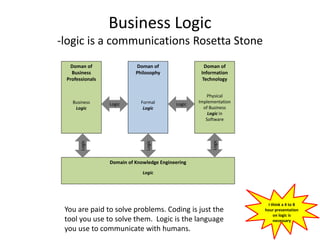
Doman of
Business
Professionals
Business
Logic
Doman of
Philosophy
Formal
Logic
Doman of
Information
Technology
Physical
Implementation
of Business
Logic in
Software
Logic Logic
Domain of Knowledge Engineering
Logic
Logic
Logic
Logic
You are paid to solve problems. Coding is just the
tool you use to solve them. Logic is the language
you use to communicate with humans.
Business Logic
-logic is a communications Rosetta Stone
I think a 4 to 8
hour presentation
on logic is
necessary
Computer Empathy
(abridged version)
Harnessing the Power of the Dumb Beasts
Unabridged
version is 71
slides, this is 14
Computers are General Purpose
Machines
• Computers are machines. The first mechanical computers,
called tabulating machines, were created in the 1900s.
• A computer has two distinct parts:
– hardware and
– software.
• What makes computers such a unique and compelling tool is not
the hardware, although that is very important; it is the software.
• Most machines tend to do one thing. Computers are extremely
useful tools because by changing only software you can make
the computer do different things. And because software is
flexible, you can make a computer perform many, many different
tasks. Computers are general purpose machines.
Computers are Dumb Beasts
• Fundamental strengths/capabilities of computers:
– store tremendous amounts of information reliably
and efficiently
– retrieve tremendous amounts of information reliably
and efficiently
– process stored information reliably and efficiently,
mechanically repeating the same process over and
over
– make information instantly accessible to individuals
and more importantly other machine-based processes
anywhere on the planet in real time
Computers are Dumb Beasts
• Major obstacles to harnessing the power of computers:
– business professional idiosyncrasies; different business
professionals use different terminologies to refer to exactly
the same thing
– information technology idiosyncrasies; information
technology professionals use different technology options,
techniques, and formats to encode and store exactly the
same information
– inconsistent domain understanding of and technology's
limitations in expressing interconnections within a domain
of knowledge
– computers are dumb beasts; computers don't understand
themselves, the programs they run, or the information
that they work with
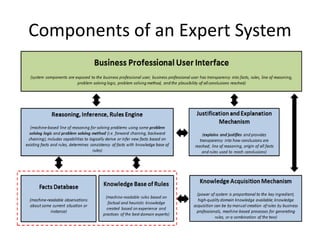
Components of a Knowledge Based
System
• Simply put, a knowledge based system is a system that
draws upon the knowledge of human experts that has
been represented in machine-readable form and
stored in a fact database and knowledge base. The
system applies problem solving logic using a problem
solving method to solve problems that normally would
require human effort and thought to solve. The
knowledge based system supplies an explanation and
justification mechanism to help system users to
understand the line of reasoning used and support
conclusions reached by the knowledge based system
and presents that information to the user of the
system.
Components of an Expert System
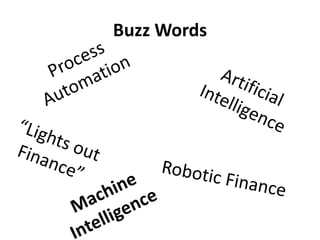
Buzz Words
Observation:
• Everyone seems to be talking about “artificial
intelligence” in very general terms using
broad brush strokes
• HOW is artificial intelligence going to change
things? No one is explaining details as to
precisely what is involved when implementing
“artificial intelligence”
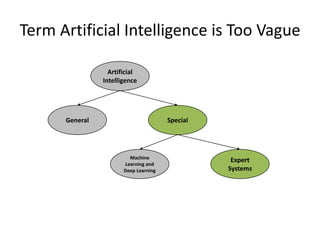
Term Artificial Intelligence is Too Vague
Artificial
Intelligence
General Special
Machine
Learning and
Deep Learning
Expert
Systems
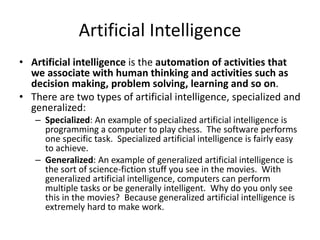
Artificial Intelligence
• Artificial intelligence is the automation of activities that
we associate with human thinking and activities such as
decision making, problem solving, learning and so on.
• There are two types of artificial intelligence, specialized and
generalized:
– Specialized: An example of specialized artificial intelligence is
programming a computer to play chess. The software performs
one specific task. Specialized artificial intelligence is fairly easy
to achieve.
– Generalized: An example of generalized artificial intelligence is
the sort of science-fiction stuff you see in the movies. With
generalized artificial intelligence, computers can perform
multiple tasks or be generally intelligent. Why do you only see
this in the movies? Because generalized artificial intelligence is
extremely hard to make work.
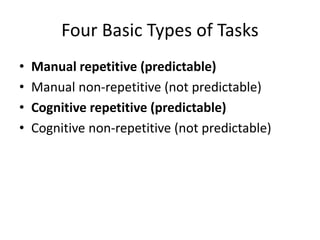
Four Basic Types of Tasks
• Manual repetitive (predictable)
• Manual non-repetitive (not predictable)
• Cognitive repetitive (predictable)
• Cognitive non-repetitive (not predictable)
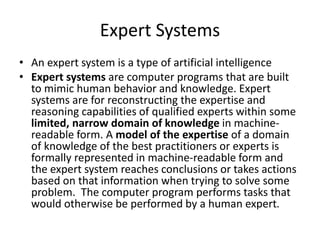
Expert Systems
• An expert system is a type of artificial intelligence
• Expert systems are computer programs that are built
to mimic human behavior and knowledge. Expert
systems are for reconstructing the expertise and
reasoning capabilities of qualified experts within some
limited, narrow domain of knowledge in machine-
readable form. A model of the expertise of a domain
of knowledge of the best practitioners or experts is
formally represented in machine-readable form and
the expert system reaches conclusions or takes actions
based on that information when trying to solve some
problem. The computer program performs tasks that
would otherwise be performed by a human expert.
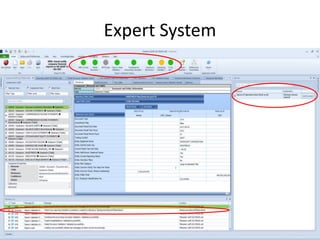
Expert System
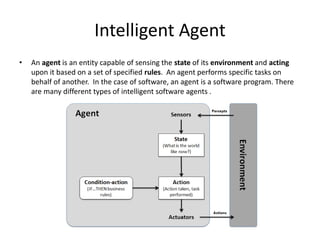
Intelligent Agent
• An agent is an entity capable of sensing the state of its environment and acting
upon it based on a set of specified rules. An agent performs specific tasks on
behalf of another. In the case of software, an agent is a software program. There
are many different types of intelligent software agents .
Three Key Technology
Changes
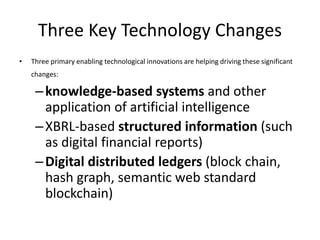
Three Key Technology Changes
• Three primary enabling technological innovations are helping driving these significant
changes:
–knowledge-based systems and other
application of artificial intelligence
–XBRL-based structured information (such
as digital financial reports)
–Digital distributed ledgers (block chain,
hash graph, semantic web standard
blockchain)
Details of Three Key Technologies
• Separate presentation
• Here is a brief, quick synopsis
I think a 1 hour
presentation to
show this
Knowledge Based Systems and
other Applications of Artificial
Intelligence
Significant increase in ability to process information
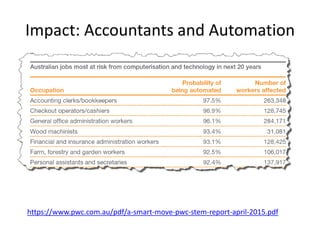
Impact: Accountants and Automation
https://www.pwc.com.au/pdf/a-smart-move-pwc-stem-report-april-2015.pdf
Lights Out Finance
• JofA, “What CPAs need to do to survive
the automation revolution”
– https://www.journalofaccountancy.com/newsletters/2017/jun/survive-automation-revolution.html
• Wall Street Journal, “It’s Digital Crunch
Time for Finance”
– http://deloitte.wsj.com/cio/2017/02/07/its-digital-crunch-time-for-finance/
• Kofax Advisor, “Is the Modern CFO Headed for
Extension?”
– http://advisor.kofax.com/index.php/is-the-modern-cfo-headed-for-extinction/
Robotic Finance
• Ventana Research, “Welcome to the Age of
Robotic Finance”
– https://robertkugel.ventanaresearch.com/welcome-to-the-age-of-robotic-finance
– Webinar:
– https://www.ventanaresearch.com/webinar/office_of_finance/robotic_finance
• Harvard Business Review, “Competitive Landscape
for Machine Intelligence”
– https://hbr.org/2016/11/the-competitive-landscape-for-machine-intelligence
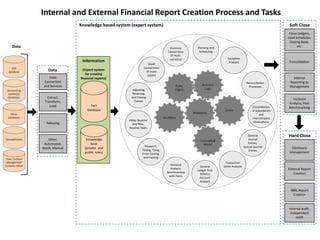
Internal and External Financial Report Creation Process and Tasks
Internal
Reporting to
Management
Soft Close
Close Ledgers,
Lead Schedules,
Closing Book,
etc.
Consolidation
Variance
Analysis, Peer
Benchmarking
External Report
Creation
Hard Close
Disclosure
Management
XBRL Report
Creation
Internal audit,
Independent
audit
Reconciliation
Processes
Variance
Analysis;
Benchmarking
with Peers
General
Ledger Trial
Balance
Account
Analysis
Exception
Analysis
General
Journal
Entries,
Special Journal
Entries
Transaction
Detail Analysis
Consolidation
of Subsidiaries
and
Intercompany
Eliminations
Planning and
Scheduling
Other Routine
and Non-
Routine Tasks
Research,
Ticking, Tying,
Cross Casting,
and Footing
Extract,
Transform,
Load
Data
Data
Connectors
and Services
Rekeying
Other,
Automated,
Batch, Manual
Currency
Conversions
(if multi-
currency)
GAAP
Conversions
(if multi-
GAAP)
Adjusting,
Reversing,
and Closing
Entries
Information
(Expert system
for creating
financial reports)
Knowledge
base
(private and
public rules)
Fact
Database
Data
Knowledge based system (expert system)
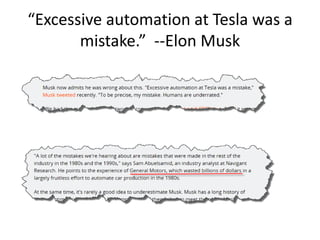
“Excessive automation at Tesla was a
mistake.” --Elon Musk
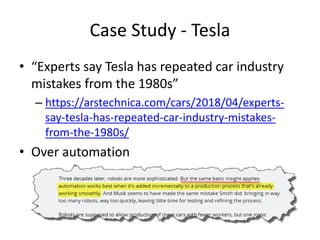
Case Study - Tesla
• “Experts say Tesla has repeated car industry
mistakes from the 1980s”
– https://arstechnica.com/cars/2018/04/experts-
say-tesla-has-repeated-car-industry-mistakes-
from-the-1980s/
• Over automation
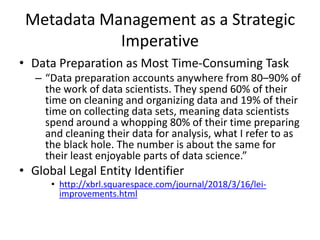
Metadata Management as a Strategic
Imperative
• Data Preparation as Most Time-Consuming Task
– “Data preparation accounts anywhere from 80–90% of
the work of data scientists. They spend 60% of their
time on cleaning and organizing data and 19% of their
time on collecting data sets, meaning data scientists
spend around a whopping 80% of their time preparing
and cleaning their data for analysis, what I refer to as
the black hole. The number is about the same for
their least enjoyable parts of data science.”
• Global Legal Entity Identifier
• http://xbrl.squarespace.com/journal/2018/3/16/lei-
improvements.html
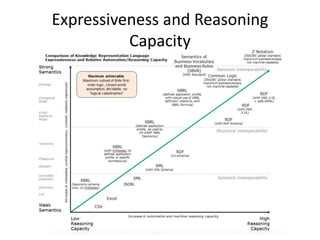
Expressiveness and Reasoning
Capacity
XBRL-based Digital Financial
Reporting
More information usable by computer processes
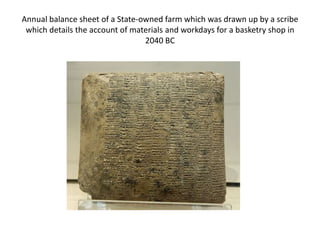
Annual balance sheet of a State-owned farm which was drawn up by a scribe
which details the account of materials and workdays for a basketry shop in
2040 BC
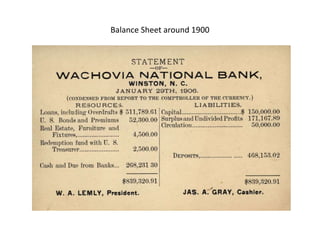
Balance Sheet around 1900
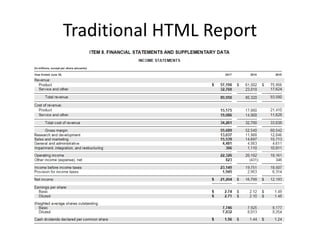
Traditional HTML Report
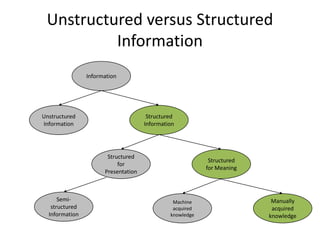
Unstructured versus Structured
Information
Information
Unstructured
Information
Structured
Information
Structured
for
Presentation
Structured
for Meaning
Semi-
structured
Information
Machine
acquired
knowledge
Manually
acquired
knowledge
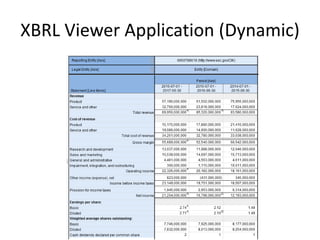
XBRL Viewer Application (Dynamic)
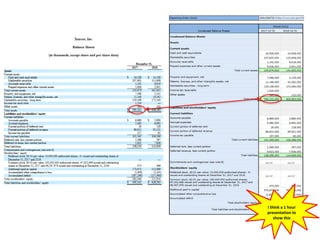
I think a 1 hour
presentation to
show this
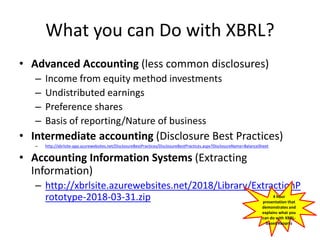
What you can Do with XBRL?
• Advanced Accounting (less common disclosures)
– Income from equity method investments
– Undistributed earnings
– Preference shares
– Basis of reporting/Nature of business
• Intermediate accounting (Disclosure Best Practices)
– http://xbrlsite-app.azurewebsites.net/DisclosureBestPractices/DisclosureBestPractices.aspx?DisclosureName=BalanceSheet
• Accounting Information Systems (Extracting
Information)
– http://xbrlsite.azurewebsites.net/2018/Library/ExtractionP
rototype-2018-03-31.zip 4 hour
presentation that
demonstrates and
explains what you
can do with XBRL-
based Reoprts
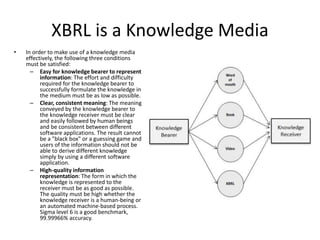
XBRL is a Knowledge Media
• In order to make use of a knowledge media
effectively, the following three conditions
must be satisfied:
– Easy for knowledge bearer to represent
information: The effort and difficulty
required for the knowledge bearer to
successfully formulate the knowledge in
the medium must be as low as possible.
– Clear, consistent meaning: The meaning
conveyed by the knowledge bearer to
the knowledge receiver must be clear
and easily followed by human beings
and be consistent between different
software applications. The result cannot
be a "black box" or a guessing game and
users of the information should not be
able to derive different knowledge
simply by using a different software
application.
– High-quality information
representation: The form in which the
knowledge is represented to the
receiver must be as good as possible.
The quality must be high whether the
knowledge receiver is a human-being or
an automated machine-based process.
Sigma level 6 is a good benchmark,
99.99966% accuracy.
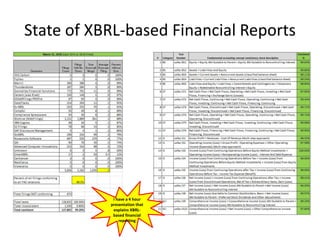
State of XBRL-based Financial Reports
I have a 4 hour
presentation that
explains XBRL-
based financial
reporting
State of XBRL-based Reporting
• XBRL-based financial reporting by public companies
to SEC is “state of the art”
• SEC and FASB are making mistakes, too political,
don’t understand the technology
• But, XBRL-based filings of public companies provide
evidence as to how to make digital financial
reporting work
• But, public companies are using “bolt on” approach
to creating XBRL-based reports
• “Robotic finance” can leverage XBRL standard
Digital Distributed Ledgers
More accessible information, supply chain integration
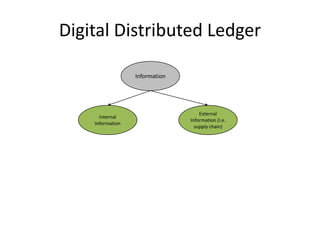
Digital Distributed Ledger
Information
Internal
Information
External
Information (i.e.
supply chain)
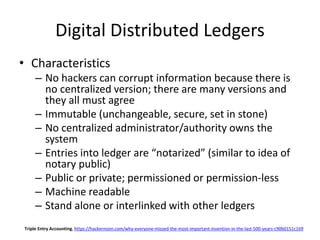
Digital Distributed Ledgers
• Characteristics
– No hackers can corrupt information because there is
no centralized version; there are many versions and
they all must agree
– Immutable (unchangeable, secure, set in stone)
– No centralized administrator/authority owns the
system
– Entries into ledger are “notarized” (similar to idea of
notary public)
– Public or private; permissioned or permission-less
– Machine readable
– Stand alone or interlinked with other ledgers
Triple Entry Accounting, https://hackernoon.com/why-everyone-missed-the-most-important-invention-in-the-last-500-years-c90b0151c169
Digital Distributed Ledger
• Ledgers:
– https://www.youtube.com/watch?v=Hwhigpr4720
– https://www.customlogocases.com/blog/b2b-blockchain/
• Blockchain:
– https://www.youtube.com/watch?v=r43LhSUUGTQ ; https://www.youtube.com/watch?v=lD9KAnkZUjU
• Digital Distributed Ledgers:
– http://xbrl.squarespace.com/journal/2015/12/3/understanding-digital-distributed-ledgers.html
– http://xbrlsite.azurewebsites.net/2017/IntelligentDigitalFinancialReporting/Part01_Chapter02.71_DistributedLedgers.pdf
• Hashgraph
• RDF-based digital distributed ledgers
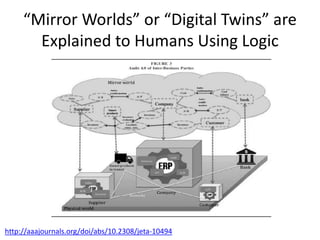
http://aaajournals.org/doi/abs/10.2308/jeta-10494
“Mirror Worlds” or “Digital Twins” are
Explained to Humans Using Logic
Ask Yourself these Questions
• Did this presentation help you understand the
moving parts of the technology changes that
are coming?
• Do you think other accountants could benefit
from this information?
• Do you think accounting students can benefit
from this information?
• TASK: Create a document that explains this
well.
Accounting, Reporting, Auditing, and Analysis in a Digital Environmentintro

Accounting, Reporting, Auditing, and Analysis in a Digital Environmentintro

  • 1.
    Accounting, Reporting, Auditing,and Analysis in a Digital Environment: an introduction Charles Hoffman, CPA (choffm@uw.edu)
  • 2.
    About Me • Graduateof Pacific Lutheran University with a degree in business administration and a concentration in accounting. • Masters of Business Administration (MBA) from Pacific Lutheran University. • Started his public accounting career as an auditor with the international firm then called Price Waterhouse, served various roles in industry and public accounting for over 35 years. • Credited as being the Father of XBRL. • In 1997, recipient of the AICPA Innovative User of Technology Award. • In 2006, received the AICPA Special Recognition Award for his pioneering role in developing XBRL. • In 2007, recipient of the Pacific Lutheran University Distinguished Alumni Award, his alma mater. • In 2012, named one of the “125 people of impact in accounting” by the Journal of Accountancy. • Authored numerous publications including XBRL for Dummies, a number of Journal of Accountancy articles, writes a blog relating to XBRL, and contributed to a number of XBRL related technical specification and best practices documents.
  • 3.
    World is Changing •“I skate to where the puck is going to be, not where it has been.” – Wayne Gretzky, legendary Canadian hockey star.
  • 4.
    The Real Reasonto be Afraid of Artificial Intelligence • https://www.youtube.com/watch?v=TRzBk_KuIaM • Healthy skepticism • Lead • Snake oil • Ignorance • Intellectual laziness • Standards
  • 5.
    Thinking about thisChange • Techno-optimists overstating the impact of change is not helpful. Nor is it helpful to unilaterally disregard all notions that change will occur; pessimism will not cause change to disappear. In all likelihood actual change will be in between the optimistic and pessimistic predictions. • Consciously understanding the dynamics that are at work is critical to having an informed position. These changes deserve to be evaluated with a healthy skepticism.
  • 6.
    Statement by aStudent • “Thus, as a current accounting student, it is vital to learn more than the basic data entry and accounting knowledge. As the robotic finance trend gradually becomes a norm in all accounting and finance industries, we must be keen on learning more technological and acquiring advanced analytical skills to stay relevant and on top of the game.”
  • 7.
    Global Standard ShippingContainer - agreeing to agree to achieve some objective
  • 8.
    Fourth Industrial Revolution -commonto each is very significant productivity gains • First industrial revolution resulted from the perfection of the steam engine. • Second industrial revolution resulted from the harnessing of oil and electricity to create mass production, the assembly line, and the invention of important technologies such as the telephone, the light bulb, the phonograph, and the internal combustion engine. • Third industrial revolution resulted from the change from analog electronic and mechanical devices to more effective and efficient digital devices. This era sees the invention of the personal computer, the internet, and significant advances in information and communications technology. • Fourth industrial revolution includes advances in artificial intelligence; internetworked physical devices (internet of things ); cyber-physical systems (which are mechanisms controlled or monitored by computer- based algorithms); nanotechnology (which is the manipulation of matter on an atomic, molecular, and supramolecular scale); and biotechnology (which is the use of organisms and living systems to create products).
  • 9.
  • 10.
    Think about itThis Way • Think of a paper map as contrast to a navigation system of a car that exists today • Think of taking a picture with a film camera, having to get the film developed, getting one picture; compare that to a taking a digital photo on your smartphone • Think of making a movie using cellulose film as contrast to digital video, the differences in workflow of the movie making process
  • 11.
  • 12.
    The Map isNot the Territory • The territory is changing. A paradigm shift has occurred. But accountants and auditors are using the same map, or mental model, to think about accounting, reporting auditing, and analysis. That map is outdated. As Stephen Covey pointed out in his seminal book, The Seven Habits of Highly Effective People, it is like being in Chicago and having a map of Detroit and trying to use that map of Detroit to make it to a specific location in Chicago. It is very frustrating and tends to be ineffective. • In order to understand the changes that are occurring we first need to help professional accountants update their mental map for thinking about computers, accounting, reporting, and auditing. The paradigm has already shifted, the world has changed and there is no going back. • Stephen R. Covey, The Seven Habits of Highly Effective People, page 23.
  • 13.
    Computer Empathy • PsychologyToday defines empathy as “the experience of understanding another person’s condition from their perspective”. • Borrowing from that definition and modifying it slightly, think of computer empathy as the experience of understanding how computer software works from the perspective of the computer. • Computer empathy is about understanding how a computer works so that you can better understand that tool and how to employ that tool in your craft to perform useful work reliably, repeatable, predictably, safely. I have a 4 hour presentation that explains computer empathy
  • 14.
    Doman of Business Professionals Business Logic Doman of Philosophy Formal Logic Domanof Information Technology Physical Implementation of Business Logic in Software Logic Logic Domain of Knowledge Engineering Logic Logic Logic Logic You are paid to solve problems. Coding is just the tool you use to solve them. Logic is the language you use to communicate with humans. Business Logic -logic is a communications Rosetta Stone I think a 4 to 8 hour presentation on logic is necessary
  • 17.
    Computer Empathy (abridged version) Harnessingthe Power of the Dumb Beasts Unabridged version is 71 slides, this is 14
  • 18.
    Computers are GeneralPurpose Machines • Computers are machines. The first mechanical computers, called tabulating machines, were created in the 1900s. • A computer has two distinct parts: – hardware and – software. • What makes computers such a unique and compelling tool is not the hardware, although that is very important; it is the software. • Most machines tend to do one thing. Computers are extremely useful tools because by changing only software you can make the computer do different things. And because software is flexible, you can make a computer perform many, many different tasks. Computers are general purpose machines.
  • 19.
    Computers are DumbBeasts • Fundamental strengths/capabilities of computers: – store tremendous amounts of information reliably and efficiently – retrieve tremendous amounts of information reliably and efficiently – process stored information reliably and efficiently, mechanically repeating the same process over and over – make information instantly accessible to individuals and more importantly other machine-based processes anywhere on the planet in real time
  • 20.
    Computers are DumbBeasts • Major obstacles to harnessing the power of computers: – business professional idiosyncrasies; different business professionals use different terminologies to refer to exactly the same thing – information technology idiosyncrasies; information technology professionals use different technology options, techniques, and formats to encode and store exactly the same information – inconsistent domain understanding of and technology's limitations in expressing interconnections within a domain of knowledge – computers are dumb beasts; computers don't understand themselves, the programs they run, or the information that they work with
  • 21.
    Components of aKnowledge Based System • Simply put, a knowledge based system is a system that draws upon the knowledge of human experts that has been represented in machine-readable form and stored in a fact database and knowledge base. The system applies problem solving logic using a problem solving method to solve problems that normally would require human effort and thought to solve. The knowledge based system supplies an explanation and justification mechanism to help system users to understand the line of reasoning used and support conclusions reached by the knowledge based system and presents that information to the user of the system.
  • 22.
    Components of anExpert System
  • 23.
  • 24.
    Observation: • Everyone seemsto be talking about “artificial intelligence” in very general terms using broad brush strokes • HOW is artificial intelligence going to change things? No one is explaining details as to precisely what is involved when implementing “artificial intelligence”
  • 25.
    Term Artificial Intelligenceis Too Vague Artificial Intelligence General Special Machine Learning and Deep Learning Expert Systems
  • 26.
    Artificial Intelligence • Artificialintelligence is the automation of activities that we associate with human thinking and activities such as decision making, problem solving, learning and so on. • There are two types of artificial intelligence, specialized and generalized: – Specialized: An example of specialized artificial intelligence is programming a computer to play chess. The software performs one specific task. Specialized artificial intelligence is fairly easy to achieve. – Generalized: An example of generalized artificial intelligence is the sort of science-fiction stuff you see in the movies. With generalized artificial intelligence, computers can perform multiple tasks or be generally intelligent. Why do you only see this in the movies? Because generalized artificial intelligence is extremely hard to make work.
  • 27.
    Four Basic Typesof Tasks • Manual repetitive (predictable) • Manual non-repetitive (not predictable) • Cognitive repetitive (predictable) • Cognitive non-repetitive (not predictable)
  • 28.
    Expert Systems • Anexpert system is a type of artificial intelligence • Expert systems are computer programs that are built to mimic human behavior and knowledge. Expert systems are for reconstructing the expertise and reasoning capabilities of qualified experts within some limited, narrow domain of knowledge in machine- readable form. A model of the expertise of a domain of knowledge of the best practitioners or experts is formally represented in machine-readable form and the expert system reaches conclusions or takes actions based on that information when trying to solve some problem. The computer program performs tasks that would otherwise be performed by a human expert.
  • 29.
  • 30.
    Intelligent Agent • Anagent is an entity capable of sensing the state of its environment and acting upon it based on a set of specified rules. An agent performs specific tasks on behalf of another. In the case of software, an agent is a software program. There are many different types of intelligent software agents .
  • 31.
  • 32.
    Three Key TechnologyChanges • Three primary enabling technological innovations are helping driving these significant changes: –knowledge-based systems and other application of artificial intelligence –XBRL-based structured information (such as digital financial reports) –Digital distributed ledgers (block chain, hash graph, semantic web standard blockchain)
  • 33.
    Details of ThreeKey Technologies • Separate presentation • Here is a brief, quick synopsis I think a 1 hour presentation to show this
  • 34.
    Knowledge Based Systemsand other Applications of Artificial Intelligence Significant increase in ability to process information
  • 35.
    Impact: Accountants andAutomation https://www.pwc.com.au/pdf/a-smart-move-pwc-stem-report-april-2015.pdf
  • 36.
    Lights Out Finance •JofA, “What CPAs need to do to survive the automation revolution” – https://www.journalofaccountancy.com/newsletters/2017/jun/survive-automation-revolution.html • Wall Street Journal, “It’s Digital Crunch Time for Finance” – http://deloitte.wsj.com/cio/2017/02/07/its-digital-crunch-time-for-finance/ • Kofax Advisor, “Is the Modern CFO Headed for Extension?” – http://advisor.kofax.com/index.php/is-the-modern-cfo-headed-for-extinction/
  • 37.
    Robotic Finance • VentanaResearch, “Welcome to the Age of Robotic Finance” – https://robertkugel.ventanaresearch.com/welcome-to-the-age-of-robotic-finance – Webinar: – https://www.ventanaresearch.com/webinar/office_of_finance/robotic_finance • Harvard Business Review, “Competitive Landscape for Machine Intelligence” – https://hbr.org/2016/11/the-competitive-landscape-for-machine-intelligence
  • 38.
    Internal and ExternalFinancial Report Creation Process and Tasks Internal Reporting to Management Soft Close Close Ledgers, Lead Schedules, Closing Book, etc. Consolidation Variance Analysis, Peer Benchmarking External Report Creation Hard Close Disclosure Management XBRL Report Creation Internal audit, Independent audit Reconciliation Processes Variance Analysis; Benchmarking with Peers General Ledger Trial Balance Account Analysis Exception Analysis General Journal Entries, Special Journal Entries Transaction Detail Analysis Consolidation of Subsidiaries and Intercompany Eliminations Planning and Scheduling Other Routine and Non- Routine Tasks Research, Ticking, Tying, Cross Casting, and Footing Extract, Transform, Load Data Data Connectors and Services Rekeying Other, Automated, Batch, Manual Currency Conversions (if multi- currency) GAAP Conversions (if multi- GAAP) Adjusting, Reversing, and Closing Entries Information (Expert system for creating financial reports) Knowledge base (private and public rules) Fact Database Data Knowledge based system (expert system)
  • 39.
    “Excessive automation atTesla was a mistake.” --Elon Musk
  • 40.
    Case Study -Tesla • “Experts say Tesla has repeated car industry mistakes from the 1980s” – https://arstechnica.com/cars/2018/04/experts- say-tesla-has-repeated-car-industry-mistakes- from-the-1980s/ • Over automation
  • 41.
    Metadata Management asa Strategic Imperative • Data Preparation as Most Time-Consuming Task – “Data preparation accounts anywhere from 80–90% of the work of data scientists. They spend 60% of their time on cleaning and organizing data and 19% of their time on collecting data sets, meaning data scientists spend around a whopping 80% of their time preparing and cleaning their data for analysis, what I refer to as the black hole. The number is about the same for their least enjoyable parts of data science.” • Global Legal Entity Identifier • http://xbrl.squarespace.com/journal/2018/3/16/lei- improvements.html
  • 42.
  • 43.
    XBRL-based Digital Financial Reporting Moreinformation usable by computer processes
  • 44.
    Annual balance sheetof a State-owned farm which was drawn up by a scribe which details the account of materials and workdays for a basketry shop in 2040 BC
  • 45.
  • 46.
  • 47.
  • 48.
  • 49.
    I think a1 hour presentation to show this
  • 50.
    What you canDo with XBRL? • Advanced Accounting (less common disclosures) – Income from equity method investments – Undistributed earnings – Preference shares – Basis of reporting/Nature of business • Intermediate accounting (Disclosure Best Practices) – http://xbrlsite-app.azurewebsites.net/DisclosureBestPractices/DisclosureBestPractices.aspx?DisclosureName=BalanceSheet • Accounting Information Systems (Extracting Information) – http://xbrlsite.azurewebsites.net/2018/Library/ExtractionP rototype-2018-03-31.zip 4 hour presentation that demonstrates and explains what you can do with XBRL- based Reoprts
  • 51.
    XBRL is aKnowledge Media • In order to make use of a knowledge media effectively, the following three conditions must be satisfied: – Easy for knowledge bearer to represent information: The effort and difficulty required for the knowledge bearer to successfully formulate the knowledge in the medium must be as low as possible. – Clear, consistent meaning: The meaning conveyed by the knowledge bearer to the knowledge receiver must be clear and easily followed by human beings and be consistent between different software applications. The result cannot be a "black box" or a guessing game and users of the information should not be able to derive different knowledge simply by using a different software application. – High-quality information representation: The form in which the knowledge is represented to the receiver must be as good as possible. The quality must be high whether the knowledge receiver is a human-being or an automated machine-based process. Sigma level 6 is a good benchmark, 99.99966% accuracy.
  • 52.
    State of XBRL-basedFinancial Reports I have a 4 hour presentation that explains XBRL- based financial reporting
  • 53.
    State of XBRL-basedReporting • XBRL-based financial reporting by public companies to SEC is “state of the art” • SEC and FASB are making mistakes, too political, don’t understand the technology • But, XBRL-based filings of public companies provide evidence as to how to make digital financial reporting work • But, public companies are using “bolt on” approach to creating XBRL-based reports • “Robotic finance” can leverage XBRL standard
  • 54.
    Digital Distributed Ledgers Moreaccessible information, supply chain integration
  • 55.
  • 56.
    Digital Distributed Ledgers •Characteristics – No hackers can corrupt information because there is no centralized version; there are many versions and they all must agree – Immutable (unchangeable, secure, set in stone) – No centralized administrator/authority owns the system – Entries into ledger are “notarized” (similar to idea of notary public) – Public or private; permissioned or permission-less – Machine readable – Stand alone or interlinked with other ledgers Triple Entry Accounting, https://hackernoon.com/why-everyone-missed-the-most-important-invention-in-the-last-500-years-c90b0151c169
  • 57.
    Digital Distributed Ledger •Ledgers: – https://www.youtube.com/watch?v=Hwhigpr4720 – https://www.customlogocases.com/blog/b2b-blockchain/ • Blockchain: – https://www.youtube.com/watch?v=r43LhSUUGTQ ; https://www.youtube.com/watch?v=lD9KAnkZUjU • Digital Distributed Ledgers: – http://xbrl.squarespace.com/journal/2015/12/3/understanding-digital-distributed-ledgers.html – http://xbrlsite.azurewebsites.net/2017/IntelligentDigitalFinancialReporting/Part01_Chapter02.71_DistributedLedgers.pdf • Hashgraph • RDF-based digital distributed ledgers
  • 58.
    http://aaajournals.org/doi/abs/10.2308/jeta-10494 “Mirror Worlds” or“Digital Twins” are Explained to Humans Using Logic
  • 59.
    Ask Yourself theseQuestions • Did this presentation help you understand the moving parts of the technology changes that are coming? • Do you think other accountants could benefit from this information? • Do you think accounting students can benefit from this information? • TASK: Create a document that explains this well.