What’s Wrong with Indian IT
        Industry?
        Rajesh Varma
          Feb 5, 2013
Who am I?
• Rajesh Varma
  – Director of Product Engineering
  – Pramata Knowledge Solutions Pvt. Ltd.
  – Bangalore, INDIA.
• B.E. (Comp. Sci. & Engg.),
  – 1993, MSRIT, Bangalore University
• Working since 1994. That’s 19 years.
  Gives me enough dough to talk about.
               Copyright (c) Rajesh Varma, 2013   2
Indian IT History…
• 1950 onwards – Government controlled
  License Raj thriving.
• 1968 – Tatas get into software business.
  TCS started.
• Mid 1970s – High import duties of 150%
  forces companies like Wipro to
  manufacture homegrown PCs.


              Copyright (c) Rajesh Varma, 2013   3
Indian IT History…
• 1986 – General Electric expands in India
  – Six Sigma becomes popular way to measure
    manufacturing efficiency
  – Wipro does lots of business with GE
• 1991 – Economic Reforms started
• 1995 – IT companies get into Y2K related
  services
  – Porting and code cleanup business
  – Dependant on skilled manpower (programming)
  – IT Business based on cost arbitrage (bodyshopping)

                 Copyright (c) Rajesh Varma, 2013        4
Indian IT History
• 2000 – Dot-com bubble bursts in US
  – Downsizing, layoffs, bankruptcies order of the day
  – Outsourcing to India accelerates
  – Indian companies expand to absorb inflow of low-end
    projects (services, maintenance, support, etc.)
• 2003 – India known as low-cost destination for
  low-end IT work
  – Lots of forex money
  – Lots of jobs for one and all
  – It’s great time!
                   Copyright (c) Rajesh Varma, 2013       5
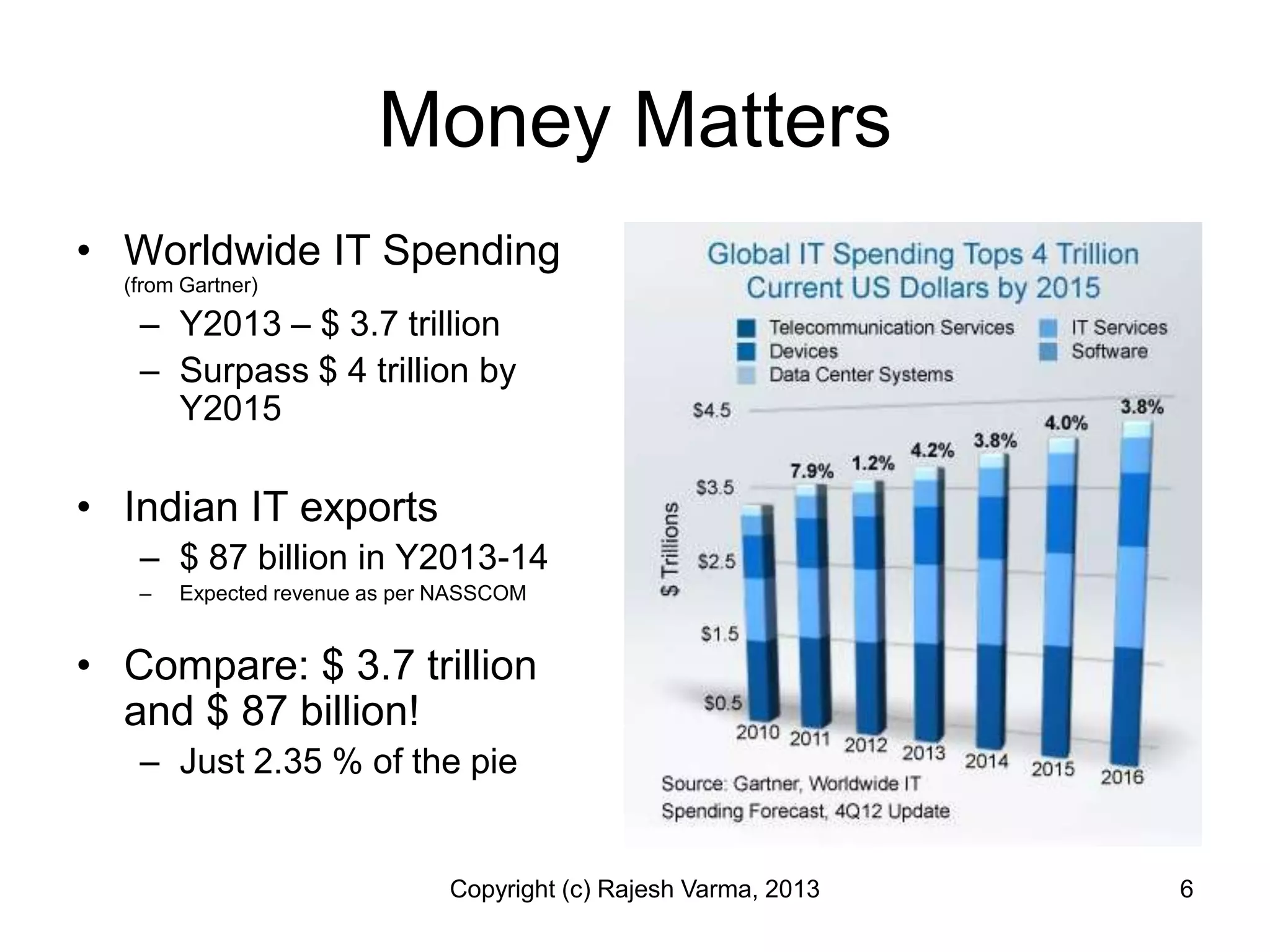
Money Matters
• Worldwide IT Spending
  (from Gartner)

   – Y2013 – $ 3.7 trillion
   – Surpass $ 4 trillion by
     Y2015

• Indian IT exports
   – $ 87 billion in Y2013-14
   –   Expected revenue as per NASSCOM


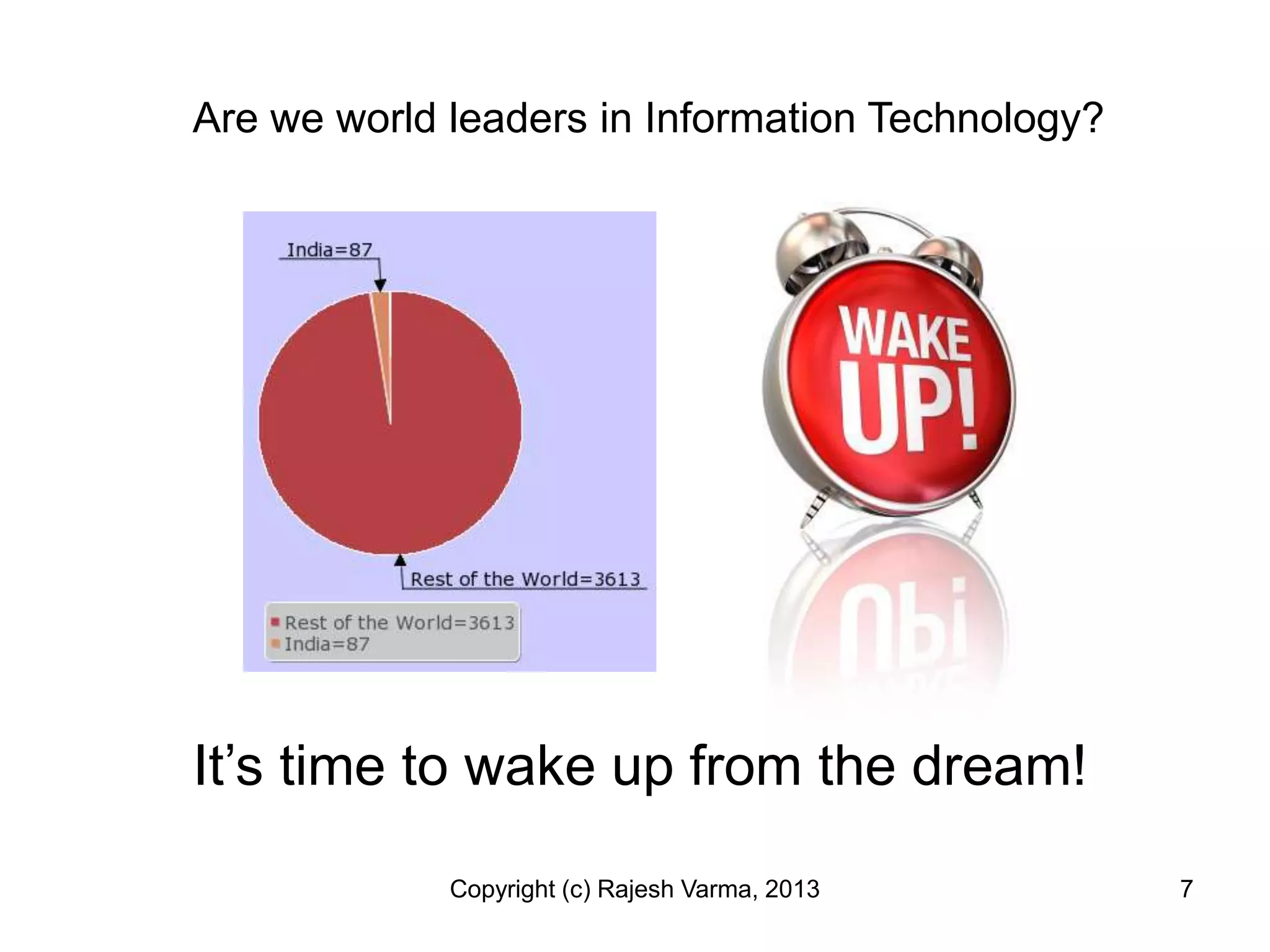
• Compare: $ 3.7 trillion
  and $ 87 billion!
   – Just 2.35 % of the pie


                               Copyright (c) Rajesh Varma, 2013   6
Are we world leaders in Information Technology?


It’s time to wake up from the dream!
             Copyright (c) Rajesh Varma, 2013     7
Is it IT?
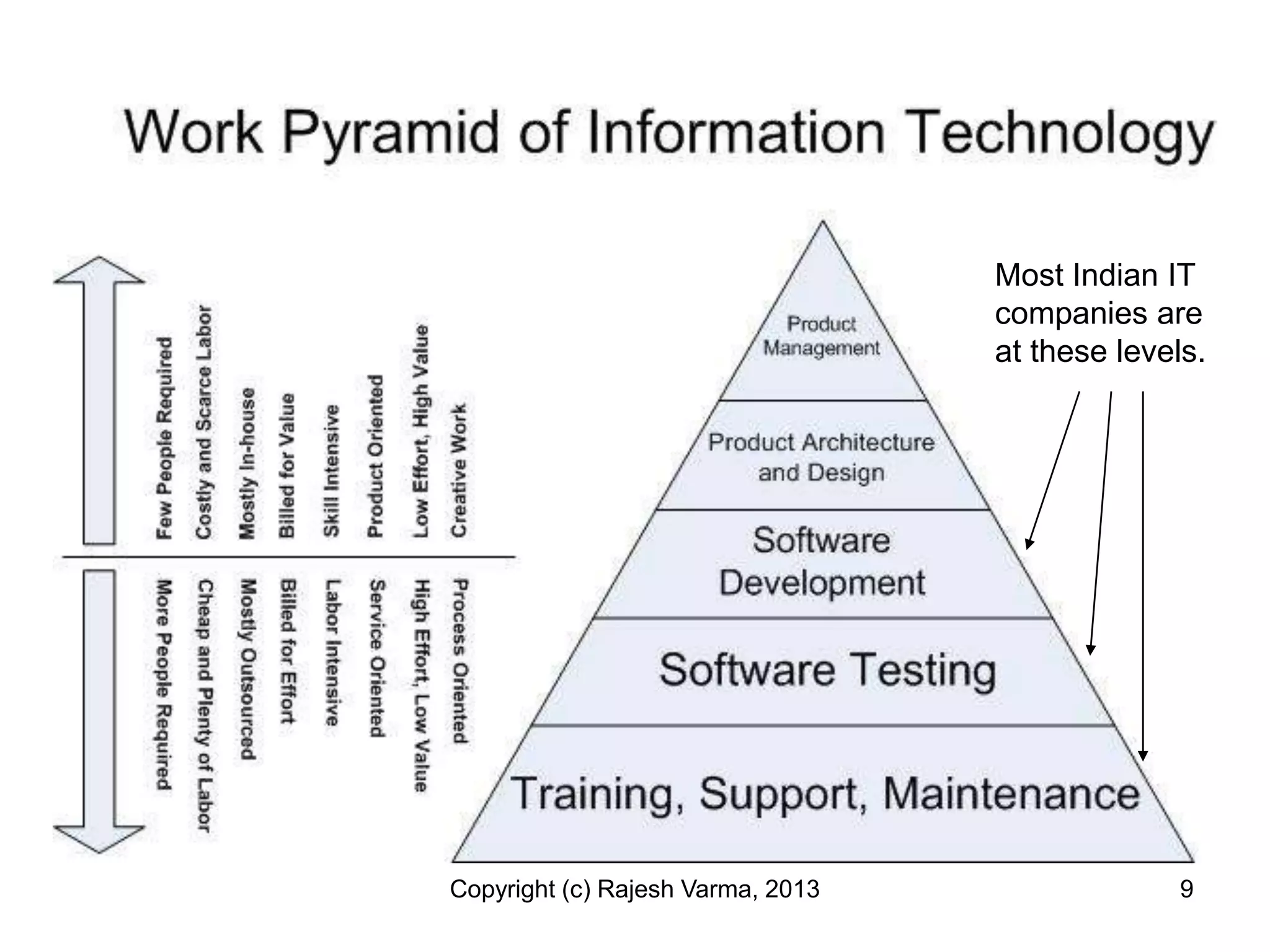
• Is Indian IT industry really an IT Industry?
  – What IT stuff do we sell?
  – IT Products? Or Services?
  – Mostly selling manpower at hourly rates!

• Even NASSCOM calls it IT-BPO.
  – IT Services 58%
  – BPO 23%
  – Engg. R&D, Software Products 19%
                Copyright (c) Rajesh Varma, 2013   8
Most Indian IT
                                   companies are
                                   at these levels.


Copyright (c) Rajesh Varma, 2013                 9
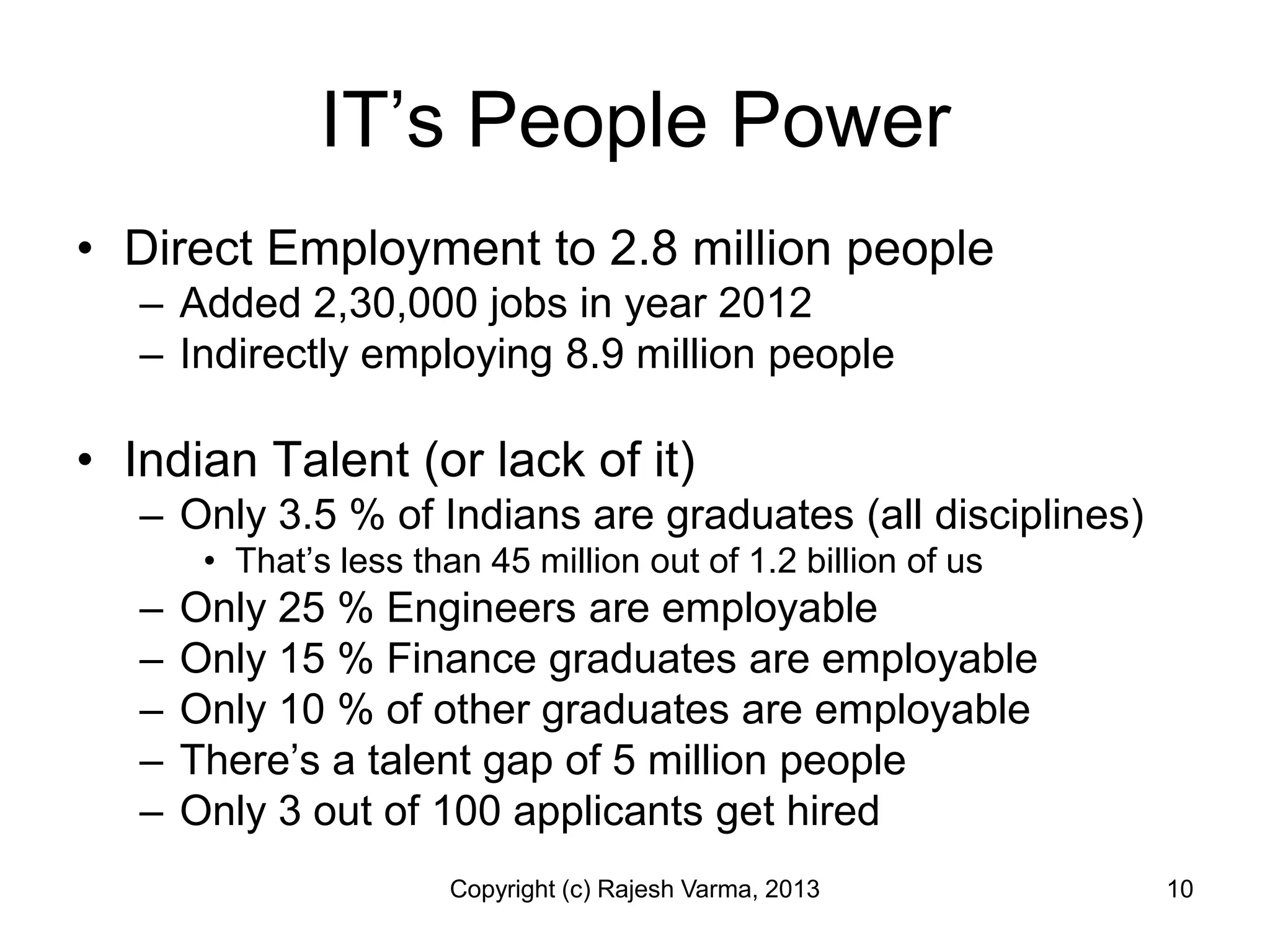
IT’s People Power
• Direct Employment to 2.8 million people
   – Added 2,30,000 jobs in year 2012
   – Indirectly employing 8.9 million people

• Indian Talent (or lack of it)
   – Only 3.5 % of Indians are graduates (all disciplines)
        • That’s less than 45 million out of 1.2 billion of us
   –   Only 25 % Engineers are employable
   –   Only 15 % Finance graduates are employable
   –   Only 10 % of other graduates are employable
   –   There’s a talent gap of 5 million people
   –   Only 3 out of 100 applicants get hired
                         Copyright (c) Rajesh Varma, 2013        10
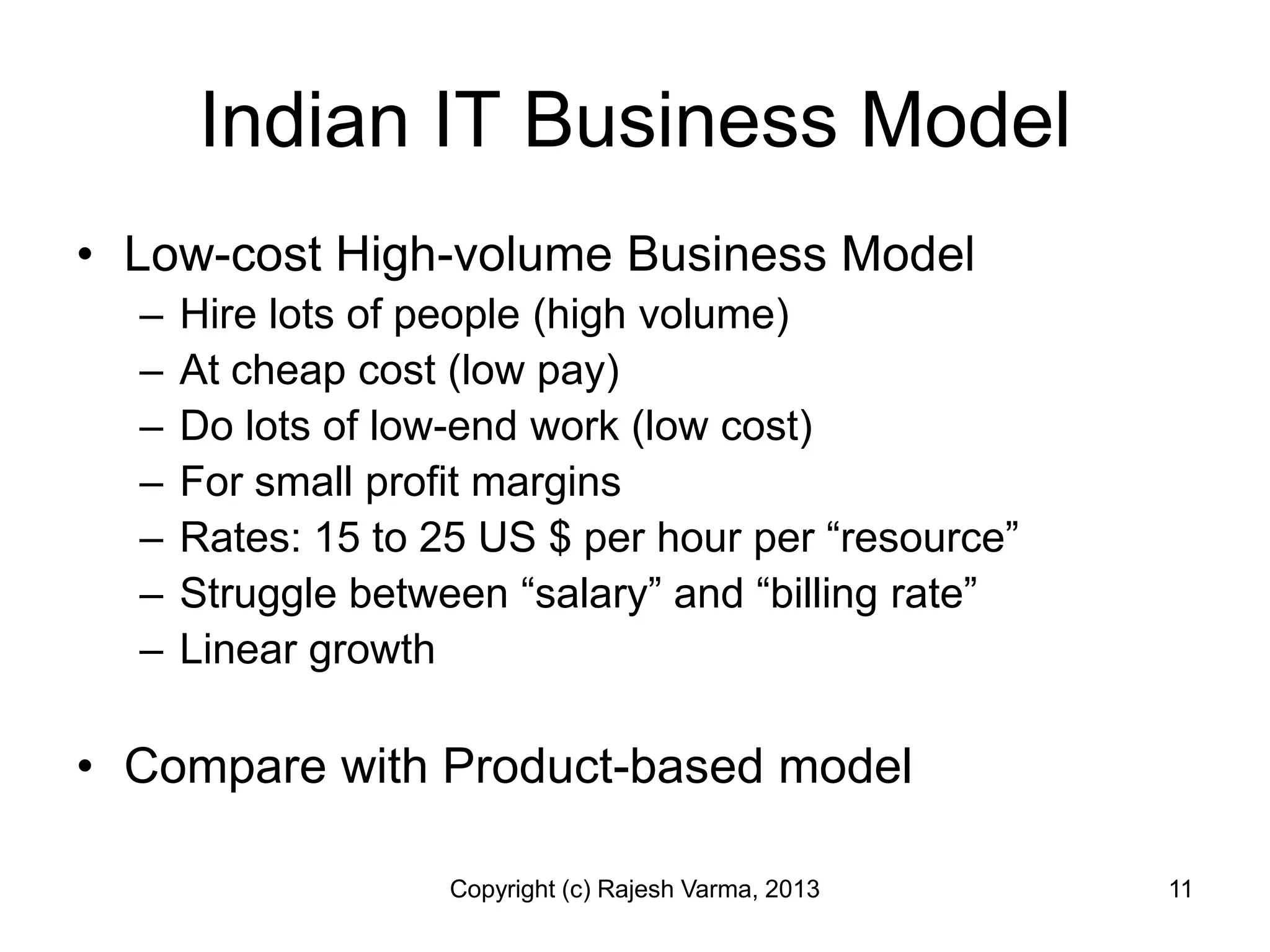
Indian IT Business Model
• Low-cost High-volume Business Model
  –   Hire lots of people (high volume)
  –   At cheap cost (low pay)
  –   Do lots of low-end work (low cost)
  –   For small profit margins
  –   Rates: 15 to 25 US $ per hour per “resource”
  –   Struggle between “salary” and “billing rate”
  –   Linear growth

• Compare with Product-based model

                    Copyright (c) Rajesh Varma, 2013   11
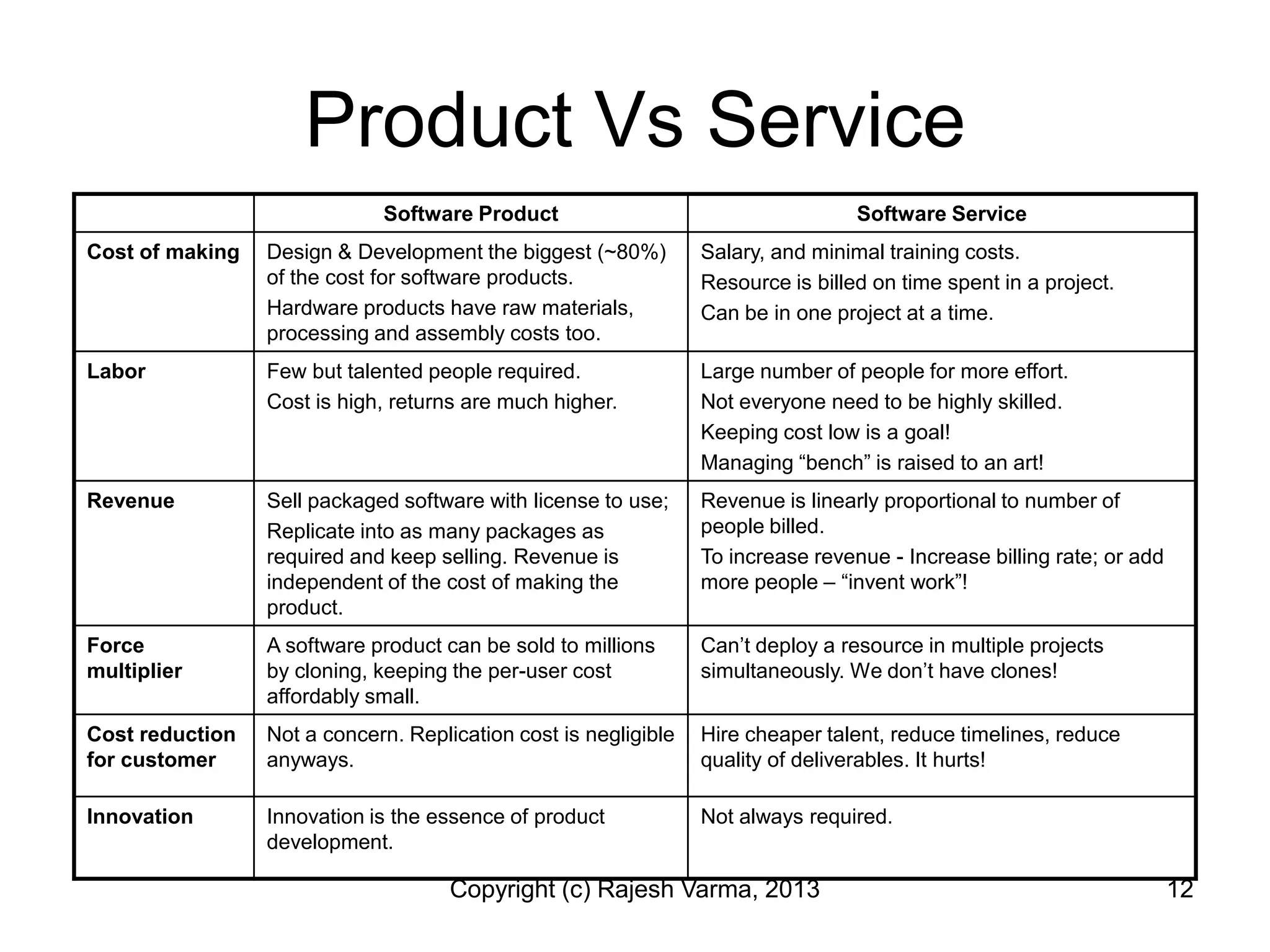
Product Vs Service
                             Software Product                                     Software Service
Cost of making   Design & Development the biggest (~80%)         Salary, and minimal training costs.
                 of the cost for software products.              Resource is billed on time spent in a project.
                 Hardware products have raw materials,           Can be in one project at a time.
                 processing and assembly costs too.
Labor            Few but talented people required.               Large number of people for more effort.
                 Cost is high, returns are much higher.          Not everyone need to be highly skilled.
                                                                 Keeping cost low is a goal!
                                                                 Managing “bench” is raised to an art!
Revenue          Sell packaged software with license to use;     Revenue is linearly proportional to number of
                 Replicate into as many packages as              people billed.
                 required and keep selling. Revenue is           To increase revenue - Increase billing rate; or add
                 independent of the cost of making the           more people – “invent work”!
                 product.
Force            A software product can be sold to millions      Can’t deploy a resource in multiple projects
multiplier       by cloning, keeping the per-user cost           simultaneously. We don’t have clones!
                 affordably small.
Cost reduction   Not a concern. Replication cost is negligible   Hire cheaper talent, reduce timelines, reduce
for customer     anyways.                                        quality of deliverables. It hurts!

Innovation       Innovation is the essence of product            Not always required.
                 development.

                                     Copyright (c) Rajesh Varma, 2013                                                  12
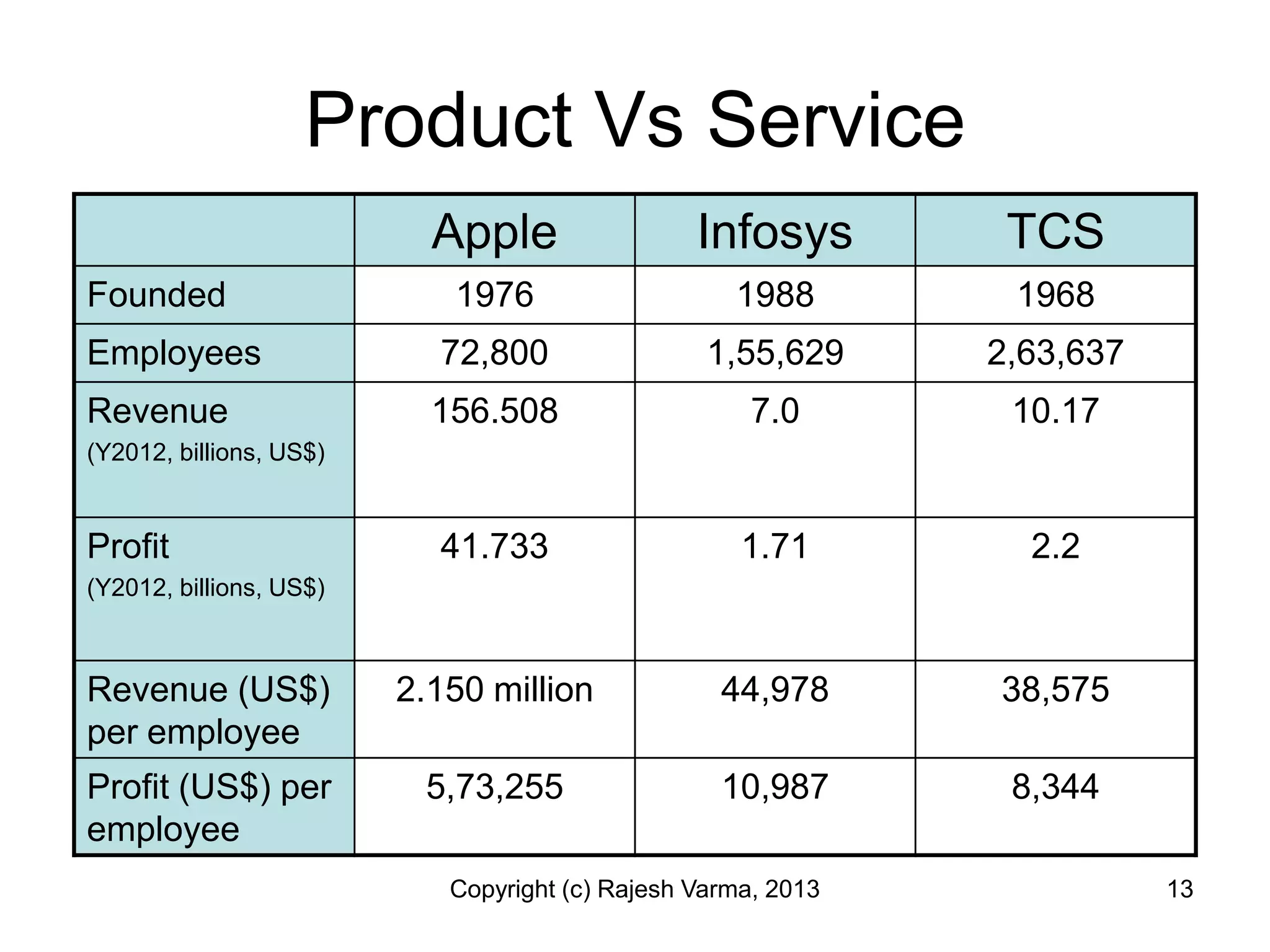
Product Vs Service
                           Apple                 Infosys        TCS
Founded                     1976                    1988        1968
Employees                  72,800                 1,55,629     2,63,637
Revenue                    156.508                    7.0       10.17
(Y2012, billions, US$)


Profit                     41.733                    1.71        2.2
(Y2012, billions, US$)


Revenue (US$)            2.150 million             44,978      38,575
per employee
Profit (US$) per          5,73,255                 10,987       8,344
employee
                            Copyright (c) Rajesh Varma, 2013              13
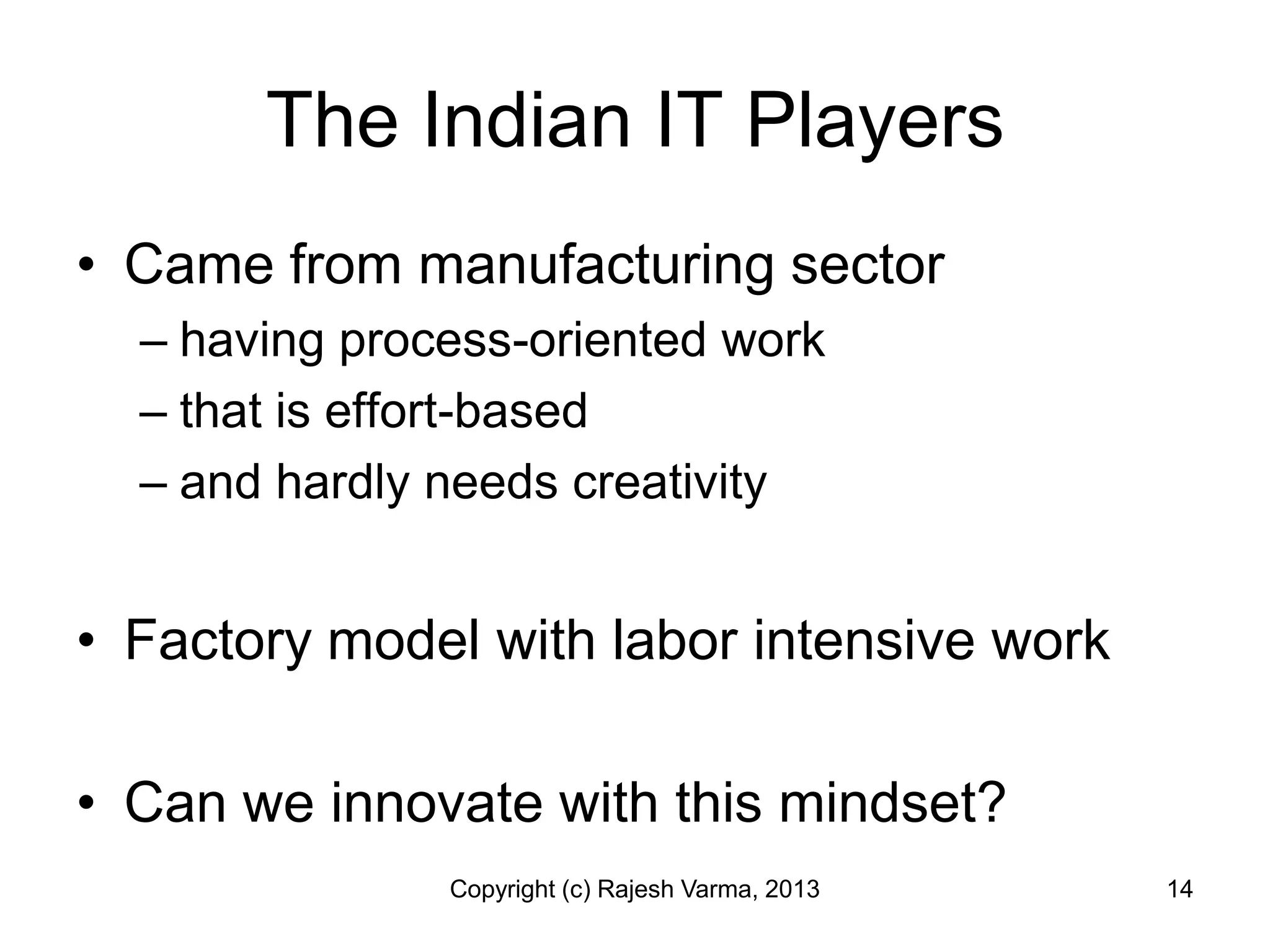
The Indian IT Players
• Came from manufacturing sector
  – having process-oriented work
  – that is effort-based
  – and hardly needs creativity


• Factory model with labor intensive work

• Can we innovate with this mindset?
               Copyright (c) Rajesh Varma, 2013   14
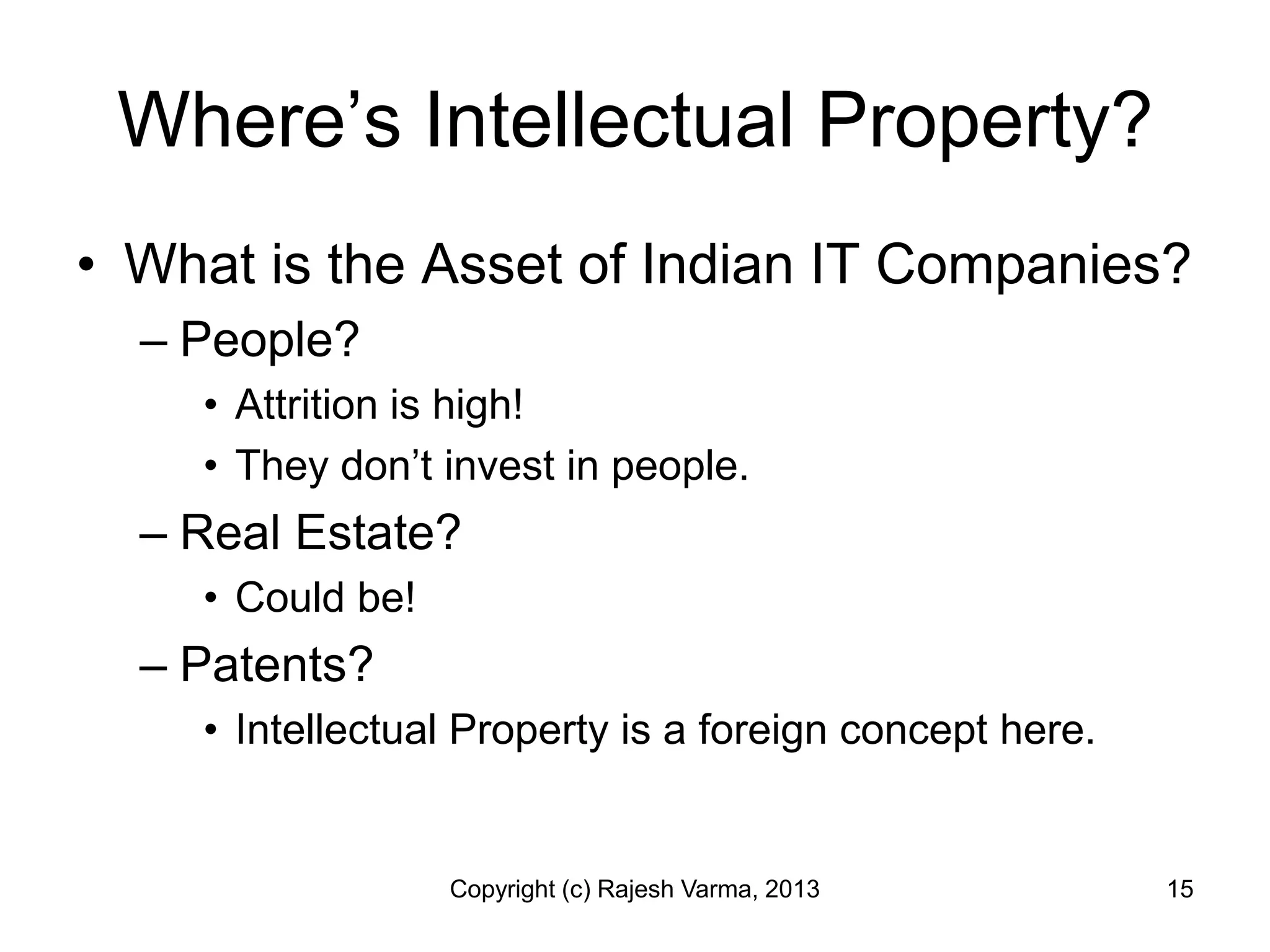
Where’s Intellectual Property?
• What is the Asset of Indian IT Companies?
  – People?
    • Attrition is high!
    • They don’t invest in people.
  – Real Estate?
    • Could be!
  – Patents?
    • Intellectual Property is a foreign concept here.


                  Copyright (c) Rajesh Varma, 2013       15
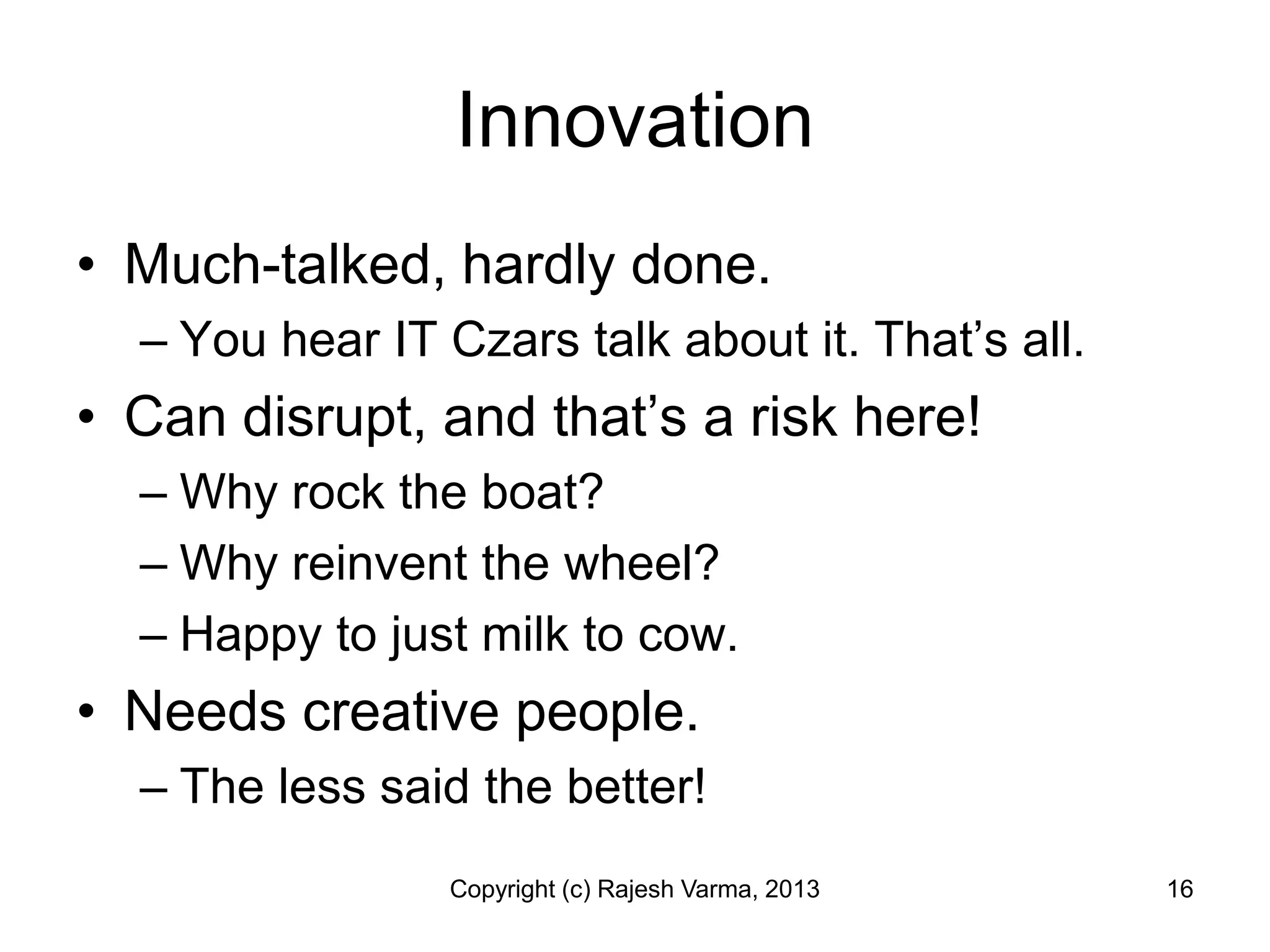
Innovation
• Much-talked, hardly done.
  – You hear IT Czars talk about it. That’s all.
• Can disrupt, and that’s a risk here!
  – Why rock the boat?
  – Why reinvent the wheel?
  – Happy to just milk to cow.
• Needs creative people.
  – The less said the better!
                 Copyright (c) Rajesh Varma, 2013   16
What’s the differentiation?


       Copyright (c) Rajesh Varma, 2013   17
Engineering Education
• IT companies have to set up their own
  training colleges!
• India has 1.5 million seats for Engineering
  students.
  – 3,50,000 engineers produced yearly
  – Many seats are unutilized
     • Many colleges are just operating in sheds.
  – 75 % of the graduates will be unemployable

                  Copyright (c) Rajesh Varma, 2013   18
Conclusion
• Indian IT is still a fledgling industry
• Based on traditional trading business
  model
• Hire talent at low cost
  – Sell manpower making a marginal profit
  – Innovation is very low
• We have an army of engineers
  – But very less intellectual capital
                 Copyright (c) Rajesh Varma, 2013   19
Questions,
suggestions,
brickbats?


Copyright (c) Rajesh Varma, 2013   20

What's Wrong with Indian IT Industry?

  • 1.
    What’s Wrong withIndian IT Industry? Rajesh Varma Feb 5, 2013
  • 2.
    Who am I? •Rajesh Varma – Director of Product Engineering – Pramata Knowledge Solutions Pvt. Ltd. – Bangalore, INDIA. • B.E. (Comp. Sci. & Engg.), – 1993, MSRIT, Bangalore University • Working since 1994. That’s 19 years. Gives me enough dough to talk about. Copyright (c) Rajesh Varma, 2013 2
  • 3.
    Indian IT History… •1950 onwards – Government controlled License Raj thriving. • 1968 – Tatas get into software business. TCS started. • Mid 1970s – High import duties of 150% forces companies like Wipro to manufacture homegrown PCs. Copyright (c) Rajesh Varma, 2013 3
  • 4.
    Indian IT History… •1986 – General Electric expands in India – Six Sigma becomes popular way to measure manufacturing efficiency – Wipro does lots of business with GE • 1991 – Economic Reforms started • 1995 – IT companies get into Y2K related services – Porting and code cleanup business – Dependant on skilled manpower (programming) – IT Business based on cost arbitrage (bodyshopping) Copyright (c) Rajesh Varma, 2013 4
  • 5.
    Indian IT History •2000 – Dot-com bubble bursts in US – Downsizing, layoffs, bankruptcies order of the day – Outsourcing to India accelerates – Indian companies expand to absorb inflow of low-end projects (services, maintenance, support, etc.) • 2003 – India known as low-cost destination for low-end IT work – Lots of forex money – Lots of jobs for one and all – It’s great time! Copyright (c) Rajesh Varma, 2013 5
  • 6.
    Money Matters • WorldwideIT Spending (from Gartner) – Y2013 – $ 3.7 trillion – Surpass $ 4 trillion by Y2015 • Indian IT exports – $ 87 billion in Y2013-14 – Expected revenue as per NASSCOM • Compare: $ 3.7 trillion and $ 87 billion! – Just 2.35 % of the pie Copyright (c) Rajesh Varma, 2013 6
  • 7.
    Are we worldleaders in Information Technology? It’s time to wake up from the dream! Copyright (c) Rajesh Varma, 2013 7
  • 8.
    Is it IT? •Is Indian IT industry really an IT Industry? – What IT stuff do we sell? – IT Products? Or Services? – Mostly selling manpower at hourly rates! • Even NASSCOM calls it IT-BPO. – IT Services 58% – BPO 23% – Engg. R&D, Software Products 19% Copyright (c) Rajesh Varma, 2013 8
  • 9.
    Most Indian IT companies are at these levels. Copyright (c) Rajesh Varma, 2013 9
  • 10.
    IT’s People Power •Direct Employment to 2.8 million people – Added 2,30,000 jobs in year 2012 – Indirectly employing 8.9 million people • Indian Talent (or lack of it) – Only 3.5 % of Indians are graduates (all disciplines) • That’s less than 45 million out of 1.2 billion of us – Only 25 % Engineers are employable – Only 15 % Finance graduates are employable – Only 10 % of other graduates are employable – There’s a talent gap of 5 million people – Only 3 out of 100 applicants get hired Copyright (c) Rajesh Varma, 2013 10
  • 11.
    Indian IT BusinessModel • Low-cost High-volume Business Model – Hire lots of people (high volume) – At cheap cost (low pay) – Do lots of low-end work (low cost) – For small profit margins – Rates: 15 to 25 US $ per hour per “resource” – Struggle between “salary” and “billing rate” – Linear growth • Compare with Product-based model Copyright (c) Rajesh Varma, 2013 11
  • 12.
    Product Vs Service Software Product Software Service Cost of making Design & Development the biggest (~80%) Salary, and minimal training costs. of the cost for software products. Resource is billed on time spent in a project. Hardware products have raw materials, Can be in one project at a time. processing and assembly costs too. Labor Few but talented people required. Large number of people for more effort. Cost is high, returns are much higher. Not everyone need to be highly skilled. Keeping cost low is a goal! Managing “bench” is raised to an art! Revenue Sell packaged software with license to use; Revenue is linearly proportional to number of Replicate into as many packages as people billed. required and keep selling. Revenue is To increase revenue - Increase billing rate; or add independent of the cost of making the more people – “invent work”! product. Force A software product can be sold to millions Can’t deploy a resource in multiple projects multiplier by cloning, keeping the per-user cost simultaneously. We don’t have clones! affordably small. Cost reduction Not a concern. Replication cost is negligible Hire cheaper talent, reduce timelines, reduce for customer anyways. quality of deliverables. It hurts! Innovation Innovation is the essence of product Not always required. development. Copyright (c) Rajesh Varma, 2013 12
  • 13.
    Product Vs Service Apple Infosys TCS Founded 1976 1988 1968 Employees 72,800 1,55,629 2,63,637 Revenue 156.508 7.0 10.17 (Y2012, billions, US$) Profit 41.733 1.71 2.2 (Y2012, billions, US$) Revenue (US$) 2.150 million 44,978 38,575 per employee Profit (US$) per 5,73,255 10,987 8,344 employee Copyright (c) Rajesh Varma, 2013 13
  • 14.
    The Indian ITPlayers • Came from manufacturing sector – having process-oriented work – that is effort-based – and hardly needs creativity • Factory model with labor intensive work • Can we innovate with this mindset? Copyright (c) Rajesh Varma, 2013 14
  • 15.
    Where’s Intellectual Property? •What is the Asset of Indian IT Companies? – People? • Attrition is high! • They don’t invest in people. – Real Estate? • Could be! – Patents? • Intellectual Property is a foreign concept here. Copyright (c) Rajesh Varma, 2013 15
  • 16.
    Innovation • Much-talked, hardlydone. – You hear IT Czars talk about it. That’s all. • Can disrupt, and that’s a risk here! – Why rock the boat? – Why reinvent the wheel? – Happy to just milk to cow. • Needs creative people. – The less said the better! Copyright (c) Rajesh Varma, 2013 16
  • 17.
    What’s the differentiation? Copyright (c) Rajesh Varma, 2013 17
  • 18.
    Engineering Education • ITcompanies have to set up their own training colleges! • India has 1.5 million seats for Engineering students. – 3,50,000 engineers produced yearly – Many seats are unutilized • Many colleges are just operating in sheds. – 75 % of the graduates will be unemployable Copyright (c) Rajesh Varma, 2013 18
  • 19.
    Conclusion • Indian ITis still a fledgling industry • Based on traditional trading business model • Hire talent at low cost – Sell manpower making a marginal profit – Innovation is very low • We have an army of engineers – But very less intellectual capital Copyright (c) Rajesh Varma, 2013 19
  • 20.