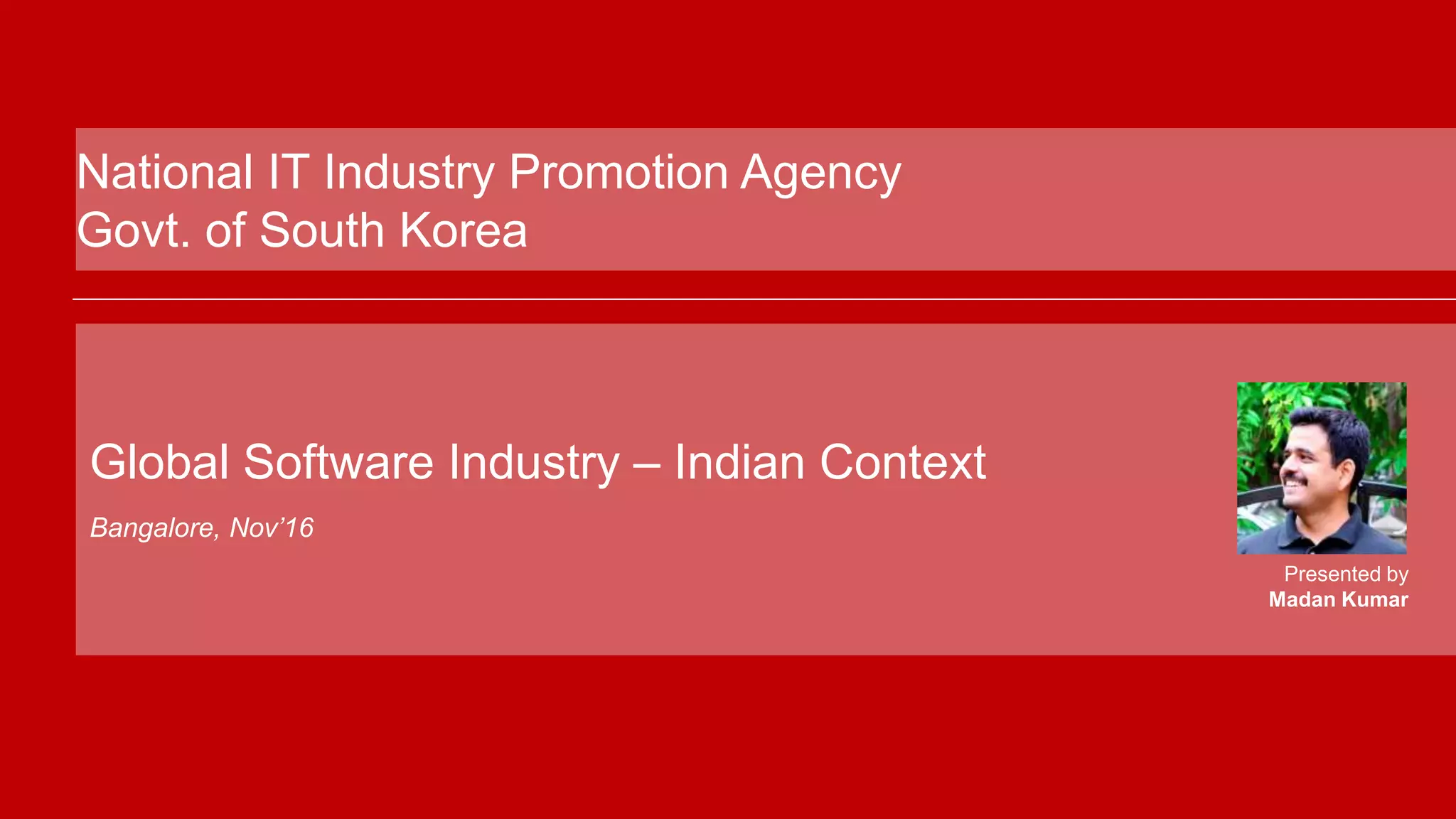
Global Software Industry – Indian Context
Bangalore, Nov’16
National IT Industry Promotion Agency
Govt. of South Korea
Presented by
Madan Kumar
2
Disclaimer
This presentation was delivered by Madan Kumar in an individual capacity at the invitation of the South
Korean trade body. He is in no way representing any company (incl. the one he works for) or participating in
this event with the motive of promoting any specific motive or organization. This activity was also not for
profit.
The content used to shape the point of view presented has been retrieved from publically available sources
identified in the Appendix
3
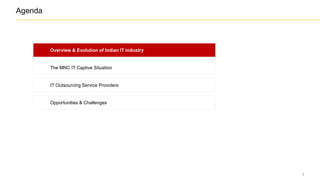
The MNC IT Captive Situation
IT Outsourcing Service Providers
Opportunities & Challenges
Overview & Evolution of Indian IT industry
Agenda
Overview & Evolution of Indian IT industry
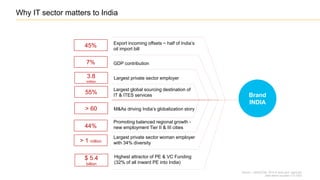
Why IT sector matters to India
GDP contribution
Largest private sector employer
Largest global sourcing destination of
IT & ITES services
Export incoming offsets ~ half of India’s
oil import bill
Promoting balanced regional growth -
new employment Tier II & III cities
Highest attractor of PE & VC Funding
(32% of all inward PE into India)
Brand
INDIA
Largest private sector woman employer
with 34% diversity
M&As driving India’s globalization story> 60
7%
3.8
million
55%
45%
44%
$ 5.4
billion
> 1 million
Source – NASSCOM, 2015 & other govt. agencies
Data above includes IT & ITES
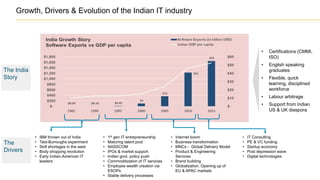
Growth, Drivers & Evolution of the Indian IT industry
• IBM thrown out of India
• Tata-Burroughs experiment
• Skill shortages in the west
• Body shopping revolution
• Early Indian-American IT
leaders
• 1st gen IT entrepreneurship
• Maturing talent pool
• NASSCOM
• IPOs & market support
• Indian govt. policy push
• Commoditization of IT services
• Employee wealth creation via
ESOPs
• Stable delivery processes
• Internet boom
• Business transformation
• MNCs - Global Delivery Model
• Product & Engineering
Services
• Brand building
• Globalization. Opening up of
EU & APAC markets
• IT Consulting
• PE & VC funding
• Startup economy
• Post depression wave
• Digital technologies
The
Drivers
The India
Story
• Certifications (CMMI,
ISO)
• English speaking
graduates
• Flexible, quick
learning, disciplined
workforce
• Labour arbitrage
• Support from Indian
US & UK diaspora
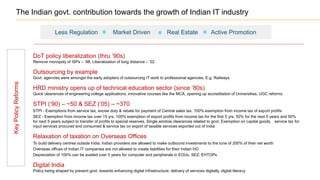
Less Regulation Market Driven Real Estate Active Promotion
The Indian govt. contribution towards the growth of Indian IT industry
DoT policy liberalization (thru ‘90s)
Remove monopoly of ISPs – ‘98, Liberalization of long distance – ‘02
Outsourcing by example
Govt. agencies were amongst the early adopters of outsourcing IT work to professional agencies. E.g. Railways
HRD ministry opens up of technical education sector (since ‘80s)
Quick clearances of engineering college applications, innovative courses like the MCA, opening up accreditation of Universities, UGC reforms
STPI (‘90) – ~50 & SEZ (‘05) – ~370
STPI - Exemptions from service tax, excise duty & rebate for payment of Central sales tax. 100% exemption from income tax of export profits
SEZ - Exemption from income tax over 15 yrs. 100% exemption of export profits from income tax for the first 5 yrs, 50% for the next 5 years and 50%
for next 5 years subject to transfer of profits to special reserves. Single window clearances related to govt. Exemption on capital goods, service tax for
input services procured and consumed & service tax on export of taxable services exported out of India
Relaxation of taxation on Overseas Offices
To build delivery centres outside India, Indian providers are allowed to make outbound investments to the tune of 200% of their net worth
Overseas offices of Indian IT companies are not allowed to create liabilities for their Indian HO
Depreciation of 100% can be availed over 5 years for computer and peripherals in EOUs, SEZ, EHTOPs
Digital India
Policy being shaped by present govt. towards enhancing digital infrastructure, delivery of services digitally, digital literacy
KeyPolicyReforms
7
The MNC IT Captive Situation
IT Outsourcing Service Providers
Opportunities & Challenges
Overview & Evolution of Indian IT industry
Agenda
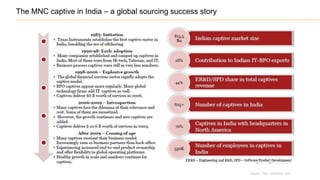
The MNC captive in India – a global sourcing success story
Source – PWC, NASSCON, 2014
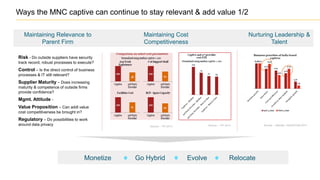
Maintaining Relevance to
Parent Firm
Maintaining Cost
Competitiveness
Nurturing Leadership &
Talent
Risk - Do outside suppliers have security
track record, robust processes to execute?
Control – Is the direct control of business
processes & IT still relevant?
Supplier Maturity – Does increasing
maturity & competence of outside firms
provide confidence?
Mgmt. Attitude -
Value Proposition – Can addl value
cost competitiveness be brought in?
Regulatory – Do possibilities to work
around data privacy
Monetize Go Hybrid Evolve Relocate
Ways the MNC captive can continue to stay relevant & add value 1/2
Source – TPI 2014 Source – TPI 2014 Source – Deloitte / NASSCOM 2014
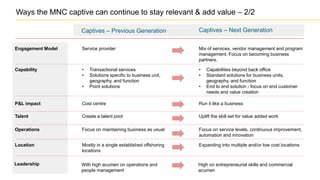
Service provider Mix of services, vendor management and program
management. Focus on becoming business
partners.
Engagement Model
• Transactional services
• Solutions specific to business unit,
geography, and function
• Point solutions
• Capabilities beyond back office
• Standard solutions for business units,
geography, and function
• End to end solution - focus on end customer
needs and value creation
Capability
Cost centre Run it like a businessP&L impact
Create a talent pool Uplift the skill set for value added workTalent
Focus on maintaining business as usual Focus on service levels, continuous improvement,
automation and innovation
Operations
Mostly in a single established offshoring
locations
Expanding into multiple and/or low cost locationsLocation
With high acumen on operations and
people management
High on entrepreneurial skills and commercial
acumen
Leadership
Captives – Previous Generation Captives – Next Generation
Ways the MNC captive can continue to stay relevant & add value – 2/2
The MNC IT Captive Situation
IT Outsourcing Service Providers
Opportunities & Challenges
Overview & Evolution of Indian IT industry
Agenda
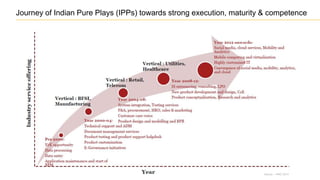
Journey of Indian Pure Plays (IPPs) towards strong execution, maturity & competence
Source – PWC,2014
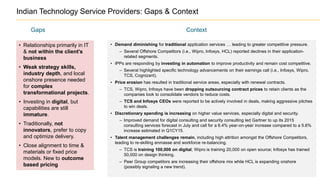
• Relationships primarily in IT
& not within the client’s
business
• Weak strategy skills,
industry depth, and local
onshore presence needed
for complex
transformational projects.
• Investing in digital, but
capabilities are still
immature.
• Traditionally, not
innovators, prefer to copy
and optimize delivery.
• Close alignment to time &
materials or fixed price
models. New to outcome
based pricing
• Demand diminishing for traditional application services … leading to greater competitive pressure.
– Several Offshore Competitors (i.e., Wipro, Infosys, HCL) reported declines in their application-
related segments.
• IPPs are responding by investing in automation to improve productivity and remain cost competitive.
– Several highlighted specific technology advancements on their earnings call (i.e., Infosys, Wipro,
TCS, Cognizant).
• Price erosion has resulted in traditional service areas, especially with renewal contracts.
– TCS, Wipro, Infosys have been dropping outsourcing contract prices to retain clients as the
companies look to consolidate vendors to reduce costs.
– TCS and Infosys CEOs were reported to be actively involved in deals, making aggressive pitches
to win deals.
• Discretionary spending is increasing on higher value services, especially digital and security.
– Improved demand for digital consulting and security consulting led Gartner to up its 2015
consulting services forecast in July and call for a 6.4% year-on-year increase compared to a 5.6%
increase estimated in Q1CY15.
• Talent management challenges remain, including high attrition amongst the Offshore Competitors,
leading to re-skilling enmasse and workforce re-balancing.
– TCS is training 100,000 on digital; Wipro is training 20,000 on open source; Infosys has trained
50,000 on design thinking.
– Peer Group competitors are increasing their offshore mix while HCL is expanding onshore
(possibly signaling a new trend).
Gaps Context
Indian Technology Service Providers: Gaps & Context
The MNC IT Captive Situation
IT Outsourcing Service Providers
Opportunities & Challenges
Overview & Evolution of Indian IT industry
Agenda
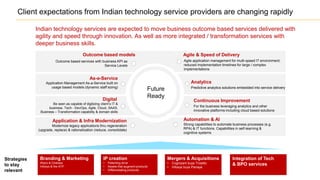
Indian technology services are expected to move business outcome based services delivered with
agility and speed through innovation. As well as more integrated / transformation services with
deeper business skills.
Outcome based models
Outcome based services with business KPI as
Service Levels
Agile & Speed of Delivery
Agile application management for multi-speed IT environment;
reduced implementation timelines for large / complex
implementations
As-a-Service
Digital
Application & Infra Modernization
Continuous Improvement
Automation & AI
Analytics
Strong capabilities to automate business processes (e.g.
RPA) & IT functions. Capabilities in self-learning &
cognitive systems
For the business leveraging analytics and other
innovative platforms including cloud based solutions
Predictive analytics solutions embedded into service delivery
Application Management As-a-Service built on
usage based models (dynamic staff sizing)
Be seen as capable of digitizing client’s IT &
business. Tech - DevOps, Agile, Cloud, SAAS,
Business – Transformation capability & domain skills
Modernize legacy applications thru regeneration
(upgrade, replace) & rationalization (reduce, consolidate)
Client expectations from Indian technology service providers are changing rapidly
Future
Ready
Branding & Marketing
Wipro & Chelsea
Infosys & the ATP
IP creation
• Patenting drive
• Assets that augment products
• Differentiating products
Mergers & Acquisitions
• Cognizant buys Trizetto
• Infosys buys Panaya
Integration of Tech
& BPO services
Strategies
to stay
relevant
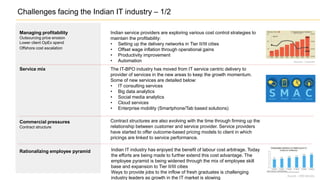
Challenges facing the Indian IT industry – 1/2
Managing profitability
Outsourcing price erosion
Lower client OpEx spend
Offshore cost escalation
Indian service providers are exploring various cost control strategies to
maintain the profitability:
• Setting up the delivery networks in Tier II/III cities
• Offset wage inflation through operational gains
• Productivity improvement
• Automation
Contract structures are also evolving with the time through firming up the
relationship between customer and service provider. Service providers
have started to offer outcome-based pricing models to client in which
pricings are linked to service performance.
The IT-BPO industry has moved from IT service centric delivery to
provider of services in the new areas to keep the growth momentum.
Some of new services are detailed below:
• IT consulting services
• Big data analytics
• Social media analytics
• Cloud services
• Enterprise mobility (Smartphone/Tab based solutions)
Service mix
Commercial pressures
Contract structure
Indian IT industry has enjoyed the benefit of labour cost arbitrage. Today
the efforts are being made to further extend this cost advantage. The
employee pyramid is being widened through the mix of employee skill
base and expansion to Tier II/III cities
Ways to provide jobs to the inflow of fresh graduates is challenging
industry leaders as growth in the IT market is slowing
Rationalizing employee pyramid
Source - Livemint
Source – HRD Ministry
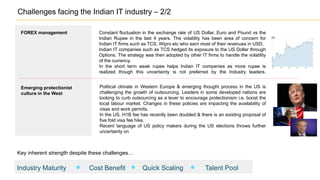
FOREX management Constant fluctuation in the exchange rate of US Dollar, Euro and Pound vs the
Indian Rupee in the last 4 years. The volatility has been area of concern for
Indian IT firms such as TCS, Wipro etc who earn most of their revenues in USD.
Indian IT companies such as TCS hedged its exposure to the US Dollar through
Options. The strategy was then adopted by other IT firms to handle the volatility
of the currency.
In the short term weak rupee helps Indian IT companies as more rupee is
realized though this uncertainty is not preferred by the Industry leaders.
Political climate in Western Europe & emerging thought process in the US is
challenging the growth of outsourcing. Leaders in some developed nations are
looking to curb outsourcing as a lever to encourage protectionism i.e. boost the
local labour market. Changes in these policies are impacting the availability of
visas and work permits.
In the US, H1B fee has recently been doubled & there is an existing proposal of
five fold visa fee hike.
Recent language of US policy makers during the US elections throws further
uncertainty on
Emerging protectionist
culture in the West
Challenges facing the Indian IT industry – 2/2
Industry Maturity Cost Benefit Quick Scaling Talent Pool
Key inherent strength despite these challenges…
Appendix
Sources
• NASSCOM – various data points related to the Indian IT industry
• HRD Ministry, RBI & reports published by other Indian govt. agencies
• Livemint
• The Hindu
• ISG & TPI Research – data points on captives
• Yahoo Finance – Forex trends USD vs INR
• Infosys Research
• PWC Consulting – study on sourcing by Soumen Mukherji
• World Bank – GDP & global financial data
• Venture Intelligence
• IIM Ahmedabad – study on Indian IT Industry by Subhash Bhatnagar et al.
• Deloitte
• Gartner
• Horses for Sources
• Image sources - UKIP, Donald Trump, Twitter & The Independent
19

A perspective on Indian IT Industry

  • 1.
    Global Software Industry– Indian Context Bangalore, Nov’16 National IT Industry Promotion Agency Govt. of South Korea Presented by Madan Kumar
  • 2.
    2 Disclaimer This presentation wasdelivered by Madan Kumar in an individual capacity at the invitation of the South Korean trade body. He is in no way representing any company (incl. the one he works for) or participating in this event with the motive of promoting any specific motive or organization. This activity was also not for profit. The content used to shape the point of view presented has been retrieved from publically available sources identified in the Appendix
  • 3.
    3 The MNC ITCaptive Situation IT Outsourcing Service Providers Opportunities & Challenges Overview & Evolution of Indian IT industry Agenda Overview & Evolution of Indian IT industry
  • 4.
    Why IT sectormatters to India GDP contribution Largest private sector employer Largest global sourcing destination of IT & ITES services Export incoming offsets ~ half of India’s oil import bill Promoting balanced regional growth - new employment Tier II & III cities Highest attractor of PE & VC Funding (32% of all inward PE into India) Brand INDIA Largest private sector woman employer with 34% diversity M&As driving India’s globalization story> 60 7% 3.8 million 55% 45% 44% $ 5.4 billion > 1 million Source – NASSCOM, 2015 & other govt. agencies Data above includes IT & ITES
  • 5.
    Growth, Drivers &Evolution of the Indian IT industry • IBM thrown out of India • Tata-Burroughs experiment • Skill shortages in the west • Body shopping revolution • Early Indian-American IT leaders • 1st gen IT entrepreneurship • Maturing talent pool • NASSCOM • IPOs & market support • Indian govt. policy push • Commoditization of IT services • Employee wealth creation via ESOPs • Stable delivery processes • Internet boom • Business transformation • MNCs - Global Delivery Model • Product & Engineering Services • Brand building • Globalization. Opening up of EU & APAC markets • IT Consulting • PE & VC funding • Startup economy • Post depression wave • Digital technologies The Drivers The India Story • Certifications (CMMI, ISO) • English speaking graduates • Flexible, quick learning, disciplined workforce • Labour arbitrage • Support from Indian US & UK diaspora
  • 6.
    Less Regulation MarketDriven Real Estate Active Promotion The Indian govt. contribution towards the growth of Indian IT industry DoT policy liberalization (thru ‘90s) Remove monopoly of ISPs – ‘98, Liberalization of long distance – ‘02 Outsourcing by example Govt. agencies were amongst the early adopters of outsourcing IT work to professional agencies. E.g. Railways HRD ministry opens up of technical education sector (since ‘80s) Quick clearances of engineering college applications, innovative courses like the MCA, opening up accreditation of Universities, UGC reforms STPI (‘90) – ~50 & SEZ (‘05) – ~370 STPI - Exemptions from service tax, excise duty & rebate for payment of Central sales tax. 100% exemption from income tax of export profits SEZ - Exemption from income tax over 15 yrs. 100% exemption of export profits from income tax for the first 5 yrs, 50% for the next 5 years and 50% for next 5 years subject to transfer of profits to special reserves. Single window clearances related to govt. Exemption on capital goods, service tax for input services procured and consumed & service tax on export of taxable services exported out of India Relaxation of taxation on Overseas Offices To build delivery centres outside India, Indian providers are allowed to make outbound investments to the tune of 200% of their net worth Overseas offices of Indian IT companies are not allowed to create liabilities for their Indian HO Depreciation of 100% can be availed over 5 years for computer and peripherals in EOUs, SEZ, EHTOPs Digital India Policy being shaped by present govt. towards enhancing digital infrastructure, delivery of services digitally, digital literacy KeyPolicyReforms
  • 7.
    7 The MNC ITCaptive Situation IT Outsourcing Service Providers Opportunities & Challenges Overview & Evolution of Indian IT industry Agenda
  • 8.
    The MNC captivein India – a global sourcing success story Source – PWC, NASSCON, 2014
  • 9.
    Maintaining Relevance to ParentFirm Maintaining Cost Competitiveness Nurturing Leadership & Talent Risk - Do outside suppliers have security track record, robust processes to execute? Control – Is the direct control of business processes & IT still relevant? Supplier Maturity – Does increasing maturity & competence of outside firms provide confidence? Mgmt. Attitude - Value Proposition – Can addl value cost competitiveness be brought in? Regulatory – Do possibilities to work around data privacy Monetize Go Hybrid Evolve Relocate Ways the MNC captive can continue to stay relevant & add value 1/2 Source – TPI 2014 Source – TPI 2014 Source – Deloitte / NASSCOM 2014
  • 10.
    Service provider Mixof services, vendor management and program management. Focus on becoming business partners. Engagement Model • Transactional services • Solutions specific to business unit, geography, and function • Point solutions • Capabilities beyond back office • Standard solutions for business units, geography, and function • End to end solution - focus on end customer needs and value creation Capability Cost centre Run it like a businessP&L impact Create a talent pool Uplift the skill set for value added workTalent Focus on maintaining business as usual Focus on service levels, continuous improvement, automation and innovation Operations Mostly in a single established offshoring locations Expanding into multiple and/or low cost locationsLocation With high acumen on operations and people management High on entrepreneurial skills and commercial acumen Leadership Captives – Previous Generation Captives – Next Generation Ways the MNC captive can continue to stay relevant & add value – 2/2
  • 11.
    The MNC ITCaptive Situation IT Outsourcing Service Providers Opportunities & Challenges Overview & Evolution of Indian IT industry Agenda
  • 12.
    Journey of IndianPure Plays (IPPs) towards strong execution, maturity & competence Source – PWC,2014
  • 13.
    • Relationships primarilyin IT & not within the client’s business • Weak strategy skills, industry depth, and local onshore presence needed for complex transformational projects. • Investing in digital, but capabilities are still immature. • Traditionally, not innovators, prefer to copy and optimize delivery. • Close alignment to time & materials or fixed price models. New to outcome based pricing • Demand diminishing for traditional application services … leading to greater competitive pressure. – Several Offshore Competitors (i.e., Wipro, Infosys, HCL) reported declines in their application- related segments. • IPPs are responding by investing in automation to improve productivity and remain cost competitive. – Several highlighted specific technology advancements on their earnings call (i.e., Infosys, Wipro, TCS, Cognizant). • Price erosion has resulted in traditional service areas, especially with renewal contracts. – TCS, Wipro, Infosys have been dropping outsourcing contract prices to retain clients as the companies look to consolidate vendors to reduce costs. – TCS and Infosys CEOs were reported to be actively involved in deals, making aggressive pitches to win deals. • Discretionary spending is increasing on higher value services, especially digital and security. – Improved demand for digital consulting and security consulting led Gartner to up its 2015 consulting services forecast in July and call for a 6.4% year-on-year increase compared to a 5.6% increase estimated in Q1CY15. • Talent management challenges remain, including high attrition amongst the Offshore Competitors, leading to re-skilling enmasse and workforce re-balancing. – TCS is training 100,000 on digital; Wipro is training 20,000 on open source; Infosys has trained 50,000 on design thinking. – Peer Group competitors are increasing their offshore mix while HCL is expanding onshore (possibly signaling a new trend). Gaps Context Indian Technology Service Providers: Gaps & Context
  • 14.
    The MNC ITCaptive Situation IT Outsourcing Service Providers Opportunities & Challenges Overview & Evolution of Indian IT industry Agenda
  • 15.
    Indian technology servicesare expected to move business outcome based services delivered with agility and speed through innovation. As well as more integrated / transformation services with deeper business skills. Outcome based models Outcome based services with business KPI as Service Levels Agile & Speed of Delivery Agile application management for multi-speed IT environment; reduced implementation timelines for large / complex implementations As-a-Service Digital Application & Infra Modernization Continuous Improvement Automation & AI Analytics Strong capabilities to automate business processes (e.g. RPA) & IT functions. Capabilities in self-learning & cognitive systems For the business leveraging analytics and other innovative platforms including cloud based solutions Predictive analytics solutions embedded into service delivery Application Management As-a-Service built on usage based models (dynamic staff sizing) Be seen as capable of digitizing client’s IT & business. Tech - DevOps, Agile, Cloud, SAAS, Business – Transformation capability & domain skills Modernize legacy applications thru regeneration (upgrade, replace) & rationalization (reduce, consolidate) Client expectations from Indian technology service providers are changing rapidly Future Ready Branding & Marketing Wipro & Chelsea Infosys & the ATP IP creation • Patenting drive • Assets that augment products • Differentiating products Mergers & Acquisitions • Cognizant buys Trizetto • Infosys buys Panaya Integration of Tech & BPO services Strategies to stay relevant
  • 16.
    Challenges facing theIndian IT industry – 1/2 Managing profitability Outsourcing price erosion Lower client OpEx spend Offshore cost escalation Indian service providers are exploring various cost control strategies to maintain the profitability: • Setting up the delivery networks in Tier II/III cities • Offset wage inflation through operational gains • Productivity improvement • Automation Contract structures are also evolving with the time through firming up the relationship between customer and service provider. Service providers have started to offer outcome-based pricing models to client in which pricings are linked to service performance. The IT-BPO industry has moved from IT service centric delivery to provider of services in the new areas to keep the growth momentum. Some of new services are detailed below: • IT consulting services • Big data analytics • Social media analytics • Cloud services • Enterprise mobility (Smartphone/Tab based solutions) Service mix Commercial pressures Contract structure Indian IT industry has enjoyed the benefit of labour cost arbitrage. Today the efforts are being made to further extend this cost advantage. The employee pyramid is being widened through the mix of employee skill base and expansion to Tier II/III cities Ways to provide jobs to the inflow of fresh graduates is challenging industry leaders as growth in the IT market is slowing Rationalizing employee pyramid Source - Livemint Source – HRD Ministry
  • 17.
    FOREX management Constantfluctuation in the exchange rate of US Dollar, Euro and Pound vs the Indian Rupee in the last 4 years. The volatility has been area of concern for Indian IT firms such as TCS, Wipro etc who earn most of their revenues in USD. Indian IT companies such as TCS hedged its exposure to the US Dollar through Options. The strategy was then adopted by other IT firms to handle the volatility of the currency. In the short term weak rupee helps Indian IT companies as more rupee is realized though this uncertainty is not preferred by the Industry leaders. Political climate in Western Europe & emerging thought process in the US is challenging the growth of outsourcing. Leaders in some developed nations are looking to curb outsourcing as a lever to encourage protectionism i.e. boost the local labour market. Changes in these policies are impacting the availability of visas and work permits. In the US, H1B fee has recently been doubled & there is an existing proposal of five fold visa fee hike. Recent language of US policy makers during the US elections throws further uncertainty on Emerging protectionist culture in the West Challenges facing the Indian IT industry – 2/2 Industry Maturity Cost Benefit Quick Scaling Talent Pool Key inherent strength despite these challenges…
  • 18.
  • 19.
    Sources • NASSCOM –various data points related to the Indian IT industry • HRD Ministry, RBI & reports published by other Indian govt. agencies • Livemint • The Hindu • ISG & TPI Research – data points on captives • Yahoo Finance – Forex trends USD vs INR • Infosys Research • PWC Consulting – study on sourcing by Soumen Mukherji • World Bank – GDP & global financial data • Venture Intelligence • IIM Ahmedabad – study on Indian IT Industry by Subhash Bhatnagar et al. • Deloitte • Gartner • Horses for Sources • Image sources - UKIP, Donald Trump, Twitter & The Independent 19