Emergence Of
SMALL FINANCE
BANKS
AND CHANGING DIMENSIONS OF BANKING IN INDIA
Presented by-
Pune Performing Assets
 Now let us have a look at the era before SFB
and understand the need to introduce SFB.
India before SFBs…….
 35% of the adult population had a bank account. Thus 500 million adults
were left out.
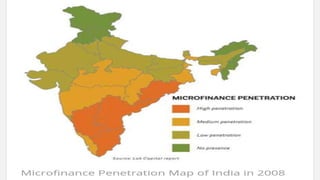
 Low income states along with the north eastern states form the majority of
the population, yet had extremely poor banking penetration.
 These LISs and NESs had 85.7 million low income households, having an
unfulfilled credit demand of roughly 18.3 trillion INR (295 billion USD) and
the potential to bring 21.4 trillion INR (USD 345 billion) in the system.
 The rural banking sector was served by MFIs which had multiple restrictions
and provided a very limited range of banking products.
 India has 597,608 villages, out of which 592,927 villages with
population below 10,000. 268454 villages with population above
2000 covered by PMJDY and other FI schemes.
 324473 of these villages were still out of the financial landscape.
Need for SFBs……
 Deepening rather than widening
 Diversification
 Low cost structure
 Changed Funding model
 Impact on Customer Financial Well
being
The Making…….
 In 2004, RBI formed “Khan commission” for incorporating financial inclusion.
 Former finance minister Arun Jaitley announced in union budget for 2014-15
that RBI will create guidelines for licensing small finance Banks.
 On 27th Nov 2014 RBI released guidelines for licensing of small and
payments banks.
 External Advisory Committee headed by Former deputy Governor of RBI,
Usha Thorat was formed to analyze and evaluate applications for SFB.
 On 5th Dec 2019, RBI released on its website, “Guidelines for Licensing of
Small Finance Banks in the Private Sector” which provided major changes
from the earlier guidelines.
Regulations and Acts
 Registered as public limited companies under
Companies Act, 2013.
 Licensed under section 22 of the Banking
Regulation Act, 1949.
 Governed by Reserve Bank of India Act,1934;
Banking Regulation Act,1949; FEMA,1999;
Payment and Settlement Systems Act,2007.
Eligibility Criteria…..
 Resident individuals/professionals singly or jointly,
each having at least 10 years of experience in banking
and finance are eligible to become a promoter. Ex-
ESAF SFB
 Companies and Societies in the private sector, that are
owned and controlled by residents and have a
successful track record of running businesses for at
least a period of five years. Ex- AU SFB.
 Existing NBFCs, MFIs and LABs in the private sector,
that are controlled by residents and have a successful
track record of running their businesses for at least a
period of five years. Ex- Ujjivan SFB, Jana SFB, Equitos
SFB.
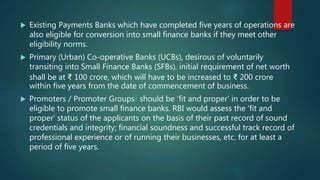
 Existing Payments Banks which have completed five years of operations are
also eligible for conversion into small finance banks if they meet other
eligibility norms.
 Primary (Urban) Co-operative Banks (UCBs), desirous of voluntarily
transiting into Small Finance Banks (SFBs), initial requirement of net worth
shall be at ₹ 100 crore, which will have to be increased to ₹ 200 crore
within five years from the date of commencement of business.
 Promoters / Promoter Groups1 should be ‘fit and proper’ in order to be
eligible to promote small finance banks. RBI would assess the ‘fit and
proper’ status of the applicants on the basis of their past record of sound
credentials and integrity; financial soundness and successful track record of
professional experience or of running their businesses, etc. for at least a
period of five years.
RBI Guidelines for SFBs….
 The minimum paid-up capital for small finance banks shall be ₹ 200 crore, except for such
small finance banks which are transited from UCBs and those which are converted from
NBFC/MFI/LAB/PB.
 Required to maintain a minimum capital adequacy ratio of 15% of its risk weighted assets
(RWA) on a continuous basis.
 The promoters to hold a minimum of 40% of the paid-up voting equity capital of the bank
during the first five years from the date of commencement of business.
 The promoters’ stake should be brought down to a maximum of 30% of the equity capital of
the bank within a period of 10 years, and to a maximum of 15% within 15 years from the
date of commencement of business.
 Entities other than the promoters not permitted to have shareholding in excess of 10% of
the paid-up voting equity capital of the bank. In case of existing NBFCs/MFIs/LABs
converting, if shareholding in excess of 10% of the equity capital by entities other than the
promoters, RBI may consider providing time up to 3 years for the shareholding to be
brought down to a maximum of 10%.
 In case of SFBs which are transited from UCBs the promoters shall hold a minimum of
26% of equity capital during the first five years from commencement of business.
Promoters’ holding may be brought down to 15 % over a period of 15 years from the
date of reaching net worth of ₹ 200 crores.
 Any acquisition of 5 % or more of paid-up share capital in a SFB or voting rights therein
will require prior approval of RBI.
 The SFB will be subject to all prudential norms of RBI as applicable to commercial banks
including requirement of maintenance of CRR and SLR.
 The bank will be required to extend 75 per cent of its Credit to the sectors eligible for
classification as priority sector lending (PSL) by RBI.
 In order to ensure that the bank extends loans primarily to small borrowers, at least
50% of its loan portfolio should constitute loans and advances of up to ₹ 25 lakh.
Additional conditions for NBFCs/MFIs/LABs/PBs
 The entity shall have a minimum net worth of ₹ 200 crore.
 If not, then it shall infuse additional paid-up voting equity capital to
achieve net worth of ₹ 200 crore within eighteen months from the
date of approval.
 The branches of the NBFC / MFI / PB should either be converted
into bank branches within a period of three years from the date of
commencement of operations or be merged / closed.
Products and services….
 Accepting deposits
 Loans
 Sell forex to customers.
 Third Party Products like insurance,
mutual funds, pension plans etc.
 Locker Facility
 Debit Cards
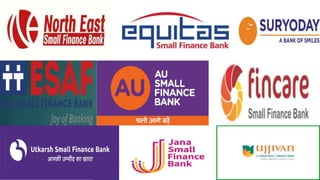
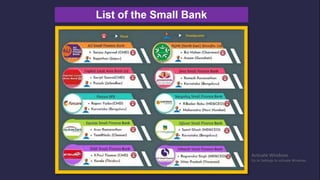
SFBs active in India….
Limitations…..
 Limitations in extending loans (50% loans <= 25
lakhs).
 Maximum loan size to single or group borrowers
cannot exceed 15% of the net capital.
 The small finance bank cannot be a Business
Correspondent (BC) for another bank. However, it
can have its own BC network.
 They cannot set up subsidiaries.
 For first 3 years, 25% of their branches should be in
unbanked rural areas.
Changing dimensions……
 SFBs will be given scheduled bank status immediately and will be allowed
to open banking outlets from the date of commencement of operations
 RBI will appoint a Standing External Advisory Committee (SEAC) with a
tenure of three years to process applications
 Successful applicants will be granted an 'in-principle' approval, which will
be valid for 18 months.
 The listing of SFB will be mandatory within three years after it reaches the
net worth of Rs 500 crore for the first time.
 A task force has been set up for studying the logistics and feasibility of
converting IPPB into an SFB.
THANK YOU

Small finance bank

  • 1.
    Emergence Of SMALL FINANCE BANKS ANDCHANGING DIMENSIONS OF BANKING IN INDIA Presented by- Pune Performing Assets
  • 2.
     Now letus have a look at the era before SFB and understand the need to introduce SFB.
  • 3.
    India before SFBs……. 35% of the adult population had a bank account. Thus 500 million adults were left out.  Low income states along with the north eastern states form the majority of the population, yet had extremely poor banking penetration.  These LISs and NESs had 85.7 million low income households, having an unfulfilled credit demand of roughly 18.3 trillion INR (295 billion USD) and the potential to bring 21.4 trillion INR (USD 345 billion) in the system.  The rural banking sector was served by MFIs which had multiple restrictions and provided a very limited range of banking products.
  • 4.
     India has597,608 villages, out of which 592,927 villages with population below 10,000. 268454 villages with population above 2000 covered by PMJDY and other FI schemes.  324473 of these villages were still out of the financial landscape.
  • 5.
    Need for SFBs…… Deepening rather than widening  Diversification  Low cost structure  Changed Funding model  Impact on Customer Financial Well being
  • 6.
    The Making…….  In2004, RBI formed “Khan commission” for incorporating financial inclusion.  Former finance minister Arun Jaitley announced in union budget for 2014-15 that RBI will create guidelines for licensing small finance Banks.  On 27th Nov 2014 RBI released guidelines for licensing of small and payments banks.  External Advisory Committee headed by Former deputy Governor of RBI, Usha Thorat was formed to analyze and evaluate applications for SFB.  On 5th Dec 2019, RBI released on its website, “Guidelines for Licensing of Small Finance Banks in the Private Sector” which provided major changes from the earlier guidelines.
  • 7.
    Regulations and Acts Registered as public limited companies under Companies Act, 2013.  Licensed under section 22 of the Banking Regulation Act, 1949.  Governed by Reserve Bank of India Act,1934; Banking Regulation Act,1949; FEMA,1999; Payment and Settlement Systems Act,2007.
  • 8.
    Eligibility Criteria…..  Residentindividuals/professionals singly or jointly, each having at least 10 years of experience in banking and finance are eligible to become a promoter. Ex- ESAF SFB  Companies and Societies in the private sector, that are owned and controlled by residents and have a successful track record of running businesses for at least a period of five years. Ex- AU SFB.  Existing NBFCs, MFIs and LABs in the private sector, that are controlled by residents and have a successful track record of running their businesses for at least a period of five years. Ex- Ujjivan SFB, Jana SFB, Equitos SFB.
  • 9.
     Existing PaymentsBanks which have completed five years of operations are also eligible for conversion into small finance banks if they meet other eligibility norms.  Primary (Urban) Co-operative Banks (UCBs), desirous of voluntarily transiting into Small Finance Banks (SFBs), initial requirement of net worth shall be at ₹ 100 crore, which will have to be increased to ₹ 200 crore within five years from the date of commencement of business.  Promoters / Promoter Groups1 should be ‘fit and proper’ in order to be eligible to promote small finance banks. RBI would assess the ‘fit and proper’ status of the applicants on the basis of their past record of sound credentials and integrity; financial soundness and successful track record of professional experience or of running their businesses, etc. for at least a period of five years.
  • 10.
  • 11.
    RBI Guidelines forSFBs….  The minimum paid-up capital for small finance banks shall be ₹ 200 crore, except for such small finance banks which are transited from UCBs and those which are converted from NBFC/MFI/LAB/PB.  Required to maintain a minimum capital adequacy ratio of 15% of its risk weighted assets (RWA) on a continuous basis.  The promoters to hold a minimum of 40% of the paid-up voting equity capital of the bank during the first five years from the date of commencement of business.  The promoters’ stake should be brought down to a maximum of 30% of the equity capital of the bank within a period of 10 years, and to a maximum of 15% within 15 years from the date of commencement of business.  Entities other than the promoters not permitted to have shareholding in excess of 10% of the paid-up voting equity capital of the bank. In case of existing NBFCs/MFIs/LABs converting, if shareholding in excess of 10% of the equity capital by entities other than the promoters, RBI may consider providing time up to 3 years for the shareholding to be brought down to a maximum of 10%.
  • 12.
     In caseof SFBs which are transited from UCBs the promoters shall hold a minimum of 26% of equity capital during the first five years from commencement of business. Promoters’ holding may be brought down to 15 % over a period of 15 years from the date of reaching net worth of ₹ 200 crores.  Any acquisition of 5 % or more of paid-up share capital in a SFB or voting rights therein will require prior approval of RBI.  The SFB will be subject to all prudential norms of RBI as applicable to commercial banks including requirement of maintenance of CRR and SLR.  The bank will be required to extend 75 per cent of its Credit to the sectors eligible for classification as priority sector lending (PSL) by RBI.  In order to ensure that the bank extends loans primarily to small borrowers, at least 50% of its loan portfolio should constitute loans and advances of up to ₹ 25 lakh.
  • 13.
    Additional conditions forNBFCs/MFIs/LABs/PBs  The entity shall have a minimum net worth of ₹ 200 crore.  If not, then it shall infuse additional paid-up voting equity capital to achieve net worth of ₹ 200 crore within eighteen months from the date of approval.  The branches of the NBFC / MFI / PB should either be converted into bank branches within a period of three years from the date of commencement of operations or be merged / closed.
  • 14.
    Products and services…. Accepting deposits  Loans  Sell forex to customers.  Third Party Products like insurance, mutual funds, pension plans etc.  Locker Facility  Debit Cards
  • 15.
    SFBs active inIndia….
  • 17.
    Limitations…..  Limitations inextending loans (50% loans <= 25 lakhs).  Maximum loan size to single or group borrowers cannot exceed 15% of the net capital.  The small finance bank cannot be a Business Correspondent (BC) for another bank. However, it can have its own BC network.  They cannot set up subsidiaries.  For first 3 years, 25% of their branches should be in unbanked rural areas.
  • 18.
    Changing dimensions……  SFBswill be given scheduled bank status immediately and will be allowed to open banking outlets from the date of commencement of operations  RBI will appoint a Standing External Advisory Committee (SEAC) with a tenure of three years to process applications  Successful applicants will be granted an 'in-principle' approval, which will be valid for 18 months.  The listing of SFB will be mandatory within three years after it reaches the net worth of Rs 500 crore for the first time.  A task force has been set up for studying the logistics and feasibility of converting IPPB into an SFB.
  • 19.