
Supervisor : Rebecca B. Newman, MD
Attending, General Internal Medicine
Assistant Professor of Clinical Medicine, NYMC
Medical Director, APCC, Cedarwood Hall/ WMC
Presenter : Jagjit Khosla, MBBS (simply “Jags”)
PGY1, Internal Medicine, NYMC at WMC
What’s trending in Sinusitis
In the Clinic…
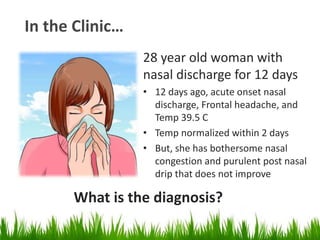
28 year old woman with
nasal discharge for 12 days
• 12 days ago, acute onset nasal
discharge, Frontal headache, and
Temp 39.5 C
• Temp normalized within 2 days
• But, she has bothersome nasal
congestion and purulent post nasal
drip that does not improve
What is the diagnosis?
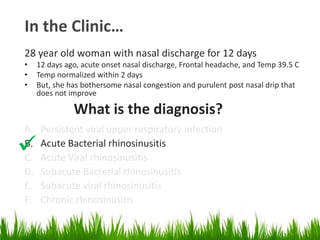
In the Clinic…
28 year old woman with nasal discharge for 12 days
• 12 days ago, acute onset nasal discharge, Frontal headache, and Temp 39.5 C
• Temp normalized within 2 days
• But, she has bothersome nasal congestion and purulent post nasal drip that
does not improve
What is the diagnosis?
A. Persistent viral upper respiratory infection
B. Acute Bacterial rhinosinusitis
C. Acute Viral rhinosinusitis
D. Subacute Bacterial rhinosinusitis
E. Subacute viral rhinosinusitis
F. Chronic rhinosinusitis
Defining and Diagnosing…
Rhinosinusitis
By Jagjit Khosla
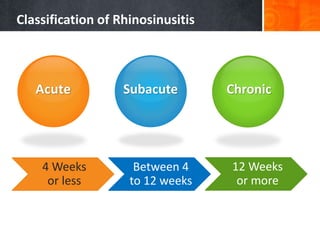
Classification of Rhinosinusitis
Acute Subacute Chronic
4 Weeks
or less
Between 4
to 12 weeks
12 Weeks
or more
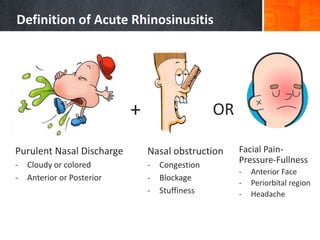
Definition of Acute Rhinosinusitis
Purulent Nasal Discharge
- Cloudy or colored
- Anterior or Posterior
+ OR
Nasal obstruction
- Congestion
- Blockage
- Stuffiness
Facial Pain-
Pressure-Fullness
- Anterior Face
- Periorbital region
- Headache
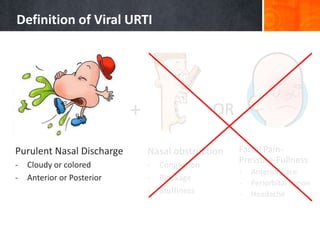
Definition of Viral URTI
Purulent Nasal Discharge
- Cloudy or colored
- Anterior or Posterior
+ OR
Nasal obstruction
- Congestion
- Blockage
- Stuffiness
Facial Pain-
Pressure-Fullness
- Anterior Face
- Periorbital region
- Headache
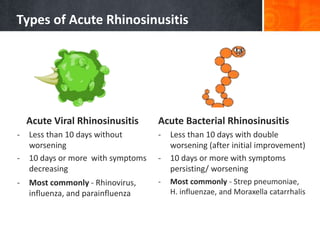
Types of Acute Rhinosinusitis
Acute Bacterial Rhinosinusitis
- Less than 10 days with double
worsening (after initial improvement)
- 10 days or more with symptoms
persisting/ worsening
Acute Viral Rhinosinusitis
- Less than 10 days without
worsening
- 10 days or more with symptoms
decreasing
- Most commonly - Rhinovirus,
influenza, and parainfluenza
- Most commonly - Strep pneumoniae,
H. influenzae, and Moraxella catarrhalis
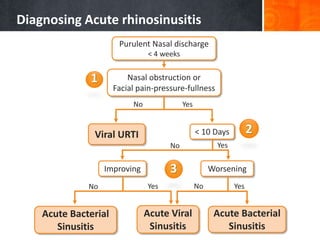
Diagnosing Acute rhinosinusitis
Purulent Nasal discharge
< 4 weeks
Nasal obstruction or
Facial pain-pressure-fullness
No Yes
Viral URTI < 10 Days
No Yes
WorseningImproving
No Yes
Acute Viral
Sinusitis
Acute Bacterial
Sinusitis
No Yes
Acute Bacterial
Sinusitis
1
2
3
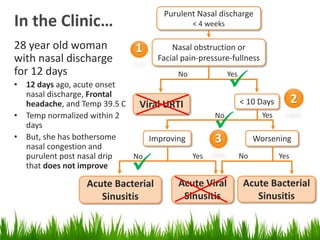
In the Clinic…
28 year old woman
with nasal discharge
for 12 days
• 12 days ago, acute onset
nasal discharge, Frontal
headache, and Temp 39.5 C
• Temp normalized within 2
days
• But, she has bothersome
nasal congestion and
purulent post nasal drip
that does not improve
Purulent Nasal discharge
< 4 weeks
Nasal obstruction or
Facial pain-pressure-fullness
No Yes
Viral URTI < 10 Days
No Yes
WorseningImproving
No Yes
Acute Viral
Sinusitis
Acute Bacterial
Sinusitis
No Yes
Acute Bacterial
Sinusitis



1
2
3
In the Clinic…
28 year old woman with nasal discharge for 12 days
• 12 days ago, acute onset nasal discharge, Frontal headache, and Temp 39.5 C
• Temp normalized within 2 days
• But, she has bothersome nasal congestion and purulent post nasal drip that
does not improve
What is the diagnosis?
A. Persistent viral upper respiratory infection
B. Acute Bacterial rhinosinusitis
C. Acute Viral rhinosinusitis
D. Subacute Bacterial rhinosinusitis
E. Subacute viral rhinosinusitis
F. Chronic rhinosinusitis

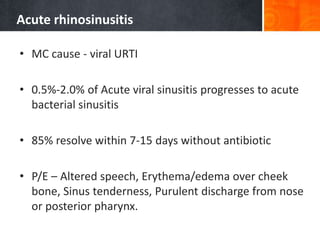
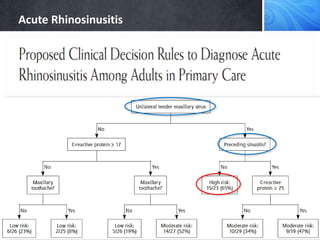
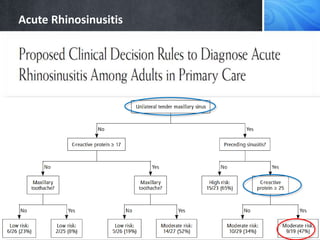
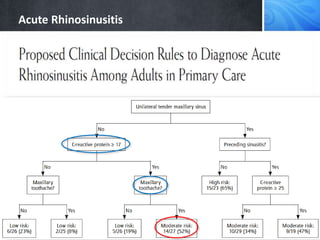
Acute rhinosinusitis
• MC cause - viral URTI
• 0.5%-2.0% of Acute viral sinusitis progresses to acute
bacterial sinusitis
• 85% resolve within 7-15 days without antibiotic
• P/E – Altered speech, Erythema/edema over cheek
bone, Sinus tenderness, Purulent discharge from nose
or posterior pharynx.
Acute rhinosinusitis
• Diagnostic testing not indicated
– unless complications suspected (orbital cellulitis, subperiosteal
abscess)
• CT scan is the best imaging method
• Never culture nasal discharge.
– Exception- DM/Immunocompromised not responding to Amox-clav
for 72 hours (Think atypical or resistant organism),
OR Temp >39C, Nasal crusting or severe facial pain (Think fungal)
• Sinus biopsy or aspirate is the gold standard.
Acute rhinosinusitis
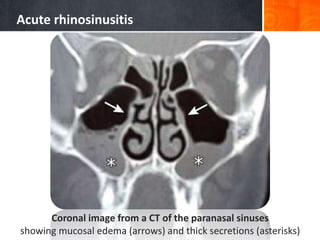
Coronal image from a CT of the paranasal sinuses
showing mucosal edema (arrows) and thick secretions (asterisks)
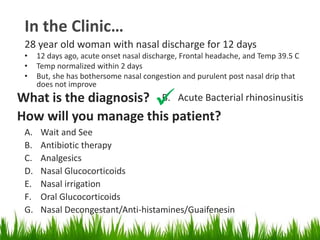
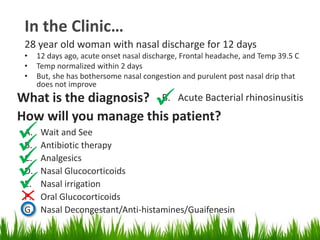
In the Clinic…
28 year old woman with nasal discharge for 12 days
• 12 days ago, acute onset nasal discharge, Frontal headache, and Temp 39.5 C
• Temp normalized within 2 days
• But, she has bothersome nasal congestion and purulent post nasal drip that
does not improve
What is the diagnosis? B. Acute Bacterial rhinosinusitis
How will you manage this patient?
A. Wait and See
B. Antibiotic therapy
C. Analgesics
D. Nasal Glucocorticoids
E. Nasal irrigation
F. Oral Glucocorticoids
G. Nasal Decongestant/Anti-histamines/Guaifenesin
Managing…
Rhinosinusitis
By Jagjit Khosla
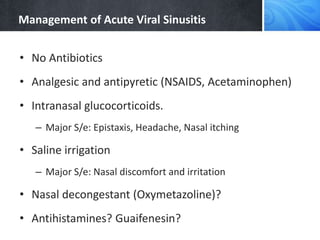
Management of Acute Viral Sinusitis
• No Antibiotics
• Analgesic and antipyretic (NSAIDS, Acetaminophen)
• Intranasal glucocorticoids.
– Major S/e: Epistaxis, Headache, Nasal itching
• Saline irrigation
– Major S/e: Nasal discomfort and irritation
• Nasal decongestant (Oxymetazoline)?
• Antihistamines? Guaifenesin?
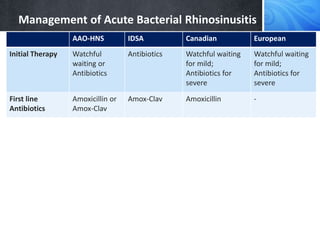
Management of Acute Bacterial Rhinosinusitis
Many guidelines
• American Academy of Otolaryngology – Head and Neck
Surgery (AAO-HNS)
• Infectious Diseases Society of America (IDSA)
• American College of Physicians (ACP) and Centers for
Disease Control and Prevention (CDCP)
• Canadian Clinical Practice Guideline
• European Position Statement
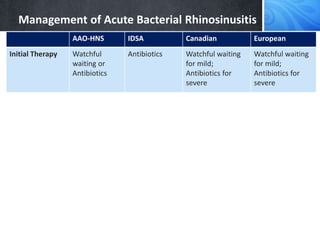
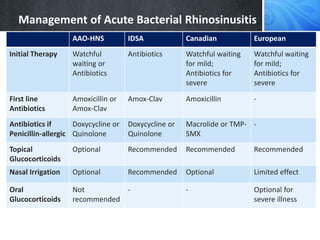
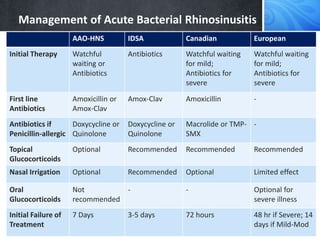
Management of Acute Bacterial Rhinosinusitis
AAO-HNS IDSA Canadian European
Initial Therapy Watchful
waiting or
Antibiotics
Antibiotics Watchful waiting
for mild;
Antibiotics for
severe
Watchful waiting
for mild;
Antibiotics for
severe
First line
Antibiotics
Amoxicillin or
Amox-Clav
Amox-Clav Amoxicillin -
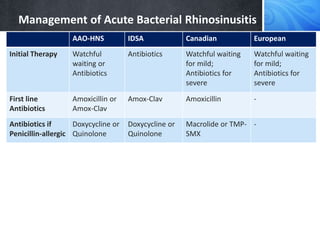
Antibiotics if
Pen-allergic
Doxycycline or
Quinolone
Doxycycline or
Quinolone
Macrolide or TMP-
SMX
-
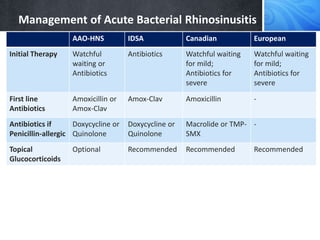
Topical
Glucocorticoids
Optional Recommended Recommended Recommended
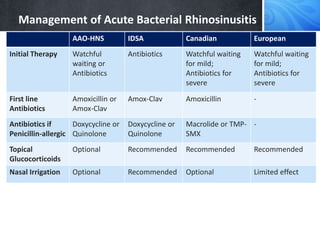
Nasal Irrigation Optional Recommended Optional Limited effect
Oral
Glucocorticoids
Not
recommended
- - Optional for
severe illness
Initial Failure of
Treatment
7 Days 3-5 days 72 hours 48 hr if Severe; 14
days if Mild-Mod
Management of Acute Bacterial Rhinosinusitis
AAO-HNS IDSA Canadian European
Initial Therapy Watchful
waiting or
Antibiotics
Antibiotics Watchful waiting
for mild;
Antibiotics for
severe
Watchful waiting
for mild;
Antibiotics for
severe
First line
Antibiotics
Amoxicillin or
Amox-Clav
Amox-Clav Amoxicillin -
Antibiotics if
Pen-allergic
Doxycycline or
Quinolone
Doxycycline or
Quinolone
Macrolide or TMP-
SMX
-
Topical
Glucocorticoids
Optional Recommended Recommended Recommended
Nasal Irrigation Optional Recommended Optional Limited effect
Oral
Glucocorticoids
Not
recommended
- - Optional for
severe illness
Initial Failure of
Treatment
7 Days 3-5 days 72 hours 48 hr if Severe; 14
days if Mild-Mod
Management of Acute Bacterial Rhinosinusitis
AAO-HNS IDSA Canadian European
Initial Therapy Watchful
waiting or
Antibiotics
Antibiotics Watchful waiting
for mild;
Antibiotics for
severe
Watchful waiting
for mild;
Antibiotics for
severe
First line
Antibiotics
Amoxicillin or
Amox-Clav
Amox-Clav Amoxicillin -
Antibiotics if
Pen-allergic
Doxycycline or
Quinolone
Doxycycline or
Quinolone
Macrolide or TMP-
SMX
-
Topical
Glucocorticoids
Optional Recommended Recommended Recommended
Nasal Irrigation Optional Recommended Optional Limited effect
Oral
Glucocorticoids
Not
recommended
- - Optional for
severe illness
Initial Failure of
Treatment
7 Days 3-5 days 72 hours 48 hr if Severe; 14
days if Mild-Mod
Management of Acute Bacterial Rhinosinusitis
AAO-HNS IDSA Canadian European
Initial Therapy Watchful
waiting or
Antibiotics
Antibiotics Watchful waiting
for mild;
Antibiotics for
severe
Watchful waiting
for mild;
Antibiotics for
severe
First line
Antibiotics
Amoxicillin or
Amox-Clav
Amox-Clav Amoxicillin -
Antibiotics if
Penicillin-allergic
Doxycycline or
Quinolone
Doxycycline or
Quinolone
Macrolide or TMP-
SMX
-
Topical
Glucocorticoids
Optional Recommended Recommended Recommended
Nasal Irrigation Optional Recommended Optional Limited effect
Oral
Glucocorticoids
Not
recommended
- - Optional for
severe illness
Initial Failure of
Treatment
7 Days 3-5 days 72 hours 48 hr if Severe; 14
days if Mild-Mod
Management of Acute Bacterial Rhinosinusitis
AAO-HNS IDSA Canadian European
Initial Therapy Watchful
waiting or
Antibiotics
Antibiotics Watchful waiting
for mild;
Antibiotics for
severe
Watchful waiting
for mild;
Antibiotics for
severe
First line
Antibiotics
Amoxicillin or
Amox-Clav
Amox-Clav Amoxicillin -
Antibiotics if
Penicillin-allergic
Doxycycline or
Quinolone
Doxycycline or
Quinolone
Macrolide or TMP-
SMX
-
Topical
Glucocorticoids
Optional Recommended Recommended Recommended
Nasal Irrigation Optional Recommended Optional Limited effect
Oral
Glucocorticoids
Not
recommended
- - Optional for
severe illness
Initial Failure of
Treatment
7 Days 3-5 days 72 hours 48 hr if Severe; 14
days if Mild-Mod
Management of Acute Bacterial Rhinosinusitis
AAO-HNS IDSA Canadian European
Initial Therapy Watchful
waiting or
Antibiotics
Antibiotics Watchful waiting
for mild;
Antibiotics for
severe
Watchful waiting
for mild;
Antibiotics for
severe
First line
Antibiotics
Amoxicillin or
Amox-Clav
Amox-Clav Amoxicillin -
Antibiotics if
Penicillin-allergic
Doxycycline or
Quinolone
Doxycycline or
Quinolone
Macrolide or TMP-
SMX
-
Topical
Glucocorticoids
Optional Recommended Recommended Recommended
Nasal Irrigation Optional Recommended Optional Limited effect
Oral
Glucocorticoids
Not
recommended
- - Optional for
severe illness
Initial Failure of
Treatment
7 Days 3-5 days 72 hours 48 hr if Severe; 14
days if Mild-Mod
Management of Acute Bacterial Rhinosinusitis
AAO-HNS IDSA Canadian European
Initial Therapy Watchful
waiting or
Antibiotics
Antibiotics Watchful waiting
for mild;
Antibiotics for
severe
Watchful waiting
for mild;
Antibiotics for
severe
First line
Antibiotics
Amoxicillin or
Amox-Clav
Amox-Clav Amoxicillin -
Antibiotics if
Penicillin-allergic
Doxycycline or
Quinolone
Doxycycline or
Quinolone
Macrolide or TMP-
SMX
-
Topical
Glucocorticoids
Optional Recommended Recommended Recommended
Nasal Irrigation Optional Recommended Optional Limited effect
Oral
Glucocorticoids
Not
recommended
- - Optional for
severe illness
Initial Failure of
Treatment
7 Days 3-5 days 72 hours 48 hr if Severe; 14
days if Mild-Mod
Management of Acute Bacterial Rhinosinusitis
AAO-HNS IDSA Canadian European
Initial Therapy Watchful
waiting or
Antibiotics
Antibiotics Watchful waiting
for mild;
Antibiotics for
severe
Watchful waiting
for mild;
Antibiotics for
severe
First line
Antibiotics
Amoxicillin or
Amox-Clav
Amox-Clav Amoxicillin -
Antibiotics if
Penicillin-allergic
Doxycycline or
Quinolone
Doxycycline or
Quinolone
Macrolide or TMP-
SMX
-
Topical
Glucocorticoids
Optional Recommended Recommended Recommended
Nasal Irrigation Optional Recommended Optional Limited effect
Oral
Glucocorticoids
Not
recommended
- - Optional for
severe illness
Initial Failure of
Treatment
7 Days 3-5 days 72 hours 48 hr if Severe; 14
days if Mild-Mod
Management of Acute Bacterial Rhinosinusitis
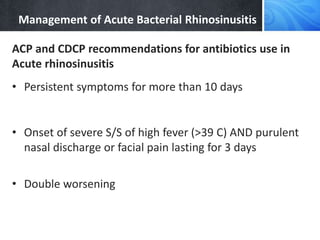
ACP and CDCP recommendations for antibiotics use in
Acute rhinosinusitis
• Persistent symptoms for more than 10 days
• Onset of severe S/S of high fever (>39 C) AND purulent
nasal discharge or facial pain lasting for 3 days
• Double worsening
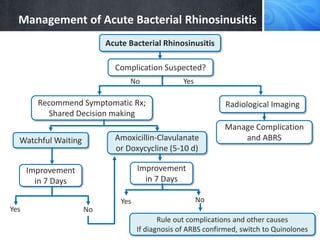
Management of Acute Bacterial Rhinosinusitis
Acute Bacterial Rhinosinusitis
No
Complication Suspected?
Yes
Radiological Imaging
Manage Complication
and ABRS
Recommend Symptomatic Rx;
Shared Decision making
Watchful Waiting Amoxicillin-Clavulanate
or Doxycycline (5-10 d)
Improvement
in 7 Days
Improvement
in 7 Days
Yes No
Yes No
Rule out complications and other causes
If diagnosis of ARBS confirmed, switch to Quinolones
Management of Acute Bacterial Rhinosinusitis
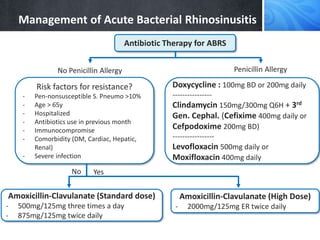
Antibiotic Therapy for ABRS
Risk factors for resistance?
- Pen-nonsusceptible S. Pneumo >10%
- Age > 65y
- Hospitalized
- Antibiotics use in previous month
- Immunocompromise
- Comorbidity (DM, Cardiac, Hepatic,
Renal)
- Severe infection
No Penicillin Allergy Penicillin Allergy
No Yes
Amoxicillin-Clavulanate (Standard dose)
- 500mg/125mg three times a day
- 875mg/125mg twice daily
Amoxicillin-Clavulanate (High Dose)
- 2000mg/125mg ER twice daily
Doxycycline : 100mg BD or 200mg daily
----------------
Clindamycin 150mg/300mg Q6H + 3rd
Gen. Cephal. (Cefixime 400mg daily or
Cefpodoxime 200mg BD)
-----------------
Levofloxacin 500mg daily or
Moxifloxacin 400mg daily
Management of Acute Bacterial Rhinosinusitis
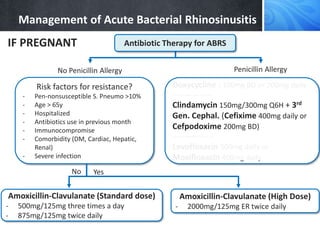
Risk factors for resistance?
- Pen-nonsusceptible S. Pneumo >10%
- Age > 65y
- Hospitalized
- Antibiotics use in previous month
- Immunocompromise
- Comorbidity (DM, Cardiac, Hepatic,
Renal)
- Severe infection
No Penicillin Allergy Penicillin Allergy
No
Amoxicillin-Clavulanate (Standard dose)
- 500mg/125mg three times a day
- 875mg/125mg twice daily
Amoxicillin-Clavulanate (High Dose)
- 2000mg/125mg ER twice daily
Doxycycline : 100mg BD or 200mg daily
----------------
Clindamycin 150mg/300mg Q6H + 3rd
Gen. Cephal. (Cefixime 400mg daily or
Cefpodoxime 200mg BD)
-----------------
Levofloxacin 500mg daily or
Moxifloxacin 400mg daily
IF PREGNANT Antibiotic Therapy for ABRS
Yes
Management of Acute Bacterial Rhinosinusitis
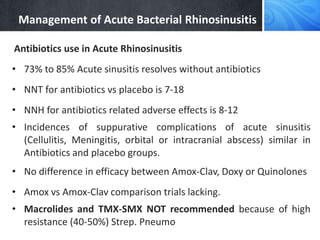
Antibiotics use in Acute Rhinosinusitis
• 73% to 85% Acute sinusitis resolves without antibiotics
• NNT for antibiotics vs placebo is 7-18
• NNH for antibiotics related adverse effects is 8-12
• Incidences of suppurative complications of acute sinusitis
(Cellulitis, Meningitis, orbital or intracranial abscess) similar in
Antibiotics and placebo groups.
• No difference in efficacy between Amox-Clav, Doxy or Quinolones
• Amox vs Amox-Clav comparison trials lacking.
• Macrolides and TMX-SMX NOT recommended because of high
resistance (40-50%) Strep. Pneumo
Management of Acute Bacterial Rhinosinusitis
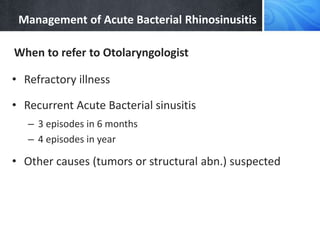
When to refer to Otolaryngologist
• Refractory illness
• Recurrent Acute Bacterial sinusitis
– 3 episodes in 6 months
– 4 episodes in year
• Other causes (tumors or structural abn.) suspected
Acute Rhinosinusitis
A. Wait and See
B. Antibiotic therapy
C. Analgesics
D. Nasal Glucocorticoids
E. Nasal irrigation
F. Oral Glucocorticoids
G. Nasal Decongestant/Anti-histamines/Guaifenesin
In the Clinic…
28 year old woman with nasal discharge for 12 days
• 12 days ago, acute onset nasal discharge, Frontal headache, and Temp 39.5 C
• Temp normalized within 2 days
• But, she has bothersome nasal congestion and purulent post nasal drip that
does not improve
What is the diagnosis? B. Acute Bacterial rhinosinusitis
How will you manage this patient?

Chronic Rhinosinusitis
By Jagjit Khosla
Definition of Chronic Rhinosinusitis
Chronic rhinosinusitis
1. Two or more of following for 12 weeks or longer
- Mucopurulent drainage
- Nasal obstruction
- Facial pain-pressure-fullness
- Decreased sense of smell
AND
2. Documented Inflammation
- Purulent mucus or edema
- Nasal polyps
- Radiographic imaging
Subtypes of Chronic Rhinosinusitis
1. CRS with Nasal Polyposis – 25%
• Bilateral nasal polyps in the middle meatus
• Associated with asthma and adverse reactions to aspirin and other NSAIDs
• Aspirin-exacerbated respiratory disease (AERD) – Asthma + CRS with NP +
Aspirin Sensitivity
2. Allergic Fungal Rhinosinusitis – 10%
• Young patients from the southern United States.
• Presents dramatically with complete nasal obstruction, gross facial
asymmetry, and/or visual changes
• Allergic mucin that contains viable fungal hyphae (fungal staining or
culture)
• IgE-mediated allergy to one or more fungi
3. CRS without Nasal Polyposis – 65%
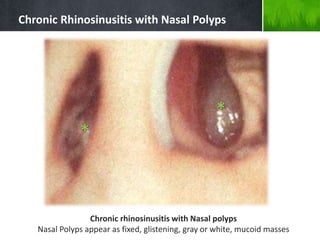
Chronic Rhinosinusitis with Nasal Polyps
Chronic rhinosinusitis with Nasal polyps
Nasal Polyps appear as fixed, glistening, gray or white, mucoid masses
*
*
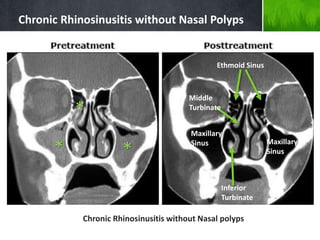
Chronic Rhinosinusitis without Nasal Polyps
Chronic Rhinosinusitis without Nasal polyps
Ethmoid Sinus
Maxillary
Sinus Maxillary
Sinus
Middle
Turbinate
Inferior
Turbinate
* *
*
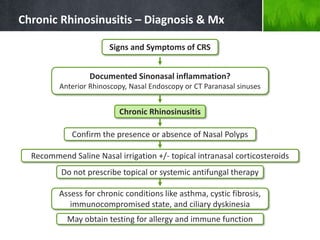
Chronic Rhinosinusitis – Diagnosis & Mx
Signs and Symptoms of CRS
Documented Sinonasal inflammation?
Anterior Rhinoscopy, Nasal Endoscopy or CT Paranasal sinuses
Chronic Rhinosinusitis
Confirm the presence or absence of Nasal Polyps
Recommend Saline Nasal irrigation +/- topical intranasal corticosteroids
Do not prescribe topical or systemic antifungal therapy
Assess for chronic conditions like asthma, cystic fibrosis,
immunocompromised state, and ciliary dyskinesia
May obtain testing for allergy and immune function
Questions
By Jagjit Khosla
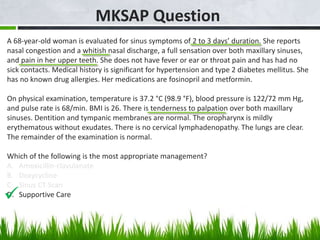
MKSAP Question
A 68-year-old woman is evaluated for sinus symptoms of 2 to 3 days’ duration. She reports
nasal congestion and a whitish nasal discharge, a full sensation over both maxillary sinuses,
and pain in her upper teeth. She does not have fever or ear or throat pain and has had no
sick contacts. Medical history is significant for hypertension and type 2 diabetes mellitus. She
has no known drug allergies. Her medications are fosinopril and metformin.
On physical examination, temperature is 37.2 °C (98.9 °F), blood pressure is 122/72 mm Hg,
and pulse rate is 68/min. BMI is 26. There is tenderness to palpation over both maxillary
sinuses. Dentition and tympanic membranes are normal. The oropharynx is mildly
erythematous without exudates. There is no cervical lymphadenopathy. The lungs are clear.
The remainder of the examination is normal.
Which of the following is the most appropriate management?
A. Amoxicillin-clavulanate
B. Doxycycline
C. Sinus CT Scan
D. Supportive Care

MKSAP Question
Key Point
Intranasal glucocorticoids, antihistamines, and topical decongestants are all appropriate for initial
treatment of acute sinusitis; antibiotics should not be used initially.
This patient, who has acute sinusitis, should be managed with supportive care. Acute sinusitis is most
commonly caused by viral infections associated with the common cold, and it has a bacterial etiology in
only a small percentage of cases. Acute sinusitis is characterized by symptoms of nasal congestion and
obstruction; facial pain, pressure, and fullness that generally worsen when bending forward; headache;
purulent nasal discharge; and maxillary tooth pain. When caused by viral infection, fever may be present
within the first 24 to 48 hours of symptom onset, often associated with other symptoms such as myalgia
and fatigue, but temperature normalizes after this time period. Bacterial sinusitis is more likely if there are
severe symptoms associated with a high fever for at least 3 or 4 consecutive days following the onset of
illness or if symptoms are persistent (lasting more than 10 days). Initial treatment of acute sinusitis is
focused on symptom relief with analgesics, decongestants (systemic or topical), antihistamines, intranasal
glucocorticoids, and nasal saline irrigation, and these treatment options would be the most appropriate
therapy in this patient who does not have findings concerning for a possible bacterial etiology. Antibiotics
are not indicated in this patient at this time. Although more than 90% of cases of acute sinusitis are viral in
origin, antibiotics are regularly prescribed for patients presenting with acute sinusitis symptoms. Antibiotics
should be reserved for patients with persistent and severe symptoms (such as high fever and marked
facial pain), progressively worsening symptoms, or failure to improve after 10 daysof supportive care. If
antibiotics are indicated, both amoxicillin-clavulanate and doxycycline would be appropriate first-line
agents. Although this patient has purulent nasal discharge, the acute nature of the symptoms makes
antibiotics inappropriate at this time. Imaging with plain radiographs or CT is rarely needed in acute sinusitis
and does not help in distinguishing a bacterial from viral cause.
A Presentation by Jagjit Khosla

What's trending in Sinusitis

  • 1.
    Supervisor : RebeccaB. Newman, MD Attending, General Internal Medicine Assistant Professor of Clinical Medicine, NYMC Medical Director, APCC, Cedarwood Hall/ WMC Presenter : Jagjit Khosla, MBBS (simply “Jags”) PGY1, Internal Medicine, NYMC at WMC What’s trending in Sinusitis
  • 2.
    In the Clinic… 28year old woman with nasal discharge for 12 days • 12 days ago, acute onset nasal discharge, Frontal headache, and Temp 39.5 C • Temp normalized within 2 days • But, she has bothersome nasal congestion and purulent post nasal drip that does not improve What is the diagnosis?
  • 3.
    In the Clinic… 28year old woman with nasal discharge for 12 days • 12 days ago, acute onset nasal discharge, Frontal headache, and Temp 39.5 C • Temp normalized within 2 days • But, she has bothersome nasal congestion and purulent post nasal drip that does not improve What is the diagnosis? A. Persistent viral upper respiratory infection B. Acute Bacterial rhinosinusitis C. Acute Viral rhinosinusitis D. Subacute Bacterial rhinosinusitis E. Subacute viral rhinosinusitis F. Chronic rhinosinusitis
  • 4.
  • 5.
    Classification of Rhinosinusitis AcuteSubacute Chronic 4 Weeks or less Between 4 to 12 weeks 12 Weeks or more
  • 6.
    Definition of AcuteRhinosinusitis Purulent Nasal Discharge - Cloudy or colored - Anterior or Posterior + OR Nasal obstruction - Congestion - Blockage - Stuffiness Facial Pain- Pressure-Fullness - Anterior Face - Periorbital region - Headache
  • 7.
    Definition of ViralURTI Purulent Nasal Discharge - Cloudy or colored - Anterior or Posterior + OR Nasal obstruction - Congestion - Blockage - Stuffiness Facial Pain- Pressure-Fullness - Anterior Face - Periorbital region - Headache
  • 8.
    Types of AcuteRhinosinusitis Acute Bacterial Rhinosinusitis - Less than 10 days with double worsening (after initial improvement) - 10 days or more with symptoms persisting/ worsening Acute Viral Rhinosinusitis - Less than 10 days without worsening - 10 days or more with symptoms decreasing - Most commonly - Rhinovirus, influenza, and parainfluenza - Most commonly - Strep pneumoniae, H. influenzae, and Moraxella catarrhalis
  • 9.
    Diagnosing Acute rhinosinusitis PurulentNasal discharge < 4 weeks Nasal obstruction or Facial pain-pressure-fullness No Yes Viral URTI < 10 Days No Yes WorseningImproving No Yes Acute Viral Sinusitis Acute Bacterial Sinusitis No Yes Acute Bacterial Sinusitis 1 2 3
  • 10.
    In the Clinic… 28year old woman with nasal discharge for 12 days • 12 days ago, acute onset nasal discharge, Frontal headache, and Temp 39.5 C • Temp normalized within 2 days • But, she has bothersome nasal congestion and purulent post nasal drip that does not improve Purulent Nasal discharge < 4 weeks Nasal obstruction or Facial pain-pressure-fullness No Yes Viral URTI < 10 Days No Yes WorseningImproving No Yes Acute Viral Sinusitis Acute Bacterial Sinusitis No Yes Acute Bacterial Sinusitis    1 2 3
  • 11.
    In the Clinic… 28year old woman with nasal discharge for 12 days • 12 days ago, acute onset nasal discharge, Frontal headache, and Temp 39.5 C • Temp normalized within 2 days • But, she has bothersome nasal congestion and purulent post nasal drip that does not improve What is the diagnosis? A. Persistent viral upper respiratory infection B. Acute Bacterial rhinosinusitis C. Acute Viral rhinosinusitis D. Subacute Bacterial rhinosinusitis E. Subacute viral rhinosinusitis F. Chronic rhinosinusitis 
  • 12.
    Acute rhinosinusitis • MCcause - viral URTI • 0.5%-2.0% of Acute viral sinusitis progresses to acute bacterial sinusitis • 85% resolve within 7-15 days without antibiotic • P/E – Altered speech, Erythema/edema over cheek bone, Sinus tenderness, Purulent discharge from nose or posterior pharynx.
  • 13.
    Acute rhinosinusitis • Diagnostictesting not indicated – unless complications suspected (orbital cellulitis, subperiosteal abscess) • CT scan is the best imaging method • Never culture nasal discharge. – Exception- DM/Immunocompromised not responding to Amox-clav for 72 hours (Think atypical or resistant organism), OR Temp >39C, Nasal crusting or severe facial pain (Think fungal) • Sinus biopsy or aspirate is the gold standard.
  • 14.
    Acute rhinosinusitis Coronal imagefrom a CT of the paranasal sinuses showing mucosal edema (arrows) and thick secretions (asterisks)
  • 15.
    In the Clinic… 28year old woman with nasal discharge for 12 days • 12 days ago, acute onset nasal discharge, Frontal headache, and Temp 39.5 C • Temp normalized within 2 days • But, she has bothersome nasal congestion and purulent post nasal drip that does not improve What is the diagnosis? B. Acute Bacterial rhinosinusitis How will you manage this patient? A. Wait and See B. Antibiotic therapy C. Analgesics D. Nasal Glucocorticoids E. Nasal irrigation F. Oral Glucocorticoids G. Nasal Decongestant/Anti-histamines/Guaifenesin
  • 16.
  • 17.
    Management of AcuteViral Sinusitis • No Antibiotics • Analgesic and antipyretic (NSAIDS, Acetaminophen) • Intranasal glucocorticoids. – Major S/e: Epistaxis, Headache, Nasal itching • Saline irrigation – Major S/e: Nasal discomfort and irritation • Nasal decongestant (Oxymetazoline)? • Antihistamines? Guaifenesin?
  • 18.
    Management of AcuteBacterial Rhinosinusitis Many guidelines • American Academy of Otolaryngology – Head and Neck Surgery (AAO-HNS) • Infectious Diseases Society of America (IDSA) • American College of Physicians (ACP) and Centers for Disease Control and Prevention (CDCP) • Canadian Clinical Practice Guideline • European Position Statement
  • 19.
    Management of AcuteBacterial Rhinosinusitis AAO-HNS IDSA Canadian European Initial Therapy Watchful waiting or Antibiotics Antibiotics Watchful waiting for mild; Antibiotics for severe Watchful waiting for mild; Antibiotics for severe First line Antibiotics Amoxicillin or Amox-Clav Amox-Clav Amoxicillin - Antibiotics if Pen-allergic Doxycycline or Quinolone Doxycycline or Quinolone Macrolide or TMP- SMX - Topical Glucocorticoids Optional Recommended Recommended Recommended Nasal Irrigation Optional Recommended Optional Limited effect Oral Glucocorticoids Not recommended - - Optional for severe illness Initial Failure of Treatment 7 Days 3-5 days 72 hours 48 hr if Severe; 14 days if Mild-Mod
  • 20.
    Management of AcuteBacterial Rhinosinusitis AAO-HNS IDSA Canadian European Initial Therapy Watchful waiting or Antibiotics Antibiotics Watchful waiting for mild; Antibiotics for severe Watchful waiting for mild; Antibiotics for severe First line Antibiotics Amoxicillin or Amox-Clav Amox-Clav Amoxicillin - Antibiotics if Pen-allergic Doxycycline or Quinolone Doxycycline or Quinolone Macrolide or TMP- SMX - Topical Glucocorticoids Optional Recommended Recommended Recommended Nasal Irrigation Optional Recommended Optional Limited effect Oral Glucocorticoids Not recommended - - Optional for severe illness Initial Failure of Treatment 7 Days 3-5 days 72 hours 48 hr if Severe; 14 days if Mild-Mod
  • 21.
    Management of AcuteBacterial Rhinosinusitis AAO-HNS IDSA Canadian European Initial Therapy Watchful waiting or Antibiotics Antibiotics Watchful waiting for mild; Antibiotics for severe Watchful waiting for mild; Antibiotics for severe First line Antibiotics Amoxicillin or Amox-Clav Amox-Clav Amoxicillin - Antibiotics if Pen-allergic Doxycycline or Quinolone Doxycycline or Quinolone Macrolide or TMP- SMX - Topical Glucocorticoids Optional Recommended Recommended Recommended Nasal Irrigation Optional Recommended Optional Limited effect Oral Glucocorticoids Not recommended - - Optional for severe illness Initial Failure of Treatment 7 Days 3-5 days 72 hours 48 hr if Severe; 14 days if Mild-Mod
  • 22.
    Management of AcuteBacterial Rhinosinusitis AAO-HNS IDSA Canadian European Initial Therapy Watchful waiting or Antibiotics Antibiotics Watchful waiting for mild; Antibiotics for severe Watchful waiting for mild; Antibiotics for severe First line Antibiotics Amoxicillin or Amox-Clav Amox-Clav Amoxicillin - Antibiotics if Penicillin-allergic Doxycycline or Quinolone Doxycycline or Quinolone Macrolide or TMP- SMX - Topical Glucocorticoids Optional Recommended Recommended Recommended Nasal Irrigation Optional Recommended Optional Limited effect Oral Glucocorticoids Not recommended - - Optional for severe illness Initial Failure of Treatment 7 Days 3-5 days 72 hours 48 hr if Severe; 14 days if Mild-Mod
  • 23.
    Management of AcuteBacterial Rhinosinusitis AAO-HNS IDSA Canadian European Initial Therapy Watchful waiting or Antibiotics Antibiotics Watchful waiting for mild; Antibiotics for severe Watchful waiting for mild; Antibiotics for severe First line Antibiotics Amoxicillin or Amox-Clav Amox-Clav Amoxicillin - Antibiotics if Penicillin-allergic Doxycycline or Quinolone Doxycycline or Quinolone Macrolide or TMP- SMX - Topical Glucocorticoids Optional Recommended Recommended Recommended Nasal Irrigation Optional Recommended Optional Limited effect Oral Glucocorticoids Not recommended - - Optional for severe illness Initial Failure of Treatment 7 Days 3-5 days 72 hours 48 hr if Severe; 14 days if Mild-Mod
  • 24.
    Management of AcuteBacterial Rhinosinusitis AAO-HNS IDSA Canadian European Initial Therapy Watchful waiting or Antibiotics Antibiotics Watchful waiting for mild; Antibiotics for severe Watchful waiting for mild; Antibiotics for severe First line Antibiotics Amoxicillin or Amox-Clav Amox-Clav Amoxicillin - Antibiotics if Penicillin-allergic Doxycycline or Quinolone Doxycycline or Quinolone Macrolide or TMP- SMX - Topical Glucocorticoids Optional Recommended Recommended Recommended Nasal Irrigation Optional Recommended Optional Limited effect Oral Glucocorticoids Not recommended - - Optional for severe illness Initial Failure of Treatment 7 Days 3-5 days 72 hours 48 hr if Severe; 14 days if Mild-Mod
  • 25.
    Management of AcuteBacterial Rhinosinusitis AAO-HNS IDSA Canadian European Initial Therapy Watchful waiting or Antibiotics Antibiotics Watchful waiting for mild; Antibiotics for severe Watchful waiting for mild; Antibiotics for severe First line Antibiotics Amoxicillin or Amox-Clav Amox-Clav Amoxicillin - Antibiotics if Penicillin-allergic Doxycycline or Quinolone Doxycycline or Quinolone Macrolide or TMP- SMX - Topical Glucocorticoids Optional Recommended Recommended Recommended Nasal Irrigation Optional Recommended Optional Limited effect Oral Glucocorticoids Not recommended - - Optional for severe illness Initial Failure of Treatment 7 Days 3-5 days 72 hours 48 hr if Severe; 14 days if Mild-Mod
  • 26.
    Management of AcuteBacterial Rhinosinusitis AAO-HNS IDSA Canadian European Initial Therapy Watchful waiting or Antibiotics Antibiotics Watchful waiting for mild; Antibiotics for severe Watchful waiting for mild; Antibiotics for severe First line Antibiotics Amoxicillin or Amox-Clav Amox-Clav Amoxicillin - Antibiotics if Penicillin-allergic Doxycycline or Quinolone Doxycycline or Quinolone Macrolide or TMP- SMX - Topical Glucocorticoids Optional Recommended Recommended Recommended Nasal Irrigation Optional Recommended Optional Limited effect Oral Glucocorticoids Not recommended - - Optional for severe illness Initial Failure of Treatment 7 Days 3-5 days 72 hours 48 hr if Severe; 14 days if Mild-Mod
  • 27.
    Management of AcuteBacterial Rhinosinusitis ACP and CDCP recommendations for antibiotics use in Acute rhinosinusitis • Persistent symptoms for more than 10 days • Onset of severe S/S of high fever (>39 C) AND purulent nasal discharge or facial pain lasting for 3 days • Double worsening
  • 28.
    Management of AcuteBacterial Rhinosinusitis Acute Bacterial Rhinosinusitis No Complication Suspected? Yes Radiological Imaging Manage Complication and ABRS Recommend Symptomatic Rx; Shared Decision making Watchful Waiting Amoxicillin-Clavulanate or Doxycycline (5-10 d) Improvement in 7 Days Improvement in 7 Days Yes No Yes No Rule out complications and other causes If diagnosis of ARBS confirmed, switch to Quinolones
  • 29.
    Management of AcuteBacterial Rhinosinusitis Antibiotic Therapy for ABRS Risk factors for resistance? - Pen-nonsusceptible S. Pneumo >10% - Age > 65y - Hospitalized - Antibiotics use in previous month - Immunocompromise - Comorbidity (DM, Cardiac, Hepatic, Renal) - Severe infection No Penicillin Allergy Penicillin Allergy No Yes Amoxicillin-Clavulanate (Standard dose) - 500mg/125mg three times a day - 875mg/125mg twice daily Amoxicillin-Clavulanate (High Dose) - 2000mg/125mg ER twice daily Doxycycline : 100mg BD or 200mg daily ---------------- Clindamycin 150mg/300mg Q6H + 3rd Gen. Cephal. (Cefixime 400mg daily or Cefpodoxime 200mg BD) ----------------- Levofloxacin 500mg daily or Moxifloxacin 400mg daily
  • 30.
    Management of AcuteBacterial Rhinosinusitis Risk factors for resistance? - Pen-nonsusceptible S. Pneumo >10% - Age > 65y - Hospitalized - Antibiotics use in previous month - Immunocompromise - Comorbidity (DM, Cardiac, Hepatic, Renal) - Severe infection No Penicillin Allergy Penicillin Allergy No Amoxicillin-Clavulanate (Standard dose) - 500mg/125mg three times a day - 875mg/125mg twice daily Amoxicillin-Clavulanate (High Dose) - 2000mg/125mg ER twice daily Doxycycline : 100mg BD or 200mg daily ---------------- Clindamycin 150mg/300mg Q6H + 3rd Gen. Cephal. (Cefixime 400mg daily or Cefpodoxime 200mg BD) ----------------- Levofloxacin 500mg daily or Moxifloxacin 400mg daily IF PREGNANT Antibiotic Therapy for ABRS Yes
  • 31.
    Management of AcuteBacterial Rhinosinusitis Antibiotics use in Acute Rhinosinusitis • 73% to 85% Acute sinusitis resolves without antibiotics • NNT for antibiotics vs placebo is 7-18 • NNH for antibiotics related adverse effects is 8-12 • Incidences of suppurative complications of acute sinusitis (Cellulitis, Meningitis, orbital or intracranial abscess) similar in Antibiotics and placebo groups. • No difference in efficacy between Amox-Clav, Doxy or Quinolones • Amox vs Amox-Clav comparison trials lacking. • Macrolides and TMX-SMX NOT recommended because of high resistance (40-50%) Strep. Pneumo
  • 32.
    Management of AcuteBacterial Rhinosinusitis When to refer to Otolaryngologist • Refractory illness • Recurrent Acute Bacterial sinusitis – 3 episodes in 6 months – 4 episodes in year • Other causes (tumors or structural abn.) suspected
  • 33.
  • 34.
  • 35.
  • 36.
    A. Wait andSee B. Antibiotic therapy C. Analgesics D. Nasal Glucocorticoids E. Nasal irrigation F. Oral Glucocorticoids G. Nasal Decongestant/Anti-histamines/Guaifenesin In the Clinic… 28 year old woman with nasal discharge for 12 days • 12 days ago, acute onset nasal discharge, Frontal headache, and Temp 39.5 C • Temp normalized within 2 days • But, she has bothersome nasal congestion and purulent post nasal drip that does not improve What is the diagnosis? B. Acute Bacterial rhinosinusitis How will you manage this patient? 
  • 37.
  • 38.
    Definition of ChronicRhinosinusitis Chronic rhinosinusitis 1. Two or more of following for 12 weeks or longer - Mucopurulent drainage - Nasal obstruction - Facial pain-pressure-fullness - Decreased sense of smell AND 2. Documented Inflammation - Purulent mucus or edema - Nasal polyps - Radiographic imaging
  • 39.
    Subtypes of ChronicRhinosinusitis 1. CRS with Nasal Polyposis – 25% • Bilateral nasal polyps in the middle meatus • Associated with asthma and adverse reactions to aspirin and other NSAIDs • Aspirin-exacerbated respiratory disease (AERD) – Asthma + CRS with NP + Aspirin Sensitivity 2. Allergic Fungal Rhinosinusitis – 10% • Young patients from the southern United States. • Presents dramatically with complete nasal obstruction, gross facial asymmetry, and/or visual changes • Allergic mucin that contains viable fungal hyphae (fungal staining or culture) • IgE-mediated allergy to one or more fungi 3. CRS without Nasal Polyposis – 65%
  • 40.
    Chronic Rhinosinusitis withNasal Polyps Chronic rhinosinusitis with Nasal polyps Nasal Polyps appear as fixed, glistening, gray or white, mucoid masses * *
  • 41.
    Chronic Rhinosinusitis withoutNasal Polyps Chronic Rhinosinusitis without Nasal polyps Ethmoid Sinus Maxillary Sinus Maxillary Sinus Middle Turbinate Inferior Turbinate * * *
  • 42.
    Chronic Rhinosinusitis –Diagnosis & Mx Signs and Symptoms of CRS Documented Sinonasal inflammation? Anterior Rhinoscopy, Nasal Endoscopy or CT Paranasal sinuses Chronic Rhinosinusitis Confirm the presence or absence of Nasal Polyps Recommend Saline Nasal irrigation +/- topical intranasal corticosteroids Do not prescribe topical or systemic antifungal therapy Assess for chronic conditions like asthma, cystic fibrosis, immunocompromised state, and ciliary dyskinesia May obtain testing for allergy and immune function
  • 43.
  • 44.
    MKSAP Question A 68-year-oldwoman is evaluated for sinus symptoms of 2 to 3 days’ duration. She reports nasal congestion and a whitish nasal discharge, a full sensation over both maxillary sinuses, and pain in her upper teeth. She does not have fever or ear or throat pain and has had no sick contacts. Medical history is significant for hypertension and type 2 diabetes mellitus. She has no known drug allergies. Her medications are fosinopril and metformin. On physical examination, temperature is 37.2 °C (98.9 °F), blood pressure is 122/72 mm Hg, and pulse rate is 68/min. BMI is 26. There is tenderness to palpation over both maxillary sinuses. Dentition and tympanic membranes are normal. The oropharynx is mildly erythematous without exudates. There is no cervical lymphadenopathy. The lungs are clear. The remainder of the examination is normal. Which of the following is the most appropriate management? A. Amoxicillin-clavulanate B. Doxycycline C. Sinus CT Scan D. Supportive Care 
  • 45.
    MKSAP Question Key Point Intranasalglucocorticoids, antihistamines, and topical decongestants are all appropriate for initial treatment of acute sinusitis; antibiotics should not be used initially. This patient, who has acute sinusitis, should be managed with supportive care. Acute sinusitis is most commonly caused by viral infections associated with the common cold, and it has a bacterial etiology in only a small percentage of cases. Acute sinusitis is characterized by symptoms of nasal congestion and obstruction; facial pain, pressure, and fullness that generally worsen when bending forward; headache; purulent nasal discharge; and maxillary tooth pain. When caused by viral infection, fever may be present within the first 24 to 48 hours of symptom onset, often associated with other symptoms such as myalgia and fatigue, but temperature normalizes after this time period. Bacterial sinusitis is more likely if there are severe symptoms associated with a high fever for at least 3 or 4 consecutive days following the onset of illness or if symptoms are persistent (lasting more than 10 days). Initial treatment of acute sinusitis is focused on symptom relief with analgesics, decongestants (systemic or topical), antihistamines, intranasal glucocorticoids, and nasal saline irrigation, and these treatment options would be the most appropriate therapy in this patient who does not have findings concerning for a possible bacterial etiology. Antibiotics are not indicated in this patient at this time. Although more than 90% of cases of acute sinusitis are viral in origin, antibiotics are regularly prescribed for patients presenting with acute sinusitis symptoms. Antibiotics should be reserved for patients with persistent and severe symptoms (such as high fever and marked facial pain), progressively worsening symptoms, or failure to improve after 10 daysof supportive care. If antibiotics are indicated, both amoxicillin-clavulanate and doxycycline would be appropriate first-line agents. Although this patient has purulent nasal discharge, the acute nature of the symptoms makes antibiotics inappropriate at this time. Imaging with plain radiographs or CT is rarely needed in acute sinusitis and does not help in distinguishing a bacterial from viral cause.
  • 46.
    A Presentation byJagjit Khosla