Content in Context
                                                                         Webinar: June 9 2011


              A Digital Solutions Firm delivering
              Marketing and Technology Solutions


New York . Toronto . Phoenix . Los Angeles . London. Dubai . New Delhi
Introductions
eDynamic Webinar Team
   Rolf Kraus: CMS Practice Director
   Shawn De Souza: Demand Generation Practice Director


                                                         1
About the eDynamic
eDynamic is a digital consultancy that helps clients acquire and
engage customers through cutting edge interactive solutions

Experienced. Founded in 1999

Trusted. Diverse business critical projects delivered for
mid-size to Fortune 500 organizations

Versatile. Experience across diverse verticals, including
Financial Services, Technology, Retail, Media & Publishing,
Education, Travel and Hospitality, Oil and Gas and others

Global. Locations in United States, Canada, Middle-East and    2
India
What we will cover today

1. Challenges with Content Marketing
2. What is Context-driven Marketing
3. How to get there
4. What is Unified Customer Engagement


                                         3
The State of Content
Marketing
                       4
The Buzz About Content...

 “Content is King!”

 “Content is the fuel for Marketing
  Automation”

 “Content marketing is becoming a
  widespread strategy more and more for
  growing tech companies. It allows
  them to achieve their lead generation
                                          5
  and marketing goals.”
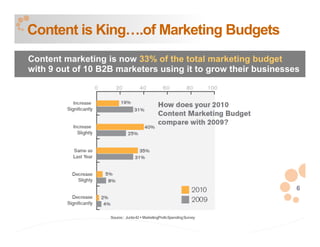
Content is King….of Marketing Budgets
Content marketing is now 33% of the total marketing budget
with 9 out of 10 B2B marketers using it to grow their businesses


                                                                       6


                   Source : Junta 42 + MarketingProfsSpending Survey
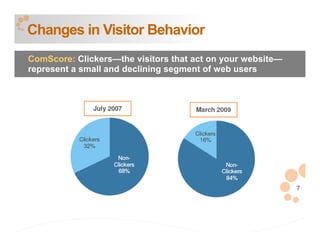
Changes in Visitor Behavior
ComScore: Clickers—the visitors that act on your website—
represent a small and declining segment of web users


                                                            7
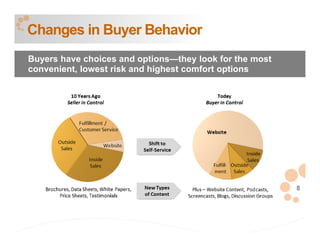
Changes in Buyer Behavior
Buyers have choices and options—they look for the most
convenient, lowest risk and highest comfort options


                                                         8
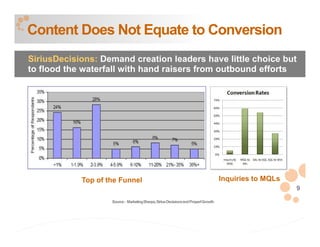
Content Does Not Equate to Conversion
SiriusDecisions: Demand creation leaders have little choice but
to flood the waterfall with hand raisers from outbound efforts


            Top of the Funnel                                                       Inquiries to MQLs
                                                                                                        9
                    Source : Marketing Sherpa, Sirius Decisions and ProperlGrowth
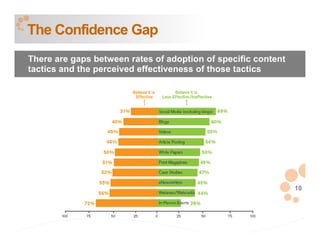
The Confidence Gap
There are gaps between rates of adoption of specific content
tactics and the perceived effectiveness of those tactics


                                                               10
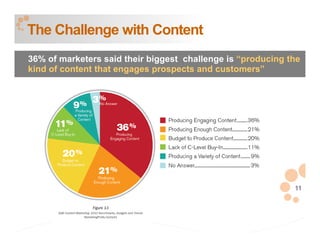
The Challenge with Content
36% of marketers said their biggest challenge is “producing the
kind of content that engages prospects and customers”


                                                             11
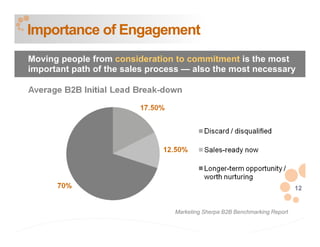
Importance of Engagement
Moving people from consideration to commitment is the most
important path of the sales process — also the most necessary


                                                                            12


                                 Marketing Sherpa B2B Benchmarking Report
The Case for
Context-driven
Marketing        13
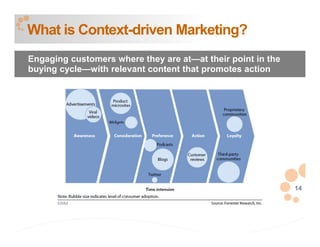
What is Context-driven Marketing?
Engaging customers where they are at—at their point in the
buying cycle—with relevant content that promotes action


                                                             14
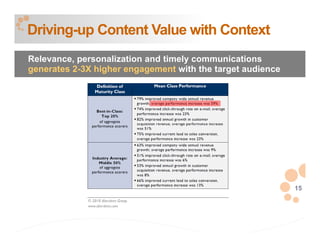
Driving-up Content Value with Context
Relevance, personalization and timely communications
generates 2-3X higher engagement with the target audience


                                                            15
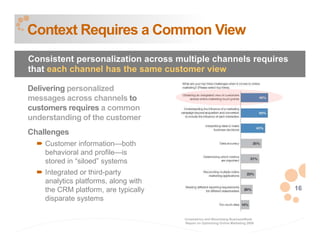
Context Requires a Common View
Consistent personalization across multiple channels requires
that each channel has the same customer view

Delivering personalized
messages across channels to
customers requires a common
understanding of the customer
Challenges
    Customer information—both
    behavioral and profile—is
    stored in “siloed” systems
    Integrated or third-party
    analytics platforms, along with
    the CRM platform, are typically                                                16
    disparate systems

                                      Coremetrics and Bloomberg BusinessWeek
                                      Report on Optimizing Online Marketing 2009
Steps toward
Context-driven
Marketing        17
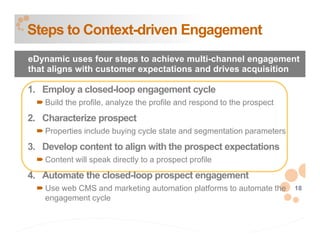
Steps to Context-driven Engagement
eDynamic uses four steps to achieve multi-channel engagement
that aligns with customer expectations and drives acquisition

1. Employ a closed-loop engagement cycle
    Build the profile, analyze the profile and respond to the prospect
2. Characterize prospect
    Properties include buying cycle state and segmentation parameters
3. Develop content to align with the prospect expectations
    Content will speak directly to a prospect profile
4. Automate the closed-loop prospect engagement
    Use web CMS and marketing automation platforms to automate the       18
    engagement cycle
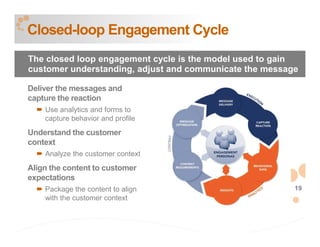
Closed-loop Engagement Cycle
The closed loop engagement cycle is the model used to gain
customer understanding, adjust and communicate the message

Deliver the messages and
capture the reaction
    Use analytics and forms to
    capture behavior and profile
Understand the customer
context
    Analyze the customer context
Align the content to customer
expectations
    Package the content to align                         19
    with the customer context
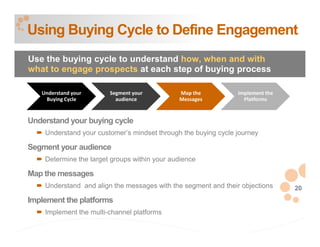
Using Buying Cycle to Define Engagement
Use the buying cycle to understand how, when and with
what to engage prospects at each step of buying process

   Understand your      Segment your          Map the           Implement the
    Buying Cycle          audience            Messages            Platforms


Understand your buying cycle
    Understand your customer’s mindset through the buying cycle journey

Segment your audience
    Determine the target groups within your audience

Map the messages
    Understand and align the messages with the segment and their objections     20
Implement the platforms
    Implement the multi-channel platforms
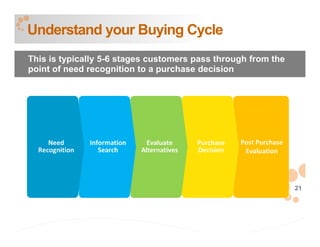
Understand your Buying Cycle
This is typically 5-6 stages customers pass through from the
point of need recognition to a purchase decision


                                                               21
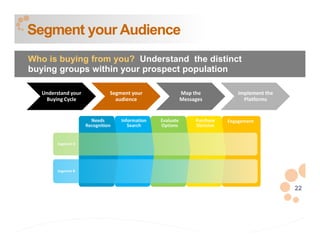
Segment your Audience
Who is buying from you? Understand the distinct
buying groups within your prospect population

   Understand your   Segment your   Map the    Implement the
    Buying Cycle       audience     Messages     Platforms


                                                               22
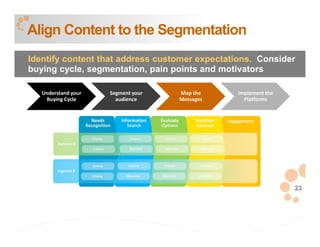
Align Content to the Segmentation
Identify content that address customer expectations. Consider
buying cycle, segmentation, pain points and motivators

   Understand your   Segment your   Map the    Implement the
    Buying Cycle       audience     Messages     Platforms


                                                               23
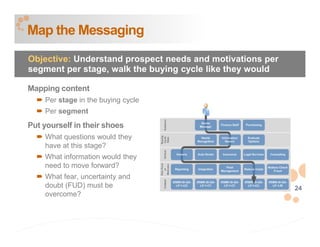
Map the Messaging
Objective: Understand prospect needs and motivations per
segment per stage, walk the buying cycle like they would

Mapping content
    Per stage in the buying cycle
    Per segment
Put yourself in their shoes
    What questions would they
    have at this stage?
    What information would they
    need to move forward?
    What fear, uncertainty and
    doubt (FUD) must be                                    24
    overcome?
Summary
1. Understand the buying cycle
   Do the standard stages apply your customer?
   B2B versus B2C differences

2. Perform a segmentation exercise
   Industries
   Roles
   Pain points and motivators

3. Define a content map
   Identify content that addresses customer expectations

                                                           25
Leveraging Digital
Platforms
                     26
Leveraging Digital Platforms
eDynamic uses four steps to achieve multi-channel engagement
that aligns with customer expectations and drives acquisition

1. Employ a closed-loop engagement cycle
    Build the profile, analyze the profile and respond to the prospect
2. Characterize prospects with a profile
    Properties include buying cycle state and segmentation parameters
3. Develop content to align with the profiles
    Content will speak directly to a prospect profile
4. Automate the closed-loop prospect engagement
    Use web CMS and marketing automation platforms to automate the       27
    engagement cycle
Leveraging Digital Platforms
CMS + MAP + CRM + Context = Increased acquisition. It takes
both platforms and approach to drive improved acquisition

1. Content Management (CMS): Supports personalized
   interactions on the web site
2. Marketing Automation Platform (MAP): Supports personalized
   interactions via outbound digital channels
3. Customer Relationship Management (CRM): Supports
   personalized interactions involving members of the sales team
4. Integration and Mapping: Integrating the three systems to
   create centralized buyer profiles that could then be mapped to
   a defined buying process                                         28

5. Measurement and Reporting: Implementing the dashboards
   and measurement tools necessary to support ongoing
   performance measurement and management
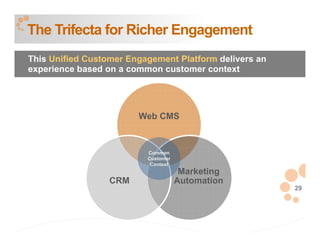
The Trifecta for Richer Engagement
This Unified Customer Engagement Platform delivers an
experience based on a common customer context


                        Web CMS


                          Common
                          Customer
                           Context
                                      Marketing
                  CRM                Automation
                                                        29
Automating the Engagement Cycle
Automating the engagement cycle across the buying cycle
requires context-specific content delivered at the right time

1. Content map: Defines the content topics that address
   the segmentation, pain points and motivations identified
2. Develop content: Develop the dynamic content
3. Profile and attribute-driven Rules: Both web CMS and
   marketing automation enable marketers to define rules
   that govern what content is displayed in a context


                                                                30
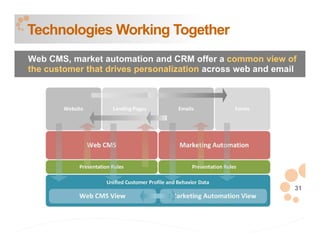
Technologies Working Together
Web CMS, market automation and CRM offer a common view of
the customer that drives personalization across web and email


                                                            31
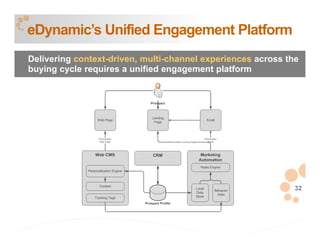
eDynamic’s Unified Engagement Platform
Delivering context-driven, multi-channel experiences across the
buying cycle requires a unified engagement platform


                                                              32
Next Steps: Demo

                   33
Questions?

             34
Contact Us
Rolf Kraus
rolf.kraus@edynamic.net

Shawn De Souza
shawn.desouza@edynamic.net


http://demandgeneration.edynamic.net

http://cms.edynamic.net
                                       35
Thank You

            36

What's driving demand gen content or context webinar

  • 1.
    Content in Context Webinar: June 9 2011 A Digital Solutions Firm delivering Marketing and Technology Solutions New York . Toronto . Phoenix . Los Angeles . London. Dubai . New Delhi
  • 2.
    Introductions eDynamic Webinar Team Rolf Kraus: CMS Practice Director Shawn De Souza: Demand Generation Practice Director 1
  • 3.
    About the eDynamic eDynamicis a digital consultancy that helps clients acquire and engage customers through cutting edge interactive solutions Experienced. Founded in 1999 Trusted. Diverse business critical projects delivered for mid-size to Fortune 500 organizations Versatile. Experience across diverse verticals, including Financial Services, Technology, Retail, Media & Publishing, Education, Travel and Hospitality, Oil and Gas and others Global. Locations in United States, Canada, Middle-East and 2 India
  • 4.
    What we willcover today 1. Challenges with Content Marketing 2. What is Context-driven Marketing 3. How to get there 4. What is Unified Customer Engagement 3
  • 5.
    The State ofContent Marketing 4
  • 6.
    The Buzz AboutContent... “Content is King!” “Content is the fuel for Marketing Automation” “Content marketing is becoming a widespread strategy more and more for growing tech companies. It allows them to achieve their lead generation 5 and marketing goals.”
  • 7.
    Content is King….ofMarketing Budgets Content marketing is now 33% of the total marketing budget with 9 out of 10 B2B marketers using it to grow their businesses 6 Source : Junta 42 + MarketingProfsSpending Survey
  • 8.
    Changes in VisitorBehavior ComScore: Clickers—the visitors that act on your website— represent a small and declining segment of web users 7
  • 9.
    Changes in BuyerBehavior Buyers have choices and options—they look for the most convenient, lowest risk and highest comfort options 8
  • 10.
    Content Does NotEquate to Conversion SiriusDecisions: Demand creation leaders have little choice but to flood the waterfall with hand raisers from outbound efforts Top of the Funnel Inquiries to MQLs 9 Source : Marketing Sherpa, Sirius Decisions and ProperlGrowth
  • 11.
    The Confidence Gap Thereare gaps between rates of adoption of specific content tactics and the perceived effectiveness of those tactics 10
  • 12.
    The Challenge withContent 36% of marketers said their biggest challenge is “producing the kind of content that engages prospects and customers” 11
  • 13.
    Importance of Engagement Movingpeople from consideration to commitment is the most important path of the sales process — also the most necessary 12 Marketing Sherpa B2B Benchmarking Report
  • 14.
  • 15.
    What is Context-drivenMarketing? Engaging customers where they are at—at their point in the buying cycle—with relevant content that promotes action 14
  • 16.
    Driving-up Content Valuewith Context Relevance, personalization and timely communications generates 2-3X higher engagement with the target audience 15
  • 17.
    Context Requires aCommon View Consistent personalization across multiple channels requires that each channel has the same customer view Delivering personalized messages across channels to customers requires a common understanding of the customer Challenges Customer information—both behavioral and profile—is stored in “siloed” systems Integrated or third-party analytics platforms, along with the CRM platform, are typically 16 disparate systems Coremetrics and Bloomberg BusinessWeek Report on Optimizing Online Marketing 2009
  • 18.
  • 19.
    Steps to Context-drivenEngagement eDynamic uses four steps to achieve multi-channel engagement that aligns with customer expectations and drives acquisition 1. Employ a closed-loop engagement cycle Build the profile, analyze the profile and respond to the prospect 2. Characterize prospect Properties include buying cycle state and segmentation parameters 3. Develop content to align with the prospect expectations Content will speak directly to a prospect profile 4. Automate the closed-loop prospect engagement Use web CMS and marketing automation platforms to automate the 18 engagement cycle
  • 20.
    Closed-loop Engagement Cycle Theclosed loop engagement cycle is the model used to gain customer understanding, adjust and communicate the message Deliver the messages and capture the reaction Use analytics and forms to capture behavior and profile Understand the customer context Analyze the customer context Align the content to customer expectations Package the content to align 19 with the customer context
  • 21.
    Using Buying Cycleto Define Engagement Use the buying cycle to understand how, when and with what to engage prospects at each step of buying process Understand your Segment your Map the Implement the Buying Cycle audience Messages Platforms Understand your buying cycle Understand your customer’s mindset through the buying cycle journey Segment your audience Determine the target groups within your audience Map the messages Understand and align the messages with the segment and their objections 20 Implement the platforms Implement the multi-channel platforms
  • 22.
    Understand your BuyingCycle This is typically 5-6 stages customers pass through from the point of need recognition to a purchase decision 21
  • 23.
    Segment your Audience Whois buying from you? Understand the distinct buying groups within your prospect population Understand your Segment your Map the Implement the Buying Cycle audience Messages Platforms 22
  • 24.
    Align Content tothe Segmentation Identify content that address customer expectations. Consider buying cycle, segmentation, pain points and motivators Understand your Segment your Map the Implement the Buying Cycle audience Messages Platforms 23
  • 25.
    Map the Messaging Objective:Understand prospect needs and motivations per segment per stage, walk the buying cycle like they would Mapping content Per stage in the buying cycle Per segment Put yourself in their shoes What questions would they have at this stage? What information would they need to move forward? What fear, uncertainty and doubt (FUD) must be 24 overcome?
  • 26.
    Summary 1. Understand thebuying cycle Do the standard stages apply your customer? B2B versus B2C differences 2. Perform a segmentation exercise Industries Roles Pain points and motivators 3. Define a content map Identify content that addresses customer expectations 25
  • 27.
  • 28.
    Leveraging Digital Platforms eDynamicuses four steps to achieve multi-channel engagement that aligns with customer expectations and drives acquisition 1. Employ a closed-loop engagement cycle Build the profile, analyze the profile and respond to the prospect 2. Characterize prospects with a profile Properties include buying cycle state and segmentation parameters 3. Develop content to align with the profiles Content will speak directly to a prospect profile 4. Automate the closed-loop prospect engagement Use web CMS and marketing automation platforms to automate the 27 engagement cycle
  • 29.
    Leveraging Digital Platforms CMS+ MAP + CRM + Context = Increased acquisition. It takes both platforms and approach to drive improved acquisition 1. Content Management (CMS): Supports personalized interactions on the web site 2. Marketing Automation Platform (MAP): Supports personalized interactions via outbound digital channels 3. Customer Relationship Management (CRM): Supports personalized interactions involving members of the sales team 4. Integration and Mapping: Integrating the three systems to create centralized buyer profiles that could then be mapped to a defined buying process 28 5. Measurement and Reporting: Implementing the dashboards and measurement tools necessary to support ongoing performance measurement and management
  • 30.
    The Trifecta forRicher Engagement This Unified Customer Engagement Platform delivers an experience based on a common customer context Web CMS Common Customer Context Marketing CRM Automation 29
  • 31.
    Automating the EngagementCycle Automating the engagement cycle across the buying cycle requires context-specific content delivered at the right time 1. Content map: Defines the content topics that address the segmentation, pain points and motivations identified 2. Develop content: Develop the dynamic content 3. Profile and attribute-driven Rules: Both web CMS and marketing automation enable marketers to define rules that govern what content is displayed in a context 30
  • 32.
    Technologies Working Together WebCMS, market automation and CRM offer a common view of the customer that drives personalization across web and email 31
  • 33.
    eDynamic’s Unified EngagementPlatform Delivering context-driven, multi-channel experiences across the buying cycle requires a unified engagement platform 32
  • 34.
  • 35.
  • 36.
    Contact Us Rolf Kraus rolf.kraus@edynamic.net ShawnDe Souza shawn.desouza@edynamic.net http://demandgeneration.edynamic.net http://cms.edynamic.net 35
  • 37.