Product Management in Practice
Bikram Gupta
Agenda
● Need for a product management process
● Vision & Strategy
● Execution
Who am I?
Need for a PM Process
Problem Space is your Business, and not a silo release at a point in time.
vs.
Examples
● Product issues or persistent theme? (strategy)
● Build or Partner? (strategy)
● Prioritize A or B? (execution)
● Finding the right north-star metric. (execution)
● Addressing issues during execution. (execution)
Why process?
● PM’s have no authority, but significant accountability.
● Organization as a whole needs to be on-board.
○ How do you build products?
○ How do you decide what to build?
○ How do you measure things at every stage? Not everything is measured by $$.
○ Templates for everything - product vision, strategy, discovery process, roadmap, etc.
○ Responsibilities (RACI matrix) for key deliverables.
It is much more efficient when the organization speaks the same language for how they build products, how they measure the
progress at each stage, and how they learn.
Vision and Strategy
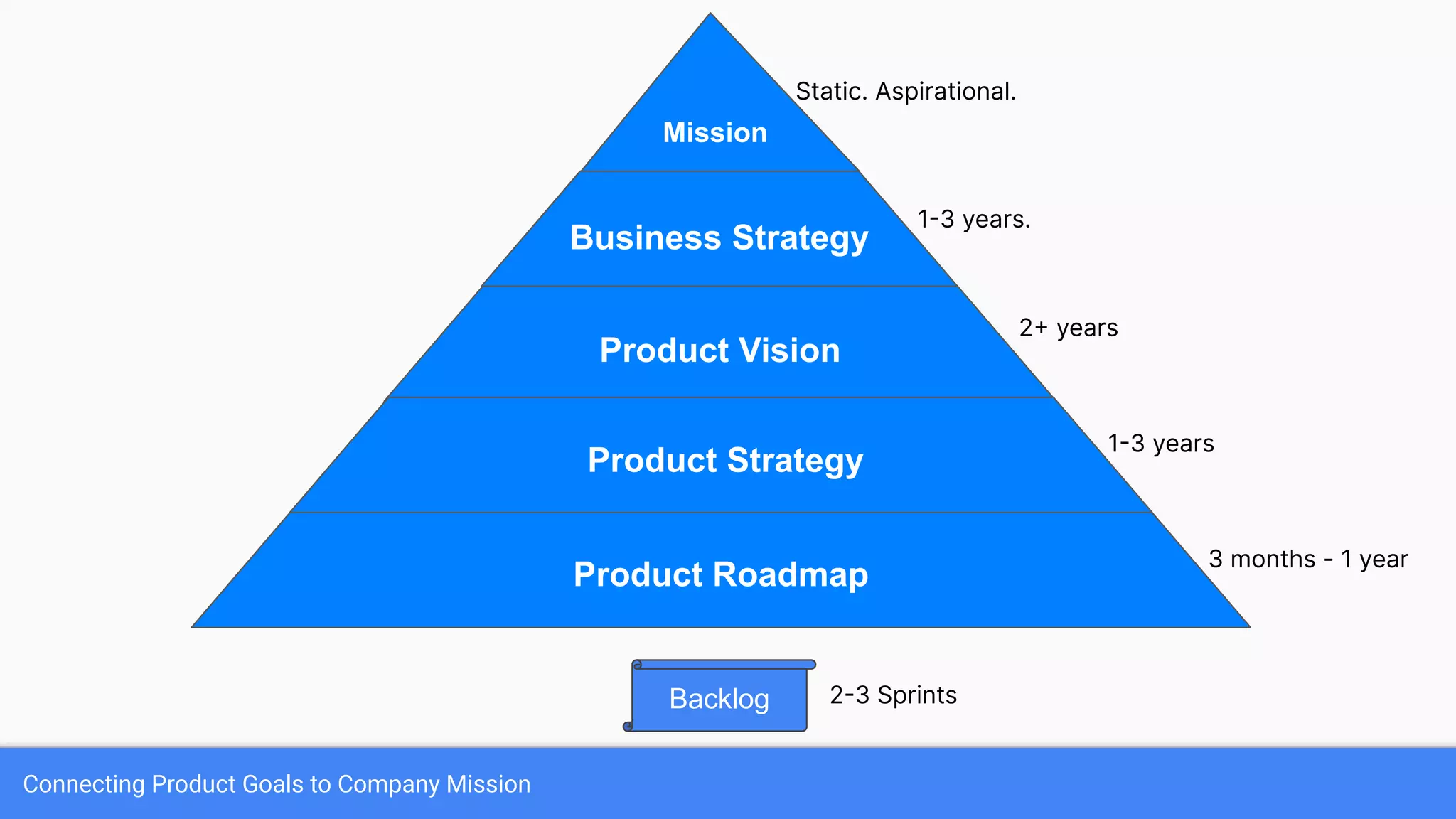
Connecting Product Goals to Company Mission
Mission
Business Strategy
Product Vision
Product Roadmap
Static. Aspirational.
13 years.
2 years
13 years
3 months - 1 year
Product Strategy
Backlog 23 Sprints
Reference: https://svpg.com/insights/product/strategy/
VISION
The product vision describes the future we are trying to create, typically
somewhere between 2 and 5 years out.
STRATEGY
How do we make the product vision a reality, while meeting the needs of the
company as we go? It is important to pick the few area that can truly make an
impact, and rationale for the same. Each strategic initiative should include the
desired goals/outcome.
DISCOVERY Quantitative, Qualitative, Technology, Industry, Shared Learnings, Competitive.
DELIVERY Roadmap, Backlog, Execution.
Product-market Fit
● Very hard problem.
○ Startups do not have the luxury to throw different products at the user base to see what
sticks. Startups are constrained in resource, customer base, and funding.
● Strategic planning cycle becomes quarterly vs. yearly.
○ You still want your strategy to drive what you’re building. Focus is key.
● Listening to your users becomes ever more important.
Execution
Stay in the Problem Space
Problem Space
Solution Space
Solution Space
Solution Space
vs.
Be in tune with your Users
● Data
● User Journey
● Product Discovery
○ Listen to your users
○ Shared Intelligence
Always be Prioritizing
References: Images from Wikipedia, Des Traynor’s strategy video, and Roadmunk’s product prioritization blog.
Tech Debt or Opportunity for Differentiation
● User experience can be a massive differentiator depending on the market
you are in.
○ Matters if tech-debt is causing a sub-par user experience.
● Tech debt can be re-positioned as customer value.
● Tech-debt can be justified with ROI.
Resources
Keep learning
● Lots of useful resources and books. Pick what works best for you.
● Continuous learning is important because one small change in PM can
have direct impact on the product/company performance.
● I like to go through the articles/videos by the following folks, and found
those valuable.
○ Marty Cagan, Dan Olsen, Sachin Rekhi, Des Traynor

Product management in practice

  • 1.
    Product Management inPractice Bikram Gupta
  • 2.
    Agenda ● Need fora product management process ● Vision & Strategy ● Execution
  • 3.
  • 4.
    Need for aPM Process
  • 5.
    Problem Space isyour Business, and not a silo release at a point in time. vs. Examples ● Product issues or persistent theme? (strategy) ● Build or Partner? (strategy) ● Prioritize A or B? (execution) ● Finding the right north-star metric. (execution) ● Addressing issues during execution. (execution)
  • 6.
    Why process? ● PM’shave no authority, but significant accountability. ● Organization as a whole needs to be on-board. ○ How do you build products? ○ How do you decide what to build? ○ How do you measure things at every stage? Not everything is measured by $$. ○ Templates for everything - product vision, strategy, discovery process, roadmap, etc. ○ Responsibilities (RACI matrix) for key deliverables. It is much more efficient when the organization speaks the same language for how they build products, how they measure the progress at each stage, and how they learn.
  • 7.
  • 8.
    Connecting Product Goalsto Company Mission Mission Business Strategy Product Vision Product Roadmap Static. Aspirational. 13 years. 2 years 13 years 3 months - 1 year Product Strategy Backlog 23 Sprints
  • 9.
    Reference: https://svpg.com/insights/product/strategy/ VISION The productvision describes the future we are trying to create, typically somewhere between 2 and 5 years out. STRATEGY How do we make the product vision a reality, while meeting the needs of the company as we go? It is important to pick the few area that can truly make an impact, and rationale for the same. Each strategic initiative should include the desired goals/outcome. DISCOVERY Quantitative, Qualitative, Technology, Industry, Shared Learnings, Competitive. DELIVERY Roadmap, Backlog, Execution.
  • 10.
    Product-market Fit ● Veryhard problem. ○ Startups do not have the luxury to throw different products at the user base to see what sticks. Startups are constrained in resource, customer base, and funding. ● Strategic planning cycle becomes quarterly vs. yearly. ○ You still want your strategy to drive what you’re building. Focus is key. ● Listening to your users becomes ever more important.
  • 11.
  • 12.
    Stay in theProblem Space Problem Space Solution Space Solution Space Solution Space vs.
  • 13.
    Be in tunewith your Users ● Data ● User Journey ● Product Discovery ○ Listen to your users ○ Shared Intelligence
  • 14.
    Always be Prioritizing References:Images from Wikipedia, Des Traynor’s strategy video, and Roadmunk’s product prioritization blog.
  • 15.
    Tech Debt orOpportunity for Differentiation ● User experience can be a massive differentiator depending on the market you are in. ○ Matters if tech-debt is causing a sub-par user experience. ● Tech debt can be re-positioned as customer value. ● Tech-debt can be justified with ROI.
  • 16.
  • 17.
    Keep learning ● Lotsof useful resources and books. Pick what works best for you. ● Continuous learning is important because one small change in PM can have direct impact on the product/company performance. ● I like to go through the articles/videos by the following folks, and found those valuable. ○ Marty Cagan, Dan Olsen, Sachin Rekhi, Des Traynor