

A Digital Solutions Firm delivering
Marketing and Technology Solutions
New York . Toronto . Phoenix . Los Angeles . London. Dubai . New Delhi
Big Data – Challenge or Opportunity?
11
Why we are here
2
1. What is Big Data?
2. How does big data affect you?
3. The three key facets of Big data
4. How toget started
5. How tointerpret and use data effectively
6. How todrive authentic customer engagement
Points covered in this webinar
33
What is Big Data?
4
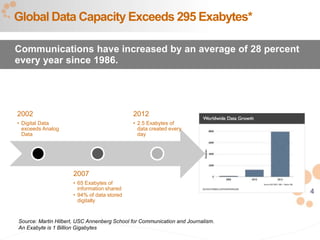
Global Data Capacity Exceeds 295 Exabytes*
Communications have increased by an average of 28 percent
every year since 1986.
2002
• Digital Data
exceeds Analog
Data
2007
• 65 Exabytes of
information shared
• 94% of data stored
digitally
2012
• 2.5 Exabytes of
data created every
day
Source: Martin Hilbert, USC Annenberg School for Communication and Journalism.
An Exabyte is 1 Billion Gigabytes
5
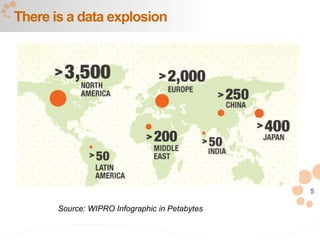
There is a data explosion
Source: WIPRO Infographic in Petabytes
66
What’s driving
Big Data?
7
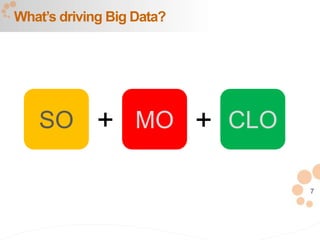
What’s driving Big Data?
SO MO CLO+ +
8
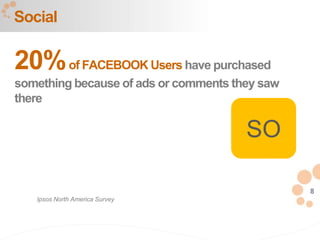
20%of FACEBOOK Users have purchased
something because of ads or comments they saw
there
Social
Ipsos North America Survey
SO
9
YouTube is the second largest
internet search engine
Social
SO
10
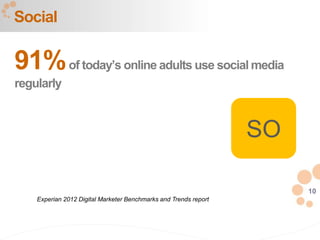
91%of today’s online adults use social media
regularly
Social
SO
Experian 2012 Digital Marketer Benchmarks and Trends report
11
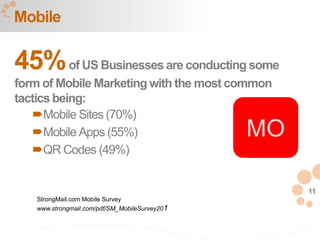
45%of US Businesses are conducting some
form of Mobile Marketing with the most common
tactics being:
Mobile Sites (70%)
Mobile Apps (55%)
QR Codes (49%)
Mobile
MO
StrongMail.com Mobile Survey
www.strongmail.com/pdf/SM_MobileSurvey201
12
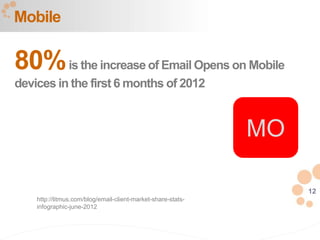
80%is the increase of Email Opens on Mobile
devices in the first 6 months of 2012
Mobile
MO
http://litmus.com/blog/email-client-market-share-stats-
infographic-june-2012
13
Mobile
MO
14
Mobile
MO
Pew Research Center
15
Mobile
MO
16
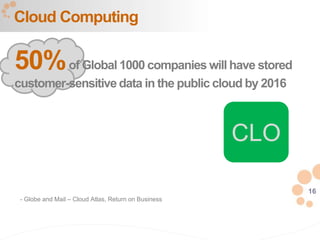
50%of Global 1000 companies will have stored
customer-sensitive data in the public cloud by 2016
Cloud Computing
CLO
- Globe and Mail – Cloud Atlas, Return on Business
17
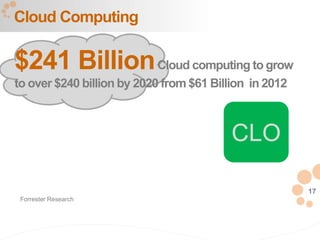
$241 BillionCloud computing to grow
to over $240 billion by 2020 from $61 Billion in 2012
Cloud Computing
CLO
Forrester Research
18
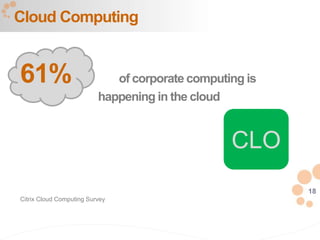
61% of corporate computing is
happening in the cloud
Cloud Computing
CLO
Citrix Cloud Computing Survey
19
Google’s Datacenters
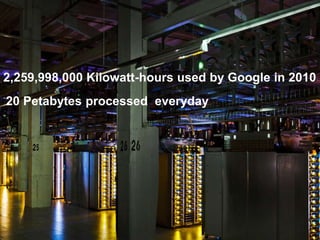
2,259,998,000 Kilowatt-hours used by Google in 2010
20 Petabytes processed everyday
20
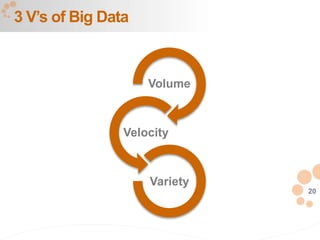
Volume
Velocity
Variety
3 V’s of Big Data
21
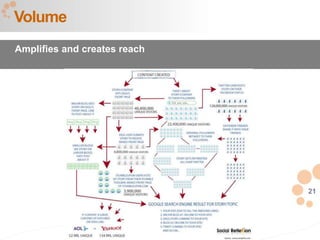
Volume
Amplifies and creates reach
22
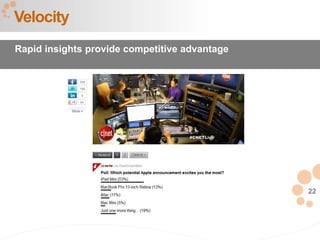
Velocity
Rapid insights provide competitive advantage
23
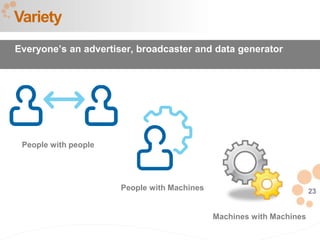
Variety
Everyone’s an advertiser, broadcaster and data generator
People with people
People with Machines
Machines with Machines
24
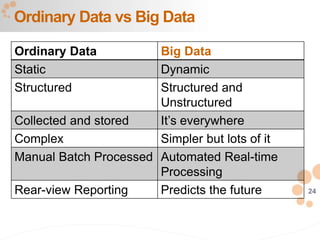
Ordinary Data Big Data
Static Dynamic
Structured Structured and
Unstructured
Collected and stored It’s everywhere
Complex Simpler but lots of it
Manual Batch Processed Automated Real-time
Processing
Rear-view Reporting Predicts the future
Ordinary Data vs Big Data
2525
Why does this
matter to you?
2626
It’s not about data!
27
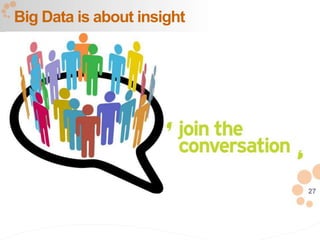
Big Data is about insight
28
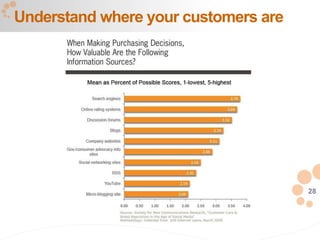
Understand where your customers are
29
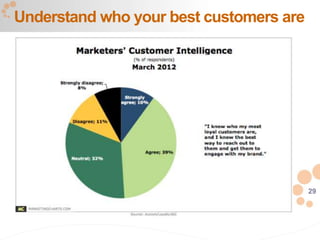
Understand who your best customers are
30
1. Customer Service
 Askforcustomertestimonials
 Respondtocustomerquestions
 Respondtocustomercomplaints
 SharelinkstoFAQs
 Respondtocustomercompliments
 Respondtocustomerfeedback
 Crowdsourcecontentfromcustomers
Applications for Marketing
31
2. Lead Generation
 Linkbacktoyourweb/landing pageforconversion
 Blogabouthelpfulinformation
 Promoteastrongcalltoaction
 CreateaCommunity
 Sharepeerreferrals
 Promoteoffers
 Optimizesiteandblogformobileviewers
 StartaLinkedIngroup
Applications for Marketing
32
5. SEO and OnlineVisibility
 IncludekeyphrasesinyourTweets
 LinktoyourblogfromFacebook
 Askfollowerstolinktoyourwebsite
 UsekeywordsonyourLinkedIncompanypage
 Includekeywordsinyourblogpostheadlinesandbody
 Tagandnameyourimages
 Categorizeandtagyourblogwithkeyphrases
 Shareebooksusingkeyphrases
 UploadvideostoYouTube(2ndlargestsearchengine)
 EncouragesharingwiththeG+buttononyourwebpages
Applications for Marketing
33
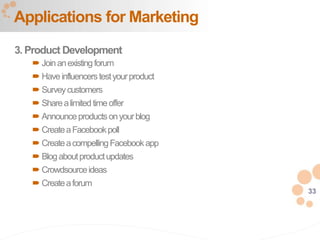
3. Product Development
 Joinanexistingforum
 Haveinfluencerstestyourproduct
 Surveycustomers
 Sharealimitedtimeoffer
 Announceproductsonyourblog
 CreateaFacebookpoll
 CreateacompellingFacebookapp
 Blogaboutproductupdates
 Crowdsourceideas
 Createaforum
Applications for Marketing
34
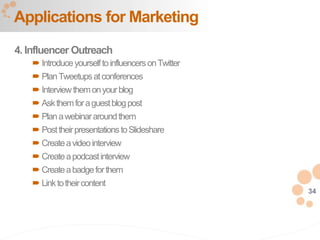
4. Influencer Outreach
 IntroduceyourselftoinfluencersonTwitter
 PlanTweetupsatconferences
 Interviewthemonyourblog
 Askthemforaguestblogpost
 Planawebinararoundthem
 PosttheirpresentationstoSlideshare
 Createavideointerview
 Createapodcastinterview
 Createabadgeforthem
 Linktotheircontent
Applications for Marketing
3535
Get Strategic about
Big Data
36
1. Engage with customers wherever they are
2. Make customer intelligence strategic
3. Focus on goals and filter out noise
4. Create usable and actionable views or data clusters
5. Act on the insights from data, not on intuition or
experience
Key Principles
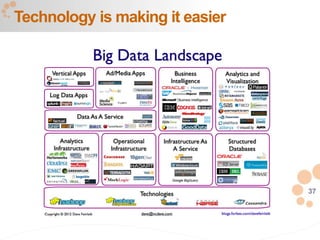
37
Technology is making it easier
3838
Contextual
Engagement in B2B
39
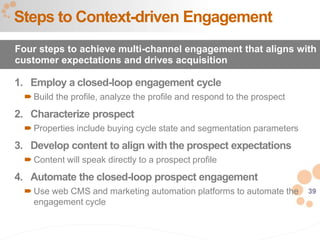
1. Employ a closed-loop engagement cycle
 Build the profile, analyze the profile and respond to the prospect
2. Characterize prospect
 Properties include buying cycle state and segmentation parameters
3. Develop content to align with the prospect expectations
 Content will speak directly to a prospect profile
4. Automate the closed-loop prospect engagement
 Use web CMS and marketing automation platforms to automate the
engagement cycle
Steps to Context-driven Engagement
Four steps to achieve multi-channel engagement that aligns with
customer expectations and drives acquisition
40
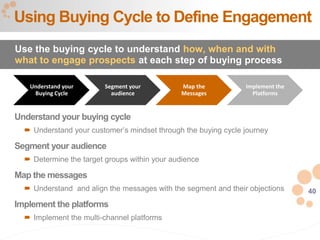
Understand your buying cycle
 Understand your customer’s mindset through the buying cycle journey
Segment your audience
 Determine the target groups within your audience
Map the messages
 Understand and align the messages with the segment and their objections
Implement the platforms
 Implement the multi-channel platforms
Using Buying Cycle to Define Engagement
Use the buying cycle to understand how, when and with
what to engage prospects at each step of buying process
Understand your
Buying Cycle
Segment your
audience
Map the
Messages
Implement the
Platforms
41
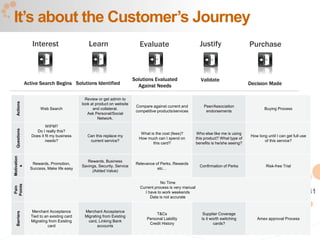
It’s about the Customer’s Journey
Evaluate PurchaseLearn JustifyInterest
Active Search Begins Solutions Identified
Solutions Evaluated
Against Needs
Validate
Decision Made
Actions
Web Search
Review or get admin to
look at product on website
and collateral.
Ask Personal/Social
Network.
Compare against current and
competitive products/services
Peer/Association
endorsements
Buying Process
Questions
WIFM?
Do I really this?
Does it fit my business
needs?
Can this replace my
current service?
What is the cost (fees)?
How much can I spend on
this card?
Who else like me is using
this product? What type of
benefits is he/she seeing?
How long until I can get full use
of this service?
Motivation
s
Rewards, Promotion,
Success, Make life easy
Rewards, Business
Savings, Security, Service
(Added Value)
Relevance of Perks, Rewards
etc…
Confirmation of Perks Risk-free Trial
Pain
Points
No Time
Current process is very manual
I have to work weekends
Data is not accurate
Barriers
Merchant Acceptance
Tied to an existing card
Migrating from Existing
card
Merchant Acceptance
Migrating from Existing
card, Linking Bank
accounts
T&Cs
Personal Liability
Credit History
Supplier Coverage
Is it worth switching
cards?
Amex approval Process
42
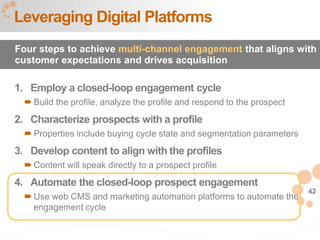
1. Employ a closed-loop engagement cycle
 Build the profile, analyze the profile and respond to the prospect
2. Characterize prospects with a profile
 Properties include buying cycle state and segmentation parameters
3. Develop content to align with the profiles
 Content will speak directly to a prospect profile
4. Automate the closed-loop prospect engagement
 Use web CMS and marketing automation platforms to automate the
engagement cycle
Leveraging Digital Platforms
Four steps to achieve multi-channel engagement that aligns with
customer expectations and drives acquisition
43
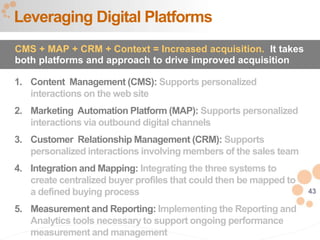
1. Content Management (CMS): Supports personalized
interactions on the web site
2. Marketing Automation Platform (MAP): Supports personalized
interactions via outbound digital channels
3. Customer Relationship Management (CRM): Supports
personalized interactions involving members of the sales team
4. Integration and Mapping: Integrating the three systems to
create centralized buyer profiles that could then be mapped to
a defined buying process
5. Measurement and Reporting: Implementing the Reporting and
Analytics tools necessary to support ongoing performance
measurement and management
Leveraging Digital Platforms
CMS + MAP + CRM + Context = Increased acquisition. It takes
both platforms and approach to drive improved acquisition
44
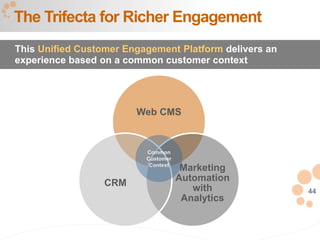
The Trifecta for Richer Engagement
This Unified Customer Engagement Platform delivers an
experience based on a common customer context
Web CMS
Marketing
Automation
with
Analytics
CRM
Common
Customer
Context
45
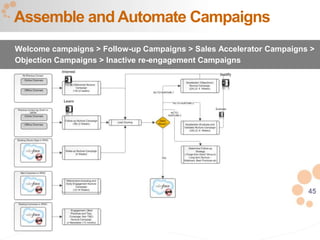
Assemble and Automate Campaigns
Welcome campaigns > Follow-up Campaigns > Sales Accelerator Campaigns >
Objection Campaigns > Inactive re-engagement Campaigns
46
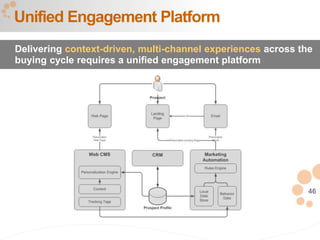
Unified Engagement Platform
Delivering context-driven, multi-channel experiences across the
buying cycle requires a unified engagement platform
47
Connect with us
1-877-339-6264
www.edynamic.net
contact@edynamic.net
twitter.com/edynamic
youtube.com/1999dynamic
facebook.com/edynamic.net

Big Data – Marketing Challenge or Opportunity?

  • 1.
    A Digital SolutionsFirm delivering Marketing and Technology Solutions New York . Toronto . Phoenix . Los Angeles . London. Dubai . New Delhi Big Data – Challenge or Opportunity?
  • 2.
  • 3.
    2 1. What isBig Data? 2. How does big data affect you? 3. The three key facets of Big data 4. How toget started 5. How tointerpret and use data effectively 6. How todrive authentic customer engagement Points covered in this webinar
  • 4.
  • 5.
    4 Global Data CapacityExceeds 295 Exabytes* Communications have increased by an average of 28 percent every year since 1986. 2002 • Digital Data exceeds Analog Data 2007 • 65 Exabytes of information shared • 94% of data stored digitally 2012 • 2.5 Exabytes of data created every day Source: Martin Hilbert, USC Annenberg School for Communication and Journalism. An Exabyte is 1 Billion Gigabytes
  • 6.
    5 There is adata explosion Source: WIPRO Infographic in Petabytes
  • 7.
  • 8.
    7 What’s driving BigData? SO MO CLO+ +
  • 9.
    8 20%of FACEBOOK Usershave purchased something because of ads or comments they saw there Social Ipsos North America Survey SO
  • 10.
    9 YouTube is thesecond largest internet search engine Social SO
  • 11.
    10 91%of today’s onlineadults use social media regularly Social SO Experian 2012 Digital Marketer Benchmarks and Trends report
  • 12.
    11 45%of US Businessesare conducting some form of Mobile Marketing with the most common tactics being: Mobile Sites (70%) Mobile Apps (55%) QR Codes (49%) Mobile MO StrongMail.com Mobile Survey www.strongmail.com/pdf/SM_MobileSurvey201
  • 13.
    12 80%is the increaseof Email Opens on Mobile devices in the first 6 months of 2012 Mobile MO http://litmus.com/blog/email-client-market-share-stats- infographic-june-2012
  • 14.
  • 15.
  • 16.
  • 17.
    16 50%of Global 1000companies will have stored customer-sensitive data in the public cloud by 2016 Cloud Computing CLO - Globe and Mail – Cloud Atlas, Return on Business
  • 18.
    17 $241 BillionCloud computingto grow to over $240 billion by 2020 from $61 Billion in 2012 Cloud Computing CLO Forrester Research
  • 19.
    18 61% of corporatecomputing is happening in the cloud Cloud Computing CLO Citrix Cloud Computing Survey
  • 20.
    19 Google’s Datacenters 2,259,998,000 Kilowatt-hoursused by Google in 2010 20 Petabytes processed everyday
  • 21.
  • 22.
  • 23.
  • 24.
    23 Variety Everyone’s an advertiser,broadcaster and data generator People with people People with Machines Machines with Machines
  • 25.
    24 Ordinary Data BigData Static Dynamic Structured Structured and Unstructured Collected and stored It’s everywhere Complex Simpler but lots of it Manual Batch Processed Automated Real-time Processing Rear-view Reporting Predicts the future Ordinary Data vs Big Data
  • 26.
  • 27.
  • 28.
    27 Big Data isabout insight
  • 29.
  • 30.
    29 Understand who yourbest customers are
  • 31.
    30 1. Customer Service Askforcustomertestimonials  Respondtocustomerquestions  Respondtocustomercomplaints  SharelinkstoFAQs  Respondtocustomercompliments  Respondtocustomerfeedback  Crowdsourcecontentfromcustomers Applications for Marketing
  • 32.
    31 2. Lead Generation Linkbacktoyourweb/landing pageforconversion  Blogabouthelpfulinformation  Promoteastrongcalltoaction  CreateaCommunity  Sharepeerreferrals  Promoteoffers  Optimizesiteandblogformobileviewers  StartaLinkedIngroup Applications for Marketing
  • 33.
    32 5. SEO andOnlineVisibility  IncludekeyphrasesinyourTweets  LinktoyourblogfromFacebook  Askfollowerstolinktoyourwebsite  UsekeywordsonyourLinkedIncompanypage  Includekeywordsinyourblogpostheadlinesandbody  Tagandnameyourimages  Categorizeandtagyourblogwithkeyphrases  Shareebooksusingkeyphrases  UploadvideostoYouTube(2ndlargestsearchengine)  EncouragesharingwiththeG+buttononyourwebpages Applications for Marketing
  • 34.
    33 3. Product Development Joinanexistingforum  Haveinfluencerstestyourproduct  Surveycustomers  Sharealimitedtimeoffer  Announceproductsonyourblog  CreateaFacebookpoll  CreateacompellingFacebookapp  Blogaboutproductupdates  Crowdsourceideas  Createaforum Applications for Marketing
  • 35.
    34 4. Influencer Outreach IntroduceyourselftoinfluencersonTwitter  PlanTweetupsatconferences  Interviewthemonyourblog  Askthemforaguestblogpost  Planawebinararoundthem  PosttheirpresentationstoSlideshare  Createavideointerview  Createapodcastinterview  Createabadgeforthem  Linktotheircontent Applications for Marketing
  • 36.
  • 37.
    36 1. Engage withcustomers wherever they are 2. Make customer intelligence strategic 3. Focus on goals and filter out noise 4. Create usable and actionable views or data clusters 5. Act on the insights from data, not on intuition or experience Key Principles
  • 38.
  • 39.
  • 40.
    39 1. Employ aclosed-loop engagement cycle  Build the profile, analyze the profile and respond to the prospect 2. Characterize prospect  Properties include buying cycle state and segmentation parameters 3. Develop content to align with the prospect expectations  Content will speak directly to a prospect profile 4. Automate the closed-loop prospect engagement  Use web CMS and marketing automation platforms to automate the engagement cycle Steps to Context-driven Engagement Four steps to achieve multi-channel engagement that aligns with customer expectations and drives acquisition
  • 41.
    40 Understand your buyingcycle  Understand your customer’s mindset through the buying cycle journey Segment your audience  Determine the target groups within your audience Map the messages  Understand and align the messages with the segment and their objections Implement the platforms  Implement the multi-channel platforms Using Buying Cycle to Define Engagement Use the buying cycle to understand how, when and with what to engage prospects at each step of buying process Understand your Buying Cycle Segment your audience Map the Messages Implement the Platforms
  • 42.
    41 It’s about theCustomer’s Journey Evaluate PurchaseLearn JustifyInterest Active Search Begins Solutions Identified Solutions Evaluated Against Needs Validate Decision Made Actions Web Search Review or get admin to look at product on website and collateral. Ask Personal/Social Network. Compare against current and competitive products/services Peer/Association endorsements Buying Process Questions WIFM? Do I really this? Does it fit my business needs? Can this replace my current service? What is the cost (fees)? How much can I spend on this card? Who else like me is using this product? What type of benefits is he/she seeing? How long until I can get full use of this service? Motivation s Rewards, Promotion, Success, Make life easy Rewards, Business Savings, Security, Service (Added Value) Relevance of Perks, Rewards etc… Confirmation of Perks Risk-free Trial Pain Points No Time Current process is very manual I have to work weekends Data is not accurate Barriers Merchant Acceptance Tied to an existing card Migrating from Existing card Merchant Acceptance Migrating from Existing card, Linking Bank accounts T&Cs Personal Liability Credit History Supplier Coverage Is it worth switching cards? Amex approval Process
  • 43.
    42 1. Employ aclosed-loop engagement cycle  Build the profile, analyze the profile and respond to the prospect 2. Characterize prospects with a profile  Properties include buying cycle state and segmentation parameters 3. Develop content to align with the profiles  Content will speak directly to a prospect profile 4. Automate the closed-loop prospect engagement  Use web CMS and marketing automation platforms to automate the engagement cycle Leveraging Digital Platforms Four steps to achieve multi-channel engagement that aligns with customer expectations and drives acquisition
  • 44.
    43 1. Content Management(CMS): Supports personalized interactions on the web site 2. Marketing Automation Platform (MAP): Supports personalized interactions via outbound digital channels 3. Customer Relationship Management (CRM): Supports personalized interactions involving members of the sales team 4. Integration and Mapping: Integrating the three systems to create centralized buyer profiles that could then be mapped to a defined buying process 5. Measurement and Reporting: Implementing the Reporting and Analytics tools necessary to support ongoing performance measurement and management Leveraging Digital Platforms CMS + MAP + CRM + Context = Increased acquisition. It takes both platforms and approach to drive improved acquisition
  • 45.
    44 The Trifecta forRicher Engagement This Unified Customer Engagement Platform delivers an experience based on a common customer context Web CMS Marketing Automation with Analytics CRM Common Customer Context
  • 46.
    45 Assemble and AutomateCampaigns Welcome campaigns > Follow-up Campaigns > Sales Accelerator Campaigns > Objection Campaigns > Inactive re-engagement Campaigns
  • 47.
    46 Unified Engagement Platform Deliveringcontext-driven, multi-channel experiences across the buying cycle requires a unified engagement platform
  • 48.

Editor's Notes

  • #6 How much information is there in the world? As of 2012, about 2.5 exabytes of data are created each day. 1 exabyte is a billion gigabytes or a million terabytes. University of Southern California researchers calculated that the world has access to enough data-storage capacity to hold 295 exabytes (295 followed by 20 zeros) of information. There are reports aplenty about technology driving a data explosion. University of Southern California researchers actually sat down and calculated that humans can store, communicate and compute about 295 exabytes of information, or about 404 billion CDs.
  • #7 How much information is there in the world? As of 2012, about 2.5 exabytes of data are created each day. 1 exabyte is a billion gigabytes or a million terabytes. University of Southern California researchers calculated that the world has access to enough data-storage capacity to hold 295 exabytes (295 followed by 20 zeros) of information. There are reports aplenty about technology driving a data explosion. University of Southern California researchers actually sat down and calculated that humans can store, communicate and compute about 295 exabytes of information, or about 404 billion CDs.
  • #9 The growth of social networks for business. Social networking account for 22% of all time spent online. Real business is taking place today in public and private social networks. It has moved far beyond using LinkedIn for recruiting, or Facebook for consumer marketing outreach. The benefits accrue quickly from being able to communicate and collaborate easily with extended networks of employees, partners, customers, across internal and external social networks. The ascendency of mobile computing. By the end of 2011, more smartphones shipped than PCs.. And Apple sold more iOS devices in 2011 than they sold Macs in 28 years. “Bring your own device” (BYOD) to work is an undeniable trend in the workplace, bringing freedom and convenience for users, but headaches for IT. Users want to interact anytime, anywhere, with localized, contextual content. And they aren’t afraid to sidestep IT if they don’t get the access they want. IT can try to ban access, but more often than not, needs to rethink their approach to mobile and secure those mobile devices to minimize risks from loss, theft or misuse. The continued rise of Cloud computing. With Forrester alone estimating enterprise cloud computing to grow to over $240 billion by 2020. It’s hard to find ANY current IT project today not considering cloud-based deployments. The conversation is no longer one of outright rejection due to security and quality-of-service concerns. Instead, the discussion is about the right mix of capabilities for the business. What should be delivered by cloud vs. on premises? How do I ensure new services are integrated with the solutions I already have in place? What’s the right policy and governance model I should be looking for from my cloud services providers? What level of customization do I really need, and how much standardization can I get away with? Despite cloud’s increasing sophistication and security in applications, information stores, transaction processing, or even analytics, critical questions still remain. The availability of information, which drives social, mobile and cloud technologies, is the connective tissue in this "nexus of forces." Gartner "In the nexus of forces, information is the context for delivering enhanced social and mobile experiences," Chris Howard, managing vice president at Gartner, explained in the report. "Mobile devices are a platform for effective social networking and new ways of work. Social links people to their work and each other in new and unexpected ways. Cloud enables delivery of information and functionality to users and systems. These forces of the Nexus are intertwined to create a user-driven ecosystem of modern computing."