R.J. Rees, R.A. Scott-James, Terry
Eagleton, Marjorie Garber, Mario
Vargas Llosa
And others.
What is Literature?
What is literature?
With which of the following definition you would like to agree?
 written works with artistic value: written works, e.g.
fiction, poetry, drama, and criticism, that are recognized as
having important or permanent artistic value
 body of written works: the body of written works of a
culture, language, people, or period of time Russian
literature
 writings on subject: the body of published work
concerned with a particular subject scientific literature
 body of music: the body of musical compositions for a
particular instrument or group of instruments literature for
the piano
 printed information: printed matter such as brochures or
flyers that give information the company's promotional
literature
 production of literary works: the creation of literary
work, especially as an art or occupation
 [14th century. Via French < Latin litteratura < litteratus (see
literate)]Microsoft® Encarta® 2009. © 1993-2008 Microsoft Corporation.
Do you agree with this definition?
 Lit is … creative writing of recognized artistic
value
 Written works, esp. those considered of superior
or lasting artistic merit
 Literature (from Latin litterae (plural); letter) is
the art of written works, and is not bound to
published sources (although, under
circumstances unpublished sources can be
exempt). Literally translated, the
word literature means "acquaintance with letters"
(as in the "arts and letters"). The two major
classification of literature are poetry and prose.
(Wikipedia)
 Is any writing, literature?
 Is use of language and words literature???
 What about colours, stones, music?
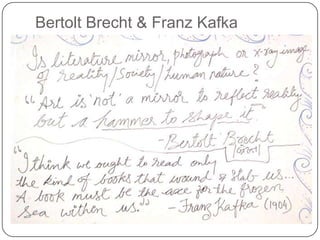
 Is literature mirror to society / human nature /
reality?
 Is it photographic representation of . . . ?
 Is it an X-Ray image of . . . ?
Bertolt Brecht & Franz Kafka
R A Scott James – The Making of
Literature
 It is with literature as an art that I am concerned
in this book, and at the outset it should be clearly
distinguished from the literature which sets out
to impart knowledge or produce moral
conviction.
 Obvious as the difference may seem to us, it was
not always obvious, and the border-line is blurred
even to-day.
 It is the distinction which may be made between
two drawings of a house, one being a " picture,"
the other an architect's plan.
 The first has an aesthetic character. The second
is a piece of information its purpose is didactic.
Knowledge and power
 How to draw line in between?
 Thomas DeQuiency:
 Literature of knowledge = Didactic – to teach
 Litearure of power = aesthetic – to move
 Thomas De Quincey, "The Literature of Knowlege and the Literature of Power" (First
Published in the North British Review, August, 1848, as part of a critical essay on Alexander
Pope)
 Literature is the product of imagination, originality,
style of expression, thought emotions and
feelings, idea etc….
Advertisement… is it literature?
 Then, can we call……. Ad, literature?
 Why?
 Why not?
 Is Graphic novel or comics book literature?
 What is the difference between pulp fiction and
serious literature?
Some universal characteristics of
Literature
 Timelessness,
 Eternity,
 universality,
 Permanence…
 Literature is a permanent expression in words of
some thought or feelings or idea about life and
the world.
R.J. Rees:
 Literature may be good, bad or indifferent; but
good literature will have same, if not all, of the
following qualities:
 Psychological truth or holding the mirror
up to nature
 Originality
 Craftsmanship
 A consciousness of moral values
Terry Eagleton: Literary Theory:An
Introduction
 „Imaginative writing in the sense of fiction‟ – writing
which is not literally true. (?)
 Imaginative Vs Realistic
 Fiction vs Fact
 Imaginative representation of realistic life.
 Historical truth Vs Artistic truth
 Novels and News Stories – fact and fiction – how to
discriminate?
 Comics and pulp fiction – purely imaginative &
fictitious, yet not „literature‟.
 Compare „Macbeth / Moll Flanders and The White
Tiger‟.
 The end – Poetic Justice Vs Realistic end.
Literature is creative and imaginative:
 Does this mean that Philosophy, History, Natural
Sciences are uncreative and unimaginative?
 Perhaps another approach is required to define
literature:
 … uses language in peculiar ways.
 Roman Jakobson – „organised violence committed
on ordinary speech‟.
 Literature transforms and intensifies ordinary
language, deviates systematically from everyday
speech.
 (???) Safdar Hashmi – Kitabe Kuchh Kehna
Chahati hai!
The Use and Abuse of Literature:
 By Marjorie Garber
 “The Use and Abuse of Literature,” the latest book by
the prolific Harvard literary scholar Marjorie Garber, is
in part about this “centripetal movement” in artistic
appreciation “from the edges to the center, from the
outside to the inside, incorporating once disparaged
genres and authors into respectable, canonical and
even classic status.” We‟ve all seen the process
applied to television and cinema and comic books
(now called, in a Maileresque turn, “graphic novels”),
but Garber reminds us that this tendency has existed
throughout history, bringing biography and
Renaissance drama (Garber‟s primary academic
specialty) and even the novel itself in from the cold,
along with private forms like letters and journals that
never wished for such consideration. “What once
wasn‟t literature,” Garber writes, “is now at the heart
of the canon.”
Why study literature?
 Understanding social milieu
 Understanding culture
 Understanding human nature & behavior
 Develop historical sense
 Relish aesthetics of artistic expression
Does it really happen?
 Do we really enjoy ‘reading’ literature?
 What does the history of civilization prove?
 Have we become better?
 Do we understand each other?
 Do we respect human values(?)?
Why study literature?
 By studying good literature we learn more about
human problems and difficulties
 Universality of such problems and ways to
overcome them
 Make ourselves better human beings
 Humanity and compassion
 International understanding and world peace.
How to read a book of literature for
examination purpose
 A book has an Author –
 A book has Genre –
 A book has central theme / subject matter -
 A book has characters –
 A book has style –
 A book has some critical observations -
Sources:
 Garber, Marjorie. The Use and Abuse of
Literature.
 Eagleton, Terry.
 Scott-James, R.A. The Making of Literature.
 Rees, R.J.
 Thomas DeQuiency.
 http://www.nytimes.com/2011/04/17/books/review/
book-review-the-use-and-abuse-of-literature-by-
marjorie-garber.html?_r=1
 http://www.uwec.edu/pnotesbd/Llosa_article.htm

Whatisliterature 130720115921-phpapp02

  • 1.
    R.J. Rees, R.A.Scott-James, Terry Eagleton, Marjorie Garber, Mario Vargas Llosa And others. What is Literature?
  • 3.
    What is literature? Withwhich of the following definition you would like to agree?  written works with artistic value: written works, e.g. fiction, poetry, drama, and criticism, that are recognized as having important or permanent artistic value  body of written works: the body of written works of a culture, language, people, or period of time Russian literature  writings on subject: the body of published work concerned with a particular subject scientific literature  body of music: the body of musical compositions for a particular instrument or group of instruments literature for the piano  printed information: printed matter such as brochures or flyers that give information the company's promotional literature  production of literary works: the creation of literary work, especially as an art or occupation  [14th century. Via French < Latin litteratura < litteratus (see literate)]Microsoft® Encarta® 2009. © 1993-2008 Microsoft Corporation.
  • 4.
    Do you agreewith this definition?  Lit is … creative writing of recognized artistic value  Written works, esp. those considered of superior or lasting artistic merit  Literature (from Latin litterae (plural); letter) is the art of written works, and is not bound to published sources (although, under circumstances unpublished sources can be exempt). Literally translated, the word literature means "acquaintance with letters" (as in the "arts and letters"). The two major classification of literature are poetry and prose. (Wikipedia)
  • 5.
     Is anywriting, literature?  Is use of language and words literature???  What about colours, stones, music?  Is literature mirror to society / human nature / reality?  Is it photographic representation of . . . ?  Is it an X-Ray image of . . . ?
  • 6.
    Bertolt Brecht &Franz Kafka
  • 7.
    R A ScottJames – The Making of Literature  It is with literature as an art that I am concerned in this book, and at the outset it should be clearly distinguished from the literature which sets out to impart knowledge or produce moral conviction.  Obvious as the difference may seem to us, it was not always obvious, and the border-line is blurred even to-day.  It is the distinction which may be made between two drawings of a house, one being a " picture," the other an architect's plan.  The first has an aesthetic character. The second is a piece of information its purpose is didactic.
  • 8.
    Knowledge and power How to draw line in between?  Thomas DeQuiency:  Literature of knowledge = Didactic – to teach  Litearure of power = aesthetic – to move  Thomas De Quincey, "The Literature of Knowlege and the Literature of Power" (First Published in the North British Review, August, 1848, as part of a critical essay on Alexander Pope)
  • 9.
     Literature isthe product of imagination, originality, style of expression, thought emotions and feelings, idea etc….
  • 10.
    Advertisement… is itliterature?  Then, can we call……. Ad, literature?  Why?  Why not?  Is Graphic novel or comics book literature?  What is the difference between pulp fiction and serious literature?
  • 11.
    Some universal characteristicsof Literature  Timelessness,  Eternity,  universality,  Permanence…  Literature is a permanent expression in words of some thought or feelings or idea about life and the world.
  • 12.
    R.J. Rees:  Literaturemay be good, bad or indifferent; but good literature will have same, if not all, of the following qualities:  Psychological truth or holding the mirror up to nature  Originality  Craftsmanship  A consciousness of moral values
  • 13.
    Terry Eagleton: LiteraryTheory:An Introduction  „Imaginative writing in the sense of fiction‟ – writing which is not literally true. (?)  Imaginative Vs Realistic  Fiction vs Fact  Imaginative representation of realistic life.  Historical truth Vs Artistic truth  Novels and News Stories – fact and fiction – how to discriminate?  Comics and pulp fiction – purely imaginative & fictitious, yet not „literature‟.  Compare „Macbeth / Moll Flanders and The White Tiger‟.  The end – Poetic Justice Vs Realistic end.
  • 14.
    Literature is creativeand imaginative:  Does this mean that Philosophy, History, Natural Sciences are uncreative and unimaginative?  Perhaps another approach is required to define literature:  … uses language in peculiar ways.  Roman Jakobson – „organised violence committed on ordinary speech‟.  Literature transforms and intensifies ordinary language, deviates systematically from everyday speech.  (???) Safdar Hashmi – Kitabe Kuchh Kehna Chahati hai!
  • 15.
    The Use andAbuse of Literature:  By Marjorie Garber  “The Use and Abuse of Literature,” the latest book by the prolific Harvard literary scholar Marjorie Garber, is in part about this “centripetal movement” in artistic appreciation “from the edges to the center, from the outside to the inside, incorporating once disparaged genres and authors into respectable, canonical and even classic status.” We‟ve all seen the process applied to television and cinema and comic books (now called, in a Maileresque turn, “graphic novels”), but Garber reminds us that this tendency has existed throughout history, bringing biography and Renaissance drama (Garber‟s primary academic specialty) and even the novel itself in from the cold, along with private forms like letters and journals that never wished for such consideration. “What once wasn‟t literature,” Garber writes, “is now at the heart of the canon.”
  • 16.
    Why study literature? Understanding social milieu  Understanding culture  Understanding human nature & behavior  Develop historical sense  Relish aesthetics of artistic expression
  • 17.
    Does it reallyhappen?  Do we really enjoy ‘reading’ literature?  What does the history of civilization prove?  Have we become better?  Do we understand each other?  Do we respect human values(?)?
  • 18.
    Why study literature? By studying good literature we learn more about human problems and difficulties  Universality of such problems and ways to overcome them  Make ourselves better human beings  Humanity and compassion  International understanding and world peace.
  • 19.
    How to reada book of literature for examination purpose
  • 20.
     A bookhas an Author –  A book has Genre –  A book has central theme / subject matter -  A book has characters –  A book has style –  A book has some critical observations -
  • 21.
    Sources:  Garber, Marjorie.The Use and Abuse of Literature.  Eagleton, Terry.  Scott-James, R.A. The Making of Literature.  Rees, R.J.  Thomas DeQuiency.  http://www.nytimes.com/2011/04/17/books/review/ book-review-the-use-and-abuse-of-literature-by- marjorie-garber.html?_r=1  http://www.uwec.edu/pnotesbd/Llosa_article.htm