1
Introduction to Literary Studies
Course Code: ENG-303
Prof. Suhail Raza Siddiqui
Head Department of English
Govt. Graduate College,
Abdullahpur, Faisalabad
BS English
Semester I
2
What is Literature?
Imagine living your life for a while
with no mirror or reflecting pool
What would happen?
What is Literature?
You would only understand
yourself from one limited
perspective.
3
What is Literature?
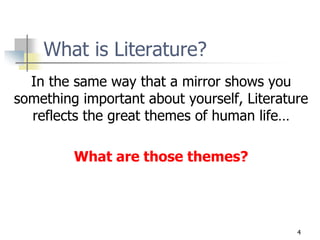
In the same way that a mirror shows you
something important about yourself, Literature
reflects the great themes of human life…
What are those themes?
4
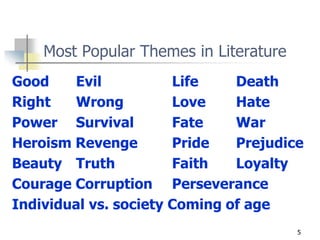
Most Popular Themes in Literature
Good Evil Life Death
Right Wrong Love Hate
Power Survival Fate War
Heroism Revenge Pride Prejudice
Beauty Truth Faith Loyalty
Courage Corruption Perseverance
Individual vs. society Coming of age
5
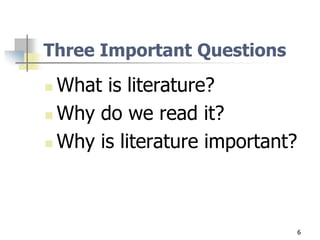
 What is literature?
 Why do we read it?
 Why is literature important?
6
Three Important Questions
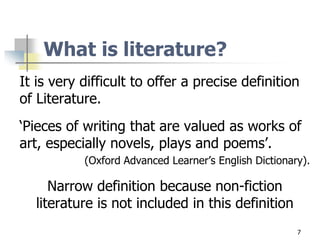
What is literature?
It is very difficult to offer a precise definition
of Literature.
‘Pieces of writing that are valued as works of
art, especially novels, plays and poems’.
(Oxford Advanced Learner’s English Dictionary).
Narrow definition because non-fiction
literature is not included in this definition
7
What is literature?
 “The body of written works produced in a
particular language, country, or age, or the
body of writings on a particular subject
(scientific, art, etc.)”
 (Merriam-Webster’s Dictionary and Thesaurus)
 Includes only written works
 Even this one is not complete
8
What is literature?
 Literature is a term used to
describe written or spoken
material.
 Usually we encounter literature on the page,
but the stage, podium, and screen are other
possible venues.
9
10
What is literature?
 Broadly speaking, "literature" is used to describe anything
from creative writing to more technical or scientific
works, but the term is most commonly used to refer to
works of the creative imagination, including works
of poetry, drama, fiction, and nonfiction.
 Literature is an art that aims at producing beauty in writing
and pleasure in the reader.
Aesthetics + Aesthetic Pleasure – Pure Lit
Facts + Gives Information – Applied Lit
11
Characteristics of literature
 Literature represents a language or a people:
culture and tradition.
 Literature introduces us to new worlds of
experience.
 The writer of literature is not only interested in
facts but also in the beauty of these facts.
 Literature is an art that aims at producing beauty
in writing and pleasure in the reader.
 Literature is an interpretation of life.
12
Basic Elements of Literature
Literature is built around several key elements. It is
important to understand these elements, if you are
going to appreciate the texts you’re reading.
 Point of View: the perspective from which a story is observed
and told
 Symbol: an object that represents an abstraction (Doves
symbolize peace.)
 Theme: the main idea
 Tone: the overall mood
 Setting: the geographical, historical, and social location
 Plot: the sequence of events and action

1. Lecture 1 PPT.ppt

  • 1.
    1 Introduction to LiteraryStudies Course Code: ENG-303 Prof. Suhail Raza Siddiqui Head Department of English Govt. Graduate College, Abdullahpur, Faisalabad BS English Semester I
  • 2.
    2 What is Literature? Imagineliving your life for a while with no mirror or reflecting pool What would happen?
  • 3.
    What is Literature? Youwould only understand yourself from one limited perspective. 3
  • 4.
    What is Literature? Inthe same way that a mirror shows you something important about yourself, Literature reflects the great themes of human life… What are those themes? 4
  • 5.
    Most Popular Themesin Literature Good Evil Life Death Right Wrong Love Hate Power Survival Fate War Heroism Revenge Pride Prejudice Beauty Truth Faith Loyalty Courage Corruption Perseverance Individual vs. society Coming of age 5
  • 6.
     What isliterature?  Why do we read it?  Why is literature important? 6 Three Important Questions
  • 7.
    What is literature? Itis very difficult to offer a precise definition of Literature. ‘Pieces of writing that are valued as works of art, especially novels, plays and poems’. (Oxford Advanced Learner’s English Dictionary). Narrow definition because non-fiction literature is not included in this definition 7
  • 8.
    What is literature? “The body of written works produced in a particular language, country, or age, or the body of writings on a particular subject (scientific, art, etc.)”  (Merriam-Webster’s Dictionary and Thesaurus)  Includes only written works  Even this one is not complete 8
  • 9.
    What is literature? Literature is a term used to describe written or spoken material.  Usually we encounter literature on the page, but the stage, podium, and screen are other possible venues. 9
  • 10.
    10 What is literature? Broadly speaking, "literature" is used to describe anything from creative writing to more technical or scientific works, but the term is most commonly used to refer to works of the creative imagination, including works of poetry, drama, fiction, and nonfiction.  Literature is an art that aims at producing beauty in writing and pleasure in the reader. Aesthetics + Aesthetic Pleasure – Pure Lit Facts + Gives Information – Applied Lit
  • 11.
    11 Characteristics of literature Literature represents a language or a people: culture and tradition.  Literature introduces us to new worlds of experience.  The writer of literature is not only interested in facts but also in the beauty of these facts.  Literature is an art that aims at producing beauty in writing and pleasure in the reader.  Literature is an interpretation of life.
  • 12.
    12 Basic Elements ofLiterature Literature is built around several key elements. It is important to understand these elements, if you are going to appreciate the texts you’re reading.  Point of View: the perspective from which a story is observed and told  Symbol: an object that represents an abstraction (Doves symbolize peace.)  Theme: the main idea  Tone: the overall mood  Setting: the geographical, historical, and social location  Plot: the sequence of events and action