What is Web 2.0?
www.techiehomeschoolers.com
Web 2.0 is BIG
A Quote from the Web2.0 Summit
“Collective intelligence applications are no longer being driven solely by
humans typing on keyboards but, increasingly, by sensors. Our phones
and cameras are being turned into eyes and ears for applications;
motion and location sensors tell where we are, what we’re looking at,
and how fast we’re moving. Data is being collected, presented, and
acted upon in real time. The scale of participation has increased by
orders of magnitude. With more users and sensors feeding more
applications and platforms, developers are able to tackle serious real-
world problems. As a result, the Web opportunity is no longer growing
arithmetically; it’s growing exponentially.”
(http://www.web2summit.com/web2009/public/schedule/detail/10194)
It's all about the conversation.
• conversation and opinions
• collaboration and team work
• contributing to the community for the greater good of the
whole community (YouTube, Flickr, Facebook, Itunes)
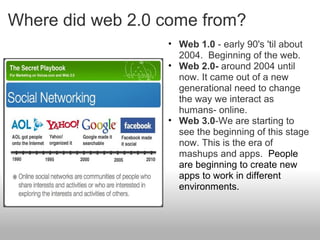
Where did web 2.0 come from?
• Web 1.0 - early 90's 'til about
2004. Beginning of the web.
• Web 2.0- around 2004 until
now. It came out of a new
generational need to change
the way we interact as
humans- online.
• Web 3.0-We are starting to
see the beginning of this stage
now. This is the era of
mashups and apps. People
are beginning to create new
apps to work in different
environments.
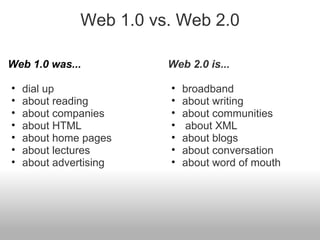
Web 1.0 vs. Web 2.0
Web 1.0 was...
• dial up
• about reading
• about companies
• about HTML
• about home pages
• about lectures
• about advertising
Web 2.0 is...
• broadband
• about writing
• about communities
• about XML
• about blogs
• about conversation
• about word of mouth
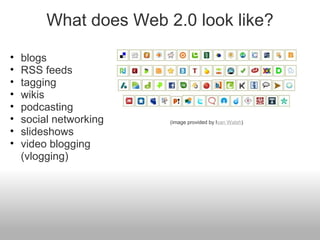
What does Web 2.0 look like?
• blogs
• RSS feeds
• tagging
• wikis
• podcasting
• social networking
• slideshows
• video blogging
(vlogging)
(image provided by Ivan Walsh)
For more info, visit
www.techiehomeschoolers.com

What is Web 2.0

  • 1.
    What is Web2.0? www.techiehomeschoolers.com
  • 2.
    Web 2.0 isBIG A Quote from the Web2.0 Summit “Collective intelligence applications are no longer being driven solely by humans typing on keyboards but, increasingly, by sensors. Our phones and cameras are being turned into eyes and ears for applications; motion and location sensors tell where we are, what we’re looking at, and how fast we’re moving. Data is being collected, presented, and acted upon in real time. The scale of participation has increased by orders of magnitude. With more users and sensors feeding more applications and platforms, developers are able to tackle serious real- world problems. As a result, the Web opportunity is no longer growing arithmetically; it’s growing exponentially.” (http://www.web2summit.com/web2009/public/schedule/detail/10194)
  • 3.
    It's all aboutthe conversation. • conversation and opinions • collaboration and team work • contributing to the community for the greater good of the whole community (YouTube, Flickr, Facebook, Itunes)
  • 4.
    Where did web2.0 come from? • Web 1.0 - early 90's 'til about 2004. Beginning of the web. • Web 2.0- around 2004 until now. It came out of a new generational need to change the way we interact as humans- online. • Web 3.0-We are starting to see the beginning of this stage now. This is the era of mashups and apps. People are beginning to create new apps to work in different environments.
  • 5.
    Web 1.0 vs.Web 2.0 Web 1.0 was... • dial up • about reading • about companies • about HTML • about home pages • about lectures • about advertising Web 2.0 is... • broadband • about writing • about communities • about XML • about blogs • about conversation • about word of mouth
  • 6.
    What does Web2.0 look like? • blogs • RSS feeds • tagging • wikis • podcasting • social networking • slideshows • video blogging (vlogging) (image provided by Ivan Walsh)
  • 7.
    For more info,visit www.techiehomeschoolers.com