SM


What the rest of the industry is doing

WHAT IS USABILITY / UX
SM


Usability!

•   What is that?
•   A Requirement
•   A set of Activities
•   A Test
•   A Discipline
•   A Process
•   A Repeatable Process
SM


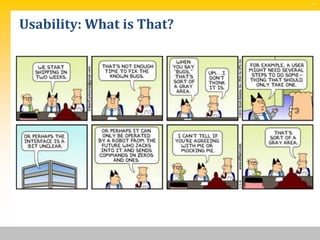
Usability: What is That?
SM


Usability as a Requirement
(ISO Usability Standard 9241 )

• Usability is how a product can be used by specified users to achieve
  specified goals with effectiveness, efficiency, and satisfaction in a specified
  context
    – Effectiveness measures accuracy and completeness
    – Efficiency measures resources expended
    – Satisfaction measures the freedom from discomfort, and positive attitudes towards the
      use of the product


         Effectiveness (% of goal achieved)
       + Efficiency (time to complete a task,
                   or the error rate,                                 =      Usability
                   or the amount of effort)
       + Satisfaction (subjective rating scale)
SM


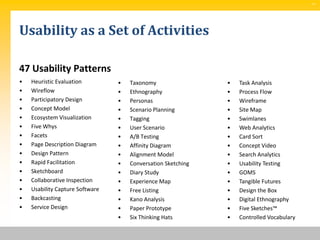
Usability as a Set of Activities

47 Usability Patterns
•   Heuristic Evaluation         •   Taxonomy                 •   Task Analysis
•   Wireflow                     •   Ethnography              •   Process Flow
•   Participatory Design         •   Personas                 •   Wireframe
•   Concept Model                •   Scenario Planning        •   Site Map
•   Ecosystem Visualization      •   Tagging                  •   Swimlanes
•   Five Whys                    •   User Scenario            •   Web Analytics
•   Facets                       •   A/B Testing              •   Card Sort
•   Page Description Diagram     •   Affinity Diagram         •   Concept Video
•   Design Pattern               •   Alignment Model          •   Search Analytics
•   Rapid Facilitation           •   Conversation Sketching   •   Usability Testing
•   Sketchboard                  •   Diary Study              •   GOMS
•   Collaborative Inspection     •   Experience Map           •   Tangible Futures
•   Usability Capture Software   •   Free Listing             •   Design the Box
•   Backcasting                  •   Kano Analysis            •   Digital Ethnography
•   Service Design               •   Paper Prototype          •   Five Sketches™
                                 •   Six Thinking Hats        •   Controlled Vocabulary
SM


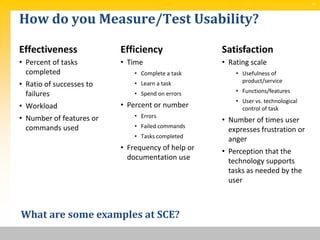
How do you Measure/Test Usability?

Effectiveness             Efficiency               Satisfaction
• Percent of tasks        • Time                   • Rating scale
  completed                   • Complete a task        • Usefulness of
                                                         product/service
• Ratio of successes to       • Learn a task
                              • Spend on errors        • Functions/features
  failures
                                                       • User vs. technological
• Workload                • Percent or number            control of task
• Number of features or       • Errors
                                                   • Number of times user
  commands used               • Failed commands
                                                     expresses frustration or
                              • Tasks completed
                                                     anger
                          • Frequency of help or   • Perception that the
                            documentation use        technology supports
                                                     tasks as needed by the
                                                     user


What are some examples at SCE?
SM


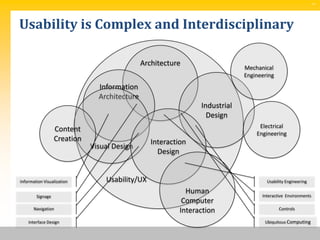
Usability is Complex and Interdisciplinary

                                              Architecture
                                                                            Mechanical
                                                                            Engineering
                               Information
                               Architecture
                                                               Industrial
                                                                 Design
                                                                                 Electrical
                  Content
                                                                                Engineering
                  Creation                       Interaction
                             Visual Design
                                                   Design


Information Visualization        Usability/UX                                       Usability Engineering

                                                           Human                  Interactive Environments
        Signage
                                                          Computer
       Navigation                                        Interaction                      Controls

    Interface Design                                                               Ubiquitous Computing
SM


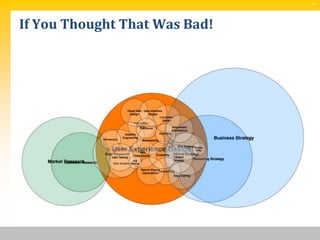
If You Thought That Was Bad!
SM


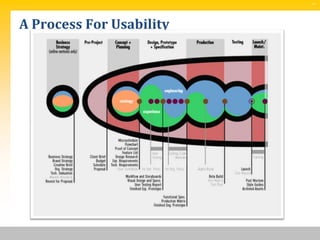
A Process For Usability
SM


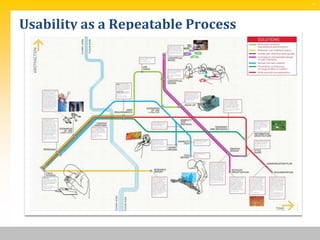
Usability as a Repeatable Process

What is Usability

  • 1.
    SM What the restof the industry is doing WHAT IS USABILITY / UX
  • 2.
    SM Usability! • What is that? • A Requirement • A set of Activities • A Test • A Discipline • A Process • A Repeatable Process
  • 3.
  • 4.
    SM Usability as aRequirement (ISO Usability Standard 9241 ) • Usability is how a product can be used by specified users to achieve specified goals with effectiveness, efficiency, and satisfaction in a specified context – Effectiveness measures accuracy and completeness – Efficiency measures resources expended – Satisfaction measures the freedom from discomfort, and positive attitudes towards the use of the product Effectiveness (% of goal achieved) + Efficiency (time to complete a task, or the error rate, = Usability or the amount of effort) + Satisfaction (subjective rating scale)
  • 5.
    SM Usability as aSet of Activities 47 Usability Patterns • Heuristic Evaluation • Taxonomy • Task Analysis • Wireflow • Ethnography • Process Flow • Participatory Design • Personas • Wireframe • Concept Model • Scenario Planning • Site Map • Ecosystem Visualization • Tagging • Swimlanes • Five Whys • User Scenario • Web Analytics • Facets • A/B Testing • Card Sort • Page Description Diagram • Affinity Diagram • Concept Video • Design Pattern • Alignment Model • Search Analytics • Rapid Facilitation • Conversation Sketching • Usability Testing • Sketchboard • Diary Study • GOMS • Collaborative Inspection • Experience Map • Tangible Futures • Usability Capture Software • Free Listing • Design the Box • Backcasting • Kano Analysis • Digital Ethnography • Service Design • Paper Prototype • Five Sketches™ • Six Thinking Hats • Controlled Vocabulary
  • 6.
    SM How do youMeasure/Test Usability? Effectiveness Efficiency Satisfaction • Percent of tasks • Time • Rating scale completed • Complete a task • Usefulness of product/service • Ratio of successes to • Learn a task • Spend on errors • Functions/features failures • User vs. technological • Workload • Percent or number control of task • Number of features or • Errors • Number of times user commands used • Failed commands expresses frustration or • Tasks completed anger • Frequency of help or • Perception that the documentation use technology supports tasks as needed by the user What are some examples at SCE?
  • 7.
    SM Usability is Complexand Interdisciplinary Architecture Mechanical Engineering Information Architecture Industrial Design Electrical Content Engineering Creation Interaction Visual Design Design Information Visualization Usability/UX Usability Engineering Human Interactive Environments Signage Computer Navigation Interaction Controls Interface Design Ubiquitous Computing
  • 8.
    SM If You ThoughtThat Was Bad!
  • 9.
  • 10.
    SM Usability as aRepeatable Process

Editor's Notes

  • #11 Communication PlanA document describing the scope and the planning of the communication project: what is to be communicated, for whom and how; where the challenges and opportunities lie.Conceptual DesignA set of sketches illustrating the main interaction concept of a digital product. The conceptual design starts with paper and pencil.Conceptual ModelThe concepts that the design must communicate in order for the user to understand and operate the product. The conceptual model differs from the technical model, which is the way the developer understands the product. It also differs from the mental model, which is the concept that an individual user develops in order to understand the product.Content InventoryA structured list of all content (documents, digital assets, information chunks, etc.) that must be considered for publication in a digital product. Detailed SpecificationA detailed specification describes the components and behaviour of the user experience in sufficient detail for the developer, and may include the design rationale.DocumentationThe final deliverables of a documentation project. Usually the writing process of documentation takes three iterations: draft version, pre-final version, and final version.Expert ReviewDuring expert reviews, a number of experts review a product, first individually, then in a group, noting issues and recommending remedial action. Experts readily use rules of thumb (heuristics) but challenge each other’s accepted wisdom.Field StudiesObserving users in the environment in which they will work with the digital product that is being designed.Graphic DesignThe design of the look and feel of the digital product. The graphical design usually consists of a specification of standard colours, icons, the location of graphical elements and typography.Information ArchitectureDocument describing the information architecture of a digital product. In some cases, the information architecture specification offers two perspectives:User’s side: what the user sees —the taxonomy and structuring of the information on the pages.Authoring/Storage side: describing the authoring and storage of the information, workflows, metadata, topics and information types.Mock-UpA more or less realistic simulation of the user interface that combines the scenarios of use with the conceptual design into real-life stories of use. A mock-up can be created in such a way that it can be used in usability tests.PersonasPersonas are lively descriptions of typical users. They are based on patterns and findings gathered during field studies. Using personas prevents designers from drifting towards an idealized view of users that lacks nuance.Research ReportA document that expresses the findings of a research project. Creative and rational at the same time, it provides insight into murky territory.Scenarios of Use [Current State/Future State]An engaging richly textured story of one or more users who use tools to achieve goals. Current-state scenarios cover how users accomplish those goals now, before introducing the new product. Future-state scenarios explore how the envisaged product would affect the storyline.Style GuideA document describing the formal conventions to be followed within a family of digital products. Conventions can be lexical (what are the codes, both visual and linguistic) and syntactical (how the codes can be assembled to form practical wholes).Taxonomy & MetadataDesign of the information structure, the labelling and the terminology that will be applied to the content of a digital product. The information structure is usually a tree or a matrix (faceted classification).Test ReportThe report summarizes the results of the usability tests, identifies the design issues that need to be re-considered, and offers recommendations for improvement.Usability TestA method by which users of a product are asked to perform tasks in an effort to measure the product’s ease-of-use, task time, and the user’s perception of the product.Usability Test ProtocolThe protocol describes scope, goals, settings, instructions and tasks to be performed by a test participant.Use CasesA use case defines a set of use-case instances in which each instance is a sequence of actions a system performs that yields an observable result of value to a particular actor, often a user.User RequirementsUser requirements are a formal expression of the desired functions and qualities of the future digital product. Not only product features, but also non-functional requirements, such as reliability and usability, are included.