Jesse James Garrett
The Elements of User Experience                                                                                                                                    jjg@jjg.net
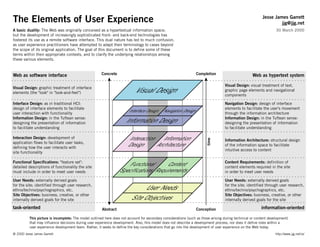
A basic duality: The Web was originally conceived as a hypertextual information space;                                                                             30 March 2000
but the development of increasingly sophisticated front- and back-end technologies has
fostered its use as a remote software interface. This dual nature has led to much confusion,
as user experience practitioners have attempted to adapt their terminology to cases beyond
the scope of its original application. The goal of this document is to define some of these
terms within their appropriate contexts, and to clarify the underlying relationships among
these various elements.


Web as software interface                             Concrete                                                   Completion                         Web as hypertext system

                                                                                                                                   Visual Design: visual treatment of text,
Visual Design: graphic treatment of interface
elements (the "look" in "look-and-feel")                                   Visual Design                                           graphic page elements and navigational
                                                                                                                                   components

Interface Design: as in traditional HCI:                                                                                           Navigation Design: design of interface
design of interface elements to facilitate                                                                                         elements to facilitate the user's movement
user interaction with functionality
                                                                       Interface Design Navigation Design                          through the information architecture
Information Design: in the Tuftean sense:
designing the presentation of information                            Information Design                                            Information Design: in the Tuftean sense:
                                                                                                                                   designing the presentation of information
to facilitate understanding                                                                                                        to facilitate understanding

Interaction Design: development of                                     Interaction Information


                                                                                                                        time
                                                                                                                                   Information Architecture: structural design
application flows to facilitate user tasks,
defining how the user interacts with
                                                                       Design     Architecture                                     of the information space to facilitate
                                                                                                                                   intuitive access to content
site functionality

Functional Specifications: "feature set":                                                                                          Content Requirements: definition of
detailed descriptions of functionality the site
                                                                      Functional      Content                                      content elements required in the site
must include in order to meet user needs                          Specifications Requirements                                      in order to meet user needs

User Needs: externally derived goals                                                                                               User Needs: externally derived goals
for the site; identified through user research,                                                                                    for the site; identified through user research,
ethno/techno/psychographics, etc.                                              User Needs                                          ethno/techno/psychographics, etc.
Site Objectives: business, creative, or other                                                                                      Site Objectives: business, creative, or other
internally derived goals for the site                                    Site Objectives                                           internally derived goals for the site
task-oriented                                          Abstract                                                  Conception                               information-oriented

          This picture is incomplete: The model outlined here does not account for secondary considerations (such as those arising during technical or content development)
          that may influence decisions during user experience development. Also, this model does not describe a development process, nor does it define roles within a
          user experience development team. Rather, it seeks to define the key considerations that go into the development of user experience on the Web today.
© 2000 Jesse James Garrett                                                                                                                                         http://www.jjg.net/ia/

The Elements of User Experience

  • 1.
    Jesse James Garrett TheElements of User Experience jjg@jjg.net A basic duality: The Web was originally conceived as a hypertextual information space; 30 March 2000 but the development of increasingly sophisticated front- and back-end technologies has fostered its use as a remote software interface. This dual nature has led to much confusion, as user experience practitioners have attempted to adapt their terminology to cases beyond the scope of its original application. The goal of this document is to define some of these terms within their appropriate contexts, and to clarify the underlying relationships among these various elements. Web as software interface Concrete Completion Web as hypertext system Visual Design: visual treatment of text, Visual Design: graphic treatment of interface elements (the "look" in "look-and-feel") Visual Design graphic page elements and navigational components Interface Design: as in traditional HCI: Navigation Design: design of interface design of interface elements to facilitate elements to facilitate the user's movement user interaction with functionality Interface Design Navigation Design through the information architecture Information Design: in the Tuftean sense: designing the presentation of information Information Design Information Design: in the Tuftean sense: designing the presentation of information to facilitate understanding to facilitate understanding Interaction Design: development of Interaction Information time Information Architecture: structural design application flows to facilitate user tasks, defining how the user interacts with Design Architecture of the information space to facilitate intuitive access to content site functionality Functional Specifications: "feature set": Content Requirements: definition of detailed descriptions of functionality the site Functional Content content elements required in the site must include in order to meet user needs Specifications Requirements in order to meet user needs User Needs: externally derived goals User Needs: externally derived goals for the site; identified through user research, for the site; identified through user research, ethno/techno/psychographics, etc. User Needs ethno/techno/psychographics, etc. Site Objectives: business, creative, or other Site Objectives: business, creative, or other internally derived goals for the site Site Objectives internally derived goals for the site task-oriented Abstract Conception information-oriented This picture is incomplete: The model outlined here does not account for secondary considerations (such as those arising during technical or content development) that may influence decisions during user experience development. Also, this model does not describe a development process, nor does it define roles within a user experience development team. Rather, it seeks to define the key considerations that go into the development of user experience on the Web today. © 2000 Jesse James Garrett http://www.jjg.net/ia/