What is the importance of statistics?
Understanding the importance of statistics transcends mere numbers; it's a cornerstone
in various facets of life, particularly in the dynamic realm of business. Statistics is more
than just crunching data; it's the compass that guides decision-making, unveils patterns,
and empowers informed choices within the business landscape. Statistics serves as the
language that deciphers the story within data. It helps in interpreting information,
spotting trends, and drawing conclusions vital for informed decision-making.
Types Of Statistics
There are two general approaches to categorizing statistics: the function approach and
the distribution of data approach.
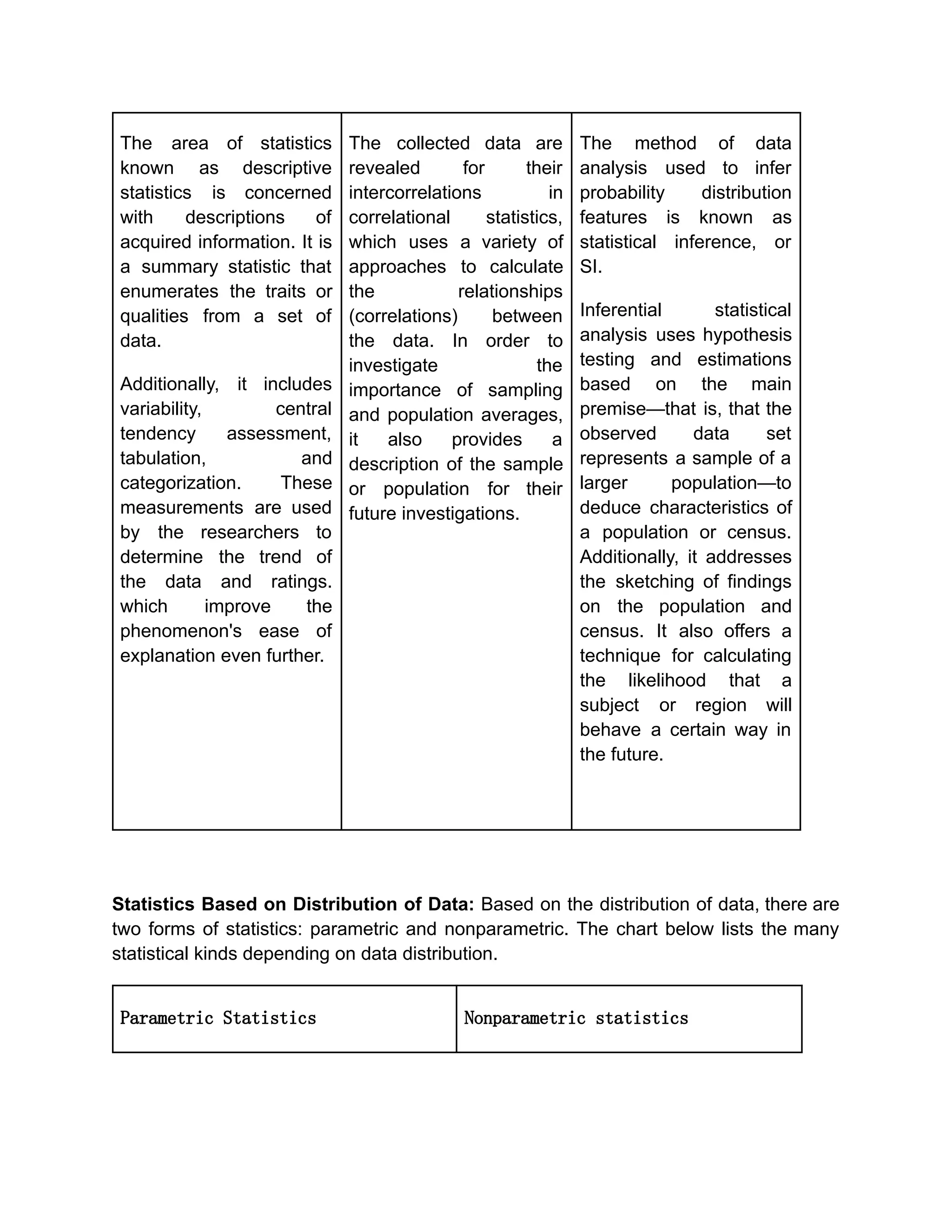
Statistics Based on Function: There are three types of statistics on the basis of
subject matter/ function.
Descriptive Statistics Correlational
statistics
Inferential statistics
The area of statistics
known as descriptive
statistics is concerned
with descriptions of
acquired information. It is
a summary statistic that
enumerates the traits or
qualities from a set of
data.
Additionally, it includes
variability, central
tendency assessment,
tabulation, and
categorization. These
measurements are used
by the researchers to
determine the trend of
the data and ratings.
which improve the
phenomenon's ease of
explanation even further.
The collected data are
revealed for their
intercorrelations in
correlational statistics,
which uses a variety of
approaches to calculate
the relationships
(correlations) between
the data. In order to
investigate the
importance of sampling
and population averages,
it also provides a
description of the sample
or population for their
future investigations.
The method of data
analysis used to infer
probability distribution
features is known as
statistical inference, or
SI.
Inferential statistical
analysis uses hypothesis
testing and estimations
based on the main
premise—that is, that the
observed data set
represents a sample of a
larger population—to
deduce characteristics of
a population or census.
Additionally, it addresses
the sketching of findings
on the population and
census. It also offers a
technique for calculating
the likelihood that a
subject or region will
behave a certain way in
the future.
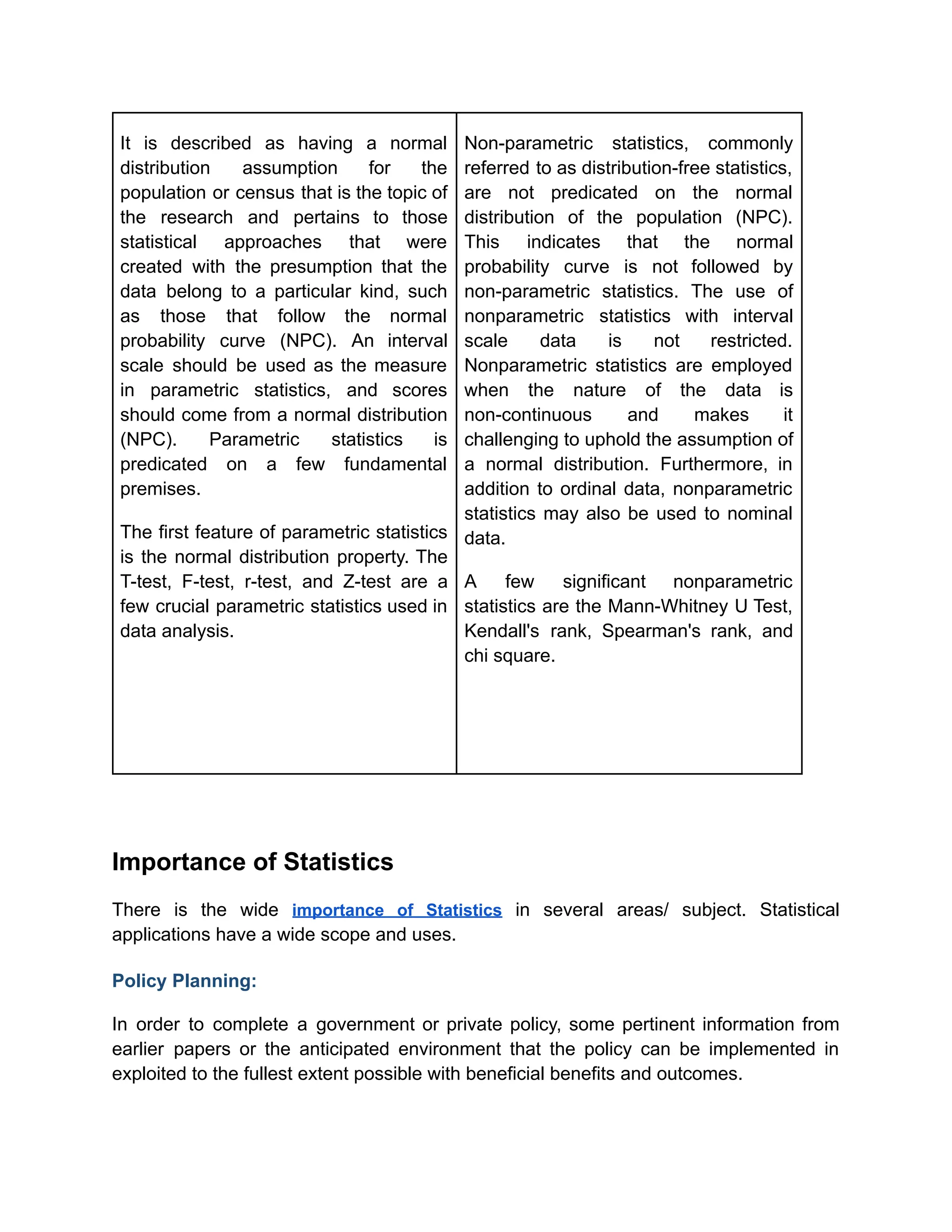
Statistics Based on Distribution of Data: Based on the distribution of data, there are
two forms of statistics: parametric and nonparametric. The chart below lists the many
statistical kinds depending on data distribution.
Parametric Statistics Nonparametric statistics
It is described as having a normal
distribution assumption for the
population or census that is the topic of
the research and pertains to those
statistical approaches that were
created with the presumption that the
data belong to a particular kind, such
as those that follow the normal
probability curve (NPC). An interval
scale should be used as the measure
in parametric statistics, and scores
should come from a normal distribution
(NPC). Parametric statistics is
predicated on a few fundamental
premises.
The first feature of parametric statistics
is the normal distribution property. The
T-test, F-test, r-test, and Z-test are a
few crucial parametric statistics used in
data analysis.
Non-parametric statistics, commonly
referred to as distribution-free statistics,
are not predicated on the normal
distribution of the population (NPC).
This indicates that the normal
probability curve is not followed by
non-parametric statistics. The use of
nonparametric statistics with interval
scale data is not restricted.
Nonparametric statistics are employed
when the nature of the data is
non-continuous and makes it
challenging to uphold the assumption of
a normal distribution. Furthermore, in
addition to ordinal data, nonparametric
statistics may also be used to nominal
data.
A few significant nonparametric
statistics are the Mann-Whitney U Test,
Kendall's rank, Spearman's rank, and
chi square.
Importance of Statistics
There is the wide importance of Statistics in several areas/ subject. Statistical
applications have a wide scope and uses.
Policy Planning:
In order to complete a government or private policy, some pertinent information from
earlier papers or the anticipated environment that the policy can be implemented in
exploited to the fullest extent possible with beneficial benefits and outcomes.
Behavioral and Social Sciences:
Both quantitative and qualitative information are used to analyze data and provide policy
recommendations in the social sciences, particularly in the field of economics.
Additionally, statistics enables researchers and academics to modify data in a thorough
manner in order to analyze and forecast behavioral patterns or trends.
Pure and quantitative sciences:
Statistical methods are also utilized in these fields to obtain accurate measurements
and to identify variations under diverse circumstances and at different times.
Education Sector:
The field of education also makes use of statistical instruments and tools. Statistics are
used to indicate the direction of growth in the education sector by identifying patterns
and trends in variables based on historical and current situations. Additionally, these
tendencies support the development of educational planning and policy.
Importance of Statistics in Business
The following illustrates the importance of statistics in business:
Marketing:
Information for decision-making in the field of marketing is often obtained through
statistical analysis. To ensure that the products reach the final customer, it is first
required to determine what can be sold and then to develop an appropriate plan. Before
making any attempt to enter a new market, a careful examination of data on production
purchasing power, labor force, consumer behavior, and transportation costs should be
conducted.
Production:
Methods and statistical data are crucial in the sphere of production. Statistical analysis
is a major factor in decisions about what to create, how to produce, when to produce,
and for whom to produce.
Finance:
The financial institution greatly relies on statistical analysis of peat and tigers to properly
carry out its finance job.
Banking:
Banking Institutes are finding that it is more and more important to set up research
departments inside their organizations in order to collect and analyze data about
everything from their own operations to the overall state of the economy to any industry
in which they might be interested.
Conclusion
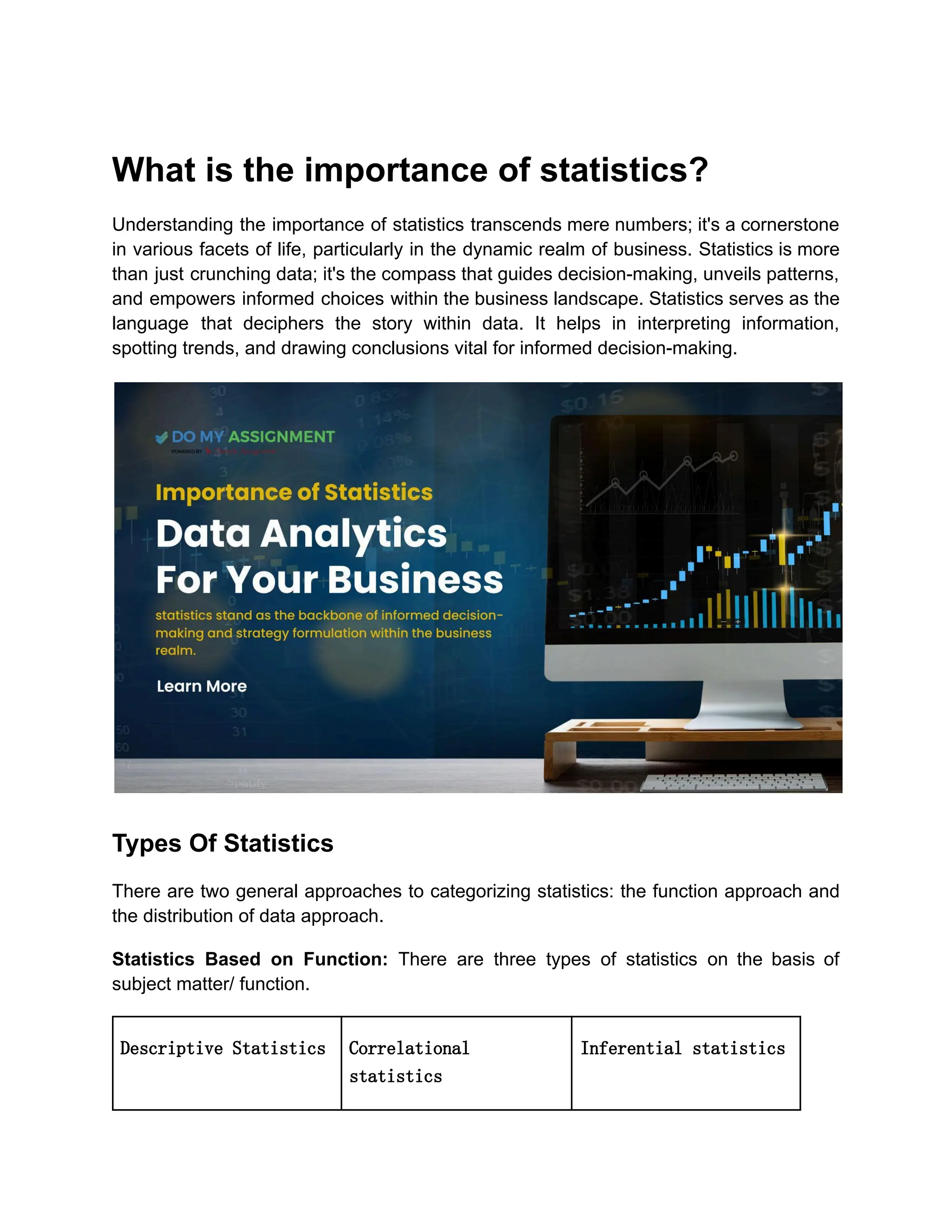
In essence, statistics stand as the backbone of informed decision-making and strategy
formulation within the business realm. It's not merely about numbers; it's the
transformative force that empowers businesses to navigate uncertainties, seize
opportunities, and thrive in dynamic market landscapes. With the aid of Do My
Assignment For Me platforms, delving into the intricacies of statistics becomes an
engaging journey of exploration and comprehension within the context of business
applications.

What is the importance of statistics.pdf

  • 1.
    What is theimportance of statistics? Understanding the importance of statistics transcends mere numbers; it's a cornerstone in various facets of life, particularly in the dynamic realm of business. Statistics is more than just crunching data; it's the compass that guides decision-making, unveils patterns, and empowers informed choices within the business landscape. Statistics serves as the language that deciphers the story within data. It helps in interpreting information, spotting trends, and drawing conclusions vital for informed decision-making. Types Of Statistics There are two general approaches to categorizing statistics: the function approach and the distribution of data approach. Statistics Based on Function: There are three types of statistics on the basis of subject matter/ function. Descriptive Statistics Correlational statistics Inferential statistics
  • 2.
    The area ofstatistics known as descriptive statistics is concerned with descriptions of acquired information. It is a summary statistic that enumerates the traits or qualities from a set of data. Additionally, it includes variability, central tendency assessment, tabulation, and categorization. These measurements are used by the researchers to determine the trend of the data and ratings. which improve the phenomenon's ease of explanation even further. The collected data are revealed for their intercorrelations in correlational statistics, which uses a variety of approaches to calculate the relationships (correlations) between the data. In order to investigate the importance of sampling and population averages, it also provides a description of the sample or population for their future investigations. The method of data analysis used to infer probability distribution features is known as statistical inference, or SI. Inferential statistical analysis uses hypothesis testing and estimations based on the main premise—that is, that the observed data set represents a sample of a larger population—to deduce characteristics of a population or census. Additionally, it addresses the sketching of findings on the population and census. It also offers a technique for calculating the likelihood that a subject or region will behave a certain way in the future. Statistics Based on Distribution of Data: Based on the distribution of data, there are two forms of statistics: parametric and nonparametric. The chart below lists the many statistical kinds depending on data distribution. Parametric Statistics Nonparametric statistics
  • 3.
    It is describedas having a normal distribution assumption for the population or census that is the topic of the research and pertains to those statistical approaches that were created with the presumption that the data belong to a particular kind, such as those that follow the normal probability curve (NPC). An interval scale should be used as the measure in parametric statistics, and scores should come from a normal distribution (NPC). Parametric statistics is predicated on a few fundamental premises. The first feature of parametric statistics is the normal distribution property. The T-test, F-test, r-test, and Z-test are a few crucial parametric statistics used in data analysis. Non-parametric statistics, commonly referred to as distribution-free statistics, are not predicated on the normal distribution of the population (NPC). This indicates that the normal probability curve is not followed by non-parametric statistics. The use of nonparametric statistics with interval scale data is not restricted. Nonparametric statistics are employed when the nature of the data is non-continuous and makes it challenging to uphold the assumption of a normal distribution. Furthermore, in addition to ordinal data, nonparametric statistics may also be used to nominal data. A few significant nonparametric statistics are the Mann-Whitney U Test, Kendall's rank, Spearman's rank, and chi square. Importance of Statistics There is the wide importance of Statistics in several areas/ subject. Statistical applications have a wide scope and uses. Policy Planning: In order to complete a government or private policy, some pertinent information from earlier papers or the anticipated environment that the policy can be implemented in exploited to the fullest extent possible with beneficial benefits and outcomes.
  • 4.
    Behavioral and SocialSciences: Both quantitative and qualitative information are used to analyze data and provide policy recommendations in the social sciences, particularly in the field of economics. Additionally, statistics enables researchers and academics to modify data in a thorough manner in order to analyze and forecast behavioral patterns or trends. Pure and quantitative sciences: Statistical methods are also utilized in these fields to obtain accurate measurements and to identify variations under diverse circumstances and at different times. Education Sector: The field of education also makes use of statistical instruments and tools. Statistics are used to indicate the direction of growth in the education sector by identifying patterns and trends in variables based on historical and current situations. Additionally, these tendencies support the development of educational planning and policy. Importance of Statistics in Business The following illustrates the importance of statistics in business: Marketing: Information for decision-making in the field of marketing is often obtained through statistical analysis. To ensure that the products reach the final customer, it is first required to determine what can be sold and then to develop an appropriate plan. Before making any attempt to enter a new market, a careful examination of data on production purchasing power, labor force, consumer behavior, and transportation costs should be conducted. Production: Methods and statistical data are crucial in the sphere of production. Statistical analysis is a major factor in decisions about what to create, how to produce, when to produce, and for whom to produce. Finance: The financial institution greatly relies on statistical analysis of peat and tigers to properly carry out its finance job.
  • 5.
    Banking: Banking Institutes arefinding that it is more and more important to set up research departments inside their organizations in order to collect and analyze data about everything from their own operations to the overall state of the economy to any industry in which they might be interested. Conclusion In essence, statistics stand as the backbone of informed decision-making and strategy formulation within the business realm. It's not merely about numbers; it's the transformative force that empowers businesses to navigate uncertainties, seize opportunities, and thrive in dynamic market landscapes. With the aid of Do My Assignment For Me platforms, delving into the intricacies of statistics becomes an engaging journey of exploration and comprehension within the context of business applications.