Doodle Artists 
Joan Miro 
Paul Klee 
Wassily Kandinsky 
Created by Margo Dupre, EDCI 571 
Concordia University – Oregon 
What is 
Doodle Art? 
Clip art provided by Microsoft
Doodle Art is a form of scribbling to 
create a design or composition using 
lines, shapes and color. 
*** The only rule in doodle art is that no 
doodles should overlap or interfere 
with other doodles.****
Learning Objectives: 
ISET standards for students: 
2. Communication and collaboration 
Students use digital media and environments to 
communicate and work collaboratively, 
including at a distance, to support individual 
learning and contribute to the learning of others. 
2a. Interact, collaborate, and publish with peers, 
experts, or others employing a variety of digital 
environments and media 
2d. Contribute to project teams to produce 
original works or solve problems 
3. Research and information fluency 
Students apply digital tools to gather, evaluate, 
and use information. 
3C: Evaluate and select information sources 
and digital tools based on the appropriateness 
to specific tasks 
Course Overview 
You will participate in the doodling process 
necessary for understanding how an artist thinks, 
using elements of art and principles of design. 
You will transfer the learning into creating and 
completing a finished original art work. 
You and a classmate will participate in team 
research of a Doodle artist using the internet 
links provided and create a PowerPoint 
to assist classmates in learning. 
Warm-up with 
Doodling 
It will be a 
portrait 
of you. 
Clip art provided by Microsoft
Doodle Portrait 
Let’s have some fun! 
I want you to draw a picture of yourself screaming. 
I mean really letting it go! Show me all of the things that your 
face would be doing if your scream could be heard around 
the world! 
You are going to have to think about all kinds of lines and 
shapes that would show me the energy to scream. 
Your paper should be filled with lines and shapes showing lots 
and lots of energy and power. All of your paper should be 
filled with marks that express how you would look and feel. 
Draw a picture of yourself screaming right now! Show me 
what you’ve got! 
Don’t be shy, after all you’re screaming. 
You have 15 minutes. 
Clip art provided by Microsoft
As soon as you’re done; 
send your doodle portrait to 
me by taking a photo with 
your phone and emailing it 
as an attachment. 
Then check out mine. 
Clip art provided by Microsoft 
There are many ways to show emotion using 
elements of art and principles of visual design. 
Think about lines: thick and thin, short and long, wavy, 
jagged, etc. What lines can you group together to 
create patterns that might show movement in your 
face when they are repeated? You are only limited by 
your imagination. 
Think about shape: geometric or organic shapes can 
help express emotion. What shapes can you use to 
show screaming in eyes, mouth, lips, ears, hair, etc. 
Think about color: in this case the color will be the black 
marker to express the feeling of screaming by creating 
patterns. 
Think about space: how will you fill the negative space 
around your portrait and the positive space within your 
portrait?
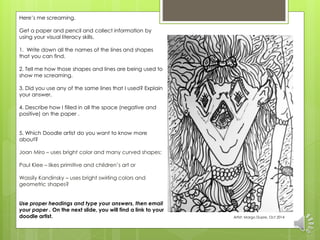
Here’s me screaming. 
Get a paper and pencil and collect information by 
using your visual literacy skills. 
1. Write down all the names of the lines and shapes 
that you can find. 
2. Tell me how those shapes and lines are being used to 
show me screaming. 
3. Did you use any of the same lines that I used? Explain 
your answer. 
4. Describe how I filled in all the space (negative and 
positive) on the paper . 
5. Which Doodle artist do you want to know more 
about? 
Joan Miro – uses bright color and many curved shapes; 
Paul Klee – likes primitive and children’s art or 
Wassily Kandinsky – uses bright swirling colors and 
geometric shapes? 
Use proper headings and type your answers, then email 
your paper . On the next slide, you will find a link to your 
doodle artist. Artist: Margo Dupre, Oct 2014
Linking you to your selected Doodle Artist 
 http://en.wikipedia.org/wiki/Joan_Mir%C3%B3 
 http://en.wikipedia.org/wiki/Paul_Klee 
 http://en.wikipedia.org/wiki/Wassily_Kandinsky 
 You two will create a 2-slide presentation. You each will be asked to 
add an extra piece of information that you find interesting about the 
artist or his work to share in the slide presentation. 
 The rubric for this assignment is on the next slide. 
 I know you two will do an awesome job. Good Luck!
Send the 
PowerPoint to me 
as an 
attachment. 
Presentation Rubric 
1. On slide one: show name of each student at bottom right corner. 
Place name of the artist in center of slide and upload (1) photo of the 
artist. Write a famous quote or saying known to be said by the artist 
under the photo. Write a short summary (5) lines or less describing the 
artist style of work. 
2. On slide two: Use the template that divides the slide in half. Upload 
photos of two pieces of the artist work. Place a photo on each side 
along with the name of the artwork, date of completion and medium. 
Below the artwork , each student will complete the following answers 
for one of the chosen art works using visual literacy skills. Write these 
answers into your PowerPoint for each work under the 
Photo. 
A. Identify the image or images in the artwork 
B. Tell what colors or color group is dominate 
C. What do you think is most important to the artist in the work? 
D. Is there a variety of lines to create movement or texture? 
E. Is there a variety of shapes (geometric or organic)? 
F. Do the shapes or directional lines connect pieces 
together within the work? 
Finally, Why did you choose this particular piece of art work? 
Clip art provided by Microsoft
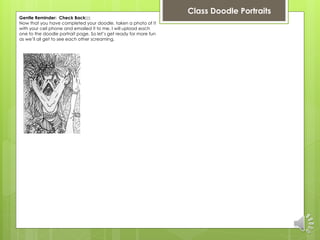
Class Doodle Portraits 
Gentle Reminder: Check Back:::: 
Now that you have completed your doodle, taken a photo of it 
with your cell phone and emailed it to me. I will upload each 
one to the doodle portrait page. So let’s get ready for more fun 
as we’ll all get to see each other screaming.

What is doodle art

  • 1.
    Doodle Artists JoanMiro Paul Klee Wassily Kandinsky Created by Margo Dupre, EDCI 571 Concordia University – Oregon What is Doodle Art? Clip art provided by Microsoft
  • 2.
    Doodle Art isa form of scribbling to create a design or composition using lines, shapes and color. *** The only rule in doodle art is that no doodles should overlap or interfere with other doodles.****
  • 3.
    Learning Objectives: ISETstandards for students: 2. Communication and collaboration Students use digital media and environments to communicate and work collaboratively, including at a distance, to support individual learning and contribute to the learning of others. 2a. Interact, collaborate, and publish with peers, experts, or others employing a variety of digital environments and media 2d. Contribute to project teams to produce original works or solve problems 3. Research and information fluency Students apply digital tools to gather, evaluate, and use information. 3C: Evaluate and select information sources and digital tools based on the appropriateness to specific tasks Course Overview You will participate in the doodling process necessary for understanding how an artist thinks, using elements of art and principles of design. You will transfer the learning into creating and completing a finished original art work. You and a classmate will participate in team research of a Doodle artist using the internet links provided and create a PowerPoint to assist classmates in learning. Warm-up with Doodling It will be a portrait of you. Clip art provided by Microsoft
  • 4.
    Doodle Portrait Let’shave some fun! I want you to draw a picture of yourself screaming. I mean really letting it go! Show me all of the things that your face would be doing if your scream could be heard around the world! You are going to have to think about all kinds of lines and shapes that would show me the energy to scream. Your paper should be filled with lines and shapes showing lots and lots of energy and power. All of your paper should be filled with marks that express how you would look and feel. Draw a picture of yourself screaming right now! Show me what you’ve got! Don’t be shy, after all you’re screaming. You have 15 minutes. Clip art provided by Microsoft
  • 5.
    As soon asyou’re done; send your doodle portrait to me by taking a photo with your phone and emailing it as an attachment. Then check out mine. Clip art provided by Microsoft There are many ways to show emotion using elements of art and principles of visual design. Think about lines: thick and thin, short and long, wavy, jagged, etc. What lines can you group together to create patterns that might show movement in your face when they are repeated? You are only limited by your imagination. Think about shape: geometric or organic shapes can help express emotion. What shapes can you use to show screaming in eyes, mouth, lips, ears, hair, etc. Think about color: in this case the color will be the black marker to express the feeling of screaming by creating patterns. Think about space: how will you fill the negative space around your portrait and the positive space within your portrait?
  • 6.
    Here’s me screaming. Get a paper and pencil and collect information by using your visual literacy skills. 1. Write down all the names of the lines and shapes that you can find. 2. Tell me how those shapes and lines are being used to show me screaming. 3. Did you use any of the same lines that I used? Explain your answer. 4. Describe how I filled in all the space (negative and positive) on the paper . 5. Which Doodle artist do you want to know more about? Joan Miro – uses bright color and many curved shapes; Paul Klee – likes primitive and children’s art or Wassily Kandinsky – uses bright swirling colors and geometric shapes? Use proper headings and type your answers, then email your paper . On the next slide, you will find a link to your doodle artist. Artist: Margo Dupre, Oct 2014
  • 7.
    Linking you toyour selected Doodle Artist  http://en.wikipedia.org/wiki/Joan_Mir%C3%B3  http://en.wikipedia.org/wiki/Paul_Klee  http://en.wikipedia.org/wiki/Wassily_Kandinsky  You two will create a 2-slide presentation. You each will be asked to add an extra piece of information that you find interesting about the artist or his work to share in the slide presentation.  The rubric for this assignment is on the next slide.  I know you two will do an awesome job. Good Luck!
  • 8.
    Send the PowerPointto me as an attachment. Presentation Rubric 1. On slide one: show name of each student at bottom right corner. Place name of the artist in center of slide and upload (1) photo of the artist. Write a famous quote or saying known to be said by the artist under the photo. Write a short summary (5) lines or less describing the artist style of work. 2. On slide two: Use the template that divides the slide in half. Upload photos of two pieces of the artist work. Place a photo on each side along with the name of the artwork, date of completion and medium. Below the artwork , each student will complete the following answers for one of the chosen art works using visual literacy skills. Write these answers into your PowerPoint for each work under the Photo. A. Identify the image or images in the artwork B. Tell what colors or color group is dominate C. What do you think is most important to the artist in the work? D. Is there a variety of lines to create movement or texture? E. Is there a variety of shapes (geometric or organic)? F. Do the shapes or directional lines connect pieces together within the work? Finally, Why did you choose this particular piece of art work? Clip art provided by Microsoft
  • 9.
    Class Doodle Portraits Gentle Reminder: Check Back:::: Now that you have completed your doodle, taken a photo of it with your cell phone and emailed it to me. I will upload each one to the doodle portrait page. So let’s get ready for more fun as we’ll all get to see each other screaming.

Editor's Notes

  • #2 Hi! This is a lesson that will help you understand what doodle art is and who is famous for doing it. On this screen, I have listed three famous doodle artists: Joan Miro, Paul Klee and Wassily Kandinsky. Once you have completed this exercise, you and a partner will have a chance to explore one of these artist to learn more about them and their special style of doodling. Please take a look at the artist easel on the left side of the screen. You will be seeing this easel a different times during this lesson. I will have notes written on the easel and will read the information to you.
  • #3 Doodle Art is a form of scribbling to create a design or composition using lines, shapes and colors. The only rule in doodle art is that no doodles should overlap or interfere with other doodles.
  • #4  For this exercise, you will be creating the cover page of your doodle journal. It will be a portrait of you.
  • #9 Now that you have an idea about doodling. Come see me to find out who your partner is for the research part. Think about which doodle artist you want to learn more about. You will need to reach into my artsy canister and pull out a slip of paper. Each slip has the name of an artist. You will be matched with the student who has pulled the same artist name. You will also get a form that will guide you to collecting information about the artist. You each will also be asked to add an extra piece of information that you find interesting to share in the slide presentation. I know the two of you will do an awesome job. Good Luck.