Year 6 “Express yourself”
Title Page Drawing Folio
Reserve the first page in your visual diary for the title
page. You will decorate this page when there is time.
How do you behave in the Art Room?
Art Class Procedures &
• Bring your iPad
• Bring pencil case with pencils,
rubber, sharpener, scissor etc.
• Make sure your artworks are
labelled with your name and
class in pencil on the back.
• Clean up after yourself.
• Put your artwork in the
appropriate location (tub or dry
rack)
• Put your chair up at the end of
the lesson.
Responsibilities
• Punctual, well mannered and be
organised
• Cooperative, considerate and
respect others
• Be open-minded to learning
something new.
• Listen carefully to instructions
• Wear a smock to protect your
uniform.
• Use tools and equipment
carefully and respectfully.
• Handle all artwork with care
• Ask questions, seek advice from
teacher if unsure
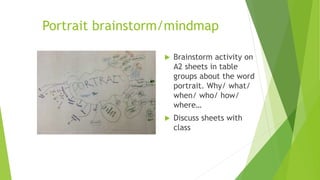
Portrait brainstorm/mindmap
 Brainstorm activity on
A2 sheets in table
groups about the word
portrait. Why/ what/
when/ who/ how/
where…
 Discuss sheets with
class
Activity 1: Drawing
portraits in visual
diary
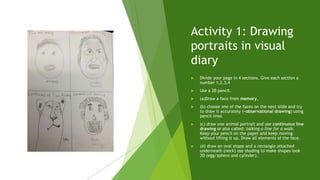
 Divide your page in 4 sections. Give each section a
number 1,2,3,4
 Use a 2B pencil.
 (a)Draw a face from memory,
 (b) choose one of the faces on the next slide and try
to draw it accurately (=observational drawing) using
pencil lines
 (c) draw one animal portrait and use continuous line
drawing or also called: talking a line for a walk.
Keep your pencil on the paper and keep moving
without lifting it up. Draw all elements of the face.
 (d) draw an oval shape and a rectangle attached
underneath (neck) use shading to make shapes look
3D (egg/sphere and cylinder).
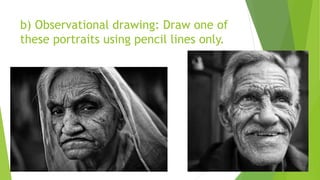
b) Observational drawing: Draw one of
these portraits using pencil lines only.
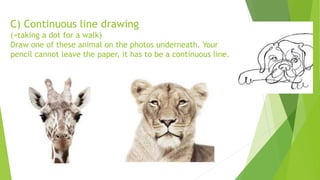
C) Continuous line drawing
(=taking a dot for a walk)
Draw one of these animal on the photos underneath. Your
pencil cannot leave the paper, it has to be a continuous line.
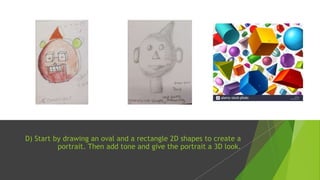
D) Start by drawing an oval and a rectangle 2D shapes to create a
portrait. Then add tone and give the portrait a 3D look.
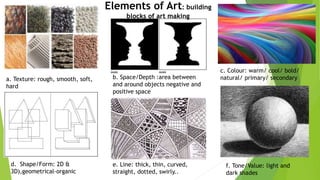
a. Texture: rough, smooth, soft,
hard
b. Space/Depth :area between
and around objects negative and
positive space
c. Colour: warm/ cool/ bold/
natural/ primary/ secondary
d. Shape/Form: 2D &
3D),geometrical-organic
e. Line: thick, thin, curved,
straight, dotted, swirly..
f. Tone/Value: light and
dark shades
Elements of Art: building
blocks of art making
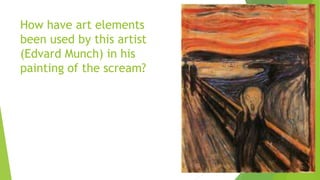
How have art elements
been used by this artist
(Edvard Munch) in his
painting of the scream?
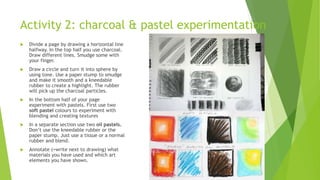
Activity 2: charcoal & pastel experimentation
 Divide a page by drawing a horizontal line
halfway. In the top half you use charcoal.
Draw different lines. Smudge some with
your finger.
 Draw a circle and turn it into sphere by
using tone. Use a paper stump to smudge
and make it smooth and a kneedable
rubber to create a highlight. The rubber
will pick up the charcoal particles.
 In the bottom half of your page
experiment with pastels. First use two
soft pastel colours to experiment with
blending and creating textures
 In a separate section use two oil pastels.
Don’t use the kneedable rubber or the
paper stump. Just use a tissue or a normal
rubber and blend.
 Annotate (=write next to drawing) what
materials you have used and which art
elements you have shown.
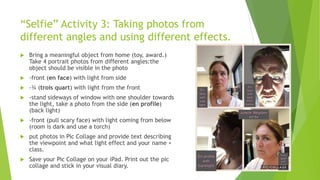
“Selfie” Activity 3: Taking photos from
different angles and using different effects.
 Bring a meaningful object from home (toy, award.)
Take 4 portrait photos from different angles:the
object should be visible in the photo
 -front (en face) with light from side
 -¾ (trois quart) with light from the front
 -stand sideways of window with one shoulder towards
the light, take a photo from the side (en profile)
(back light)
 -front (pull scary face) with light coming from below
(room is dark and use a torch)
 put photos in Pic Collage and provide text describing
the viewpoint and what light effect and your name +
class.
 Save your Pic Collage on your iPad. Print out the pic
collage and stick in your visual diary.
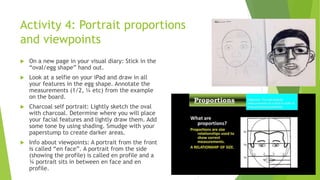
Activity 4: Portrait proportions
and viewpoints
 On a new page in your visual diary: Stick in the
“oval/egg shape” hand out.
 Look at a selfie on your iPad and draw in all
your features in the egg shape. Annotate the
measurements (1/2, ¼ etc) from the example
on the board.
 Charcoal self portrait: Lightly sketch the oval
with charcoal. Determine where you will place
your facial features and lightly draw them. Add
some tone by using shading. Smudge with your
paperstump to create darker areas.
 Info about viewpoints: A portrait from the front
is called “en face”. A portrait from the side
(showing the profile) is called en profile and a
¾ portrait sits in between en face and en
profile.
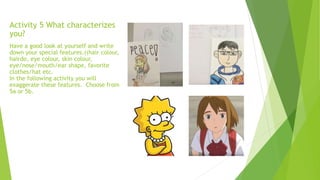
Activity 5 What characterizes
you?
Have a good look at yourself and write
down your special features.((hair colour,
hairdo, eye colour, skin colour,
eye/nose/mouth/ear shape, favorite
clothes/hat etc.
In the following activity you will
exaggerate these features. Choose from
5a or 5b.
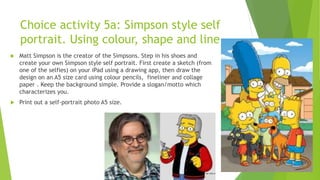
Choice activity 5a: Simpson style self
portrait. Using colour, shape and line.
 Matt Simpson is the creator of the Simpsons. Step in his shoes and
create your own Simpson style self portrait. First create a sketch (from
one of the selfies) on your iPad using a drawing app, then draw the
design on an A5 size card using colour pencils, fineliner and collage
paper . Keep the background simple. Provide a slogan/motto which
characterizes you.
 Print out a self-portrait photo A5 size.
Choice activity 5b: Manga style self
portrait (using colour, shape and
line)
 If you are more into Japanese or Chinese
manga/anime movies. Get inspired by
your favorite artist and character you
like. Go and create a Manga self-
portrait. Use one of your selfies to
create a sketch on your iPad in a
drawing app, then draw the design on an
A5 size card using colour pencils,
fineliner and collage paper. Keep the
background simple.
 Provide a slogan/motto/action which
characterizes you.
 Print out a self-portrait photo A5
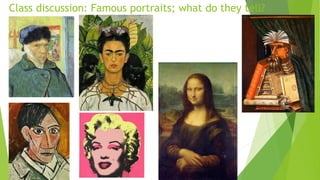
Class discussion: Famous portraits; what do they tell?
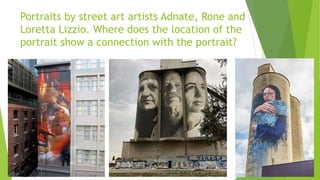
Portraits by street art artists Adnate, Rone and
Loretta Lizzio. Where does the location of the
portrait show a connection with the portrait?
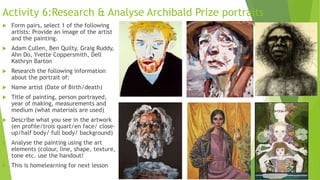
Activity 6:Research & Analyse Archibald Prize portraits
 Form pairs, select 1 of the following
artists: Provide an image of the artist
and the painting.
 Adam Cullen, Ben Quilty, Graig Ruddy,
Ahn Do, Yvette Coppersmith, Dell
Kathryn Barton
 Research the following information
about the portrait of:
 Name artist (Date of Birth/death)
 Title of painting, person portrayed,
year of making, measurements and
medium (what materials are used)
 Describe what you see in the artwork
(en profile/trois quart/en face/ close-
up/half body/ full body/ background)
 Analyse the painting using the art
elements (colour, line, shape, texture,
tone etc. use the handout!
 This is homelearning for next lesson
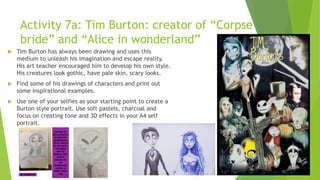
Activity 7a: Tim Burton: creator of “Corpse
bride” and “Alice in wonderland”
 Tim Burton has always been drawing and uses this
medium to unleash his imagination and escape reality.
His art teacher encouraged him to develop his own style.
His creatures look gothic, have pale skin, scary looks.
 Find some of his drawings of characters and print out
some inspirational examples.
 Use one of your selfies as your starting point to create a
Burton style portrait. Use soft pastels, charcoal and
focus on creating tone and 3D effects in your A4 self
portrait.
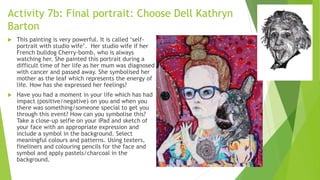
Activity 7b: Final portrait: Choose Dell Kathryn
Barton
 This painting is very powerful. It is called ‘self-
portrait with studio wife’. Her studio wife if her
French bulldog Cherry-bomb, who is always
watching her. She painted this portrait during a
difficult time of her life as her mum was diagnosed
with cancer and passed away. She symbolised her
mother as the leaf which represents the energy of
life. How has she expressed her feelings?
 Have you had a moment in your life which has had
impact (positive/negative) on you and when you
there was something/someone special to get you
through this event? How can you symbolise this?
Take a close-up selfie on your iPad and sketch of
your face with an appropriate expression and
include a symbol in the background. Select
meaningful colours and patterns. Using texters,
fineliners and colouring pencils for the face and
symbol and apply pastels/charcoal in the
background.
Activity 8: Self reflection in Pic collage
or Word document
 You have created 3 different style portraits. Take a photo of each artwork and present
these in your document. Describe for each self-portrait:
 Who is your inspiring artist/style (Simpson/Manga, Tim Burton, Dell Barton/Bryan)
 How is the concept "perspective’ visible in your portrait/ what is the message/feeling you
tried to express?
 Select the portrait you like best and describe how you have used Art elements
(colour/line/shape/tone) to express your message.
 Does your artwork have other references such as objects/symbols or things in the
background that tell a story? Please describe your ideas.
 What do like best in the selected portrait and explain why.
 What would you improve and how?
 Submit your document on STL link.
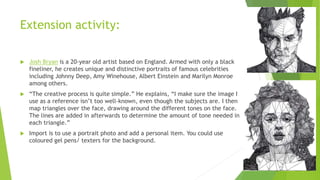
Extension activity:
 Josh Bryan is a 20-year old artist based on England. Armed with only a black
fineliner, he creates unique and distinctive portraits of famous celebrities
including Johnny Deep, Amy Winehouse, Albert Einstein and Marilyn Monroe
among others.
 “The creative process is quite simple.” He explains, “I make sure the image I
use as a reference isn’t too well-known, even though the subjects are. I then
map triangles over the face, drawing around the different tones on the face.
The lines are added in afterwards to determine the amount of tone needed in
each triangle.”
 Import is to use a portrait photo and add a personal item. You could use
coloured gel pens/ texters for the background.

Express yourself portrait 2021 version 1 grade 6

  • 1.
    Year 6 “Expressyourself” Title Page Drawing Folio Reserve the first page in your visual diary for the title page. You will decorate this page when there is time.
  • 2.
    How do youbehave in the Art Room? Art Class Procedures & • Bring your iPad • Bring pencil case with pencils, rubber, sharpener, scissor etc. • Make sure your artworks are labelled with your name and class in pencil on the back. • Clean up after yourself. • Put your artwork in the appropriate location (tub or dry rack) • Put your chair up at the end of the lesson. Responsibilities • Punctual, well mannered and be organised • Cooperative, considerate and respect others • Be open-minded to learning something new. • Listen carefully to instructions • Wear a smock to protect your uniform. • Use tools and equipment carefully and respectfully. • Handle all artwork with care • Ask questions, seek advice from teacher if unsure
  • 3.
    Portrait brainstorm/mindmap  Brainstormactivity on A2 sheets in table groups about the word portrait. Why/ what/ when/ who/ how/ where…  Discuss sheets with class
  • 4.
    Activity 1: Drawing portraitsin visual diary  Divide your page in 4 sections. Give each section a number 1,2,3,4  Use a 2B pencil.  (a)Draw a face from memory,  (b) choose one of the faces on the next slide and try to draw it accurately (=observational drawing) using pencil lines  (c) draw one animal portrait and use continuous line drawing or also called: talking a line for a walk. Keep your pencil on the paper and keep moving without lifting it up. Draw all elements of the face.  (d) draw an oval shape and a rectangle attached underneath (neck) use shading to make shapes look 3D (egg/sphere and cylinder).
  • 5.
    b) Observational drawing:Draw one of these portraits using pencil lines only.
  • 6.
    C) Continuous linedrawing (=taking a dot for a walk) Draw one of these animal on the photos underneath. Your pencil cannot leave the paper, it has to be a continuous line.
  • 7.
    D) Start bydrawing an oval and a rectangle 2D shapes to create a portrait. Then add tone and give the portrait a 3D look.
  • 8.
    a. Texture: rough,smooth, soft, hard b. Space/Depth :area between and around objects negative and positive space c. Colour: warm/ cool/ bold/ natural/ primary/ secondary d. Shape/Form: 2D & 3D),geometrical-organic e. Line: thick, thin, curved, straight, dotted, swirly.. f. Tone/Value: light and dark shades Elements of Art: building blocks of art making
  • 9.
    How have artelements been used by this artist (Edvard Munch) in his painting of the scream?
  • 10.
    Activity 2: charcoal& pastel experimentation  Divide a page by drawing a horizontal line halfway. In the top half you use charcoal. Draw different lines. Smudge some with your finger.  Draw a circle and turn it into sphere by using tone. Use a paper stump to smudge and make it smooth and a kneedable rubber to create a highlight. The rubber will pick up the charcoal particles.  In the bottom half of your page experiment with pastels. First use two soft pastel colours to experiment with blending and creating textures  In a separate section use two oil pastels. Don’t use the kneedable rubber or the paper stump. Just use a tissue or a normal rubber and blend.  Annotate (=write next to drawing) what materials you have used and which art elements you have shown.
  • 11.
    “Selfie” Activity 3:Taking photos from different angles and using different effects.  Bring a meaningful object from home (toy, award.) Take 4 portrait photos from different angles:the object should be visible in the photo  -front (en face) with light from side  -¾ (trois quart) with light from the front  -stand sideways of window with one shoulder towards the light, take a photo from the side (en profile) (back light)  -front (pull scary face) with light coming from below (room is dark and use a torch)  put photos in Pic Collage and provide text describing the viewpoint and what light effect and your name + class.  Save your Pic Collage on your iPad. Print out the pic collage and stick in your visual diary.
  • 12.
    Activity 4: Portraitproportions and viewpoints  On a new page in your visual diary: Stick in the “oval/egg shape” hand out.  Look at a selfie on your iPad and draw in all your features in the egg shape. Annotate the measurements (1/2, ¼ etc) from the example on the board.  Charcoal self portrait: Lightly sketch the oval with charcoal. Determine where you will place your facial features and lightly draw them. Add some tone by using shading. Smudge with your paperstump to create darker areas.  Info about viewpoints: A portrait from the front is called “en face”. A portrait from the side (showing the profile) is called en profile and a ¾ portrait sits in between en face and en profile.
  • 13.
    Activity 5 Whatcharacterizes you? Have a good look at yourself and write down your special features.((hair colour, hairdo, eye colour, skin colour, eye/nose/mouth/ear shape, favorite clothes/hat etc. In the following activity you will exaggerate these features. Choose from 5a or 5b.
  • 14.
    Choice activity 5a:Simpson style self portrait. Using colour, shape and line.  Matt Simpson is the creator of the Simpsons. Step in his shoes and create your own Simpson style self portrait. First create a sketch (from one of the selfies) on your iPad using a drawing app, then draw the design on an A5 size card using colour pencils, fineliner and collage paper . Keep the background simple. Provide a slogan/motto which characterizes you.  Print out a self-portrait photo A5 size.
  • 15.
    Choice activity 5b:Manga style self portrait (using colour, shape and line)  If you are more into Japanese or Chinese manga/anime movies. Get inspired by your favorite artist and character you like. Go and create a Manga self- portrait. Use one of your selfies to create a sketch on your iPad in a drawing app, then draw the design on an A5 size card using colour pencils, fineliner and collage paper. Keep the background simple.  Provide a slogan/motto/action which characterizes you.  Print out a self-portrait photo A5
  • 16.
    Class discussion: Famousportraits; what do they tell?
  • 17.
    Portraits by streetart artists Adnate, Rone and Loretta Lizzio. Where does the location of the portrait show a connection with the portrait?
  • 18.
    Activity 6:Research &Analyse Archibald Prize portraits  Form pairs, select 1 of the following artists: Provide an image of the artist and the painting.  Adam Cullen, Ben Quilty, Graig Ruddy, Ahn Do, Yvette Coppersmith, Dell Kathryn Barton  Research the following information about the portrait of:  Name artist (Date of Birth/death)  Title of painting, person portrayed, year of making, measurements and medium (what materials are used)  Describe what you see in the artwork (en profile/trois quart/en face/ close- up/half body/ full body/ background)  Analyse the painting using the art elements (colour, line, shape, texture, tone etc. use the handout!  This is homelearning for next lesson
  • 19.
    Activity 7a: TimBurton: creator of “Corpse bride” and “Alice in wonderland”  Tim Burton has always been drawing and uses this medium to unleash his imagination and escape reality. His art teacher encouraged him to develop his own style. His creatures look gothic, have pale skin, scary looks.  Find some of his drawings of characters and print out some inspirational examples.  Use one of your selfies as your starting point to create a Burton style portrait. Use soft pastels, charcoal and focus on creating tone and 3D effects in your A4 self portrait.
  • 20.
    Activity 7b: Finalportrait: Choose Dell Kathryn Barton  This painting is very powerful. It is called ‘self- portrait with studio wife’. Her studio wife if her French bulldog Cherry-bomb, who is always watching her. She painted this portrait during a difficult time of her life as her mum was diagnosed with cancer and passed away. She symbolised her mother as the leaf which represents the energy of life. How has she expressed her feelings?  Have you had a moment in your life which has had impact (positive/negative) on you and when you there was something/someone special to get you through this event? How can you symbolise this? Take a close-up selfie on your iPad and sketch of your face with an appropriate expression and include a symbol in the background. Select meaningful colours and patterns. Using texters, fineliners and colouring pencils for the face and symbol and apply pastels/charcoal in the background.
  • 21.
    Activity 8: Selfreflection in Pic collage or Word document  You have created 3 different style portraits. Take a photo of each artwork and present these in your document. Describe for each self-portrait:  Who is your inspiring artist/style (Simpson/Manga, Tim Burton, Dell Barton/Bryan)  How is the concept "perspective’ visible in your portrait/ what is the message/feeling you tried to express?  Select the portrait you like best and describe how you have used Art elements (colour/line/shape/tone) to express your message.  Does your artwork have other references such as objects/symbols or things in the background that tell a story? Please describe your ideas.  What do like best in the selected portrait and explain why.  What would you improve and how?  Submit your document on STL link.
  • 22.
    Extension activity:  JoshBryan is a 20-year old artist based on England. Armed with only a black fineliner, he creates unique and distinctive portraits of famous celebrities including Johnny Deep, Amy Winehouse, Albert Einstein and Marilyn Monroe among others.  “The creative process is quite simple.” He explains, “I make sure the image I use as a reference isn’t too well-known, even though the subjects are. I then map triangles over the face, drawing around the different tones on the face. The lines are added in afterwards to determine the amount of tone needed in each triangle.”  Import is to use a portrait photo and add a personal item. You could use coloured gel pens/ texters for the background.