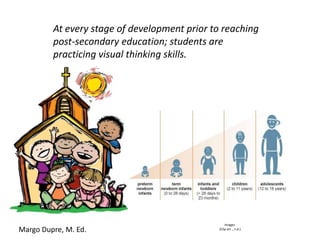
At every stage of development prior to reaching
post-secondary education; students are
practicing visual thinking skills.
Margo Dupre, M. Ed.
Images
(Clip art , n.d.)
Developing partnerships and participating in collaborations with artist
teachers, visiting artists, and art educational programs; core content teachers
may experience more confidence in actively creating visual studies throughout
the K -12 educational experience for students.
… “teaching about art; teaching through art; and teaching with art” (Oreck, 2004, January).
Image
(Clip art , n.d.)
What art instructional strategies can support literacy and build
a stronger foundation for students to develop their cognitive
skills, resulting in college and career ready young adults?
Image
(Clip art , n.d.)
Nurturing Visual Art Thinking
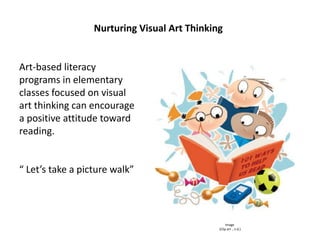
Art-based literacy
programs in elementary
classes focused on visual
art thinking can encourage
a positive attitude toward
reading.
“ Let’s take a picture walk”
Image
(Clip art , n.d.)
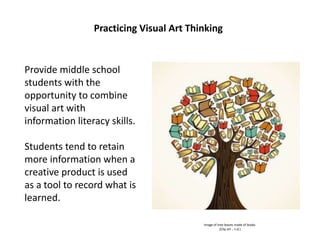
Provide middle school
students with the
opportunity to combine
visual art with
information literacy skills.
Students tend to retain
more information when a
creative product is used
as a tool to record what is
learned.
Practicing Visual Art Thinking
Image of tree leaves made of books
(Clip art , n.d.)
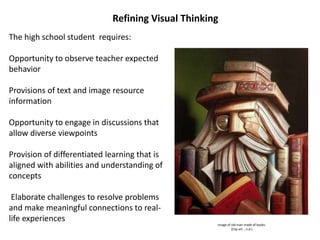
Refining Visual Thinking
The high school student requires:
Opportunity to observe teacher expected
behavior
Provisions of text and image resource
information
Opportunity to engage in discussions that
allow diverse viewpoints
Provision of differentiated learning that is
aligned with abilities and understanding of
concepts
Elaborate challenges to resolve problems
and make meaningful connections to real-
life experiences
Image of old man made of books
(Clip art , n.d.)
Reference
Franco, M., & Unrath, K. (2014). Carpe diem: Seizing the common core with visual
thinking strategies in the visual arts classroom. Art Education, 67(1), 28 -32.
Retrieved from http://www.arteducators.org/research/art-education
Oreck, B. (2004, January). The artistic and professional development of teachers, a
study of teacher’s attitudes toward and use of the arts in teaching. Journal
of Teacher Education, 55(1), 55- 69. Retrieved from doi:
10.1177/0022487103260072
Gaiter, J. M. E. (2008, Fall). A former student’s perception of not gifted, just different:
A case study. Gifted Child Today, 31(4), 46 – 58. doi: 10.4219/gct-2008-802
Holdren, T. Shoemaker (2012, May). Using art to assess reading comprehension and
critical thinking in adolescents. Journal of Adolescent & Adult Literacy, 55(8),
692-703. Retrieved from doi: 10.1002/JAAL.00084

Integrating literacy in art

  • 1.
    At every stageof development prior to reaching post-secondary education; students are practicing visual thinking skills. Margo Dupre, M. Ed. Images (Clip art , n.d.)
  • 2.
    Developing partnerships andparticipating in collaborations with artist teachers, visiting artists, and art educational programs; core content teachers may experience more confidence in actively creating visual studies throughout the K -12 educational experience for students. … “teaching about art; teaching through art; and teaching with art” (Oreck, 2004, January). Image (Clip art , n.d.)
  • 3.
    What art instructionalstrategies can support literacy and build a stronger foundation for students to develop their cognitive skills, resulting in college and career ready young adults? Image (Clip art , n.d.)
  • 4.
    Nurturing Visual ArtThinking Art-based literacy programs in elementary classes focused on visual art thinking can encourage a positive attitude toward reading. “ Let’s take a picture walk” Image (Clip art , n.d.)
  • 5.
    Provide middle school studentswith the opportunity to combine visual art with information literacy skills. Students tend to retain more information when a creative product is used as a tool to record what is learned. Practicing Visual Art Thinking Image of tree leaves made of books (Clip art , n.d.)
  • 6.
    Refining Visual Thinking Thehigh school student requires: Opportunity to observe teacher expected behavior Provisions of text and image resource information Opportunity to engage in discussions that allow diverse viewpoints Provision of differentiated learning that is aligned with abilities and understanding of concepts Elaborate challenges to resolve problems and make meaningful connections to real- life experiences Image of old man made of books (Clip art , n.d.)
  • 7.
    Reference Franco, M., &Unrath, K. (2014). Carpe diem: Seizing the common core with visual thinking strategies in the visual arts classroom. Art Education, 67(1), 28 -32. Retrieved from http://www.arteducators.org/research/art-education Oreck, B. (2004, January). The artistic and professional development of teachers, a study of teacher’s attitudes toward and use of the arts in teaching. Journal of Teacher Education, 55(1), 55- 69. Retrieved from doi: 10.1177/0022487103260072 Gaiter, J. M. E. (2008, Fall). A former student’s perception of not gifted, just different: A case study. Gifted Child Today, 31(4), 46 – 58. doi: 10.4219/gct-2008-802 Holdren, T. Shoemaker (2012, May). Using art to assess reading comprehension and critical thinking in adolescents. Journal of Adolescent & Adult Literacy, 55(8), 692-703. Retrieved from doi: 10.1002/JAAL.00084