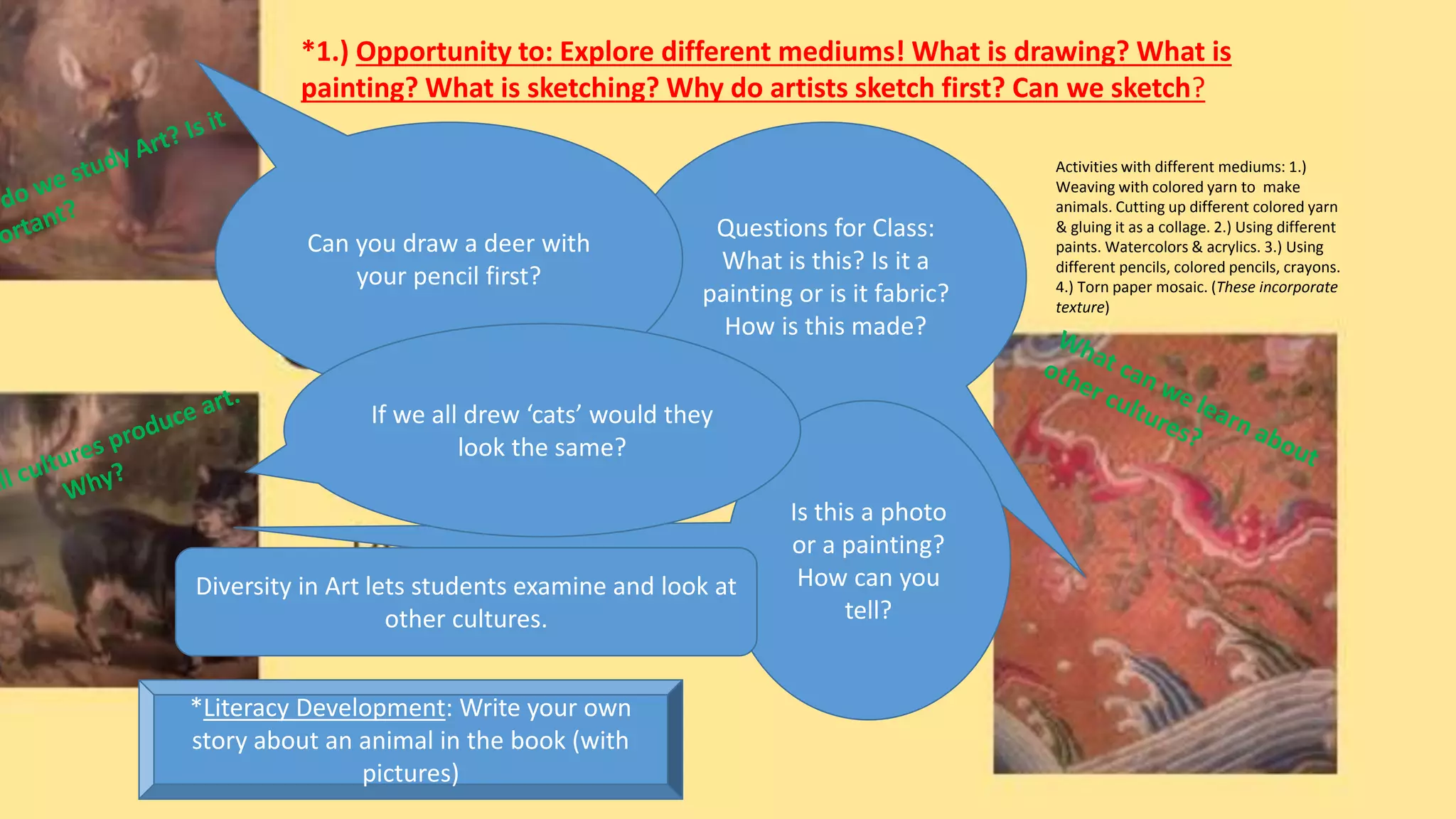
Questions for Class:
What is this? Is it a
painting or is it fabric?
How is this made?
*1.) Opportunity to: Explore different mediums! What is drawing? What is
painting? What is sketching? Why do artists sketch first? Can we sketch?
Is this a photo
or a painting?
How can you
tell?
Can you draw a deer with
your pencil first?
Activities with different mediums: 1.)
Weaving with colored yarn to make
animals. Cutting up different colored yarn
& gluing it as a collage. 2.) Using different
paints. Watercolors & acrylics. 3.) Using
different pencils, colored pencils, crayons.
4.) Torn paper mosaic. (These incorporate
texture)
If we all drew ‘cats’ would they
look the same?
Diversity in Art lets students examine and look at
other cultures.
*Literacy Development: Write your own
story about an animal in the book (with
pictures)
Why
Art?
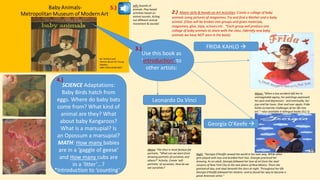
2.) Motor skills & Hands-on Art Activities: Create a collage of baby
animals using pictures of magazines. Try and find a Mother and a baby
animal. (Class will be broken into groups and given materials,
magazines, glue, tape, scissors etc. *Each group will produce one
collage of baby animals to share with the class. (Identify new baby
animals we have NOT seen in the book)
SCIENCE Adaptations:
Baby Birds hatch from
eggs. Where do baby bats
come from? What kind of
animal are they? What
about baby Kangaroos?
What is a marsupial? Is
an Opossum a marsupial?
MATH: How many babies
are in a ‘gaggle of geese’
and How many cubs are
in a ‘litter’…?
Use this book as
‘introduction’ to
other artists:
FRIDA KAHLO 
Above: “When a bus accident left her in
unimaginable agony, her paintings expressed
her pain and depression - and eventually, her
joys and her loves. Over and over again, Frida
Kahlo turned the challenges of her life into
art.” –also available in bilingual books (ELL’s)
Leonardo Da Vinci
Above: *Da Vinci is most famous for
portraits. “What can we learn from
drawing portraits of ourselves and
others?” Activity: Create ‘self-
portraits’ of ourselves. How do we
see ourselves?
4.)
3.)
Georgia O’Keefe 
Right: “Georgia O'Keeffe viewed the world in her own way. While other
girls played with toys and braided their hair, Georgia practiced her
drawing. As an adult, Georgia followed her love of art from the steel
canyons of New York City to the vast plains of New Mexico. There she
painted all day, and slept beneath the stars at night. Throughout her life
Georgia O'Keeffe followed her dreams--and so found her way to become a
great American artist.”
5.) Left: Sounds of
animals..Play based
activities based on
animal sounds. Acting
out different animal
movement & sounds!
*Introduction to ‘counting’
Works Cited:
Retrieved from Amazon.com 2/21/2015:
http://www.amazon.com/My-Name-Is-Georgia-
Portrait/dp/015204597X/ref=pd_sim_b_4?ie=UTF8&refRID=1F4GES9YAEYZY8P0VBFK
http://www.amazon.com/Frida-English-Language-Edition-Winter/dp/0590203207
http://www.amazon.com/Baby-Animals-Little-Ones-
Works/dp/0810994577/ref=la_B001IYVEMK_1_2?s=books&ie=UTF8&qid=1423878625&sr=1-2
References:
http://www.metmuseum.org/
http://www.metmuseum.org/about-the-museum/now-at-the-met

Curriculum pp babyanimals

  • 1.
    Questions for Class: Whatis this? Is it a painting or is it fabric? How is this made? *1.) Opportunity to: Explore different mediums! What is drawing? What is painting? What is sketching? Why do artists sketch first? Can we sketch? Is this a photo or a painting? How can you tell? Can you draw a deer with your pencil first? Activities with different mediums: 1.) Weaving with colored yarn to make animals. Cutting up different colored yarn & gluing it as a collage. 2.) Using different paints. Watercolors & acrylics. 3.) Using different pencils, colored pencils, crayons. 4.) Torn paper mosaic. (These incorporate texture) If we all drew ‘cats’ would they look the same? Diversity in Art lets students examine and look at other cultures. *Literacy Development: Write your own story about an animal in the book (with pictures)
  • 2.
  • 3.
    2.) Motor skills& Hands-on Art Activities: Create a collage of baby animals using pictures of magazines. Try and find a Mother and a baby animal. (Class will be broken into groups and given materials, magazines, glue, tape, scissors etc. *Each group will produce one collage of baby animals to share with the class. (Identify new baby animals we have NOT seen in the book) SCIENCE Adaptations: Baby Birds hatch from eggs. Where do baby bats come from? What kind of animal are they? What about baby Kangaroos? What is a marsupial? Is an Opossum a marsupial? MATH: How many babies are in a ‘gaggle of geese’ and How many cubs are in a ‘litter’…? Use this book as ‘introduction’ to other artists: FRIDA KAHLO  Above: “When a bus accident left her in unimaginable agony, her paintings expressed her pain and depression - and eventually, her joys and her loves. Over and over again, Frida Kahlo turned the challenges of her life into art.” –also available in bilingual books (ELL’s) Leonardo Da Vinci Above: *Da Vinci is most famous for portraits. “What can we learn from drawing portraits of ourselves and others?” Activity: Create ‘self- portraits’ of ourselves. How do we see ourselves? 4.) 3.) Georgia O’Keefe  Right: “Georgia O'Keeffe viewed the world in her own way. While other girls played with toys and braided their hair, Georgia practiced her drawing. As an adult, Georgia followed her love of art from the steel canyons of New York City to the vast plains of New Mexico. There she painted all day, and slept beneath the stars at night. Throughout her life Georgia O'Keeffe followed her dreams--and so found her way to become a great American artist.” 5.) Left: Sounds of animals..Play based activities based on animal sounds. Acting out different animal movement & sounds! *Introduction to ‘counting’
  • 4.
    Works Cited: Retrieved fromAmazon.com 2/21/2015: http://www.amazon.com/My-Name-Is-Georgia- Portrait/dp/015204597X/ref=pd_sim_b_4?ie=UTF8&refRID=1F4GES9YAEYZY8P0VBFK http://www.amazon.com/Frida-English-Language-Edition-Winter/dp/0590203207 http://www.amazon.com/Baby-Animals-Little-Ones- Works/dp/0810994577/ref=la_B001IYVEMK_1_2?s=books&ie=UTF8&qid=1423878625&sr=1-2 References: http://www.metmuseum.org/ http://www.metmuseum.org/about-the-museum/now-at-the-met