WHAT IS COMPETITION BASED PRICING?
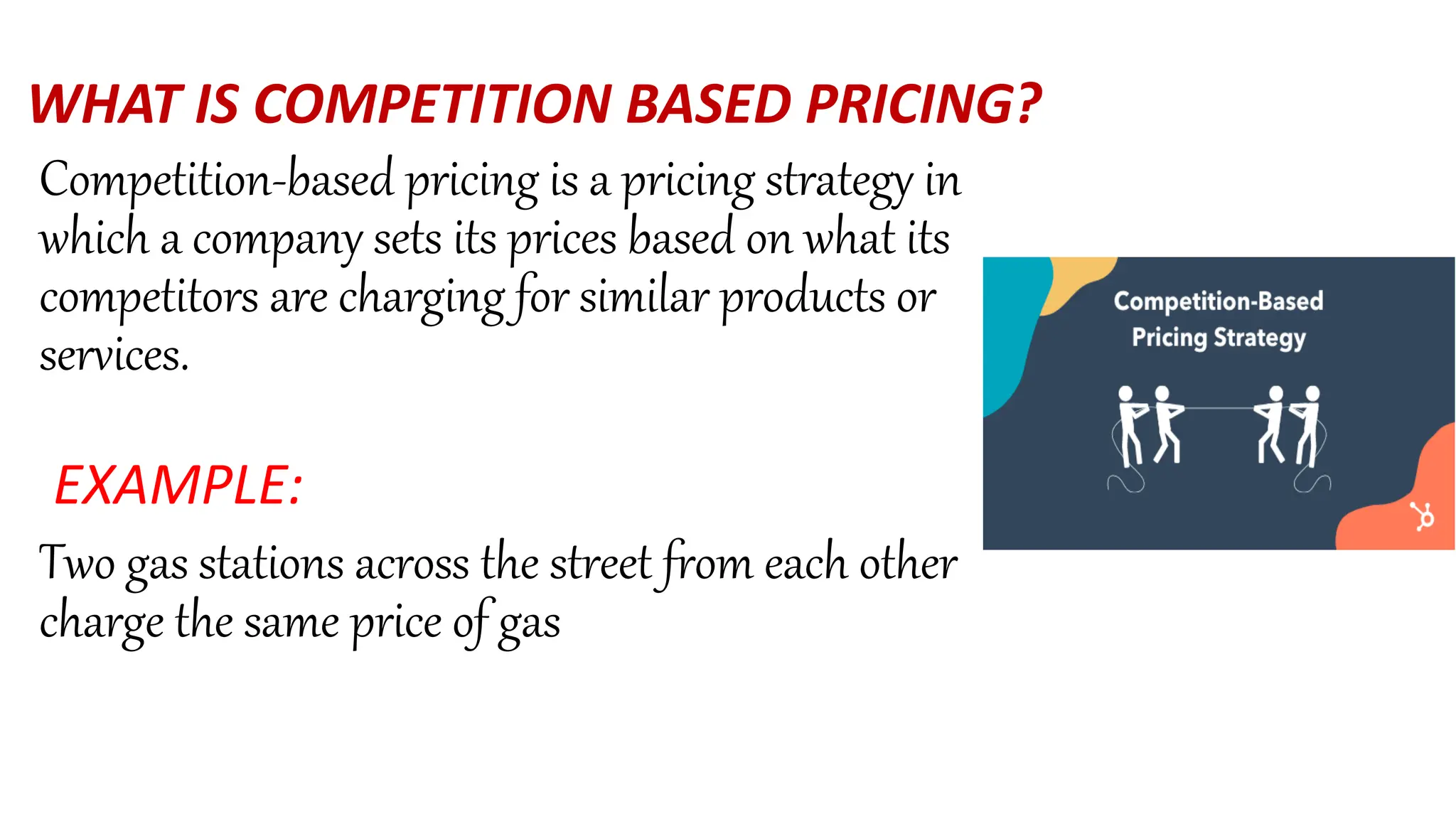
Competition-based pricing is a pricing strategy in
which a company sets its prices based on what its
competitors are charging for similar products or
services.
EXAMPLE:
Two gas stations across the street from each other
charge the same price of gas
OTHER INTERNAL AND EXTERNAL
CONSIDERATIONS AFFECTING PRICE DECISION:
• Internal considerations include
marketing objectives, costs, and the
company’s overall marketing mix.
• External considerations include the
market and demand, competition, and
legal and ethical considerations.
OVERALL MARKETING STRATEGY, OBJECTIVE AND MIX:
• A company’s overall marketing strategy is the plan it uses to reach
its target market and achieve its marketing objectives.
• The marketing mix includes the 4 P’s: product, price, promotion,
and place.
• The marketing objectives are the specific goals the company aims
to achieve through its marketing efforts.
• MARKETING STRATEGY:
A marketing strategy refers to a business's overall game plan for
reaching prospective consumers and turning them into customers of
their products or services. A marketing strategy contains the
company's value proposition, key brand messaging, data on target
customer demographics, and other high-level elements.
• MARKETING MIX:
 PRODUCT: High-quality, premium products with unique features
that set them apart from competitors.
 PRICE: Higher than competitors to reflect the premium quality
and exclusivity of the products.
 PROMOTION: Advertising campaigns that emphasize the quality
and exclusivity of the products, as well as superior customer service.
 PLACE: Premium retail locations and an online store that reflects
the brand’s exclusivity.
• MARKETING OBJECTIVE:
Marketing objectives are a set of clearly defined, measurable goals
established as part of a marketing plan. Marketing objectives provide
specific targets to be met within a time frame, such as “decrease
customer acquisition cost by 10% by the end of next quarter.”
ORGANIZATIONAL CONSIDERATION:
Organizational considerations refer to the internal factors that affect a
company’s pricing decisions. These include the company’s marketing
objectives, costs, and the overall marketing mix
THE MARKET AND DEMAND:
Market refers to the group of people who are interested in
buying a particular product or service. Demand, on the
other hand, is the amount of a product or service that
people are willing to buy at a certain price.
EXAMPLE:
Demand for smartphones. Many people in the market
want to buy smartphones, and the total demand for
smartphones depend on factors such as the price, quality,
and availability of the product.
DEMAND AND PRICE RELATIONSHIP:
Price is dependent on the interaction between demand and
supply components of a market. Demand and supply represent
the willingness of consumers and producers to engage in buying
and selling. An exchange of a product takes place when buyers
and sellers can agree upon a price.
DEMAND CURVE:
A demand curve is a graph that shows the
relationship between the price of a good or service
and the quantity demanded within a specified
time frame. Demand curves can be used to
understand the price-quantity relationship for
consumers in a particular market, such as corn
or soybeans.
THE ECONOMY:
The Economy refers to the system that a society uses to
produce and distribute goods and services. Economic
factors such as inflation, unemployment, and GDP
growth can have a significant impact on businesses
and consumers.
EXAMPLE:
COVID-19 pandemic, effects many jobs and businesses
so that effect economy all over the world.
PRICE ELASTICITY:
A measure of the sensitivity of demand to changes in
price.
EXAMPLE:
People like coffee and tea equally, if the price of
coffee goes up, people will have no problem
switching to tea, and the demand for coffee will fall.
OTHER EXTERNAL FACTORS:
There are several external factors that can affect the economy and
businesses, including:
1. Technological Advancements.
2. Government policies
3. Natural disaster
4. Global events
5. Demographics changes

WHAT IS COMPETITION BASED PRICING.pdf. Online

  • 1.
    WHAT IS COMPETITIONBASED PRICING? Competition-based pricing is a pricing strategy in which a company sets its prices based on what its competitors are charging for similar products or services. EXAMPLE: Two gas stations across the street from each other charge the same price of gas
  • 2.
    OTHER INTERNAL ANDEXTERNAL CONSIDERATIONS AFFECTING PRICE DECISION: • Internal considerations include marketing objectives, costs, and the company’s overall marketing mix. • External considerations include the market and demand, competition, and legal and ethical considerations.
  • 3.
    OVERALL MARKETING STRATEGY,OBJECTIVE AND MIX: • A company’s overall marketing strategy is the plan it uses to reach its target market and achieve its marketing objectives. • The marketing mix includes the 4 P’s: product, price, promotion, and place. • The marketing objectives are the specific goals the company aims to achieve through its marketing efforts.
  • 4.
    • MARKETING STRATEGY: Amarketing strategy refers to a business's overall game plan for reaching prospective consumers and turning them into customers of their products or services. A marketing strategy contains the company's value proposition, key brand messaging, data on target customer demographics, and other high-level elements.
  • 5.
    • MARKETING MIX: PRODUCT: High-quality, premium products with unique features that set them apart from competitors.  PRICE: Higher than competitors to reflect the premium quality and exclusivity of the products.  PROMOTION: Advertising campaigns that emphasize the quality and exclusivity of the products, as well as superior customer service.  PLACE: Premium retail locations and an online store that reflects the brand’s exclusivity.
  • 6.
    • MARKETING OBJECTIVE: Marketingobjectives are a set of clearly defined, measurable goals established as part of a marketing plan. Marketing objectives provide specific targets to be met within a time frame, such as “decrease customer acquisition cost by 10% by the end of next quarter.”
  • 7.
    ORGANIZATIONAL CONSIDERATION: Organizational considerationsrefer to the internal factors that affect a company’s pricing decisions. These include the company’s marketing objectives, costs, and the overall marketing mix
  • 8.
    THE MARKET ANDDEMAND: Market refers to the group of people who are interested in buying a particular product or service. Demand, on the other hand, is the amount of a product or service that people are willing to buy at a certain price. EXAMPLE: Demand for smartphones. Many people in the market want to buy smartphones, and the total demand for smartphones depend on factors such as the price, quality, and availability of the product.
  • 9.
    DEMAND AND PRICERELATIONSHIP: Price is dependent on the interaction between demand and supply components of a market. Demand and supply represent the willingness of consumers and producers to engage in buying and selling. An exchange of a product takes place when buyers and sellers can agree upon a price.
  • 10.
    DEMAND CURVE: A demandcurve is a graph that shows the relationship between the price of a good or service and the quantity demanded within a specified time frame. Demand curves can be used to understand the price-quantity relationship for consumers in a particular market, such as corn or soybeans.
  • 11.
    THE ECONOMY: The Economyrefers to the system that a society uses to produce and distribute goods and services. Economic factors such as inflation, unemployment, and GDP growth can have a significant impact on businesses and consumers. EXAMPLE: COVID-19 pandemic, effects many jobs and businesses so that effect economy all over the world.
  • 12.
    PRICE ELASTICITY: A measureof the sensitivity of demand to changes in price. EXAMPLE: People like coffee and tea equally, if the price of coffee goes up, people will have no problem switching to tea, and the demand for coffee will fall.
  • 13.
    OTHER EXTERNAL FACTORS: Thereare several external factors that can affect the economy and businesses, including: 1. Technological Advancements. 2. Government policies 3. Natural disaster 4. Global events 5. Demographics changes