AYURVEDAAYURVEDA
Dr. Amali DayanandaDr. Amali Dayananda
B.A.M.S (Hons)B.A.M.S (Hons)
(01) What is Ayurveda?(01) What is Ayurveda?
 It isIt is the Science of lifethe Science of life ;; thethe ‘‘knowledge of longevityknowledge of longevity ’;’; ‘the‘the
Science of Natural & Holistic HealingScience of Natural & Holistic Healing ’.’.
 It is way to healthy & long life.It is way to healthy & long life.
 It is an ancient art of medicine.It is an ancient art of medicine.
 It is more than a system of herbal medicine.It is more than a system of herbal medicine.
 Ayurvedic medicine is a system ofAyurvedic medicine is a system of traditional medicinetraditional medicine  native to native to
the the Indian subcontinentIndian subcontinent
 In Western medicine, Ayurveda is classified as a systemIn Western medicine, Ayurveda is classified as a system
of complementary and alternative medicine (CAM) that is used toof complementary and alternative medicine (CAM) that is used to
complement, rather than replace, the treatment regimen andcomplement, rather than replace, the treatment regimen and
relationship that exists between a patient and their existingrelationship that exists between a patient and their existing
physicianphysician
 It is a vast medical science; it is not an alternative medicine.It is a vast medical science; it is not an alternative medicine.
 It is believed to be the only complete medical system in the world.It is believed to be the only complete medical system in the world.
 It was developed 5000 years ago , in India by the spiritual elite.It was developed 5000 years ago , in India by the spiritual elite.
 It is one of the oldest forms of Medical science known to man.It is one of the oldest forms of Medical science known to man.
 It will be a major component of the future global science ofIt will be a major component of the future global science of
medicine.medicine.
 It is a fully developed Medicinal art with a number of unique &It is a fully developed Medicinal art with a number of unique &
exclusive medicinal therapies & surgical procedures for the variousexclusive medicinal therapies & surgical procedures for the various
ailments & diseases.ailments & diseases.
 Evolving throughout its history, Ayurveda remains an influentialEvolving throughout its history, Ayurveda remains an influential
system of medicine in South Asia & It is a living practice in Indiasystem of medicine in South Asia & It is a living practice in India
and Sri Lanka.and Sri Lanka.
 Over the following centuries, Ayurvedic practitioners developed aOver the following centuries, Ayurvedic practitioners developed a
number of medicinal preparations and surgical procedures for thenumber of medicinal preparations and surgical procedures for the
treatment of various ailments and diseases.treatment of various ailments and diseases.
(02) What does the word Ayurveda means?(02) What does the word Ayurveda means?
The word ‘The word ‘Ayurveda’Ayurveda’ is derived of two Sanskrit words.is derived of two Sanskrit words.
‘‘ AYUHAYUH’ /’ / āyusāyus + ‘+ ‘VEDAVEDA’’
(the life/ longevity ) (knowledge of science)(the life/ longevity ) (knowledge of science)
The science of lifeThe science of life
(03) ‘Ayuh’(03) ‘Ayuh’
ShareeraShareera
(Body)(Body)
Atma Ayuh indriyaAtma Ayuh indriya
(soul) (The Life) (Sensor)(soul) (The Life) (Sensor)
SatvaSatva
(Mind)(Mind)
(04) Aims of Ayurveda(04) Aims of Ayurveda
1. The promotion of Positive health1. The promotion of Positive health
It helps individuals to strength their immune system.It helps individuals to strength their immune system.
2. The cure for the diseases.2. The cure for the diseases.
It treats the symptoms of a diseases.It treats the symptoms of a diseases.
Ayurveda focuses more on healthy living than treatment of diseaseAyurveda focuses more on healthy living than treatment of disease
Immune system ok No disesese : + ve healthImmune system ok No disesese : + ve health
Immune system not ok disease : -ve healthImmune system not ok disease : -ve health
Ayurveda treats : Body , Mind, soul, sensor (person as a whole)Ayurveda treats : Body , Mind, soul, sensor (person as a whole)
It works on the basis that the mind body (effect each other)It works on the basis that the mind body (effect each other)
(Mind + Body together can overcome disease(Mind + Body together can overcome disease
(05) Origin & Background of Ayurveda(05) Origin & Background of Ayurveda
 Start from theStart from the Vedic periodVedic period (time of the holy books)(time of the holy books)
aboutabout 50005000 years ago inyears ago in IndiaIndia..
 Before the advent of writing the ancient wisdom of this healing systemBefore the advent of writing the ancient wisdom of this healing system
was a part of the spiritual traditionwas a part of the spiritual tradition
 The knowledge of Ayurveda is believed to be of Divine origin and wasThe knowledge of Ayurveda is believed to be of Divine origin and was
communicated to the saints and sages of India who received itscommunicated to the saints and sages of India who received its
wisdom through deep meditation.wisdom through deep meditation.
 The hymns, the mantras & medical information contained in theThe hymns, the mantras & medical information contained in the
VedasVedas were contribution of Rishis, Munis, sages who devoted theirwere contribution of Rishis, Munis, sages who devoted their
life to understanding the world.life to understanding the world.
 The native land of Aryans covers large area surrounding theThe native land of Aryans covers large area surrounding the
HimalayasHimalayas & is believed to be the place where the Rishis & Munis& is believed to be the place where the Rishis & Munis
lived.lived.
 Originally only Brahmins were considered as physicians. But laterOriginally only Brahmins were considered as physicians. But later
people from other castes also learned this art of healing and a specificpeople from other castes also learned this art of healing and a specific
termterm VaidyaVaidya was used for these practitioners.was used for these practitioners.
(06) Ancient Hindu(06) Ancient Hindu Mythological origins of AyurvedaMythological origins of Ayurveda
 In India, knowledge is considered sacred since it is believed to have emanatedIn India, knowledge is considered sacred since it is believed to have emanated
from the gods. According to Hindu mythology, the harmony of the universe isfrom the gods. According to Hindu mythology, the harmony of the universe is
maintained by the Trimurtis :maintained by the Trimurtis : Brahma the CreatorBrahma the Creator
Vishnu the PreserverVishnu the Preserver
Siva the DestroyerSiva the Destroyer
 At the time of creation, Ayurveda is believed to have originated as a ray ofAt the time of creation, Ayurveda is believed to have originated as a ray of
enlightenment in the cosmic consciousness ofenlightenment in the cosmic consciousness of BrahmaBrahma..
This self-existent creator composed Ayurveda as a branch of Atharva Veda.This self-existent creator composed Ayurveda as a branch of Atharva Veda.
Consisting of aConsisting of a hundred thousand verses in a thousand chaptershundred thousand verses in a thousand chapters,, it was dividedit was divided
by him intoby him into eight sectionseight sections or parts, according toor parts, according to SusruthaSusrutha the ancient surgeon.the ancient surgeon.
 Brahma is believed to have imparted the knowledge of Ayurveda to his discipleBrahma is believed to have imparted the knowledge of Ayurveda to his disciple
Daksha Prajapati,Daksha Prajapati, who passed it on to thewho passed it on to the AswinsAswins,, the twin gods, who in turnthe twin gods, who in turn
conferred it onconferred it on IndraIndra,, the king of the gods.the king of the gods.
 While all this happened in the heavens, humanity continued to be plagued byWhile all this happened in the heavens, humanity continued to be plagued by
pains and illnesses. Great seers meditated upon remedies for the numerouspains and illnesses. Great seers meditated upon remedies for the numerous
human maladies but in vain. It was decided that the eminenthuman maladies but in vain. It was decided that the eminent sage Dhanwantarisage Dhanwantari,,
reincarnated asreincarnated as DivodasaDivodasa,, and theand the sages Bharadwajasages Bharadwaja andand KashyapaKashyapa be deputedbe deputed
to go to heaven to learn the divine science of healing directly fromto go to heaven to learn the divine science of healing directly from IndraIndra..
 That, according to legend, was how Ayurveda descended from the skies toThat, according to legend, was how Ayurveda descended from the skies to
alleviate suffering on the mortal plane.alleviate suffering on the mortal plane.
According to the another legend;
When diseases and death started creating havoc, all great sages
gathered in order to find solution to this havoc In Himalaya -creating
problem (sage conference). One of the sage from Sri Lanka name
Sage Pulasti also represented this conference. During this meeting
sage Bharadvaja came forward to learn this art of healing from Indra.
Bharadvaja then taught this science to Athreya- who further
transmitted this knowledge throughout world through his six disciples.
Later Agnivesha who was foremost among the disciples of Athreya
wrote Agnivesha Sanhita- the most comprehensive form of Ayurveda.
(The oldest compilations of Athreya and Agnivesha are lost).
 Divodasa DhanwantariDivodasa Dhanwantari and his disciples specialized in Shalyaand his disciples specialized in Shalya
chikitsa (surgery) and formed the school of surgery. His importantchikitsa (surgery) and formed the school of surgery. His important
students includedstudents included Sushruta, Aupadhenava, Vaitarana, Aurabhadra,Sushruta, Aupadhenava, Vaitarana, Aurabhadra,
Pushkalavata, Nimi, Kara, Karaveerya, Gopurarakshita, Bhoja,Pushkalavata, Nimi, Kara, Karaveerya, Gopurarakshita, Bhoja,
Kankayana, Galava and Gargava.Kankayana, Galava and Gargava.
 Punarvasu ArtreyaPunarvasu Artreya , who was the disciple of, who was the disciple of BharadwajaBharadwaja hadhad
seven pupils -seven pupils -Agnivesa, Charaka, Bhela, Jatukarna, Parasara,Agnivesa, Charaka, Bhela, Jatukarna, Parasara,
Hareeta and Ksharapaani.Hareeta and Ksharapaani. They were called the Artreya School ofThey were called the Artreya School of
physicians and specialized in Kaya chikitsa (general medicine).physicians and specialized in Kaya chikitsa (general medicine).
 TheThe KashyapaKashyapa School specialized in Kumarabhrutya (paediatrics).School specialized in Kumarabhrutya (paediatrics).
Foremost among Kashyapa's students wasForemost among Kashyapa's students was Vruddha (the elder)Vruddha (the elder)
JeevakaJeevaka who wrote Kashyapa Samhita. His other disciples werewho wrote Kashyapa Samhita. His other disciples were
Vasishta, Atri, Bhrigu, Jeevaka, Parvataka and BandhakaVasishta, Atri, Bhrigu, Jeevaka, Parvataka and Bandhaka
(07) Ayurvedic Genealogy(07) Ayurvedic Genealogy
LORD BRAHMA – CREATORLORD BRAHMA – CREATOR
DAKSHAPRAJAPATIDAKSHAPRAJAPATI
ASHWINI KUMARASASHWINI KUMARAS
INDRAINDRA
BHARADWAJABHARADWAJA ((800-600BC)800-600BC)
ATREYAATREYA ((Athreya Sanhita)Athreya Sanhita) DHANAVANTRIDHANAVANTRI
(School of Physicians)(School of Physicians) ((school of Surgeonsschool of Surgeons) (900-600BC) (900-600BC))
AGNIVESHAAGNIVESHA SUSHRUTHASUSHRUTHA BC 800-400BC 800-400
(Agnivesha Samhitha)(Agnivesha Samhitha) ((Sushruta Samhita)Sushruta Samhita)
CharakaCharaka ADI00ADI00
(Charaka Sanhita)(Charaka Sanhita)
There are three main re-organizers of Ayurveda whose works were
compiled in texts.
These works are Charaka, Susrutha and Vaghbata Sanhita still
exist and in use.
Charaka was the first man who based his Sanhita on Agnivesha
Sanhita and enlarged it with his interpretations and annotations. It is
called Charaka Sanhita.
Vaghbata compiled the third treatise called Ashtanga Hridaya that
is a concise version of both the works of Charaka Sanhita and
Susrutha Sanhita.
(These texts still contain the original and complete knowledge of the
Ayurvedic world of medicine.)
(08)(08)
VruddhatrayaVruddhatraya
(09) 4 Vedas/ Vedic Books(09) 4 Vedas/ Vedic Books
1.1. Rig/ RIkRig/ RIk
2.2. SamanSaman
3.3. YajurYajur
4.4. AtharvanAtharvan
Contents of Vedas:Contents of Vedas:
 HealthHealth
 AstrologyAstrology
 Spiritual BusinessSpiritual Business
 Government/ politicsGovernment/ politics
 ArmyArmy
 PoetryPoetry
 Spiritual livingSpiritual living
 BehaviorBehavior
The Vedic sages took the passage from the VedicThe Vedic sages took the passage from the Vedic
scriptures relating to Ayurveda & compiled separatescriptures relating to Ayurveda & compiled separate
books dealing only with Ayurveda.books dealing only with Ayurveda.
(10) Rik Veda(10) Rik Veda
 Oldest surviving book of any Indo- European language (3000B.C.)Oldest surviving book of any Indo- European language (3000B.C.)
 Rik Veda refers as cosmology known as Sankya Philosophy, which liesRik Veda refers as cosmology known as Sankya Philosophy, which lies
at the base of both Ayurveda & yoga.at the base of both Ayurveda & yoga.
 Contents:Contents:
 Nature of healthNature of health
 Nature of diseasesNature of diseases
 PathogenesisPathogenesis
 Principle of treatmentPrinciple of treatment
 Discussions of Three Dosha ConceptDiscussions of Three Dosha Concept
 Uses of herbs to heal the diseasesUses of herbs to heal the diseases
 Foster longevityFoster longevity
Ex.Ex.
 Saina Chikitsa (Treatments of the Army)Saina Chikitsa (Treatments of the Army)
 The doctors of Gods (Ashvini Kumara) performed many surgeries & bodyThe doctors of Gods (Ashvini Kumara) performed many surgeries & body
implantsimplants
 The steel legs in place of broken legs of Vishaka, the daughter of king Ravel.The steel legs in place of broken legs of Vishaka, the daughter of king Ravel.
 Implantation of a horse’s mouth in place of Dadichi’s head.Implantation of a horse’s mouth in place of Dadichi’s head.
(11) Atharva Veda (1500B.C.)(11) Atharva Veda (1500B.C.)
 Contains hymns about treatment & principles of healing of variousContains hymns about treatment & principles of healing of various
diseases & ailments.diseases & ailments.
 Lists the 8 divisions of Ayurveda.Lists the 8 divisions of Ayurveda.
Kaaya-chikitsa – (Internal Medicine)Kaaya-chikitsa – (Internal Medicine)
Shalakya – (Diseases above the Clavicle; Surgery of Head andShalakya – (Diseases above the Clavicle; Surgery of Head and
Neck, Opthamology & OtorinolaryngologyNeck, Opthamology & Otorinolaryngology
Shalya-Chikitsa – (Surgery)Shalya-Chikitsa – (Surgery)
Agada tantra – (Toxicology)Agada tantra – (Toxicology)
Bhuta Vidya – (Psychiatry)Bhuta Vidya – (Psychiatry)
Kaumarabhrtya – (Pediatrics)Kaumarabhrtya – (Pediatrics)
Rasayana - (Gerontology or Science of Rejuvenation)Rasayana - (Gerontology or Science of Rejuvenation)
Vajikarana – (Science of Fertility)Vajikarana – (Science of Fertility)
(12) MANUSCRIPT PAGE(12) MANUSCRIPT PAGE
FROM ATHARVAVEDA TUBINGENFROM ATHARVAVEDA TUBINGEN
(13) Two principle Ayurvedic schools(13) Two principle Ayurvedic schools
 Around 1500 BC, various authors took AyurvedicAround 1500 BC, various authors took Ayurvedic
passages from the four scriptures and createdpassages from the four scriptures and created
Ayurvedic texts for eight specific branches ofAyurvedic texts for eight specific branches of
medicine.medicine.
 It divided intoIt divided into two principle Ayurvedictwo principle Ayurvedic
schoolsschools::
ATREYAATREYA
DHANVANTARIDHANVANTARI
(The School of Physicians)(The School of Physicians) (The School of(The School of
Surgeons)Surgeons)
These two schools transformed Ayurveda from aThese two schools transformed Ayurveda from a
primarily religious discipline to a scientific medicalprimarily religious discipline to a scientific medical
system. This made Ayurveda a more systematicallysystem. This made Ayurveda a more systematically
classified medical science, hereafter.classified medical science, hereafter.
(14) DHANVANTARI(14) DHANVANTARI
The state of the art of ancient healing was enhanced by the myths and legendsThe state of the art of ancient healing was enhanced by the myths and legends
of the, Divodosa Dhanvantariof the, Divodosa Dhanvantari
 Dhanvantari, who is considered to be a reincarnation of Lord Vishnu, wasDhanvantari, who is considered to be a reincarnation of Lord Vishnu, was
the guiding sage of Ayurveda. He made this science of health and longevitythe guiding sage of Ayurveda. He made this science of health and longevity
popular and widely acceptable through experimentation and research.popular and widely acceptable through experimentation and research.
Sage Dhanvantari is considered the father of this branch of medicine, almostSage Dhanvantari is considered the father of this branch of medicine, almost
considered the God of Indian Medicine/ God of healing / Hindu system ofconsidered the God of Indian Medicine/ God of healing / Hindu system of
medicine and well being. It is believed that Dhanvantari, who later wrotemedicine and well being. It is believed that Dhanvantari, who later wrote
down the text of Ayurveda, taught the science of medicine to the sagesdown the text of Ayurveda, taught the science of medicine to the sages
His birthday two days before the festival of Deepavali is celebrated asHis birthday two days before the festival of Deepavali is celebrated as
Dhanvantari -diwasDhanvantari -diwas
 An incarnation of Vishnu emerged from the Milky-Ocean at the end of theAn incarnation of Vishnu emerged from the Milky-Ocean at the end of the
churning by the devas (Gods) and the asuras (DEMONS) during a tug ofchurning by the devas (Gods) and the asuras (DEMONS) during a tug of
war.war.
 A Description of Dhanvantari reads as follows:A Description of Dhanvantari reads as follows:
"Armed with conch, discus, leach and the golden pot of 'Amrita'-Elixir of"Armed with conch, discus, leach and the golden pot of 'Amrita'-Elixir of
Immortality, clad in yellow silk garment, An exquisitely textured cloth aroundImmortality, clad in yellow silk garment, An exquisitely textured cloth around
the coiffure, with eyes as dark as the rain-cloud, Who annihilates diseasethe coiffure, with eyes as dark as the rain-cloud, Who annihilates disease
and suffering, like the raging forest fire, Which totally consumes the forest".and suffering, like the raging forest fire, Which totally consumes the forest".
(16) Charaka Sanhita(16) Charaka Sanhita
 CHARAKACHARAKA ( ADI00 ), The great sage - physician of the( ADI00 ), The great sage - physician of the AthreyaAthreya
schoolschool, authored , authored Charaka Sanhita Charaka Sanhita  revising and supplementingrevising and supplementing
the text written bythe text written by AthreyaAthreya
 Charaka was the first man who based his Sanhita onCharaka was the first man who based his Sanhita on AgniveshaAgnivesha
SanhitaSanhita (BC 600) and enlarged it with his interpretations and(BC 600) and enlarged it with his interpretations and
annotations.annotations. which has remained the most referred Ayurvedic textwhich has remained the most referred Ayurvedic text
on internal medicine till date.on internal medicine till date.
 All of the treaties available, Charaka Sanhita is considered the best.All of the treaties available, Charaka Sanhita is considered the best.
It consists the details about the elements of Ayurvedic therapeuticsIt consists the details about the elements of Ayurvedic therapeutics
and is also the only work that covers Ayurveda comprehensively.and is also the only work that covers Ayurveda comprehensively.
(17) Charaka Acharya compiled(17) Charaka Acharya compiled
information oninformation on
 Diagnosis and prevention of disease,Diagnosis and prevention of disease,
 Internal and external causes of illness, etiologyInternal and external causes of illness, etiology
 Herbal prescriptions and medicinal plants and their usage forHerbal prescriptions and medicinal plants and their usage for
treatment of ailmentstreatment of ailments
 anatomy. physiology,anatomy. physiology,
 He stated that all disease - physical, mental and spiritual - isHe stated that all disease - physical, mental and spiritual - is
fundamentally caused by a separation from Divine Oneness.fundamentally caused by a separation from Divine Oneness.
 He also gave strikingly detailed descriptions of human fetalHe also gave strikingly detailed descriptions of human fetal
development month-by month.development month-by month.
   pathogenesis and symptoms of diseases.pathogenesis and symptoms of diseases.
(18) SUSHRUTA SANHITA(18) SUSHRUTA SANHITA
SUSHRUTASUSHRUTA, who is, who is
known as the father ofknown as the father of
surgery from thesurgery from the
Dhanvantari school,Dhanvantari school,
down his life’s teachingsdown his life’s teachings
about various surgeries– inabout various surgeries– in
his treatise calledhis treatise called
Sushruta SanhitaSushruta Sanhita (BC(BC
800-400).800-400).
TEACHING INITIALLY BY WORD OF MOUTH –- THEREFORE THE TIME OFTEACHING INITIALLY BY WORD OF MOUTH –- THEREFORE THE TIME OF
ORIGIN IS STILL CONTROVERSIAL.ORIGIN IS STILL CONTROVERSIAL.
Revised byRevised by
NAGARJUNA (2nd – 4NAGARJUNA (2nd – 4thth
century BC)century BC)
KITAB-I-SUSRURD (8KITAB-I-SUSRURD (8thth
Century AD)Century AD)
(19) SUSHRUTHA SAMHITA INCORPORATES IN IT ALL(19) SUSHRUTHA SAMHITA INCORPORATES IN IT ALL
THE CLASSICAL 8 LIMBS OF AYURVEDA.THE CLASSICAL 8 LIMBS OF AYURVEDA.
 SALYA -SALYA - (MAJOR SURGERY)(MAJOR SURGERY)
 SALKYA -SALKYA - (SUPRACLAVICLE SURGERY)(SUPRACLAVICLE SURGERY)
 KAYACIKITSA -KAYACIKITSA - (MEDICINE)(MEDICINE)
 BHUTAVIDYA -BHUTAVIDYA - (DEMONOLOGY)(DEMONOLOGY)
 KUMARABHRTYA -KUMARABHRTYA - (PAEDIATRICS & OBSTETRICS)(PAEDIATRICS & OBSTETRICS)
 AGADATANTRA -AGADATANTRA - (TOXICOLOGY)(TOXICOLOGY)
 RASAYANATANTRA -RASAYANATANTRA - (STUDY OF ELIXIRS)(STUDY OF ELIXIRS)
 VAGIKARNATANTRA -VAGIKARNATANTRA - (SCIENCE OF FERTILITY,(SCIENCE OF FERTILITY,
VIRILITY)VIRILITY)
(20) SUSHRUTHA SAMHITA(20) SUSHRUTHA SAMHITA
VRADDHA SUSHRUTHAVRADDHA SUSHRUTHA
120 Chapters120 Chapters
 SUTRA STHANASUTRA STHANA Fundamental principlesFundamental principles
 NIDANANIDANA EtiologyEtiology
 SARIRA STHANASARIRA STHANA Anatomy and PhysiologyAnatomy and Physiology
 CIKITSA STHANACIKITSA STHANA TherapeuticsTherapeutics
 KALPA STHANAKALPA STHANA ToxicologyToxicology
Other notable chapters are onOther notable chapters are on
# training and attributes of a surgeon# training and attributes of a surgeon
# surgical instruments# surgical instruments
# dreams# dreams
(21) Rare mention about the Brain?(21) Rare mention about the Brain?
--SARIRA STHANASARIRA STHANA
 In the fifth month the fetus is endowed with the mind andIn the fifth month the fetus is endowed with the mind and
wakes up from the sleep of his subconscious existence.wakes up from the sleep of his subconscious existence.
 In the sixth month cognition (Buddhi) comes in.In the sixth month cognition (Buddhi) comes in.
 In the seventh month all the limbs and members of itsIn the seventh month all the limbs and members of its
body are markedly developed.body are markedly developed.
 SANUKA says that probably the head of the fetus is theSANUKA says that probably the head of the fetus is the
first developed since head is the only organ that makesfirst developed since head is the only organ that makes
the functions of all other organs possible.the functions of all other organs possible.
(22) SHIROROGA --- Disorders of the
Head
VATAVYADHI --- Disorders of “Vayu”
MODERN COMPARISION
AKSHEPAKA C0NVULSIONS
PAKSHAVADHA HEMIPLEGIA
ARDITA TOTAL PARALYSIS
DANDA PATANKA ?PARKINSONS
MANYA STAMBHA STIFF NECK
JIHAVASTAMBHA PARALYSIS OF
TONGUE
GRIDHARASI SCIATICA
MURCHA FAINTING
DHANUSH STAMBHA TETANUS
APASMARA EPILEPSY
UNMADA MADNESS
SUSHRUTHASUSHRUTHA CONSIDEREDCONSIDERED
THETHE HEADHEAD AS THE CENTERAS THE CENTER
OF ALL SPECIAL SENSES,OF ALL SPECIAL SENSES,
AND DESCRIBES CERTAINAND DESCRIBES CERTAIN
CRANIAL NERVESCRANIAL NERVES
CONNECTED WITH SPECIFICCONNECTED WITH SPECIFIC
SENSORY FUNCTIONS.SENSORY FUNCTIONS.
 two nerves lower down at thetwo nerves lower down at the
back of ear (vidhura) which if cutback of ear (vidhura) which if cut
produceproduce deafnessdeafness..
 a pair of nerves inside the twoa pair of nerves inside the two
nostrils which if cut causenostrils which if cut cause
AnsoniaAnsonia..
 a pair of nerves below the end ofa pair of nerves below the end of
the eyebrow which if cut causesthe eyebrow which if cut causes
blindnessblindness..
“Ten nerves maintain the functions
of the body by carrying impulses of
sound, touch, vision, taste, smell,
respiration, sighing, yawning,
hunger, laughing, speech, and
crying…”
“A pair of nerve each responds to
sound, touch, vision, taste, & smell.”
(24) Sushrutha Acharya classified(24) Sushrutha Acharya classified
 functions of organs,functions of organs,
 nerves and joints,nerves and joints,
 catalogued various kinds of wounds andcatalogued various kinds of wounds and
 details and discussions of various surgeries,details and discussions of various surgeries,
 prosthetic surgery to replace limbs,prosthetic surgery to replace limbs,
 cosmetic surgery /plastic surgery,cosmetic surgery /plastic surgery,
 cataract operations,cataract operations,
 caesarian operationscaesarian operations
 brain surgery.brain surgery.
 He is famed for his innovation of cosmetic surgery on nose or rhinoplastyHe is famed for his innovation of cosmetic surgery on nose or rhinoplasty
 burns, fractures, wounds and amputationburns, fractures, wounds and amputation
 described sophisticated surgical equipment used in technical procedures.described sophisticated surgical equipment used in technical procedures.
 His text also includes the first mention of the science of massage usingHis text also includes the first mention of the science of massage using
MARMA points, (massage of vital body points/ vital nerve intersections likeMARMA points, (massage of vital body points/ vital nerve intersections like
those used in Chinese acupuncture.)those used in Chinese acupuncture.)
 Susrutha divided 1120 diseases into natural and supernatural.Susrutha divided 1120 diseases into natural and supernatural.
 He taught palpation and auscultation of heart, lungs, and womb; andHe taught palpation and auscultation of heart, lungs, and womb; and
advocated the use of special senses.advocated the use of special senses.
 He was the pioneer of most teaching techniques in experimental andHe was the pioneer of most teaching techniques in experimental and
clinical surgeryclinical surgery..
(25) SURGICAL INSTRUMENTS DESCRIBED IN(25) SURGICAL INSTRUMENTS DESCRIBED IN
SUSRUTHA SANHITASUSRUTHA SANHITA
SUSHRUTA SANHITASUSHRUTA SANHITA:: MARMA POINTSMARMA POINTS
(28) SUSHRUTA SANHITA:(28) SUSHRUTA SANHITA: COSMETIC SURGERY ONCOSMETIC SURGERY ON
NOSE(RHINOPLASTY)NOSE(RHINOPLASTY)
(29) SUSHRUTA SAMHITA(29) SUSHRUTA SAMHITA : CATARACT SURGERY: CATARACT SURGERY
Cataract in human eye magnified view seen onCataract in human eye magnified view seen on
examination with a slit lamp. Cataract surgery wasexamination with a slit lamp. Cataract surgery was
known to the physician known to the physician SusruthaSusrutha in the first millennium in the first millennium
BC, and was performed with a special tool calledBC, and was performed with a special tool called
the the jabamukhi salakajabamukhi salaka , a curved needle used to loosen, a curved needle used to loosen
the lens and push the cataract out of the field of vision.the lens and push the cataract out of the field of vision.
The eye would later be soaked with warm butter andThe eye would later be soaked with warm butter and
then bandagedthen bandaged..
(30) SUSHRUTHA(30) SUSHRUTHA-- Learning methods of SurgeryLearning methods of Surgery
(31) SUSRUTHA(31) SUSRUTHA,, Performing an artificial ear lobePerforming an artificial ear lobe
(36) Conclusion(36) Conclusion
 To Sushrutha, belongs the honor ofTo Sushrutha, belongs the honor of
being called “the FATHER OF SURGERY”being called “the FATHER OF SURGERY”
and the ‘PATRON OF A SURGEON INand the ‘PATRON OF A SURGEON IN
TRAINING’,TRAINING’,
as he was the first before all to emphasizeas he was the first before all to emphasize
on practical training in experimental andon practical training in experimental and
clinical surgery.clinical surgery.
(37) Other texts…….(37) Other texts…….
   VAGHBAT ( AD700 ) compiled the third major treatise onVAGHBAT ( AD700 ) compiled the third major treatise on
Ayurveda, Ayurveda, Ashtanga HridayaAshtanga Hridaya .. It contained knowledge comprising the twoIt contained knowledge comprising the two
schools of Ayurveda.schools of Ayurveda.
 From 500 AD to 1900 AD, sixteen majorFrom 500 AD to 1900 AD, sixteen major  NighantusNighantus   ( supplementary texts)( supplementary texts)
on Ayurveda like Dhanvantarion Ayurveda like Dhanvantari BhavaprakashaBhavaprakasha , Raja and Shaligram, Raja and Shaligram
among others were written incorporating new drugs, expansion inamong others were written incorporating new drugs, expansion in
applications, discarding of old drugs and identification of substitutes.applications, discarding of old drugs and identification of substitutes.
 These texts mention about 1814 varieties of plants in vogue.These texts mention about 1814 varieties of plants in vogue.
 The Egyptians learnt about Ayurveda long before the invasion of AlexanderThe Egyptians learnt about Ayurveda long before the invasion of Alexander
in the 4th century BC through their sea-trade with India.in the 4th century BC through their sea-trade with India.
 Greeks and Romans come to know about it after the famous invasion.Greeks and Romans come to know about it after the famous invasion.
 The The Unani Unani form of medical tradition came out of this interaction    form of medical tradition came out of this interaction    
Archaeological history of Sri Lanka harks back to at least 30,000 B.C
The country has its own indigenous system of medicine which has been
practiced for many centuries.
Ayurvedic tradition of Sri Lanka is a mixture of the
• Ayurveda and Siddha systems of India,
• Unani medicine from the Arabs, and most importantly,
• Desheeya Chikitsa, which is the indigenous medicine of Sri Lanka
(39) THE HISTORY OF AYURVEDIC PRACTICE
IN SRI LANKA
Historically the Ayurvedic physicians enjoyed a noble position in the
country's social hierarchy due to their royal patronage. From this legacy
stems a well-known Sri Lankan saying: "If you can not be a king,
become a healer." Along with Buddhism, the interrelationship between
Ayurveda and royalty continues to influence politics in Sri Lanka.
 Sri Lanka developed its own Ayurvedic system based on a series ofSri Lanka developed its own Ayurvedic system based on a series of
prescriptions handed down from generation to generation over a period ofprescriptions handed down from generation to generation over a period of
3,000 years. Buddhism influenced the advent of Ayurveda in Sri Lanka in3,000 years. Buddhism influenced the advent of Ayurveda in Sri Lanka in
thethe 3rd century BC3rd century BC. The ancient Kings of Sri Lanka who were also. The ancient Kings of Sri Lanka who were also
prominent physicians, sustained its survival and longevity & theyprominent physicians, sustained its survival and longevity & they
contributed to the development of Ayurveda.contributed to the development of Ayurveda.
e.g.e.g.
 King BuddhadasaKing Buddhadasa (398 AD) was an eminent Ayurvedic physician himself(398 AD) was an eminent Ayurvedic physician himself
and was famed for treating soldiers, horses and elephants wroteand was famed for treating soldiers, horses and elephants wrote
the the Sarartha SangrahayaSarartha Sangrahaya, a comprehensive manuscript which Sri Lankan, a comprehensive manuscript which Sri Lankan
physicians still use today for referencephysicians still use today for reference
 King PandukabayaKing Pandukabaya set up Ayurveda hospitals in Ritigala.set up Ayurveda hospitals in Ritigala.
 King KasyappaKing Kasyappa constructed Ayurveda hospitals in Anuradhapura.constructed Ayurveda hospitals in Anuradhapura.
 King ParakramabahuKing Parakramabahu constructed irrigation works and the Royal Hospital.constructed irrigation works and the Royal Hospital.
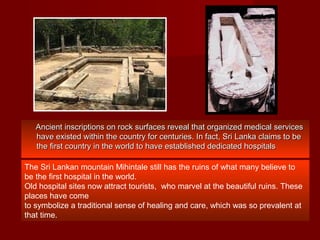
Even to day the ruins of Ayurveda hospitals and medicinal troughs (9thEven to day the ruins of Ayurveda hospitals and medicinal troughs (9th
century BC) known ascentury BC) known as 'Beheth Oruwa'Beheth Oruwa' can be seen' can be seen MihintaleMihintale..
Ancient inscriptions on rock surfaces reveal that organized medical servicesAncient inscriptions on rock surfaces reveal that organized medical services
have existed within the country for centuries. In fact, Sri Lanka claims to behave existed within the country for centuries. In fact, Sri Lanka claims to be
the first country in the world to have established dedicated hospitalsthe first country in the world to have established dedicated hospitals
The Sri Lankan mountain Mihintale still has the ruins of what many believe to
be the first hospital in the world.
Old hospital sites now attract tourists, who marvel at the beautiful ruins. These
places have come
to symbolize a traditional sense of healing and care, which was so prevalent at
that time.
(42) Indigenous wisdom of Sri Lanka written
on ola leaves
(42) Eight(42) Eight Divisions of AyurvedaDivisions of Ayurveda
(Ashtanga Ayurveda)(Ashtanga Ayurveda)
 Ayurveda, being a vast science is divided into eight branches,Ayurveda, being a vast science is divided into eight branches,
which are collectively called as Ashtanga Ayurveda.which are collectively called as Ashtanga Ayurveda.
 Like any other modern medicinal therapies, Ayurveda believesLike any other modern medicinal therapies, Ayurveda believes
in specialized treatment for different body parts.in specialized treatment for different body parts.
 Thus, the medicinal art have been categorized under branchesThus, the medicinal art have been categorized under branches
that deal with psychiatry, internal medicine, treatment of eyes,that deal with psychiatry, internal medicine, treatment of eyes,
ears, nose, throat and head, toxicology and gerentorologyears, nose, throat and head, toxicology and gerentorology
separately.separately.
 Ayurveda is the first ever medicine system to categorizeAyurveda is the first ever medicine system to categorize
pediatrics, aphrodisiacs and surgery as the branches of anypediatrics, aphrodisiacs and surgery as the branches of any
medicinal science.medicinal science.  
(43) Eight(43) Eight Divisions of Ayurveda (AshtangaDivisions of Ayurveda (Ashtanga
Ayurveda)Ayurveda)
There are two main traditions in Ayurveda.There are two main traditions in Ayurveda.
Kaya Chikitsa Shalya ChikitsaKaya Chikitsa Shalya Chikitsa
(Internal Medicine) (Surgery)(Internal Medicine) (Surgery)
Eight divisions of AyurvedaEight divisions of Ayurveda (Ashtanga Ayurveda):(Ashtanga Ayurveda):
1.Kaaya Chikithsa – Internal Medicine1.Kaaya Chikithsa – Internal Medicine
2.Shalya Chikithsa – Surgery Medicine2.Shalya Chikithsa – Surgery Medicine
3.Shalakya Tantra –E.N.T. & Eye3.Shalakya Tantra –E.N.T. & Eye
4.Kaumara Brutya -Pediatrics, Gynecology, Obstetrics4.Kaumara Brutya -Pediatrics, Gynecology, Obstetrics
5.Bhuta Vidya – Psychiatry, Astrology5.Bhuta Vidya – Psychiatry, Astrology
6.Agada Tantra – Toxicology6.Agada Tantra – Toxicology
7.Rasayana Tantra – Rejuvenation Treatment/ Gerentorology7.Rasayana Tantra – Rejuvenation Treatment/ Gerentorology
8.Vajikarana Tantra – Vitiation Theory/ Aphrodisiacs8.Vajikarana Tantra – Vitiation Theory/ Aphrodisiacs
ATREYAATREYA
DHANAVANTRIDHANAVANTRI
(School of Physicians) (school of Surgeons)(School of Physicians) (school of Surgeons)
& 7 other subjects & 7 other subjects& 7 other subjects & 7 other subjects
kaya Chikithsa/
Internal Medicine
Shalya Chikitsa/
surgery
(45) KAYA CHIKITHSA(45) KAYA CHIKITHSA
(Internal Medicine/ General medicine)(Internal Medicine/ General medicine)
The word Kaya means body.
Another meaning of Kaya is Agni (internal fire).
Therefore, Kaya Chikitsa means the management of the disorders of
internal fire as well as the body.
Defining the scope of Kaya Chikitsa, Susrutha states
that
the branch of Ayurveda which deals with the management of the disease
such as Jwara (fever), Raktapitta (Bleeding dyscrasias,
Hemophilia, etc.)   Shosha (phthisis), Unmada (mania), Apasmara
(epilepsy), Kustha (skin disorders) Prameha (urinary disorders),
Atisara (diarrhea) etc, occurring in the whole of the body, is Kaya
Chikitsa.
The specialties of general medicine, pathology, cardiology, neurology,
etc are also included in Kaya Chikitsa
(46) SHALYA CHIKITHSA (SURGERY(46) SHALYA CHIKITHSA (SURGERY
MEDICINE)MEDICINE)
The word Shalya means everything that bothers the psyche and / or soma.
While defining Shalya Tanta Susrutha (Su. 1/8) states that Shalya Tantra −
surgery − is the branch of Ayurveda which employs
•Yantra (blunt surgical instruments and tools)
•Shastra (sharp surgical instruments)
•Kshara (caustic bio chemical substances),
•Agni (cauterization)
To extract various types of foreign bodies such as:
 grass,
 wooden splinters,
 stones,
 minute particles,
 metal pieces,
 lumps,
 bones,
 hairs,
 nails,
 pus,
 exudate,
 abnormal foetus, etc.
 as well as the study of Vrna (traumatic wounds including
inflammation). Shalya Tantra incorporates the specialty of surgery
(47) SHALAKYA TANTRA(47) SHALAKYA TANTRA
(Diseases of Eye, Ear, Nose & Throat)(Diseases of Eye, Ear, Nose & Throat)
The term Shalakya is derived from the term Shalakya, which means a lancet or
probe, implying that the branch of Ayurveda employing the usage of lancet and
probe for the management of disease is Shalakya Tantra.
In a true sense, though, the scope of Shalakya Tantra is much more than this.
Shalakya Tantra deals with the etiology, diagnosis, prognosis, prevention and
treatment of diseases that are located above the neck region such as the head,
ear, nose, eye and throat.
It is responsible for all types of problems in and around the head.
According to Susrutha, Shalakya Tantra encompasses the management of the
clavicle bone.
The specialties of ENT and ophthalmology are included in Shalakya Tantra.
(48) KAUMARA BRUTHYA(48) KAUMARA BRUTHYA
(Pediatrics , Gynecology, Obstetrics)(Pediatrics , Gynecology, Obstetrics)
The literal meaning of the word Kaumarabhritya is theThe literal meaning of the word Kaumarabhritya is the
Nurturing of Kumara (Child) but in fact comprises muchNurturing of Kumara (Child) but in fact comprises much
more.more.
According to Sushruta,According to Sushruta,
Kaumarabhritya is that branch of Ayurveda which deals withKaumarabhritya is that branch of Ayurveda which deals with
the management of Nurturing of Kumara, rectifying thethe management of Nurturing of Kumara, rectifying the
problems of the mother’s breast milk – Dhatri, as well asproblems of the mother’s breast milk – Dhatri, as well as
other diseases of infancy and childhood.other diseases of infancy and childhood.
Subsequently, the Kumara Bhritya branch has come toSubsequently, the Kumara Bhritya branch has come to
encompass specialties of gynecology and obstetrics together withencompass specialties of gynecology and obstetrics together with
pediatrics.pediatrics.
(49) BHUTA VIDYA(49) BHUTA VIDYA
(Psychiatry, Astrology)(Psychiatry, Astrology)
The word Bhuta means that which came into existence, but over the yearsThe word Bhuta means that which came into existence, but over the years
the word has been used in connection with ghosts and other supernaturalthe word has been used in connection with ghosts and other supernatural
beings.beings.
Sushruta also states that Bbhuta Vidya is - the branch of Ayurveda whichSushruta also states that Bbhuta Vidya is - the branch of Ayurveda which
advocates the use of Shanti karma (appeasement rituals), Bali (sacrifice),advocates the use of Shanti karma (appeasement rituals), Bali (sacrifice),
etc. to rectify the problems arising out of the harmful influence ofetc. to rectify the problems arising out of the harmful influence of
supernatural entities.supernatural entities.
While discussing the manner of influence of these supernatural entities,While discussing the manner of influence of these supernatural entities,
Sushruta, further states that these entities do not themselves enter into aSushruta, further states that these entities do not themselves enter into a
person but rather, innumerable followers of the particular entity enter theperson but rather, innumerable followers of the particular entity enter the
body of a person and accordingly produce signs and symptoms.body of a person and accordingly produce signs and symptoms.
This discussion brings into sharp focus, the school of thought which equatesThis discussion brings into sharp focus, the school of thought which equates
the concept of Bhuta with that of mental disorders. Thus the specialty ofthe concept of Bhuta with that of mental disorders. Thus the specialty of
psychiatry is included under Bhuta Vidya.psychiatry is included under Bhuta Vidya.
(50) AGADA TANTRA (Toxicology)(50) AGADA TANTRA (Toxicology)
In general the word ‘In general the word ‘GadaGada’ means disease,’ means disease,
thereby implying that ‘thereby implying that ‘A-gadaA-gada’ means without disease,’ means without disease,
but in particular the word ‘but in particular the word ‘Agad’Agad’ stands for ‘Anti-poison’.stands for ‘Anti-poison’.
Sushruta defines:Sushruta defines:
Agada TantraAgada Tantra as the branch of Ayurveda which dealsas the branch of Ayurveda which deals
withwith
the management of disorders arising out of thethe management of disorders arising out of the
 bites from snakes,bites from snakes,
 insects, spiders,insects, spiders,
 rats andrats and
 other vermin,other vermin,
 as well as the effects of various venoms and poisons.as well as the effects of various venoms and poisons.
Agada Tantra incorporates the specialty of toxicology.Agada Tantra incorporates the specialty of toxicology.
(51) RASAYANA CHIKITHSA(51) RASAYANA CHIKITHSA
(rejuvenation treatment/ gerentorology)(rejuvenation treatment/ gerentorology)
Rasayana Chikitsa is the branch of Ayurvedic science, which deals withRasayana Chikitsa is the branch of Ayurvedic science, which deals with
various aspects of preventive health care. This branch of Ashtangvarious aspects of preventive health care. This branch of Ashtang
Ayurveda aims at achieving a long and healthy life. It includes longevity,Ayurveda aims at achieving a long and healthy life. It includes longevity,
improved memory, health,,improved memory, health,,
Chakra defines Rasayana as the measures adopted to achieve the bestChakra defines Rasayana as the measures adopted to achieve the best
quality of Dhatus (body tissues).quality of Dhatus (body tissues).
Sushruta defines Rasayana Tantra as that branch of Ayurveda which dealsSushruta defines Rasayana Tantra as that branch of Ayurveda which deals
with the measures to check the effects of aging as well as to increase lifewith the measures to check the effects of aging as well as to increase life
span, youthfulness, glow, complexion, generosity, strength of body andspan, youthfulness, glow, complexion, generosity, strength of body and
senses and memory.senses and memory.
In the process, there may also be results in the improvement of diseases.In the process, there may also be results in the improvement of diseases.
Rasayana Tantra, therefore, is a specialty essentially dealing with theRasayana Tantra, therefore, is a specialty essentially dealing with the
management of the phenomena of aging (Geriatrics)management of the phenomena of aging (Geriatrics)
(52) VAJIKARANA TANTRA(52) VAJIKARANA TANTRA
(Vitiation Theory/ Aphrodisiacs/ sexology )(Vitiation Theory/ Aphrodisiacs/ sexology )
The literal meaning of the word ‘Vaji’ is stallion, thereby implying
that Vajikarana means the process of metamorphosis of an ordinary
man into a stallion − especially in terms of his sexual power.
According to Sushruta – Vajikarana Tantra is that branch of
Ayurveda which deals with the management of the various
disorders of Retas (semen). Broadly speaking, Vajikarana Tantra
incorporates the specialty of Andrology and Sexology.
The art of producing healthy progeny for the creation of a better
society. It deals with various diseases like infertility and conditions
relating to weak shukra dhatu or the vital reproductive fluids of the
body. which means the medicine or therapy by which a man
becomes capable of copulating with a woman
PART 2PART 2
FUNDAMENTALS OFFUNDAMENTALS OF
AYURVEDAAYURVEDA
THE FIVE BASIC ELEMENTS INTHE FIVE BASIC ELEMENTS IN
AYURVEDAAYURVEDA
(PANCHA MAHA BHUTA)(PANCHA MAHA BHUTA)
According to ancient Vedic scientific thinking, All the matter in theAccording to ancient Vedic scientific thinking, All the matter in the
universe is composed of five basic elements. They are known asuniverse is composed of five basic elements. They are known as
‘Pancha Maha Bhuta’. Hence the human body as well as the food‘Pancha Maha Bhuta’. Hence the human body as well as the food
and drugs are also made out of these five basic elements.and drugs are also made out of these five basic elements.
THE FIVE BASIC ELEMENTS INTHE FIVE BASIC ELEMENTS IN
AYURVEDAAYURVEDA
(PANCHA MAHA BHUTA)(PANCHA MAHA BHUTA)
 Pritvi -Pritvi -EarthEarth – Solid– Solid
 Aap –Aap – WaterWater – Liquid– Liquid
 Tejas –Tejas – FireFire – Heat & Light– Heat & Light
 Vaayu –Vaayu – AirAir – Motion– Motion
 Akasha –Akasha – SpaceSpace – Sound– Sound
The properties and functions of the Basic Elements (Mahabhutas)
 
  
AkashaAkasha(Ether)(Ether)


VayuVayu (Air)(Air)


TejaTeja (fire) (fire)


JalaJala (Water)(Water)


PrithviPrithvi (Earth)(Earth)
                                                     
PropertiesProperties Light,  Minute, Light,  Minute, 
Clear,  Soft  & Clear,  Soft  & 
InactiveInactive
Light, Rough, Light, Rough, 
Minute & ClearMinute & Clear
Light,  Rough, Light,  Rough, 
Minute,  Clear  & Minute,  Clear  & 
SharpSharp
Heavy,  Fluid, Heavy,  Fluid, 
Slimy,  Soft  & Slimy,  Soft  & 
inactiveinactive
Heavy,  Rough, Heavy,  Rough, 
Firm,  Hard  & Firm,  Hard  & 
inactiveinactive
Relation  with Relation  with 
senses/sense senses/sense 
organsorgans
SoundSound
(Ear)(Ear)
                
TouchTouch
(Skin)(Skin)
VisionVision
(Eye)(Eye)
TasteTaste
(Tongue)(Tongue)
SmellSmell
(Nose)(Nose)
Relation  with Relation  with 
BodyBody
Body Cavities & Body Cavities & 
passagespassages
Body  Cavities, Body  Cavities, 
all  movements all  movements 
&  pulsation  in &  pulsation  in 
the bodythe body
Whole  body  is Whole  body  is 
concernedconcerned
Body fluidsBody fluids Body organsBody organs
Taste Taste 
responsibleresponsible
Not anyNot any Predominantly, Predominantly, 
astringent, astringent, 
slightly bitterslightly bitter
Predominantly, Predominantly, 
pungent, pungent, 
slightly sour & slightly sour & 
saltysalty
Predominantly Predominantly 
sweet,  slightly, sweet,  slightly, 
astringent, salty astringent, salty 
& sour& sour
Predom-inantly Predom-inantly 
sweet,  slightly sweet,  slightly 
astringentastringent
PritviPritvi
EarthEarth – Solid– Solid
Earth represents the solid state of matter in theEarth represents the solid state of matter in the
planet. It symbolizes stability, permanence andplanet. It symbolizes stability, permanence and
rigidity. The human body consists of bones,rigidity. The human body consists of bones,
teeth, cells and tissues, as the manifestations ofteeth, cells and tissues, as the manifestations of
the earth. Earth is regarded as a stablethe earth. Earth is regarded as a stable
substance. Talking about human being, stabilitysubstance. Talking about human being, stability
is the prerequisite for leading a healthy life,is the prerequisite for leading a healthy life,
which is focused by Ayurveda.which is focused by Ayurveda.  
AapAap
WaterWater – Liquid– Liquid
The liquid state is represented by water, another elementThe liquid state is represented by water, another element
of Ayurveda. Water is the prerequisite for the survival ofof Ayurveda. Water is the prerequisite for the survival of
living creatures, including humankind.living creatures, including humankind.
About 70% of human body is made up of water, the veryAbout 70% of human body is made up of water, the very
important liquid that is required for smooth functioning. Inimportant liquid that is required for smooth functioning. In
addition to water, fluids including our blood and lymphaddition to water, fluids including our blood and lymph
move between our cells and through our vessels,move between our cells and through our vessels,
thereby providing us the energy required. The bodythereby providing us the energy required. The body
temperature is also regulated. Water is a form withouttemperature is also regulated. Water is a form without
stability.stability.
TejasTejas
FireFire – Heat & Light– Heat & Light
In order to convert solids into liquids, to gas andIn order to convert solids into liquids, to gas and
back again to the original state, a certainback again to the original state, a certain
amount of power is required, which is providedamount of power is required, which is provided
by fire.by fire.
Fire has the power to change the state of anyFire has the power to change the state of any
substance.substance.
In human body, fire is present in the form ofIn human body, fire is present in the form of
energy that binds atoms together, converts foodenergy that binds atoms together, converts food
to fat and muscle.to fat and muscle.
In addition, fire creates impulses of nervousIn addition, fire creates impulses of nervous
reactions and even our thought process. reactions and even our thought process. 
VaayuVaayu
AirAir – Motion– Motion
One of the forms of the Pancha Maha Bhuta - air - isOne of the forms of the Pancha Maha Bhuta - air - is
mobile and dynamic.mobile and dynamic.
Within the human body, air is present in the form ofWithin the human body, air is present in the form of
oxygen, which is the basis for all energy transferoxygen, which is the basis for all energy transfer
reactions.reactions.
Existent without form, air is the prerequisite for fire toExistent without form, air is the prerequisite for fire to
burn.burn.
Talking about the human body, air is indirectly required toTalking about the human body, air is indirectly required to
produce energy, which is the basic requisite for one'sproduce energy, which is the basic requisite for one's
survival.survival.
Air is also the basic element of Ayurveda. Air is also the basic element of Ayurveda. 
The first element to come into existence, Akasha is 
also the subtlest. 
It is the most expansive and least dense, and though 
it seems a vast expanse of nothingness and its 
existence is a paradox of sorts, it is the matrix for all 
the other elements. 
Having evolved from the Sabda Tanmatra (sound), it 
is capable of carrying sound energy. 
The entire spectrum of vibration travels in the form 
of waves through this medium. 
Akasha
Ether - space
 AapAap - water; creates the taste sensation (rasa), its sensory organ - water; creates the taste sensation (rasa), its sensory organ
being the tonguebeing the tongue
 ThejaTheja - fire; creates the visual impute of colour (rupa), its sensory - fire; creates the visual impute of colour (rupa), its sensory
organ being the eyesorgan being the eyes
 VayuVayu - air; creates the physical sensation of touch (Sparsha), its - air; creates the physical sensation of touch (Sparsha), its
sensory organ being skinsensory organ being skin
 PruthuviPruthuvi - earth; creates the sensation of smell and odour - earth; creates the sensation of smell and odour
(gandha), its sensory organ being the nose(gandha), its sensory organ being the nose
 AkashaAkasha - ether (space); creates the auditory sensation of sound - ether (space); creates the auditory sensation of sound
(sharsda), its sensory organ being the ear(sharsda), its sensory organ being the ear..
5 M.B. is the conceptual model that Ayurveda uses to understand the5 M.B. is the conceptual model that Ayurveda uses to understand the
principles of nature’s functioning.principles of nature’s functioning.
This theory serves as the foundation for all of Ayurveda’s diagnosticThis theory serves as the foundation for all of Ayurveda’s diagnostic
and treatment.and treatment.
The Ayurvedic physician is trained to successfully detect and treatThe Ayurvedic physician is trained to successfully detect and treat
imbalances of these basic elements any where in human life.imbalances of these basic elements any where in human life.
According to Ayurveda, it is believed that the Pancha Maha bhutasAccording to Ayurveda, it is believed that the Pancha Maha bhutas
should be balanced, which when disrupted, a number of naturalshould be balanced, which when disrupted, a number of natural
calamities such ascalamities such as
flood, cyclone and earthquakes occur.flood, cyclone and earthquakes occur.
Ayurveda believes that every living creature in theAyurveda believes that every living creature in the
universe is made up of the five elements, whichuniverse is made up of the five elements, which
serve as the building blocks of life. Life doesn'tserve as the building blocks of life. Life doesn't
exist without these five elements. This reveals thatexist without these five elements. This reveals that
the ancient medicinal form of Ayurveda is closelythe ancient medicinal form of Ayurveda is closely
related to Mother Naturerelated to Mother Nature
The five basic elements of the universeThe five basic elements of the universe
Basic FundamentalsBasic Fundamentals
 According to Ayurveda, the human body isAccording to Ayurveda, the human body is
composed of four basics-composed of four basics-
DoshaDosha
DhatuDhatu
MalaMala
AgniAgni
 There is immense significance of all theseThere is immense significance of all these
basics of the body in Ayurveda. These are alsobasics of the body in Ayurveda. These are also
called thecalled the Moola Siddhanta (basic fundamentals)Moola Siddhanta (basic fundamentals)
of Ayurveda Treatmentsof Ayurveda Treatments
Three Doshas in the Human BodyThree Doshas in the Human Body
Biological application of Panchamahabhutas reflects in the form of.
‘Tri’ means three
‘Dosha’ represents to humor (bio-entity)
Thus the word ‘Tridosha’ denotes to three humors i.e. Vata, Pitta and
Kapha.
These are said ‘Dosha’ because these have tendency to get vitiated and also to
vitiate others.
This bilateral tendency of Dosha is cause of health and diseases. State of
balance of Dosha represents health while imbalance to the disease.  
Every Dosha has definite place/location and functions in our body. All have
their five types respectively.
VataVata
PittaPitta
KaphaKapha
Panchabhautic constitutions of Dosha have definite patternPanchabhautic constitutions of Dosha have definite pattern
 Akasha + Vayu = VATA= The principle of movement
      Teja + Jala  = PITTA  = the principle of transformation 
Jala + Prithvi       =  KAPHA  = The principle of stability
Location of the three DoshasLocation of the three Doshas   
The verse from Charaka Sanhita willThe verse from Charaka Sanhita will
explain the location of the Doshas  explain the location of the Doshas  
““The important sites of location of theseThe important sites of location of these
three Doshas are as below;three Doshas are as below;
Urinary bladder, rectum, waist, thighs,Urinary bladder, rectum, waist, thighs,
legs, bones and colon are the sites oflegs, bones and colon are the sites of
vatavata;;
among them colon is the mostamong them colon is the most
important site. important site. 
Sweat, lymph, blood and small intestineSweat, lymph, blood and small intestine
are the sites ofare the sites of pittapitta;;
among them, small intestine is theamong them, small intestine is the
most important site.most important site.
Chest, head, neck, joint, stomach and fatChest, head, neck, joint, stomach and fat
are the sites ofare the sites of kaphakapha; among them; among them
chest is the most important site.”chest is the most important site.”
  
    Caraka sustrasthana Chapter XX,Caraka sustrasthana Chapter XX,
verse 8verse 8
Theses three Dosha have
contradictory characters and so they
are capable of maintaining
equilibrium. Dosha of the body are of
vital importance because they are
responsible for coordinating and
directing all the structures and
substances of the body.
This theory of Dosha, Dhatu, and
Mala is the cornerstone of all its
diagnostic and treatment modalities
Vata -Vata - 'The principle of Movement ''The principle of Movement '  
 Vata though not apparently dominant in physicalVata though not apparently dominant in physical
structure very much dominant in the function and isstructure very much dominant in the function and is
supposed to be the leader of the three Dosha.supposed to be the leader of the three Dosha.
 VATAVATA governs all the motor and sensory function. Itgoverns all the motor and sensory function. It
can be compared with nervous system. Vatacan be compared with nervous system. Vata  is theis the
moving power or principle of movement in the humanmoving power or principle of movement in the human
body.body.
 In the external universe the wind is the principle of theIn the external universe the wind is the principle of the
movement: but Vata should not be compared with themovement: but Vata should not be compared with the
wind, as it is a kind of energy, which is an internal forcewind, as it is a kind of energy, which is an internal force
VataVata
 Vata is light, minute, and rough, dry, clear and cold in nature.Vata is light, minute, and rough, dry, clear and cold in nature.
It can’t be visualized due to its minute character, butIt can’t be visualized due to its minute character, but
perceived only by observing their actions. perceived only by observing their actions. 
Function:Function:
1. Responsible for all the movements of the body, even at1. Responsible for all the movements of the body, even at
cellular level.cellular level.
2. Controls the metabolic processes. But due to its stimulating2. Controls the metabolic processes. But due to its stimulating
action it increases the catabolic processes.action it increases the catabolic processes.
3. Controls the movements of other two doshas Pitta & Kapha.3. Controls the movements of other two doshas Pitta & Kapha.
4. Cell division.4. Cell division.
5. Stimulate all the sensory as well as motor centers.5. Stimulate all the sensory as well as motor centers.
6. Controls respiratory process.6. Controls respiratory process.
7. Responsible for normal functioning of the intellect.7. Responsible for normal functioning of the intellect.
8. Originator of zeal and joy.8. Originator of zeal and joy.
5 Subtypes of Vata:5 Subtypes of Vata:
typetype LocationsLocations ActionsActions
1.1. PranaPrana Mouth , Head, Ear,Mouth , Head, Ear,
Tongue, Nose &Tongue, Nose &
ChestChest
Respiration, swallowing,Respiration, swallowing,
sneezing, spitting etc.sneezing, spitting etc.
2.2. UdanaUdana Larynx, chest,Larynx, chest,
umbilical regionumbilical region
Speech, directing mentalSpeech, directing mental
activities, physical strengthactivities, physical strength
3.3. SamanaSamana Stomach, duodenumStomach, duodenum Digestion, sweating etc.Digestion, sweating etc.
4.4. VyanaVyana Everywhere in theEverywhere in the
bodybody
Circulation in the body, closing ofCirculation in the body, closing of
eyelids etc.eyelids etc.
5.5. ApanaApana Region of umbilicus,Region of umbilicus,
colon, rectum,colon, rectum,
bladder, penis, hipbladder, penis, hip
joints and thighsjoints and thighs
Defecation, micturation,Defecation, micturation,
menstruation, seminal discharge,menstruation, seminal discharge,
deliverydelivery
PITTA -PITTA - The principle of Transformation'The principle of Transformation'
 PITTAPITTA governs all the digestion,governs all the digestion,
metabolism and transforming processes. Itmetabolism and transforming processes. It
can be compared with all hormones andcan be compared with all hormones and
enzymes in the body.enzymes in the body.
 The sun is the energy of conversionThe sun is the energy of conversion
and is represented by fire: whenand is represented by fire: when
anything comes in contact with heatanything comes in contact with heat
it changes its appearance. Pitait changes its appearance. Pita
Dosha inside the human body is saidDosha inside the human body is said
to have this conversion power.to have this conversion power.
PittaPitta
 Pitta is hot, light and clear. It moves upwards orPitta is hot, light and clear. It moves upwards or
downwards depending upon dominancy of energydownwards depending upon dominancy of energy
and water elements, respectively. and water elements, respectively. 
 FunctionFunction
  
1   Heat production.1   Heat production.
2   Increase appetite and thirst.2   Increase appetite and thirst.
3   Maintains color, complexion and luster of skin.3   Maintains color, complexion and luster of skin.
4   Maintains vision.4   Maintains vision.
5   Increases the catabolic processes.5   Increases the catabolic processes.
6   Improves the mental activities.6   Improves the mental activities.
7   Concerned with various emotions like joy, fear7   Concerned with various emotions like joy, fear
anger and courage.anger and courage.
5 Subtypes of pitta5 Subtypes of pitta
SubtypesSubtypes LocationsLocations ActionsActions
1.1. PachakaPachaka Lower part ofLower part of
stomachstomach
small intestinesmall intestine
DigestionDigestion
2.2. RanjakaRanjaka Liver, spleen,Liver, spleen,
stomachstomach
Formation of bloodFormation of blood
3.3. SadhakaSadhaka Heart / BrainHeart / Brain Effect on mental function –Effect on mental function –
fear/ bravery, calmness /fear/ bravery, calmness /
anger confusion / clarityanger confusion / clarity
4.4. AlochakaAlochaka EyeEye VisionVision
5.5. BhrajakaBhrajaka SkinSkin Temperature regulation,Temperature regulation,
sweating, color andsweating, color and
complexioncomplexion
KAPHA -KAPHA - TheThe principle of Stabilityprinciple of Stability   
 KAPHAKAPHA which is responsible for cohesionwhich is responsible for cohesion
(adhesive power), static energy (strength),(adhesive power), static energy (strength),
growth and liquefaction. It can be compared withgrowth and liquefaction. It can be compared with
mucous system.mucous system.
 Kapha is the force of attraction and helps toKapha is the force of attraction and helps to
prevent the disintegration of the human body. Itprevent the disintegration of the human body. It
has and is responsible for the formation andhas and is responsible for the formation and
maintenance of the body and regulates itsmaintenance of the body and regulates its
temperature.temperature.
 The moon is responsible for cooling andThe moon is responsible for cooling and
regulating the temperature around the universeregulating the temperature around the universe
KAPHAKAPHA
 It is heavy, stable, smooth, soft, slimy, viscous and moist inIt is heavy, stable, smooth, soft, slimy, viscous and moist in
nature. Due to its slimy, viscid and unctuous character it isnature. Due to its slimy, viscid and unctuous character it is
responsible for giving compactness to the body. responsible for giving compactness to the body. 
FunctionFunction
1.  Constitutes the main body mass.1.  Constitutes the main body mass.
2.  Responsible for strength, stability and firmness of the body.2.  Responsible for strength, stability and firmness of the body.
3.  Maintenance of body fluid.3.  Maintenance of body fluid.
4.  All the anabolic process including growth and development4.  All the anabolic process including growth and development
of the body.of the body.
5.  Healing of wounds.5.  Healing of wounds.
6.  Fertility.6.  Fertility.
7.  Responsible for certain positive mental attitude zeal,7.  Responsible for certain positive mental attitude zeal,
knowledge, memory, absence of greed and forgiveness.knowledge, memory, absence of greed and forgiveness.
Negative mental qualities like ignorance, laziness, jealouslyNegative mental qualities like ignorance, laziness, jealously
etc. are due to dominancy of Kapha.etc. are due to dominancy of Kapha.
5 Subtypes of Kapha5 Subtypes of Kapha
SubtypesSubtypes LocationsLocations ActionsActions
11
KledakaKledaka StomachStomach Moistens and lubricates foodMoistens and lubricates food
to help in digestionto help in digestion
22
AvalambakaAvalambaka Chest (heart)Chest (heart) Circulation of bloodCirculation of blood
33
BodhakaBodhaka TongueTongue Perception of tastePerception of taste
44
TarpakaTarpaka Head (brain)Head (brain) Nourishment of senseNourishment of sense
organsorgans
55
ShleshakaShleshaka jointsjoints LubricationLubrication
DoshasDoshas
The entire body is inThe entire body is in
fact the abode of all thefact the abode of all the
three Doshas (vata,three Doshas (vata,
pitta, kapha) and aspitta, kapha) and as
such these Doshas bringsuch these Doshas bring
about good and badabout good and bad
results according asresults according as
they are in normal andthey are in normal and
abnormal statesabnormal states
respectively. When in arespectively. When in a
normal state, they bringnormal state, they bring
about good results likeabout good results like
growth, strength,growth, strength,
complexion, happinesscomplexion, happiness
etc. When, in anetc. When, in an
abnormal state, theyabnormal state, they
cause various types ofcause various types of
diseases.  diseases.  
Charaka Sanhita   Charaka Sanhita   
Sustra sthanaSustra sthana
Chapter XXChapter XX
verse 8verse 8
Common factor responsible for imbalanced status of DoshasCommon factor responsible for imbalanced status of Doshas
  
In our day to day life, if we are deviating from naturalIn our day to day life, if we are deviating from natural
pattern of living, we are likely to suffer from imbalancedpattern of living, we are likely to suffer from imbalanced
state of Doshas. This makes the chance for us to fall illstate of Doshas. This makes the chance for us to fall ill
  
  
Imbalance ofImbalance of
VataVata..
Summer & monsoon seasons.Summer & monsoon seasons.
Lack of sleepLack of sleep
ExcessiveExcessive
physicalphysical
activityactivity
Long hours of fastingLong hours of fasting
StressStress
Imbalance of Pitta.Imbalance of Pitta.
  (a) Consuming too much spicy or oily food.(a) Consuming too much spicy or oily food.
(b)      Late night dinner(b)      Late night dinner
(c) Excessive consumption of alcohol(c) Excessive consumption of alcohol
(d)   Tension or anxiety(d)   Tension or anxiety
Imbalance of KaphaImbalance of Kapha
     Consumption ofConsumption of
sweet in excesssweet in excess
amount.amount.
  ExcessiveExcessive
intake ofintake of
food rich infood rich in
carbohydratecarbohydrate
s and fatss and fats..
LessLess
PhysicalPhysical
activityactivity
The three vital principles of doshas are vata, pitta andThe three vital principles of doshas are vata, pitta and
kapha, which together regulate and control the catabolickapha, which together regulate and control the catabolic
and anabolic metabolism. The main function of the threeand anabolic metabolism. The main function of the three
Doshas is to carry the byproduct of digested foodsDoshas is to carry the byproduct of digested foods
throughout the body, which helps in building up the bodythroughout the body, which helps in building up the body
tissues. Any malfunction in these doshas causes disease. tissues. Any malfunction in these doshas causes disease. 
Doshas play a vital role in the basic foundation ofDoshas play a vital role in the basic foundation of
Ayurveda. They are responsible for coordinating andAyurveda. They are responsible for coordinating and
directing all the substances and structures of the body.directing all the substances and structures of the body.
According to Ayurveda there are three vital principles,According to Ayurveda there are three vital principles,
which regulate and control the biological functions of thewhich regulate and control the biological functions of the
body.body.
The common origin of the universe and manThe common origin of the universe and man
 The human body is also made of these five elements. Accordingly, theThe human body is also made of these five elements. Accordingly, the
elements in the universe and the elements in the human body reveal aelements in the universe and the elements in the human body reveal a
common origin. These common factors create a harmony between man andcommon origin. These common factors create a harmony between man and
the universe and there is a co-relation between the universe and the humanthe universe and there is a co-relation between the universe and the human
body. In the external universe there are three main causative factors - thebody. In the external universe there are three main causative factors - the
sun, moon, and wind. In the human body there are three constituentsun, moon, and wind. In the human body there are three constituent
elements - Vatha, Pitha and Kapha. There are similarities between theseelements - Vatha, Pitha and Kapha. There are similarities between these
causative factors.causative factors.
 Just as much as theJust as much as the sunsun,, thethe moonmoon,, and theand the windwind have achieved a sensehave achieved a sense
of balance to maintain the universe,of balance to maintain the universe, VathaVatha,, PithaPitha andand KaphaKapha have to behave to be
in correct balance to maintain the human body and well being of the humanin correct balance to maintain the human body and well being of the human
body.body.
 As universe and man have a common origin the activities in the universeAs universe and man have a common origin the activities in the universe
also takes place inside the human being. In the same way that the Sun,also takes place inside the human being. In the same way that the Sun,
Moon, and Wind maintain the world, Vatha, Pitha and Kapha sustains theMoon, and Wind maintain the world, Vatha, Pitha and Kapha sustains the
body.body.
Seven Dhatu (tissue elements) in the human bodySeven Dhatu (tissue elements) in the human body
The word “dhatu” comes from a Sanskrit word whichThe word “dhatu” comes from a Sanskrit word which
means “that which enters into the formation of the body”.means “that which enters into the formation of the body”.
Dhatu are basically the body tissues which are responsibleDhatu are basically the body tissues which are responsible
for the functioning of the systems and organs and thefor the functioning of the systems and organs and the
structure of the body. Each of the Dhatus is built out of astructure of the body. Each of the Dhatus is built out of a
previous one and they develop on the nourishment thatprevious one and they develop on the nourishment that
comes from the digestive system. (The nutrition of ourcomes from the digestive system. (The nutrition of our
foods converts in to Seven Dhatus)foods converts in to Seven Dhatus)
It helps in the growth and structure of mind.It helps in the growth and structure of mind.
Dosha and Dhatus have relation with each other in healthDosha and Dhatus have relation with each other in health
and disease. In pathogenesis of disease these both playand disease. In pathogenesis of disease these both play
key role.key role.    Each dhatu consists of countless infinite smallEach dhatu consists of countless infinite small
cells which are units of structure and functioncells which are units of structure and function
Blood tissueBlood tissue
 Rasa (Plasma tissue element)Rasa (Plasma tissue element)
 Rakta (Blood tissue element)Rakta (Blood tissue element)
 Mansa (Muscles tissue element)Mansa (Muscles tissue element)
 Medas (Fat tissue element)Medas (Fat tissue element)
 Asti (Bone tissue element)Asti (Bone tissue element)
 Majja (Bone marrow tissue element)Majja (Bone marrow tissue element)
 Shukra (Reproductive tissue element)Shukra (Reproductive tissue element)
Rasa DhatuRasa Dhatu  
This dhatu comprises of  fluids like chyle,This dhatu comprises of  fluids like chyle,
blood plasma, extra cellular andblood plasma, extra cellular and
transcellular fluid lymph. Its function istranscellular fluid lymph. Its function is
nourishment. - Status of Rasa dhatu cannourishment. - Status of Rasa dhatu can
be assessed by the condition of the skin.be assessed by the condition of the skin.
Good  condition of Rasa dhatu isGood  condition of Rasa dhatu is
demonstrated by smooth , soft anddemonstrated by smooth , soft and
delicate skindelicate skin
Rakta  DhatuRakta  Dhatu
  This is blood. Its function is invigoration.This is blood. Its function is invigoration.
Appearance of mouth ,tongue, lips, palms,Appearance of mouth ,tongue, lips, palms,
soles, nails is reddish and full of lusture.soles, nails is reddish and full of lusture.
This indicate the wellness of Rakta dhatu.This indicate the wellness of Rakta dhatu.
Mamsa DhatuMamsa Dhatu
    This is muscle tissue. Its function isThis is muscle tissue. Its function is
holding the skeleton together. A personholding the skeleton together. A person
who is having well developed muscles, hiswho is having well developed muscles, his
Mamsa dhatu is well in order.Mamsa dhatu is well in order.
Meda DhatuMeda Dhatu
This is fat/adipose tissue. Its function isThis is fat/adipose tissue. Its function is
lubrication. Unctuousness in complexion islubrication. Unctuousness in complexion is
the feature of normal Meda dhatuthe feature of normal Meda dhatu
Asthi DhatuAsthi Dhatu     
This is bone tissue. It function is to provideThis is bone tissue. It function is to provide
support.support.
When Asthi dhatu is in order it makes theWhen Asthi dhatu is in order it makes the
body strong and firmbody strong and firm
  Majja DhatuMajja Dhatu
This is marrow inside the bone, brain andThis is marrow inside the bone, brain and
spinal cord. It’s function is to fill the bonespinal cord. It’s function is to fill the bone
joints.joints.
Shukra DhatuShukra Dhatu
This is the male and female sexual fluids.This is the male and female sexual fluids.
Its function is reproduction and productionIts function is reproduction and production
of a fluid (of a fluid (ojasojas) which produces strength,) which produces strength,
aura and controls the immunity. In normalaura and controls the immunity. In normal
course shukra dhatu is indicated bycourse shukra dhatu is indicated by
round, firm and even teeth, goodround, firm and even teeth, good
complexion, voice and cheerfulness.complexion, voice and cheerfulness.
Three Main Mala (excretory substances)Three Main Mala (excretory substances)
in the human bodyin the human body
Mala means waste products or dirty.Mala means waste products or dirty.
The human body produces three main waste products thatThe human body produces three main waste products that
i.e.i.e. stool, urine and sweat.stool, urine and sweat.
It is important that these waste products are expelled from the bodyIt is important that these waste products are expelled from the body
regularly, or else they collect as toxins. They are actually by productsregularly, or else they collect as toxins. They are actually by products
formed as a result of various physiological activities going on in theformed as a result of various physiological activities going on in the
body.body.
Purish (stool / Faeces)),Purish (stool / Faeces)),
Mutra (urine)Mutra (urine)
Sweda (sweatSweda (sweat ) are considered as main excretory product of the body.) are considered as main excretory product of the body.
These are also known as Dushya as these tend to be influenced to causeThese are also known as Dushya as these tend to be influenced to cause
pathology or disease by imbalanced doshas.pathology or disease by imbalanced doshas.
It is third in the trinity of the body i.e. doshas and dhatu. Malas areIt is third in the trinity of the body i.e. doshas and dhatu. Malas are
mainly the waste products of the body so their proper excretion from themainly the waste products of the body so their proper excretion from the
body is essential to maintain the proper health of the individual. Therebody is essential to maintain the proper health of the individual. There
are mainly two aspect of mala i.e. mala and kitta. Mala is about wasteare mainly two aspect of mala i.e. mala and kitta. Mala is about waste
products of the body whereas kitta is all about the waste products ofproducts of the body whereas kitta is all about the waste products of
Dhatu.Dhatu.
 While Dosha (While Dosha (three body humorsthree body humors) are the most important in) are the most important in
the control of the physiological functioning of the body Dhatuthe control of the physiological functioning of the body Dhatu
((Tissue ElementsTissue Elements), Mala (), Mala (Excretory substancesExcretory substances), Agni (), Agni (thethe
digestive powerdigestive power), Ojas (), Ojas (Immunological factorsImmunological factors) also play a) also play a
vital role.vital role.
 All these factors are important to maintain health. And theyAll these factors are important to maintain health. And they
get disturbed or affected by various disease conditions. Theget disturbed or affected by various disease conditions. The
Ayurvedic Doctors role is to restore the balance or theAyurvedic Doctors role is to restore the balance or the
normalcy of these factors using foods, behavioral andnormalcy of these factors using foods, behavioral and
medicament remedies which are mostly naturalmedicament remedies which are mostly natural..
What is Prakriti?What is Prakriti?
The termThe term PrakrutiPrakruti is a Sanskrit word that literally means,is a Sanskrit word that literally means,
‘‘the science of nature,’ orthe science of nature,’ or
‘‘basic traitbasic trait’’ ,,
'nature','nature',
'creativity''creativity'
the first creationthe first creation which determines the innate character,which determines the innate character,
physical constitution or disposition of a personphysical constitution or disposition of a person
The combination of Vata, Pitta, and Kapha which is present in the 
individual at the time of conception is maintained throughout his lifetime
Every person is born with a definite genetic constitution. 
There are three major types of Prakriti vata, pitta, kapha and these reflect 
predominance of that particular Dosha. 
 The body behaves according to the status of Dosha Prakriti. Different 
persons can have different combination of Vata, Pitta and kapha as their 
basic constitution . 
PrakritiPrakriti
 That is why; two people react differently when exposedThat is why; two people react differently when exposed
to a similar situation.to a similar situation.
For example,For example,
a person is born with Vata Prakriti and his or her diet isa person is born with Vata Prakriti and his or her diet is
rich in Vata promoting substances then he or she is likelyrich in Vata promoting substances then he or she is likely
to develop a problems like Constipation etc.to develop a problems like Constipation etc.
 while the same diet is consumed by a person of Pittawhile the same diet is consumed by a person of Pitta
constitution that will keep him or her in order.constitution that will keep him or her in order.
 Thus, according to Ayurveda everyone is unique andThus, according to Ayurveda everyone is unique and
each one of them has a distinct body constitution, whicheach one of them has a distinct body constitution, which
is totally different from each other.is totally different from each other.  
PrakritiPrakriti
There are seven possible Prakriti (constitution) types –There are seven possible Prakriti (constitution) types –
a)a)  Vata PrakritiVata Prakriti
b)b)  Pitta PrakritiPitta Prakriti
c)c)  Kapha PrakritiKapha Prakriti
d)d)  Vata – Pitta PrakritiVata – Pitta Prakriti
e)e)  Vata – Kapha PrakritiVata – Kapha Prakriti
f)f)    Pitta – Kapha PrakritiPitta – Kapha Prakriti
g)g)    Tridosha PrakritiTridosha Prakriti
These are only broad categories. But by variation inThese are only broad categories. But by variation in
proportion it may be of innumerable types. We find thatproportion it may be of innumerable types. We find that
most people around us have a dual personality.most people around us have a dual personality.
PrakritiPrakriti
 One has to develop a good concept of Prakriti analysis,One has to develop a good concept of Prakriti analysis,
without knowledge of one’s Prakriti, it is practicallywithout knowledge of one’s Prakriti, it is practically
impossible to apply Ayurvedic fundamentals inimpossible to apply Ayurvedic fundamentals in
prevention, promotion and cure of diseaseprevention, promotion and cure of disease
 The Fundamental approach of treatment in Ayurveda isThe Fundamental approach of treatment in Ayurveda is
individual. Diagnosis and treatment is focused on notindividual. Diagnosis and treatment is focused on not
only on the symptoms or the disease but on theonly on the symptoms or the disease but on the
individual as a whole.individual as a whole.
 The diagnosis finds out the prakritiThe diagnosis finds out the prakriti (Body Constitution of(Body Constitution of
thethe person), food, habits and behaviors underline theperson), food, habits and behaviors underline the
disease , the causative factors of the disease, thedisease , the causative factors of the disease, the
affected channels and organs, the affected Dosha,affected channels and organs, the affected Dosha,
Dhatu, Mala and etc., the condition of the digestiveDhatu, Mala and etc., the condition of the digestive
power, the presence of Ama (Indigested matter or toxicpower, the presence of Ama (Indigested matter or toxic
substances), the condition of Ojas and etc.substances), the condition of Ojas and etc.
The diagnosis of the Body Constitution is a very
important and vital point to decide on the
treatment or to decide on the health promotion
measures.
There is some unique diagnosis methods used in
Ayurveda with the other usual techniques
It helps in deciding the ideal life style and
therapeutic regimen for an individual.
Depending on the predominance of a single
Dosha, or different permutations and
combinations, Prakriti could be of seven types
out of which the three main types are vata, pitta
and kapha whereas Vikriti has several types and
can be determined only through thorough
examinations
Meaning of VikritiMeaning of Vikriti
 VikrutiVikruti is the discrepancy that makes our body different from a normal oris the discrepancy that makes our body different from a normal or
healthy constitution.healthy constitution.
 In simple terms, it is the abnormal or the diseased state. When the DoshasIn simple terms, it is the abnormal or the diseased state. When the Doshas
of the body are not in perfect equilibrium, it can be termed as the stage ofof the body are not in perfect equilibrium, it can be termed as the stage of
VikrutiVikruti..
 Any kind of abnormality (Any kind of abnormality (VikrutiVikruti) in the body can lead to complications in the) in the body can lead to complications in the
normal regulation of body functions and thus lead to any seriousnormal regulation of body functions and thus lead to any serious
complication or disease.complication or disease.
 For treatingFor treating VikrutiVikruti,,
– reason or etiology of the disease,reason or etiology of the disease,
– the state of Doshas,the state of Doshas,
– the state of the dushyas (the dhatus that are vitiated by the dosha),the state of the dushyas (the dhatus that are vitiated by the dosha),
– desha (habitat of the person anddesha (habitat of the person and
– kala (seasonal time),kala (seasonal time),
– bala (strength of the patient and disease) andbala (strength of the patient and disease) and
– symptoms of the individual is determined.symptoms of the individual is determined.
Vikriti cont…Vikriti cont…
 In Ayurveda, both Prakriti and Vikriti form aIn Ayurveda, both Prakriti and Vikriti form a
significant part, the latter being more perused.significant part, the latter being more perused.
 In simple words,In simple words,
if a doctor is a particular of a person, then heif a doctor is a particular of a person, then he
is treating the Vikriti of the person.is treating the Vikriti of the person.
Treating a disease = treating the VikritiTreating a disease = treating the Vikriti
 The science of life states that if the Doshas ofThe science of life states that if the Doshas of
the body are not in equilibrium, then a personthe body are not in equilibrium, then a person
suffers from any form of disease.suffers from any form of disease.
VattaVatta Vikriti Vikriti
There are various factors responsible for increasing vataThere are various factors responsible for increasing vata::
 Excessive intake of food like cabbage, cauliflower, broccoli, sprouts, beans,Excessive intake of food like cabbage, cauliflower, broccoli, sprouts, beans,
dry fruits, mushrooms and raw foods.dry fruits, mushrooms and raw foods.
 Travelling too much by any means of transportation.Travelling too much by any means of transportation.
 Untimely sleeping hours or late nightsUntimely sleeping hours or late nights
 Too much eating of junk food, frozen food and micro waved cookedToo much eating of junk food, frozen food and micro waved cooked
 Exposure to sound pollutionExposure to sound pollution
 Too much exposure to television and computers or any electric gadgetsToo much exposure to television and computers or any electric gadgets
 Indulging more in sexual activitiesIndulging more in sexual activities
 Excessive physical labor like sportsExcessive physical labor like sports
 Taking too much medicinal, recreational and stimulating drugs.Taking too much medicinal, recreational and stimulating drugs.
Symptoms: Symptoms caused by excess of vata in the body are:Symptoms: Symptoms caused by excess of vata in the body are:
 Joint PainsJoint Pains
 ConstipationConstipation
 Dry SkinDry Skin
 Loss of MemoryLoss of Memory
 Palpitation insomniaPalpitation insomnia
 Stiffness of musclesStiffness of muscles
 Weight LossWeight Loss
 MigraineMigraine
 VertigoVertigo
 TremorsTremors
Pitta VikritPitta Vikrit
There are various factors responsible for increasing vata:There are various factors responsible for increasing vata:
 Drinking too much tea, coffee, alcohol and excessive smokingDrinking too much tea, coffee, alcohol and excessive smoking
increase pitta in the body.increase pitta in the body.
 Eating of hot and spicy foodEating of hot and spicy food
 Too intake of chillies, tomatoes, egg plant, spinach, and onions.Too intake of chillies, tomatoes, egg plant, spinach, and onions.
 Exposure to sun and heat also increases pitta.Exposure to sun and heat also increases pitta.
Symptoms: Some of the symptoms caused by excess of pitta in the body areSymptoms: Some of the symptoms caused by excess of pitta in the body are::
 HyperacidityHyperacidity
 Skin diseasesSkin diseases
 Burning sensationBurning sensation
 FeverFever
 InfectionsInfections
 Ulcers And Liver disordersUlcers And Liver disorders
KaphaKapha VikritiVikriti
There are various factors responsible for increasing Kapha:There are various factors responsible for increasing Kapha:
 Eating too much sugars, fats, oily and fried foods, iceEating too much sugars, fats, oily and fried foods, ice
creams, meats, dairy products and nutscreams, meats, dairy products and nuts
 Sleeping during day time and less of physical activitiesSleeping during day time and less of physical activities
Symptoms: Some of the symptoms caused by excess of kapha in the body are:Symptoms: Some of the symptoms caused by excess of kapha in the body are:
 AsthmaAsthma
 Cough and coldCough and cold
 Congestion in the chestCongestion in the chest
 AnorexiaAnorexia
 ObesityObesity
Concept of Agni, AmaConcept of Agni, Ama
 The other important principle governing the basic physiology ofThe other important principle governing the basic physiology of
Ayurveda isAyurveda is AgniAgni. Ayurveda believes that any disturbance in. Ayurveda believes that any disturbance in
digestion and metabolism leads to the formation of toxinsdigestion and metabolism leads to the formation of toxins (Ama),(Ama),
which give rise to diseases.which give rise to diseases. AgniAgni governs this disturbance ofgoverns this disturbance of
digestion and metabolism.digestion and metabolism.
 When there is an imbalance of the Tri Dosha or Saptha Dhatu orWhen there is an imbalance of the Tri Dosha or Saptha Dhatu or
AgniAgni, the disease process begins. The balanced state of the things, the disease process begins. The balanced state of the things
mentioned above is responsible for the natural immunity of thementioned above is responsible for the natural immunity of the
person.person.
 AgniAgni All kinds of metabolic and digestive activity of the body takes All kinds of metabolic and digestive activity of the body takes
place with the help of the biological fire of the body calledplace with the help of the biological fire of the body called AgniAgni.. AgniAgni
can be termed as the various enzymes present in the elementarycan be termed as the various enzymes present in the elementary
canal, liver and the tissue cells.canal, liver and the tissue cells.
 ((Ama is a peculiar concept in Ayurveda (for which modern chemistry has no correlate). It is an important factor in a cause of disease andAma is a peculiar concept in Ayurveda (for which modern chemistry has no correlate). It is an important factor in a cause of disease and
in modification of disease process. Role of Ama - Ama originates from improperly digested toxic particles that clog the channels in yourin modification of disease process. Role of Ama - Ama originates from improperly digested toxic particles that clog the channels in your
body. Some of these channels are physical and include the intestines, lymphatic system, arteries and veins, capillaries, and genitourinarybody. Some of these channels are physical and include the intestines, lymphatic system, arteries and veins, capillaries, and genitourinary
tract. Others are nonphysical channels called nadis through which your energy flows. )tract. Others are nonphysical channels called nadis through which your energy flows. )
What is Diseases?What is Diseases?
 An Example: The concept ofAn Example: The concept of Prakruti and VikrutiPrakruti and Vikruti can be illustrated withcan be illustrated with
reference to our body temperature. When healthy, we maintain an averagereference to our body temperature. When healthy, we maintain an average
body temperature of about 98.4oF, which can be regarded.body temperature of about 98.4oF, which can be regarded.
 As our Prakriti Although different persons can have different baseAs our Prakriti Although different persons can have different base
temperatures, it does not change much so long as the person is healthy.temperatures, it does not change much so long as the person is healthy.
When we go outside on a winter day, our body temperature may go downWhen we go outside on a winter day, our body temperature may go down
slightly; but will come right back to the normal if we are healthy.slightly; but will come right back to the normal if we are healthy.
 When we areWhen we are sick or catch a cold, our body temperature will go upsick or catch a cold, our body temperature will go up. This. This
indicates that we are sick or outside our normal base condition. We mayindicates that we are sick or outside our normal base condition. We may
take medicine to bring the body temperature back to the normal range. Intake medicine to bring the body temperature back to the normal range. In
analogy to Ayurveda, our present temperature may be considered asanalogy to Ayurveda, our present temperature may be considered as
Vikruti, because Vikruti means the state of disease. So it is important toVikruti, because Vikruti means the state of disease. So it is important to
understand theunderstand the Prakriti and Vikruti of our bodyPrakriti and Vikruti of our body. . 
Unlike other ancient medical sciences, the science of Ayurvedic healing isUnlike other ancient medical sciences, the science of Ayurvedic healing is
not simply based on assumptions and probabilities rather based on logicalnot simply based on assumptions and probabilities rather based on logical
examinations and testsexaminations and tests. . 
Nidana (Etiology or Cause of Disease)Nidana (Etiology or Cause of Disease)
 Disease is defined as the state of mind where in a person experiencesDisease is defined as the state of mind where in a person experiences
discomfort, pain and injury. Fundamentally, a disease is caused by thediscomfort, pain and injury. Fundamentally, a disease is caused by the
imbalance of the three doshas - Vata, Pitta and Kapha.imbalance of the three doshas - Vata, Pitta and Kapha.
 However, the diseases are also categorized into those thatHowever, the diseases are also categorized into those that can be curedcan be cured andand
the one thatthe one that cannot be curedcannot be cured by Ayurvedic treatment. Moreover, the texts ofby Ayurvedic treatment. Moreover, the texts of
Ayurveda suggest that diseases are also classified according to the underlyingAyurveda suggest that diseases are also classified according to the underlying
cause - whether it iscause - whether it is psychological, physiological or an external factorpsychological, physiological or an external factor. . 
 One of the fundamental truths of the Ayurvedic philosophy is proclaimed in theOne of the fundamental truths of the Ayurvedic philosophy is proclaimed in the
classical idea of classical idea of loka-purusha samyaloka-purusha samya. This very important concept teaches that. This very important concept teaches that
thethe universe (loka) and the individual human being (universe (loka) and the individual human being (purushapurusha)) are under theare under the
same laws and in fact exist on a continuum which reaches from the realm ofsame laws and in fact exist on a continuum which reaches from the realm of
the universal to that of the smallest form of creation.the universal to that of the smallest form of creation.
 The individual living being, whether it be a man or an ant, is a miniature replicaThe individual living being, whether it be a man or an ant, is a miniature replica
of the universe. This concept is beautifully and succinctly captured in theof the universe. This concept is beautifully and succinctly captured in the
famous sutra "as above, so below". It is important to reflect on the fullfamous sutra "as above, so below". It is important to reflect on the full
implications of this universal truth and to realize that the microcosm (man) andimplications of this universal truth and to realize that the microcosm (man) and
macrocosm (universe) are in a never-ending interaction with each other. Thismacrocosm (universe) are in a never-ending interaction with each other. This
interaction operates under the law of interaction operates under the law of samanya - vishesasamanya - vishesa  or like-increases-like.or like-increases-like.
The constantly changing conditions both in Nature and in the individual createThe constantly changing conditions both in Nature and in the individual create
a dynamic harmony between the two--a state which we recognize as health.a dynamic harmony between the two--a state which we recognize as health.
When there is more deviation that can be tolerated between the individual andWhen there is more deviation that can be tolerated between the individual and
Nature (the universe) that harmony is lost and a disease state can arise.Nature (the universe) that harmony is lost and a disease state can arise.
loka and purushaloka and purusha
 The universe and the individual being interact through the eternallyThe universe and the individual being interact through the eternally
shifting interplay of three factors which exist in both realm and formshifting interplay of three factors which exist in both realm and form
a bridge between a bridge between lokaloka and  and purushapurusha. These three factors are:. These three factors are:
 Buddhi (intellect)Buddhi (intellect)
 Indriyartha (sense objects)Indriyartha (sense objects)
 Kala (natural rhythms)Kala (natural rhythms)
 The healthy state of all three of these factors is called samayogaThe healthy state of all three of these factors is called samayoga
(balanced). However buddhi, indriyartha, and kala can also become(balanced). However buddhi, indriyartha, and kala can also become
imbalanced asimbalanced as atiyoga (excessiveatiyoga (excessive),), ayoga (deficient),ayoga (deficient), oror mithyayogamithyayoga
(distorted).(distorted).  
 These deviations of buddhi, indriyartha, and kala from their normalThese deviations of buddhi, indriyartha, and kala from their normal
balanced state are considered in Ayurveda to be the fundamentalbalanced state are considered in Ayurveda to be the fundamental
cause of disease.cause of disease. It is these disharmonies which lead to the vitiation It is these disharmonies which lead to the vitiation
of the doshas, accumulation of ama, weakening of agni, and theof the doshas, accumulation of ama, weakening of agni, and the
entire cascade of the Kriyakala. We give specific names to each ofentire cascade of the Kriyakala. We give specific names to each of
these fundamental causes of disease:these fundamental causes of disease:
 11.. PrajnaparadhaPrajnaparadha
 2. Asatmyendriyartha samyoga2. Asatmyendriyartha samyoga
 3. Kalaparinama3. Kalaparinama
They are defined asThey are defined as
follows…follows…
 PrajnaparadhaPrajnaparadha  literally means a " literally means a "blasphemy,or mistake, of the intellectblasphemy,or mistake, of the intellect".".
Improper use of the intellect which results in a wrong understanding of someImproper use of the intellect which results in a wrong understanding of some
kind is an example of prajnaparadha. Another form of this disease factor iskind is an example of prajnaparadha. Another form of this disease factor is
a a volitional transgressionvolitional transgression against what an individual knows to be correct and against what an individual knows to be correct and
true. Whether volitional or non-volitional, prajnaparadha leads to fallacioustrue. Whether volitional or non-volitional, prajnaparadha leads to fallacious
information, wrong conclusions, and hazzardous actions. When aninformation, wrong conclusions, and hazzardous actions. When an
intelligent and educated person indulges in an unhealthy habit or abuse, it isintelligent and educated person indulges in an unhealthy habit or abuse, it is
always a consequence of prajnaparadha.always a consequence of prajnaparadha.
 Asatmyendriyartha samyogaAsatmyendriyartha samyoga   literally means an "literally means an "inappropriateinappropriate
association of the sense organs with certain sense objectsassociation of the sense organs with certain sense objects". This is a". This is a
fascinating concept with wide implications for creating health and preventingfascinating concept with wide implications for creating health and preventing
disease. This concept views the sense organs as having a direct connectiondisease. This concept views the sense organs as having a direct connection
with the highest levels of the mind. An unwholesome (excessive, deficient,with the highest levels of the mind. An unwholesome (excessive, deficient,
or distorted) perceived stimulus produces an unwholesome effect in theor distorted) perceived stimulus produces an unwholesome effect in the
mind which in turn causes stress and a vulnerability to disease. Themind which in turn causes stress and a vulnerability to disease. The
unwholesome perception disturbs theunwholesome perception disturbs the sattvicsattvic quality of the mind and createsquality of the mind and creates
aa rajasicrajasic oror tamasictamasic state. This mental state, in turn, can promotestate. This mental state, in turn, can promote
aggravation of the doshas, transforming an initially mental phenomenon intoaggravation of the doshas, transforming an initially mental phenomenon into
a somatic manifestation.a somatic manifestation.
Kala parinamaKala parinama ….. …..
 is defined as "is defined as "being out of harmony with the rhythms and cycles ofbeing out of harmony with the rhythms and cycles of NatureNature".".
Ayurveda recognizes several important cycles on the macroscopicAyurveda recognizes several important cycles on the macroscopic
scale which have corresponding effects on the human being.scale which have corresponding effects on the human being.
 If an individual does not become aware of these cycles and modifyIf an individual does not become aware of these cycles and modify
his life accordingly, that discordance will lead to a disease state.his life accordingly, that discordance will lead to a disease state.
 The diurnal rhythms discovered by modern physiologists, the femaleThe diurnal rhythms discovered by modern physiologists, the female
menstrual cycle, the male and female sexual peaks, the seasonalmenstrual cycle, the male and female sexual peaks, the seasonal
variations in immune status, the sleep cycle, the daily changes invariations in immune status, the sleep cycle, the daily changes in
breathing patterns are all examples of chronobiological rhythmsbreathing patterns are all examples of chronobiological rhythms
which were intuitively known to the ancient which were intuitively known to the ancient vaidyasvaidyas..
Ayurveda recognizes three primary levels ofAyurveda recognizes three primary levels of
healinghealing
 Treatment of disease Treatment of disease 
 Prevention of disease and promotion ofPrevention of disease and promotion of
well-being well-being 
 Development of self awareness andDevelopment of self awareness and
balance of body, mind and spiritbalance of body, mind and spirit
The majority of us think of medicine when we "The majority of us think of medicine when we "fall illfall ill" and we seek" and we seek
treatment of a disease. The medicine we take is aimed at fixingtreatment of a disease. The medicine we take is aimed at fixing
something already broken. Western medicine treats disease throughsomething already broken. Western medicine treats disease through
invasive therapies such as drugs or surgery which may haveinvasive therapies such as drugs or surgery which may have
resulting side effects. Ayurveda treats disease with a series ofresulting side effects. Ayurveda treats disease with a series of
internal and external therapies using natural ingredients that haveinternal and external therapies using natural ingredients that have
little or no adverse side effects.little or no adverse side effects.
Ayurveda as it name implies is a "science of life" according to whichAyurveda as it name implies is a "science of life" according to which
we are made up of the same five elements as the universe (Water,we are made up of the same five elements as the universe (Water,
Fire, Air, Earth and Space) When we are close to these elements orFire, Air, Earth and Space) When we are close to these elements or
one with them and nature, then there is perfect balance in theone with them and nature, then there is perfect balance in the
energies (the doshas) within us and we enjoy good health.energies (the doshas) within us and we enjoy good health.
When these links are disrupted there is an imbalance in the energiesWhen these links are disrupted there is an imbalance in the energies
within us, and this leads to ill -health and disease. In thesewithin us, and this leads to ill -health and disease. In these
circumstances Ayurveda uses natural products - made up of thecircumstances Ayurveda uses natural products - made up of the
same elements as the universe, derived from trees and herbs, tosame elements as the universe, derived from trees and herbs, to
prepare medicine that can treat the root causes of the illness andprepare medicine that can treat the root causes of the illness and
restore our balance and good health. This aspect of Ayurveda isrestore our balance and good health. This aspect of Ayurveda is
known as"Shamana Chikitsa“known as"Shamana Chikitsa“
 At another level of healing, Ayurveda prevents and eliminates diseaseAt another level of healing, Ayurveda prevents and eliminates disease
before the symptoms manifest. To be able to do this, we have tobefore the symptoms manifest. To be able to do this, we have to
consider our life style, environment, work and psychologicalconsider our life style, environment, work and psychological
conditions. We need to remove those factors of our lives that make usconditions. We need to remove those factors of our lives that make us
vulnerable to disease. Health then becomes a matter of continuingvulnerable to disease. Health then becomes a matter of continuing
adjustment, and achieving a balanced life style.adjustment, and achieving a balanced life style.
 Our modern life style is such that we invariably move away from ourOur modern life style is such that we invariably move away from our
natural balanced state. The food we eat, the air and noise pollution wenatural balanced state. The food we eat, the air and noise pollution we
face, the stress at work, and balancing competing interest of work andface, the stress at work, and balancing competing interest of work and
family all add up to build toxin which collect in various parts of thefamily all add up to build toxin which collect in various parts of the
body and lead to disease. So Ayurveda recommends a system ofbody and lead to disease. So Ayurveda recommends a system of
purification with natural ingredients and therapies to collect the toxinspurification with natural ingredients and therapies to collect the toxins
in specific parts of the body, and then expel them from the body. Thisin specific parts of the body, and then expel them from the body. This
purification process also includes a process of rejuvenation andpurification process also includes a process of rejuvenation and
strengthening of the immune system to prolong well-being. This lifestrengthening of the immune system to prolong well-being. This life
enhancement therapy, aims at improving our vitality and enables us toenhancement therapy, aims at improving our vitality and enables us to
delay the aging process and live longer. This aspect of Ayurveda isdelay the aging process and live longer. This aspect of Ayurveda is
called "Shodana Chikitsa“called "Shodana Chikitsa“
 At a profound level, Ayurveda encouragesAt a profound level, Ayurveda encourages
development of self awareness, through adevelopment of self awareness, through a
conscious way of life. Health is not an end inconscious way of life. Health is not an end in
itself and our energy has to be channeled toitself and our energy has to be channeled to
developing self awareness of our place in thedeveloping self awareness of our place in the
universeuniverse..
 The philosophy of Ayurveda was first discoveredThe philosophy of Ayurveda was first discovered
(or revealed) to the "Rishis" or the wise men(or revealed) to the "Rishis" or the wise men
during times of deep yogic meditation. Thusduring times of deep yogic meditation. Thus
Yoga and meditation complements AyurvedaYoga and meditation complements Ayurveda
Therapies and are important elements inTherapies and are important elements in
achieving a harmonious balance of body, mindachieving a harmonious balance of body, mind
and spirit.and spirit.
Diagnosis of DoshasDiagnosis of Doshas
 Diagnosis is a very vital aspect of Ayurvedic treatment. Diagnosis isDiagnosis is a very vital aspect of Ayurvedic treatment. Diagnosis is to findto find
out the root cause of a disease (Nidan)out the root cause of a disease (Nidan). Unless the proper diagnosis is not. Unless the proper diagnosis is not
done it is difficult to provide medicine and cure the disease. It is not alwaysdone it is difficult to provide medicine and cure the disease. It is not always
necessary that the root cause is internal. Many times the causes may benecessary that the root cause is internal. Many times the causes may be
external. To give permanent relief the root cause of the disease has to beexternal. To give permanent relief the root cause of the disease has to be
eliminated. Ayurveda thus believes not only in the treatment of the physicaleliminated. Ayurveda thus believes not only in the treatment of the physical
aspect of the disease but completely eliminating the disease. All causativeaspect of the disease but completely eliminating the disease. All causative
factors of disease, whether internal or external, directly or indirectly create anfactors of disease, whether internal or external, directly or indirectly create an
imbalance (increase or decrease) in these Doshas first and only then do theimbalance (increase or decrease) in these Doshas first and only then do the
symptoms of the disease manifest.symptoms of the disease manifest.
 The causative factors of diseases can be the food, life style or other activities.The causative factors of diseases can be the food, life style or other activities.
Factors affecting your health could be your diet, life style or daily activities. InFactors affecting your health could be your diet, life style or daily activities. In
Ayurveda, the diagnosis and treatment of disease is always individual to eachAyurveda, the diagnosis and treatment of disease is always individual to each
patient.patient.
 As Ayurveda treats according to the constitution of an individual, it is knownAs Ayurveda treats according to the constitution of an individual, it is known
as a highly accurate and personalized method of analyzing diseases. Allas a highly accurate and personalized method of analyzing diseases. All
diseases are caused by aggravation of the three Doshas i.e. vata, pitta anddiseases are caused by aggravation of the three Doshas i.e. vata, pitta and
kapha. The Nidan or the solution of the disease is done in accordance withkapha. The Nidan or the solution of the disease is done in accordance with
the Doshasthe Doshas
Diagnosing Methods in AyurvedaDiagnosing Methods in Ayurveda
(Ayurveda Pareeksha)(Ayurveda Pareeksha)
 Ayurveda is a very logical science based on basicAyurveda is a very logical science based on basic
scientific principles. The science of Ayurvedascientific principles. The science of Ayurveda
doesn’t only depend upon the symptoms as tolddoesn’t only depend upon the symptoms as told
by the patient rather it believes in a thoroughby the patient rather it believes in a thorough
examination to find out the root cause of theexamination to find out the root cause of the
ailment in the patients body.ailment in the patients body.
Disease manifests as the opposite of some or allDisease manifests as the opposite of some or all
of the criteria for health listed above. It is a stateof the criteria for health listed above. It is a state
of disequilibrium of the doshas, dhatus, agnis,of disequilibrium of the doshas, dhatus, agnis,
and malas; the individual is out of harmony bothand malas; the individual is out of harmony both
internally and with relation to the environmentinternally and with relation to the environment
and experiences unpleasant sensations andand experiences unpleasant sensations and
misery in some form (duhkya).misery in some form (duhkya).
Ayurveda recognizes the closely intertwined
relationship between describing the pathological
process in a person and assessing the disease
state. Ayurvedic medicine demands an extensive
and precise examination of the disease process
and of the individual in whom it is manifesting.
There are in fact no short cuts to take to arrive at
a correct diagnosis.
No computerized diagnostic tools or
technological imaging techniques can ever
produce an accurate picture of the disease
process. In order to reach an understanding of
both the nature of the disease as well as the
disease process in the individual, Ayurveda has
evolved a unique simultaneous approach to
diagnosis and pathology. This method is known
as rogi-roga pariksha
 Ayurveda is indeed the only medical system which describes an elaborateAyurveda is indeed the only medical system which describes an elaborate
strategy for assessing both the patient (rogi) and the disease (roga). Instrategy for assessing both the patient (rogi) and the disease (roga). In
contrast, allopathic medicine focuses intently on only the disease. Patients incontrast, allopathic medicine focuses intently on only the disease. Patients in
modern hospitals are even often identified only by their particular disease asmodern hospitals are even often identified only by their particular disease as
exemplified by the common query on morning rounds: "How's the gastric ulcerexemplified by the common query on morning rounds: "How's the gastric ulcer
doing in Room 584?".doing in Room 584?".
 The Ayurvedic physician never regards his patient as some form of "diseaseThe Ayurvedic physician never regards his patient as some form of "disease
entity" and always keeps in view the complete human being. In every patiententity" and always keeps in view the complete human being. In every patient
there is a human being; in every disease condition there is also health. For inthere is a human being; in every disease condition there is also health. For in
actual reality even when a person has a disease of some kind, he or she hasactual reality even when a person has a disease of some kind, he or she has
certainly not lost his or her entire health. Aspects of health always remain withcertainly not lost his or her entire health. Aspects of health always remain with
a person along side the disease state. This important reservoir of health is thea person along side the disease state. This important reservoir of health is the
foundation of his eventual recovery according to the principle offoundation of his eventual recovery according to the principle of
svabhavoparamavada--the tendency for the body to eliminate the root of asvabhavoparamavada--the tendency for the body to eliminate the root of a
disease and to heal itself when properly supported.disease and to heal itself when properly supported.
 In Ayurveda, attention is paid to the nature andIn Ayurveda, attention is paid to the nature and directlydirectly observable attributesobservable attributes
of the disease process itself and to the pattern of doshic disturbance in theof the disease process itself and to the pattern of doshic disturbance in the
individual. Understanding the disturbance, or "vitiation" of the individual'sindividual. Understanding the disturbance, or "vitiation" of the individual's
normal doshic is the essence of Ayurvedic diagnosis and forms the basis fornormal doshic is the essence of Ayurvedic diagnosis and forms the basis for
the therapeutic approach.the therapeutic approach.
 As has been stated above, in addition toAs has been stated above, in addition to
assessing the doshic vitiation, the physician alsoassessing the doshic vitiation, the physician also
must understand the tissues affected, the srotasmust understand the tissues affected, the srotas
involved, the patient's social circumstances, theinvolved, the patient's social circumstances, the
emotional tendencies, personality traits, and theemotional tendencies, personality traits, and the
general state of the patient's health and life.general state of the patient's health and life.
Clearly, this information gathering demands anClearly, this information gathering demands an
extensive interrogation and physical examinationextensive interrogation and physical examination
which Ayurveda teaches as a two-part approach:which Ayurveda teaches as a two-part approach:
1) Diagnosis of the patient (rogipareeksha), and1) Diagnosis of the patient (rogipareeksha), and
2) Diagnosis of the disease (rogapareeksha)2) Diagnosis of the disease (rogapareeksha)
Rogi pareeksha: (Diagnosis of the Patient)Rogi pareeksha: (Diagnosis of the Patient)
 The first of these, rogi pareeksha, is the trueThe first of these, rogi pareeksha, is the true
strength of Ayurvedic diagnosis. It includes thestrength of Ayurvedic diagnosis. It includes the
physician's judgment regarding the patient as aphysician's judgment regarding the patient as a
whole, his temperament, discipline, habits,whole, his temperament, discipline, habits,
digestive capacity, intelligence, hereditary traits,digestive capacity, intelligence, hereditary traits,
emotional set, finances, support system, desireemotional set, finances, support system, desire
to heal, and of course his constitutional type.to heal, and of course his constitutional type.
Charaka also described a ten-fold methodologyCharaka also described a ten-fold methodology
for this aspect of Ayurvedic diagnosis which isfor this aspect of Ayurvedic diagnosis which is
still in use today precisely as outlined below:still in use today precisely as outlined below:
Ten-fold Ayurvedic Diagnosis of the PatientTen-fold Ayurvedic Diagnosis of the Patient
(Rogipareeksha)(Rogipareeksha)
1.1. Constitution (Prakriti).Constitution (Prakriti).  
Constitution includes the inherited physical andConstitution includes the inherited physical and
mental characteristics of an individual. Thesemental characteristics of an individual. These
characteristics are assessed through thecharacteristics are assessed through the
physician's knowledge of the tridosa andphysician's knowledge of the tridosa and
the triguna. Recall that prakriti represents thethe triguna. Recall that prakriti represents the
proportion of the three doshas and three gunasproportion of the three doshas and three gunas
which is the original proportion for a givenwhich is the original proportion for a given
individual. It is that very proportion whichindividual. It is that very proportion which
manifests in the physical and psychologicalmanifests in the physical and psychological
features of the person.features of the person.
 2.  2.   Doshic Vititation (Vikriti).Doshic Vititation (Vikriti).
This refers to the degree to which an individualThis refers to the degree to which an individual
has deviated from the original proportion of thehas deviated from the original proportion of the
three doshas (prakriti). This can be assessed bythree doshas (prakriti). This can be assessed by
close observation of the dhatus, upadhatus,close observation of the dhatus, upadhatus,
malas, function, structure, intellect, andmalas, function, structure, intellect, and
emotions of the individual.emotions of the individual.
 3. Quality of the Tissues (Sara). 3. Quality of the Tissues (Sara). 
This aspect of the patient examination assesses theThis aspect of the patient examination assesses the
quality of the seven dhatus and the mind. We usuallyquality of the seven dhatus and the mind. We usually
grade the quality of each tissuegrade the quality of each tissue
as pravara(excellent), mahdyama (medium),as pravara(excellent), mahdyama (medium),
or avara (inferior). Pravara status implies overallor avara (inferior). Pravara status implies overall
excellent immune status, recuperative capacity, andexcellent immune status, recuperative capacity, and
good prognosis; avara status implies poor immunity andgood prognosis; avara status implies poor immunity and
general vitality and a poorer prognosis. Sara parikshageneral vitality and a poorer prognosis. Sara pariksha
also includes assessment of the degree of sattvic qualityalso includes assessment of the degree of sattvic quality
in the mind. It presence is indicated by brightness of thein the mind. It presence is indicated by brightness of the
intellect, mental calm, and capacity for discrimination; itsintellect, mental calm, and capacity for discrimination; its
absence is recognized by rajasic or tamasic qualities ofabsence is recognized by rajasic or tamasic qualities of
the mindthe mind
 4. Compactness of the Body (Samhanana). 4. Compactness of the Body (Samhanana). 
This is the solidity and overall physique of theThis is the solidity and overall physique of the
body frame. A more compact body usuallybody frame. A more compact body usually
indicates better immunity and healing capacityindicates better immunity and healing capacity
than a very soft and flaccid body habitusthan a very soft and flaccid body habitus..
 5. General Stature and Physical Proportionality5. General Stature and Physical Proportionality
(Pramana). (Pramana). 
This term really refers to the ratio of the height toThis term really refers to the ratio of the height to
the outstretched arms (which should be thethe outstretched arms (which should be the
same), and several other scripturalsame), and several other scriptural
measurements said to indicate a well-measurements said to indicate a well-
proportioned body. The well-proportioned frameproportioned body. The well-proportioned frame
is said to have superior health capacity andis said to have superior health capacity and
better prognosisbetter prognosis
 6. Physical Strength (Vyayama Shakti). 6. Physical Strength (Vyayama Shakti). 
This factor means the capacity of the individual to beThis factor means the capacity of the individual to be
physically exerted and is measured by assessing thephysically exerted and is measured by assessing the
powers of endurance. The exercise endurance is a goodpowers of endurance. The exercise endurance is a good
measure of certain metabolic measures which createmeasure of certain metabolic measures which create
strength and stamina. These include the ability of thestrength and stamina. These include the ability of the
heart rate and blood pressure to increase appropriately,heart rate and blood pressure to increase appropriately,
the ability to generate sympathetic nervous activity, thethe ability to generate sympathetic nervous activity, the
ability to secrete insulin, cortisol, and other hormones,ability to secrete insulin, cortisol, and other hormones,
the ability to up-regulate the respiratory rate. All of thesethe ability to up-regulate the respiratory rate. All of these
functions are tested by the patient's exercise capacity.functions are tested by the patient's exercise capacity.
 7. Adaptability (Satmya).7. Adaptability (Satmya).
This is a measure of the capacity of an individualThis is a measure of the capacity of an individual
to adjust to both physically and mentallyto adjust to both physically and mentally
unsettling conditions and to maintainunsettling conditions and to maintain
homeostasis in the face of these factors. This ishomeostasis in the face of these factors. This is
a very unique diagnostic concept which we finda very unique diagnostic concept which we find
only in Ayurveda. It includes a wide range ofonly in Ayurveda. It includes a wide range of
psychoneuroimmunological assessments butpsychoneuroimmunological assessments but
can be simplified for clinical measurements tocan be simplified for clinical measurements to
the following data.the following data.
 8. Emotional Balance (Sattva). 8. Emotional Balance (Sattva). 
This feature specifically refers to the mentalThis feature specifically refers to the mental
steadfastness: the ability to tolerate andsteadfastness: the ability to tolerate and
withstand distractions such as pain and physicalwithstand distractions such as pain and physical
or mental discomfort and still proceed with one'sor mental discomfort and still proceed with one's
duties. It also includes the immediate reactionduties. It also includes the immediate reaction
which one has toward unexpectedly alteredwhich one has toward unexpectedly altered
circumstances and strange situations. Thecircumstances and strange situations. The
capacity to remain even-minded and calm is acapacity to remain even-minded and calm is a
sign of emotional balance and a strong andsign of emotional balance and a strong and
healthy buddhi (intellect).healthy buddhi (intellect).
 9. Digestive Capacity (Ahara Shakti). 9. Digestive Capacity (Ahara Shakti). 
This is an assessment of the capacity to ingest,This is an assessment of the capacity to ingest,
digest, and assimilate food. One way ofdigest, and assimilate food. One way of
assessing this is by virtue of the appetite andassessing this is by virtue of the appetite and
how strong and sharp (sudden onset) it is. Thehow strong and sharp (sudden onset) it is. The
actual quantity of food consumed is anotheractual quantity of food consumed is another
feature of this assessment. The time periodfeature of this assessment. The time period
between consuming a meal and the next onsetbetween consuming a meal and the next onset
of hunger is a measure ofagnibala, or theof hunger is a measure ofagnibala, or the
strength of the agni. The more optimum thestrength of the agni. The more optimum the
ahara Shakti of a patient the faster will be theahara Shakti of a patient the faster will be the
recovery from imbalance and disease.recovery from imbalance and disease.
 10. Rate of Aging (Vaya). 10. Rate of Aging (Vaya). 
This is the comparison of the person's actualThis is the comparison of the person's actual
chronological age with one's apparent age. Ifchronological age with one's apparent age. If
one appears to be younger than one'sone appears to be younger than one's
chronological age, this is a sign of positivechronological age, this is a sign of positive
health; and the converse holds true. Parametershealth; and the converse holds true. Parameters
such as long and short term memory, skinsuch as long and short term memory, skin
texture and luster, strength of the voice, posture,texture and luster, strength of the voice, posture,
quality of movements, gait, quality of the hair,quality of movements, gait, quality of the hair,
and daily activities are the measures of vaya.and daily activities are the measures of vaya.
The antedote to premature aging is rasayanaThe antedote to premature aging is rasayana
cikitsa,or anti-aging therapies.cikitsa,or anti-aging therapies.
Roga pareeksha: Diagnosis of the DiseaseRoga pareeksha: Diagnosis of the Disease
 The diagnosis of the disease (roga pareeksha), is aimed towardThe diagnosis of the disease (roga pareeksha), is aimed toward
assessing the nature of the disease and is divided into three mainassessing the nature of the disease and is divided into three main
activities:activities:
1.1. Prasna (Interrogation)Prasna (Interrogation)  
Obtaining the history of present illness, pertinent positives andObtaining the history of present illness, pertinent positives and
negatives of the past medical history, and a very complete andnegatives of the past medical history, and a very complete and
accurate review of systems.accurate review of systems.
2.2. Panchendriya pariksha (Physical examination using the fivePanchendriya pariksha (Physical examination using the five
senses). senses). Complete physical examination; Ayurveda divides theComplete physical examination; Ayurveda divides the
body into the sadangas, or six major regions, for this purpose andbody into the sadangas, or six major regions, for this purpose and
includes the head, neck, chest, abdomen, and the upper andincludes the head, neck, chest, abdomen, and the upper and
lower extremities. This includes assessment of the srotaslower extremities. This includes assessment of the srotas
(channels) and dhatus (tissues) throughout the entire body. The(channels) and dhatus (tissues) throughout the entire body. The
physical examination includes darshana ( inspection) andphysical examination includes darshana ( inspection) and
sparshana (palpation).sparshana (palpation).
3.3. Ashtavidha pariksha (Specialized "Eight-fold" AyurvedicAshtavidha pariksha (Specialized "Eight-fold" Ayurvedic
examination).examination).
Ayurvedic Eight-fold Examination to Assess Disease (Rogapariksha)Ayurvedic Eight-fold Examination to Assess Disease (Rogapariksha)
 1. Examination of the complexion1. Examination of the complexion
 2. Examination of the eyes2. Examination of the eyes
 3. Examination of the speech and voice3. Examination of the speech and voice
 4. Examination of the tongue4. Examination of the tongue
 5. Examination of the skin5. Examination of the skin
 6. Examination of the stool6. Examination of the stool
 7. Examination of the urine7. Examination of the urine
 8. Examination of the pulses8. Examination of the pulses
 These three activities are applied to assess the nature of diseaseThese three activities are applied to assess the nature of disease
using the following rational and orderly approach.using the following rational and orderly approach.
First one identifies the cause(s) of the disease (Nidana).First one identifies the cause(s) of the disease (Nidana).
Next, one evaluates the stage of progression of the disease orNext, one evaluates the stage of progression of the disease or
pathogenesis (Samprapti). This is followed by careful observationpathogenesis (Samprapti). This is followed by careful observation
of any very early signs of disease (Purvarupa) and the overtof any very early signs of disease (Purvarupa) and the overt
symptoms of the manifest disease condition (Rupa).symptoms of the manifest disease condition (Rupa).
Finally, we derive additional information about the disease from howFinally, we derive additional information about the disease from how
it responds to theraputic interventions which are administered,it responds to theraputic interventions which are administered,
i.e. response to treatment (Upashaya).i.e. response to treatment (Upashaya).
What is Panchakarma (The five fold Treatments)What is Panchakarma (The five fold Treatments)
 Ayurveda emphasizes preventative and healing therapies, along with myriadAyurveda emphasizes preventative and healing therapies, along with myriad
methods of purification and rejuvenation of the body, mind and soul.methods of purification and rejuvenation of the body, mind and soul.
 Apart from being a healing system, it is a science that tells us the art ofApart from being a healing system, it is a science that tells us the art of
appropriate living. It tells us how to achieve longevity and live a life that is free ofappropriate living. It tells us how to achieve longevity and live a life that is free of
diseases.diseases.
 Panchakarma is Ayurveda‘ s one of the ancient and important purification andPanchakarma is Ayurveda‘ s one of the ancient and important purification and
detoxification treatments.detoxification treatments.
 In Sanskrit, the word ‘ Panchakarma literally means "In Sanskrit, the word ‘ Panchakarma literally means "five therapies",five therapies", whichwhich
suggests that it is a comprehensive system of knowledge and practices to purifysuggests that it is a comprehensive system of knowledge and practices to purify
the body of toxins and restore it to balance with the law of Mother Nature. the body of toxins and restore it to balance with the law of Mother Nature. 
 The five therapeutic means of eliminating toxins from the body, which constituteThe five therapeutic means of eliminating toxins from the body, which constitute
the Panchakarma, are Vamana, Virechana, Nasya, Basti and Raktamoskshana.the Panchakarma, are Vamana, Virechana, Nasya, Basti and Raktamoskshana.
 The therapies deal with stress related problems and the toxins that may triggerThe therapies deal with stress related problems and the toxins that may trigger
an ailment, at the same time, they concentrate on creating a balance betweenan ailment, at the same time, they concentrate on creating a balance between
the Dosha (energies that govern all biological functions).the Dosha (energies that govern all biological functions).
 Although Panchakarma is a highly effective therapy, it can remain ineffective, ifAlthough Panchakarma is a highly effective therapy, it can remain ineffective, if
the person doesn't follow a special detoxification diet, along with the treatments.the person doesn't follow a special detoxification diet, along with the treatments.
 In this section, we have provided comprehensive information on PanchakarmaIn this section, we have provided comprehensive information on Panchakarma
therapy and its significance in Ayurvedatherapy and its significance in Ayurveda
Three major Objective of Pancha KarmaThree major Objective of Pancha Karma
 Health maintenanceHealth maintenance (Swasthya Rakshana)(Swasthya Rakshana)
 PK is recommended for most individuals, even those who arePK is recommended for most individuals, even those who are
healthy, as part of regular seasonal regimenshealthy, as part of regular seasonal regimens
 The doshas naturally accumulate owing to seasonal changes and canThe doshas naturally accumulate owing to seasonal changes and can
cause disease if they are not timely removed.cause disease if they are not timely removed.
 Elimination of the diseaseElimination of the disease ((Removing a disease as a whole)Removing a disease as a whole)
In acute diseases, if the vitiated doshas are removed timely, diseaseIn acute diseases, if the vitiated doshas are removed timely, disease
progression can be immediately arrested.progression can be immediately arrested.
In chronic diseases, Ama (endo-toxins) adhere to organs and cells;In chronic diseases, Ama (endo-toxins) adhere to organs and cells;
vitiated doshas are first removed by Pancha Karma therapies.vitiated doshas are first removed by Pancha Karma therapies.
 Prepare for rejuvenationPrepare for rejuvenation ((Revitalization therapies)Revitalization therapies)
After completion of Pancha Karma, rejuvenation (Rasayana)After completion of Pancha Karma, rejuvenation (Rasayana)
and revitalization (Vajeekarana) therapies are performed toand revitalization (Vajeekarana) therapies are performed to
enhance strengthen tissuesenhance strengthen tissues
SEASONAL PANCHAKARMASEASONAL PANCHAKARMA
InIn autumn (Vata season), Bastiautumn (Vata season), Basti (medicated enema) is(medicated enema) is
recommended to alleviate the normal aggravation of vatarecommended to alleviate the normal aggravation of vata
caused by the cold wind, dryness of the seasoncaused by the cold wind, dryness of the season
InIn summer (Pitta season),summer (Pitta season), VirechanaVirechana (induced(induced
purgation) is given to remove excess pitta dosha, causedpurgation) is given to remove excess pitta dosha, caused
by excessive heatby excessive heat
InIn spring (Kapha season),spring (Kapha season), VamanaVamana (induced emesis) &(induced emesis) &
NasyaNasya (nasal therapy) is performed to remove excess(nasal therapy) is performed to remove excess
kapha caused by the coolness and dampness of the seasonkapha caused by the coolness and dampness of the season
Benefits of Pancha KarmaBenefits of Pancha Karma
 Strengthens immune system and provides more resistance to illnessStrengthens immune system and provides more resistance to illness
 Cleansing and rejuvenating therapy for body, mind and consciousnessCleansing and rejuvenating therapy for body, mind and consciousness
 Beneficial effects on overall health, wellness and self-healingBeneficial effects on overall health, wellness and self-healing
 Relives stress from both body and mindRelives stress from both body and mind
 Slows aging processSlows aging process
 Reduces dependence on drugs and medicationsReduces dependence on drugs and medications
 Eliminates excess Doshas and toxins from cells.Eliminates excess Doshas and toxins from cells.
 Enhances digestion and metabolismEnhances digestion and metabolism
 Clears the sense faculties, mind, intelligence and complexionClears the sense faculties, mind, intelligence and complexion
 Increases strength, nourishes the bodyIncreases strength, nourishes the body
 Revitalizes the nervous systemRevitalizes the nervous system
 Restores constitutional balance, improving health and wellnessRestores constitutional balance, improving health and wellness
 Reverses the negative effects of stress on body and mind, thereby slowing theReverses the negative effects of stress on body and mind, thereby slowing the
aging processaging process
 Enhances self-reliance, strength,Enhances self-reliance, strength, energy, vitality and mental clarityenergy, vitality and mental clarity
 Brings deep relaxation and sense of well-beingBrings deep relaxation and sense of well-being
 Implements positive lifestyle changesImplements positive lifestyle changes
 VitiatedVitiated doshasdoshas are eliminated through the alimentary tractare eliminated through the alimentary tract
 Reduced cardiovascular risk factorsReduced cardiovascular risk factors
 Reduction in total cholesterol levels: decrease in lipid peroxide levels (LP);Reduction in total cholesterol levels: decrease in lipid peroxide levels (LP);
increased HDL cholesterolincreased HDL cholesterol
 Reduction in diastolic blood pressureReduction in diastolic blood pressure
 Reduced anxiety levelsReduced anxiety levels
 Reduction in levels of toxins such as lead, and dioxinsReduction in levels of toxins such as lead, and dioxins
CONTRAINDICATIONS OF PANCHA KARMACONTRAINDICATIONS OF PANCHA KARMA
Pregnancy,Pregnancy,
lactation,lactation,
extreme obesity,extreme obesity,
during menstruation,during menstruation,
lympho-sacroma,lympho-sacroma,
cancer of lungs,cancer of lungs,
melanoma,melanoma,
hypertension,hypertension,
angina,angina,
CCF,CCF,
emaciation,emaciation,
active HIV or AIDS,active HIV or AIDS,
or any active infectious diseaseor any active infectious disease
PANCHAKARMAPANCHAKARMA
PANCHAPANCHA ++ KARMAKARMA
Pancha means FIVEPancha means FIVE Karma means actions or proceduresKarma means actions or procedures
Kaya Chikitsa (Internal Medicine) basically has two main lines of treatmentKaya Chikitsa (Internal Medicine) basically has two main lines of treatment
1.1. Shamana ChikitsaShamana Chikitsa
(Pacification therapy/ palliation therapy /(Pacification therapy/ palliation therapy /Curing of diseasesCuring of diseases ))
 Used to subdue the vitiated or disturbed Doshas, from which any ailments mayUsed to subdue the vitiated or disturbed Doshas, from which any ailments may
have arisenhave arisen
 Administration of various medicinal herbo-mineral preparationsAdministration of various medicinal herbo-mineral preparations
((manages the symptoms of the disease and treats the cause of the diseasemanages the symptoms of the disease and treats the cause of the disease
with the help of various Ayurveda medicine and therapies. In Ayurvedawith the help of various Ayurveda medicine and therapies. In Ayurveda
there are thousands of medicines consisting of herbs, minerals, andthere are thousands of medicines consisting of herbs, minerals, and
biological products, which are used singly or jointly to suppress and curebiological products, which are used singly or jointly to suppress and cure
diseases, particularly when the disease is at an early stage. It is thediseases, particularly when the disease is at an early stage. It is the
method of treating the disease without eliminating Doshas out.)method of treating the disease without eliminating Doshas out.)
 Shodana chikithsa (Prevention of diseases /Purification/ Elimination)Shodana chikithsa (Prevention of diseases /Purification/ Elimination)
1.1. Shodhana ChikitsaShodhana Chikitsa (Purification therapy)(Purification therapy)
 If the Doshas are vitiated beyond a particular level, they give rise toIf the Doshas are vitiated beyond a particular level, they give rise to
various endo-toxinsvarious endo-toxins (Ama),(Ama), which have a tendency to bewhich have a tendency to be
accumulated in the minute channelsaccumulated in the minute channels (Srotas)(Srotas)
 These endo-toxinsThese endo-toxins (Ama)(Ama) are beyond the level of pacification andare beyond the level of pacification and
hence they need to be eliminated from the body throughhence they need to be eliminated from the body through SodhanaSodhana
therapytherapy
 Ayurveda recommends purification therapy for the majority ofAyurveda recommends purification therapy for the majority of
chronic diseaseschronic diseases
 Pancha Karma is classified asPancha Karma is classified as ““Shodhana ChikitsaShodhana Chikitsa””
(purification/detoxification procedure)(purification/detoxification procedure)
(( is the method of eliminating vitiated Doshas out of the bodyis the method of eliminating vitiated Doshas out of the body ..
 It is one the most important and advanced techniques in Ayurveda and is anIt is one the most important and advanced techniques in Ayurveda and is an
internal purification process.internal purification process.
 Purification can be used to cure diseases and at the same time to promotePurification can be used to cure diseases and at the same time to promote
the healthy state of the body. It is thus a unique science.the healthy state of the body. It is thus a unique science.
 It is possible to successfully cure a number of difficult diseases like Arthritis,It is possible to successfully cure a number of difficult diseases like Arthritis,
Paralysis etc with the help of Shodana Chikithsa.Paralysis etc with the help of Shodana Chikithsa.
 Shodana chikitsa removes the Ama and Mala (toxins) from the body andShodana chikitsa removes the Ama and Mala (toxins) from the body and
restores the balance of the Doshas. Shodana Chikitsa consists of a three-restores the balance of the Doshas. Shodana Chikitsa consists of a three-
stage purification process as follows:stage purification process as follows:
Pancha KarmaPancha Karma Classified as –Classified as –
Poorva karmaPoorva karma -- preparatory purification actions prior to the main purificationpreparatory purification actions prior to the main purification..
Pachana - Digestive TherapyPachana - Digestive Therapy
Snehana - External & Internal Oleation TherapySnehana - External & Internal Oleation Therapy
Swedana - Sudation / Fomentation TherapySwedana - Sudation / Fomentation Therapy
Pradhana karmaPradhana karma -- the main five purification methods (Panchakarmathe main five purification methods (Panchakarma))
 Vamana - Induced vomitingVamana - Induced vomiting
 Virechana - Induced purgationVirechana - Induced purgation
 Basti - Medicated enemaBasti - Medicated enema
Kashaya basti - herbal decoction enemaKashaya basti - herbal decoction enema
Taila basti (matra) - herbal oil enemaTaila basti (matra) - herbal oil enema
 Nasya - Nasal medicationNasya - Nasal medication
 Raktha Mokshana- Blood lettingRaktha Mokshana- Blood letting
Paschath karmaPaschath karma -- post rejuvenation therapeutic actionspost rejuvenation therapeutic actions
Digestive TherapyDigestive Therapy (Pachana)(Pachana)
 During digestive therapy, cleansing is achieved by the ingestionDuring digestive therapy, cleansing is achieved by the ingestion
of various herbs and decoctions, which are pungent, bitter inof various herbs and decoctions, which are pungent, bitter in
taste and hot in potency, depending upon Ama conditiontaste and hot in potency, depending upon Ama condition
 These herbs stimulate the metabolism, activate digestiveThese herbs stimulate the metabolism, activate digestive
enzymes, increase peristalsis, improve circulation and enhanceenzymes, increase peristalsis, improve circulation and enhance
mental concentrationmental concentration
 Many of the herbs are anti-parasitic or antibacterial in activity;Many of the herbs are anti-parasitic or antibacterial in activity;
some enhance the immune systemsome enhance the immune system
 These herbs are - Trikatu, Triphala, Turmeric, Chitrak, Pippali,These herbs are - Trikatu, Triphala, Turmeric, Chitrak, Pippali,
Black pepper, FennelBlack pepper, Fennel
 PanchakarmaPanchakarma is used for the treatment of disease as well as for theis used for the treatment of disease as well as for the
positive health promotion. This treatment intensively guides thepositive health promotion. This treatment intensively guides the
toxins to specific sites for elimination. Hence its mechanism oftoxins to specific sites for elimination. Hence its mechanism of
action is to completely expel the causative factor from the body.action is to completely expel the causative factor from the body.
 The main treatments are followed by various kinds ofThe main treatments are followed by various kinds of oil treatmentsoil treatments
((snigdha/ sneha)snigdha/ sneha) andand therapeutic sweating (therapeutic sweating (swedasweda).). The oil andThe oil and
heat treatments are preparative for the main treatment as well asheat treatments are preparative for the main treatment as well as
pacifying and rejuvenatepacifying and rejuvenate..
 Various kinds of massages are mainly among the oil treatments.Various kinds of massages are mainly among the oil treatments.
TheThe massage known asmassage known as abhyangaabhyanga is one of the most traditional andis one of the most traditional and
authentic massages.authentic massages.
 The massage prevents and corrects the aging process, hence it isThe massage prevents and corrects the aging process, hence it is
remunerative. It increases the strength of the body, overcomes fattyremunerative. It increases the strength of the body, overcomes fatty
and stress and pacify the Vata body humor. It regulates andand stress and pacify the Vata body humor. It regulates and
normalizes the physiological functions of the body and mind.normalizes the physiological functions of the body and mind.
SNEHANA THERAPYSNEHANA THERAPY
 DuringDuring SnehanaSnehana Therapy patients are oleated externally and internallyTherapy patients are oleated externally and internally
 Ghee or flaxseed oil are ingested, gradually increasing the quantity over a period ofGhee or flaxseed oil are ingested, gradually increasing the quantity over a period of
3-7 days, according to an individual’s digestive power3-7 days, according to an individual’s digestive power
 Simultaneously, oil is applied to the skin using a variety of Ayurvedic massageSimultaneously, oil is applied to the skin using a variety of Ayurvedic massage
techniquestechniques
 Oleation therapy liquefies the imbalanced or aggravatedOleation therapy liquefies the imbalanced or aggravated doshasdoshas and allows the bodyand allows the body
to maintain healthy tissues, loosens deep rooted toxins within the system, andto maintain healthy tissues, loosens deep rooted toxins within the system, and
flushes them out through the skin pores.flushes them out through the skin pores.
IndicationsIndications
 Persons who suffer from the following may undergo Pancha Karma: Vata disorders,Persons who suffer from the following may undergo Pancha Karma: Vata disorders,
arthritis, nervous problems, physical strain, psychological problems - anxiety,arthritis, nervous problems, physical strain, psychological problems - anxiety,
emotional stress, coryza, cough, asthma, hiccough, earache, headache, facial palsy,emotional stress, coryza, cough, asthma, hiccough, earache, headache, facial palsy,
hemiplegia, sciatica, joint disorders, constipation, spasmodic pains.hemiplegia, sciatica, joint disorders, constipation, spasmodic pains.
ContraindicationsContraindications
 Kapha predominance, adipose or fat tissue, pregnant women, menstruation, ascites,Kapha predominance, adipose or fat tissue, pregnant women, menstruation, ascites,
indigestion, anorexia, nausea, during basti, nasya therapy.indigestion, anorexia, nausea, during basti, nasya therapy.
SWEDANA THERAPYSWEDANA THERAPY
 Applies heat through various methods including the use of hotApplies heat through various methods including the use of hot
poultice, steam baths, hot showers/baths, sauna, heating stones,poultice, steam baths, hot showers/baths, sauna, heating stones,
covering the body with thick woolen clothes etc.covering the body with thick woolen clothes etc.
 Swedana allows the body to remove endo-toxinsSwedana allows the body to remove endo-toxins (Ama)(Ama) throughthrough
opened skin poresopened skin pores
 Swedana relieves stiffness, soreness, heaviness, coldness in the bodySwedana relieves stiffness, soreness, heaviness, coldness in the body
IndicationsIndications
 Chronic coryza, asthma, cough, hiccough, headache, pharyngitis,Chronic coryza, asthma, cough, hiccough, headache, pharyngitis,
paraplegia, hemiplegia, facial paralysis, arthritis, sciatica, backache,paraplegia, hemiplegia, facial paralysis, arthritis, sciatica, backache,
joint disorders, oedema, constipation, urinary obstruction, spasmodicjoint disorders, oedema, constipation, urinary obstruction, spasmodic
pains, etc.pains, etc.
ContraindicationsContraindications
 Alcoholics, pregnant women, during menstruation, malnourishedAlcoholics, pregnant women, during menstruation, malnourished
persons, diabetics, liver disorders, cataract, glaucoma, very old peoplepersons, diabetics, liver disorders, cataract, glaucoma, very old people
VAMANA (Therapeutic Emesis)VAMANA (Therapeutic Emesis)
 This is the method of eliminating Doshas from the upper orifice of theThis is the method of eliminating Doshas from the upper orifice of the
alimentary canal (e.g. mouth).alimentary canal (e.g. mouth).
 The kapha toxins accumulated in the body and the respiratory tractThe kapha toxins accumulated in the body and the respiratory tract
are effectively removed by Vamana, one of the five therapies ofare effectively removed by Vamana, one of the five therapies of
Panchakarma in Ayurveda.Panchakarma in Ayurveda.
 Vamana is therapeutic vomiting, which is a medicated emesisVamana is therapeutic vomiting, which is a medicated emesis
therapy.therapy.
 People with high imbalance of kapha are given this type of treatment,People with high imbalance of kapha are given this type of treatment,
which loosens and mobilizes the toxins, in an effort to eliminate themwhich loosens and mobilizes the toxins, in an effort to eliminate them
from the body.from the body.
 During Vamana, person is advised to drink milk, sugar water, licorice tea,During Vamana, person is advised to drink milk, sugar water, licorice tea,
and buttermilk, after which the emetic fruit Randia dumetorum seedand buttermilk, after which the emetic fruit Randia dumetorum seed
(Madanphala) with calamus (Vacha) and licorice (Yastimadhu) is(Madanphala) with calamus (Vacha) and licorice (Yastimadhu) is
administered to induce vomiting.administered to induce vomiting.
 Vamana purges excess Kapha (mucus) and Pitta from the stomach and allVamana purges excess Kapha (mucus) and Pitta from the stomach and all
over the body, and purifies the body fluids.over the body, and purifies the body fluids.
Indications:Indications:
 Helps alleviate asthma, cough, bronchitis,Helps alleviate asthma, cough, bronchitis,
repeated colds, dyspnea, nausea, loss ofrepeated colds, dyspnea, nausea, loss of
appetite, sinusitis, skin diseases, obesity,appetite, sinusitis, skin diseases, obesity,
diabetes, and all other Kapha relateddiabetes, and all other Kapha related
problems.problems.
Contra indicationsContra indications
 Young children, elderly, debilitated, veryYoung children, elderly, debilitated, very
weak patients, stomach ulcers, trauma to theweak patients, stomach ulcers, trauma to the
lungs, heart disease, abdominal tumors,lungs, heart disease, abdominal tumors,
intestinal obstruction.intestinal obstruction.
The yellow colored bile with mucus shown
VIRECHANA/ VIREKA (Therapeutic Purgation)VIRECHANA/ VIREKA (Therapeutic Purgation)
 In this method the vitiated DoshasIn this method the vitiated Doshas
are eliminated through the lowerare eliminated through the lower
orifice of the alimentary canal. (E.g.orifice of the alimentary canal. (E.g.
anus)anus)
 This method is commonly used forThis method is commonly used for
Pitta or Pitta prominent diseases.Pitta or Pitta prominent diseases.
 Induced by herbal purgatives such asInduced by herbal purgatives such as
castor oil, triphala, katuki, Abhaya tocastor oil, triphala, katuki, Abhaya to
eliminate solid/liquid wastes (feces,eliminate solid/liquid wastes (feces,
urine) from the bodyurine) from the body
 Virechana can be given in the morningVirechana can be given in the morning
 Observe quantity, times, color, andObserve quantity, times, color, and
consistency of waste; blood pressure,consistency of waste; blood pressure,
pulse, respiration chart maintained.pulse, respiration chart maintained.
INDICATIONSINDICATIONS
 Chronic skin disorders, diabetes, fistula,Chronic skin disorders, diabetes, fistula,
hemorrhoids, ascites, anemia, migraine, asthma,hemorrhoids, ascites, anemia, migraine, asthma,
cough, jaundice, edema, gout, liver disorderscough, jaundice, edema, gout, liver disorders
CONTRA INDICATIONSCONTRA INDICATIONS
 Anal fissures, ano-rectal bleeding, anorexia,Anal fissures, ano-rectal bleeding, anorexia,
indigestion, fever, alcoholism, weak persons,indigestion, fever, alcoholism, weak persons,
pregnant women, old age and children.pregnant women, old age and children.
BENEFITSBENEFITS
 Allows the body to eliminate Pitta disorders, bloodAllows the body to eliminate Pitta disorders, blood
disordersdisorders
 Improves skin conditions, rejuvenate the tissues,Improves skin conditions, rejuvenate the tissues,
abdominal organsabdominal organs
 Enhances immunityEnhances immunity
BASTI/ VASTI (Medicated enema)BASTI/ VASTI (Medicated enema)
 In this method medicated enemas are given.In this method medicated enemas are given.
 ““Basti” means sac or pouch. Various medicated enemas are introduced into theBasti” means sac or pouch. Various medicated enemas are introduced into the
large intestine through the rectum with the help of an enema bag.large intestine through the rectum with the help of an enema bag.
 It can be used for alleviating of loosened Vata Dosha out through theIt can be used for alleviating of loosened Vata Dosha out through the
rectum.rectum.
 The treatment involves the introduction of medicinal substances, suchThe treatment involves the introduction of medicinal substances, such
as, herbal oils and decoctions in a liquid medium, into the rectum of theas, herbal oils and decoctions in a liquid medium, into the rectum of the
person. This is because vata is predominantly located in the colon andperson. This is because vata is predominantly located in the colon and
bones.bones.
 Basti serves to cleanse or lubricate the system and alleviate dryness caused byBasti serves to cleanse or lubricate the system and alleviate dryness caused by
an excess of Vataan excess of Vata
 Vitiated Vata moves to the intestines and is gently eliminated.Vitiated Vata moves to the intestines and is gently eliminated.
 Basically there are three kinds of Vasti.Basically there are three kinds of Vasti.
– Niruha Vasti -Enema with herbal decoction. This eliminates Vata.Niruha Vasti -Enema with herbal decoction. This eliminates Vata.
– Anuvasana Vasti – Enema with herbal oil, ghee, milk. This is aAnuvasana Vasti – Enema with herbal oil, ghee, milk. This is a
nourishing type of enema.nourishing type of enema.
– Uttara Vasti – This is a kind of Vasti given in the bladder, throughUttara Vasti – This is a kind of Vasti given in the bladder, through
the urethra & vaginal orifice.the urethra & vaginal orifice.
Classification of medicated enemas (Basti)Classification of medicated enemas (Basti)
 According to the site where they areAccording to the site where they are
administeredadministered
RectumRectum
VaginaVagina
UrethraUrethra
Wound cavityWound cavity
 According to substance usedAccording to substance used
Cleansing (Niruha / Asthapana / Kashaya)Cleansing (Niruha / Asthapana / Kashaya)
Oleating (Anuvasana /Taila)Oleating (Anuvasana /Taila)
Cleansing Enema (Kashaya Basti)Cleansing Enema (Kashaya Basti)
 Administered with honey, salt, oil, and herbal (dasamoola etc.,)Administered with honey, salt, oil, and herbal (dasamoola etc.,)
decoctions. The quantity of the total mixture should be 500 ccdecoctions. The quantity of the total mixture should be 500 cc
depending upon the age, disease and condition of the patientdepending upon the age, disease and condition of the patient
 Enema should be given on an empty stomach in the morning.Enema should be given on an empty stomach in the morning.
 Administered in left-lateral position.Administered in left-lateral position.
 Medicated contents of cleansing enema are retained in theMedicated contents of cleansing enema are retained in the
intestines a maximum of 45 minutes and allowed to come outintestines a maximum of 45 minutes and allowed to come out
along with fecal matter and excess Pitta and Kaphaalong with fecal matter and excess Pitta and Kapha
 Person can use bed pan or rest near to the bathroomPerson can use bed pan or rest near to the bathroom
 During Kashaya Basti time avoid bath or shower.During Kashaya Basti time avoid bath or shower.
 After cleansing enema, the person should take rest, be givenAfter cleansing enema, the person should take rest, be given
warm herbal tea, and when hungry, should take a nutritive grainwarm herbal tea, and when hungry, should take a nutritive grain
soup.soup.
INDICATIONSINDICATIONS
 Pain disorders - pain in the abdomen, chest, pelvic region,Pain disorders - pain in the abdomen, chest, pelvic region,
eyes, ears or legs, headache, cardiac pain, hemiplegia oreyes, ears or legs, headache, cardiac pain, hemiplegia or
facial paralysis, arthritis, nervous disorders, amenorrhoea,facial paralysis, arthritis, nervous disorders, amenorrhoea,
infertility, obstruction of urine, stools and flatusinfertility, obstruction of urine, stools and flatus..
CONTRAINDICATIONSCONTRAINDICATIONS
 Indigestion, obstruction or perforation in the intestines, forIndigestion, obstruction or perforation in the intestines, for
very old or debilitated patients, endo-toxins (Ama) in thevery old or debilitated patients, endo-toxins (Ama) in the
GI tract, diarrhea, vomiting, tuberculosis, ascites,GI tract, diarrhea, vomiting, tuberculosis, ascites,
peritonitis, dysentery.peritonitis, dysentery.
Oil enema (Asthapana / taila basti)Oil enema (Asthapana / taila basti)
 Herbal or plain sesame oil is usedHerbal or plain sesame oil is used
 Generally 100 cc of herbal oil is administered after a meal, preferablyGenerally 100 cc of herbal oil is administered after a meal, preferably
during nightduring night
 Because of the small quantity of content, no harm to the person, evenBecause of the small quantity of content, no harm to the person, even
if retained in the intestines more than 24 hoursif retained in the intestines more than 24 hours
 Generally the oil is absorbed slowly through the intestines.Generally the oil is absorbed slowly through the intestines.
INDICATIONSINDICATIONS
 Vata disorders - tissue (wasting and debilitating diseases), nervousVata disorders - tissue (wasting and debilitating diseases), nervous
exhaustion, sexual debility or low body weight, tuberculosis, diabetes,exhaustion, sexual debility or low body weight, tuberculosis, diabetes,
skin diseases, asthma.skin diseases, asthma.
CONTRAINDICATIONSCONTRAINDICATIONS
 Severe hemorrhoids, excessive Kapha in GI tract, low digestive fire,Severe hemorrhoids, excessive Kapha in GI tract, low digestive fire,
ascites, excessive anemia, jaundice, obesity, intestinal wormsascites, excessive anemia, jaundice, obesity, intestinal worms
 The nose is the doorway to the mind and senses, whereThe nose is the doorway to the mind and senses, where PranaPrana or vitalor vital
energy is absorbed in the process of breathingenergy is absorbed in the process of breathing
 Involves the cleansing of the nasal passage by the administration of herbalInvolves the cleansing of the nasal passage by the administration of herbal
oils, milk, decoctions, herbal powders, herbal juices, infusions or smokeoils, milk, decoctions, herbal powders, herbal juices, infusions or smoke
 Massaging the forehead, face, neck with herbal oilsMassaging the forehead, face, neck with herbal oils
 fomentation: Oil massage and fomentation loosens toxins in the head.fomentation: Oil massage and fomentation loosens toxins in the head.
 Nasya can eliminate accumulated doshas above the clavicle (ear, nose,Nasya can eliminate accumulated doshas above the clavicle (ear, nose,
eye, throat, head); strengthens the hair and improves mental functionseye, throat, head); strengthens the hair and improves mental functions
 In this treatment herbal oils, milk, decoction, herbal powders areIn this treatment herbal oils, milk, decoction, herbal powders are
administered through the nasal routeadministered through the nasal route to clear and nourish the sinusesto clear and nourish the sinuses..
 The nose is the approach to the interior of the head and eliminates mainlyThe nose is the approach to the interior of the head and eliminates mainly
Kapha in the head.Kapha in the head.
 Since nose is the gateway of the head, the therapy is highly effective inSince nose is the gateway of the head, the therapy is highly effective in
curing a number of diseases pertaining to the head,curing a number of diseases pertaining to the head, if it is performedif it is performed
systematically. systematically. 
 Therefore the medicines given through nose are effective in the headTherefore the medicines given through nose are effective in the head
diseases and various diseases above the sternal notch. Opens updiseases and various diseases above the sternal notch. Opens up
breathing channels, helping to promote a clear mindbreathing channels, helping to promote a clear mind
NASYA (Snuffing)NASYA (Snuffing)
Types of NasyaTypes of Nasya
According to actionAccording to action
 Purification (Shodhana) to eliminate doshasPurification (Shodhana) to eliminate doshas
 Palliation (Shamana) to reduce dosha provocationPalliation (Shamana) to reduce dosha provocation
 Tonifying (Brimhana) to strengthen VataTonifying (Brimhana) to strengthen Vata
According to substance usedAccording to substance used
 Avapeeda - uses herbal extracts, juicesAvapeeda - uses herbal extracts, juices
 Naavana - instilling milk, oils etc.,Naavana - instilling milk, oils etc.,
 Dhuma - inhaling smoke of various herbsDhuma - inhaling smoke of various herbs
 Virechana - applying medicinal powders into the nose withVirechana - applying medicinal powders into the nose with
special apparatusspecial apparatus
According to dose:According to dose:
 Pratimarsha - 2 drops in each nostrilPratimarsha - 2 drops in each nostril
 Marsha - 8 - 32 drops in each nostrilMarsha - 8 - 32 drops in each nostril
Indications for liquid NasyaIndications for liquid Nasya
Vata - pitta disorders of head, ears, eyes, nose, mouth, dryness of the throat,Vata - pitta disorders of head, ears, eyes, nose, mouth, dryness of the throat,
dental disorders, tonsillitis, facial paralysis, hair loss, graying of hair,dental disorders, tonsillitis, facial paralysis, hair loss, graying of hair,
allergic and breathing problemsallergic and breathing problems
Indications of dry NasyaIndications of dry Nasya
Kapha related problems in head region, sinusitis, heaviness in the head,Kapha related problems in head region, sinusitis, heaviness in the head,
epilepsy, loss of voice, excessive congestion,epilepsy, loss of voice, excessive congestion,
 Rock salt, garlic, dry ginger, calamus, black pepper, turmeric can beRock salt, garlic, dry ginger, calamus, black pepper, turmeric can be
usedused
 For smoking purpose - guggul, boswellia can usedFor smoking purpose - guggul, boswellia can used
ContraindicationsContraindications
Severe digestive disorders, fever, immediately after physical exertion,Severe digestive disorders, fever, immediately after physical exertion,
pregnant women, children under 5 years.pregnant women, children under 5 years.
This is the method of Blood Letting (Oozing the bloodThis is the method of Blood Letting (Oozing the blood
outside the body) It stimulatesoutside the body) It stimulates Rakta vaha srotusRakta vaha srotus (spleen(spleen
& liver)& liver) to produce better qualityto produce better quality RaktaRakta DhatuDhatu
(blood).(blood).Raktamoksha is performed to eliminate theRaktamoksha is performed to eliminate the
toxins from the bloodstream through the gastrointestinaltoxins from the bloodstream through the gastrointestinal
tract.tract.
It is a safe, painless and highly effective form ofIt is a safe, painless and highly effective form of
Panchakarma. Raktamoksha entails the refinement ofPanchakarma. Raktamoksha entails the refinement of
blood, hence administered to treat disorders pertainingblood, hence administered to treat disorders pertaining
to skin, such as urticaria, rash, eczema, acne, scabies,to skin, such as urticaria, rash, eczema, acne, scabies,
leucoderma, chronic itching and hives.leucoderma, chronic itching and hives.
RAKTHA MOKSHANA (Blood letting)RAKTHA MOKSHANA (Blood letting)
RAKTHA MOKSHANA (Blood letting)
Raktha Mokshana (blood letting through medicinal leeches)
Indication: skin diseases, abscess, varicose veins, glaucoma
This is blood letting by special medicinal leeches to remove
in a save way the poison of the blood.
RAKTHA MOKSHANA (Blood letting)RAKTHA MOKSHANA (Blood letting)
Pizzichill (warm oil bath)Pizzichill (warm oil bath)
 A luxurious treatment in which aA luxurious treatment in which a
continuous stream of warm herbal oil iscontinuous stream of warm herbal oil is
poured over the entire body while twopoured over the entire body while two
therapists perform massage; a relaxing andtherapists perform massage; a relaxing and
deeply cleansing technique to remove deepdeeply cleansing technique to remove deep
rooted toxinsrooted toxins
GARSHANAGARSHANA
 Vigorous, dry, full body massageVigorous, dry, full body massage
performed with woolen gloves; enlivensperformed with woolen gloves; enlivens
the physiology, promotes circulation,the physiology, promotes circulation,
pulls the deep rooted impurities frompulls the deep rooted impurities from
the bodythe body
UDVARTANAUDVARTANA
 Full body massage with warm herbal pasteFull body massage with warm herbal paste
performed by two therapists;performed by two therapists;
 Drains impurities from the the lymphatics, tissuesDrains impurities from the the lymphatics, tissues
 Stimulates circulationStimulates circulation
 Removes excessive fat or adipose tissueRemoves excessive fat or adipose tissue
 Eliminate impure Kapha doshaEliminate impure Kapha dosha
 Exfoliates the bodyExfoliates the body
 Strengthen the musculo-skeletal systemStrengthen the musculo-skeletal system
 Brings glow to the skinBrings glow to the skin
NETRA TARPANANETRA TARPANA
Specialized eye bath thatSpecialized eye bath that
calms, cools and strengthencalms, cools and strengthen
the optic system; performedthe optic system; performed
withghee (clarified butter) orwithghee (clarified butter) or
herbalized gheeherbalized ghee
BENEFITSBENEFITS
 Eye strain due to computer & TV screensEye strain due to computer & TV screens
 Refractive errors of the eyesRefractive errors of the eyes
 Chronic Conjunctivitis Corneal UlcerChronic Conjunctivitis Corneal Ulcer
 Eye diseases due to aggravation of Vata and Pitta toxins, Glaucoma,Eye diseases due to aggravation of Vata and Pitta toxins, Glaucoma,
helps in preventing early formation of Cataracthelps in preventing early formation of Cataract
 Improper co-ordination and loss of movement of the eyeballs, PainImproper co-ordination and loss of movement of the eyeballs, Pain
and burning sensation in the eyesand burning sensation in the eyes
NavarakizhiNavarakizhi
Rejuvenation technique using a special type of rice (navara rice,
which is grown in 60 days) that is cooked, tied into boluses and
dipped into an herbal decoction and warm milk, then massaged
simultaneously all over the body after the Abhyanga
Benefits
Paralytic strokes, anti-aging & rejuvenating, strengthens tissues,
body ache, emaciation, debility, hemiplegia, paralysis,
osteoarthritis, rheumatoid arthritis
Shiro Pichu
Cotton cloth is soaked in herbal oil and
applied to the head
BENEFITS
Facial palsy, headache, chronic insomnia,
improves memory, dermatitis of the scalp,
dandruff, paralysis, other neurological
disorders, skin disorders such as eczema,
psoriasis, stress related problems
OTHER TYPES OF BASTIOTHER TYPES OF BASTI
 SHIRO BASTISHIRO BASTI
 HRUT BASTIHRUT BASTI
 KATI BASTIKATI BASTI
 JANU BASTIJANU BASTI
 NABHI BASTINABHI BASTI
PASHCHAT KARMAPASHCHAT KARMA
 Samsarjana Krama - Special dieteticsSamsarjana Krama - Special dietetics
– Manda - Thin gruelManda - Thin gruel
 14 parts water, 1 part rice, boil to cook rice, strain, drink the liquid14 parts water, 1 part rice, boil to cook rice, strain, drink the liquid
portionportion
– Peya - Thick gruelPeya - Thick gruel
 14 parts water, 1 part rice, boil to cook rice until completely mashed14 parts water, 1 part rice, boil to cook rice until completely mashed
like a thin gruellike a thin gruel
– Vilepi - Thick porridgeVilepi - Thick porridge
 4 parts water, 1 part rice, cook to become soft4 parts water, 1 part rice, cook to become soft
– Anna - Solid foodAnna - Solid food
 Rules to follow specific activities:Rules to follow specific activities:
 DietDiet
 RegimenRegimen
Ayurvedic Approach to Healthy LifeAyurvedic Approach to Healthy Life
(Swasthavritta(Swasthavritta))
 Ayurveda is not only a medical science but also a way ofAyurveda is not only a medical science but also a way of
healthy living.healthy living.
 Apart from prescribing treatment to various chronic andApart from prescribing treatment to various chronic and
complex diseases, Ayurveda also emphasizes on ancomplex diseases, Ayurveda also emphasizes on an
ideal method of healthy living.ideal method of healthy living.
 A special section of Ayurveda,A special section of Ayurveda, swasthavrittaswasthavritta deals withdeals with
the science of health and the code for a healthy conduct.the science of health and the code for a healthy conduct.
 ‘‘SwasthavrittaSwasthavritta’ which literally means’ which literally means 'the regime of'the regime of
abiding in one's own nature'abiding in one's own nature' is an individual’s guide tois an individual’s guide to
the path of healthy and long life.the path of healthy and long life.
 In Ayurveda, one’s body is regarded as a temple andIn Ayurveda, one’s body is regarded as a temple and
thus, several ways are prescribed for keeping it healthythus, several ways are prescribed for keeping it healthy
and young life long.and young life long.
According to Ayurveda, there is no magical remedy or short cut forAccording to Ayurveda, there is no magical remedy or short cut for
healthy living.healthy living. InsteadInstead, strict and staunch regulation of the charyas,, strict and staunch regulation of the charyas,
the principles of healthy lifestyle which include a proper routinethe principles of healthy lifestyle which include a proper routine
regardingregarding ahar, vihar and acharsahar, vihar and achars based onbased on hetu (Material cause),hetu (Material cause),
kala (Season) and desha (Habitat)kala (Season) and desha (Habitat) are the only ways for healthyare the only ways for healthy
living.living.
Ayurveda defines the healthy state as:Ayurveda defines the healthy state as:
'A person, whose somatic and psychic humors are in equilibrium,'A person, whose somatic and psychic humors are in equilibrium,
digestion is uniformly healthy, with normal functioning of thedigestion is uniformly healthy, with normal functioning of the
fundamental tissues of the body and body wastes, accompanied byfundamental tissues of the body and body wastes, accompanied by
the processes of the soul, cognitive organs and the mind, is said tothe processes of the soul, cognitive organs and the mind, is said to
be a healthybe a healthy person.'person.'  
The principles of maintaining a proper well being of theThe principles of maintaining a proper well being of the
body and mind are two-fold, first the consumption of dietbody and mind are two-fold, first the consumption of diet
and second, the observance of personal, moral,and second, the observance of personal, moral,
seasonal and spiritual conduct.seasonal and spiritual conduct.
SwasthavrittaSwasthavritta mainly emphasizes on following a propermainly emphasizes on following a proper
routine regime as well as seasonal regime.routine regime as well as seasonal regime.
Other than these two,Other than these two, SwasthavrittaSwasthavritta also prescribesalso prescribes
SadvrittaSadvritta, the right ways of living i.e. following good, the right ways of living i.e. following good
mental, social, religious, personal and moral conduct.mental, social, religious, personal and moral conduct.
Thus, we can sum upThus, we can sum up SwasthavrittaSwasthavritta as an ideal lifestyleas an ideal lifestyle
for a human being. It is actually the crux of Ayurvedicfor a human being. It is actually the crux of Ayurvedic
living.living.
Public SvasthavrttaPublic Svasthavrtta
 In olden days, the Rishis initiated the science ofIn olden days, the Rishis initiated the science of
Ayurveda for the general awareness of the public.Ayurveda for the general awareness of the public.
 Public Svasthavrtta is a very important subject inPublic Svasthavrtta is a very important subject in
Ayurveda.Ayurveda.
 Attempts were made on a large scale to apply theAttempts were made on a large scale to apply the
knowledge of Ayurveda and collect medicinal substancesknowledge of Ayurveda and collect medicinal substances
to be used in days of scarcity. to be used in days of scarcity. 
TripodsTripods
In Ayurveda,In Ayurveda, food (Ahara), sleep (nidra) andfood (Ahara), sleep (nidra) and
brahmacharya (controlled sex)brahmacharya (controlled sex) are regarded as theare regarded as the
three pillars or tripods of healthy living. It is importantthree pillars or tripods of healthy living. It is important
for our body to be adjusted to timely intake of goodfor our body to be adjusted to timely intake of good
quality and proper food, regular sleeping habits andquality and proper food, regular sleeping habits and
controlled indulgence in sex because as all thiscontrolled indulgence in sex because as all this
ensures long and healthy life.ensures long and healthy life.
Ayurveda DietAyurveda Diet
 A balanced diet is one of the key Ayurvedic tools, for promoting goodA balanced diet is one of the key Ayurvedic tools, for promoting good
health.health.
 The practitioners of the Ayurveda suggest that the diets for people areThe practitioners of the Ayurveda suggest that the diets for people are
individualized, based on many factors, such as theirindividualized, based on many factors, such as their age, gender, theage, gender, the
doshic tendencies, the strength of body tissues and digestive fires anddoshic tendencies, the strength of body tissues and digestive fires and
the level of ama (toxins) in their bodythe level of ama (toxins) in their body..
 This is the reason why Ayurveda is considered the complete system ofThis is the reason why Ayurveda is considered the complete system of
healthcare, since ages.healthcare, since ages.
 The effect of right and wrong type of diet is clearly mentioned by theThe effect of right and wrong type of diet is clearly mentioned by the
Ayurvedic practitioners. This helps people to have an idea about whatAyurvedic practitioners. This helps people to have an idea about what
to eat and the right way of eating food.to eat and the right way of eating food.
 Apart from a wholesome diet, studies conducted by AyurvedaApart from a wholesome diet, studies conducted by Ayurveda
practitioners also suggest that one should follow some basic rules,practitioners also suggest that one should follow some basic rules,
when it comes to consumption of food.when it comes to consumption of food.
 According to Ayurveda,According to Ayurveda, food should be consumed only after thefood should be consumed only after the
digestion of the previous meal, because it promotes proper digestion,digestion of the previous meal, because it promotes proper digestion,
appetite and the right manifestation of the natural urges.appetite and the right manifestation of the natural urges.
 Ayurveda is the complete health guide, which insists that all the sixAyurveda is the complete health guide, which insists that all the six
tastes should be included in each main meal that you eat. That is thetastes should be included in each main meal that you eat. That is the
reason why Ayurveda is referred to as a holistic alternative science.reason why Ayurveda is referred to as a holistic alternative science.
Rasayana (Vitalizers)Rasayana (Vitalizers)
 The rejuvenator group of herbal medicines in Ayurveda is termed asThe rejuvenator group of herbal medicines in Ayurveda is termed as
'Rasayana'.'Rasayana'.
 A pivotal part of Ayurveda, the Rasayana (vitalizes) help a greatA pivotal part of Ayurveda, the Rasayana (vitalizes) help a great
deal in replenishing the vital body fluids that are necessary fordeal in replenishing the vital body fluids that are necessary for
smooth functioning.smooth functioning.
 The micronutrients, which are one of the key ingredients ofThe micronutrients, which are one of the key ingredients of
Rasayanas, are beneficial to the body, because they improveRasayanas, are beneficial to the body, because they improve
health, immunity, vigor, vitality and longevity of life, Intelligence,health, immunity, vigor, vitality and longevity of life, Intelligence,
memory power, youth and luster are also enhanced by Rasayana.memory power, youth and luster are also enhanced by Rasayana.
 It can cure many diseases that are otherwise hard to find treatmentIt can cure many diseases that are otherwise hard to find treatment
for. Some of the common Rasayana prescribed by Ayurvedicfor. Some of the common Rasayana prescribed by Ayurvedic
practitioners include Chyavanaprasha, Pippali Rasayana, Triphalapractitioners include Chyavanaprasha, Pippali Rasayana, Triphala
Rasayana and Shilajita Rasayana.Rasayana and Shilajita Rasayana.
 They are great stress busters, which is the reason why RasayanasThey are great stress busters, which is the reason why Rasayanas
are recommended for people of different age groups, from childrenare recommended for people of different age groups, from children
to adults.to adults.
Pippali RasayanaPippali Rasayana
The traditional AyurvedicThe traditional Ayurvedic
Rasayanas are formulated toRasayanas are formulated to
serve as vitalizers or rejuvenators.serve as vitalizers or rejuvenators.
They are prepared by combiningThey are prepared by combining
different herbs, spices, clarifieddifferent herbs, spices, clarified
butter and honey.butter and honey.
The Rasayanas are usuallyThe Rasayanas are usually
prescribed by Ayurvedicprescribed by Ayurvedic
practitioners, depending upon thepractitioners, depending upon the
age and health requirements ofage and health requirements of
the person consuming it.the person consuming it.
Among the Ayurvedic RasayanasAmong the Ayurvedic Rasayanas
(vitalizers), Pippali Rasayana is(vitalizers), Pippali Rasayana is
the one of the most popularthe one of the most popular
medicines. medicines. 
Triphala RasayanaTriphala Rasayana
Triphala, the well-known traditional Ayurvedic formulation, makes anTriphala, the well-known traditional Ayurvedic formulation, makes an
excellent skin tonic. It is one of the most popular Ayurvedicexcellent skin tonic. It is one of the most popular Ayurvedic
medicinal herbs, prescribed by a number of Ayurvedic practitioners.medicinal herbs, prescribed by a number of Ayurvedic practitioners.
Triphala literally means 'three fruits'.Triphala literally means 'three fruits'.
The three fruits contained in Triphala areThe three fruits contained in Triphala are
 AmalakiAmalaki
(Indian Gooseberry),(Indian Gooseberry),
 HaritakiHaritaki
(Indian Gallnut or Terminalia chebula),(Indian Gallnut or Terminalia chebula),
 BibhitakiBibhitaki
(Beleric Myrobalan /Terminaliabellerica).(Beleric Myrobalan /Terminaliabellerica).
DincharyaDincharya
 In Sanskrit, the wordIn Sanskrit, the word 'dincharya''dincharya' means daily routine.means daily routine.
 According to Ayurveda, one should follow the dincharya in order toAccording to Ayurveda, one should follow the dincharya in order to
lead a healthy and disease-free life. Everyday, two cycles of changelead a healthy and disease-free life. Everyday, two cycles of change
pass through the human body, each bringing a Vata, Pitta, or Kaphapass through the human body, each bringing a Vata, Pitta, or Kapha
predominance.predominance.
 Based on the cycles of vata, pitta and kapha, our daily routineBased on the cycles of vata, pitta and kapha, our daily routine
should be divided intoshould be divided into morning, noon, evening/twilight, dinner andmorning, noon, evening/twilight, dinner and
bedtime.bedtime.
 In the Ayurvedic texts, it is written that a person should wake up twoIn the Ayurvedic texts, it is written that a person should wake up two
hours prior to the sunrise, if he/she is not suffering from anyhours prior to the sunrise, if he/she is not suffering from any
diseases such as fever or diarrheadiseases such as fever or diarrhea. Very young, very old and sick. Very young, very old and sick
people are some of the exceptions.people are some of the exceptions.
 According to dincharya, the day should be kick-started by eliminating the colon and theAccording to dincharya, the day should be kick-started by eliminating the colon and the
bladder, followed by a through cleaning of the senses - ears, eyes, mouth etc.bladder, followed by a through cleaning of the senses - ears, eyes, mouth etc.
 This should be followed by an oil self massage.This should be followed by an oil self massage.
 Exercise in the morning, just after the massage, helps rejuvenate the body and soul.Exercise in the morning, just after the massage, helps rejuvenate the body and soul.
 After bathing, one should head towards the dining table for breakfast. The day follows byAfter bathing, one should head towards the dining table for breakfast. The day follows by
activities like studying, working or traveling.activities like studying, working or traveling.
 During the lunch, one should consume nutritious meal.During the lunch, one should consume nutritious meal.
 After working for the day, twilight is the time to offer evening prayers. Dinner should consistAfter working for the day, twilight is the time to offer evening prayers. Dinner should consist
of a light meal.of a light meal.
 Before going to bed, one should sit back and relax.Before going to bed, one should sit back and relax.
 By following the dincharya of Ayurveda, one can ensure a healthy life. By following the dincharya of Ayurveda, one can ensure a healthy life. 
 Though it is difficult to follow a stringent dinacharya in this fast moving life, it is highlyThough it is difficult to follow a stringent dinacharya in this fast moving life, it is highly
recommended by Ayurvedic physicians, because a number of health benefits arerecommended by Ayurvedic physicians, because a number of health benefits are
associated with it.associated with it.
 The dinacharya makes one to lead a healthy and disciplined life. According to the latestThe dinacharya makes one to lead a healthy and disciplined life. According to the latest
studies in the field of medical science, people who stick to the daily routine are more fitstudies in the field of medical science, people who stick to the daily routine are more fit
than those, who do not have a particular time to perform their everyday activities.than those, who do not have a particular time to perform their everyday activities.
 It is said that dinacharya reduces the stress level to a great extent. In addition to this, theIt is said that dinacharya reduces the stress level to a great extent. In addition to this, the
person's body is purified and detoxified.person's body is purified and detoxified.
 Therefore, barring a few exceptions like sickness, very old and young age, AyurvedicTherefore, barring a few exceptions like sickness, very old and young age, Ayurvedic
Ancient Daily RegimeAncient Daily Regime
The Ayurvedic classics give us detailed descriptions of how to maintainThe Ayurvedic classics give us detailed descriptions of how to maintain
healthy and disciplined lifestyle.healthy and disciplined lifestyle.
CharakaCharaka has given a comprehensive and detailed account of the mode ofhas given a comprehensive and detailed account of the mode of
living and rules of good conduct to be followed if we want a good, healthyliving and rules of good conduct to be followed if we want a good, healthy
and happy life. The average span of life for human beings should be oneand happy life. The average span of life for human beings should be one
hundred years, but this may decrease if the prescribed good conduct is nothundred years, but this may decrease if the prescribed good conduct is not
adhered to.adhered to.
The ancient medicinal form suggests that in order to achieve theThe ancient medicinal form suggests that in order to achieve the four foldfour fold
objectives of Human lifeobjectives of Human life ––
 DHARMADHARMA (virtuous duty/ Right Conduct )(virtuous duty/ Right Conduct )
 ARTHAARTHA (Right wealth)(Right wealth)
 KAMAKAMA (enjoyment/ Right Desire)(enjoyment/ Right Desire)
 MOKSHAMOKSHA (salvation/ right liberation)(salvation/ right liberation)
Relationship between Relationship between  Dharma, ArthaDharma, Artha, , KamaKama and  and MokshaMoksha
 Human life is consumed in chasing materialism (Artha) and sense pleasuresHuman life is consumed in chasing materialism (Artha) and sense pleasures
(Kama).(Kama).
 These two pursuits should never be at the cost of Dharma (righteousness).These two pursuits should never be at the cost of Dharma (righteousness).
 In withholding dharma, both Artha and Kama can be and must be sacrificed.In withholding dharma, both Artha and Kama can be and must be sacrificed.
 The ultimate goal of life is Moksha (liberation) and it can be attained only byThe ultimate goal of life is Moksha (liberation) and it can be attained only by
relinquishing Artha and Kama and by strictly following a life of Dharma.relinquishing Artha and Kama and by strictly following a life of Dharma.
Ayurvedic HerbologyAyurvedic Herbology
 The science of Ayurveda is a unique holistic system, based on the interaction of body, mind andThe science of Ayurveda is a unique holistic system, based on the interaction of body, mind and
spirit.spirit.
 The treatment of Ayurveda is based on Indian herbs, which have a healing energy.The treatment of Ayurveda is based on Indian herbs, which have a healing energy.
 Herbs have a unique flavor and intoxicating aroma, which contribute to their medicinal quality.Herbs have a unique flavor and intoxicating aroma, which contribute to their medicinal quality.
The science of life - Ayurveda - has focused on the use of herbs as to lead a healthy life, free ofThe science of life - Ayurveda - has focused on the use of herbs as to lead a healthy life, free of
diseases.diseases.
 Specific emphasis is given on the preparation and storage of herbs, followed since the ancientSpecific emphasis is given on the preparation and storage of herbs, followed since the ancient
period, when Indian sages used herbs for curing a number of diseases.period, when Indian sages used herbs for curing a number of diseases.
 The herbs used in Ayurvedic are different from each other, in terms of a number of factors. AThe herbs used in Ayurvedic are different from each other, in terms of a number of factors. A
number of herbs vary according to their taste, while others are categorized according to theirnumber of herbs vary according to their taste, while others are categorized according to their
medicinal value.medicinal value.
 There are mainly three different categories of herbs: mild, strong and toxic. Herbalists mainlyThere are mainly three different categories of herbs: mild, strong and toxic. Herbalists mainly
use mild herbs, because they have nutritive, energetic and therapeutic values without causinguse mild herbs, because they have nutritive, energetic and therapeutic values without causing
reactions or toxic effects. Use of herbs is regarded as the friendly way of treatment, becausereactions or toxic effects. Use of herbs is regarded as the friendly way of treatment, because
very less or no side effects are associated with them. very less or no side effects are associated with them. 
 Today, Ayurveda and its herbal treatment flourishes side by side with Homeopathic, Unani &Today, Ayurveda and its herbal treatment flourishes side by side with Homeopathic, Unani &
Western conventional medicine and is actively encouraged as an inexpensive alternative toWestern conventional medicine and is actively encouraged as an inexpensive alternative to
drugs. Ayurvedic herbal treatment is one of the most natural ways of curing a disease, as it hasdrugs. Ayurvedic herbal treatment is one of the most natural ways of curing a disease, as it has
no side effects and after-treatment complications. That's why it is regarded as the most safestno side effects and after-treatment complications. That's why it is regarded as the most safest
and inexpensive healing.and inexpensive healing.
Effects of Ayurvedic HerbsEffects of Ayurvedic Herbs
A number of herbs are used as medicines in Ayurveda . Since ages, herbs have beenA number of herbs are used as medicines in Ayurveda . Since ages, herbs have been
known to help relieve aches and inflammation. The Ayurvedic rishis in the ancient timesknown to help relieve aches and inflammation. The Ayurvedic rishis in the ancient times
used herbs and mixed them with other herbs to create medicines that could treat manyused herbs and mixed them with other herbs to create medicines that could treat many
deadly diseases. Some of them proved to be elixirs. The herbs used in Ayurveda havedeadly diseases. Some of them proved to be elixirs. The herbs used in Ayurveda have
diverse chemical formation. diverse chemical formation. 
Types of Ayurvedic HerbsTypes of Ayurvedic Herbs
Ayurveda is the ancient science of life, which aims to promote a healthy lifestyle, free ofAyurveda is the ancient science of life, which aims to promote a healthy lifestyle, free of
diseases. The Ayurvedic rishis in the ancient times have discovered the medicinal use ofdiseases. The Ayurvedic rishis in the ancient times have discovered the medicinal use of
many herbs, which are effective in curing a number of diseases that are otherwise difficultmany herbs, which are effective in curing a number of diseases that are otherwise difficult
to get rid of. The herbs have been in use since the ancient times, when people were notto get rid of. The herbs have been in use since the ancient times, when people were not
familiar with allopath and other forms of treatment and resorted to the herbs andfamiliar with allopath and other forms of treatment and resorted to the herbs and
Ayurvedic medicines that were available.Ayurvedic medicines that were available.
Significance of Ayurvedic HerbsSignificance of Ayurvedic Herbs
The Ayurvedic treatment is entirely based on herbs, which have certain medicinal value orThe Ayurvedic treatment is entirely based on herbs, which have certain medicinal value or
property. In the ancient times, the Indian sages believed that Ayurvedic herbs are one-property. In the ancient times, the Indian sages believed that Ayurvedic herbs are one-
stop solutions to cure a number of health related problems and diseases.stop solutions to cure a number of health related problems and diseases.
Properties of Ayurvedic HerbsProperties of Ayurvedic Herbs
The basic principle of Ayurvedic treatment is to cure the causative element of the diseaseThe basic principle of Ayurvedic treatment is to cure the causative element of the disease
from its root instead of suppressing its symptoms. The Ayurvedic treatment is largelyfrom its root instead of suppressing its symptoms. The Ayurvedic treatment is largely
based on the natural elements and herbs. All the Ayurvedic medicines are prepared bybased on the natural elements and herbs. All the Ayurvedic medicines are prepared by
using these herbs in prescribed quantities. The properties of herbs and effects of theusing these herbs in prescribed quantities. The properties of herbs and effects of the
Doshas are taken into account in designing the Ayurvedic herb formulas.Doshas are taken into account in designing the Ayurvedic herb formulas.
The different principles of AyurvedaThe different principles of Ayurveda
Bhaijasya KalpanaBhaijasya Kalpana
Bhaisajya Kalpana is one of the most important branches inBhaisajya Kalpana is one of the most important branches in
ayurveda, which deals with awareness of drugs, includingayurveda, which deals with awareness of drugs, including
identification, procurement, processing, preparation and application.identification, procurement, processing, preparation and application.
The term Bhaisajya Kalpana consist of two words -BhaishajyaThe term Bhaisajya Kalpana consist of two words -Bhaishajya
stands for 'medicine' and Kalpana means 'forms'.stands for 'medicine' and Kalpana means 'forms'.
Rasa ShastraRasa Shastra
Historically, Rasa Shastra or 'Vedic Chemistry' is an offshoot ofHistorically, Rasa Shastra or 'Vedic Chemistry' is an offshoot of
Ayurveda that was developed around the period, when BuddhaAyurveda that was developed around the period, when Buddha
existed, i.e. more than 2500 years ago. Derived from Sanskrit,existed, i.e. more than 2500 years ago. Derived from Sanskrit,
RASA has several meaning attached to it - "Rasyate aaswadyate itiRASA has several meaning attached to it - "Rasyate aaswadyate iti
rasa" which stands for taste, "Rasati shariire aasu prsarati it Rasa"rasa" which stands for taste, "Rasati shariire aasu prsarati it Rasa"
meaning juice, "Rasati aharahargachhati iti Rasa" that stands for themeaning juice, "Rasati aharahargachhati iti Rasa" that stands for the
first material formed after digestion or liquids, under thefirst material formed after digestion or liquids, under the
transportation system of the body like plasma, chyle or lymphtransportation system of the body like plasma, chyle or lymph
 TheThe Ayurvedic definitionAyurvedic definition of health is that state in which theof health is that state in which the
structure and function of a particular individual is operatingstructure and function of a particular individual is operating
optimally and the individual is in a state of physical, mental, andoptimally and the individual is in a state of physical, mental, and
spiritual equilibrium.spiritual equilibrium.
Both Charaka and Vagbhata elegantly describe the AyurvedicBoth Charaka and Vagbhata elegantly describe the Ayurvedic
state of health:state of health:
 All three doshas are in equilibrium with regard to theAll three doshas are in equilibrium with regard to the
individual prakritiindividual prakriti
 All seven tissues, dhatus, are in the proper state of strength andAll seven tissues, dhatus, are in the proper state of strength and
integrityintegrity
 The digestive fires, agnis, are balanced resulting in properThe digestive fires, agnis, are balanced resulting in proper
appetite, digestion, and assimilationappetite, digestion, and assimilation
 The waste materials, malas, are being produced and eliminated inThe waste materials, malas, are being produced and eliminated in
a regular mannera regular manner
 The sense organs, indriyani, are functioning normally and the mindThe sense organs, indriyani, are functioning normally and the mind
is undisturbedis undisturbed
 The individual is experiencing happiness and contentmentThe individual is experiencing happiness and contentment
 Some practitioners of Ayurveda regard it to be a perfect science andSome practitioners of Ayurveda regard it to be a perfect science and
try to equate its age-old concepts with those of modern medicine.try to equate its age-old concepts with those of modern medicine.
For example,For example,
the actions of five vayus or winds (the actions of five vayus or winds (udana, prana, samana, apanaudana, prana, samana, apana
and vyanaand vyana) are invoked by Ayurveda for explaining the physiological) are invoked by Ayurveda for explaining the physiological
movements of organs, but some Ayurvedacaryas try to identify themmovements of organs, but some Ayurvedacaryas try to identify them
with the modern concept of nervous influx. Such identifications havewith the modern concept of nervous influx. Such identifications have
brought only ill-reputation to this ancient art of healing.brought only ill-reputation to this ancient art of healing.
 One of the most important principles of Ayurveda treatment is thatOne of the most important principles of Ayurveda treatment is that
the treatment given is not only to the ailments or the affected parts,the treatment given is not only to the ailments or the affected parts,
but to the person as a whole.but to the person as a whole.
 This creates an environment for purifying your body naturally, whichThis creates an environment for purifying your body naturally, which
eliminates all toxic imbalances from your body, enabling you toeliminates all toxic imbalances from your body, enabling you to
regain natural resistance from diseases and attain good healthregain natural resistance from diseases and attain good health
Ayurveda is now used by millions to heal: 
1. Addictions
2. Detoxification
3. Weight loss
4. Respiratory problems
5. Allergy and skin disorders
6. Joint and muscle pains or degeneration
7. Immune system boost
8. Infertility
9. Beauty treatments and massages for relaxation and rejuvenation
10. Skin cancer and several other forms of cancer.
11. Diabetes and obesity related conditions
12. Facial paralysis
13. Migraines
14. Rheumatism
15. Spinal disorders
16. And many more health issues
THANK YOU !THANK YOU !
amalidayananda@ymail.comamalidayananda@ymail.com

What is Ayurveda

  • 1.
    AYURVEDAAYURVEDA Dr. Amali DayanandaDr.Amali Dayananda B.A.M.S (Hons)B.A.M.S (Hons)
  • 2.
    (01) What isAyurveda?(01) What is Ayurveda?  It isIt is the Science of lifethe Science of life ;; thethe ‘‘knowledge of longevityknowledge of longevity ’;’; ‘the‘the Science of Natural & Holistic HealingScience of Natural & Holistic Healing ’.’.  It is way to healthy & long life.It is way to healthy & long life.  It is an ancient art of medicine.It is an ancient art of medicine.  It is more than a system of herbal medicine.It is more than a system of herbal medicine.  Ayurvedic medicine is a system ofAyurvedic medicine is a system of traditional medicinetraditional medicine  native to native to the the Indian subcontinentIndian subcontinent  In Western medicine, Ayurveda is classified as a systemIn Western medicine, Ayurveda is classified as a system of complementary and alternative medicine (CAM) that is used toof complementary and alternative medicine (CAM) that is used to complement, rather than replace, the treatment regimen andcomplement, rather than replace, the treatment regimen and relationship that exists between a patient and their existingrelationship that exists between a patient and their existing physicianphysician  It is a vast medical science; it is not an alternative medicine.It is a vast medical science; it is not an alternative medicine.
  • 3.
     It isbelieved to be the only complete medical system in the world.It is believed to be the only complete medical system in the world.  It was developed 5000 years ago , in India by the spiritual elite.It was developed 5000 years ago , in India by the spiritual elite.  It is one of the oldest forms of Medical science known to man.It is one of the oldest forms of Medical science known to man.  It will be a major component of the future global science ofIt will be a major component of the future global science of medicine.medicine.  It is a fully developed Medicinal art with a number of unique &It is a fully developed Medicinal art with a number of unique & exclusive medicinal therapies & surgical procedures for the variousexclusive medicinal therapies & surgical procedures for the various ailments & diseases.ailments & diseases.  Evolving throughout its history, Ayurveda remains an influentialEvolving throughout its history, Ayurveda remains an influential system of medicine in South Asia & It is a living practice in Indiasystem of medicine in South Asia & It is a living practice in India and Sri Lanka.and Sri Lanka.  Over the following centuries, Ayurvedic practitioners developed aOver the following centuries, Ayurvedic practitioners developed a number of medicinal preparations and surgical procedures for thenumber of medicinal preparations and surgical procedures for the treatment of various ailments and diseases.treatment of various ailments and diseases.
  • 4.
    (02) What doesthe word Ayurveda means?(02) What does the word Ayurveda means? The word ‘The word ‘Ayurveda’Ayurveda’ is derived of two Sanskrit words.is derived of two Sanskrit words. ‘‘ AYUHAYUH’ /’ / āyusāyus + ‘+ ‘VEDAVEDA’’ (the life/ longevity ) (knowledge of science)(the life/ longevity ) (knowledge of science) The science of lifeThe science of life
  • 5.
    (03) ‘Ayuh’(03) ‘Ayuh’ ShareeraShareera (Body)(Body) AtmaAyuh indriyaAtma Ayuh indriya (soul) (The Life) (Sensor)(soul) (The Life) (Sensor) SatvaSatva (Mind)(Mind)
  • 6.
    (04) Aims ofAyurveda(04) Aims of Ayurveda 1. The promotion of Positive health1. The promotion of Positive health It helps individuals to strength their immune system.It helps individuals to strength their immune system. 2. The cure for the diseases.2. The cure for the diseases. It treats the symptoms of a diseases.It treats the symptoms of a diseases. Ayurveda focuses more on healthy living than treatment of diseaseAyurveda focuses more on healthy living than treatment of disease Immune system ok No disesese : + ve healthImmune system ok No disesese : + ve health Immune system not ok disease : -ve healthImmune system not ok disease : -ve health Ayurveda treats : Body , Mind, soul, sensor (person as a whole)Ayurveda treats : Body , Mind, soul, sensor (person as a whole) It works on the basis that the mind body (effect each other)It works on the basis that the mind body (effect each other) (Mind + Body together can overcome disease(Mind + Body together can overcome disease
  • 7.
    (05) Origin &Background of Ayurveda(05) Origin & Background of Ayurveda  Start from theStart from the Vedic periodVedic period (time of the holy books)(time of the holy books) aboutabout 50005000 years ago inyears ago in IndiaIndia..  Before the advent of writing the ancient wisdom of this healing systemBefore the advent of writing the ancient wisdom of this healing system was a part of the spiritual traditionwas a part of the spiritual tradition  The knowledge of Ayurveda is believed to be of Divine origin and wasThe knowledge of Ayurveda is believed to be of Divine origin and was communicated to the saints and sages of India who received itscommunicated to the saints and sages of India who received its wisdom through deep meditation.wisdom through deep meditation.  The hymns, the mantras & medical information contained in theThe hymns, the mantras & medical information contained in the VedasVedas were contribution of Rishis, Munis, sages who devoted theirwere contribution of Rishis, Munis, sages who devoted their life to understanding the world.life to understanding the world.  The native land of Aryans covers large area surrounding theThe native land of Aryans covers large area surrounding the HimalayasHimalayas & is believed to be the place where the Rishis & Munis& is believed to be the place where the Rishis & Munis lived.lived.  Originally only Brahmins were considered as physicians. But laterOriginally only Brahmins were considered as physicians. But later people from other castes also learned this art of healing and a specificpeople from other castes also learned this art of healing and a specific termterm VaidyaVaidya was used for these practitioners.was used for these practitioners.
  • 8.
    (06) Ancient Hindu(06)Ancient Hindu Mythological origins of AyurvedaMythological origins of Ayurveda  In India, knowledge is considered sacred since it is believed to have emanatedIn India, knowledge is considered sacred since it is believed to have emanated from the gods. According to Hindu mythology, the harmony of the universe isfrom the gods. According to Hindu mythology, the harmony of the universe is maintained by the Trimurtis :maintained by the Trimurtis : Brahma the CreatorBrahma the Creator Vishnu the PreserverVishnu the Preserver Siva the DestroyerSiva the Destroyer  At the time of creation, Ayurveda is believed to have originated as a ray ofAt the time of creation, Ayurveda is believed to have originated as a ray of enlightenment in the cosmic consciousness ofenlightenment in the cosmic consciousness of BrahmaBrahma.. This self-existent creator composed Ayurveda as a branch of Atharva Veda.This self-existent creator composed Ayurveda as a branch of Atharva Veda. Consisting of aConsisting of a hundred thousand verses in a thousand chaptershundred thousand verses in a thousand chapters,, it was dividedit was divided by him intoby him into eight sectionseight sections or parts, according toor parts, according to SusruthaSusrutha the ancient surgeon.the ancient surgeon.  Brahma is believed to have imparted the knowledge of Ayurveda to his discipleBrahma is believed to have imparted the knowledge of Ayurveda to his disciple Daksha Prajapati,Daksha Prajapati, who passed it on to thewho passed it on to the AswinsAswins,, the twin gods, who in turnthe twin gods, who in turn conferred it onconferred it on IndraIndra,, the king of the gods.the king of the gods.  While all this happened in the heavens, humanity continued to be plagued byWhile all this happened in the heavens, humanity continued to be plagued by pains and illnesses. Great seers meditated upon remedies for the numerouspains and illnesses. Great seers meditated upon remedies for the numerous human maladies but in vain. It was decided that the eminenthuman maladies but in vain. It was decided that the eminent sage Dhanwantarisage Dhanwantari,, reincarnated asreincarnated as DivodasaDivodasa,, and theand the sages Bharadwajasages Bharadwaja andand KashyapaKashyapa be deputedbe deputed to go to heaven to learn the divine science of healing directly fromto go to heaven to learn the divine science of healing directly from IndraIndra..  That, according to legend, was how Ayurveda descended from the skies toThat, according to legend, was how Ayurveda descended from the skies to alleviate suffering on the mortal plane.alleviate suffering on the mortal plane.
  • 9.
    According to theanother legend; When diseases and death started creating havoc, all great sages gathered in order to find solution to this havoc In Himalaya -creating problem (sage conference). One of the sage from Sri Lanka name Sage Pulasti also represented this conference. During this meeting sage Bharadvaja came forward to learn this art of healing from Indra. Bharadvaja then taught this science to Athreya- who further transmitted this knowledge throughout world through his six disciples. Later Agnivesha who was foremost among the disciples of Athreya wrote Agnivesha Sanhita- the most comprehensive form of Ayurveda. (The oldest compilations of Athreya and Agnivesha are lost).
  • 10.
     Divodasa DhanwantariDivodasaDhanwantari and his disciples specialized in Shalyaand his disciples specialized in Shalya chikitsa (surgery) and formed the school of surgery. His importantchikitsa (surgery) and formed the school of surgery. His important students includedstudents included Sushruta, Aupadhenava, Vaitarana, Aurabhadra,Sushruta, Aupadhenava, Vaitarana, Aurabhadra, Pushkalavata, Nimi, Kara, Karaveerya, Gopurarakshita, Bhoja,Pushkalavata, Nimi, Kara, Karaveerya, Gopurarakshita, Bhoja, Kankayana, Galava and Gargava.Kankayana, Galava and Gargava.  Punarvasu ArtreyaPunarvasu Artreya , who was the disciple of, who was the disciple of BharadwajaBharadwaja hadhad seven pupils -seven pupils -Agnivesa, Charaka, Bhela, Jatukarna, Parasara,Agnivesa, Charaka, Bhela, Jatukarna, Parasara, Hareeta and Ksharapaani.Hareeta and Ksharapaani. They were called the Artreya School ofThey were called the Artreya School of physicians and specialized in Kaya chikitsa (general medicine).physicians and specialized in Kaya chikitsa (general medicine).  TheThe KashyapaKashyapa School specialized in Kumarabhrutya (paediatrics).School specialized in Kumarabhrutya (paediatrics). Foremost among Kashyapa's students wasForemost among Kashyapa's students was Vruddha (the elder)Vruddha (the elder) JeevakaJeevaka who wrote Kashyapa Samhita. His other disciples werewho wrote Kashyapa Samhita. His other disciples were Vasishta, Atri, Bhrigu, Jeevaka, Parvataka and BandhakaVasishta, Atri, Bhrigu, Jeevaka, Parvataka and Bandhaka
  • 11.
    (07) Ayurvedic Genealogy(07)Ayurvedic Genealogy LORD BRAHMA – CREATORLORD BRAHMA – CREATOR DAKSHAPRAJAPATIDAKSHAPRAJAPATI ASHWINI KUMARASASHWINI KUMARAS INDRAINDRA BHARADWAJABHARADWAJA ((800-600BC)800-600BC) ATREYAATREYA ((Athreya Sanhita)Athreya Sanhita) DHANAVANTRIDHANAVANTRI (School of Physicians)(School of Physicians) ((school of Surgeonsschool of Surgeons) (900-600BC) (900-600BC)) AGNIVESHAAGNIVESHA SUSHRUTHASUSHRUTHA BC 800-400BC 800-400 (Agnivesha Samhitha)(Agnivesha Samhitha) ((Sushruta Samhita)Sushruta Samhita) CharakaCharaka ADI00ADI00 (Charaka Sanhita)(Charaka Sanhita)
  • 12.
    There are threemain re-organizers of Ayurveda whose works were compiled in texts. These works are Charaka, Susrutha and Vaghbata Sanhita still exist and in use. Charaka was the first man who based his Sanhita on Agnivesha Sanhita and enlarged it with his interpretations and annotations. It is called Charaka Sanhita. Vaghbata compiled the third treatise called Ashtanga Hridaya that is a concise version of both the works of Charaka Sanhita and Susrutha Sanhita. (These texts still contain the original and complete knowledge of the Ayurvedic world of medicine.) (08)(08) VruddhatrayaVruddhatraya
  • 13.
    (09) 4 Vedas/Vedic Books(09) 4 Vedas/ Vedic Books 1.1. Rig/ RIkRig/ RIk 2.2. SamanSaman 3.3. YajurYajur 4.4. AtharvanAtharvan Contents of Vedas:Contents of Vedas:  HealthHealth  AstrologyAstrology  Spiritual BusinessSpiritual Business  Government/ politicsGovernment/ politics  ArmyArmy  PoetryPoetry  Spiritual livingSpiritual living  BehaviorBehavior The Vedic sages took the passage from the VedicThe Vedic sages took the passage from the Vedic scriptures relating to Ayurveda & compiled separatescriptures relating to Ayurveda & compiled separate books dealing only with Ayurveda.books dealing only with Ayurveda.
  • 14.
    (10) Rik Veda(10)Rik Veda  Oldest surviving book of any Indo- European language (3000B.C.)Oldest surviving book of any Indo- European language (3000B.C.)  Rik Veda refers as cosmology known as Sankya Philosophy, which liesRik Veda refers as cosmology known as Sankya Philosophy, which lies at the base of both Ayurveda & yoga.at the base of both Ayurveda & yoga.  Contents:Contents:  Nature of healthNature of health  Nature of diseasesNature of diseases  PathogenesisPathogenesis  Principle of treatmentPrinciple of treatment  Discussions of Three Dosha ConceptDiscussions of Three Dosha Concept  Uses of herbs to heal the diseasesUses of herbs to heal the diseases  Foster longevityFoster longevity Ex.Ex.  Saina Chikitsa (Treatments of the Army)Saina Chikitsa (Treatments of the Army)  The doctors of Gods (Ashvini Kumara) performed many surgeries & bodyThe doctors of Gods (Ashvini Kumara) performed many surgeries & body implantsimplants  The steel legs in place of broken legs of Vishaka, the daughter of king Ravel.The steel legs in place of broken legs of Vishaka, the daughter of king Ravel.  Implantation of a horse’s mouth in place of Dadichi’s head.Implantation of a horse’s mouth in place of Dadichi’s head.
  • 15.
    (11) Atharva Veda(1500B.C.)(11) Atharva Veda (1500B.C.)  Contains hymns about treatment & principles of healing of variousContains hymns about treatment & principles of healing of various diseases & ailments.diseases & ailments.  Lists the 8 divisions of Ayurveda.Lists the 8 divisions of Ayurveda. Kaaya-chikitsa – (Internal Medicine)Kaaya-chikitsa – (Internal Medicine) Shalakya – (Diseases above the Clavicle; Surgery of Head andShalakya – (Diseases above the Clavicle; Surgery of Head and Neck, Opthamology & OtorinolaryngologyNeck, Opthamology & Otorinolaryngology Shalya-Chikitsa – (Surgery)Shalya-Chikitsa – (Surgery) Agada tantra – (Toxicology)Agada tantra – (Toxicology) Bhuta Vidya – (Psychiatry)Bhuta Vidya – (Psychiatry) Kaumarabhrtya – (Pediatrics)Kaumarabhrtya – (Pediatrics) Rasayana - (Gerontology or Science of Rejuvenation)Rasayana - (Gerontology or Science of Rejuvenation) Vajikarana – (Science of Fertility)Vajikarana – (Science of Fertility)
  • 16.
    (12) MANUSCRIPT PAGE(12)MANUSCRIPT PAGE FROM ATHARVAVEDA TUBINGENFROM ATHARVAVEDA TUBINGEN
  • 17.
    (13) Two principleAyurvedic schools(13) Two principle Ayurvedic schools  Around 1500 BC, various authors took AyurvedicAround 1500 BC, various authors took Ayurvedic passages from the four scriptures and createdpassages from the four scriptures and created Ayurvedic texts for eight specific branches ofAyurvedic texts for eight specific branches of medicine.medicine.  It divided intoIt divided into two principle Ayurvedictwo principle Ayurvedic schoolsschools:: ATREYAATREYA DHANVANTARIDHANVANTARI (The School of Physicians)(The School of Physicians) (The School of(The School of Surgeons)Surgeons) These two schools transformed Ayurveda from aThese two schools transformed Ayurveda from a primarily religious discipline to a scientific medicalprimarily religious discipline to a scientific medical system. This made Ayurveda a more systematicallysystem. This made Ayurveda a more systematically classified medical science, hereafter.classified medical science, hereafter.
  • 18.
    (14) DHANVANTARI(14) DHANVANTARI Thestate of the art of ancient healing was enhanced by the myths and legendsThe state of the art of ancient healing was enhanced by the myths and legends of the, Divodosa Dhanvantariof the, Divodosa Dhanvantari  Dhanvantari, who is considered to be a reincarnation of Lord Vishnu, wasDhanvantari, who is considered to be a reincarnation of Lord Vishnu, was the guiding sage of Ayurveda. He made this science of health and longevitythe guiding sage of Ayurveda. He made this science of health and longevity popular and widely acceptable through experimentation and research.popular and widely acceptable through experimentation and research. Sage Dhanvantari is considered the father of this branch of medicine, almostSage Dhanvantari is considered the father of this branch of medicine, almost considered the God of Indian Medicine/ God of healing / Hindu system ofconsidered the God of Indian Medicine/ God of healing / Hindu system of medicine and well being. It is believed that Dhanvantari, who later wrotemedicine and well being. It is believed that Dhanvantari, who later wrote down the text of Ayurveda, taught the science of medicine to the sagesdown the text of Ayurveda, taught the science of medicine to the sages His birthday two days before the festival of Deepavali is celebrated asHis birthday two days before the festival of Deepavali is celebrated as Dhanvantari -diwasDhanvantari -diwas  An incarnation of Vishnu emerged from the Milky-Ocean at the end of theAn incarnation of Vishnu emerged from the Milky-Ocean at the end of the churning by the devas (Gods) and the asuras (DEMONS) during a tug ofchurning by the devas (Gods) and the asuras (DEMONS) during a tug of war.war.  A Description of Dhanvantari reads as follows:A Description of Dhanvantari reads as follows: "Armed with conch, discus, leach and the golden pot of 'Amrita'-Elixir of"Armed with conch, discus, leach and the golden pot of 'Amrita'-Elixir of Immortality, clad in yellow silk garment, An exquisitely textured cloth aroundImmortality, clad in yellow silk garment, An exquisitely textured cloth around the coiffure, with eyes as dark as the rain-cloud, Who annihilates diseasethe coiffure, with eyes as dark as the rain-cloud, Who annihilates disease and suffering, like the raging forest fire, Which totally consumes the forest".and suffering, like the raging forest fire, Which totally consumes the forest".
  • 20.
    (16) Charaka Sanhita(16)Charaka Sanhita  CHARAKACHARAKA ( ADI00 ), The great sage - physician of the( ADI00 ), The great sage - physician of the AthreyaAthreya schoolschool, authored , authored Charaka Sanhita Charaka Sanhita  revising and supplementingrevising and supplementing the text written bythe text written by AthreyaAthreya  Charaka was the first man who based his Sanhita onCharaka was the first man who based his Sanhita on AgniveshaAgnivesha SanhitaSanhita (BC 600) and enlarged it with his interpretations and(BC 600) and enlarged it with his interpretations and annotations.annotations. which has remained the most referred Ayurvedic textwhich has remained the most referred Ayurvedic text on internal medicine till date.on internal medicine till date.  All of the treaties available, Charaka Sanhita is considered the best.All of the treaties available, Charaka Sanhita is considered the best. It consists the details about the elements of Ayurvedic therapeuticsIt consists the details about the elements of Ayurvedic therapeutics and is also the only work that covers Ayurveda comprehensively.and is also the only work that covers Ayurveda comprehensively.
  • 21.
    (17) Charaka Acharyacompiled(17) Charaka Acharya compiled information oninformation on  Diagnosis and prevention of disease,Diagnosis and prevention of disease,  Internal and external causes of illness, etiologyInternal and external causes of illness, etiology  Herbal prescriptions and medicinal plants and their usage forHerbal prescriptions and medicinal plants and their usage for treatment of ailmentstreatment of ailments  anatomy. physiology,anatomy. physiology,  He stated that all disease - physical, mental and spiritual - isHe stated that all disease - physical, mental and spiritual - is fundamentally caused by a separation from Divine Oneness.fundamentally caused by a separation from Divine Oneness.  He also gave strikingly detailed descriptions of human fetalHe also gave strikingly detailed descriptions of human fetal development month-by month.development month-by month.    pathogenesis and symptoms of diseases.pathogenesis and symptoms of diseases.
  • 22.
    (18) SUSHRUTA SANHITA(18)SUSHRUTA SANHITA SUSHRUTASUSHRUTA, who is, who is known as the father ofknown as the father of surgery from thesurgery from the Dhanvantari school,Dhanvantari school, down his life’s teachingsdown his life’s teachings about various surgeries– inabout various surgeries– in his treatise calledhis treatise called Sushruta SanhitaSushruta Sanhita (BC(BC 800-400).800-400). TEACHING INITIALLY BY WORD OF MOUTH –- THEREFORE THE TIME OFTEACHING INITIALLY BY WORD OF MOUTH –- THEREFORE THE TIME OF ORIGIN IS STILL CONTROVERSIAL.ORIGIN IS STILL CONTROVERSIAL. Revised byRevised by NAGARJUNA (2nd – 4NAGARJUNA (2nd – 4thth century BC)century BC) KITAB-I-SUSRURD (8KITAB-I-SUSRURD (8thth Century AD)Century AD)
  • 23.
    (19) SUSHRUTHA SAMHITAINCORPORATES IN IT ALL(19) SUSHRUTHA SAMHITA INCORPORATES IN IT ALL THE CLASSICAL 8 LIMBS OF AYURVEDA.THE CLASSICAL 8 LIMBS OF AYURVEDA.  SALYA -SALYA - (MAJOR SURGERY)(MAJOR SURGERY)  SALKYA -SALKYA - (SUPRACLAVICLE SURGERY)(SUPRACLAVICLE SURGERY)  KAYACIKITSA -KAYACIKITSA - (MEDICINE)(MEDICINE)  BHUTAVIDYA -BHUTAVIDYA - (DEMONOLOGY)(DEMONOLOGY)  KUMARABHRTYA -KUMARABHRTYA - (PAEDIATRICS & OBSTETRICS)(PAEDIATRICS & OBSTETRICS)  AGADATANTRA -AGADATANTRA - (TOXICOLOGY)(TOXICOLOGY)  RASAYANATANTRA -RASAYANATANTRA - (STUDY OF ELIXIRS)(STUDY OF ELIXIRS)  VAGIKARNATANTRA -VAGIKARNATANTRA - (SCIENCE OF FERTILITY,(SCIENCE OF FERTILITY, VIRILITY)VIRILITY)
  • 24.
    (20) SUSHRUTHA SAMHITA(20)SUSHRUTHA SAMHITA VRADDHA SUSHRUTHAVRADDHA SUSHRUTHA 120 Chapters120 Chapters  SUTRA STHANASUTRA STHANA Fundamental principlesFundamental principles  NIDANANIDANA EtiologyEtiology  SARIRA STHANASARIRA STHANA Anatomy and PhysiologyAnatomy and Physiology  CIKITSA STHANACIKITSA STHANA TherapeuticsTherapeutics  KALPA STHANAKALPA STHANA ToxicologyToxicology Other notable chapters are onOther notable chapters are on # training and attributes of a surgeon# training and attributes of a surgeon # surgical instruments# surgical instruments # dreams# dreams
  • 25.
    (21) Rare mentionabout the Brain?(21) Rare mention about the Brain? --SARIRA STHANASARIRA STHANA  In the fifth month the fetus is endowed with the mind andIn the fifth month the fetus is endowed with the mind and wakes up from the sleep of his subconscious existence.wakes up from the sleep of his subconscious existence.  In the sixth month cognition (Buddhi) comes in.In the sixth month cognition (Buddhi) comes in.  In the seventh month all the limbs and members of itsIn the seventh month all the limbs and members of its body are markedly developed.body are markedly developed.  SANUKA says that probably the head of the fetus is theSANUKA says that probably the head of the fetus is the first developed since head is the only organ that makesfirst developed since head is the only organ that makes the functions of all other organs possible.the functions of all other organs possible.
  • 26.
    (22) SHIROROGA ---Disorders of the Head VATAVYADHI --- Disorders of “Vayu” MODERN COMPARISION AKSHEPAKA C0NVULSIONS PAKSHAVADHA HEMIPLEGIA ARDITA TOTAL PARALYSIS DANDA PATANKA ?PARKINSONS MANYA STAMBHA STIFF NECK JIHAVASTAMBHA PARALYSIS OF TONGUE GRIDHARASI SCIATICA MURCHA FAINTING DHANUSH STAMBHA TETANUS APASMARA EPILEPSY UNMADA MADNESS
  • 27.
    SUSHRUTHASUSHRUTHA CONSIDEREDCONSIDERED THETHE HEADHEADAS THE CENTERAS THE CENTER OF ALL SPECIAL SENSES,OF ALL SPECIAL SENSES, AND DESCRIBES CERTAINAND DESCRIBES CERTAIN CRANIAL NERVESCRANIAL NERVES CONNECTED WITH SPECIFICCONNECTED WITH SPECIFIC SENSORY FUNCTIONS.SENSORY FUNCTIONS.  two nerves lower down at thetwo nerves lower down at the back of ear (vidhura) which if cutback of ear (vidhura) which if cut produceproduce deafnessdeafness..  a pair of nerves inside the twoa pair of nerves inside the two nostrils which if cut causenostrils which if cut cause AnsoniaAnsonia..  a pair of nerves below the end ofa pair of nerves below the end of the eyebrow which if cut causesthe eyebrow which if cut causes blindnessblindness.. “Ten nerves maintain the functions of the body by carrying impulses of sound, touch, vision, taste, smell, respiration, sighing, yawning, hunger, laughing, speech, and crying…” “A pair of nerve each responds to sound, touch, vision, taste, & smell.”
  • 28.
    (24) Sushrutha Acharyaclassified(24) Sushrutha Acharya classified  functions of organs,functions of organs,  nerves and joints,nerves and joints,  catalogued various kinds of wounds andcatalogued various kinds of wounds and  details and discussions of various surgeries,details and discussions of various surgeries,  prosthetic surgery to replace limbs,prosthetic surgery to replace limbs,  cosmetic surgery /plastic surgery,cosmetic surgery /plastic surgery,  cataract operations,cataract operations,  caesarian operationscaesarian operations  brain surgery.brain surgery.  He is famed for his innovation of cosmetic surgery on nose or rhinoplastyHe is famed for his innovation of cosmetic surgery on nose or rhinoplasty  burns, fractures, wounds and amputationburns, fractures, wounds and amputation  described sophisticated surgical equipment used in technical procedures.described sophisticated surgical equipment used in technical procedures.  His text also includes the first mention of the science of massage usingHis text also includes the first mention of the science of massage using MARMA points, (massage of vital body points/ vital nerve intersections likeMARMA points, (massage of vital body points/ vital nerve intersections like those used in Chinese acupuncture.)those used in Chinese acupuncture.)  Susrutha divided 1120 diseases into natural and supernatural.Susrutha divided 1120 diseases into natural and supernatural.  He taught palpation and auscultation of heart, lungs, and womb; andHe taught palpation and auscultation of heart, lungs, and womb; and advocated the use of special senses.advocated the use of special senses.  He was the pioneer of most teaching techniques in experimental andHe was the pioneer of most teaching techniques in experimental and clinical surgeryclinical surgery..
  • 29.
    (25) SURGICAL INSTRUMENTSDESCRIBED IN(25) SURGICAL INSTRUMENTS DESCRIBED IN SUSRUTHA SANHITASUSRUTHA SANHITA
  • 31.
    SUSHRUTA SANHITASUSHRUTA SANHITA::MARMA POINTSMARMA POINTS
  • 32.
    (28) SUSHRUTA SANHITA:(28)SUSHRUTA SANHITA: COSMETIC SURGERY ONCOSMETIC SURGERY ON NOSE(RHINOPLASTY)NOSE(RHINOPLASTY)
  • 33.
    (29) SUSHRUTA SAMHITA(29)SUSHRUTA SAMHITA : CATARACT SURGERY: CATARACT SURGERY Cataract in human eye magnified view seen onCataract in human eye magnified view seen on examination with a slit lamp. Cataract surgery wasexamination with a slit lamp. Cataract surgery was known to the physician known to the physician SusruthaSusrutha in the first millennium in the first millennium BC, and was performed with a special tool calledBC, and was performed with a special tool called the the jabamukhi salakajabamukhi salaka , a curved needle used to loosen, a curved needle used to loosen the lens and push the cataract out of the field of vision.the lens and push the cataract out of the field of vision. The eye would later be soaked with warm butter andThe eye would later be soaked with warm butter and then bandagedthen bandaged..
  • 34.
    (30) SUSHRUTHA(30) SUSHRUTHA--Learning methods of SurgeryLearning methods of Surgery
  • 35.
    (31) SUSRUTHA(31) SUSRUTHA,,Performing an artificial ear lobePerforming an artificial ear lobe
  • 36.
    (36) Conclusion(36) Conclusion To Sushrutha, belongs the honor ofTo Sushrutha, belongs the honor of being called “the FATHER OF SURGERY”being called “the FATHER OF SURGERY” and the ‘PATRON OF A SURGEON INand the ‘PATRON OF A SURGEON IN TRAINING’,TRAINING’, as he was the first before all to emphasizeas he was the first before all to emphasize on practical training in experimental andon practical training in experimental and clinical surgery.clinical surgery.
  • 37.
    (37) Other texts…….(37)Other texts…….    VAGHBAT ( AD700 ) compiled the third major treatise onVAGHBAT ( AD700 ) compiled the third major treatise on Ayurveda, Ayurveda, Ashtanga HridayaAshtanga Hridaya .. It contained knowledge comprising the twoIt contained knowledge comprising the two schools of Ayurveda.schools of Ayurveda.  From 500 AD to 1900 AD, sixteen majorFrom 500 AD to 1900 AD, sixteen major  NighantusNighantus   ( supplementary texts)( supplementary texts) on Ayurveda like Dhanvantarion Ayurveda like Dhanvantari BhavaprakashaBhavaprakasha , Raja and Shaligram, Raja and Shaligram among others were written incorporating new drugs, expansion inamong others were written incorporating new drugs, expansion in applications, discarding of old drugs and identification of substitutes.applications, discarding of old drugs and identification of substitutes.  These texts mention about 1814 varieties of plants in vogue.These texts mention about 1814 varieties of plants in vogue.  The Egyptians learnt about Ayurveda long before the invasion of AlexanderThe Egyptians learnt about Ayurveda long before the invasion of Alexander in the 4th century BC through their sea-trade with India.in the 4th century BC through their sea-trade with India.  Greeks and Romans come to know about it after the famous invasion.Greeks and Romans come to know about it after the famous invasion.  The The Unani Unani form of medical tradition came out of this interaction    form of medical tradition came out of this interaction    
  • 38.
    Archaeological history ofSri Lanka harks back to at least 30,000 B.C The country has its own indigenous system of medicine which has been practiced for many centuries. Ayurvedic tradition of Sri Lanka is a mixture of the • Ayurveda and Siddha systems of India, • Unani medicine from the Arabs, and most importantly, • Desheeya Chikitsa, which is the indigenous medicine of Sri Lanka (39) THE HISTORY OF AYURVEDIC PRACTICE IN SRI LANKA Historically the Ayurvedic physicians enjoyed a noble position in the country's social hierarchy due to their royal patronage. From this legacy stems a well-known Sri Lankan saying: "If you can not be a king, become a healer." Along with Buddhism, the interrelationship between Ayurveda and royalty continues to influence politics in Sri Lanka.
  • 39.
     Sri Lankadeveloped its own Ayurvedic system based on a series ofSri Lanka developed its own Ayurvedic system based on a series of prescriptions handed down from generation to generation over a period ofprescriptions handed down from generation to generation over a period of 3,000 years. Buddhism influenced the advent of Ayurveda in Sri Lanka in3,000 years. Buddhism influenced the advent of Ayurveda in Sri Lanka in thethe 3rd century BC3rd century BC. The ancient Kings of Sri Lanka who were also. The ancient Kings of Sri Lanka who were also prominent physicians, sustained its survival and longevity & theyprominent physicians, sustained its survival and longevity & they contributed to the development of Ayurveda.contributed to the development of Ayurveda. e.g.e.g.  King BuddhadasaKing Buddhadasa (398 AD) was an eminent Ayurvedic physician himself(398 AD) was an eminent Ayurvedic physician himself and was famed for treating soldiers, horses and elephants wroteand was famed for treating soldiers, horses and elephants wrote the the Sarartha SangrahayaSarartha Sangrahaya, a comprehensive manuscript which Sri Lankan, a comprehensive manuscript which Sri Lankan physicians still use today for referencephysicians still use today for reference  King PandukabayaKing Pandukabaya set up Ayurveda hospitals in Ritigala.set up Ayurveda hospitals in Ritigala.  King KasyappaKing Kasyappa constructed Ayurveda hospitals in Anuradhapura.constructed Ayurveda hospitals in Anuradhapura.  King ParakramabahuKing Parakramabahu constructed irrigation works and the Royal Hospital.constructed irrigation works and the Royal Hospital. Even to day the ruins of Ayurveda hospitals and medicinal troughs (9thEven to day the ruins of Ayurveda hospitals and medicinal troughs (9th century BC) known ascentury BC) known as 'Beheth Oruwa'Beheth Oruwa' can be seen' can be seen MihintaleMihintale..
  • 40.
    Ancient inscriptions onrock surfaces reveal that organized medical servicesAncient inscriptions on rock surfaces reveal that organized medical services have existed within the country for centuries. In fact, Sri Lanka claims to behave existed within the country for centuries. In fact, Sri Lanka claims to be the first country in the world to have established dedicated hospitalsthe first country in the world to have established dedicated hospitals The Sri Lankan mountain Mihintale still has the ruins of what many believe to be the first hospital in the world. Old hospital sites now attract tourists, who marvel at the beautiful ruins. These places have come to symbolize a traditional sense of healing and care, which was so prevalent at that time.
  • 41.
    (42) Indigenous wisdomof Sri Lanka written on ola leaves
  • 42.
    (42) Eight(42) EightDivisions of AyurvedaDivisions of Ayurveda (Ashtanga Ayurveda)(Ashtanga Ayurveda)  Ayurveda, being a vast science is divided into eight branches,Ayurveda, being a vast science is divided into eight branches, which are collectively called as Ashtanga Ayurveda.which are collectively called as Ashtanga Ayurveda.  Like any other modern medicinal therapies, Ayurveda believesLike any other modern medicinal therapies, Ayurveda believes in specialized treatment for different body parts.in specialized treatment for different body parts.  Thus, the medicinal art have been categorized under branchesThus, the medicinal art have been categorized under branches that deal with psychiatry, internal medicine, treatment of eyes,that deal with psychiatry, internal medicine, treatment of eyes, ears, nose, throat and head, toxicology and gerentorologyears, nose, throat and head, toxicology and gerentorology separately.separately.  Ayurveda is the first ever medicine system to categorizeAyurveda is the first ever medicine system to categorize pediatrics, aphrodisiacs and surgery as the branches of anypediatrics, aphrodisiacs and surgery as the branches of any medicinal science.medicinal science.  
  • 43.
    (43) Eight(43) EightDivisions of Ayurveda (AshtangaDivisions of Ayurveda (Ashtanga Ayurveda)Ayurveda) There are two main traditions in Ayurveda.There are two main traditions in Ayurveda. Kaya Chikitsa Shalya ChikitsaKaya Chikitsa Shalya Chikitsa (Internal Medicine) (Surgery)(Internal Medicine) (Surgery) Eight divisions of AyurvedaEight divisions of Ayurveda (Ashtanga Ayurveda):(Ashtanga Ayurveda): 1.Kaaya Chikithsa – Internal Medicine1.Kaaya Chikithsa – Internal Medicine 2.Shalya Chikithsa – Surgery Medicine2.Shalya Chikithsa – Surgery Medicine 3.Shalakya Tantra –E.N.T. & Eye3.Shalakya Tantra –E.N.T. & Eye 4.Kaumara Brutya -Pediatrics, Gynecology, Obstetrics4.Kaumara Brutya -Pediatrics, Gynecology, Obstetrics 5.Bhuta Vidya – Psychiatry, Astrology5.Bhuta Vidya – Psychiatry, Astrology 6.Agada Tantra – Toxicology6.Agada Tantra – Toxicology 7.Rasayana Tantra – Rejuvenation Treatment/ Gerentorology7.Rasayana Tantra – Rejuvenation Treatment/ Gerentorology 8.Vajikarana Tantra – Vitiation Theory/ Aphrodisiacs8.Vajikarana Tantra – Vitiation Theory/ Aphrodisiacs
  • 44.
    ATREYAATREYA DHANAVANTRIDHANAVANTRI (School of Physicians)(school of Surgeons)(School of Physicians) (school of Surgeons) & 7 other subjects & 7 other subjects& 7 other subjects & 7 other subjects kaya Chikithsa/ Internal Medicine Shalya Chikitsa/ surgery
  • 45.
    (45) KAYA CHIKITHSA(45)KAYA CHIKITHSA (Internal Medicine/ General medicine)(Internal Medicine/ General medicine) The word Kaya means body. Another meaning of Kaya is Agni (internal fire). Therefore, Kaya Chikitsa means the management of the disorders of internal fire as well as the body. Defining the scope of Kaya Chikitsa, Susrutha states that the branch of Ayurveda which deals with the management of the disease such as Jwara (fever), Raktapitta (Bleeding dyscrasias, Hemophilia, etc.)   Shosha (phthisis), Unmada (mania), Apasmara (epilepsy), Kustha (skin disorders) Prameha (urinary disorders), Atisara (diarrhea) etc, occurring in the whole of the body, is Kaya Chikitsa. The specialties of general medicine, pathology, cardiology, neurology, etc are also included in Kaya Chikitsa
  • 46.
    (46) SHALYA CHIKITHSA(SURGERY(46) SHALYA CHIKITHSA (SURGERY MEDICINE)MEDICINE) The word Shalya means everything that bothers the psyche and / or soma. While defining Shalya Tanta Susrutha (Su. 1/8) states that Shalya Tantra − surgery − is the branch of Ayurveda which employs •Yantra (blunt surgical instruments and tools) •Shastra (sharp surgical instruments) •Kshara (caustic bio chemical substances), •Agni (cauterization) To extract various types of foreign bodies such as:  grass,  wooden splinters,  stones,  minute particles,  metal pieces,  lumps,  bones,  hairs,  nails,  pus,  exudate,  abnormal foetus, etc.  as well as the study of Vrna (traumatic wounds including inflammation). Shalya Tantra incorporates the specialty of surgery
  • 47.
    (47) SHALAKYA TANTRA(47)SHALAKYA TANTRA (Diseases of Eye, Ear, Nose & Throat)(Diseases of Eye, Ear, Nose & Throat) The term Shalakya is derived from the term Shalakya, which means a lancet or probe, implying that the branch of Ayurveda employing the usage of lancet and probe for the management of disease is Shalakya Tantra. In a true sense, though, the scope of Shalakya Tantra is much more than this. Shalakya Tantra deals with the etiology, diagnosis, prognosis, prevention and treatment of diseases that are located above the neck region such as the head, ear, nose, eye and throat. It is responsible for all types of problems in and around the head. According to Susrutha, Shalakya Tantra encompasses the management of the clavicle bone. The specialties of ENT and ophthalmology are included in Shalakya Tantra.
  • 48.
    (48) KAUMARA BRUTHYA(48)KAUMARA BRUTHYA (Pediatrics , Gynecology, Obstetrics)(Pediatrics , Gynecology, Obstetrics) The literal meaning of the word Kaumarabhritya is theThe literal meaning of the word Kaumarabhritya is the Nurturing of Kumara (Child) but in fact comprises muchNurturing of Kumara (Child) but in fact comprises much more.more. According to Sushruta,According to Sushruta, Kaumarabhritya is that branch of Ayurveda which deals withKaumarabhritya is that branch of Ayurveda which deals with the management of Nurturing of Kumara, rectifying thethe management of Nurturing of Kumara, rectifying the problems of the mother’s breast milk – Dhatri, as well asproblems of the mother’s breast milk – Dhatri, as well as other diseases of infancy and childhood.other diseases of infancy and childhood. Subsequently, the Kumara Bhritya branch has come toSubsequently, the Kumara Bhritya branch has come to encompass specialties of gynecology and obstetrics together withencompass specialties of gynecology and obstetrics together with pediatrics.pediatrics.
  • 49.
    (49) BHUTA VIDYA(49)BHUTA VIDYA (Psychiatry, Astrology)(Psychiatry, Astrology) The word Bhuta means that which came into existence, but over the yearsThe word Bhuta means that which came into existence, but over the years the word has been used in connection with ghosts and other supernaturalthe word has been used in connection with ghosts and other supernatural beings.beings. Sushruta also states that Bbhuta Vidya is - the branch of Ayurveda whichSushruta also states that Bbhuta Vidya is - the branch of Ayurveda which advocates the use of Shanti karma (appeasement rituals), Bali (sacrifice),advocates the use of Shanti karma (appeasement rituals), Bali (sacrifice), etc. to rectify the problems arising out of the harmful influence ofetc. to rectify the problems arising out of the harmful influence of supernatural entities.supernatural entities. While discussing the manner of influence of these supernatural entities,While discussing the manner of influence of these supernatural entities, Sushruta, further states that these entities do not themselves enter into aSushruta, further states that these entities do not themselves enter into a person but rather, innumerable followers of the particular entity enter theperson but rather, innumerable followers of the particular entity enter the body of a person and accordingly produce signs and symptoms.body of a person and accordingly produce signs and symptoms. This discussion brings into sharp focus, the school of thought which equatesThis discussion brings into sharp focus, the school of thought which equates the concept of Bhuta with that of mental disorders. Thus the specialty ofthe concept of Bhuta with that of mental disorders. Thus the specialty of psychiatry is included under Bhuta Vidya.psychiatry is included under Bhuta Vidya.
  • 50.
    (50) AGADA TANTRA(Toxicology)(50) AGADA TANTRA (Toxicology) In general the word ‘In general the word ‘GadaGada’ means disease,’ means disease, thereby implying that ‘thereby implying that ‘A-gadaA-gada’ means without disease,’ means without disease, but in particular the word ‘but in particular the word ‘Agad’Agad’ stands for ‘Anti-poison’.stands for ‘Anti-poison’. Sushruta defines:Sushruta defines: Agada TantraAgada Tantra as the branch of Ayurveda which dealsas the branch of Ayurveda which deals withwith the management of disorders arising out of thethe management of disorders arising out of the  bites from snakes,bites from snakes,  insects, spiders,insects, spiders,  rats andrats and  other vermin,other vermin,  as well as the effects of various venoms and poisons.as well as the effects of various venoms and poisons. Agada Tantra incorporates the specialty of toxicology.Agada Tantra incorporates the specialty of toxicology.
  • 51.
    (51) RASAYANA CHIKITHSA(51)RASAYANA CHIKITHSA (rejuvenation treatment/ gerentorology)(rejuvenation treatment/ gerentorology) Rasayana Chikitsa is the branch of Ayurvedic science, which deals withRasayana Chikitsa is the branch of Ayurvedic science, which deals with various aspects of preventive health care. This branch of Ashtangvarious aspects of preventive health care. This branch of Ashtang Ayurveda aims at achieving a long and healthy life. It includes longevity,Ayurveda aims at achieving a long and healthy life. It includes longevity, improved memory, health,,improved memory, health,, Chakra defines Rasayana as the measures adopted to achieve the bestChakra defines Rasayana as the measures adopted to achieve the best quality of Dhatus (body tissues).quality of Dhatus (body tissues). Sushruta defines Rasayana Tantra as that branch of Ayurveda which dealsSushruta defines Rasayana Tantra as that branch of Ayurveda which deals with the measures to check the effects of aging as well as to increase lifewith the measures to check the effects of aging as well as to increase life span, youthfulness, glow, complexion, generosity, strength of body andspan, youthfulness, glow, complexion, generosity, strength of body and senses and memory.senses and memory. In the process, there may also be results in the improvement of diseases.In the process, there may also be results in the improvement of diseases. Rasayana Tantra, therefore, is a specialty essentially dealing with theRasayana Tantra, therefore, is a specialty essentially dealing with the management of the phenomena of aging (Geriatrics)management of the phenomena of aging (Geriatrics)
  • 52.
    (52) VAJIKARANA TANTRA(52)VAJIKARANA TANTRA (Vitiation Theory/ Aphrodisiacs/ sexology )(Vitiation Theory/ Aphrodisiacs/ sexology ) The literal meaning of the word ‘Vaji’ is stallion, thereby implying that Vajikarana means the process of metamorphosis of an ordinary man into a stallion − especially in terms of his sexual power. According to Sushruta – Vajikarana Tantra is that branch of Ayurveda which deals with the management of the various disorders of Retas (semen). Broadly speaking, Vajikarana Tantra incorporates the specialty of Andrology and Sexology. The art of producing healthy progeny for the creation of a better society. It deals with various diseases like infertility and conditions relating to weak shukra dhatu or the vital reproductive fluids of the body. which means the medicine or therapy by which a man becomes capable of copulating with a woman
  • 53.
    PART 2PART 2 FUNDAMENTALSOFFUNDAMENTALS OF AYURVEDAAYURVEDA
  • 54.
    THE FIVE BASICELEMENTS INTHE FIVE BASIC ELEMENTS IN AYURVEDAAYURVEDA (PANCHA MAHA BHUTA)(PANCHA MAHA BHUTA) According to ancient Vedic scientific thinking, All the matter in theAccording to ancient Vedic scientific thinking, All the matter in the universe is composed of five basic elements. They are known asuniverse is composed of five basic elements. They are known as ‘Pancha Maha Bhuta’. Hence the human body as well as the food‘Pancha Maha Bhuta’. Hence the human body as well as the food and drugs are also made out of these five basic elements.and drugs are also made out of these five basic elements.
  • 55.
    THE FIVE BASICELEMENTS INTHE FIVE BASIC ELEMENTS IN AYURVEDAAYURVEDA (PANCHA MAHA BHUTA)(PANCHA MAHA BHUTA)  Pritvi -Pritvi -EarthEarth – Solid– Solid  Aap –Aap – WaterWater – Liquid– Liquid  Tejas –Tejas – FireFire – Heat & Light– Heat & Light  Vaayu –Vaayu – AirAir – Motion– Motion  Akasha –Akasha – SpaceSpace – Sound– Sound
  • 56.
    The properties andfunctions of the Basic Elements (Mahabhutas)      AkashaAkasha(Ether)(Ether)                                                                                                VayuVayu (Air)(Air)                                                                                                                         TejaTeja (fire) (fire)                                                                                                            JalaJala (Water)(Water)                                                                                            PrithviPrithvi (Earth)(Earth)                                                       PropertiesProperties Light,  Minute, Light,  Minute,  Clear,  Soft  & Clear,  Soft  &  InactiveInactive Light, Rough, Light, Rough,  Minute & ClearMinute & Clear Light,  Rough, Light,  Rough,  Minute,  Clear  & Minute,  Clear  &  SharpSharp Heavy,  Fluid, Heavy,  Fluid,  Slimy,  Soft  & Slimy,  Soft  &  inactiveinactive Heavy,  Rough, Heavy,  Rough,  Firm,  Hard  & Firm,  Hard  &  inactiveinactive Relation  with Relation  with  senses/sense senses/sense  organsorgans SoundSound (Ear)(Ear)                  TouchTouch (Skin)(Skin) VisionVision (Eye)(Eye) TasteTaste (Tongue)(Tongue) SmellSmell (Nose)(Nose) Relation  with Relation  with  BodyBody Body Cavities & Body Cavities &  passagespassages Body  Cavities, Body  Cavities,  all  movements all  movements  &  pulsation  in &  pulsation  in  the bodythe body Whole  body  is Whole  body  is  concernedconcerned Body fluidsBody fluids Body organsBody organs Taste Taste  responsibleresponsible Not anyNot any Predominantly, Predominantly,  astringent, astringent,  slightly bitterslightly bitter Predominantly, Predominantly,  pungent, pungent,  slightly sour & slightly sour &  saltysalty Predominantly Predominantly  sweet,  slightly, sweet,  slightly,  astringent, salty astringent, salty  & sour& sour Predom-inantly Predom-inantly  sweet,  slightly sweet,  slightly  astringentastringent
  • 57.
    PritviPritvi EarthEarth – Solid–Solid Earth represents the solid state of matter in theEarth represents the solid state of matter in the planet. It symbolizes stability, permanence andplanet. It symbolizes stability, permanence and rigidity. The human body consists of bones,rigidity. The human body consists of bones, teeth, cells and tissues, as the manifestations ofteeth, cells and tissues, as the manifestations of the earth. Earth is regarded as a stablethe earth. Earth is regarded as a stable substance. Talking about human being, stabilitysubstance. Talking about human being, stability is the prerequisite for leading a healthy life,is the prerequisite for leading a healthy life, which is focused by Ayurveda.which is focused by Ayurveda.  
  • 58.
    AapAap WaterWater – Liquid–Liquid The liquid state is represented by water, another elementThe liquid state is represented by water, another element of Ayurveda. Water is the prerequisite for the survival ofof Ayurveda. Water is the prerequisite for the survival of living creatures, including humankind.living creatures, including humankind. About 70% of human body is made up of water, the veryAbout 70% of human body is made up of water, the very important liquid that is required for smooth functioning. Inimportant liquid that is required for smooth functioning. In addition to water, fluids including our blood and lymphaddition to water, fluids including our blood and lymph move between our cells and through our vessels,move between our cells and through our vessels, thereby providing us the energy required. The bodythereby providing us the energy required. The body temperature is also regulated. Water is a form withouttemperature is also regulated. Water is a form without stability.stability.
  • 59.
    TejasTejas FireFire – Heat& Light– Heat & Light In order to convert solids into liquids, to gas andIn order to convert solids into liquids, to gas and back again to the original state, a certainback again to the original state, a certain amount of power is required, which is providedamount of power is required, which is provided by fire.by fire. Fire has the power to change the state of anyFire has the power to change the state of any substance.substance. In human body, fire is present in the form ofIn human body, fire is present in the form of energy that binds atoms together, converts foodenergy that binds atoms together, converts food to fat and muscle.to fat and muscle. In addition, fire creates impulses of nervousIn addition, fire creates impulses of nervous reactions and even our thought process. reactions and even our thought process. 
  • 60.
    VaayuVaayu AirAir – Motion–Motion One of the forms of the Pancha Maha Bhuta - air - isOne of the forms of the Pancha Maha Bhuta - air - is mobile and dynamic.mobile and dynamic. Within the human body, air is present in the form ofWithin the human body, air is present in the form of oxygen, which is the basis for all energy transferoxygen, which is the basis for all energy transfer reactions.reactions. Existent without form, air is the prerequisite for fire toExistent without form, air is the prerequisite for fire to burn.burn. Talking about the human body, air is indirectly required toTalking about the human body, air is indirectly required to produce energy, which is the basic requisite for one'sproduce energy, which is the basic requisite for one's survival.survival. Air is also the basic element of Ayurveda. Air is also the basic element of Ayurveda. 
  • 61.
  • 62.
     AapAap - water;creates the taste sensation (rasa), its sensory organ - water; creates the taste sensation (rasa), its sensory organ being the tonguebeing the tongue  ThejaTheja - fire; creates the visual impute of colour (rupa), its sensory - fire; creates the visual impute of colour (rupa), its sensory organ being the eyesorgan being the eyes  VayuVayu - air; creates the physical sensation of touch (Sparsha), its - air; creates the physical sensation of touch (Sparsha), its sensory organ being skinsensory organ being skin  PruthuviPruthuvi - earth; creates the sensation of smell and odour - earth; creates the sensation of smell and odour (gandha), its sensory organ being the nose(gandha), its sensory organ being the nose  AkashaAkasha - ether (space); creates the auditory sensation of sound - ether (space); creates the auditory sensation of sound (sharsda), its sensory organ being the ear(sharsda), its sensory organ being the ear.. 5 M.B. is the conceptual model that Ayurveda uses to understand the5 M.B. is the conceptual model that Ayurveda uses to understand the principles of nature’s functioning.principles of nature’s functioning. This theory serves as the foundation for all of Ayurveda’s diagnosticThis theory serves as the foundation for all of Ayurveda’s diagnostic and treatment.and treatment. The Ayurvedic physician is trained to successfully detect and treatThe Ayurvedic physician is trained to successfully detect and treat imbalances of these basic elements any where in human life.imbalances of these basic elements any where in human life.
  • 63.
    According to Ayurveda,it is believed that the Pancha Maha bhutasAccording to Ayurveda, it is believed that the Pancha Maha bhutas should be balanced, which when disrupted, a number of naturalshould be balanced, which when disrupted, a number of natural calamities such ascalamities such as flood, cyclone and earthquakes occur.flood, cyclone and earthquakes occur. Ayurveda believes that every living creature in theAyurveda believes that every living creature in the universe is made up of the five elements, whichuniverse is made up of the five elements, which serve as the building blocks of life. Life doesn'tserve as the building blocks of life. Life doesn't exist without these five elements. This reveals thatexist without these five elements. This reveals that the ancient medicinal form of Ayurveda is closelythe ancient medicinal form of Ayurveda is closely related to Mother Naturerelated to Mother Nature
  • 64.
    The five basicelements of the universeThe five basic elements of the universe
  • 65.
    Basic FundamentalsBasic Fundamentals According to Ayurveda, the human body isAccording to Ayurveda, the human body is composed of four basics-composed of four basics- DoshaDosha DhatuDhatu MalaMala AgniAgni  There is immense significance of all theseThere is immense significance of all these basics of the body in Ayurveda. These are alsobasics of the body in Ayurveda. These are also called thecalled the Moola Siddhanta (basic fundamentals)Moola Siddhanta (basic fundamentals) of Ayurveda Treatmentsof Ayurveda Treatments
  • 66.
    Three Doshas inthe Human BodyThree Doshas in the Human Body Biological application of Panchamahabhutas reflects in the form of. ‘Tri’ means three ‘Dosha’ represents to humor (bio-entity) Thus the word ‘Tridosha’ denotes to three humors i.e. Vata, Pitta and Kapha. These are said ‘Dosha’ because these have tendency to get vitiated and also to vitiate others. This bilateral tendency of Dosha is cause of health and diseases. State of balance of Dosha represents health while imbalance to the disease.   Every Dosha has definite place/location and functions in our body. All have their five types respectively. VataVata PittaPitta KaphaKapha
  • 67.
    Panchabhautic constitutions ofDosha have definite patternPanchabhautic constitutions of Dosha have definite pattern  Akasha + Vayu = VATA= The principle of movement       Teja + Jala  = PITTA  = the principle of transformation  Jala + Prithvi       =  KAPHA  = The principle of stability
  • 68.
    Location of thethree DoshasLocation of the three Doshas    The verse from Charaka Sanhita willThe verse from Charaka Sanhita will explain the location of the Doshas  explain the location of the Doshas   ““The important sites of location of theseThe important sites of location of these three Doshas are as below;three Doshas are as below; Urinary bladder, rectum, waist, thighs,Urinary bladder, rectum, waist, thighs, legs, bones and colon are the sites oflegs, bones and colon are the sites of vatavata;; among them colon is the mostamong them colon is the most important site. important site.  Sweat, lymph, blood and small intestineSweat, lymph, blood and small intestine are the sites ofare the sites of pittapitta;; among them, small intestine is theamong them, small intestine is the most important site.most important site. Chest, head, neck, joint, stomach and fatChest, head, neck, joint, stomach and fat are the sites ofare the sites of kaphakapha; among them; among them chest is the most important site.”chest is the most important site.”        Caraka sustrasthana Chapter XX,Caraka sustrasthana Chapter XX, verse 8verse 8
  • 69.
    Theses three Doshahave contradictory characters and so they are capable of maintaining equilibrium. Dosha of the body are of vital importance because they are responsible for coordinating and directing all the structures and substances of the body. This theory of Dosha, Dhatu, and Mala is the cornerstone of all its diagnostic and treatment modalities
  • 70.
    Vata -Vata -'The principle of Movement ''The principle of Movement '    Vata though not apparently dominant in physicalVata though not apparently dominant in physical structure very much dominant in the function and isstructure very much dominant in the function and is supposed to be the leader of the three Dosha.supposed to be the leader of the three Dosha.  VATAVATA governs all the motor and sensory function. Itgoverns all the motor and sensory function. It can be compared with nervous system. Vatacan be compared with nervous system. Vata  is theis the moving power or principle of movement in the humanmoving power or principle of movement in the human body.body.  In the external universe the wind is the principle of theIn the external universe the wind is the principle of the movement: but Vata should not be compared with themovement: but Vata should not be compared with the wind, as it is a kind of energy, which is an internal forcewind, as it is a kind of energy, which is an internal force
  • 71.
    VataVata  Vata islight, minute, and rough, dry, clear and cold in nature.Vata is light, minute, and rough, dry, clear and cold in nature. It can’t be visualized due to its minute character, butIt can’t be visualized due to its minute character, but perceived only by observing their actions. perceived only by observing their actions.  Function:Function: 1. Responsible for all the movements of the body, even at1. Responsible for all the movements of the body, even at cellular level.cellular level. 2. Controls the metabolic processes. But due to its stimulating2. Controls the metabolic processes. But due to its stimulating action it increases the catabolic processes.action it increases the catabolic processes. 3. Controls the movements of other two doshas Pitta & Kapha.3. Controls the movements of other two doshas Pitta & Kapha. 4. Cell division.4. Cell division. 5. Stimulate all the sensory as well as motor centers.5. Stimulate all the sensory as well as motor centers. 6. Controls respiratory process.6. Controls respiratory process. 7. Responsible for normal functioning of the intellect.7. Responsible for normal functioning of the intellect. 8. Originator of zeal and joy.8. Originator of zeal and joy.
  • 72.
    5 Subtypes ofVata:5 Subtypes of Vata: typetype LocationsLocations ActionsActions 1.1. PranaPrana Mouth , Head, Ear,Mouth , Head, Ear, Tongue, Nose &Tongue, Nose & ChestChest Respiration, swallowing,Respiration, swallowing, sneezing, spitting etc.sneezing, spitting etc. 2.2. UdanaUdana Larynx, chest,Larynx, chest, umbilical regionumbilical region Speech, directing mentalSpeech, directing mental activities, physical strengthactivities, physical strength 3.3. SamanaSamana Stomach, duodenumStomach, duodenum Digestion, sweating etc.Digestion, sweating etc. 4.4. VyanaVyana Everywhere in theEverywhere in the bodybody Circulation in the body, closing ofCirculation in the body, closing of eyelids etc.eyelids etc. 5.5. ApanaApana Region of umbilicus,Region of umbilicus, colon, rectum,colon, rectum, bladder, penis, hipbladder, penis, hip joints and thighsjoints and thighs Defecation, micturation,Defecation, micturation, menstruation, seminal discharge,menstruation, seminal discharge, deliverydelivery
  • 73.
    PITTA -PITTA -The principle of Transformation'The principle of Transformation'  PITTAPITTA governs all the digestion,governs all the digestion, metabolism and transforming processes. Itmetabolism and transforming processes. It can be compared with all hormones andcan be compared with all hormones and enzymes in the body.enzymes in the body.  The sun is the energy of conversionThe sun is the energy of conversion and is represented by fire: whenand is represented by fire: when anything comes in contact with heatanything comes in contact with heat it changes its appearance. Pitait changes its appearance. Pita Dosha inside the human body is saidDosha inside the human body is said to have this conversion power.to have this conversion power.
  • 74.
    PittaPitta  Pitta ishot, light and clear. It moves upwards orPitta is hot, light and clear. It moves upwards or downwards depending upon dominancy of energydownwards depending upon dominancy of energy and water elements, respectively. and water elements, respectively.   FunctionFunction    1   Heat production.1   Heat production. 2   Increase appetite and thirst.2   Increase appetite and thirst. 3   Maintains color, complexion and luster of skin.3   Maintains color, complexion and luster of skin. 4   Maintains vision.4   Maintains vision. 5   Increases the catabolic processes.5   Increases the catabolic processes. 6   Improves the mental activities.6   Improves the mental activities. 7   Concerned with various emotions like joy, fear7   Concerned with various emotions like joy, fear anger and courage.anger and courage.
  • 75.
    5 Subtypes ofpitta5 Subtypes of pitta SubtypesSubtypes LocationsLocations ActionsActions 1.1. PachakaPachaka Lower part ofLower part of stomachstomach small intestinesmall intestine DigestionDigestion 2.2. RanjakaRanjaka Liver, spleen,Liver, spleen, stomachstomach Formation of bloodFormation of blood 3.3. SadhakaSadhaka Heart / BrainHeart / Brain Effect on mental function –Effect on mental function – fear/ bravery, calmness /fear/ bravery, calmness / anger confusion / clarityanger confusion / clarity 4.4. AlochakaAlochaka EyeEye VisionVision 5.5. BhrajakaBhrajaka SkinSkin Temperature regulation,Temperature regulation, sweating, color andsweating, color and complexioncomplexion
  • 76.
    KAPHA -KAPHA -TheThe principle of Stabilityprinciple of Stability     KAPHAKAPHA which is responsible for cohesionwhich is responsible for cohesion (adhesive power), static energy (strength),(adhesive power), static energy (strength), growth and liquefaction. It can be compared withgrowth and liquefaction. It can be compared with mucous system.mucous system.  Kapha is the force of attraction and helps toKapha is the force of attraction and helps to prevent the disintegration of the human body. Itprevent the disintegration of the human body. It has and is responsible for the formation andhas and is responsible for the formation and maintenance of the body and regulates itsmaintenance of the body and regulates its temperature.temperature.  The moon is responsible for cooling andThe moon is responsible for cooling and regulating the temperature around the universeregulating the temperature around the universe
  • 77.
    KAPHAKAPHA  It isheavy, stable, smooth, soft, slimy, viscous and moist inIt is heavy, stable, smooth, soft, slimy, viscous and moist in nature. Due to its slimy, viscid and unctuous character it isnature. Due to its slimy, viscid and unctuous character it is responsible for giving compactness to the body. responsible for giving compactness to the body.  FunctionFunction 1.  Constitutes the main body mass.1.  Constitutes the main body mass. 2.  Responsible for strength, stability and firmness of the body.2.  Responsible for strength, stability and firmness of the body. 3.  Maintenance of body fluid.3.  Maintenance of body fluid. 4.  All the anabolic process including growth and development4.  All the anabolic process including growth and development of the body.of the body. 5.  Healing of wounds.5.  Healing of wounds. 6.  Fertility.6.  Fertility. 7.  Responsible for certain positive mental attitude zeal,7.  Responsible for certain positive mental attitude zeal, knowledge, memory, absence of greed and forgiveness.knowledge, memory, absence of greed and forgiveness. Negative mental qualities like ignorance, laziness, jealouslyNegative mental qualities like ignorance, laziness, jealously etc. are due to dominancy of Kapha.etc. are due to dominancy of Kapha.
  • 78.
    5 Subtypes ofKapha5 Subtypes of Kapha SubtypesSubtypes LocationsLocations ActionsActions 11 KledakaKledaka StomachStomach Moistens and lubricates foodMoistens and lubricates food to help in digestionto help in digestion 22 AvalambakaAvalambaka Chest (heart)Chest (heart) Circulation of bloodCirculation of blood 33 BodhakaBodhaka TongueTongue Perception of tastePerception of taste 44 TarpakaTarpaka Head (brain)Head (brain) Nourishment of senseNourishment of sense organsorgans 55 ShleshakaShleshaka jointsjoints LubricationLubrication
  • 79.
    DoshasDoshas The entire bodyis inThe entire body is in fact the abode of all thefact the abode of all the three Doshas (vata,three Doshas (vata, pitta, kapha) and aspitta, kapha) and as such these Doshas bringsuch these Doshas bring about good and badabout good and bad results according asresults according as they are in normal andthey are in normal and abnormal statesabnormal states respectively. When in arespectively. When in a normal state, they bringnormal state, they bring about good results likeabout good results like growth, strength,growth, strength, complexion, happinesscomplexion, happiness etc. When, in anetc. When, in an abnormal state, theyabnormal state, they cause various types ofcause various types of diseases.  diseases.   Charaka Sanhita   Charaka Sanhita    Sustra sthanaSustra sthana Chapter XXChapter XX verse 8verse 8
  • 80.
    Common factor responsiblefor imbalanced status of DoshasCommon factor responsible for imbalanced status of Doshas    In our day to day life, if we are deviating from naturalIn our day to day life, if we are deviating from natural pattern of living, we are likely to suffer from imbalancedpattern of living, we are likely to suffer from imbalanced state of Doshas. This makes the chance for us to fall illstate of Doshas. This makes the chance for us to fall ill      
  • 81.
    Imbalance ofImbalance of VataVata.. Summer& monsoon seasons.Summer & monsoon seasons. Lack of sleepLack of sleep ExcessiveExcessive physicalphysical activityactivity Long hours of fastingLong hours of fasting StressStress
  • 82.
    Imbalance of Pitta.Imbalanceof Pitta.   (a) Consuming too much spicy or oily food.(a) Consuming too much spicy or oily food.
  • 83.
  • 84.
    (c) Excessive consumptionof alcohol(c) Excessive consumption of alcohol
  • 85.
  • 86.
    Imbalance of KaphaImbalanceof Kapha      Consumption ofConsumption of sweet in excesssweet in excess amount.amount.   ExcessiveExcessive intake ofintake of food rich infood rich in carbohydratecarbohydrate s and fatss and fats.. LessLess PhysicalPhysical activityactivity
  • 87.
    The three vitalprinciples of doshas are vata, pitta andThe three vital principles of doshas are vata, pitta and kapha, which together regulate and control the catabolickapha, which together regulate and control the catabolic and anabolic metabolism. The main function of the threeand anabolic metabolism. The main function of the three Doshas is to carry the byproduct of digested foodsDoshas is to carry the byproduct of digested foods throughout the body, which helps in building up the bodythroughout the body, which helps in building up the body tissues. Any malfunction in these doshas causes disease. tissues. Any malfunction in these doshas causes disease.  Doshas play a vital role in the basic foundation ofDoshas play a vital role in the basic foundation of Ayurveda. They are responsible for coordinating andAyurveda. They are responsible for coordinating and directing all the substances and structures of the body.directing all the substances and structures of the body. According to Ayurveda there are three vital principles,According to Ayurveda there are three vital principles, which regulate and control the biological functions of thewhich regulate and control the biological functions of the body.body.
  • 88.
    The common originof the universe and manThe common origin of the universe and man  The human body is also made of these five elements. Accordingly, theThe human body is also made of these five elements. Accordingly, the elements in the universe and the elements in the human body reveal aelements in the universe and the elements in the human body reveal a common origin. These common factors create a harmony between man andcommon origin. These common factors create a harmony between man and the universe and there is a co-relation between the universe and the humanthe universe and there is a co-relation between the universe and the human body. In the external universe there are three main causative factors - thebody. In the external universe there are three main causative factors - the sun, moon, and wind. In the human body there are three constituentsun, moon, and wind. In the human body there are three constituent elements - Vatha, Pitha and Kapha. There are similarities between theseelements - Vatha, Pitha and Kapha. There are similarities between these causative factors.causative factors.  Just as much as theJust as much as the sunsun,, thethe moonmoon,, and theand the windwind have achieved a sensehave achieved a sense of balance to maintain the universe,of balance to maintain the universe, VathaVatha,, PithaPitha andand KaphaKapha have to behave to be in correct balance to maintain the human body and well being of the humanin correct balance to maintain the human body and well being of the human body.body.  As universe and man have a common origin the activities in the universeAs universe and man have a common origin the activities in the universe also takes place inside the human being. In the same way that the Sun,also takes place inside the human being. In the same way that the Sun, Moon, and Wind maintain the world, Vatha, Pitha and Kapha sustains theMoon, and Wind maintain the world, Vatha, Pitha and Kapha sustains the body.body.
  • 89.
    Seven Dhatu (tissueelements) in the human bodySeven Dhatu (tissue elements) in the human body The word “dhatu” comes from a Sanskrit word whichThe word “dhatu” comes from a Sanskrit word which means “that which enters into the formation of the body”.means “that which enters into the formation of the body”. Dhatu are basically the body tissues which are responsibleDhatu are basically the body tissues which are responsible for the functioning of the systems and organs and thefor the functioning of the systems and organs and the structure of the body. Each of the Dhatus is built out of astructure of the body. Each of the Dhatus is built out of a previous one and they develop on the nourishment thatprevious one and they develop on the nourishment that comes from the digestive system. (The nutrition of ourcomes from the digestive system. (The nutrition of our foods converts in to Seven Dhatus)foods converts in to Seven Dhatus) It helps in the growth and structure of mind.It helps in the growth and structure of mind. Dosha and Dhatus have relation with each other in healthDosha and Dhatus have relation with each other in health and disease. In pathogenesis of disease these both playand disease. In pathogenesis of disease these both play key role.key role.    Each dhatu consists of countless infinite smallEach dhatu consists of countless infinite small cells which are units of structure and functioncells which are units of structure and function
  • 90.
    Blood tissueBlood tissue Rasa (Plasma tissue element)Rasa (Plasma tissue element)  Rakta (Blood tissue element)Rakta (Blood tissue element)  Mansa (Muscles tissue element)Mansa (Muscles tissue element)  Medas (Fat tissue element)Medas (Fat tissue element)  Asti (Bone tissue element)Asti (Bone tissue element)  Majja (Bone marrow tissue element)Majja (Bone marrow tissue element)  Shukra (Reproductive tissue element)Shukra (Reproductive tissue element)
  • 91.
    Rasa DhatuRasa Dhatu   Thisdhatu comprises of  fluids like chyle,This dhatu comprises of  fluids like chyle, blood plasma, extra cellular andblood plasma, extra cellular and transcellular fluid lymph. Its function istranscellular fluid lymph. Its function is nourishment. - Status of Rasa dhatu cannourishment. - Status of Rasa dhatu can be assessed by the condition of the skin.be assessed by the condition of the skin. Good  condition of Rasa dhatu isGood  condition of Rasa dhatu is demonstrated by smooth , soft anddemonstrated by smooth , soft and delicate skindelicate skin
  • 92.
    Rakta  DhatuRakta  Dhatu   Thisis blood. Its function is invigoration.This is blood. Its function is invigoration. Appearance of mouth ,tongue, lips, palms,Appearance of mouth ,tongue, lips, palms, soles, nails is reddish and full of lusture.soles, nails is reddish and full of lusture. This indicate the wellness of Rakta dhatu.This indicate the wellness of Rakta dhatu.
  • 93.
    Mamsa DhatuMamsa Dhatu    This is muscle tissue. Its function isThis is muscle tissue. Its function is holding the skeleton together. A personholding the skeleton together. A person who is having well developed muscles, hiswho is having well developed muscles, his Mamsa dhatu is well in order.Mamsa dhatu is well in order.
  • 94.
    Meda DhatuMeda Dhatu Thisis fat/adipose tissue. Its function isThis is fat/adipose tissue. Its function is lubrication. Unctuousness in complexion islubrication. Unctuousness in complexion is the feature of normal Meda dhatuthe feature of normal Meda dhatu
  • 95.
    Asthi DhatuAsthi Dhatu     This is bone tissue. It function is to provideThis is bone tissue. It function is to provide support.support. When Asthi dhatu is in order it makes theWhen Asthi dhatu is in order it makes the body strong and firmbody strong and firm
  • 96.
      Majja DhatuMajja Dhatu Thisis marrow inside the bone, brain andThis is marrow inside the bone, brain and spinal cord. It’s function is to fill the bonespinal cord. It’s function is to fill the bone joints.joints.
  • 97.
    Shukra DhatuShukra Dhatu Thisis the male and female sexual fluids.This is the male and female sexual fluids. Its function is reproduction and productionIts function is reproduction and production of a fluid (of a fluid (ojasojas) which produces strength,) which produces strength, aura and controls the immunity. In normalaura and controls the immunity. In normal course shukra dhatu is indicated bycourse shukra dhatu is indicated by round, firm and even teeth, goodround, firm and even teeth, good complexion, voice and cheerfulness.complexion, voice and cheerfulness.
  • 98.
    Three Main Mala(excretory substances)Three Main Mala (excretory substances) in the human bodyin the human body Mala means waste products or dirty.Mala means waste products or dirty. The human body produces three main waste products thatThe human body produces three main waste products that i.e.i.e. stool, urine and sweat.stool, urine and sweat. It is important that these waste products are expelled from the bodyIt is important that these waste products are expelled from the body regularly, or else they collect as toxins. They are actually by productsregularly, or else they collect as toxins. They are actually by products formed as a result of various physiological activities going on in theformed as a result of various physiological activities going on in the body.body. Purish (stool / Faeces)),Purish (stool / Faeces)), Mutra (urine)Mutra (urine) Sweda (sweatSweda (sweat ) are considered as main excretory product of the body.) are considered as main excretory product of the body. These are also known as Dushya as these tend to be influenced to causeThese are also known as Dushya as these tend to be influenced to cause pathology or disease by imbalanced doshas.pathology or disease by imbalanced doshas. It is third in the trinity of the body i.e. doshas and dhatu. Malas areIt is third in the trinity of the body i.e. doshas and dhatu. Malas are mainly the waste products of the body so their proper excretion from themainly the waste products of the body so their proper excretion from the body is essential to maintain the proper health of the individual. Therebody is essential to maintain the proper health of the individual. There are mainly two aspect of mala i.e. mala and kitta. Mala is about wasteare mainly two aspect of mala i.e. mala and kitta. Mala is about waste products of the body whereas kitta is all about the waste products ofproducts of the body whereas kitta is all about the waste products of Dhatu.Dhatu.
  • 99.
     While Dosha(While Dosha (three body humorsthree body humors) are the most important in) are the most important in the control of the physiological functioning of the body Dhatuthe control of the physiological functioning of the body Dhatu ((Tissue ElementsTissue Elements), Mala (), Mala (Excretory substancesExcretory substances), Agni (), Agni (thethe digestive powerdigestive power), Ojas (), Ojas (Immunological factorsImmunological factors) also play a) also play a vital role.vital role.  All these factors are important to maintain health. And theyAll these factors are important to maintain health. And they get disturbed or affected by various disease conditions. Theget disturbed or affected by various disease conditions. The Ayurvedic Doctors role is to restore the balance or theAyurvedic Doctors role is to restore the balance or the normalcy of these factors using foods, behavioral andnormalcy of these factors using foods, behavioral and medicament remedies which are mostly naturalmedicament remedies which are mostly natural..
  • 100.
    What is Prakriti?Whatis Prakriti? The termThe term PrakrutiPrakruti is a Sanskrit word that literally means,is a Sanskrit word that literally means, ‘‘the science of nature,’ orthe science of nature,’ or ‘‘basic traitbasic trait’’ ,, 'nature','nature', 'creativity''creativity' the first creationthe first creation which determines the innate character,which determines the innate character, physical constitution or disposition of a personphysical constitution or disposition of a person The combination of Vata, Pitta, and Kapha which is present in the  individual at the time of conception is maintained throughout his lifetime Every person is born with a definite genetic constitution.  There are three major types of Prakriti vata, pitta, kapha and these reflect  predominance of that particular Dosha.   The body behaves according to the status of Dosha Prakriti. Different  persons can have different combination of Vata, Pitta and kapha as their  basic constitution . 
  • 101.
    PrakritiPrakriti  That iswhy; two people react differently when exposedThat is why; two people react differently when exposed to a similar situation.to a similar situation. For example,For example, a person is born with Vata Prakriti and his or her diet isa person is born with Vata Prakriti and his or her diet is rich in Vata promoting substances then he or she is likelyrich in Vata promoting substances then he or she is likely to develop a problems like Constipation etc.to develop a problems like Constipation etc.  while the same diet is consumed by a person of Pittawhile the same diet is consumed by a person of Pitta constitution that will keep him or her in order.constitution that will keep him or her in order.  Thus, according to Ayurveda everyone is unique andThus, according to Ayurveda everyone is unique and each one of them has a distinct body constitution, whicheach one of them has a distinct body constitution, which is totally different from each other.is totally different from each other.  
  • 102.
    PrakritiPrakriti There are sevenpossible Prakriti (constitution) types –There are seven possible Prakriti (constitution) types – a)a)  Vata PrakritiVata Prakriti b)b)  Pitta PrakritiPitta Prakriti c)c)  Kapha PrakritiKapha Prakriti d)d)  Vata – Pitta PrakritiVata – Pitta Prakriti e)e)  Vata – Kapha PrakritiVata – Kapha Prakriti f)f)    Pitta – Kapha PrakritiPitta – Kapha Prakriti g)g)    Tridosha PrakritiTridosha Prakriti These are only broad categories. But by variation inThese are only broad categories. But by variation in proportion it may be of innumerable types. We find thatproportion it may be of innumerable types. We find that most people around us have a dual personality.most people around us have a dual personality.
  • 103.
    PrakritiPrakriti  One hasto develop a good concept of Prakriti analysis,One has to develop a good concept of Prakriti analysis, without knowledge of one’s Prakriti, it is practicallywithout knowledge of one’s Prakriti, it is practically impossible to apply Ayurvedic fundamentals inimpossible to apply Ayurvedic fundamentals in prevention, promotion and cure of diseaseprevention, promotion and cure of disease  The Fundamental approach of treatment in Ayurveda isThe Fundamental approach of treatment in Ayurveda is individual. Diagnosis and treatment is focused on notindividual. Diagnosis and treatment is focused on not only on the symptoms or the disease but on theonly on the symptoms or the disease but on the individual as a whole.individual as a whole.  The diagnosis finds out the prakritiThe diagnosis finds out the prakriti (Body Constitution of(Body Constitution of thethe person), food, habits and behaviors underline theperson), food, habits and behaviors underline the disease , the causative factors of the disease, thedisease , the causative factors of the disease, the affected channels and organs, the affected Dosha,affected channels and organs, the affected Dosha, Dhatu, Mala and etc., the condition of the digestiveDhatu, Mala and etc., the condition of the digestive power, the presence of Ama (Indigested matter or toxicpower, the presence of Ama (Indigested matter or toxic substances), the condition of Ojas and etc.substances), the condition of Ojas and etc.
  • 104.
    The diagnosis ofthe Body Constitution is a very important and vital point to decide on the treatment or to decide on the health promotion measures. There is some unique diagnosis methods used in Ayurveda with the other usual techniques It helps in deciding the ideal life style and therapeutic regimen for an individual. Depending on the predominance of a single Dosha, or different permutations and combinations, Prakriti could be of seven types out of which the three main types are vata, pitta and kapha whereas Vikriti has several types and can be determined only through thorough examinations
  • 105.
    Meaning of VikritiMeaningof Vikriti  VikrutiVikruti is the discrepancy that makes our body different from a normal oris the discrepancy that makes our body different from a normal or healthy constitution.healthy constitution.  In simple terms, it is the abnormal or the diseased state. When the DoshasIn simple terms, it is the abnormal or the diseased state. When the Doshas of the body are not in perfect equilibrium, it can be termed as the stage ofof the body are not in perfect equilibrium, it can be termed as the stage of VikrutiVikruti..  Any kind of abnormality (Any kind of abnormality (VikrutiVikruti) in the body can lead to complications in the) in the body can lead to complications in the normal regulation of body functions and thus lead to any seriousnormal regulation of body functions and thus lead to any serious complication or disease.complication or disease.  For treatingFor treating VikrutiVikruti,, – reason or etiology of the disease,reason or etiology of the disease, – the state of Doshas,the state of Doshas, – the state of the dushyas (the dhatus that are vitiated by the dosha),the state of the dushyas (the dhatus that are vitiated by the dosha), – desha (habitat of the person anddesha (habitat of the person and – kala (seasonal time),kala (seasonal time), – bala (strength of the patient and disease) andbala (strength of the patient and disease) and – symptoms of the individual is determined.symptoms of the individual is determined.
  • 106.
    Vikriti cont…Vikriti cont… In Ayurveda, both Prakriti and Vikriti form aIn Ayurveda, both Prakriti and Vikriti form a significant part, the latter being more perused.significant part, the latter being more perused.  In simple words,In simple words, if a doctor is a particular of a person, then heif a doctor is a particular of a person, then he is treating the Vikriti of the person.is treating the Vikriti of the person. Treating a disease = treating the VikritiTreating a disease = treating the Vikriti  The science of life states that if the Doshas ofThe science of life states that if the Doshas of the body are not in equilibrium, then a personthe body are not in equilibrium, then a person suffers from any form of disease.suffers from any form of disease.
  • 107.
    VattaVatta Vikriti Vikriti There are variousfactors responsible for increasing vataThere are various factors responsible for increasing vata::  Excessive intake of food like cabbage, cauliflower, broccoli, sprouts, beans,Excessive intake of food like cabbage, cauliflower, broccoli, sprouts, beans, dry fruits, mushrooms and raw foods.dry fruits, mushrooms and raw foods.  Travelling too much by any means of transportation.Travelling too much by any means of transportation.  Untimely sleeping hours or late nightsUntimely sleeping hours or late nights  Too much eating of junk food, frozen food and micro waved cookedToo much eating of junk food, frozen food and micro waved cooked  Exposure to sound pollutionExposure to sound pollution  Too much exposure to television and computers or any electric gadgetsToo much exposure to television and computers or any electric gadgets  Indulging more in sexual activitiesIndulging more in sexual activities  Excessive physical labor like sportsExcessive physical labor like sports  Taking too much medicinal, recreational and stimulating drugs.Taking too much medicinal, recreational and stimulating drugs. Symptoms: Symptoms caused by excess of vata in the body are:Symptoms: Symptoms caused by excess of vata in the body are:  Joint PainsJoint Pains  ConstipationConstipation  Dry SkinDry Skin  Loss of MemoryLoss of Memory  Palpitation insomniaPalpitation insomnia  Stiffness of musclesStiffness of muscles  Weight LossWeight Loss  MigraineMigraine  VertigoVertigo  TremorsTremors
  • 108.
    Pitta VikritPitta Vikrit Thereare various factors responsible for increasing vata:There are various factors responsible for increasing vata:  Drinking too much tea, coffee, alcohol and excessive smokingDrinking too much tea, coffee, alcohol and excessive smoking increase pitta in the body.increase pitta in the body.  Eating of hot and spicy foodEating of hot and spicy food  Too intake of chillies, tomatoes, egg plant, spinach, and onions.Too intake of chillies, tomatoes, egg plant, spinach, and onions.  Exposure to sun and heat also increases pitta.Exposure to sun and heat also increases pitta. Symptoms: Some of the symptoms caused by excess of pitta in the body areSymptoms: Some of the symptoms caused by excess of pitta in the body are::  HyperacidityHyperacidity  Skin diseasesSkin diseases  Burning sensationBurning sensation  FeverFever  InfectionsInfections  Ulcers And Liver disordersUlcers And Liver disorders
  • 109.
    KaphaKapha VikritiVikriti There arevarious factors responsible for increasing Kapha:There are various factors responsible for increasing Kapha:  Eating too much sugars, fats, oily and fried foods, iceEating too much sugars, fats, oily and fried foods, ice creams, meats, dairy products and nutscreams, meats, dairy products and nuts  Sleeping during day time and less of physical activitiesSleeping during day time and less of physical activities Symptoms: Some of the symptoms caused by excess of kapha in the body are:Symptoms: Some of the symptoms caused by excess of kapha in the body are:  AsthmaAsthma  Cough and coldCough and cold  Congestion in the chestCongestion in the chest  AnorexiaAnorexia  ObesityObesity
  • 110.
    Concept of Agni,AmaConcept of Agni, Ama  The other important principle governing the basic physiology ofThe other important principle governing the basic physiology of Ayurveda isAyurveda is AgniAgni. Ayurveda believes that any disturbance in. Ayurveda believes that any disturbance in digestion and metabolism leads to the formation of toxinsdigestion and metabolism leads to the formation of toxins (Ama),(Ama), which give rise to diseases.which give rise to diseases. AgniAgni governs this disturbance ofgoverns this disturbance of digestion and metabolism.digestion and metabolism.  When there is an imbalance of the Tri Dosha or Saptha Dhatu orWhen there is an imbalance of the Tri Dosha or Saptha Dhatu or AgniAgni, the disease process begins. The balanced state of the things, the disease process begins. The balanced state of the things mentioned above is responsible for the natural immunity of thementioned above is responsible for the natural immunity of the person.person.  AgniAgni All kinds of metabolic and digestive activity of the body takes All kinds of metabolic and digestive activity of the body takes place with the help of the biological fire of the body calledplace with the help of the biological fire of the body called AgniAgni.. AgniAgni can be termed as the various enzymes present in the elementarycan be termed as the various enzymes present in the elementary canal, liver and the tissue cells.canal, liver and the tissue cells.  ((Ama is a peculiar concept in Ayurveda (for which modern chemistry has no correlate). It is an important factor in a cause of disease andAma is a peculiar concept in Ayurveda (for which modern chemistry has no correlate). It is an important factor in a cause of disease and in modification of disease process. Role of Ama - Ama originates from improperly digested toxic particles that clog the channels in yourin modification of disease process. Role of Ama - Ama originates from improperly digested toxic particles that clog the channels in your body. Some of these channels are physical and include the intestines, lymphatic system, arteries and veins, capillaries, and genitourinarybody. Some of these channels are physical and include the intestines, lymphatic system, arteries and veins, capillaries, and genitourinary tract. Others are nonphysical channels called nadis through which your energy flows. )tract. Others are nonphysical channels called nadis through which your energy flows. )
  • 111.
    What is Diseases?Whatis Diseases?  An Example: The concept ofAn Example: The concept of Prakruti and VikrutiPrakruti and Vikruti can be illustrated withcan be illustrated with reference to our body temperature. When healthy, we maintain an averagereference to our body temperature. When healthy, we maintain an average body temperature of about 98.4oF, which can be regarded.body temperature of about 98.4oF, which can be regarded.  As our Prakriti Although different persons can have different baseAs our Prakriti Although different persons can have different base temperatures, it does not change much so long as the person is healthy.temperatures, it does not change much so long as the person is healthy. When we go outside on a winter day, our body temperature may go downWhen we go outside on a winter day, our body temperature may go down slightly; but will come right back to the normal if we are healthy.slightly; but will come right back to the normal if we are healthy.  When we areWhen we are sick or catch a cold, our body temperature will go upsick or catch a cold, our body temperature will go up. This. This indicates that we are sick or outside our normal base condition. We mayindicates that we are sick or outside our normal base condition. We may take medicine to bring the body temperature back to the normal range. Intake medicine to bring the body temperature back to the normal range. In analogy to Ayurveda, our present temperature may be considered asanalogy to Ayurveda, our present temperature may be considered as Vikruti, because Vikruti means the state of disease. So it is important toVikruti, because Vikruti means the state of disease. So it is important to understand theunderstand the Prakriti and Vikruti of our bodyPrakriti and Vikruti of our body. .  Unlike other ancient medical sciences, the science of Ayurvedic healing isUnlike other ancient medical sciences, the science of Ayurvedic healing is not simply based on assumptions and probabilities rather based on logicalnot simply based on assumptions and probabilities rather based on logical examinations and testsexaminations and tests. . 
  • 112.
    Nidana (Etiology orCause of Disease)Nidana (Etiology or Cause of Disease)  Disease is defined as the state of mind where in a person experiencesDisease is defined as the state of mind where in a person experiences discomfort, pain and injury. Fundamentally, a disease is caused by thediscomfort, pain and injury. Fundamentally, a disease is caused by the imbalance of the three doshas - Vata, Pitta and Kapha.imbalance of the three doshas - Vata, Pitta and Kapha.  However, the diseases are also categorized into those thatHowever, the diseases are also categorized into those that can be curedcan be cured andand the one thatthe one that cannot be curedcannot be cured by Ayurvedic treatment. Moreover, the texts ofby Ayurvedic treatment. Moreover, the texts of Ayurveda suggest that diseases are also classified according to the underlyingAyurveda suggest that diseases are also classified according to the underlying cause - whether it iscause - whether it is psychological, physiological or an external factorpsychological, physiological or an external factor. .   One of the fundamental truths of the Ayurvedic philosophy is proclaimed in theOne of the fundamental truths of the Ayurvedic philosophy is proclaimed in the classical idea of classical idea of loka-purusha samyaloka-purusha samya. This very important concept teaches that. This very important concept teaches that thethe universe (loka) and the individual human being (universe (loka) and the individual human being (purushapurusha)) are under theare under the same laws and in fact exist on a continuum which reaches from the realm ofsame laws and in fact exist on a continuum which reaches from the realm of the universal to that of the smallest form of creation.the universal to that of the smallest form of creation.  The individual living being, whether it be a man or an ant, is a miniature replicaThe individual living being, whether it be a man or an ant, is a miniature replica of the universe. This concept is beautifully and succinctly captured in theof the universe. This concept is beautifully and succinctly captured in the famous sutra "as above, so below". It is important to reflect on the fullfamous sutra "as above, so below". It is important to reflect on the full implications of this universal truth and to realize that the microcosm (man) andimplications of this universal truth and to realize that the microcosm (man) and macrocosm (universe) are in a never-ending interaction with each other. Thismacrocosm (universe) are in a never-ending interaction with each other. This interaction operates under the law of interaction operates under the law of samanya - vishesasamanya - vishesa  or like-increases-like.or like-increases-like. The constantly changing conditions both in Nature and in the individual createThe constantly changing conditions both in Nature and in the individual create a dynamic harmony between the two--a state which we recognize as health.a dynamic harmony between the two--a state which we recognize as health. When there is more deviation that can be tolerated between the individual andWhen there is more deviation that can be tolerated between the individual and Nature (the universe) that harmony is lost and a disease state can arise.Nature (the universe) that harmony is lost and a disease state can arise.
  • 113.
    loka and purushaloka and purusha  The universeand the individual being interact through the eternallyThe universe and the individual being interact through the eternally shifting interplay of three factors which exist in both realm and formshifting interplay of three factors which exist in both realm and form a bridge between a bridge between lokaloka and  and purushapurusha. These three factors are:. These three factors are:  Buddhi (intellect)Buddhi (intellect)  Indriyartha (sense objects)Indriyartha (sense objects)  Kala (natural rhythms)Kala (natural rhythms)  The healthy state of all three of these factors is called samayogaThe healthy state of all three of these factors is called samayoga (balanced). However buddhi, indriyartha, and kala can also become(balanced). However buddhi, indriyartha, and kala can also become imbalanced asimbalanced as atiyoga (excessiveatiyoga (excessive),), ayoga (deficient),ayoga (deficient), oror mithyayogamithyayoga (distorted).(distorted).    These deviations of buddhi, indriyartha, and kala from their normalThese deviations of buddhi, indriyartha, and kala from their normal balanced state are considered in Ayurveda to be the fundamentalbalanced state are considered in Ayurveda to be the fundamental cause of disease.cause of disease. It is these disharmonies which lead to the vitiation It is these disharmonies which lead to the vitiation of the doshas, accumulation of ama, weakening of agni, and theof the doshas, accumulation of ama, weakening of agni, and the entire cascade of the Kriyakala. We give specific names to each ofentire cascade of the Kriyakala. We give specific names to each of these fundamental causes of disease:these fundamental causes of disease:  11.. PrajnaparadhaPrajnaparadha  2. Asatmyendriyartha samyoga2. Asatmyendriyartha samyoga  3. Kalaparinama3. Kalaparinama
  • 114.
    They are definedasThey are defined as follows…follows…  PrajnaparadhaPrajnaparadha  literally means a " literally means a "blasphemy,or mistake, of the intellectblasphemy,or mistake, of the intellect".". Improper use of the intellect which results in a wrong understanding of someImproper use of the intellect which results in a wrong understanding of some kind is an example of prajnaparadha. Another form of this disease factor iskind is an example of prajnaparadha. Another form of this disease factor is a a volitional transgressionvolitional transgression against what an individual knows to be correct and against what an individual knows to be correct and true. Whether volitional or non-volitional, prajnaparadha leads to fallacioustrue. Whether volitional or non-volitional, prajnaparadha leads to fallacious information, wrong conclusions, and hazzardous actions. When aninformation, wrong conclusions, and hazzardous actions. When an intelligent and educated person indulges in an unhealthy habit or abuse, it isintelligent and educated person indulges in an unhealthy habit or abuse, it is always a consequence of prajnaparadha.always a consequence of prajnaparadha.  Asatmyendriyartha samyogaAsatmyendriyartha samyoga   literally means an "literally means an "inappropriateinappropriate association of the sense organs with certain sense objectsassociation of the sense organs with certain sense objects". This is a". This is a fascinating concept with wide implications for creating health and preventingfascinating concept with wide implications for creating health and preventing disease. This concept views the sense organs as having a direct connectiondisease. This concept views the sense organs as having a direct connection with the highest levels of the mind. An unwholesome (excessive, deficient,with the highest levels of the mind. An unwholesome (excessive, deficient, or distorted) perceived stimulus produces an unwholesome effect in theor distorted) perceived stimulus produces an unwholesome effect in the mind which in turn causes stress and a vulnerability to disease. Themind which in turn causes stress and a vulnerability to disease. The unwholesome perception disturbs theunwholesome perception disturbs the sattvicsattvic quality of the mind and createsquality of the mind and creates aa rajasicrajasic oror tamasictamasic state. This mental state, in turn, can promotestate. This mental state, in turn, can promote aggravation of the doshas, transforming an initially mental phenomenon intoaggravation of the doshas, transforming an initially mental phenomenon into a somatic manifestation.a somatic manifestation.
  • 115.
    Kala parinamaKala parinama ….. ….. is defined as "is defined as "being out of harmony with the rhythms and cycles ofbeing out of harmony with the rhythms and cycles of NatureNature".". Ayurveda recognizes several important cycles on the macroscopicAyurveda recognizes several important cycles on the macroscopic scale which have corresponding effects on the human being.scale which have corresponding effects on the human being.  If an individual does not become aware of these cycles and modifyIf an individual does not become aware of these cycles and modify his life accordingly, that discordance will lead to a disease state.his life accordingly, that discordance will lead to a disease state.  The diurnal rhythms discovered by modern physiologists, the femaleThe diurnal rhythms discovered by modern physiologists, the female menstrual cycle, the male and female sexual peaks, the seasonalmenstrual cycle, the male and female sexual peaks, the seasonal variations in immune status, the sleep cycle, the daily changes invariations in immune status, the sleep cycle, the daily changes in breathing patterns are all examples of chronobiological rhythmsbreathing patterns are all examples of chronobiological rhythms which were intuitively known to the ancient which were intuitively known to the ancient vaidyasvaidyas..
  • 116.
    Ayurveda recognizes threeprimary levels ofAyurveda recognizes three primary levels of healinghealing  Treatment of disease Treatment of disease   Prevention of disease and promotion ofPrevention of disease and promotion of well-being well-being   Development of self awareness andDevelopment of self awareness and balance of body, mind and spiritbalance of body, mind and spirit
  • 117.
    The majority ofus think of medicine when we "The majority of us think of medicine when we "fall illfall ill" and we seek" and we seek treatment of a disease. The medicine we take is aimed at fixingtreatment of a disease. The medicine we take is aimed at fixing something already broken. Western medicine treats disease throughsomething already broken. Western medicine treats disease through invasive therapies such as drugs or surgery which may haveinvasive therapies such as drugs or surgery which may have resulting side effects. Ayurveda treats disease with a series ofresulting side effects. Ayurveda treats disease with a series of internal and external therapies using natural ingredients that haveinternal and external therapies using natural ingredients that have little or no adverse side effects.little or no adverse side effects. Ayurveda as it name implies is a "science of life" according to whichAyurveda as it name implies is a "science of life" according to which we are made up of the same five elements as the universe (Water,we are made up of the same five elements as the universe (Water, Fire, Air, Earth and Space) When we are close to these elements orFire, Air, Earth and Space) When we are close to these elements or one with them and nature, then there is perfect balance in theone with them and nature, then there is perfect balance in the energies (the doshas) within us and we enjoy good health.energies (the doshas) within us and we enjoy good health. When these links are disrupted there is an imbalance in the energiesWhen these links are disrupted there is an imbalance in the energies within us, and this leads to ill -health and disease. In thesewithin us, and this leads to ill -health and disease. In these circumstances Ayurveda uses natural products - made up of thecircumstances Ayurveda uses natural products - made up of the same elements as the universe, derived from trees and herbs, tosame elements as the universe, derived from trees and herbs, to prepare medicine that can treat the root causes of the illness andprepare medicine that can treat the root causes of the illness and restore our balance and good health. This aspect of Ayurveda isrestore our balance and good health. This aspect of Ayurveda is known as"Shamana Chikitsa“known as"Shamana Chikitsa“
  • 118.
     At anotherlevel of healing, Ayurveda prevents and eliminates diseaseAt another level of healing, Ayurveda prevents and eliminates disease before the symptoms manifest. To be able to do this, we have tobefore the symptoms manifest. To be able to do this, we have to consider our life style, environment, work and psychologicalconsider our life style, environment, work and psychological conditions. We need to remove those factors of our lives that make usconditions. We need to remove those factors of our lives that make us vulnerable to disease. Health then becomes a matter of continuingvulnerable to disease. Health then becomes a matter of continuing adjustment, and achieving a balanced life style.adjustment, and achieving a balanced life style.  Our modern life style is such that we invariably move away from ourOur modern life style is such that we invariably move away from our natural balanced state. The food we eat, the air and noise pollution wenatural balanced state. The food we eat, the air and noise pollution we face, the stress at work, and balancing competing interest of work andface, the stress at work, and balancing competing interest of work and family all add up to build toxin which collect in various parts of thefamily all add up to build toxin which collect in various parts of the body and lead to disease. So Ayurveda recommends a system ofbody and lead to disease. So Ayurveda recommends a system of purification with natural ingredients and therapies to collect the toxinspurification with natural ingredients and therapies to collect the toxins in specific parts of the body, and then expel them from the body. Thisin specific parts of the body, and then expel them from the body. This purification process also includes a process of rejuvenation andpurification process also includes a process of rejuvenation and strengthening of the immune system to prolong well-being. This lifestrengthening of the immune system to prolong well-being. This life enhancement therapy, aims at improving our vitality and enables us toenhancement therapy, aims at improving our vitality and enables us to delay the aging process and live longer. This aspect of Ayurveda isdelay the aging process and live longer. This aspect of Ayurveda is called "Shodana Chikitsa“called "Shodana Chikitsa“
  • 119.
     At aprofound level, Ayurveda encouragesAt a profound level, Ayurveda encourages development of self awareness, through adevelopment of self awareness, through a conscious way of life. Health is not an end inconscious way of life. Health is not an end in itself and our energy has to be channeled toitself and our energy has to be channeled to developing self awareness of our place in thedeveloping self awareness of our place in the universeuniverse..  The philosophy of Ayurveda was first discoveredThe philosophy of Ayurveda was first discovered (or revealed) to the "Rishis" or the wise men(or revealed) to the "Rishis" or the wise men during times of deep yogic meditation. Thusduring times of deep yogic meditation. Thus Yoga and meditation complements AyurvedaYoga and meditation complements Ayurveda Therapies and are important elements inTherapies and are important elements in achieving a harmonious balance of body, mindachieving a harmonious balance of body, mind and spirit.and spirit.
  • 120.
    Diagnosis of DoshasDiagnosisof Doshas  Diagnosis is a very vital aspect of Ayurvedic treatment. Diagnosis isDiagnosis is a very vital aspect of Ayurvedic treatment. Diagnosis is to findto find out the root cause of a disease (Nidan)out the root cause of a disease (Nidan). Unless the proper diagnosis is not. Unless the proper diagnosis is not done it is difficult to provide medicine and cure the disease. It is not alwaysdone it is difficult to provide medicine and cure the disease. It is not always necessary that the root cause is internal. Many times the causes may benecessary that the root cause is internal. Many times the causes may be external. To give permanent relief the root cause of the disease has to beexternal. To give permanent relief the root cause of the disease has to be eliminated. Ayurveda thus believes not only in the treatment of the physicaleliminated. Ayurveda thus believes not only in the treatment of the physical aspect of the disease but completely eliminating the disease. All causativeaspect of the disease but completely eliminating the disease. All causative factors of disease, whether internal or external, directly or indirectly create anfactors of disease, whether internal or external, directly or indirectly create an imbalance (increase or decrease) in these Doshas first and only then do theimbalance (increase or decrease) in these Doshas first and only then do the symptoms of the disease manifest.symptoms of the disease manifest.  The causative factors of diseases can be the food, life style or other activities.The causative factors of diseases can be the food, life style or other activities. Factors affecting your health could be your diet, life style or daily activities. InFactors affecting your health could be your diet, life style or daily activities. In Ayurveda, the diagnosis and treatment of disease is always individual to eachAyurveda, the diagnosis and treatment of disease is always individual to each patient.patient.  As Ayurveda treats according to the constitution of an individual, it is knownAs Ayurveda treats according to the constitution of an individual, it is known as a highly accurate and personalized method of analyzing diseases. Allas a highly accurate and personalized method of analyzing diseases. All diseases are caused by aggravation of the three Doshas i.e. vata, pitta anddiseases are caused by aggravation of the three Doshas i.e. vata, pitta and kapha. The Nidan or the solution of the disease is done in accordance withkapha. The Nidan or the solution of the disease is done in accordance with the Doshasthe Doshas
  • 121.
    Diagnosing Methods inAyurvedaDiagnosing Methods in Ayurveda (Ayurveda Pareeksha)(Ayurveda Pareeksha)  Ayurveda is a very logical science based on basicAyurveda is a very logical science based on basic scientific principles. The science of Ayurvedascientific principles. The science of Ayurveda doesn’t only depend upon the symptoms as tolddoesn’t only depend upon the symptoms as told by the patient rather it believes in a thoroughby the patient rather it believes in a thorough examination to find out the root cause of theexamination to find out the root cause of the ailment in the patients body.ailment in the patients body. Disease manifests as the opposite of some or allDisease manifests as the opposite of some or all of the criteria for health listed above. It is a stateof the criteria for health listed above. It is a state of disequilibrium of the doshas, dhatus, agnis,of disequilibrium of the doshas, dhatus, agnis, and malas; the individual is out of harmony bothand malas; the individual is out of harmony both internally and with relation to the environmentinternally and with relation to the environment and experiences unpleasant sensations andand experiences unpleasant sensations and misery in some form (duhkya).misery in some form (duhkya).
  • 122.
    Ayurveda recognizes theclosely intertwined relationship between describing the pathological process in a person and assessing the disease state. Ayurvedic medicine demands an extensive and precise examination of the disease process and of the individual in whom it is manifesting. There are in fact no short cuts to take to arrive at a correct diagnosis. No computerized diagnostic tools or technological imaging techniques can ever produce an accurate picture of the disease process. In order to reach an understanding of both the nature of the disease as well as the disease process in the individual, Ayurveda has evolved a unique simultaneous approach to diagnosis and pathology. This method is known as rogi-roga pariksha
  • 123.
     Ayurveda isindeed the only medical system which describes an elaborateAyurveda is indeed the only medical system which describes an elaborate strategy for assessing both the patient (rogi) and the disease (roga). Instrategy for assessing both the patient (rogi) and the disease (roga). In contrast, allopathic medicine focuses intently on only the disease. Patients incontrast, allopathic medicine focuses intently on only the disease. Patients in modern hospitals are even often identified only by their particular disease asmodern hospitals are even often identified only by their particular disease as exemplified by the common query on morning rounds: "How's the gastric ulcerexemplified by the common query on morning rounds: "How's the gastric ulcer doing in Room 584?".doing in Room 584?".  The Ayurvedic physician never regards his patient as some form of "diseaseThe Ayurvedic physician never regards his patient as some form of "disease entity" and always keeps in view the complete human being. In every patiententity" and always keeps in view the complete human being. In every patient there is a human being; in every disease condition there is also health. For inthere is a human being; in every disease condition there is also health. For in actual reality even when a person has a disease of some kind, he or she hasactual reality even when a person has a disease of some kind, he or she has certainly not lost his or her entire health. Aspects of health always remain withcertainly not lost his or her entire health. Aspects of health always remain with a person along side the disease state. This important reservoir of health is thea person along side the disease state. This important reservoir of health is the foundation of his eventual recovery according to the principle offoundation of his eventual recovery according to the principle of svabhavoparamavada--the tendency for the body to eliminate the root of asvabhavoparamavada--the tendency for the body to eliminate the root of a disease and to heal itself when properly supported.disease and to heal itself when properly supported.  In Ayurveda, attention is paid to the nature andIn Ayurveda, attention is paid to the nature and directlydirectly observable attributesobservable attributes of the disease process itself and to the pattern of doshic disturbance in theof the disease process itself and to the pattern of doshic disturbance in the individual. Understanding the disturbance, or "vitiation" of the individual'sindividual. Understanding the disturbance, or "vitiation" of the individual's normal doshic is the essence of Ayurvedic diagnosis and forms the basis fornormal doshic is the essence of Ayurvedic diagnosis and forms the basis for the therapeutic approach.the therapeutic approach.
  • 124.
     As hasbeen stated above, in addition toAs has been stated above, in addition to assessing the doshic vitiation, the physician alsoassessing the doshic vitiation, the physician also must understand the tissues affected, the srotasmust understand the tissues affected, the srotas involved, the patient's social circumstances, theinvolved, the patient's social circumstances, the emotional tendencies, personality traits, and theemotional tendencies, personality traits, and the general state of the patient's health and life.general state of the patient's health and life. Clearly, this information gathering demands anClearly, this information gathering demands an extensive interrogation and physical examinationextensive interrogation and physical examination which Ayurveda teaches as a two-part approach:which Ayurveda teaches as a two-part approach: 1) Diagnosis of the patient (rogipareeksha), and1) Diagnosis of the patient (rogipareeksha), and 2) Diagnosis of the disease (rogapareeksha)2) Diagnosis of the disease (rogapareeksha)
  • 125.
    Rogi pareeksha: (Diagnosisof the Patient)Rogi pareeksha: (Diagnosis of the Patient)  The first of these, rogi pareeksha, is the trueThe first of these, rogi pareeksha, is the true strength of Ayurvedic diagnosis. It includes thestrength of Ayurvedic diagnosis. It includes the physician's judgment regarding the patient as aphysician's judgment regarding the patient as a whole, his temperament, discipline, habits,whole, his temperament, discipline, habits, digestive capacity, intelligence, hereditary traits,digestive capacity, intelligence, hereditary traits, emotional set, finances, support system, desireemotional set, finances, support system, desire to heal, and of course his constitutional type.to heal, and of course his constitutional type. Charaka also described a ten-fold methodologyCharaka also described a ten-fold methodology for this aspect of Ayurvedic diagnosis which isfor this aspect of Ayurvedic diagnosis which is still in use today precisely as outlined below:still in use today precisely as outlined below:
  • 126.
    Ten-fold Ayurvedic Diagnosisof the PatientTen-fold Ayurvedic Diagnosis of the Patient (Rogipareeksha)(Rogipareeksha) 1.1. Constitution (Prakriti).Constitution (Prakriti).   Constitution includes the inherited physical andConstitution includes the inherited physical and mental characteristics of an individual. Thesemental characteristics of an individual. These characteristics are assessed through thecharacteristics are assessed through the physician's knowledge of the tridosa andphysician's knowledge of the tridosa and the triguna. Recall that prakriti represents thethe triguna. Recall that prakriti represents the proportion of the three doshas and three gunasproportion of the three doshas and three gunas which is the original proportion for a givenwhich is the original proportion for a given individual. It is that very proportion whichindividual. It is that very proportion which manifests in the physical and psychologicalmanifests in the physical and psychological features of the person.features of the person.
  • 127.
     2.  2.  Doshic Vititation (Vikriti).Doshic Vititation (Vikriti). This refers to the degree to which an individualThis refers to the degree to which an individual has deviated from the original proportion of thehas deviated from the original proportion of the three doshas (prakriti). This can be assessed bythree doshas (prakriti). This can be assessed by close observation of the dhatus, upadhatus,close observation of the dhatus, upadhatus, malas, function, structure, intellect, andmalas, function, structure, intellect, and emotions of the individual.emotions of the individual.
  • 128.
     3. Qualityof the Tissues (Sara). 3. Quality of the Tissues (Sara).  This aspect of the patient examination assesses theThis aspect of the patient examination assesses the quality of the seven dhatus and the mind. We usuallyquality of the seven dhatus and the mind. We usually grade the quality of each tissuegrade the quality of each tissue as pravara(excellent), mahdyama (medium),as pravara(excellent), mahdyama (medium), or avara (inferior). Pravara status implies overallor avara (inferior). Pravara status implies overall excellent immune status, recuperative capacity, andexcellent immune status, recuperative capacity, and good prognosis; avara status implies poor immunity andgood prognosis; avara status implies poor immunity and general vitality and a poorer prognosis. Sara parikshageneral vitality and a poorer prognosis. Sara pariksha also includes assessment of the degree of sattvic qualityalso includes assessment of the degree of sattvic quality in the mind. It presence is indicated by brightness of thein the mind. It presence is indicated by brightness of the intellect, mental calm, and capacity for discrimination; itsintellect, mental calm, and capacity for discrimination; its absence is recognized by rajasic or tamasic qualities ofabsence is recognized by rajasic or tamasic qualities of the mindthe mind
  • 129.
     4. Compactnessof the Body (Samhanana). 4. Compactness of the Body (Samhanana).  This is the solidity and overall physique of theThis is the solidity and overall physique of the body frame. A more compact body usuallybody frame. A more compact body usually indicates better immunity and healing capacityindicates better immunity and healing capacity than a very soft and flaccid body habitusthan a very soft and flaccid body habitus..
  • 130.
     5. GeneralStature and Physical Proportionality5. General Stature and Physical Proportionality (Pramana). (Pramana).  This term really refers to the ratio of the height toThis term really refers to the ratio of the height to the outstretched arms (which should be thethe outstretched arms (which should be the same), and several other scripturalsame), and several other scriptural measurements said to indicate a well-measurements said to indicate a well- proportioned body. The well-proportioned frameproportioned body. The well-proportioned frame is said to have superior health capacity andis said to have superior health capacity and better prognosisbetter prognosis
  • 131.
     6. PhysicalStrength (Vyayama Shakti). 6. Physical Strength (Vyayama Shakti).  This factor means the capacity of the individual to beThis factor means the capacity of the individual to be physically exerted and is measured by assessing thephysically exerted and is measured by assessing the powers of endurance. The exercise endurance is a goodpowers of endurance. The exercise endurance is a good measure of certain metabolic measures which createmeasure of certain metabolic measures which create strength and stamina. These include the ability of thestrength and stamina. These include the ability of the heart rate and blood pressure to increase appropriately,heart rate and blood pressure to increase appropriately, the ability to generate sympathetic nervous activity, thethe ability to generate sympathetic nervous activity, the ability to secrete insulin, cortisol, and other hormones,ability to secrete insulin, cortisol, and other hormones, the ability to up-regulate the respiratory rate. All of thesethe ability to up-regulate the respiratory rate. All of these functions are tested by the patient's exercise capacity.functions are tested by the patient's exercise capacity.
  • 132.
     7. Adaptability(Satmya).7. Adaptability (Satmya). This is a measure of the capacity of an individualThis is a measure of the capacity of an individual to adjust to both physically and mentallyto adjust to both physically and mentally unsettling conditions and to maintainunsettling conditions and to maintain homeostasis in the face of these factors. This ishomeostasis in the face of these factors. This is a very unique diagnostic concept which we finda very unique diagnostic concept which we find only in Ayurveda. It includes a wide range ofonly in Ayurveda. It includes a wide range of psychoneuroimmunological assessments butpsychoneuroimmunological assessments but can be simplified for clinical measurements tocan be simplified for clinical measurements to the following data.the following data.
  • 133.
     8. EmotionalBalance (Sattva). 8. Emotional Balance (Sattva).  This feature specifically refers to the mentalThis feature specifically refers to the mental steadfastness: the ability to tolerate andsteadfastness: the ability to tolerate and withstand distractions such as pain and physicalwithstand distractions such as pain and physical or mental discomfort and still proceed with one'sor mental discomfort and still proceed with one's duties. It also includes the immediate reactionduties. It also includes the immediate reaction which one has toward unexpectedly alteredwhich one has toward unexpectedly altered circumstances and strange situations. Thecircumstances and strange situations. The capacity to remain even-minded and calm is acapacity to remain even-minded and calm is a sign of emotional balance and a strong andsign of emotional balance and a strong and healthy buddhi (intellect).healthy buddhi (intellect).
  • 134.
     9. DigestiveCapacity (Ahara Shakti). 9. Digestive Capacity (Ahara Shakti).  This is an assessment of the capacity to ingest,This is an assessment of the capacity to ingest, digest, and assimilate food. One way ofdigest, and assimilate food. One way of assessing this is by virtue of the appetite andassessing this is by virtue of the appetite and how strong and sharp (sudden onset) it is. Thehow strong and sharp (sudden onset) it is. The actual quantity of food consumed is anotheractual quantity of food consumed is another feature of this assessment. The time periodfeature of this assessment. The time period between consuming a meal and the next onsetbetween consuming a meal and the next onset of hunger is a measure ofagnibala, or theof hunger is a measure ofagnibala, or the strength of the agni. The more optimum thestrength of the agni. The more optimum the ahara Shakti of a patient the faster will be theahara Shakti of a patient the faster will be the recovery from imbalance and disease.recovery from imbalance and disease.
  • 135.
     10. Rateof Aging (Vaya). 10. Rate of Aging (Vaya).  This is the comparison of the person's actualThis is the comparison of the person's actual chronological age with one's apparent age. Ifchronological age with one's apparent age. If one appears to be younger than one'sone appears to be younger than one's chronological age, this is a sign of positivechronological age, this is a sign of positive health; and the converse holds true. Parametershealth; and the converse holds true. Parameters such as long and short term memory, skinsuch as long and short term memory, skin texture and luster, strength of the voice, posture,texture and luster, strength of the voice, posture, quality of movements, gait, quality of the hair,quality of movements, gait, quality of the hair, and daily activities are the measures of vaya.and daily activities are the measures of vaya. The antedote to premature aging is rasayanaThe antedote to premature aging is rasayana cikitsa,or anti-aging therapies.cikitsa,or anti-aging therapies.
  • 136.
    Roga pareeksha: Diagnosisof the DiseaseRoga pareeksha: Diagnosis of the Disease  The diagnosis of the disease (roga pareeksha), is aimed towardThe diagnosis of the disease (roga pareeksha), is aimed toward assessing the nature of the disease and is divided into three mainassessing the nature of the disease and is divided into three main activities:activities: 1.1. Prasna (Interrogation)Prasna (Interrogation)   Obtaining the history of present illness, pertinent positives andObtaining the history of present illness, pertinent positives and negatives of the past medical history, and a very complete andnegatives of the past medical history, and a very complete and accurate review of systems.accurate review of systems. 2.2. Panchendriya pariksha (Physical examination using the fivePanchendriya pariksha (Physical examination using the five senses). senses). Complete physical examination; Ayurveda divides theComplete physical examination; Ayurveda divides the body into the sadangas, or six major regions, for this purpose andbody into the sadangas, or six major regions, for this purpose and includes the head, neck, chest, abdomen, and the upper andincludes the head, neck, chest, abdomen, and the upper and lower extremities. This includes assessment of the srotaslower extremities. This includes assessment of the srotas (channels) and dhatus (tissues) throughout the entire body. The(channels) and dhatus (tissues) throughout the entire body. The physical examination includes darshana ( inspection) andphysical examination includes darshana ( inspection) and sparshana (palpation).sparshana (palpation). 3.3. Ashtavidha pariksha (Specialized "Eight-fold" AyurvedicAshtavidha pariksha (Specialized "Eight-fold" Ayurvedic examination).examination).
  • 137.
    Ayurvedic Eight-fold Examinationto Assess Disease (Rogapariksha)Ayurvedic Eight-fold Examination to Assess Disease (Rogapariksha)  1. Examination of the complexion1. Examination of the complexion  2. Examination of the eyes2. Examination of the eyes  3. Examination of the speech and voice3. Examination of the speech and voice  4. Examination of the tongue4. Examination of the tongue  5. Examination of the skin5. Examination of the skin  6. Examination of the stool6. Examination of the stool  7. Examination of the urine7. Examination of the urine  8. Examination of the pulses8. Examination of the pulses
  • 138.
     These threeactivities are applied to assess the nature of diseaseThese three activities are applied to assess the nature of disease using the following rational and orderly approach.using the following rational and orderly approach. First one identifies the cause(s) of the disease (Nidana).First one identifies the cause(s) of the disease (Nidana). Next, one evaluates the stage of progression of the disease orNext, one evaluates the stage of progression of the disease or pathogenesis (Samprapti). This is followed by careful observationpathogenesis (Samprapti). This is followed by careful observation of any very early signs of disease (Purvarupa) and the overtof any very early signs of disease (Purvarupa) and the overt symptoms of the manifest disease condition (Rupa).symptoms of the manifest disease condition (Rupa). Finally, we derive additional information about the disease from howFinally, we derive additional information about the disease from how it responds to theraputic interventions which are administered,it responds to theraputic interventions which are administered, i.e. response to treatment (Upashaya).i.e. response to treatment (Upashaya).
  • 139.
    What is Panchakarma(The five fold Treatments)What is Panchakarma (The five fold Treatments)  Ayurveda emphasizes preventative and healing therapies, along with myriadAyurveda emphasizes preventative and healing therapies, along with myriad methods of purification and rejuvenation of the body, mind and soul.methods of purification and rejuvenation of the body, mind and soul.  Apart from being a healing system, it is a science that tells us the art ofApart from being a healing system, it is a science that tells us the art of appropriate living. It tells us how to achieve longevity and live a life that is free ofappropriate living. It tells us how to achieve longevity and live a life that is free of diseases.diseases.  Panchakarma is Ayurveda‘ s one of the ancient and important purification andPanchakarma is Ayurveda‘ s one of the ancient and important purification and detoxification treatments.detoxification treatments.  In Sanskrit, the word ‘ Panchakarma literally means "In Sanskrit, the word ‘ Panchakarma literally means "five therapies",five therapies", whichwhich suggests that it is a comprehensive system of knowledge and practices to purifysuggests that it is a comprehensive system of knowledge and practices to purify the body of toxins and restore it to balance with the law of Mother Nature. the body of toxins and restore it to balance with the law of Mother Nature.   The five therapeutic means of eliminating toxins from the body, which constituteThe five therapeutic means of eliminating toxins from the body, which constitute the Panchakarma, are Vamana, Virechana, Nasya, Basti and Raktamoskshana.the Panchakarma, are Vamana, Virechana, Nasya, Basti and Raktamoskshana.  The therapies deal with stress related problems and the toxins that may triggerThe therapies deal with stress related problems and the toxins that may trigger an ailment, at the same time, they concentrate on creating a balance betweenan ailment, at the same time, they concentrate on creating a balance between the Dosha (energies that govern all biological functions).the Dosha (energies that govern all biological functions).  Although Panchakarma is a highly effective therapy, it can remain ineffective, ifAlthough Panchakarma is a highly effective therapy, it can remain ineffective, if the person doesn't follow a special detoxification diet, along with the treatments.the person doesn't follow a special detoxification diet, along with the treatments.  In this section, we have provided comprehensive information on PanchakarmaIn this section, we have provided comprehensive information on Panchakarma therapy and its significance in Ayurvedatherapy and its significance in Ayurveda
  • 140.
    Three major Objectiveof Pancha KarmaThree major Objective of Pancha Karma  Health maintenanceHealth maintenance (Swasthya Rakshana)(Swasthya Rakshana)  PK is recommended for most individuals, even those who arePK is recommended for most individuals, even those who are healthy, as part of regular seasonal regimenshealthy, as part of regular seasonal regimens  The doshas naturally accumulate owing to seasonal changes and canThe doshas naturally accumulate owing to seasonal changes and can cause disease if they are not timely removed.cause disease if they are not timely removed.  Elimination of the diseaseElimination of the disease ((Removing a disease as a whole)Removing a disease as a whole) In acute diseases, if the vitiated doshas are removed timely, diseaseIn acute diseases, if the vitiated doshas are removed timely, disease progression can be immediately arrested.progression can be immediately arrested. In chronic diseases, Ama (endo-toxins) adhere to organs and cells;In chronic diseases, Ama (endo-toxins) adhere to organs and cells; vitiated doshas are first removed by Pancha Karma therapies.vitiated doshas are first removed by Pancha Karma therapies.  Prepare for rejuvenationPrepare for rejuvenation ((Revitalization therapies)Revitalization therapies) After completion of Pancha Karma, rejuvenation (Rasayana)After completion of Pancha Karma, rejuvenation (Rasayana) and revitalization (Vajeekarana) therapies are performed toand revitalization (Vajeekarana) therapies are performed to enhance strengthen tissuesenhance strengthen tissues
  • 141.
    SEASONAL PANCHAKARMASEASONAL PANCHAKARMA InInautumn (Vata season), Bastiautumn (Vata season), Basti (medicated enema) is(medicated enema) is recommended to alleviate the normal aggravation of vatarecommended to alleviate the normal aggravation of vata caused by the cold wind, dryness of the seasoncaused by the cold wind, dryness of the season InIn summer (Pitta season),summer (Pitta season), VirechanaVirechana (induced(induced purgation) is given to remove excess pitta dosha, causedpurgation) is given to remove excess pitta dosha, caused by excessive heatby excessive heat InIn spring (Kapha season),spring (Kapha season), VamanaVamana (induced emesis) &(induced emesis) & NasyaNasya (nasal therapy) is performed to remove excess(nasal therapy) is performed to remove excess kapha caused by the coolness and dampness of the seasonkapha caused by the coolness and dampness of the season
  • 142.
    Benefits of PanchaKarmaBenefits of Pancha Karma  Strengthens immune system and provides more resistance to illnessStrengthens immune system and provides more resistance to illness  Cleansing and rejuvenating therapy for body, mind and consciousnessCleansing and rejuvenating therapy for body, mind and consciousness  Beneficial effects on overall health, wellness and self-healingBeneficial effects on overall health, wellness and self-healing  Relives stress from both body and mindRelives stress from both body and mind  Slows aging processSlows aging process  Reduces dependence on drugs and medicationsReduces dependence on drugs and medications  Eliminates excess Doshas and toxins from cells.Eliminates excess Doshas and toxins from cells.  Enhances digestion and metabolismEnhances digestion and metabolism  Clears the sense faculties, mind, intelligence and complexionClears the sense faculties, mind, intelligence and complexion  Increases strength, nourishes the bodyIncreases strength, nourishes the body  Revitalizes the nervous systemRevitalizes the nervous system  Restores constitutional balance, improving health and wellnessRestores constitutional balance, improving health and wellness  Reverses the negative effects of stress on body and mind, thereby slowing theReverses the negative effects of stress on body and mind, thereby slowing the aging processaging process  Enhances self-reliance, strength,Enhances self-reliance, strength, energy, vitality and mental clarityenergy, vitality and mental clarity  Brings deep relaxation and sense of well-beingBrings deep relaxation and sense of well-being  Implements positive lifestyle changesImplements positive lifestyle changes  VitiatedVitiated doshasdoshas are eliminated through the alimentary tractare eliminated through the alimentary tract  Reduced cardiovascular risk factorsReduced cardiovascular risk factors  Reduction in total cholesterol levels: decrease in lipid peroxide levels (LP);Reduction in total cholesterol levels: decrease in lipid peroxide levels (LP); increased HDL cholesterolincreased HDL cholesterol  Reduction in diastolic blood pressureReduction in diastolic blood pressure  Reduced anxiety levelsReduced anxiety levels  Reduction in levels of toxins such as lead, and dioxinsReduction in levels of toxins such as lead, and dioxins
  • 143.
    CONTRAINDICATIONS OF PANCHAKARMACONTRAINDICATIONS OF PANCHA KARMA Pregnancy,Pregnancy, lactation,lactation, extreme obesity,extreme obesity, during menstruation,during menstruation, lympho-sacroma,lympho-sacroma, cancer of lungs,cancer of lungs, melanoma,melanoma, hypertension,hypertension, angina,angina, CCF,CCF, emaciation,emaciation, active HIV or AIDS,active HIV or AIDS, or any active infectious diseaseor any active infectious disease
  • 144.
    PANCHAKARMAPANCHAKARMA PANCHAPANCHA ++ KARMAKARMA Panchameans FIVEPancha means FIVE Karma means actions or proceduresKarma means actions or procedures Kaya Chikitsa (Internal Medicine) basically has two main lines of treatmentKaya Chikitsa (Internal Medicine) basically has two main lines of treatment 1.1. Shamana ChikitsaShamana Chikitsa (Pacification therapy/ palliation therapy /(Pacification therapy/ palliation therapy /Curing of diseasesCuring of diseases ))  Used to subdue the vitiated or disturbed Doshas, from which any ailments mayUsed to subdue the vitiated or disturbed Doshas, from which any ailments may have arisenhave arisen  Administration of various medicinal herbo-mineral preparationsAdministration of various medicinal herbo-mineral preparations ((manages the symptoms of the disease and treats the cause of the diseasemanages the symptoms of the disease and treats the cause of the disease with the help of various Ayurveda medicine and therapies. In Ayurvedawith the help of various Ayurveda medicine and therapies. In Ayurveda there are thousands of medicines consisting of herbs, minerals, andthere are thousands of medicines consisting of herbs, minerals, and biological products, which are used singly or jointly to suppress and curebiological products, which are used singly or jointly to suppress and cure diseases, particularly when the disease is at an early stage. It is thediseases, particularly when the disease is at an early stage. It is the method of treating the disease without eliminating Doshas out.)method of treating the disease without eliminating Doshas out.)
  • 145.
     Shodana chikithsa (Preventionof diseases /Purification/ Elimination)Shodana chikithsa (Prevention of diseases /Purification/ Elimination) 1.1. Shodhana ChikitsaShodhana Chikitsa (Purification therapy)(Purification therapy)  If the Doshas are vitiated beyond a particular level, they give rise toIf the Doshas are vitiated beyond a particular level, they give rise to various endo-toxinsvarious endo-toxins (Ama),(Ama), which have a tendency to bewhich have a tendency to be accumulated in the minute channelsaccumulated in the minute channels (Srotas)(Srotas)  These endo-toxinsThese endo-toxins (Ama)(Ama) are beyond the level of pacification andare beyond the level of pacification and hence they need to be eliminated from the body throughhence they need to be eliminated from the body through SodhanaSodhana therapytherapy  Ayurveda recommends purification therapy for the majority ofAyurveda recommends purification therapy for the majority of chronic diseaseschronic diseases  Pancha Karma is classified asPancha Karma is classified as ““Shodhana ChikitsaShodhana Chikitsa”” (purification/detoxification procedure)(purification/detoxification procedure) (( is the method of eliminating vitiated Doshas out of the bodyis the method of eliminating vitiated Doshas out of the body ..  It is one the most important and advanced techniques in Ayurveda and is anIt is one the most important and advanced techniques in Ayurveda and is an internal purification process.internal purification process.  Purification can be used to cure diseases and at the same time to promotePurification can be used to cure diseases and at the same time to promote the healthy state of the body. It is thus a unique science.the healthy state of the body. It is thus a unique science.  It is possible to successfully cure a number of difficult diseases like Arthritis,It is possible to successfully cure a number of difficult diseases like Arthritis, Paralysis etc with the help of Shodana Chikithsa.Paralysis etc with the help of Shodana Chikithsa.  Shodana chikitsa removes the Ama and Mala (toxins) from the body andShodana chikitsa removes the Ama and Mala (toxins) from the body and restores the balance of the Doshas. Shodana Chikitsa consists of a three-restores the balance of the Doshas. Shodana Chikitsa consists of a three- stage purification process as follows:stage purification process as follows:
  • 146.
    Pancha KarmaPancha KarmaClassified as –Classified as – Poorva karmaPoorva karma -- preparatory purification actions prior to the main purificationpreparatory purification actions prior to the main purification.. Pachana - Digestive TherapyPachana - Digestive Therapy Snehana - External & Internal Oleation TherapySnehana - External & Internal Oleation Therapy Swedana - Sudation / Fomentation TherapySwedana - Sudation / Fomentation Therapy Pradhana karmaPradhana karma -- the main five purification methods (Panchakarmathe main five purification methods (Panchakarma))  Vamana - Induced vomitingVamana - Induced vomiting  Virechana - Induced purgationVirechana - Induced purgation  Basti - Medicated enemaBasti - Medicated enema Kashaya basti - herbal decoction enemaKashaya basti - herbal decoction enema Taila basti (matra) - herbal oil enemaTaila basti (matra) - herbal oil enema  Nasya - Nasal medicationNasya - Nasal medication  Raktha Mokshana- Blood lettingRaktha Mokshana- Blood letting Paschath karmaPaschath karma -- post rejuvenation therapeutic actionspost rejuvenation therapeutic actions
  • 147.
    Digestive TherapyDigestive Therapy(Pachana)(Pachana)  During digestive therapy, cleansing is achieved by the ingestionDuring digestive therapy, cleansing is achieved by the ingestion of various herbs and decoctions, which are pungent, bitter inof various herbs and decoctions, which are pungent, bitter in taste and hot in potency, depending upon Ama conditiontaste and hot in potency, depending upon Ama condition  These herbs stimulate the metabolism, activate digestiveThese herbs stimulate the metabolism, activate digestive enzymes, increase peristalsis, improve circulation and enhanceenzymes, increase peristalsis, improve circulation and enhance mental concentrationmental concentration  Many of the herbs are anti-parasitic or antibacterial in activity;Many of the herbs are anti-parasitic or antibacterial in activity; some enhance the immune systemsome enhance the immune system  These herbs are - Trikatu, Triphala, Turmeric, Chitrak, Pippali,These herbs are - Trikatu, Triphala, Turmeric, Chitrak, Pippali, Black pepper, FennelBlack pepper, Fennel
  • 148.
     PanchakarmaPanchakarma isused for the treatment of disease as well as for theis used for the treatment of disease as well as for the positive health promotion. This treatment intensively guides thepositive health promotion. This treatment intensively guides the toxins to specific sites for elimination. Hence its mechanism oftoxins to specific sites for elimination. Hence its mechanism of action is to completely expel the causative factor from the body.action is to completely expel the causative factor from the body.  The main treatments are followed by various kinds ofThe main treatments are followed by various kinds of oil treatmentsoil treatments ((snigdha/ sneha)snigdha/ sneha) andand therapeutic sweating (therapeutic sweating (swedasweda).). The oil andThe oil and heat treatments are preparative for the main treatment as well asheat treatments are preparative for the main treatment as well as pacifying and rejuvenatepacifying and rejuvenate..  Various kinds of massages are mainly among the oil treatments.Various kinds of massages are mainly among the oil treatments. TheThe massage known asmassage known as abhyangaabhyanga is one of the most traditional andis one of the most traditional and authentic massages.authentic massages.  The massage prevents and corrects the aging process, hence it isThe massage prevents and corrects the aging process, hence it is remunerative. It increases the strength of the body, overcomes fattyremunerative. It increases the strength of the body, overcomes fatty and stress and pacify the Vata body humor. It regulates andand stress and pacify the Vata body humor. It regulates and normalizes the physiological functions of the body and mind.normalizes the physiological functions of the body and mind.
  • 149.
    SNEHANA THERAPYSNEHANA THERAPY DuringDuring SnehanaSnehana Therapy patients are oleated externally and internallyTherapy patients are oleated externally and internally  Ghee or flaxseed oil are ingested, gradually increasing the quantity over a period ofGhee or flaxseed oil are ingested, gradually increasing the quantity over a period of 3-7 days, according to an individual’s digestive power3-7 days, according to an individual’s digestive power  Simultaneously, oil is applied to the skin using a variety of Ayurvedic massageSimultaneously, oil is applied to the skin using a variety of Ayurvedic massage techniquestechniques  Oleation therapy liquefies the imbalanced or aggravatedOleation therapy liquefies the imbalanced or aggravated doshasdoshas and allows the bodyand allows the body to maintain healthy tissues, loosens deep rooted toxins within the system, andto maintain healthy tissues, loosens deep rooted toxins within the system, and flushes them out through the skin pores.flushes them out through the skin pores. IndicationsIndications  Persons who suffer from the following may undergo Pancha Karma: Vata disorders,Persons who suffer from the following may undergo Pancha Karma: Vata disorders, arthritis, nervous problems, physical strain, psychological problems - anxiety,arthritis, nervous problems, physical strain, psychological problems - anxiety, emotional stress, coryza, cough, asthma, hiccough, earache, headache, facial palsy,emotional stress, coryza, cough, asthma, hiccough, earache, headache, facial palsy, hemiplegia, sciatica, joint disorders, constipation, spasmodic pains.hemiplegia, sciatica, joint disorders, constipation, spasmodic pains. ContraindicationsContraindications  Kapha predominance, adipose or fat tissue, pregnant women, menstruation, ascites,Kapha predominance, adipose or fat tissue, pregnant women, menstruation, ascites, indigestion, anorexia, nausea, during basti, nasya therapy.indigestion, anorexia, nausea, during basti, nasya therapy.
  • 150.
    SWEDANA THERAPYSWEDANA THERAPY Applies heat through various methods including the use of hotApplies heat through various methods including the use of hot poultice, steam baths, hot showers/baths, sauna, heating stones,poultice, steam baths, hot showers/baths, sauna, heating stones, covering the body with thick woolen clothes etc.covering the body with thick woolen clothes etc.  Swedana allows the body to remove endo-toxinsSwedana allows the body to remove endo-toxins (Ama)(Ama) throughthrough opened skin poresopened skin pores  Swedana relieves stiffness, soreness, heaviness, coldness in the bodySwedana relieves stiffness, soreness, heaviness, coldness in the body IndicationsIndications  Chronic coryza, asthma, cough, hiccough, headache, pharyngitis,Chronic coryza, asthma, cough, hiccough, headache, pharyngitis, paraplegia, hemiplegia, facial paralysis, arthritis, sciatica, backache,paraplegia, hemiplegia, facial paralysis, arthritis, sciatica, backache, joint disorders, oedema, constipation, urinary obstruction, spasmodicjoint disorders, oedema, constipation, urinary obstruction, spasmodic pains, etc.pains, etc. ContraindicationsContraindications  Alcoholics, pregnant women, during menstruation, malnourishedAlcoholics, pregnant women, during menstruation, malnourished persons, diabetics, liver disorders, cataract, glaucoma, very old peoplepersons, diabetics, liver disorders, cataract, glaucoma, very old people
  • 151.
    VAMANA (Therapeutic Emesis)VAMANA(Therapeutic Emesis)  This is the method of eliminating Doshas from the upper orifice of theThis is the method of eliminating Doshas from the upper orifice of the alimentary canal (e.g. mouth).alimentary canal (e.g. mouth).  The kapha toxins accumulated in the body and the respiratory tractThe kapha toxins accumulated in the body and the respiratory tract are effectively removed by Vamana, one of the five therapies ofare effectively removed by Vamana, one of the five therapies of Panchakarma in Ayurveda.Panchakarma in Ayurveda.  Vamana is therapeutic vomiting, which is a medicated emesisVamana is therapeutic vomiting, which is a medicated emesis therapy.therapy.  People with high imbalance of kapha are given this type of treatment,People with high imbalance of kapha are given this type of treatment, which loosens and mobilizes the toxins, in an effort to eliminate themwhich loosens and mobilizes the toxins, in an effort to eliminate them from the body.from the body.  During Vamana, person is advised to drink milk, sugar water, licorice tea,During Vamana, person is advised to drink milk, sugar water, licorice tea, and buttermilk, after which the emetic fruit Randia dumetorum seedand buttermilk, after which the emetic fruit Randia dumetorum seed (Madanphala) with calamus (Vacha) and licorice (Yastimadhu) is(Madanphala) with calamus (Vacha) and licorice (Yastimadhu) is administered to induce vomiting.administered to induce vomiting.  Vamana purges excess Kapha (mucus) and Pitta from the stomach and allVamana purges excess Kapha (mucus) and Pitta from the stomach and all over the body, and purifies the body fluids.over the body, and purifies the body fluids.
  • 152.
    Indications:Indications:  Helps alleviateasthma, cough, bronchitis,Helps alleviate asthma, cough, bronchitis, repeated colds, dyspnea, nausea, loss ofrepeated colds, dyspnea, nausea, loss of appetite, sinusitis, skin diseases, obesity,appetite, sinusitis, skin diseases, obesity, diabetes, and all other Kapha relateddiabetes, and all other Kapha related problems.problems. Contra indicationsContra indications  Young children, elderly, debilitated, veryYoung children, elderly, debilitated, very weak patients, stomach ulcers, trauma to theweak patients, stomach ulcers, trauma to the lungs, heart disease, abdominal tumors,lungs, heart disease, abdominal tumors, intestinal obstruction.intestinal obstruction.
  • 153.
    The yellow coloredbile with mucus shown
  • 154.
    VIRECHANA/ VIREKA (TherapeuticPurgation)VIRECHANA/ VIREKA (Therapeutic Purgation)  In this method the vitiated DoshasIn this method the vitiated Doshas are eliminated through the lowerare eliminated through the lower orifice of the alimentary canal. (E.g.orifice of the alimentary canal. (E.g. anus)anus)  This method is commonly used forThis method is commonly used for Pitta or Pitta prominent diseases.Pitta or Pitta prominent diseases.  Induced by herbal purgatives such asInduced by herbal purgatives such as castor oil, triphala, katuki, Abhaya tocastor oil, triphala, katuki, Abhaya to eliminate solid/liquid wastes (feces,eliminate solid/liquid wastes (feces, urine) from the bodyurine) from the body  Virechana can be given in the morningVirechana can be given in the morning  Observe quantity, times, color, andObserve quantity, times, color, and consistency of waste; blood pressure,consistency of waste; blood pressure, pulse, respiration chart maintained.pulse, respiration chart maintained.
  • 155.
    INDICATIONSINDICATIONS  Chronic skindisorders, diabetes, fistula,Chronic skin disorders, diabetes, fistula, hemorrhoids, ascites, anemia, migraine, asthma,hemorrhoids, ascites, anemia, migraine, asthma, cough, jaundice, edema, gout, liver disorderscough, jaundice, edema, gout, liver disorders CONTRA INDICATIONSCONTRA INDICATIONS  Anal fissures, ano-rectal bleeding, anorexia,Anal fissures, ano-rectal bleeding, anorexia, indigestion, fever, alcoholism, weak persons,indigestion, fever, alcoholism, weak persons, pregnant women, old age and children.pregnant women, old age and children. BENEFITSBENEFITS  Allows the body to eliminate Pitta disorders, bloodAllows the body to eliminate Pitta disorders, blood disordersdisorders  Improves skin conditions, rejuvenate the tissues,Improves skin conditions, rejuvenate the tissues, abdominal organsabdominal organs  Enhances immunityEnhances immunity
  • 156.
    BASTI/ VASTI (Medicatedenema)BASTI/ VASTI (Medicated enema)  In this method medicated enemas are given.In this method medicated enemas are given.  ““Basti” means sac or pouch. Various medicated enemas are introduced into theBasti” means sac or pouch. Various medicated enemas are introduced into the large intestine through the rectum with the help of an enema bag.large intestine through the rectum with the help of an enema bag.  It can be used for alleviating of loosened Vata Dosha out through theIt can be used for alleviating of loosened Vata Dosha out through the rectum.rectum.  The treatment involves the introduction of medicinal substances, suchThe treatment involves the introduction of medicinal substances, such as, herbal oils and decoctions in a liquid medium, into the rectum of theas, herbal oils and decoctions in a liquid medium, into the rectum of the person. This is because vata is predominantly located in the colon andperson. This is because vata is predominantly located in the colon and bones.bones.  Basti serves to cleanse or lubricate the system and alleviate dryness caused byBasti serves to cleanse or lubricate the system and alleviate dryness caused by an excess of Vataan excess of Vata  Vitiated Vata moves to the intestines and is gently eliminated.Vitiated Vata moves to the intestines and is gently eliminated.  Basically there are three kinds of Vasti.Basically there are three kinds of Vasti. – Niruha Vasti -Enema with herbal decoction. This eliminates Vata.Niruha Vasti -Enema with herbal decoction. This eliminates Vata. – Anuvasana Vasti – Enema with herbal oil, ghee, milk. This is aAnuvasana Vasti – Enema with herbal oil, ghee, milk. This is a nourishing type of enema.nourishing type of enema. – Uttara Vasti – This is a kind of Vasti given in the bladder, throughUttara Vasti – This is a kind of Vasti given in the bladder, through the urethra & vaginal orifice.the urethra & vaginal orifice.
  • 158.
    Classification of medicatedenemas (Basti)Classification of medicated enemas (Basti)  According to the site where they areAccording to the site where they are administeredadministered RectumRectum VaginaVagina UrethraUrethra Wound cavityWound cavity  According to substance usedAccording to substance used Cleansing (Niruha / Asthapana / Kashaya)Cleansing (Niruha / Asthapana / Kashaya) Oleating (Anuvasana /Taila)Oleating (Anuvasana /Taila)
  • 159.
    Cleansing Enema (KashayaBasti)Cleansing Enema (Kashaya Basti)  Administered with honey, salt, oil, and herbal (dasamoola etc.,)Administered with honey, salt, oil, and herbal (dasamoola etc.,) decoctions. The quantity of the total mixture should be 500 ccdecoctions. The quantity of the total mixture should be 500 cc depending upon the age, disease and condition of the patientdepending upon the age, disease and condition of the patient  Enema should be given on an empty stomach in the morning.Enema should be given on an empty stomach in the morning.  Administered in left-lateral position.Administered in left-lateral position.  Medicated contents of cleansing enema are retained in theMedicated contents of cleansing enema are retained in the intestines a maximum of 45 minutes and allowed to come outintestines a maximum of 45 minutes and allowed to come out along with fecal matter and excess Pitta and Kaphaalong with fecal matter and excess Pitta and Kapha  Person can use bed pan or rest near to the bathroomPerson can use bed pan or rest near to the bathroom  During Kashaya Basti time avoid bath or shower.During Kashaya Basti time avoid bath or shower.  After cleansing enema, the person should take rest, be givenAfter cleansing enema, the person should take rest, be given warm herbal tea, and when hungry, should take a nutritive grainwarm herbal tea, and when hungry, should take a nutritive grain soup.soup.
  • 160.
    INDICATIONSINDICATIONS  Pain disorders- pain in the abdomen, chest, pelvic region,Pain disorders - pain in the abdomen, chest, pelvic region, eyes, ears or legs, headache, cardiac pain, hemiplegia oreyes, ears or legs, headache, cardiac pain, hemiplegia or facial paralysis, arthritis, nervous disorders, amenorrhoea,facial paralysis, arthritis, nervous disorders, amenorrhoea, infertility, obstruction of urine, stools and flatusinfertility, obstruction of urine, stools and flatus.. CONTRAINDICATIONSCONTRAINDICATIONS  Indigestion, obstruction or perforation in the intestines, forIndigestion, obstruction or perforation in the intestines, for very old or debilitated patients, endo-toxins (Ama) in thevery old or debilitated patients, endo-toxins (Ama) in the GI tract, diarrhea, vomiting, tuberculosis, ascites,GI tract, diarrhea, vomiting, tuberculosis, ascites, peritonitis, dysentery.peritonitis, dysentery.
  • 161.
    Oil enema (Asthapana/ taila basti)Oil enema (Asthapana / taila basti)  Herbal or plain sesame oil is usedHerbal or plain sesame oil is used  Generally 100 cc of herbal oil is administered after a meal, preferablyGenerally 100 cc of herbal oil is administered after a meal, preferably during nightduring night  Because of the small quantity of content, no harm to the person, evenBecause of the small quantity of content, no harm to the person, even if retained in the intestines more than 24 hoursif retained in the intestines more than 24 hours  Generally the oil is absorbed slowly through the intestines.Generally the oil is absorbed slowly through the intestines. INDICATIONSINDICATIONS  Vata disorders - tissue (wasting and debilitating diseases), nervousVata disorders - tissue (wasting and debilitating diseases), nervous exhaustion, sexual debility or low body weight, tuberculosis, diabetes,exhaustion, sexual debility or low body weight, tuberculosis, diabetes, skin diseases, asthma.skin diseases, asthma. CONTRAINDICATIONSCONTRAINDICATIONS  Severe hemorrhoids, excessive Kapha in GI tract, low digestive fire,Severe hemorrhoids, excessive Kapha in GI tract, low digestive fire, ascites, excessive anemia, jaundice, obesity, intestinal wormsascites, excessive anemia, jaundice, obesity, intestinal worms
  • 162.
     The noseis the doorway to the mind and senses, whereThe nose is the doorway to the mind and senses, where PranaPrana or vitalor vital energy is absorbed in the process of breathingenergy is absorbed in the process of breathing  Involves the cleansing of the nasal passage by the administration of herbalInvolves the cleansing of the nasal passage by the administration of herbal oils, milk, decoctions, herbal powders, herbal juices, infusions or smokeoils, milk, decoctions, herbal powders, herbal juices, infusions or smoke  Massaging the forehead, face, neck with herbal oilsMassaging the forehead, face, neck with herbal oils  fomentation: Oil massage and fomentation loosens toxins in the head.fomentation: Oil massage and fomentation loosens toxins in the head.  Nasya can eliminate accumulated doshas above the clavicle (ear, nose,Nasya can eliminate accumulated doshas above the clavicle (ear, nose, eye, throat, head); strengthens the hair and improves mental functionseye, throat, head); strengthens the hair and improves mental functions  In this treatment herbal oils, milk, decoction, herbal powders areIn this treatment herbal oils, milk, decoction, herbal powders are administered through the nasal routeadministered through the nasal route to clear and nourish the sinusesto clear and nourish the sinuses..  The nose is the approach to the interior of the head and eliminates mainlyThe nose is the approach to the interior of the head and eliminates mainly Kapha in the head.Kapha in the head.  Since nose is the gateway of the head, the therapy is highly effective inSince nose is the gateway of the head, the therapy is highly effective in curing a number of diseases pertaining to the head,curing a number of diseases pertaining to the head, if it is performedif it is performed systematically. systematically.   Therefore the medicines given through nose are effective in the headTherefore the medicines given through nose are effective in the head diseases and various diseases above the sternal notch. Opens updiseases and various diseases above the sternal notch. Opens up breathing channels, helping to promote a clear mindbreathing channels, helping to promote a clear mind NASYA (Snuffing)NASYA (Snuffing)
  • 165.
    Types of NasyaTypesof Nasya According to actionAccording to action  Purification (Shodhana) to eliminate doshasPurification (Shodhana) to eliminate doshas  Palliation (Shamana) to reduce dosha provocationPalliation (Shamana) to reduce dosha provocation  Tonifying (Brimhana) to strengthen VataTonifying (Brimhana) to strengthen Vata According to substance usedAccording to substance used  Avapeeda - uses herbal extracts, juicesAvapeeda - uses herbal extracts, juices  Naavana - instilling milk, oils etc.,Naavana - instilling milk, oils etc.,  Dhuma - inhaling smoke of various herbsDhuma - inhaling smoke of various herbs  Virechana - applying medicinal powders into the nose withVirechana - applying medicinal powders into the nose with special apparatusspecial apparatus According to dose:According to dose:  Pratimarsha - 2 drops in each nostrilPratimarsha - 2 drops in each nostril  Marsha - 8 - 32 drops in each nostrilMarsha - 8 - 32 drops in each nostril
  • 166.
    Indications for liquidNasyaIndications for liquid Nasya Vata - pitta disorders of head, ears, eyes, nose, mouth, dryness of the throat,Vata - pitta disorders of head, ears, eyes, nose, mouth, dryness of the throat, dental disorders, tonsillitis, facial paralysis, hair loss, graying of hair,dental disorders, tonsillitis, facial paralysis, hair loss, graying of hair, allergic and breathing problemsallergic and breathing problems Indications of dry NasyaIndications of dry Nasya Kapha related problems in head region, sinusitis, heaviness in the head,Kapha related problems in head region, sinusitis, heaviness in the head, epilepsy, loss of voice, excessive congestion,epilepsy, loss of voice, excessive congestion,  Rock salt, garlic, dry ginger, calamus, black pepper, turmeric can beRock salt, garlic, dry ginger, calamus, black pepper, turmeric can be usedused  For smoking purpose - guggul, boswellia can usedFor smoking purpose - guggul, boswellia can used ContraindicationsContraindications Severe digestive disorders, fever, immediately after physical exertion,Severe digestive disorders, fever, immediately after physical exertion, pregnant women, children under 5 years.pregnant women, children under 5 years.
  • 167.
    This is themethod of Blood Letting (Oozing the bloodThis is the method of Blood Letting (Oozing the blood outside the body) It stimulatesoutside the body) It stimulates Rakta vaha srotusRakta vaha srotus (spleen(spleen & liver)& liver) to produce better qualityto produce better quality RaktaRakta DhatuDhatu (blood).(blood).Raktamoksha is performed to eliminate theRaktamoksha is performed to eliminate the toxins from the bloodstream through the gastrointestinaltoxins from the bloodstream through the gastrointestinal tract.tract. It is a safe, painless and highly effective form ofIt is a safe, painless and highly effective form of Panchakarma. Raktamoksha entails the refinement ofPanchakarma. Raktamoksha entails the refinement of blood, hence administered to treat disorders pertainingblood, hence administered to treat disorders pertaining to skin, such as urticaria, rash, eczema, acne, scabies,to skin, such as urticaria, rash, eczema, acne, scabies, leucoderma, chronic itching and hives.leucoderma, chronic itching and hives. RAKTHA MOKSHANA (Blood letting)RAKTHA MOKSHANA (Blood letting)
  • 168.
    RAKTHA MOKSHANA (Bloodletting) Raktha Mokshana (blood letting through medicinal leeches) Indication: skin diseases, abscess, varicose veins, glaucoma This is blood letting by special medicinal leeches to remove in a save way the poison of the blood.
  • 169.
    RAKTHA MOKSHANA (Bloodletting)RAKTHA MOKSHANA (Blood letting)
  • 170.
    Pizzichill (warm oilbath)Pizzichill (warm oil bath)  A luxurious treatment in which aA luxurious treatment in which a continuous stream of warm herbal oil iscontinuous stream of warm herbal oil is poured over the entire body while twopoured over the entire body while two therapists perform massage; a relaxing andtherapists perform massage; a relaxing and deeply cleansing technique to remove deepdeeply cleansing technique to remove deep rooted toxinsrooted toxins
  • 171.
    GARSHANAGARSHANA  Vigorous, dry,full body massageVigorous, dry, full body massage performed with woolen gloves; enlivensperformed with woolen gloves; enlivens the physiology, promotes circulation,the physiology, promotes circulation, pulls the deep rooted impurities frompulls the deep rooted impurities from the bodythe body
  • 172.
    UDVARTANAUDVARTANA  Full bodymassage with warm herbal pasteFull body massage with warm herbal paste performed by two therapists;performed by two therapists;  Drains impurities from the the lymphatics, tissuesDrains impurities from the the lymphatics, tissues  Stimulates circulationStimulates circulation  Removes excessive fat or adipose tissueRemoves excessive fat or adipose tissue  Eliminate impure Kapha doshaEliminate impure Kapha dosha  Exfoliates the bodyExfoliates the body  Strengthen the musculo-skeletal systemStrengthen the musculo-skeletal system  Brings glow to the skinBrings glow to the skin
  • 173.
    NETRA TARPANANETRA TARPANA Specializedeye bath thatSpecialized eye bath that calms, cools and strengthencalms, cools and strengthen the optic system; performedthe optic system; performed withghee (clarified butter) orwithghee (clarified butter) or herbalized gheeherbalized ghee BENEFITSBENEFITS  Eye strain due to computer & TV screensEye strain due to computer & TV screens  Refractive errors of the eyesRefractive errors of the eyes  Chronic Conjunctivitis Corneal UlcerChronic Conjunctivitis Corneal Ulcer  Eye diseases due to aggravation of Vata and Pitta toxins, Glaucoma,Eye diseases due to aggravation of Vata and Pitta toxins, Glaucoma, helps in preventing early formation of Cataracthelps in preventing early formation of Cataract  Improper co-ordination and loss of movement of the eyeballs, PainImproper co-ordination and loss of movement of the eyeballs, Pain and burning sensation in the eyesand burning sensation in the eyes
  • 174.
    NavarakizhiNavarakizhi Rejuvenation technique usinga special type of rice (navara rice, which is grown in 60 days) that is cooked, tied into boluses and dipped into an herbal decoction and warm milk, then massaged simultaneously all over the body after the Abhyanga Benefits Paralytic strokes, anti-aging & rejuvenating, strengthens tissues, body ache, emaciation, debility, hemiplegia, paralysis, osteoarthritis, rheumatoid arthritis
  • 175.
    Shiro Pichu Cotton clothis soaked in herbal oil and applied to the head BENEFITS Facial palsy, headache, chronic insomnia, improves memory, dermatitis of the scalp, dandruff, paralysis, other neurological disorders, skin disorders such as eczema, psoriasis, stress related problems
  • 176.
    OTHER TYPES OFBASTIOTHER TYPES OF BASTI  SHIRO BASTISHIRO BASTI  HRUT BASTIHRUT BASTI  KATI BASTIKATI BASTI  JANU BASTIJANU BASTI  NABHI BASTINABHI BASTI
  • 177.
    PASHCHAT KARMAPASHCHAT KARMA Samsarjana Krama - Special dieteticsSamsarjana Krama - Special dietetics – Manda - Thin gruelManda - Thin gruel  14 parts water, 1 part rice, boil to cook rice, strain, drink the liquid14 parts water, 1 part rice, boil to cook rice, strain, drink the liquid portionportion – Peya - Thick gruelPeya - Thick gruel  14 parts water, 1 part rice, boil to cook rice until completely mashed14 parts water, 1 part rice, boil to cook rice until completely mashed like a thin gruellike a thin gruel – Vilepi - Thick porridgeVilepi - Thick porridge  4 parts water, 1 part rice, cook to become soft4 parts water, 1 part rice, cook to become soft – Anna - Solid foodAnna - Solid food  Rules to follow specific activities:Rules to follow specific activities:  DietDiet  RegimenRegimen
  • 178.
    Ayurvedic Approach toHealthy LifeAyurvedic Approach to Healthy Life (Swasthavritta(Swasthavritta))  Ayurveda is not only a medical science but also a way ofAyurveda is not only a medical science but also a way of healthy living.healthy living.  Apart from prescribing treatment to various chronic andApart from prescribing treatment to various chronic and complex diseases, Ayurveda also emphasizes on ancomplex diseases, Ayurveda also emphasizes on an ideal method of healthy living.ideal method of healthy living.  A special section of Ayurveda,A special section of Ayurveda, swasthavrittaswasthavritta deals withdeals with the science of health and the code for a healthy conduct.the science of health and the code for a healthy conduct.  ‘‘SwasthavrittaSwasthavritta’ which literally means’ which literally means 'the regime of'the regime of abiding in one's own nature'abiding in one's own nature' is an individual’s guide tois an individual’s guide to the path of healthy and long life.the path of healthy and long life.  In Ayurveda, one’s body is regarded as a temple andIn Ayurveda, one’s body is regarded as a temple and thus, several ways are prescribed for keeping it healthythus, several ways are prescribed for keeping it healthy and young life long.and young life long.
  • 179.
    According to Ayurveda,there is no magical remedy or short cut forAccording to Ayurveda, there is no magical remedy or short cut for healthy living.healthy living. InsteadInstead, strict and staunch regulation of the charyas,, strict and staunch regulation of the charyas, the principles of healthy lifestyle which include a proper routinethe principles of healthy lifestyle which include a proper routine regardingregarding ahar, vihar and acharsahar, vihar and achars based onbased on hetu (Material cause),hetu (Material cause), kala (Season) and desha (Habitat)kala (Season) and desha (Habitat) are the only ways for healthyare the only ways for healthy living.living. Ayurveda defines the healthy state as:Ayurveda defines the healthy state as: 'A person, whose somatic and psychic humors are in equilibrium,'A person, whose somatic and psychic humors are in equilibrium, digestion is uniformly healthy, with normal functioning of thedigestion is uniformly healthy, with normal functioning of the fundamental tissues of the body and body wastes, accompanied byfundamental tissues of the body and body wastes, accompanied by the processes of the soul, cognitive organs and the mind, is said tothe processes of the soul, cognitive organs and the mind, is said to be a healthybe a healthy person.'person.'  
  • 180.
    The principles ofmaintaining a proper well being of theThe principles of maintaining a proper well being of the body and mind are two-fold, first the consumption of dietbody and mind are two-fold, first the consumption of diet and second, the observance of personal, moral,and second, the observance of personal, moral, seasonal and spiritual conduct.seasonal and spiritual conduct. SwasthavrittaSwasthavritta mainly emphasizes on following a propermainly emphasizes on following a proper routine regime as well as seasonal regime.routine regime as well as seasonal regime. Other than these two,Other than these two, SwasthavrittaSwasthavritta also prescribesalso prescribes SadvrittaSadvritta, the right ways of living i.e. following good, the right ways of living i.e. following good mental, social, religious, personal and moral conduct.mental, social, religious, personal and moral conduct. Thus, we can sum upThus, we can sum up SwasthavrittaSwasthavritta as an ideal lifestyleas an ideal lifestyle for a human being. It is actually the crux of Ayurvedicfor a human being. It is actually the crux of Ayurvedic living.living.
  • 181.
    Public SvasthavrttaPublic Svasthavrtta In olden days, the Rishis initiated the science ofIn olden days, the Rishis initiated the science of Ayurveda for the general awareness of the public.Ayurveda for the general awareness of the public.  Public Svasthavrtta is a very important subject inPublic Svasthavrtta is a very important subject in Ayurveda.Ayurveda.  Attempts were made on a large scale to apply theAttempts were made on a large scale to apply the knowledge of Ayurveda and collect medicinal substancesknowledge of Ayurveda and collect medicinal substances to be used in days of scarcity. to be used in days of scarcity. 
  • 182.
    TripodsTripods In Ayurveda,In Ayurveda,food (Ahara), sleep (nidra) andfood (Ahara), sleep (nidra) and brahmacharya (controlled sex)brahmacharya (controlled sex) are regarded as theare regarded as the three pillars or tripods of healthy living. It is importantthree pillars or tripods of healthy living. It is important for our body to be adjusted to timely intake of goodfor our body to be adjusted to timely intake of good quality and proper food, regular sleeping habits andquality and proper food, regular sleeping habits and controlled indulgence in sex because as all thiscontrolled indulgence in sex because as all this ensures long and healthy life.ensures long and healthy life.
  • 183.
    Ayurveda DietAyurveda Diet A balanced diet is one of the key Ayurvedic tools, for promoting goodA balanced diet is one of the key Ayurvedic tools, for promoting good health.health.  The practitioners of the Ayurveda suggest that the diets for people areThe practitioners of the Ayurveda suggest that the diets for people are individualized, based on many factors, such as theirindividualized, based on many factors, such as their age, gender, theage, gender, the doshic tendencies, the strength of body tissues and digestive fires anddoshic tendencies, the strength of body tissues and digestive fires and the level of ama (toxins) in their bodythe level of ama (toxins) in their body..  This is the reason why Ayurveda is considered the complete system ofThis is the reason why Ayurveda is considered the complete system of healthcare, since ages.healthcare, since ages.  The effect of right and wrong type of diet is clearly mentioned by theThe effect of right and wrong type of diet is clearly mentioned by the Ayurvedic practitioners. This helps people to have an idea about whatAyurvedic practitioners. This helps people to have an idea about what to eat and the right way of eating food.to eat and the right way of eating food.  Apart from a wholesome diet, studies conducted by AyurvedaApart from a wholesome diet, studies conducted by Ayurveda practitioners also suggest that one should follow some basic rules,practitioners also suggest that one should follow some basic rules, when it comes to consumption of food.when it comes to consumption of food.  According to Ayurveda,According to Ayurveda, food should be consumed only after thefood should be consumed only after the digestion of the previous meal, because it promotes proper digestion,digestion of the previous meal, because it promotes proper digestion, appetite and the right manifestation of the natural urges.appetite and the right manifestation of the natural urges.  Ayurveda is the complete health guide, which insists that all the sixAyurveda is the complete health guide, which insists that all the six tastes should be included in each main meal that you eat. That is thetastes should be included in each main meal that you eat. That is the reason why Ayurveda is referred to as a holistic alternative science.reason why Ayurveda is referred to as a holistic alternative science.
  • 184.
    Rasayana (Vitalizers)Rasayana (Vitalizers) The rejuvenator group of herbal medicines in Ayurveda is termed asThe rejuvenator group of herbal medicines in Ayurveda is termed as 'Rasayana'.'Rasayana'.  A pivotal part of Ayurveda, the Rasayana (vitalizes) help a greatA pivotal part of Ayurveda, the Rasayana (vitalizes) help a great deal in replenishing the vital body fluids that are necessary fordeal in replenishing the vital body fluids that are necessary for smooth functioning.smooth functioning.  The micronutrients, which are one of the key ingredients ofThe micronutrients, which are one of the key ingredients of Rasayanas, are beneficial to the body, because they improveRasayanas, are beneficial to the body, because they improve health, immunity, vigor, vitality and longevity of life, Intelligence,health, immunity, vigor, vitality and longevity of life, Intelligence, memory power, youth and luster are also enhanced by Rasayana.memory power, youth and luster are also enhanced by Rasayana.  It can cure many diseases that are otherwise hard to find treatmentIt can cure many diseases that are otherwise hard to find treatment for. Some of the common Rasayana prescribed by Ayurvedicfor. Some of the common Rasayana prescribed by Ayurvedic practitioners include Chyavanaprasha, Pippali Rasayana, Triphalapractitioners include Chyavanaprasha, Pippali Rasayana, Triphala Rasayana and Shilajita Rasayana.Rasayana and Shilajita Rasayana.  They are great stress busters, which is the reason why RasayanasThey are great stress busters, which is the reason why Rasayanas are recommended for people of different age groups, from childrenare recommended for people of different age groups, from children to adults.to adults.
  • 185.
    Pippali RasayanaPippali Rasayana Thetraditional AyurvedicThe traditional Ayurvedic Rasayanas are formulated toRasayanas are formulated to serve as vitalizers or rejuvenators.serve as vitalizers or rejuvenators. They are prepared by combiningThey are prepared by combining different herbs, spices, clarifieddifferent herbs, spices, clarified butter and honey.butter and honey. The Rasayanas are usuallyThe Rasayanas are usually prescribed by Ayurvedicprescribed by Ayurvedic practitioners, depending upon thepractitioners, depending upon the age and health requirements ofage and health requirements of the person consuming it.the person consuming it. Among the Ayurvedic RasayanasAmong the Ayurvedic Rasayanas (vitalizers), Pippali Rasayana is(vitalizers), Pippali Rasayana is the one of the most popularthe one of the most popular medicines. medicines. 
  • 186.
    Triphala RasayanaTriphala Rasayana Triphala,the well-known traditional Ayurvedic formulation, makes anTriphala, the well-known traditional Ayurvedic formulation, makes an excellent skin tonic. It is one of the most popular Ayurvedicexcellent skin tonic. It is one of the most popular Ayurvedic medicinal herbs, prescribed by a number of Ayurvedic practitioners.medicinal herbs, prescribed by a number of Ayurvedic practitioners. Triphala literally means 'three fruits'.Triphala literally means 'three fruits'. The three fruits contained in Triphala areThe three fruits contained in Triphala are  AmalakiAmalaki (Indian Gooseberry),(Indian Gooseberry),  HaritakiHaritaki (Indian Gallnut or Terminalia chebula),(Indian Gallnut or Terminalia chebula),  BibhitakiBibhitaki (Beleric Myrobalan /Terminaliabellerica).(Beleric Myrobalan /Terminaliabellerica).
  • 187.
    DincharyaDincharya  In Sanskrit,the wordIn Sanskrit, the word 'dincharya''dincharya' means daily routine.means daily routine.  According to Ayurveda, one should follow the dincharya in order toAccording to Ayurveda, one should follow the dincharya in order to lead a healthy and disease-free life. Everyday, two cycles of changelead a healthy and disease-free life. Everyday, two cycles of change pass through the human body, each bringing a Vata, Pitta, or Kaphapass through the human body, each bringing a Vata, Pitta, or Kapha predominance.predominance.  Based on the cycles of vata, pitta and kapha, our daily routineBased on the cycles of vata, pitta and kapha, our daily routine should be divided intoshould be divided into morning, noon, evening/twilight, dinner andmorning, noon, evening/twilight, dinner and bedtime.bedtime.  In the Ayurvedic texts, it is written that a person should wake up twoIn the Ayurvedic texts, it is written that a person should wake up two hours prior to the sunrise, if he/she is not suffering from anyhours prior to the sunrise, if he/she is not suffering from any diseases such as fever or diarrheadiseases such as fever or diarrhea. Very young, very old and sick. Very young, very old and sick people are some of the exceptions.people are some of the exceptions.
  • 188.
     According todincharya, the day should be kick-started by eliminating the colon and theAccording to dincharya, the day should be kick-started by eliminating the colon and the bladder, followed by a through cleaning of the senses - ears, eyes, mouth etc.bladder, followed by a through cleaning of the senses - ears, eyes, mouth etc.  This should be followed by an oil self massage.This should be followed by an oil self massage.  Exercise in the morning, just after the massage, helps rejuvenate the body and soul.Exercise in the morning, just after the massage, helps rejuvenate the body and soul.  After bathing, one should head towards the dining table for breakfast. The day follows byAfter bathing, one should head towards the dining table for breakfast. The day follows by activities like studying, working or traveling.activities like studying, working or traveling.  During the lunch, one should consume nutritious meal.During the lunch, one should consume nutritious meal.  After working for the day, twilight is the time to offer evening prayers. Dinner should consistAfter working for the day, twilight is the time to offer evening prayers. Dinner should consist of a light meal.of a light meal.  Before going to bed, one should sit back and relax.Before going to bed, one should sit back and relax.  By following the dincharya of Ayurveda, one can ensure a healthy life. By following the dincharya of Ayurveda, one can ensure a healthy life.   Though it is difficult to follow a stringent dinacharya in this fast moving life, it is highlyThough it is difficult to follow a stringent dinacharya in this fast moving life, it is highly recommended by Ayurvedic physicians, because a number of health benefits arerecommended by Ayurvedic physicians, because a number of health benefits are associated with it.associated with it.  The dinacharya makes one to lead a healthy and disciplined life. According to the latestThe dinacharya makes one to lead a healthy and disciplined life. According to the latest studies in the field of medical science, people who stick to the daily routine are more fitstudies in the field of medical science, people who stick to the daily routine are more fit than those, who do not have a particular time to perform their everyday activities.than those, who do not have a particular time to perform their everyday activities.  It is said that dinacharya reduces the stress level to a great extent. In addition to this, theIt is said that dinacharya reduces the stress level to a great extent. In addition to this, the person's body is purified and detoxified.person's body is purified and detoxified.  Therefore, barring a few exceptions like sickness, very old and young age, AyurvedicTherefore, barring a few exceptions like sickness, very old and young age, Ayurvedic
  • 189.
    Ancient Daily RegimeAncientDaily Regime The Ayurvedic classics give us detailed descriptions of how to maintainThe Ayurvedic classics give us detailed descriptions of how to maintain healthy and disciplined lifestyle.healthy and disciplined lifestyle. CharakaCharaka has given a comprehensive and detailed account of the mode ofhas given a comprehensive and detailed account of the mode of living and rules of good conduct to be followed if we want a good, healthyliving and rules of good conduct to be followed if we want a good, healthy and happy life. The average span of life for human beings should be oneand happy life. The average span of life for human beings should be one hundred years, but this may decrease if the prescribed good conduct is nothundred years, but this may decrease if the prescribed good conduct is not adhered to.adhered to.
  • 190.
    The ancient medicinalform suggests that in order to achieve theThe ancient medicinal form suggests that in order to achieve the four foldfour fold objectives of Human lifeobjectives of Human life ––  DHARMADHARMA (virtuous duty/ Right Conduct )(virtuous duty/ Right Conduct )  ARTHAARTHA (Right wealth)(Right wealth)  KAMAKAMA (enjoyment/ Right Desire)(enjoyment/ Right Desire)  MOKSHAMOKSHA (salvation/ right liberation)(salvation/ right liberation) Relationship between Relationship between  Dharma, ArthaDharma, Artha, , KamaKama and  and MokshaMoksha  Human life is consumed in chasing materialism (Artha) and sense pleasuresHuman life is consumed in chasing materialism (Artha) and sense pleasures (Kama).(Kama).  These two pursuits should never be at the cost of Dharma (righteousness).These two pursuits should never be at the cost of Dharma (righteousness).  In withholding dharma, both Artha and Kama can be and must be sacrificed.In withholding dharma, both Artha and Kama can be and must be sacrificed.  The ultimate goal of life is Moksha (liberation) and it can be attained only byThe ultimate goal of life is Moksha (liberation) and it can be attained only by relinquishing Artha and Kama and by strictly following a life of Dharma.relinquishing Artha and Kama and by strictly following a life of Dharma.
  • 191.
    Ayurvedic HerbologyAyurvedic Herbology The science of Ayurveda is a unique holistic system, based on the interaction of body, mind andThe science of Ayurveda is a unique holistic system, based on the interaction of body, mind and spirit.spirit.  The treatment of Ayurveda is based on Indian herbs, which have a healing energy.The treatment of Ayurveda is based on Indian herbs, which have a healing energy.  Herbs have a unique flavor and intoxicating aroma, which contribute to their medicinal quality.Herbs have a unique flavor and intoxicating aroma, which contribute to their medicinal quality. The science of life - Ayurveda - has focused on the use of herbs as to lead a healthy life, free ofThe science of life - Ayurveda - has focused on the use of herbs as to lead a healthy life, free of diseases.diseases.  Specific emphasis is given on the preparation and storage of herbs, followed since the ancientSpecific emphasis is given on the preparation and storage of herbs, followed since the ancient period, when Indian sages used herbs for curing a number of diseases.period, when Indian sages used herbs for curing a number of diseases.  The herbs used in Ayurvedic are different from each other, in terms of a number of factors. AThe herbs used in Ayurvedic are different from each other, in terms of a number of factors. A number of herbs vary according to their taste, while others are categorized according to theirnumber of herbs vary according to their taste, while others are categorized according to their medicinal value.medicinal value.  There are mainly three different categories of herbs: mild, strong and toxic. Herbalists mainlyThere are mainly three different categories of herbs: mild, strong and toxic. Herbalists mainly use mild herbs, because they have nutritive, energetic and therapeutic values without causinguse mild herbs, because they have nutritive, energetic and therapeutic values without causing reactions or toxic effects. Use of herbs is regarded as the friendly way of treatment, becausereactions or toxic effects. Use of herbs is regarded as the friendly way of treatment, because very less or no side effects are associated with them. very less or no side effects are associated with them.   Today, Ayurveda and its herbal treatment flourishes side by side with Homeopathic, Unani &Today, Ayurveda and its herbal treatment flourishes side by side with Homeopathic, Unani & Western conventional medicine and is actively encouraged as an inexpensive alternative toWestern conventional medicine and is actively encouraged as an inexpensive alternative to drugs. Ayurvedic herbal treatment is one of the most natural ways of curing a disease, as it hasdrugs. Ayurvedic herbal treatment is one of the most natural ways of curing a disease, as it has no side effects and after-treatment complications. That's why it is regarded as the most safestno side effects and after-treatment complications. That's why it is regarded as the most safest and inexpensive healing.and inexpensive healing.
  • 192.
    Effects of AyurvedicHerbsEffects of Ayurvedic Herbs A number of herbs are used as medicines in Ayurveda . Since ages, herbs have beenA number of herbs are used as medicines in Ayurveda . Since ages, herbs have been known to help relieve aches and inflammation. The Ayurvedic rishis in the ancient timesknown to help relieve aches and inflammation. The Ayurvedic rishis in the ancient times used herbs and mixed them with other herbs to create medicines that could treat manyused herbs and mixed them with other herbs to create medicines that could treat many deadly diseases. Some of them proved to be elixirs. The herbs used in Ayurveda havedeadly diseases. Some of them proved to be elixirs. The herbs used in Ayurveda have diverse chemical formation. diverse chemical formation.  Types of Ayurvedic HerbsTypes of Ayurvedic Herbs Ayurveda is the ancient science of life, which aims to promote a healthy lifestyle, free ofAyurveda is the ancient science of life, which aims to promote a healthy lifestyle, free of diseases. The Ayurvedic rishis in the ancient times have discovered the medicinal use ofdiseases. The Ayurvedic rishis in the ancient times have discovered the medicinal use of many herbs, which are effective in curing a number of diseases that are otherwise difficultmany herbs, which are effective in curing a number of diseases that are otherwise difficult to get rid of. The herbs have been in use since the ancient times, when people were notto get rid of. The herbs have been in use since the ancient times, when people were not familiar with allopath and other forms of treatment and resorted to the herbs andfamiliar with allopath and other forms of treatment and resorted to the herbs and Ayurvedic medicines that were available.Ayurvedic medicines that were available. Significance of Ayurvedic HerbsSignificance of Ayurvedic Herbs The Ayurvedic treatment is entirely based on herbs, which have certain medicinal value orThe Ayurvedic treatment is entirely based on herbs, which have certain medicinal value or property. In the ancient times, the Indian sages believed that Ayurvedic herbs are one-property. In the ancient times, the Indian sages believed that Ayurvedic herbs are one- stop solutions to cure a number of health related problems and diseases.stop solutions to cure a number of health related problems and diseases. Properties of Ayurvedic HerbsProperties of Ayurvedic Herbs The basic principle of Ayurvedic treatment is to cure the causative element of the diseaseThe basic principle of Ayurvedic treatment is to cure the causative element of the disease from its root instead of suppressing its symptoms. The Ayurvedic treatment is largelyfrom its root instead of suppressing its symptoms. The Ayurvedic treatment is largely based on the natural elements and herbs. All the Ayurvedic medicines are prepared bybased on the natural elements and herbs. All the Ayurvedic medicines are prepared by using these herbs in prescribed quantities. The properties of herbs and effects of theusing these herbs in prescribed quantities. The properties of herbs and effects of the Doshas are taken into account in designing the Ayurvedic herb formulas.Doshas are taken into account in designing the Ayurvedic herb formulas.
  • 193.
    The different principlesof AyurvedaThe different principles of Ayurveda Bhaijasya KalpanaBhaijasya Kalpana Bhaisajya Kalpana is one of the most important branches inBhaisajya Kalpana is one of the most important branches in ayurveda, which deals with awareness of drugs, includingayurveda, which deals with awareness of drugs, including identification, procurement, processing, preparation and application.identification, procurement, processing, preparation and application. The term Bhaisajya Kalpana consist of two words -BhaishajyaThe term Bhaisajya Kalpana consist of two words -Bhaishajya stands for 'medicine' and Kalpana means 'forms'.stands for 'medicine' and Kalpana means 'forms'. Rasa ShastraRasa Shastra Historically, Rasa Shastra or 'Vedic Chemistry' is an offshoot ofHistorically, Rasa Shastra or 'Vedic Chemistry' is an offshoot of Ayurveda that was developed around the period, when BuddhaAyurveda that was developed around the period, when Buddha existed, i.e. more than 2500 years ago. Derived from Sanskrit,existed, i.e. more than 2500 years ago. Derived from Sanskrit, RASA has several meaning attached to it - "Rasyate aaswadyate itiRASA has several meaning attached to it - "Rasyate aaswadyate iti rasa" which stands for taste, "Rasati shariire aasu prsarati it Rasa"rasa" which stands for taste, "Rasati shariire aasu prsarati it Rasa" meaning juice, "Rasati aharahargachhati iti Rasa" that stands for themeaning juice, "Rasati aharahargachhati iti Rasa" that stands for the first material formed after digestion or liquids, under thefirst material formed after digestion or liquids, under the transportation system of the body like plasma, chyle or lymphtransportation system of the body like plasma, chyle or lymph
  • 194.
     TheThe AyurvedicdefinitionAyurvedic definition of health is that state in which theof health is that state in which the structure and function of a particular individual is operatingstructure and function of a particular individual is operating optimally and the individual is in a state of physical, mental, andoptimally and the individual is in a state of physical, mental, and spiritual equilibrium.spiritual equilibrium. Both Charaka and Vagbhata elegantly describe the AyurvedicBoth Charaka and Vagbhata elegantly describe the Ayurvedic state of health:state of health:  All three doshas are in equilibrium with regard to theAll three doshas are in equilibrium with regard to the individual prakritiindividual prakriti  All seven tissues, dhatus, are in the proper state of strength andAll seven tissues, dhatus, are in the proper state of strength and integrityintegrity  The digestive fires, agnis, are balanced resulting in properThe digestive fires, agnis, are balanced resulting in proper appetite, digestion, and assimilationappetite, digestion, and assimilation  The waste materials, malas, are being produced and eliminated inThe waste materials, malas, are being produced and eliminated in a regular mannera regular manner  The sense organs, indriyani, are functioning normally and the mindThe sense organs, indriyani, are functioning normally and the mind is undisturbedis undisturbed  The individual is experiencing happiness and contentmentThe individual is experiencing happiness and contentment
  • 195.
     Some practitionersof Ayurveda regard it to be a perfect science andSome practitioners of Ayurveda regard it to be a perfect science and try to equate its age-old concepts with those of modern medicine.try to equate its age-old concepts with those of modern medicine. For example,For example, the actions of five vayus or winds (the actions of five vayus or winds (udana, prana, samana, apanaudana, prana, samana, apana and vyanaand vyana) are invoked by Ayurveda for explaining the physiological) are invoked by Ayurveda for explaining the physiological movements of organs, but some Ayurvedacaryas try to identify themmovements of organs, but some Ayurvedacaryas try to identify them with the modern concept of nervous influx. Such identifications havewith the modern concept of nervous influx. Such identifications have brought only ill-reputation to this ancient art of healing.brought only ill-reputation to this ancient art of healing.  One of the most important principles of Ayurveda treatment is thatOne of the most important principles of Ayurveda treatment is that the treatment given is not only to the ailments or the affected parts,the treatment given is not only to the ailments or the affected parts, but to the person as a whole.but to the person as a whole.  This creates an environment for purifying your body naturally, whichThis creates an environment for purifying your body naturally, which eliminates all toxic imbalances from your body, enabling you toeliminates all toxic imbalances from your body, enabling you to regain natural resistance from diseases and attain good healthregain natural resistance from diseases and attain good health
  • 196.
    Ayurveda is nowused by millions to heal:  1. Addictions 2. Detoxification 3. Weight loss 4. Respiratory problems 5. Allergy and skin disorders 6. Joint and muscle pains or degeneration 7. Immune system boost 8. Infertility 9. Beauty treatments and massages for relaxation and rejuvenation 10. Skin cancer and several other forms of cancer. 11. Diabetes and obesity related conditions 12. Facial paralysis 13. Migraines 14. Rheumatism 15. Spinal disorders 16. And many more health issues
  • 197.
  • 198.