2010: THE YEAR OF EXPERIENCE BRANDS
                        2010: THE YEAR OF EXPERIENCE BRANDS   /1
At the dawn of a new decade,
amidst a proliferation of new ideas and opportunities, we believe
marketers can set their course guided by one overarching principle:
that the brands that lead in the 21st century will be experience
brands. The more that marketers can build experience brands, the
more they will succeed.

This begs the question: what exactly is an experience brand?

This article is the first in a series on experience brands to be published
by Jack Morton in 2010.

We start with the essentials on the pages that follow:

* Definitions: brand?makes an experience brand an
  experience
               What
                                                                             The brands that
* Examples: What areWhat do experience brandstotoday?by
                       notable                                               lead in the 21st
                                                                             century will be
* The business case: brands?
  becoming experience
                               companies stand gain
                                                                             experience
                                                                             brands.
Liz Bigham
Director of Brand Marketing
Jack Morton Worldwide


                                                                                   2010: THE YEAR OF EXPERIENCE BRANDS   /2
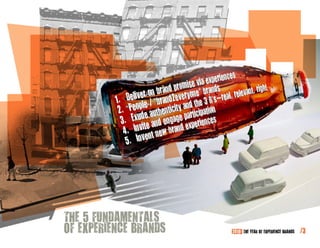
THE 5 FuNDAmENTALS
OF EXPERIENCE BRANDS   2010: THE YEAR OF EXPERIENCE BRANDS   /3
EXPERIENCE BRAND?
WHAT’S THAT?
Defined literally, a brand is the identifying marks, names and words
that distinguish one company’s product or service from another’s.

But more meaningfully, a brand is a promise—a distinct value
offered.

And in the most meaningful sense, a brand is a promise kept—
through experiences that deliver on that promise at every point of
interaction with the brand.                                            The first fundamental
                                                                       of being an
                                                                       experience brand?
Following are five fundamental truths about experience brands.

The first fundamental of being an experience brand? Delivering on
your brand promise at every point of interaction.
                                                                       Delivering on your
                                                                       brand promise
Because you can talk all you want, you can spend all you want on
carefully crafted messages, but at the end of the day, what people
                                                                       at every point of
remember is what they actually experience.                             interaction.


                                                                             2010: THE YEAR OF EXPERIENCE BRANDS   /4
Your brand is
formed primarily,
not by what your
company says about
itself, but what the
company does.
Jeff Bezos, Amazon


        2010: THE YEAR OF EXPERIENCE BRANDS   /5
You’re defined by what you do—not what you say. So…

*	 If you saytheir questions,your topan experience that defines can’t
   answer
               customers are
                              that’s
                                      priority, but your call center
                                                                     your
    brand as the opposite of “customer-focused.”

*	 If you say customer communityloyalty, but youwith each other easy
   for your
              you value customer
                                  to connect
                                                 haven’t made it
                                                                 and
    influence your next generation of prospects? Again, your
    experience contradicts your promise—and your brand will suffer.

Every interaction is an opportunity: those aspiring to be experience
                                                                            Every interaction
brands should holistically assess all the touchpoints that comprise their   is an opportunity.
brand for stakeholders. In theory, no experience is too small to qualify,
but different companies will weigh touchpoints depending on needs,
resources and whether they’re a product or service-based brand, B2C
or B2B.


                                                                                  2010: THE YEAR OF EXPERIENCE BRANDS   /6
The second fundamental of experience brands: they’re true “people
brands.”

Experience brands don’t just say that people matter—they take a
“brand2everyone” approach that puts that commitment into action, at
every level in the organization. Think of US apparel retailer Patagonia.
The passions that motivated founder (and Let My People Go Surfing
author) Yvon Chouinard—outdoor sport, environmentalism, global
good citizenship—are authentic to its staff and proved out in its HR,

                                                                           The second
operations and CSR practices. Or online retailer Zappos, whose
CEO Tony Hsieh is the “cheerleader in chief” behind its zealous
customer service ethos. According to a New Yorker profile, “He talks       fundamental of
about being the architect of a movement to spread happiness, or            experience brands:
‘Zappiness’,” and inspires that in employees.
                                                                           they’re people
The third fundamental of experience brands: they build relationships
                                                                           brands.
                                                                           The third: they
based on values of authenticity and the “three R’s”—what’s real, right
and relevant when the brand comes together with its communities.

That authenticity really comes through because experience brands
                                                                           value authenticity
promise values that are truthfully delivered by people across the          and the “3 Rs”---
organization, from the CEO on down. They feel authentic to customers       what’s real, right
and end-users because they are core to the brands at the level of          and relevant for
corporate and cultural DNA.
                                                                           their brand and its
The belief this inspires is one reason why you’ll find, among the
ranks of experience brands, so many that you’d also describe as fan
                                                                           people.
brands, community brands, tribal brands, brands that have and are
embraced by communities that not only buy, but also talk, promote
and share their experiences with others.


                                                                                 2010: THE YEAR OF EXPERIENCE BRANDS   /7
That’s a great set-up for the fourth fundamental of experience brands:
they aggressively seek out the participation of their stakeholders.

Experience brands invite participation in three key ways:

*		 they welcome ideas fromadapt the brand to their needs
                            the outside

*	 they empower people with the social web
                         to

* they’re trulysocial media not as the channels—Twitter versus
They think of
                engaged


Facebook—but as a strategy of interaction where their people (even
c-level people) both talk and listen. Above and beyond their digital
footprint, they invite customers, users and staff across functional
areas to share their input and ideas as part of a cultural commitment
to innovation. Google is an exemplar: the very first of their famous
“9 Notions of Innovation” is: “Ideas come from everywhere.”
                                                                         The fourth
                                                                         fundamental of
And finally, experience brands are not afraid to empower users to
adapt and play with the brand. NIKEiD and Vans customized shoes
                                                                         experience brands:
are familiar examples of how this plays out thanks to the power          they aggressively
of mass customization; Google invites users to create fan logos;         seek out
and more recently, following the devastating earthquake in Haiti,
CNN.com gave site visitors the ability to control camera angles as
                                                                         participation.
online footage was playing.


                                                                              2010: THE YEAR OF EXPERIENCE BRANDS   /8
EXPERIENCE BRANDS RECOgNIzE:
IDEAS COmE FROm EvERYWHERE.
                               2010: THE YEAR OF EXPERIENCE BRANDS   /9
An important complement to all this active participation and outside
thinking: experience brands are famously good at inventing new
ways for people to interact with them, above and beyond the
products and services they sell.

So that’s the fifth fundamental of experience brands: they invent new
experiences beyond their core offering that differentiate them from
their competition.

In some instances, companies can add new revenue streams by
going into the experience business, creating physical destinations
or transactional happenings that are so great, so different, people
will pay for them.

Yet incremental experiences do not have to fit this literal interpretation;
there are robust opportunities to create new experiences that aren’t          The fifth
dependent on a physical destination or so costly to undertake. For            fundamental
example, smart companies transform corporate social responsibility
(CSR) initiatives into new experiences—think of Nike+ Human Race
                                                                              of experience
or Google.org’s PowerMeter.                                                   brands: they
Ultimately, every experience brand is unique—and they’ll tailor these
                                                                              invent new
incremental experiences accordingly.                                          experiences, new
                                                                              ways to interact.


                                                                                   2010: THE YEAR OF EXPERIENCE BRANDS   /10
3 gREAT EXPERIENCE BRANDS
Experience brands are not all B2C, lifestyle-driven brands—they’re
B2C and B2B, product-based and service-based. Truly, any brand
can be an experience brand.

That said, there are overarching principles that hold true for all
experience brands. Every experience brand must optimize the
following core elements:

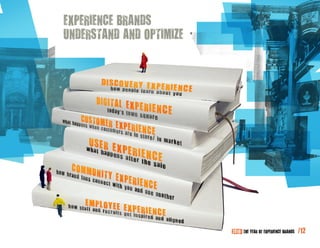
*		 The digital experience (since mobile devices and computer screens
        discovery experience (how people learn about you)

* The today’s default shopping mall and town square)
    are
                                                                         The experience
*	 The customer experience (what happens in store or when customers
    are in market)                                                       they create
                                                                         around their
*		 The user experience (what happens after the sale) with you           products or
* The community experience (how stakeholders connect
    and one another beyond what you sell)                                services is as
                                                                         carefully thought
*	 The employee experience (how vision) potential recruits align
    around core values, culture and
                                     staff and
                                                                         through as their
So what does that look like, in action? Sketched out on the pages that   products and
follow are three exemplary experience brands. Radically different        services.
in their business models, they’ve all transformed experience from
a marketing channel to a point of differentiation. The experience
they create around their products or services is as carefully thought
through as their products and services.

This isn’t a ranking of top experience brands, but an effort
to define by example. We’ve purposely left off some of the
more obvious experience brands—like Apple and Starbucks.
Look for our experience brands ranking in a future article.
                                                                               2010: THE YEAR OF EXPERIENCE BRANDS   /11
EXPERIENCE BRANDS
uNDERSTAND AND OPTImIzE


                          2010: THE YEAR OF EXPERIENCE BRANDS   /12
zIPCAR
Tiny compared to the other experience brands cited here, Zipcar
introduced car sharing to the US with its 2000 launch—and has
built an hourly car rental brand so distinctive that giants like Avis
and Hertz are moving into its core market. Still, Zipcar’s CEO told
CNNmoney.com they’ll be a $1 billion company in under five years;
they’re growing at about 30% a year. Here’s what makes them an
experience brand:

*	convenient, web-enabled whatso simpleselling isbe expressed in
it’s
     Zipcar is crystal clear that
                                  and
                                      they are
                                               it can
                                                      an experience:

four simple steps. Fortune calls it Netflix for cars.
                                                                          zipcar is crystal
*	Zipcar is flawless at the first fundamentalpointexperience brands:
                                              of                          clear: it’s selling
delivering on its brand promise at every            of interaction. Its
voice threads through everything from the reservation process to its
                                                                          an experience.
iPhone app to the emails users get if they return a car late. Voice
and personality are so strong that customers are made to feel they’re
part of a community of like-minded people—despite the fact that
it’s possible to be a frequent customer without ever seeing a Zipcar
employee or another customer (rentals are handled online and pick
up is self-service).

*	Zipcar has consistentlypresencenew heavily urbantoUS business—
expanding from its initial
                           added
                                   in
                                      experiences its
                                                       markets to
universities and programs for business, and more recently leasing
its proprietary technology to city governments that need it to better
manage their sizable car fleets. Others are looking to Zipcar to help
prepare for a future of plug-ins and electric car grids. Even big car
brands like Toyota and Ford are talking to Zipcar about how the
experiences they create might be complementary.


                                                                                2010: THE YEAR OF EXPERIENCE BRANDS   /13
IBm
One of the most respected companies in the world, IBM is ranked
among the most powerful brands in the world by BusinessWeek and
Interbrand—one of just three B2B brands that consistently number
among the top 10 (the other two being Intel and GE). What’s truly
exemplary about IBM is how it has maintained that brand and its
core promise even as it has continuously evolved its business. Behind
this evolution lies great experience brand thinking:

*	 IBMis famous: according to itsitsChairman & brand Sam Palmisano,
culture
         staff—“IBMers”—are           front-line
                                                 CEO,
                                                      advocates. Its

“[IBM’s] revolutionary idea was to define and run a company by a
set of strongly held beliefs.” It is consistently ranked high on Fortune’s
Best Places to Start a Career and has an authentic commitment to
social media as part of its corporate culture and communications.
                                                                             Conversations
                                                                             like IBm’s are
*	 IBM’s “Smarter” campaign takestoacreateidea—“welcome to the
decade of smart”—and extends that
                                     core
                                           “a global conversation
                                                                             hallmarks of
about how the planet is becoming smarter” across an array of industry        an experience
sectors and communities. What IBM can do to make cities smarter, or          brand.
healthcare smarter, or energy smarter—conversations this compelling
are hallmarks of an experience brand. IBM has also done a great
job of extending them through high-level events like its Smarter Cities
conferences around the world.

*	 IBM has consistently innovated the platforms through which it hosts
conversations with its communities—resulting in new experiences that
may counter conventional wisdom. It has been called a “pioneer
in what today might be called open or crowd-sourced employee
innovation” for a staff innovation program it founded in 1928. It
made an early stake in Second Life with its IBM Briefing Center, a
virtual presence it has maintained.

                                                                                   2010: THE YEAR OF EXPERIENCE BRANDS   /14
LEgO
Children around the world spend 5 billion hours a year playing with
LEGO’s trademark plastic bricks, famously dubbed the “toy of the
century” (the last one). After some rough years, LEGO is being hailed
by the Harvard Business Review for a comeback that’s (arguably)
fueled by experience brand thinking and that sets it up for great
success in the years to come. Here are some of the reasons LEGO
wins our vote as a great experience brand:

*		LEGO sees a strong link between the brandthey’reemployees.they
seekers are advised that no matter
                                    its
                                        role
                                              and
                                                    seeking,
                                                              Job

should understand and embrace its vision—because it’s “values
that make the LEGO brand unique—and give us an edge on all the
others.”                                                                LEgO constantly
                                                                        innovates how its
*		LEGObrand and innovates howThey’ve created(kids) can connect
with the
         constantly
                    each other.
                                its passionates
                                                a vibrant social        passionates can
networking site for kids as well as LEGO Universe, a multiplayer        connect with the
online game environment, all while maintaining their most robust
model and game products, not to mention Legoland theme parks
                                                                        brand and each
and destinations.                                                       other.
*		LEGO has innovated newDesign byME, that invite consumers to
become creators—like LEGO
                          experiences
                                      where consumers create
their own LEGO design online and then receive a custom kit (right
down to the box and building manual) in the mail.

*		LaEGO issponsor of toThe FIRST LEGO League,not just customers.
It’s  title
            commited kids as future innovators,
                                                an international
organization that gets kids engaged in robotics. Over 150,000 kids
in scores of countries solve hands-on competitive challenges that
empower their creativity and inspire them to careers in engineering
and technology.
                                                                             2010: THE YEAR OF EXPERIENCE BRANDS   /15
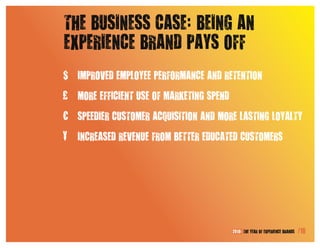
THE BuSINESS CASE: BEINg AN
EXPERIENCE BRAND PAYS OFF
$ ImPROvED EmPLOYEE PERFORmANCE AND RETENTION

   mORE EFFICIENT uSE OF mARkETINg SPEND

   SPEEDIER CuSTOmER ACquISITION AND mORE LASTINg LOYALTY

   INCREASED REvENuE FROm BETTER EDuCATED CuSTOmERS


                                           2010: THE YEAR OF EXPERIENCE BRANDS   /16
WHAT’S THE ROI OF BEINg
AN EXPERIENCE BRAND?
There are a lot of ways that being an experience brand can pay
off for the companies that achieve this status. Here are four core
metrics:

1. Employee performance and retention
Because experience brands understand and leverage the impact
employees have on customers, they invest in employee engagement
that creates better alignment and performance in support of brand
and business goals. Because employees feel valued and engaged,
they want to stick around. The combination of these two factors
increases staff impact while lowering costs due to attrition and          Experiences may
retraining.                                                               be experienced
2. Efficiency of marketing spend                                          by few, but they
Experience brands do things that people talk about and share. They        are witnessed
provoke conversation. They have stories that people want to spread.       and talked about
And when they make an investment in creating an experience for
the people who matter most to them, those experiences may be
                                                                          by many.
experienced by few, but they are witnessed by many.

3. Customer acquisition and loyalty
Because they promise and deliver a great experience, experience
brands win customers more quickly and keep them long-term. Because
they invite interaction and engagement, they are able to take people on
a journey from relative indifference to commitment and advocacy more
quickly than other brands.


                                                                               2010: THE YEAR OF EXPERIENCE BRANDS   /17
4. Customer revenue
Because experience brands do a good job of inviting participation and
sharing information, their customer communities are better educated—
making them better and higher-value customers.

Experience brands can measure impact both ways: what happens
when they improve their experience, and what happens when their
experience declines.

BusinessWeek has reported that Best Buy’s improvements in employee
engagement are directly tied to store profits.

Starbucks, which innovated a “third space” experience brand but
                                                                         “For every
suffered from over-expansion and extensions that weakened its core       one tenth of a
brand promise, has recently achieved a comeback that Forrester           point increase
customer experience guru Bruce Temkin has described as follows:
“Nearly two years ago I wrote that Starbucks had lost its soul. That’s
                                                                         in employee
why Schultz returned to his role as CEO in January 2008. Shortly         engagement,
after his return, Shultz took the unprecedented action of closing        each Best Buy
7,100 stores for three hours to ”retrain” employees on the Starbucks
                                                                         store increased
                                                                         profits by
experience.”

Imagine a CEO shutting down the business to retrain employees
on the brand experience. That sums up just how much ROI he feels
                                                                         $100,000 a
Starbucks can win (or lose) on the basis of their experience brand.      year.”
                                                                         (BusinessWeek)
Not every brand is Starbucks. But every brand can be or become an
experience brand—and reap the benefits.


                                                                                 2010: THE YEAR OF EXPERIENCE BRANDS   /18
2010: THE YEAR OF
EXPERIENCE BRANDS
We believe that this year will mark a new ascendancy for brands that
are or seek to be experience brands.

We’re committed to doing our part to contribute to the conversation
about experience brands in a series of forthcoming articles that
expand on key topics.

Look for upcoming articles including:

*	 Experience brands are people brands: Engaging and leveraging
    employees

*		 Experience brands and Howsocial web brand thinking could
                            the

* Back fromathe dead:brand experience
    reanimate dormant

*		 Gotta love it: Experience brands and theirperformers
                                               passionates

* The experience brand index: ranking top


                                                                       2010: THE YEAR OF EXPERIENCE BRANDS   /19
SHARE THIS EXPERIENCE
If you like this article, please share it with your friends and colleagues


								SHARE ON DELICIOuS
								SHARE ON DIgg

								SHARE ON FACEBOOk

								SHARE ON LINkEDIN

								SHARE ON TWITTER

        SHARE vIA EmAIL

Follow us on Twitter @jackmorton

For	more	information,	contact	Liz	Bigham	at		
liz_bigham@jackmorton.com	or	212-401-7212.	


                                                                             2010: THE YEAR OF EXPERIENCE BRANDS   /20
Jack Morton Worldwide is a global brand experience agency.
We create experiences that strengthen relationships between
brands and the people who matter most to them—thereby helping
our clients become talked-about experience brands. Rated among
the top marketing service agencies worldwide, we integrate live
and online experiences, digital and social media, and branded 3D
environments that engage and inspire consumers, business partners
and employees. Our staff work across the US, Europe and Asia-
Pacific as part of an idea-led agency culture.

© Jack Morton Worldwide 2010


 2010: THE YEAR OF EXPERIENCE BRANDS                                2010: THE YEAR OF EXPERIENCE BRANDS   /21

Brand experience examples and best practices

  • 1.
    2010: THE YEAROF EXPERIENCE BRANDS 2010: THE YEAR OF EXPERIENCE BRANDS /1
  • 2.
    At the dawnof a new decade, amidst a proliferation of new ideas and opportunities, we believe marketers can set their course guided by one overarching principle: that the brands that lead in the 21st century will be experience brands. The more that marketers can build experience brands, the more they will succeed. This begs the question: what exactly is an experience brand? This article is the first in a series on experience brands to be published by Jack Morton in 2010. We start with the essentials on the pages that follow: * Definitions: brand?makes an experience brand an experience What The brands that * Examples: What areWhat do experience brandstotoday?by notable lead in the 21st century will be * The business case: brands? becoming experience companies stand gain experience brands. Liz Bigham Director of Brand Marketing Jack Morton Worldwide 2010: THE YEAR OF EXPERIENCE BRANDS /2
  • 3.
    THE 5 FuNDAmENTALS OFEXPERIENCE BRANDS 2010: THE YEAR OF EXPERIENCE BRANDS /3
  • 4.
    EXPERIENCE BRAND? WHAT’S THAT? Definedliterally, a brand is the identifying marks, names and words that distinguish one company’s product or service from another’s. But more meaningfully, a brand is a promise—a distinct value offered. And in the most meaningful sense, a brand is a promise kept— through experiences that deliver on that promise at every point of interaction with the brand. The first fundamental of being an experience brand? Following are five fundamental truths about experience brands. The first fundamental of being an experience brand? Delivering on your brand promise at every point of interaction. Delivering on your brand promise Because you can talk all you want, you can spend all you want on carefully crafted messages, but at the end of the day, what people at every point of remember is what they actually experience. interaction. 2010: THE YEAR OF EXPERIENCE BRANDS /4
  • 5.
    Your brand is formedprimarily, not by what your company says about itself, but what the company does. Jeff Bezos, Amazon 2010: THE YEAR OF EXPERIENCE BRANDS /5
  • 6.
    You’re defined bywhat you do—not what you say. So… * If you saytheir questions,your topan experience that defines can’t answer customers are that’s priority, but your call center your brand as the opposite of “customer-focused.” * If you say customer communityloyalty, but youwith each other easy for your you value customer to connect haven’t made it and influence your next generation of prospects? Again, your experience contradicts your promise—and your brand will suffer. Every interaction is an opportunity: those aspiring to be experience Every interaction brands should holistically assess all the touchpoints that comprise their is an opportunity. brand for stakeholders. In theory, no experience is too small to qualify, but different companies will weigh touchpoints depending on needs, resources and whether they’re a product or service-based brand, B2C or B2B. 2010: THE YEAR OF EXPERIENCE BRANDS /6
  • 7.
    The second fundamentalof experience brands: they’re true “people brands.” Experience brands don’t just say that people matter—they take a “brand2everyone” approach that puts that commitment into action, at every level in the organization. Think of US apparel retailer Patagonia. The passions that motivated founder (and Let My People Go Surfing author) Yvon Chouinard—outdoor sport, environmentalism, global good citizenship—are authentic to its staff and proved out in its HR, The second operations and CSR practices. Or online retailer Zappos, whose CEO Tony Hsieh is the “cheerleader in chief” behind its zealous customer service ethos. According to a New Yorker profile, “He talks fundamental of about being the architect of a movement to spread happiness, or experience brands: ‘Zappiness’,” and inspires that in employees. they’re people The third fundamental of experience brands: they build relationships brands. The third: they based on values of authenticity and the “three R’s”—what’s real, right and relevant when the brand comes together with its communities. That authenticity really comes through because experience brands value authenticity promise values that are truthfully delivered by people across the and the “3 Rs”--- organization, from the CEO on down. They feel authentic to customers what’s real, right and end-users because they are core to the brands at the level of and relevant for corporate and cultural DNA. their brand and its The belief this inspires is one reason why you’ll find, among the ranks of experience brands, so many that you’d also describe as fan people. brands, community brands, tribal brands, brands that have and are embraced by communities that not only buy, but also talk, promote and share their experiences with others. 2010: THE YEAR OF EXPERIENCE BRANDS /7
  • 8.
    That’s a greatset-up for the fourth fundamental of experience brands: they aggressively seek out the participation of their stakeholders. Experience brands invite participation in three key ways: * they welcome ideas fromadapt the brand to their needs the outside * they empower people with the social web to * they’re trulysocial media not as the channels—Twitter versus They think of engaged Facebook—but as a strategy of interaction where their people (even c-level people) both talk and listen. Above and beyond their digital footprint, they invite customers, users and staff across functional areas to share their input and ideas as part of a cultural commitment to innovation. Google is an exemplar: the very first of their famous “9 Notions of Innovation” is: “Ideas come from everywhere.” The fourth fundamental of And finally, experience brands are not afraid to empower users to adapt and play with the brand. NIKEiD and Vans customized shoes experience brands: are familiar examples of how this plays out thanks to the power they aggressively of mass customization; Google invites users to create fan logos; seek out and more recently, following the devastating earthquake in Haiti, CNN.com gave site visitors the ability to control camera angles as participation. online footage was playing. 2010: THE YEAR OF EXPERIENCE BRANDS /8
  • 9.
    EXPERIENCE BRANDS RECOgNIzE: IDEASCOmE FROm EvERYWHERE. 2010: THE YEAR OF EXPERIENCE BRANDS /9
  • 10.
    An important complementto all this active participation and outside thinking: experience brands are famously good at inventing new ways for people to interact with them, above and beyond the products and services they sell. So that’s the fifth fundamental of experience brands: they invent new experiences beyond their core offering that differentiate them from their competition. In some instances, companies can add new revenue streams by going into the experience business, creating physical destinations or transactional happenings that are so great, so different, people will pay for them. Yet incremental experiences do not have to fit this literal interpretation; there are robust opportunities to create new experiences that aren’t The fifth dependent on a physical destination or so costly to undertake. For fundamental example, smart companies transform corporate social responsibility (CSR) initiatives into new experiences—think of Nike+ Human Race of experience or Google.org’s PowerMeter. brands: they Ultimately, every experience brand is unique—and they’ll tailor these invent new incremental experiences accordingly. experiences, new ways to interact. 2010: THE YEAR OF EXPERIENCE BRANDS /10
  • 11.
    3 gREAT EXPERIENCEBRANDS Experience brands are not all B2C, lifestyle-driven brands—they’re B2C and B2B, product-based and service-based. Truly, any brand can be an experience brand. That said, there are overarching principles that hold true for all experience brands. Every experience brand must optimize the following core elements: * The digital experience (since mobile devices and computer screens discovery experience (how people learn about you) * The today’s default shopping mall and town square) are The experience * The customer experience (what happens in store or when customers are in market) they create around their * The user experience (what happens after the sale) with you products or * The community experience (how stakeholders connect and one another beyond what you sell) services is as carefully thought * The employee experience (how vision) potential recruits align around core values, culture and staff and through as their So what does that look like, in action? Sketched out on the pages that products and follow are three exemplary experience brands. Radically different services. in their business models, they’ve all transformed experience from a marketing channel to a point of differentiation. The experience they create around their products or services is as carefully thought through as their products and services. This isn’t a ranking of top experience brands, but an effort to define by example. We’ve purposely left off some of the more obvious experience brands—like Apple and Starbucks. Look for our experience brands ranking in a future article. 2010: THE YEAR OF EXPERIENCE BRANDS /11
  • 12.
    EXPERIENCE BRANDS uNDERSTAND ANDOPTImIzE 2010: THE YEAR OF EXPERIENCE BRANDS /12
  • 13.
    zIPCAR Tiny compared tothe other experience brands cited here, Zipcar introduced car sharing to the US with its 2000 launch—and has built an hourly car rental brand so distinctive that giants like Avis and Hertz are moving into its core market. Still, Zipcar’s CEO told CNNmoney.com they’ll be a $1 billion company in under five years; they’re growing at about 30% a year. Here’s what makes them an experience brand: * convenient, web-enabled whatso simpleselling isbe expressed in it’s Zipcar is crystal clear that and they are it can an experience: four simple steps. Fortune calls it Netflix for cars. zipcar is crystal * Zipcar is flawless at the first fundamentalpointexperience brands: of clear: it’s selling delivering on its brand promise at every of interaction. Its voice threads through everything from the reservation process to its an experience. iPhone app to the emails users get if they return a car late. Voice and personality are so strong that customers are made to feel they’re part of a community of like-minded people—despite the fact that it’s possible to be a frequent customer without ever seeing a Zipcar employee or another customer (rentals are handled online and pick up is self-service). * Zipcar has consistentlypresencenew heavily urbantoUS business— expanding from its initial added in experiences its markets to universities and programs for business, and more recently leasing its proprietary technology to city governments that need it to better manage their sizable car fleets. Others are looking to Zipcar to help prepare for a future of plug-ins and electric car grids. Even big car brands like Toyota and Ford are talking to Zipcar about how the experiences they create might be complementary. 2010: THE YEAR OF EXPERIENCE BRANDS /13
  • 14.
    IBm One of themost respected companies in the world, IBM is ranked among the most powerful brands in the world by BusinessWeek and Interbrand—one of just three B2B brands that consistently number among the top 10 (the other two being Intel and GE). What’s truly exemplary about IBM is how it has maintained that brand and its core promise even as it has continuously evolved its business. Behind this evolution lies great experience brand thinking: * IBMis famous: according to itsitsChairman & brand Sam Palmisano, culture staff—“IBMers”—are front-line CEO, advocates. Its “[IBM’s] revolutionary idea was to define and run a company by a set of strongly held beliefs.” It is consistently ranked high on Fortune’s Best Places to Start a Career and has an authentic commitment to social media as part of its corporate culture and communications. Conversations like IBm’s are * IBM’s “Smarter” campaign takestoacreateidea—“welcome to the decade of smart”—and extends that core “a global conversation hallmarks of about how the planet is becoming smarter” across an array of industry an experience sectors and communities. What IBM can do to make cities smarter, or brand. healthcare smarter, or energy smarter—conversations this compelling are hallmarks of an experience brand. IBM has also done a great job of extending them through high-level events like its Smarter Cities conferences around the world. * IBM has consistently innovated the platforms through which it hosts conversations with its communities—resulting in new experiences that may counter conventional wisdom. It has been called a “pioneer in what today might be called open or crowd-sourced employee innovation” for a staff innovation program it founded in 1928. It made an early stake in Second Life with its IBM Briefing Center, a virtual presence it has maintained. 2010: THE YEAR OF EXPERIENCE BRANDS /14
  • 15.
    LEgO Children around theworld spend 5 billion hours a year playing with LEGO’s trademark plastic bricks, famously dubbed the “toy of the century” (the last one). After some rough years, LEGO is being hailed by the Harvard Business Review for a comeback that’s (arguably) fueled by experience brand thinking and that sets it up for great success in the years to come. Here are some of the reasons LEGO wins our vote as a great experience brand: * LEGO sees a strong link between the brandthey’reemployees.they seekers are advised that no matter its role and seeking, Job should understand and embrace its vision—because it’s “values that make the LEGO brand unique—and give us an edge on all the others.” LEgO constantly innovates how its * LEGObrand and innovates howThey’ve created(kids) can connect with the constantly each other. its passionates a vibrant social passionates can networking site for kids as well as LEGO Universe, a multiplayer connect with the online game environment, all while maintaining their most robust model and game products, not to mention Legoland theme parks brand and each and destinations. other. * LEGO has innovated newDesign byME, that invite consumers to become creators—like LEGO experiences where consumers create their own LEGO design online and then receive a custom kit (right down to the box and building manual) in the mail. * LaEGO issponsor of toThe FIRST LEGO League,not just customers. It’s title commited kids as future innovators, an international organization that gets kids engaged in robotics. Over 150,000 kids in scores of countries solve hands-on competitive challenges that empower their creativity and inspire them to careers in engineering and technology. 2010: THE YEAR OF EXPERIENCE BRANDS /15
  • 16.
    THE BuSINESS CASE:BEINg AN EXPERIENCE BRAND PAYS OFF $ ImPROvED EmPLOYEE PERFORmANCE AND RETENTION mORE EFFICIENT uSE OF mARkETINg SPEND SPEEDIER CuSTOmER ACquISITION AND mORE LASTINg LOYALTY INCREASED REvENuE FROm BETTER EDuCATED CuSTOmERS 2010: THE YEAR OF EXPERIENCE BRANDS /16
  • 17.
    WHAT’S THE ROIOF BEINg AN EXPERIENCE BRAND? There are a lot of ways that being an experience brand can pay off for the companies that achieve this status. Here are four core metrics: 1. Employee performance and retention Because experience brands understand and leverage the impact employees have on customers, they invest in employee engagement that creates better alignment and performance in support of brand and business goals. Because employees feel valued and engaged, they want to stick around. The combination of these two factors increases staff impact while lowering costs due to attrition and Experiences may retraining. be experienced 2. Efficiency of marketing spend by few, but they Experience brands do things that people talk about and share. They are witnessed provoke conversation. They have stories that people want to spread. and talked about And when they make an investment in creating an experience for the people who matter most to them, those experiences may be by many. experienced by few, but they are witnessed by many. 3. Customer acquisition and loyalty Because they promise and deliver a great experience, experience brands win customers more quickly and keep them long-term. Because they invite interaction and engagement, they are able to take people on a journey from relative indifference to commitment and advocacy more quickly than other brands. 2010: THE YEAR OF EXPERIENCE BRANDS /17
  • 18.
    4. Customer revenue Becauseexperience brands do a good job of inviting participation and sharing information, their customer communities are better educated— making them better and higher-value customers. Experience brands can measure impact both ways: what happens when they improve their experience, and what happens when their experience declines. BusinessWeek has reported that Best Buy’s improvements in employee engagement are directly tied to store profits. Starbucks, which innovated a “third space” experience brand but “For every suffered from over-expansion and extensions that weakened its core one tenth of a brand promise, has recently achieved a comeback that Forrester point increase customer experience guru Bruce Temkin has described as follows: “Nearly two years ago I wrote that Starbucks had lost its soul. That’s in employee why Schultz returned to his role as CEO in January 2008. Shortly engagement, after his return, Shultz took the unprecedented action of closing each Best Buy 7,100 stores for three hours to ”retrain” employees on the Starbucks store increased profits by experience.” Imagine a CEO shutting down the business to retrain employees on the brand experience. That sums up just how much ROI he feels $100,000 a Starbucks can win (or lose) on the basis of their experience brand. year.” (BusinessWeek) Not every brand is Starbucks. But every brand can be or become an experience brand—and reap the benefits. 2010: THE YEAR OF EXPERIENCE BRANDS /18
  • 19.
    2010: THE YEAROF EXPERIENCE BRANDS We believe that this year will mark a new ascendancy for brands that are or seek to be experience brands. We’re committed to doing our part to contribute to the conversation about experience brands in a series of forthcoming articles that expand on key topics. Look for upcoming articles including: * Experience brands are people brands: Engaging and leveraging employees * Experience brands and Howsocial web brand thinking could the * Back fromathe dead:brand experience reanimate dormant * Gotta love it: Experience brands and theirperformers passionates * The experience brand index: ranking top 2010: THE YEAR OF EXPERIENCE BRANDS /19
  • 20.
    SHARE THIS EXPERIENCE Ifyou like this article, please share it with your friends and colleagues SHARE ON DELICIOuS SHARE ON DIgg SHARE ON FACEBOOk SHARE ON LINkEDIN SHARE ON TWITTER SHARE vIA EmAIL Follow us on Twitter @jackmorton For more information, contact Liz Bigham at liz_bigham@jackmorton.com or 212-401-7212. 2010: THE YEAR OF EXPERIENCE BRANDS /20
  • 21.
    Jack Morton Worldwideis a global brand experience agency. We create experiences that strengthen relationships between brands and the people who matter most to them—thereby helping our clients become talked-about experience brands. Rated among the top marketing service agencies worldwide, we integrate live and online experiences, digital and social media, and branded 3D environments that engage and inspire consumers, business partners and employees. Our staff work across the US, Europe and Asia- Pacific as part of an idea-led agency culture. © Jack Morton Worldwide 2010 2010: THE YEAR OF EXPERIENCE BRANDS 2010: THE YEAR OF EXPERIENCE BRANDS /21